
Recent from talks
3200 Phaethon
Knowledge base stats:
Talk channels stats:
Members stats:
3200 Phaethon
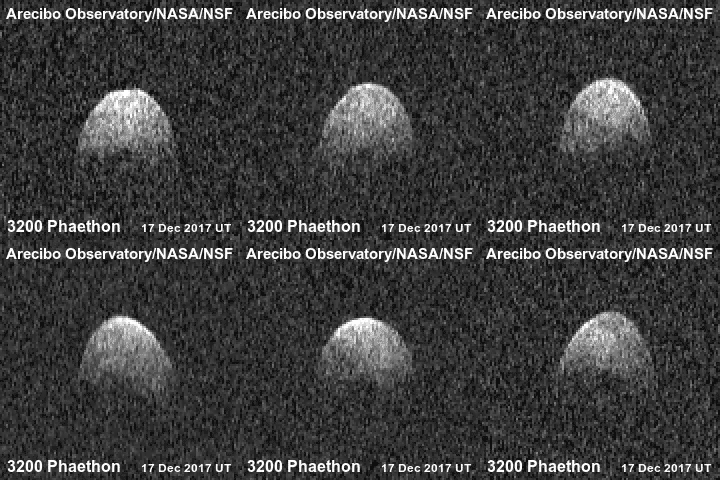
3200 Phaethon (/ˈfeɪ.əˌθɒn/; previously sometimes spelled Phæton), provisionally designated 1983 TB, is an active Apollo asteroid with an orbit that brings it closer to the Sun than any other named asteroid (though there are numerous unnamed asteroids with smaller perihelia, such as (137924) 2000 BD19). For this reason, it was named after the Greek Hero, Phaëthon, son of the sun god Helios. It is 5.8 km (3.6 mi) in diameter and is the parent body of the Geminids meteor shower of mid-December. With an observation arc of 35+ years, it has a very well determined orbit. The 2017 Earth approach distance of about 10 million km was known with an accuracy of ±700 m.
Phaethon was the first asteroid to be discovered using images from a spacecraft. Simon F. Green and John K. Davies discovered it in images from October 11, 1983, while searching Infrared Astronomical Satellite (IRAS) data for moving objects. It was formally announced on October 14 in IAUC 3878 along with optical confirmation by Charles T. Kowal, who reported it to be asteroidal in appearance. Its provisional designation was 1983 TB, and it later received the numerical designation and name 3200 Phaethon in 1985.
Phaethon is categorized as an Apollo asteroid, as its orbital semi-major axis is greater than that of the Earth's at 1.27 AU (190 million km; 118 million mi). It is also suspected to be a member of the Pallas family of asteroids.
Its most remarkable distinction is that it approaches the Sun closer than any other named asteroid: its perihelion is only 0.14 AU (20.9 million km; 13.0 million mi) — less than half of Mercury's perihelial distance. It is a Mercury-, Venus-, Earth-, and Mars-crosser as a result of its high orbital eccentricity. The surface temperature at perihelion could reach around 1,025 K (750 °C; 1,390 °F).
Phaethon is a possible candidate for detecting general relativistic and/or solar oblateness effects in its orbital motion due to the frequent close approaches to the Sun. The Apollo asteroids (155140) 2005 UD and (225416) 1999 YC share similar orbits with Phaethon, suggesting a possible common breakup origin.
Phaethon is categorized as a potentially hazardous asteroid (PHA), but that does not mean there is a near-term threat of an impact. It is a potentially hazardous asteroid merely as a result of its size (absolute magnitude H ≤ 22) and Earth minimum orbit intersection distance (Earth MOID ≤ 0.05 AU). The Earth minimum orbit intersection distance (E-MOID) is 0.01945 AU (2,910,000 km; 1,808,000 mi), which is defined by the shortest distance between the orbit of Phaethon and the orbit of Earth. With a 30+ year observation arc, the orbit of Phaethon is very well understood with very small uncertainties. Close approaches of Phaethon are well constrained for the next 400 years.
Phaethon is an asteroid with fairly unusual characteristics in that its orbit more closely resembles that of a comet than an asteroid; it has been referred to as a "rock comet". In studies performed by NASA's STEREO spacecraft in 2009 and 2012, rapid brightening and dust tail have been observed. It is possible that the Sun's heat is causing fractures similar to mudcracks in a dry lake bed. This occurs because Phaethon's orbit takes it closer to the Sun than any other named asteroid (0.14 AU at perihelion) causing extreme heating and enough solar radiation pressure to push any separated pieces off the asteroid's surface. Since its discovery, several other objects were found exhibiting mixed cometary and asteroidal features, such as 133P/Elst–Pizarro, leading to a new class of objects dubbed "active asteroids".
In 2018, observations revealed that Phaethon was blue in color. This is extremely rare, as most asteroids tend to be grey or red. In 2020, polarimetric study revealed Phaethon has a surface with steep slopes covered by a mix of regolith with larger pebbles. Phaethon's composition fits the notion of its cometary origin; it is classified as a F-type asteroid because it is composed of dark material or a B-type asteroid because of its blue color. In 2022 it was shown how Phaethon's blue color and its rock-comet-like emission activity can be explained by the effects of the intense solar heating at perihelion causing sublimation of any darkish-red refractory organic, nano-phase iron (nFe0), and pyroxene materials on its surface.
Hub AI
3200 Phaethon AI simulator
(@3200 Phaethon_simulator)
3200 Phaethon
3200 Phaethon (/ˈfeɪ.əˌθɒn/; previously sometimes spelled Phæton), provisionally designated 1983 TB, is an active Apollo asteroid with an orbit that brings it closer to the Sun than any other named asteroid (though there are numerous unnamed asteroids with smaller perihelia, such as (137924) 2000 BD19). For this reason, it was named after the Greek Hero, Phaëthon, son of the sun god Helios. It is 5.8 km (3.6 mi) in diameter and is the parent body of the Geminids meteor shower of mid-December. With an observation arc of 35+ years, it has a very well determined orbit. The 2017 Earth approach distance of about 10 million km was known with an accuracy of ±700 m.
Phaethon was the first asteroid to be discovered using images from a spacecraft. Simon F. Green and John K. Davies discovered it in images from October 11, 1983, while searching Infrared Astronomical Satellite (IRAS) data for moving objects. It was formally announced on October 14 in IAUC 3878 along with optical confirmation by Charles T. Kowal, who reported it to be asteroidal in appearance. Its provisional designation was 1983 TB, and it later received the numerical designation and name 3200 Phaethon in 1985.
Phaethon is categorized as an Apollo asteroid, as its orbital semi-major axis is greater than that of the Earth's at 1.27 AU (190 million km; 118 million mi). It is also suspected to be a member of the Pallas family of asteroids.
Its most remarkable distinction is that it approaches the Sun closer than any other named asteroid: its perihelion is only 0.14 AU (20.9 million km; 13.0 million mi) — less than half of Mercury's perihelial distance. It is a Mercury-, Venus-, Earth-, and Mars-crosser as a result of its high orbital eccentricity. The surface temperature at perihelion could reach around 1,025 K (750 °C; 1,390 °F).
Phaethon is a possible candidate for detecting general relativistic and/or solar oblateness effects in its orbital motion due to the frequent close approaches to the Sun. The Apollo asteroids (155140) 2005 UD and (225416) 1999 YC share similar orbits with Phaethon, suggesting a possible common breakup origin.
Phaethon is categorized as a potentially hazardous asteroid (PHA), but that does not mean there is a near-term threat of an impact. It is a potentially hazardous asteroid merely as a result of its size (absolute magnitude H ≤ 22) and Earth minimum orbit intersection distance (Earth MOID ≤ 0.05 AU). The Earth minimum orbit intersection distance (E-MOID) is 0.01945 AU (2,910,000 km; 1,808,000 mi), which is defined by the shortest distance between the orbit of Phaethon and the orbit of Earth. With a 30+ year observation arc, the orbit of Phaethon is very well understood with very small uncertainties. Close approaches of Phaethon are well constrained for the next 400 years.
Phaethon is an asteroid with fairly unusual characteristics in that its orbit more closely resembles that of a comet than an asteroid; it has been referred to as a "rock comet". In studies performed by NASA's STEREO spacecraft in 2009 and 2012, rapid brightening and dust tail have been observed. It is possible that the Sun's heat is causing fractures similar to mudcracks in a dry lake bed. This occurs because Phaethon's orbit takes it closer to the Sun than any other named asteroid (0.14 AU at perihelion) causing extreme heating and enough solar radiation pressure to push any separated pieces off the asteroid's surface. Since its discovery, several other objects were found exhibiting mixed cometary and asteroidal features, such as 133P/Elst–Pizarro, leading to a new class of objects dubbed "active asteroids".
In 2018, observations revealed that Phaethon was blue in color. This is extremely rare, as most asteroids tend to be grey or red. In 2020, polarimetric study revealed Phaethon has a surface with steep slopes covered by a mix of regolith with larger pebbles. Phaethon's composition fits the notion of its cometary origin; it is classified as a F-type asteroid because it is composed of dark material or a B-type asteroid because of its blue color. In 2022 it was shown how Phaethon's blue color and its rock-comet-like emission activity can be explained by the effects of the intense solar heating at perihelion causing sublimation of any darkish-red refractory organic, nano-phase iron (nFe0), and pyroxene materials on its surface.
Recent media