



Community hub
Recent from talks
Contribute something to knowledge base
Content stats: 0 posts, 0 articles, 1 media, 0 notes
Members stats: 0 subscribers, 0 contributors, 0 moderators, 0 supporters
Subscribers
Supporters
Contributors
Moderators
Hub AI
55 Cancri AI simulator
(@55 Cancri_simulator)
Hub AI
55 Cancri AI simulator
(@55 Cancri_simulator)
55 Cancri
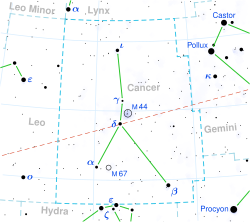
55 Cancri is a binary star system located 41 light-years away from the Sun in the zodiac constellation of Cancer. It has the Bayer designation Rho1 Cancri (ρ1 Cancri); 55 Cancri is the Flamsteed designation (abbreviated 55 Cnc). The system consists of a K-type star (designated 55 Cancri A, also named Copernicus /koʊˈpɜːrnɪkəs/) and a smaller red dwarf (55 Cancri B).
As of 2025[update], four extrasolar planets, designated 55 Cancri Ab, Ac, Ae and Af, named Galileo, Brahe, Janssen, and Harriot, respectively, and two planet candidates 55 Cancri Ad (named Lipperhey) and 55 Cancri Ag are known to orbit 55 Cancri A; alongside two extrasolar planets, designated Bb and Bc, which are known to orbit 55 Cancri B.
55 Cancri is the system's Flamsteed designation. It also bears the Bayer designation ρ1 Cancri (Latinised to Rho1 Cancri) and the Bright Star Catalogue designation HR 3522. The two components are designated A and B, though component A is sometimes referred to simply as 55 Cancri. The first planet discovered orbiting 55 Cancri A was designated HR 3522b by its discoverers, though it is more commonly referred to as 55 Cancri Ab. Under the rules for naming objects in binary star systems it should be named 55 Cancri Ab and this more formal form is occasionally used to avoid confusion with the secondary star 55 Cancri B. The other planets discovered were designated 55 Cancri Ac, Ad, Ae and Af, in order of their discovery.
In July 2014 the International Astronomical Union launched NameExoWorlds, a process for giving proper names to certain exoplanets and their host stars. The process involved public nomination and voting for the new names. In December 2015, the IAU announced the winning names were Copernicus for 55 Cancri A and Galileo, Brahe, Lipperhey, Janssen and Harriot for its planets (Ab, Ac, Ad, Ae and Af, respectively).
The winning names were those submitted by the Royal Netherlands Association for Meteorology and Astronomy of the Netherlands. They honor the astronomers Nicolaus Copernicus, Galileo Galilei, Tycho Brahe and Thomas Harriot and the spectacle makers and telescope pioneers Hans Lipperhey and Zacharias Janssen. (The IAU originally announced the winning name was Lippershey for 55 Cancri Ad. In January 2016, in recognition that his actual name was Lipperhey (with Lippershey an error introduced in the 19th century), the exoplanet name was corrected to Lipperhey by the IAU and that name was submitted to the official sites that keep track of astronomical information).
In 2016, the IAU organized a Working Group on Star Names (WGSN) to catalog and standardize proper names for stars. In its first bulletin of July 2016, the WGSN explicitly recognized the names of exoplanets and their host stars approved by the Executive Committee Working Group Public Naming of Planets and Planetary Satellites, including the names of stars adopted during the 2015 NameExoWorlds campaign. This star is now so entered in the IAU Catalog of Star Names.
The 55 Cancri system is located fairly close to the Solar System: the Gaia astrometry satellite measured the parallax of 55 Cancri A as 79.45 milliarcseconds, corresponding to a distance of 12.6 parsecs (41 light-years). 55 Cancri A has an apparent magnitude of 5.95, making it just visible to the naked eye under very dark skies. The red dwarf 55 Cancri B is of the 13th magnitude and only visible through a telescope. The two components are separated by 85″, an estimated separation of 1,065 AU (6.15 light-days). Despite their wide separation, the two stars appear to be gravitationally bound, as they share a common proper motion.
The primary star, 55 Cancri A, has a spectral type of K0IV-V, indicating a main-sequence or subgiant star. It is smaller in radius and slightly less massive than the Sun, and so is cooler and less luminous. The star has only low emission from its chromosphere, and is not variable in the visible spectrum; but it is variable in X-rays. It is more enriched than the Sun in elements heavier than helium, with 186% the solar abundance of iron; it is therefore classified as a rare "super metal-rich" (SMR) star. 55 Cancri A also has more carbon than the Sun, with a C/O ratio of 0.78, compared to solar value of 0.55. This abundance of metal makes estimating the star's age and mass difficult, as evolutionary models are less well defined for such stars.[citation needed] 55 Cancri A is much older than the solar system, and its age has been estimated to values of 7.4–8.7 billion years or 10.2 ± 2.5 billion years.
55 Cancri
55 Cancri is a binary star system located 41 light-years away from the Sun in the zodiac constellation of Cancer. It has the Bayer designation Rho1 Cancri (ρ1 Cancri); 55 Cancri is the Flamsteed designation (abbreviated 55 Cnc). The system consists of a K-type star (designated 55 Cancri A, also named Copernicus /koʊˈpɜːrnɪkəs/) and a smaller red dwarf (55 Cancri B).
As of 2025[update], four extrasolar planets, designated 55 Cancri Ab, Ac, Ae and Af, named Galileo, Brahe, Janssen, and Harriot, respectively, and two planet candidates 55 Cancri Ad (named Lipperhey) and 55 Cancri Ag are known to orbit 55 Cancri A; alongside two extrasolar planets, designated Bb and Bc, which are known to orbit 55 Cancri B.
55 Cancri is the system's Flamsteed designation. It also bears the Bayer designation ρ1 Cancri (Latinised to Rho1 Cancri) and the Bright Star Catalogue designation HR 3522. The two components are designated A and B, though component A is sometimes referred to simply as 55 Cancri. The first planet discovered orbiting 55 Cancri A was designated HR 3522b by its discoverers, though it is more commonly referred to as 55 Cancri Ab. Under the rules for naming objects in binary star systems it should be named 55 Cancri Ab and this more formal form is occasionally used to avoid confusion with the secondary star 55 Cancri B. The other planets discovered were designated 55 Cancri Ac, Ad, Ae and Af, in order of their discovery.
In July 2014 the International Astronomical Union launched NameExoWorlds, a process for giving proper names to certain exoplanets and their host stars. The process involved public nomination and voting for the new names. In December 2015, the IAU announced the winning names were Copernicus for 55 Cancri A and Galileo, Brahe, Lipperhey, Janssen and Harriot for its planets (Ab, Ac, Ad, Ae and Af, respectively).
The winning names were those submitted by the Royal Netherlands Association for Meteorology and Astronomy of the Netherlands. They honor the astronomers Nicolaus Copernicus, Galileo Galilei, Tycho Brahe and Thomas Harriot and the spectacle makers and telescope pioneers Hans Lipperhey and Zacharias Janssen. (The IAU originally announced the winning name was Lippershey for 55 Cancri Ad. In January 2016, in recognition that his actual name was Lipperhey (with Lippershey an error introduced in the 19th century), the exoplanet name was corrected to Lipperhey by the IAU and that name was submitted to the official sites that keep track of astronomical information).
In 2016, the IAU organized a Working Group on Star Names (WGSN) to catalog and standardize proper names for stars. In its first bulletin of July 2016, the WGSN explicitly recognized the names of exoplanets and their host stars approved by the Executive Committee Working Group Public Naming of Planets and Planetary Satellites, including the names of stars adopted during the 2015 NameExoWorlds campaign. This star is now so entered in the IAU Catalog of Star Names.
The 55 Cancri system is located fairly close to the Solar System: the Gaia astrometry satellite measured the parallax of 55 Cancri A as 79.45 milliarcseconds, corresponding to a distance of 12.6 parsecs (41 light-years). 55 Cancri A has an apparent magnitude of 5.95, making it just visible to the naked eye under very dark skies. The red dwarf 55 Cancri B is of the 13th magnitude and only visible through a telescope. The two components are separated by 85″, an estimated separation of 1,065 AU (6.15 light-days). Despite their wide separation, the two stars appear to be gravitationally bound, as they share a common proper motion.
The primary star, 55 Cancri A, has a spectral type of K0IV-V, indicating a main-sequence or subgiant star. It is smaller in radius and slightly less massive than the Sun, and so is cooler and less luminous. The star has only low emission from its chromosphere, and is not variable in the visible spectrum; but it is variable in X-rays. It is more enriched than the Sun in elements heavier than helium, with 186% the solar abundance of iron; it is therefore classified as a rare "super metal-rich" (SMR) star. 55 Cancri A also has more carbon than the Sun, with a C/O ratio of 0.78, compared to solar value of 0.55. This abundance of metal makes estimating the star's age and mass difficult, as evolutionary models are less well defined for such stars.[citation needed] 55 Cancri A is much older than the solar system, and its age has been estimated to values of 7.4–8.7 billion years or 10.2 ± 2.5 billion years.
Recent media
Recent media