



Community hub
Recent from talks
Contribute something to knowledge base
Content stats: 0 posts, 0 articles, 1 media, 0 notes
Members stats: 0 subscribers, 0 contributors, 0 moderators, 0 supporters
Subscribers
Supporters
Contributors
Moderators
Hub AI
Cancer (constellation) AI simulator
(@Cancer (constellation)_simulator)
Hub AI
Cancer (constellation) AI simulator
(@Cancer (constellation)_simulator)
Cancer (constellation)
Cancer is one of the twelve constellations of the zodiac and is located in the Northern celestial hemisphere. Its name is Latin for crab and it is commonly represented as one. Cancer is a medium-size constellation with an area of 506 square degrees and its stars are rather faint, its brightest star Beta Cancri having an apparent magnitude of 3.5. It contains ten stars with known planets, including 55 Cancri, which has five: one super-Earth and four gas giants, one of which is in the habitable zone and as such has expected temperatures similar to Earth. At the (angular) heart of this sector of our celestial sphere is Praesepe (Messier 44), one of the closest open clusters to Earth and a popular target for amateur astronomers.
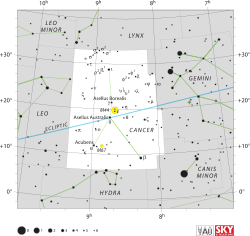
Cancer is a medium-sized constellation that is bordered by Gemini to the west, Lynx to the north, Leo Minor to the northeast, Leo to the east, Hydra to the south, and Canis Minor to the southwest. The three-letter abbreviation for the constellation, as adopted by the International Astronomical Union in 1922, is "Cnc".
The official constellation boundaries, as set by Belgian astronomer Eugène Delporte in 1930, are defined by a polygon of 3 main and 7 western edgework forming sides (illustrated in infobox). Covering 506 square degrees or 0.921% of the sky, it ranks 31st of the 88 constellations in size. It can be seen at latitudes between +90° and -60° and is best visible at 9 p.m. during the month of March. Cancer borders the bright constellations of Leo, Gemini and Canis Minor. Under city skies, Cancer is invisible to the naked eye.
Cancer is the dimmest of the zodiacal constellations, having only two stars above the fourth magnitude. The German cartographer Johann Bayer used the Greek letters Alpha through Omega to label the most prominent stars in the constellation, followed by the letter A, then lowercase b, c and d. Within the constellation's borders, there are 104 stars brighter than or equal to apparent magnitude 6.5.
Also known as Altarf or Tarf, Beta Cancri is the brightest star in Cancer at apparent magnitude 3.5. Located 290 ± 30 light-years from Earth, it is a binary star system, its main component an orange giant of spectral type K4III that is varies slightly from a baseline magnitude of 3.53—dipping by 0.005 magnitude over a period of 6 days. An aging star, it has expanded to around 50 times the Sun's diameter and shines with 660 times its luminosity. It has a faint magnitude 14 red dwarf companion located 29 arcseconds away that takes 76,000 years to complete an orbit. Altarf represents a part of Cancer's body.
At magnitude 3.9 is Delta Cancri, also known as Asellus Australis. Located 131±1 light-years from Earth, it is an orange-hued giant star that has swollen and cooled off the main sequence to become an orange giant with a radius 11 times and luminosity 53 times that of the Sun. Its common name means "southern donkey". The star also holds a record for the longest name, "Arkushanangarushashutu," derived from ancient Babylonian language, which translates to "the southeast star in the Crab."[citation needed] Delta Cancri also makes it easy to find X Cancri, the reddest star in the sky. Known as Asellus Borealis "northern donkey", Gamma Cancri is a white-hued A-type subgiant of spectral type A1IV and magnitude 4.67, that is 35 times as luminous as of the Sun. It is located 181 ± 2 light-years from Earth.
Iota Cancri is a wide double star. The primary is a yellow-hued G-type bright giant star of magnitude 4.0, located 330 ± 20 light-years from Earth. It spent much of its stellar life as a B-type main sequence star before expanding and cooling to its current state as it spent its core hydrogen. The secondary is a white main sequence star of spectral type A3V and magnitude 6.57. Despite having different distances when measured by the HIPPARCOS satellite, the two stars share a common proper motion and appear to be a natural binary system.
Located 181 ± 2 light-years from Earth, Alpha Cancri (Acubens) is a multiple star with a primary component an apparent white main sequence star of spectral type A5 and magnitude 4.26. The secondary is of magnitude 12.0 and is visible in small amateur telescopes. Its common name means "the claw". The primary is actually two very similar white main sequence stars that are 5.3 AU distant from each other and the secondary is two small main sequence stars, most likely red dwarfs, that are 600 AU from the main pair. Hence the system is a quadruple one.
Cancer (constellation)
Cancer is one of the twelve constellations of the zodiac and is located in the Northern celestial hemisphere. Its name is Latin for crab and it is commonly represented as one. Cancer is a medium-size constellation with an area of 506 square degrees and its stars are rather faint, its brightest star Beta Cancri having an apparent magnitude of 3.5. It contains ten stars with known planets, including 55 Cancri, which has five: one super-Earth and four gas giants, one of which is in the habitable zone and as such has expected temperatures similar to Earth. At the (angular) heart of this sector of our celestial sphere is Praesepe (Messier 44), one of the closest open clusters to Earth and a popular target for amateur astronomers.
Cancer is a medium-sized constellation that is bordered by Gemini to the west, Lynx to the north, Leo Minor to the northeast, Leo to the east, Hydra to the south, and Canis Minor to the southwest. The three-letter abbreviation for the constellation, as adopted by the International Astronomical Union in 1922, is "Cnc".
The official constellation boundaries, as set by Belgian astronomer Eugène Delporte in 1930, are defined by a polygon of 3 main and 7 western edgework forming sides (illustrated in infobox). Covering 506 square degrees or 0.921% of the sky, it ranks 31st of the 88 constellations in size. It can be seen at latitudes between +90° and -60° and is best visible at 9 p.m. during the month of March. Cancer borders the bright constellations of Leo, Gemini and Canis Minor. Under city skies, Cancer is invisible to the naked eye.
Cancer is the dimmest of the zodiacal constellations, having only two stars above the fourth magnitude. The German cartographer Johann Bayer used the Greek letters Alpha through Omega to label the most prominent stars in the constellation, followed by the letter A, then lowercase b, c and d. Within the constellation's borders, there are 104 stars brighter than or equal to apparent magnitude 6.5.
Also known as Altarf or Tarf, Beta Cancri is the brightest star in Cancer at apparent magnitude 3.5. Located 290 ± 30 light-years from Earth, it is a binary star system, its main component an orange giant of spectral type K4III that is varies slightly from a baseline magnitude of 3.53—dipping by 0.005 magnitude over a period of 6 days. An aging star, it has expanded to around 50 times the Sun's diameter and shines with 660 times its luminosity. It has a faint magnitude 14 red dwarf companion located 29 arcseconds away that takes 76,000 years to complete an orbit. Altarf represents a part of Cancer's body.
At magnitude 3.9 is Delta Cancri, also known as Asellus Australis. Located 131±1 light-years from Earth, it is an orange-hued giant star that has swollen and cooled off the main sequence to become an orange giant with a radius 11 times and luminosity 53 times that of the Sun. Its common name means "southern donkey". The star also holds a record for the longest name, "Arkushanangarushashutu," derived from ancient Babylonian language, which translates to "the southeast star in the Crab."[citation needed] Delta Cancri also makes it easy to find X Cancri, the reddest star in the sky. Known as Asellus Borealis "northern donkey", Gamma Cancri is a white-hued A-type subgiant of spectral type A1IV and magnitude 4.67, that is 35 times as luminous as of the Sun. It is located 181 ± 2 light-years from Earth.
Iota Cancri is a wide double star. The primary is a yellow-hued G-type bright giant star of magnitude 4.0, located 330 ± 20 light-years from Earth. It spent much of its stellar life as a B-type main sequence star before expanding and cooling to its current state as it spent its core hydrogen. The secondary is a white main sequence star of spectral type A3V and magnitude 6.57. Despite having different distances when measured by the HIPPARCOS satellite, the two stars share a common proper motion and appear to be a natural binary system.
Located 181 ± 2 light-years from Earth, Alpha Cancri (Acubens) is a multiple star with a primary component an apparent white main sequence star of spectral type A5 and magnitude 4.26. The secondary is of magnitude 12.0 and is visible in small amateur telescopes. Its common name means "the claw". The primary is actually two very similar white main sequence stars that are 5.3 AU distant from each other and the secondary is two small main sequence stars, most likely red dwarfs, that are 600 AU from the main pair. Hence the system is a quadruple one.
Recent media
Recent media