Hubbry Logo
ACMUACMUMain
Open search
ACMU
Community hub
ACMU
logo
8 pages, 0 posts
0 subscribers
Be the first to start a discussion here.
ACMU
ACMU
from Wikipedia
ACMU
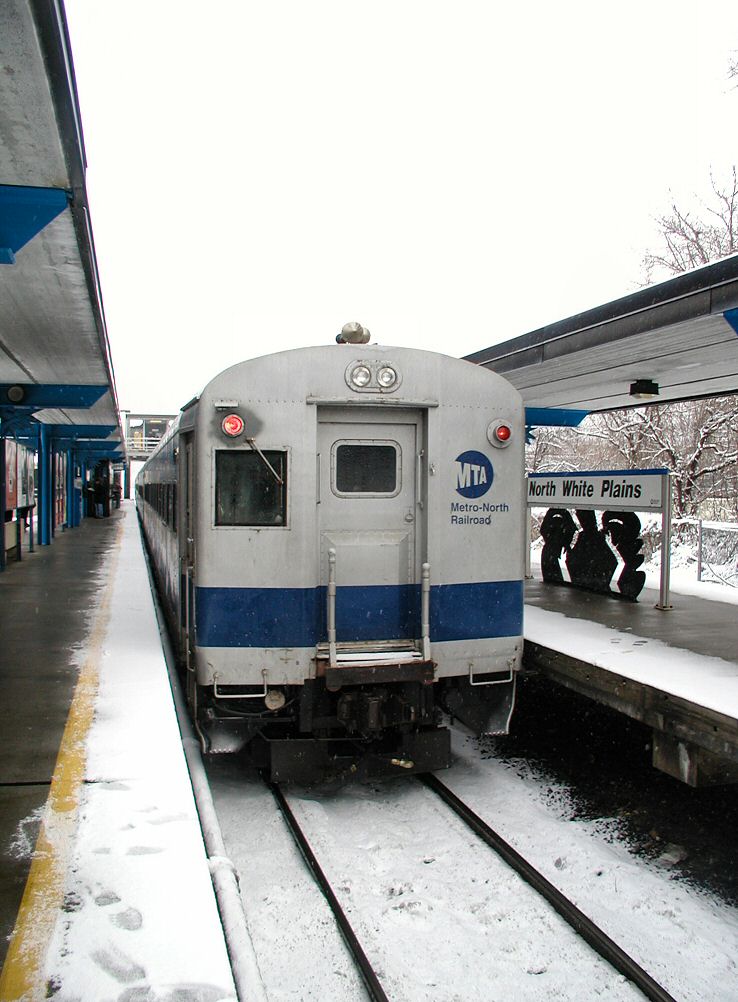
ACMU at the North White Plains station in 2004.
In service1950–2004
Manufacturer
Constructed
  • 4500 series: 1950–1951
  • 4600 series: 1962
  • 4700 series: 1962–1965
  • MP75: 1963
Number built
  • 4500 series: 100
  • 4600 series: 26
  • 4700 series: 61
  • MP75: 30
Number preserved4
Successor4500 Series: M1a
4600/4700 series: M7a
MP75: C3
FormationSingle unit
Fleet numbers
  • NYC: 4500–4599 (later MN 1000–1099)
  • NYC: 4600–4625, 4700–4726, 4750–4783 (later MN 1100–1186)
  • LIRR: 2525–2536, 2675–2692
Capacity130
Operators
Specifications
Car length85 ft 0 in (25.91 m)
Width10 ft 11+12 in (3.340 m)
Doors2 vestibule doors
Maximum speed80 mph (130 km/h)
Weight114,000 lb (52,000 kg)
Traction motors
  • 4 × GE 1240 (100 hp)
  • 4 × WE 1453-A (100 hp) - LIRR MP75 only
Power output400 hp (300 kW)
HVACElectric heat, air conditioning
Electric system(s)660 V DC third rail
Current collectionContact shoe
Braking system(s)Pneumatic
Safety system(s)emergency brakes
Coupling systemAAR

The ACMUs (short for Air Conditioned Multiple Unit) were a series of electric multiple unit railcars built for the New York Central Railroad in three orders between 1950 and 1965. The ACMUs were intended to replace/supplement the original fleet of heavyweight MU cars, some of which dated to the start of electric operations on the New York Central. These were the first New York Central units to offer air conditioning, with sealed windows replacing the drop sash and clerestory types found on earlier cars. The initial set of 100 cars was retired in 1970, upon completion of the M1 railcar delivery, while the second and third orders, totaling 87 cars, remained in service until 2004, when they were replaced by the new M7 fleet.

An order of near-identical cars was built for the Long Island Rail Road as the MP75 class in 1963. The LIRR cars were eventually converted to non-powered push-pull coaches before being retired in the late 1990s.

History

[edit]

The ACMU fleet was intended to replace some of the oldest MU cars on the New York Central system, many of which were already 40 years old and dated from the start of electrified service in 1906. The first series of 100 cars were ordered from the St. Louis Car company in 1949 and paid for by the New York Central railroad itself. 10 years later the financial condition of the railroad had deteriorated while the original MU fleet had only gotten older and less reliable. In 1962, the Central ordered an additional batch of 26 ACMUs from Pullman Standard and to assist the Central to improve its commuter rail service, the Port Authority of New York and New Jersey purchased an additional 27 cars which were numbered in the 4700 series to distinguish them from the Central owned cars in the 4600 series. In 1965 a second order of 34 4700 cars was purchased by the Port Authority bringing the total of 4600/4700 series cars to 87.[1]

A set of ACMUs at Croton–Harmon in 1976

In 1968, the New York Central was merged into the Penn Central railroad and the 4500 series were renumbered into the 1000 series and the 4600 and 4700 units renumbered into the combined 1100 series. With the railroad's finances worse than ever, the state acted to further prop up the ailing commuter operations and its fleet of several hundred remaining pre-war MU cars through the purchase of 174 new M1A "Metropolitan" railcars which were delivered between 1971 and 1973. By this point, the original 4500 series was 20 years old and in need of a mid-life overhaul. Due to the effects of deferred maintenance that took place in the 1950s, before the State funding became available, the decision was made to simply replace the fleet with new M1As instead of attempting to rebuild the run-down 4500s, although one car, #1037, lingered in service for several more years as a special car for a private car for commuters.[1] Starting in 1976, Conrail took over the state-supported commuter operations from the bankrupt Penn Central using the combined fleet of M1As and 1100 series ACMUs.

In 1983, Metro-North took over operations from Conrail and embarked on a capital improvement program that included the installation of cab signals on its main lines. 34 cars were sent to Morrison-Knudsen for a rebuild to be equipped with cab signals with another 34 cars getting a lighter rebuild in-house. The remainder of the fleet was retired leaving Metro-North with 68 active 1100-series ACMU cars. The non-cab signal equipped cars were referred to as "B cars" and used in the middle of trainsets. ACMUs were restricted from operating to Brewster North in later years because the ACMUs were never fitted with the FRA required ditch lights for operation over grade crossings, per a 1997 mandate.

The ACMU fleet continued on in service until 2004 when they, and most of the M1As were replaced by the new order of M7A railcars. In their last decades of service, the ACMUs were generally restricted to rush hour service on locals to North White Plains and Croton-Harmon. Two cars, 1128 and 1171, were preserved and sent to the Danbury Railway Museum.[2] Two additional cars, 1105 (originally #4605) and 1153, are preserved at the Kentucky Railway Museum.

MP75

[edit]

In 1963, the Long Island Rail Road placed an order with Pullman Standard for a nearly identical set of MUs based on the 1962 New York Central order. The LIRR units were virtually identical except for some minor cosmetic differences, Westinghouse control equipment, MU capability with older LIRR MU rolling stock, automatic doors and Automatic Speed Control. The order was broken into two sub-classes with a total of 12 MP75C control cars with cabs on each end, and 18 MP75T trailer cars without cabs. Each car had 400 HP with four Westinghouse 1453-A motors and an XC-548D cam control group.

The MP75s were ordered in part for expanded service to the 1964 World's Fair and were sometimes known as the "World's Fair Cars", but their superior performance compared with the aging MP54s and even more recent MP72 and MP70 cars lead them to be nicknamed the "Zip Cars". The MP75s continued on in self-propelled service until the final deliveries of the Budd M1 order by 1973, and were converted to non-powered locomotive hauled push-pull P75 cars. They were replaced by 1999 with the Kawasaki bi-level C3 railcars.

Design

[edit]
ACMU interior

The ACMUs represented a significant upgrade compared to the heavyweight cars that came before them. In addition to air conditioning and large sealed windows, the cars had flush steel panel sides with smooth rounded vents. The initial paint scheme was khaki green with yellow lettering and a yellow stripe below and above the windows. The lettering was eventually replaced by Penn Central decals and then an overall white with a large blue stripe in the Metro-North era.

The propulsion systems were significant upgrades featuring camshaft driven motor controllers that offered both higher and smoother acceleration. The air compressors and motor gear train were far quieter; that along with the sealed windows and fluorescent lighting provided an isolated and relaxing environment for the passengers. Seating consisted of reversible 3-2 bench seats with a synthetic canvas covering with a total capacity of 130 persons per car, far more than the cars they replaced. The cars were built with manually operated doors that contained convertible traps for low-level operation. After the electrified lines were converted to all high level operation with the arrival of the M1A cars, the ACMUs were left in their high-level configuration full-time. The manual side doors were never automated resulting in the frequent practice of doors being left open for the entire duration of a trip.

There were a few differences between 4500 series and later 4600 and 4700 series. The 4500 series had much larger windows as well as a single large-diameter headlamp in the centre of the car above the door. The 4600/4700 cars had much narrower windows with a twin sealed beam headlamp above the door. The 4500 series also had windows on both sides of the car end, where the 4600/4700 cars only had a window on the engineer's side. The only difference between the 4600 and 4700 cars was that the centerline of the windows on the 4700s was 4 inches (10 cm) lower due to passenger feedback.

See also

[edit]

References

[edit]
Revisions and contributorsEdit on WikipediaRead on Wikipedia
from Grokipedia
The ACMUs (Air Conditioned Multiple Units) were a series of railcars designed for commuter service on the New York Central Railroad's electrified lines in the . Built in three orders between 1950 and 1965 and totaling 186 cars, the ACMUs represented a significant upgrade over the railroad's aging fleet of wooden multiple units, introducing air conditioning, modern amenities, and streamlined designs to improve passenger comfort and efficiency on routes such as those between and points north. The first order consisted of 100 single-unit cars numbered 4500–4599, constructed by the in 1950–1951 at a facility in , , marking the initial step in replacing pre-World War I equipment. Subsequent orders expanded the fleet with cars built by Pullman-Standard: 26 owned units numbered 4600–4625, delivered between February and May 1962 after an order placed in May 1961, and a final batch of 60 leased units (4700–4725 and 4750–4783) ordered in 1964 and delivered in 1965, with the latter funded partly by the of New York and New Jersey under Governor —earning some the nickname "Rockefeller cars." Each car measured 85 feet in length, seated 130 passengers, and was designed for speeds up to 100 mph (operational maximum 80 mph), featuring innovations like sealed tinted windows, twin-beam headlights, and air-conditioning units for reliable operation in varying weather. The ACMUs entered service primarily on the and Hudson Lines, serving the New York Central until its merger into Penn Central in 1968; the initial St. series was retired in 1970 with the introduction of M1 cars, while the later Pullman-Standard cars continued under Penn Central, , and until retirement in 2004, displaced by M7 cars. A few examples, such as cars 1128 and 1171 (renumbered from the original series for Metro-North consistency), have been preserved at museums like the Danbury Railway Museum, highlighting their role in the transition from steam-era railroading to modern electric commuter systems.

History

Development and Initial Orders

Following , the faced the challenge of modernizing its aging fleet of multiple-unit electric cars used in commuter services on its electrified and Hudson Lines, many of which dated back 25 to 30 years and lacked modern amenities for passenger comfort during New York City's hot summers. To address these needs, the railroad prioritized electrification upgrades and the introduction of as a key innovation to improve ventilation and temperature control in crowded trains. In 1949, the New York Central placed an initial order for 100 air-conditioned multiple-unit (ACMU) cars in the 4500 series, with contracts awarded to the in June and September of the previous year. These cars, constructed and delivered between late 1949 and 1951 at a total cost of $13 million (approximately $130,000 per car), represented the railroad's first major investment in fully air-conditioned commuter equipment. The handled the complete construction, incorporating advanced assembly techniques to produce the single-end control cars efficiently for rapid deployment. The 4500 series introduced pioneering features for U.S. railcars, including fully sealed, double-paned shatterproof windows to maintain airtight integrity and efficient HVAC systems that provided filtered cooling in summer and automatic heating in winter, marking a significant advancement in passenger comfort over open-window designs. Deliveries began in December 1949, with the full order completed by April 1950, allowing the cars to enter service starting in late 1950 on the to North White Plains and the Hudson Line to Croton-on-Hudson.

Later Orders and Expansions

In the early 1960s, amid increasing demands in the , the placed a second order for 26 air-conditioned (ACMU) cars, numbered in the 4600 series and built by Pullman-Standard Car Manufacturing Company. These cars, delivered between February and May 1962, incorporated modifications to meet evolving safety standards, including sealed twin-beam headlights in place of the single-beam units on the earlier 4500 series. The design retained compatibility with the baseline 4500-series cars for mixed operations while featuring smaller, tinted passenger windows that eliminated the need for interior shades. A third order followed, comprising 61 cars in the 4700 series (including sub-batches 4700–4726 and 4750–4783), also constructed by Pullman-Standard in –1965. These units emphasized enhanced structural integrity through even narrower window dimensions compared to prior series, alongside continued refinements in air-conditioning and interior layout. Production costs for these later cars averaged approximately $150,000 per unit, reflecting inflationary pressures and added features such as improved lighting and ventilation systems. The expansion decisions were shaped by the New York Central's mounting financial difficulties in the mid-1960s, including high operational losses from commuter services that strained the railroad's resources. To mitigate costs, many of the 4700-series cars were leased from the of New York and rather than purchased outright, a supported by state initiatives. These pressures culminated in the 1968 merger with the to form , which inherited the expanded ACMU fleet but continued to grapple with commuter obligations. By 1965, the total ACMU fleet had grown to 187 cars, providing a modernized backbone for electrified suburban operations. Minor adjustments in later batches included subtle increases in to 132 passengers per car, optimizing space without altering the overall 85-foot length.

MP75 Introduction

The MP75 class represented a specialized variant of the Air Conditioned Multiple Unit (ACMU) cars, tailored specifically for the Long Island Rail Road (LIRR) as part of its expanding electrification efforts in the early 1960s. In 1963, the LIRR ordered 30 self-propelled MP75 multiple unit cars from Pullman-Standard, consisting of 12 cab control cars (MP75C, numbered 2525–2536) and 18 intermediate cars (MP75, numbered 2675–2692), closely mirroring the design of the preceding 87-car order for the New York Central Railroad under a shared New York State assistance program. These cars, adapted for third-rail electrification, were constructed to enhance service on electrified mainline routes, addressing the growing demand for reliable electric multiple units amid the LIRR's push to modernize its fleet for higher-speed commuter operations. Measuring 85 feet in length, the MP75 cars featured several adaptations for LIRR-specific needs, including modified door arrangements and interior fittings to better suit the railroad's operational environment, such as compatibility with high-level platforms at key stations like Penn Station. Interiors emphasized durability with paint-free construction using metal, , aluminum, and panels, while providing seating for 130 to 133 passengers in a comfortable layout with improved lighting and powerful air-conditioning systems. Propulsion was provided by four Westinghouse 1453-A motors delivering a total of 4,000 horsepower per powered car, along with innovative —the first such system on LIRR multiple units—for enhanced performance on the coastal commuter routes. These modifications also incorporated enhanced materials for corrosion resistance, suitable for the humid, salt-laden conditions of operations. The MP75 cars entered on August 29, 1963, debuting on trains between Penn Station and , and were initially painted in a distinctive scheme to promote the . As the final production run of the ACMU design lineage, these 30 units served a transitional role, harmonizing the LIRR fleet with contemporary New York Central equipment before the railroads' operational paths diverged further under changing ownership structures. Early operations revealed reliability challenges with the systems, which experienced frequent issues when integrated with non-dynamic brake cars, prompting minor retrofits by 1965 to improve consistency in mixed consists.

Design

Construction and Body

The ACMU railcars measured 85 feet in length, providing a compact yet spacious design for commuter operations on the New York Central system. Later variants built by Pullman-Standard in 1962 and 1965 incorporated steel construction with riveted and welded joints to enhance durability and reduce maintenance needs. These cars featured an interior layout with a capacity of 130 passengers in a 2+2 seating arrangement, utilizing reversible bench seats covered in synthetic materials for comfort during short-haul trips. Air conditioning was provided by roof-mounted HVAC units, marking these as among the earliest such systems in New York Central service, while fluorescent lighting ensured even illumination throughout the passenger compartment. Window designs varied across series to balance , , and structural integrity; the 4500 series included large picture windows to maximize views, whereas the 4600 and 4700 series employed narrower frames for added strength, with all windows sealed and tinted to support climate control. was facilitated by pneumatic at each end, complemented by strategically placed handrails for safe boarding in crowded conditions. Safety features adhered to standards, incorporating early fire-resistant interior materials and a sealed twin-beam headlight for improved . Evolution from initial builds in 1950–1951 to later Pullman-Standard models included minor body refinements for better and .

Propulsion and Electrical Systems

The ACMU railcars drew power from a 660 V DC system, enabling operation on electrified lines into . This under-running configuration was standard for New York Central's commuter services on the and Hudson divisions, providing reliable collection without overhead infrastructure. Each car featured four 100 horsepower traction motors, delivering a total output of 400 horsepower to drive the two trucks. These motors, one per , supported a maximum operating speed of 80 mph, suitable for suburban commuter routes with frequent stops. The braking system employed pneumatic straight air brakes, manufactured by Westinghouse Air Brake Company (WABCO) under the 26-MUE designation, which allowed for consistent stopping performance across consists. Control was facilitated through multiple-unit (MU) systems, permitting operation of up to eight cars in a single consist from a lead vehicle, with integration of deadman throttles for safety and automatic train stop (ATS) for signal enforcement. Electrical systems included 64-volt control circuits for managing propulsion and auxiliary functions, backed by batteries for emergency operations such as door release and lighting. The air conditioning, a defining feature of the ACMU design, was powered by auxiliary generators rather than relying on steam heating from locomotives, yielding significant efficiency improvements in energy use and passenger comfort over predecessor cars.

Operations

Service on New York Central and Successors

The ACMUs entered service on the New York Central Railroad's electrified commuter lines, including the and Hudson lines, beginning in 1950, reaching peak usage during the 1950–1968 era. Following the 1968 merger that formed , the ACMUs continued operations on these routes but encountered significant maintenance challenges amid the railroad's 1970 bankruptcy, despite widespread deferred upkeep and declining infrastructure. During the 1976–1983 transition, standardization initiatives were implemented across the inherited fleet, though the gradual phase-out of ACMUs had already commenced with the delivery of M1 cars in the early 1970s, prioritizing newer equipment on high-density segments. In the Metro-North era from 1983 to 2004, the surviving ACMUs were primarily deployed on the for final operations until retirement.

Long Island Rail Road Usage

The MP75 cars, adapted from the ACMU design for the , entered service in 1963 on the electrified mainline between Penn Station and Mineola. These multiple-unit cars were initially deployed in consists of up to 10 cars to handle growing commuter demand, including special service to the . With the extension of third-rail electrification to Hicksville in 1970, MP75 operations expanded eastward, supporting increased capacity on the mainline. The 20-car fleet enabled more frequent runs during peak periods. Throughout the 1970s and 1980s, the cars primarily served the and Port Jefferson branches, forming consists of up to 10 cars on rush-hour trains to accommodate high ridership volumes. Despite their modern features, the MP75 cars encountered operational challenges, particularly with reliability when coupled to older equipment lacking compatible systems, which often necessitated splitting longer trains and contributed to inconsistent performance. Featuring power-operated doors, unlike the manually operated doors on their ACMU counterparts, these cars still required additional crew attention on busy routes. In response, starting in 1972, many were depowered and converted to push-pull control trailers for diesel service on non-electrified extensions. By the early 1970s, the MP75 fleet was phased out of electric multiple-unit operations following the introduction of M1 cars, shifting to unpowered roles in mixed diesel consists. The remaining cars continued in push-pull service through the 1980s and 1990s but were gradually retired as M3 and later M7 cars entered the fleet, with the final MP75 runs occurring in late 1999.

Preservation and Legacy

Preserved Examples

Of the 187 ACMU cars built for the between 1950 and 1965, four survive in preservation, representing a small fraction of the original fleet that revolutionized with and self-propulsion. Restoration efforts for these survivors began in 2005, focusing on maintaining their historical integrity while addressing age-related deterioration in electrical and climate control systems. Two examples from the later Pullman-Standard orders are preserved at the Danbury Railway Museum in . Metro-North #1128 (ex-New York Central #4767, built 1965) and #1171 (ex-New York Central #4768, built 1965) were donated by in November 2005 and arrived via rail from the Croton-Harmon yard. These 4700-series cars, each seating 130 passengers, feature original third-rail propulsion and air-conditioning systems, though full operational restoration has prioritized static display and partial mechanical overhauls to prevent further decay. Volunteers have sourced compatible parts from surplus components to rebuild HVAC units, with per-car costs exceeding $50,000 funded through donations and grants. The remaining two preserved cars, Metro-North #1105 (ex-New York Central #4605, 4600-series) and #1153 (4600-series), are held at the Kentucky Railway Museum in New Haven, , as static exhibits highlighting mid-20th-century commuter innovation (as of 2023). These units underwent exterior restoration in the mid-2010s, including paint and minor structural repairs, but lack propulsion functionality. Public access to these preserved ACMUs is primarily through static display at the museums, with the Danbury examples occasionally used for educational demonstrations on the museum's short track segment.

Historical Significance

The ACMUs represented a pivotal advancement in U.S. technology, introducing among the earliest air-conditioned cars to the New York Central System and thereby elevating passenger comfort through sealed environments and reliable HVAC systems. Built between 1950 and 1965 in three orders by manufacturers including and Pullman-Standard, these all-electric units operated on 600-volt DC , marking a shift from locomotive-hauled trains to self-propelled cars that enhanced efficiency and reduced operational costs for electrified lines. This innovation set benchmarks for subsequent designs by prioritizing climate control in high-density urban commuting, addressing the discomfort of open-window cars prevalent in earlier eras. As direct precursors to later fleets, the ACMUs influenced the development of the M1, M3, and M7 series on Metro-North and the , with enduring elements such as third-rail compatibility and modular multiple-unit configurations carried forward into modern operations. Their long service life—spanning New York Central, Penn Central, , and Metro-North until retirement in the early —demonstrated proven reliability in demanding suburban routes like the and Hudson Lines, informing the standardization of electric multiple units in commuter networks. This lineage underscores the ACMUs' role in bridging mid-20th-century efforts with contemporary high-capacity rail systems. Economically, the ACMUs contributed to sustaining New York Central's commuter ridership amid the decline driven by highway competition, modernizing service on lines serving over 100,000 daily passengers and supporting urban workforce mobility in the . By facilitating consistent, comfortable travel into , they helped maintain rail's viability as an alternative to automobiles during a period when national intercity passenger volumes fell sharply. Their legacy extends to the broader evolution of urban transit, where early adoption of all-electric, air-conditioned designs paved the way for sustainable, high-frequency operations that remain integral to regional economies today.
Add your contribution
Related Hubs
User Avatar
No comments yet.