


Community hub
Recent from talks
Contribute something
Nothing was collected or created yet.
Saturn AL-31
View on Wikipedia| AL-31 | |
|---|---|

| |
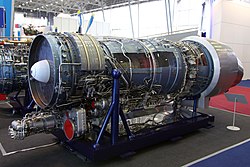
| Saturn AL-31FN turbofan engine | |
| Type | Turbofan |
| National origin | USSR/Russia |
| Manufacturer | Lyulka (now NPO Saturn), UMPO, NPC Salyut, HAL India |
| Major applications | Chengdu J-10 Chengdu J-20 Sukhoi Su-27 Sukhoi Su-30MKI Sukhoi Su-57 Shenyang J-11 Sukhoi S-70 Okhotnik-B |
The Saturn AL-31 (originally Lyulka) is a family of axial flow turbofan engines, developed by the Lyulka-Saturn design bureau in the Soviet Union, now NPO Saturn in Russia, originally as a 12.5-tonne (122.6 kN, 27,560 lbf) powerplant for the Sukhoi Su-27 long range air superiority fighter. The AL-31 currently powers the Su-27 family of combat aircraft and some variants of the Chengdu J-10 multirole jet fighter. Assembly of the engine is also performed under license in India by HAL, for the Sukhoi Su-30MKI. Improved variants power the fifth-generation Sukhoi Su-57 and Chengdu J-20.
Development and design
[edit]The design of the AL-31 turbofan began in the 1970s under the designation izdeliye 99[N 1] by the Lyulka design bureau, also known as Lyulka-Saturn. With an emphasis on greater fuel efficiency over turbojets for longer range, the 12.5 tonnes-force (122.6 kN; 27,560 lbf) class turbofan engine was intended to power the heavy PFI (Russian: ПФИ, short for: перспективного фронтового истребителя, lit. 'Prospective Frontline Fighter'), which was being developed by Sukhoi as the T-10. The chief designer was Arkhip M. Lyulka, and after his death, Victor M. Chepkin. As the AL-31 was not yet ready for the first two T-10 prototypes in 1977, they were initially powered by modified AL-21F3 turbojet engines. The third prototype would be the first to install the AL-31. The T-10 design would be heavily revised into the T-10S, with T-10-7 being the first prototype of the improved design; the aircraft's aerodynamic refinements from changes in the outer shaping and packaging also resulted in the AL-31 gearbox changing to a top-mounted position. State tests of the AL-31 were completed in 1985, and the T-10 entering Soviet air services as the Su-27. The engine is manufactured at Ufa-based UMPO and Moscow-based Salyut.[1][2]
After the collapse of the Soviet Union, design bureau and production plant distinctions realigned and gradually faded, and Lyulka-Saturn eventually merged with Rybinsk Motors to become NPO Saturn and was closely aligned with UMPO while Salyut became an independent entity; both Saturn and Salyut would make their own developments for the AL-31 family. Salyut also supplies AL-31 variants to fighters operated by the China. The J-10 uses the AL-31FN before newer variants transitioned to the domestic WS-10A, while the J-20 uses the AL-31FM2 as an interim engine until its intended WS-15 is ready.[3] This reorganization would result in serious disputes between Saturn and Salyut over intellectual property rights and royalties over AL-31 sales to China.[2]
The AL-31 was also used to assist Chinese engine designer and manufacturer Shenyang/Liming in developing the WS-10, with early examples directly using the AL-31F control system.[4] According to Saturn's Victor M. Chepkin, chief designer of the 117 and 117S engines, the WS-10 was developed with the aid of the AL-31's maintenance technical documentation;[5] this was recently confirmed by Aviation Industry Corporation of China (AVIC), the parent of Shenyang Aircraft Corporation.[6]
Design
[edit]The base model AL-31F is a two-shaft axial-flow afterburning turbofan. The engine has a four-stage low-pressure compressor and a nine-stage high-pressure compressor, both driven by single stage turbines. Overall pressure ratio is 23, and the turbine inlet temperature is 1,392 °C (1,665 K; 2,538 °F); the turbine blades incorporate air film cooling. The engine is controlled by the analogue KRD-99 unit, and can tolerate severely distorted air flow from the intake. It produces 7.8 tonnes-force (76.49 kN; 17,200 lbf) of thrust dry and 12.5 tonnes-force (122.6 kN; 27,560 lbf) of thrust in afterburner. The AL-31 has a modular design to facilitate maintenance and overhaul. In the twin-engine Su-27, left and right engines are interchangeable. Initially, the Mean Time Between Overhaul (MTBO) of the engine was only 100 hours, short of the required 300 hours. Later series incrementally improved the MTBO figure to 500 hours while service life was assigned as 1,500 hours. Further improved variants, such as the AL-31F Series 42, increased the MTBO to 1,000 hours with a full-life of 2,000 hours.[2]
Further developments
[edit]Thrust vectoring
[edit]The AL-37FU and AL-31FP variants have thrust vectoring. The AL-37FU was an experimental thrust vectoring variant for a modified Su-27M, later designated Su-37, and was uprated to 14.5 tonnes-force (142.2 kN; 31,970 lbf) of thrust. The thrust vectoring nozzles could deflect ±15° in the vertical plane together for pitch or differentially for roll. After the engines reached the end of their service lives, the sole Su-37 was equipped with the normal AL-31F until it crashed in December 2002.[7]
The research on thrust vectoring would be applied to the production AL-31FP used in the Sukhoi/Irkut Su-30MKI for India as well as further derivatives including the Su-30MKM for Malaysia and the Su-30SM for the Russian Air Force and Navy. The AL-31FP has the same thrust of 12.5 tonnes-force (122.6 kN; 27,560 lbf) as the baseline AL-31F, but can deflect its nozzle to a maximum of ±15° at a rate of 30°/sec. The vectoring nozzle is used primarily in the pitch plane, but unlike the AL-37FU, the canting of the vectoring axes allow differential vectoring to produce roll and yaw moments as well. The AL-31FP nozzle has a time before overhaul of 500 hours, while the engine's MTBO is 1,000 hours, and both have a service life of 2,000 hours. AL-31FP is built by UMPO as well as in India by Hindustan Aeronautics Limited (HAL) at the Koraput facility under a deep technology transfer agreement.[2]
Salyut developments
[edit]AL-31FN
[edit]The AL-31FN variant was developed by Salyut to power the Chengdu J-10, with key differences including slightly more thrust of 12.7 tonnes-force (124.54 kN; 27,999 lbf) and gearbox relocated from the top to the bottom of the engine. Later J-10 variants and production lots were equipped with the improved AL-31FN series 3, with thrust increased to 13.7 tonnes-force (134.35 kN; 30,203 lbf) and service life raised by 250 hours.[8] Further production J-10 batches would eventually be equipped with the Shenyang/Liming WS-10A in lieu of the AL-31FN.[2]
During the 2024 Zhuhai Air Show, Rostec introduced the Series 5 upgrade of the AL-31FN, having a theoretical thrust of 14 tonnes-force (137.29 kN; 30,865 lbf) and a 6% enhancement in fuel consumption.[9]
AL-31FM1, FM2, and FM3
[edit]
Salyut also developed additional improved variants of the AL-31F with increased thrust and reliability. The first is the AL-31FM1, also designated as the AL-31F series 42, which had a larger KND-924-4 fan, with inlet diameter increasing from 905 mm (35.6 in) on the baseline AL-31 to 924 mm (36.4 in) which increased airflow by 6%. Additional enhancements include an improved core for greater turbine inlet temperature, and improved engine control system. The engine also had improved MTBO of 1,000 hours, projected life of 2,000 hours, and its thrust was increased to 13.5 tonnes-force (132.4 kN; 29,760 lbf); this engine passed Russian state acceptance testing in 2006 and was equipped on the Su-27SM, Su-30M2, and Su-34.[1][10]
The AL-31FM2 is a further development of the AL-31FM1. Fan aerodynamics was further refined to increase its pressure ratio. The engine also incorporated improvements to the combustor and turbine blade aerodynamics and cooling for higher entry temperatures. The AL-31FM2 has a new full authority digital engine control (FADEC) with a hydromechanical backup. Thrust was increased 9% across the envelope, with a maximum thrust of 14.5 tonnes-force (142.2 kN; 31,970 lbf) in afterburner. The engine has an MTBO of 1,000 hours and projected life increased to 3,000 hours. A version of the AL-31FM2 powers initial production batches of the Chengdu J-20 while later batches transitioned to the WS-10C; both of these engines are interim powerplants in place of the J-20's intended Xian WS-15.[11]
The last in this line is the proposed AL-31FM3, which would have a new 3-stage fan, designated KND-924-3, with further increased pressure ratio and additional core improvements to increase turbine inlet temperature by 150 °C. Maximum thrust was increased to 15 tonnes-force (147.1 kN; 33,070 lbf) in afterburner.[1] The AL-31FM3 had been proposed as a potential powerplant for Sukhoi's T-50 PAK FA design but this was not pursued by Sukhoi, which instead chose Salyut rival NPO Saturn and its AL-41F1.[12][13][10]
Salyut's developments of the AL-31 would result in serious disputes with Lyulka-Saturn's successor corporation NPO Saturn, which considers them unsanctioned and in violation of intellectual property rights.[2]
Saturn developments
[edit]AL-41F-1 (izdeliye 117)
[edit].jpg)
Due to the decline of the Mikoyan Project 1.42/1.44 MFI fifth-generation fighter program in the 1990s, the Russian Defence Ministry initiated the PAK FA program for a more affordable next-generation multirole fighter, with the competition announced in 2001. As the designs would be smaller than the MFI, the original Lyulka-Saturn AL-41F design for the MiG 1.42/1.44 was too large. Instead, a deeply improved AL-31F derivative from Lyulka-Saturn (later NPO Saturn) designated the izdeliye 117 was contracted by Sukhoi for its T-50 design, which would eventually win the competition in 2002 and enter service in 2020 as the Su-57. First proposed by Saturn in 2001, the izdeliye 117, or AL-41F1, formally began development in April 2004 with contract signing by NPO Saturn.[14][15]
While the AL-41F1 has the same overall architecture as the baseline AL-31, with a 4-stage low-pressure compressor (fan) and 9-stage high-pressure compressor and one-stage low pressure and one-stage high pressure turbines, the engine was deeply improved with up to 80% new parts and application of technology from the AL-41F.[16] It has increased fan diameter of 932 millimetres (36.7 in), new high- and low-pressure turbines, provisions for thrust-vectoring nozzles similar to the AL-31FP, and a digital control system (FADEC) integrated into the aircraft's flight control system. Though the specifics remain classified, the AL-41F1's thrust was increased by 2.5 tonnes-force (24.5 kN; 5,510 lbf) over the AL-31 while the engine weight growth was reduced by 150 kg (330 lb). The engine produces 9 tonnes-force (88.26 kN; 19,840 lbf) of thrust dry, 14.5 tonnes-force (142.2 kN; 31,970 lbf) in afterburner, and 15 tonnes-force (147.1 kN; 33,070 lbf) in an emergency, with a dry weight of approximately 1,600 kg (3,527 lb).[N 2] The engine enables the Su-57 to achieve supersonic speed without afterburner, or supercruise, at Mach 1.3.[17][18]
Following completion of state tests to meet Russian Air Force requirements, serial production of the AL-41F1 began in 2019 for installation in production Su-57 fighters supplied to the Russian Air Force and prospective foreign clients.[19] A non-afterburning version of the AL-41F1 powers the Sukhoi S-70 Okhotnik unmanned combat aerial vehicle (UCAV).[20] While the current Su-57 production tranches are powered by the AL-41F1, the aircraft is to be the basis for a family of stealth combat aircraft; future improved variants are planned to be powered by the Saturn izdeliye 30, later designated AL-51F-1, a new design that fits into the same footprint as the AL-41F1.
AL-41F-1S (izdeliye 117S)
[edit]To spread out development risks and associated costs with the fifth-generation PAK FA program, Sukhoi applied some of the technology, including the propulsion system, into a highly upgraded Su-27 variant, designated T-10BM (popularly called the Su-35BM), before being designated just as the Su-35. The aircraft's powerplant, the NPO Saturn izdeliye 117S, or AL-41F1S, is a slightly simplified derivative of the AL-41F1 from the Su-57, with the key difference being the separate engine control system of the AL-41F1S. The Su-35 and its AL-41F1S engines were originally developed by Sukhoi and Saturn internally for export, although the initial customer would be the Russia Defence Ministry.[21] The engine produces 8.8 tonnes-force (86.30 kN; 19,400 lbf) of thrust dry, 14 tonnes-force (137.3 kN; 30,860 lbf) in afterburner, and 14.5 tonnes-force (142.2 kN; 31,970 lbf) in an emergency.[22] The AL-41F1S fan diameter was increased by 3% over the baseline AL-31, from 905 mm (35.6 in) to 932 mm (36.7 in), and also has increased turbine inlet temperature. This engine weighs 1,604 kg (3,536 lb) dry and has an assigned life of 4,000 hours and an MTBO of 1,000 to 1,500 hours.[23] The first flight of this engine was completed in an Su-35BM on 20 February 2008.[24] On 9 August 2010, UMPO started supplying AL-41F1S intended for Su-35S fighters. The engine is also equipped on the Su-30SM2 as part of the upgrade plan to unify its systems with the Su-35S.[25]
During the 2024 Zhuhai Airshow, United Engine Corporation showcased the engine with a new serrated nozzle under the "117S" generic designation.[26]
Variants
[edit]| Name | Description | Builder | Year | Thrust | Thrust vectoring | Aircraft | Status |
|---|---|---|---|---|---|---|---|
| AL-31F | The basic engine developed to power the Su-27 fighter | Salyut, UMPO | 1981 | 27,560 lbf (122.6 kN) | No | Sukhoi Su-27, Shenyang J-11, Sukhoi Su-30MKK, Sukhoi Su-30 (Salyut) | In service/production |
| AL-31F3 | Improved variant for the naval version Su-33 | Saturn Lyulka | 28,230 lbf (125.57 kN) | No | Sukhoi Su-33 | In service | |
| AL-31FP | Improved variant for the Indian Su-30MKI with thrust vectoring | Salyut, HAL | 2000 | 27,560 lbf (122.6 kN) | Yes | Sukhoi Su-30 MKI, Sukhoi Su-30MKM, Su-30MKA, Sukhoi Su-30SM | In service/production |
| AL-31FN[27] | Improved variant for the Chengdu J-10 | Salyut | 2002 | 27,998 lbf (124.54 kN) | No | Chengdu J-10 | In service |
| AL-31FN Series 3[28] | Improved variant for the Chengdu J-10B | Salyut | 2013 | 30,203 lbf (134.35 kN) | No | Chengdu J-10 | In service/production |
| AL-31FN Series 5[9] | Improved variant offered for Chengdu J-10B | Salyut | 2024 | 30,864 lbf (137.29 kN) | No | Chengdu J-10 | Proposed and offered to the J-10 |
| AL-31FM1 (Series 42)[29] | Improved version for the Russian Air Force | Salyut | 2007 | 29,760 lbf (132.4 kN) | Yes
(Optional)[29] |
Sukhoi Su-27SM, Sukhoi Su-30, Sukhoi Su-34 | In service/production |
| AL-31FM2[11] | Improved version for the Chengdu J-20 | Salyut | 2012 | 31,970 lbf (142.2 kN) | No | Chengdu J-20 | In service/production |
| AL-37FU | Advanced derivative for the Su-37 | UMPO | 31,970 lbf (142.2 kN) | Yes | Sukhoi Su-37 | Experimental derivative for the Su-37 | |
| AL-41F-1S (117S)[30] | Advanced derivative for the Su-35 | UMPO | 2008 | 31,970 lbf (142.2 kN) | Yes | Sukhoi Su-35, Sukhoi Su-30SM2 | In service/production |
| AL-41F1 (117) | Advanced derivative for the Sukhoi Su-57 | UMPO | 2010 | 33,070 lbf (147.1 kN) | Yes | Sukhoi Su-57, Sukhoi S-70 | In service/production |
Specifications
[edit]AL-31F
[edit]Data from Gordon,[31] Rosoboronexport,[32] United Engine Corporation,[33] UMPO,[34][35] Saylut[36]
General characteristics
- Type: Two-shaft axial-flow afterburning turbofan
- Length: 4,945 mm (194.7 in)
- Diameter:
- 905 mm (35.6 in) inlet;
- 1,280 mm (50 in) maximum external
- Dry weight: 1,520 kg (3,350 lb)
Components
- Compressor: 4-stage low pressure compressor (fan) and 9-stage high pressure compressor
- Combustors: Annular
- Turbine: 1-staged low pressure, 1-stage high pressure turbines
- Nozzle: 2-dimensional vectoring
Performance
- Maximum thrust:
- Overall pressure ratio: 23:1
- Bypass ratio: 0.56:1
- Air mass flow: 112 kg/s (247 lb/s)
- Turbine inlet temperature: 1,665 K (2,537 °F; 1,392 °C)
- Specific fuel consumption:
- Dry thrust: 22.1 g/kN/s (0.78 lb/lbf/h)
- With afterburner: 55.5 g/kN/s (1.96 lb/lbf/h)
- Thrust-to-weight ratio: 4.93 (dry), 8.22 (afterburning)
AL-41F-1S (117S)
[edit]Data from Rosoboronexport[37][38]
General characteristics
- Type: Two-shaft axial-flow afterburning turbofan
- Length: 494.2 cm (194.6 in)
- Diameter: 93.2 cm (36.7 in) inlet
- Dry weight: 1,604 kg (3,536 lb)
Components
- Compressor: 4-stage low pressure compressor (fan), 9-stage high pressure compressor
- Combustors: Annular
- Turbine: 1-stage low pressure, 1-stage high pressure turbines
- Nozzle: 2-dimensional vectoring
Performance
- Maximum thrust:
- 8.8 tf (86.30 kN; 19,400 lbf) dry thrust
- 14 tf (137.3 kN; 30,860 lbf) with afterburner
- 14.5 tf (142.2 kN; 31,970 lbf) emergency thrust
- Turbine inlet temperature: 1,745 K (2,681 °F; 1,472 °C),
- Fuel consumption:
- 6,813 kg/h (15,020 lb/h) dry
- 24,969 kg/h (55,050 lb/h) with afterburner
- Specific fuel consumption:
- 22.37 g/kN/s (0.790 lb/lbf/h) dry
- 51.53 g/kN/s (1.819 lb/lbf/h) with afterburner
- Thrust-to-weight ratio: 5.49 (dry), 8.75 with afterburner, 9.04 with emergency thrust
See also
[edit]Comparable engines
Related lists
References
[edit]Notes
[edit]References
[edit]- ^ a b c "AL-31F". Leteckemotory.
- ^ a b c d e f "After the burn". Key Aero. 10 September 2021.
- ^ Rupprecht, Andreas (1 November 2016). "China's new J-20 "Mighty Dragon" stealth fighter officially unveiled and ready to enter active service".
- ^ Fisher, Richard (27 May 2015). "ANALYSIS: Can China break the military aircraft engine bottleneck?". FlightGlobal. Archived from the original on 10 June 2015. Retrieved 5 August 2015.
- ^ Коробков, Егор (2011-08-17). "О положении дел в Российском авиамоторостроении. Год 2008". Retrieved 3 April 2018.
- ^ F_200788. "AVIC report: China's Taihang engine widely deployed in military - People's Daily Online". en.people.cn. Retrieved 3 April 2018.
{{cite web}}: CS1 maint: numeric names: authors list (link) - ^ Andrews, Thomas (Spring 2003). "Su-27/30 family: 'Flanker' in the 21st Century". International Air Power Review. Vol. 8. Norwalk, Connecticut: AIRtime Publishing. p. 58. ISBN 978-1-880588-54-3.
- ^ "JOINT-STOCK COMPANY "GAS-TURBINE ENGINEERING RESEARCH AND PRODUCTION CENTER «SALUT" - NEWS - NEWS - The FSUE "GTE-RPC "Salut"-produced AL-31FN series-3 engine receives code letter "O1"". www.salut.ru. Archived from the original on 8 July 2017. Retrieved 3 April 2018.
- ^ a b "UEC has First Presented the Latest Fifth Generation Aircraft Engine". Rostec. Retrieved 2025-02-20.
The AL-31F/FN/FP family engines for multi-role fighters have received upgraded appearance — Series 5. The new AL-31FN engine version is designed especially for single engine aircraft and features increased reliability. The engine will expand the aircraft range and altitude potential. This is ensured by a takeoff thrust increased up to 14 000 kgf and fuel consumption reduced by 6%.
- ^ a b Karnozov, Vladimir (30 April 2007). "Military engines: Russia". Flight Global.
- ^ a b "AL-31F M2 engine contemplated by OKB Sukhogo (Sukhoi Design Bureau)". Salut. 12 March 2012. Archived from the original on 24 October 2017. Retrieved 24 September 2020.
- ^ Pyadushkin, Maxim (26 April 2010). "Rivals Plan Joint Effort Next Stage PAK FA Engine". Aviation Week.
- ^ "Russia unveils AESA radar for PAK FA fighter". Flight Global. 28 August 2009.
- ^ Butowski, Piotr (2021). Su-57 Felon. Stamford, UK: Key Books. pp. 22–24. ISBN 978-1-913870-44-7.
- ^ "New AL-41 unveiled at MAKS-2001". Flight International. 27 August 2001.
- ^ Butowski, Piotr. "Is Russia's fifth-generation PAK FA fighter programme still on track?". Air International, June 2015, pp. 76–81. Stamford, UK: Key Publishing.
- ^ Butowski, Piotr (October 2019). "The Final Flanker; Russian Fifth-Gen". Air International. London: Key Publishing. Retrieved 12 April 2020.
- ^ PAK-FA is flying with new engine already installed Archived July 27, 2011, at the Wayback Machine
- ^ "Двигатель "первого этапа" для Су-57 прошел все испытания и запущен в серию". TASS. 23 April 2019. Retrieved 28 April 2019.
- ^ Butowski, Piotr (4 September 2020). "Russia Reveals Loyal Wingman Concept". Aviation Week.
- ^ АВДЕЕВ, Юрий (24 March 2010). ""СУ"ДАРЬ РАСПРАВЛЯЕТ КРЫЛЬЯ". Красная звезда. Archived from the original on 23 April 2010.
- ^ Hillebrand, Niels. "MILAVIA Aircraft - Sukhoi Su-35 (Su-27BM) "4++ Generation Flanker"". www.milavia.net. Retrieved 3 April 2018.
- ^ "NPO Saturn finishes endurance tests for S-117 Engine meant for Su-35". Archived from the original on 28 March 2008. Retrieved 3 April 2018.
- ^ "Новый истребитель Су-35 полностью выполнил программу первого полета". 20 February 2008. Retrieved 3 April 2018.
- ^ "Новости - Приволжский федеральный округ - interfax-russia.ru". www.interfax-russia.ru. 9 August 2010. Retrieved 3 April 2018.
- ^ "Rostec - Media - News - UEC has First Presented the Latest Fifth Generation Aircraft Engine". Rostec. Retrieved 2025-07-24.
The world premiere of the 177S fifth generation engine will take place in China
- ^ "JOINT-STOCK COMPANY "GAS-TURBINE ENGINEERING RESEARCH AND PRODUCTION CENTER «SALUT" - Production - AEROENGINES - AL-31FN". www.salut.ru. Archived from the original on 24 September 2015. Retrieved 3 April 2018.
- ^ "JOINT-STOCK COMPANY "GAS-TURBINE ENGINEERING RESEARCH AND PRODUCTION CENTER «SALUT" - NEWS - NEWS - FSUE "Gas-Turbine Engineering RPC "Salut" has successfully completed the first phase of engine longevity and performance bench tests in view of future deliveries of a new version of AL-31FN Series 3". www.salut.ru. Archived from the original on 26 November 2015. Retrieved 3 April 2018.
- ^ a b "АО "НПЦ газотурбостроения «САЛЮТ" - Продукция - АВИАЦИОННЫЕ ДВИГАТЕЛИ - АЛ-31Ф серии 42 (М1)". www.salut.ru. Archived from the original on 8 July 2017. Retrieved 3 April 2018.
- ^ "UMPO press release". Retrieved 3 April 2018.
- ^ Gordon, Yefim (2006). Sukhoi Su-27. Specialty Press. p. 91. ISBN 1-5800-7196-1.
- ^ "AL-31F". Rosobonexport.
- ^ "AL-31F". United Engine Corporation. Archived from the original on 2020-01-15. Retrieved 2020-01-15.
- ^ "UMPO page on AL-31F". Archived from the original on 24 February 2018. Retrieved 3 April 2018.
- ^ "AL-31F Turbojet Bypass Engine with a Common Afterburner". Archived from the original on 2016-01-17. Retrieved 2011-03-11.
- ^ "Salyut page on AL-31F". Archived from the original on 2014-07-09. Retrieved 2011-01-20.
- ^ "AL-41F-1S". Rosoboronexport.
- ^ "Russia presented the fifth-generation 177C engine for front-line aviation at the exhibition in China – RuAviation". ruavia.su. 2024-11-12. Retrieved 2024-11-16.
External links
[edit]
- Russian Military Analysis - AL-31 F aircraft turbofan engine
- AL-31F on LeteckeMotory.cz (cs,en)
- AL-41F1A (117S) on LeteckeMotory.cz (cs,en)
Saturn AL-31
View on GrokipediaHistory and Development
Origins and Initial Design
The Saturn AL-31 engine's development originated in the Soviet Union's efforts during the 1970s to advance military aviation technology, specifically as the powerplant for the Sukhoi Su-27 fighter under the Perspektivnyy Frontovoy Istrebitel (PFI) program. Launched in 1969, the PFI initiative sought to produce a next-generation air superiority fighter with capabilities including supercruise and superior maneuverability to match emerging Western threats. Engine work began in 1975 at the Arkhip Lyulka design bureau, focusing on creating a high-thrust turbofan to meet these rigorous demands for the Su-27 prototype.[4][1] Led by General Designer Arkhip Lyulka, whose team emphasized innovative modular construction, the AL-31 was conceived as a two-shaft, afterburning turbofan engine to deliver approximately 123 kN of thrust with afterburner while prioritizing efficiency and durability for frontline operations. The design targeted a high thrust-to-weight ratio of around 8:1 and low fuel consumption during cruise, though initial goals of 0.60 lb/h-lbf were adjusted to 0.67 lb/h-lbf in practice. As the Lyulka bureau evolved into NPO Saturn, this foundational approach ensured scalability for future variants.[5][4] In the broader historical context, the AL-31 addressed the need for Soviet engines comparable to those in U.S. fighters like the F-15 Eagle's Pratt & Whitney F100, which offered about 105 kN of afterburning thrust; the AL-31's higher output enabled the Su-27's edge in speed and payload. First bench tests occurred in 1974, validating core design principles amid iterative refinements to achieve the targeted performance for supercruise and sustained high-altitude flight.[1][6]Testing and Production Entry
Flight tests of the Saturn AL-31F engine commenced in 1977 aboard prototypes of the Sukhoi Su-27 fighter, initially using interim powerplants before full integration of the new turbofan.[1] These trials revealed early reliability challenges, particularly with turbine blade durability and compressor aerodynamics, necessitating significant redesigns to meet performance and safety standards.[1] Through iterative ground and flight evaluations, the time between overhauls (TBO) was progressively enhanced during the testing phase, ultimately achieving 500 hours by the conclusion of state trials.[2] State testing was finalized in August 1985, marking the engine's certification for operational deployment.[7] Serial production of the AL-31F began in 1981 at the Ufa Motor-Building Production Association (UMPO), establishing the primary manufacturing hub for the engine.[1] To scale output and distribute workload, production partnerships were formed with NPC Salyut in Moscow, where assembly of critical components like hot-section parts commenced in May 1984.[1] The engine entered service powering the Su-27 in 1985, coinciding with the fighter's introduction into Soviet Air Force inventories.[8] Subsequent international collaborations, including licensed production with Hindustan Aeronautics Limited (HAL) in India for export variants, expanded the engine's global footprint starting in the 1990s.[9]Design Features
Core Architecture
The Saturn AL-31F is a modular two-shaft axial flow turbofan engine, featuring a low-pressure compressor with four stages, including a fan section, followed by a nine-stage high-pressure compressor.[1] The compressors incorporate variable stator vanes to optimize airflow and efficiency across varying flight regimes, enabling adjustable inlet guide vanes in the low-pressure section for enhanced performance.[1] Downstream, an annular combustor provides stable combustion, directing hot gases to a single-stage high-pressure turbine that drives the high-pressure compressor, and a single-stage low-pressure turbine that powers the low-pressure compressor and fan.[1][10] The engine's airflow path follows a mixed-flow configuration, where core and bypass streams blend after the turbines for improved thrust augmentation in the afterburner section, which includes multiple fuel injection nozzles for reheat.[1] This design achieves a bypass ratio of approximately 0.57, balancing core efficiency with bypass contributions to overall propulsion.[7] The overall pressure ratio stands at 23:1, reflecting the compression capabilities of the staged compressors.[1] Physically, the AL-31F measures 4.94 meters in length with a fan inlet diameter of 90 cm and a dry weight of 1,520 kg, facilitating integration into fighter aircraft while maintaining modularity for maintenance and upgrades.[1] This architecture supports reliable operation in high-performance environments, with the two-shaft arrangement allowing independent speed control of the low- and high-pressure spools for better responsiveness.[1]Key Technologies
The Saturn AL-31 turbofan engine incorporates advanced materials to enhance performance under extreme operating conditions. Titanium alloys are utilized in the fan and low-pressure compressor sections, providing high strength-to-weight ratios and resistance to high temperatures during high-speed airflow.[1] These alloys contribute to the engine's durability in supersonic flight regimes, where components face significant thermal and mechanical stresses. Turbine blades are made from directionally solidified nickel-based superalloys for improved creep resistance and thermal fatigue life.[11] The engine's control architecture represents an early evolution toward modern digital systems. The baseline AL-31F employs an analog hydro-mechanical system for afterburner management, serving as a precursor to full-authority digital engine control (FADEC) by enabling precise fuel scheduling and thrust response.[7] In upgraded variants like the AL-31F-M1, a FADEC-type digital control system replaces the analog setup, improving acceleration characteristics, fuel efficiency, and overall reliability through automated parameter optimization.[1] This transition facilitates better integration with aircraft avionics, reducing pilot workload during high-maneuverability scenarios. A notable innovation in the AL-31FP variant is the axisymmetric thrust vectoring nozzle, which features a gimbal movement of ±15 degrees in the pitch plane to enhance aircraft agility.[12] This system, driven by hydraulic actuators, allows for supermaneuverability without relying solely on aerodynamic surfaces, particularly in post-stall flight. For noise suppression and efficiency, the bypass duct includes acoustic liners to attenuate fan noise propagation, while later iterations such as the AL-31F-M2/M3 adopt single-crystal turbine blades, extending mean time between overhauls (MTBO) beyond 1,000 hours through improved creep resistance and thermal fatigue life.[1]Variants and Upgrades
Domestic Upgrades
The domestic upgrades to the Saturn AL-31 engine family have emphasized incremental enhancements in thrust output, operational reliability, and supermaneuverability, primarily to meet the evolving requirements of Russian Air Force fighters such as the Su-27 derivatives and advanced Flankers. These modifications leverage the baseline architecture's modular design, incorporating digital engine controls and advanced materials to extend service life and performance without major redesigns.[1] A key early upgrade was the AL-31F M1 variant, developed in the 1990s as the first stage of a multi-phase modernization program. This version introduced digital full-authority digital engine control (FADEC) for precise fuel management and thrust optimization, alongside increased airflow through the core and a 25°C rise in turbine inlet temperature, resulting in wet thrust of approximately 130 kN and improved reliability under high-stress conditions. These changes reduced maintenance intervals and enhanced overall engine durability, with the M1 passing bench and flight tests ahead of serial production for integration into Su-27/30 family aircraft.[1] Building on this foundation, the AL-41F-1 (izdeliye 117), introduced in the 2000s, represented a significant leap for fifth-generation applications like the Su-57 fighter. This afterburning turbofan delivers 147 kN of wet thrust—a roughly 20% increase over the baseline AL-31F—achieved through FADEC-enabled variable bypass ratios, higher compressor pressure ratios, and single-crystal blade materials in the high-pressure turbine for better efficiency and heat resistance. The engine supports supercruise capability without afterburner, prioritizing stealth and sustained high-speed performance in contested airspace.[1][13] Thrust vectoring emerged as a hallmark of domestic enhancements, starting with the AL-31FP variant certified in 1998 for supermaneuverable Su-30-series aircraft. Featuring asymmetric 2D nozzles capable of ±15° deflection in the vertical plane, the AL-31FP integrates hydraulic actuators with FADEC for rapid response, enabling post-stall maneuvers and enhanced agility during close-quarters combat without compromising the engine's 123 kN wet thrust rating. This technology was refined in the AL-41F-1S (izdeliye 117S) during the 2010s for the Su-35, which employs an axisymmetric nozzle for 3D vectoring—allowing ±15° pitch control per engine, with differential actuation for yaw and roll—while boosting wet thrust to 142 kN and incorporating plasma ignition for reliable starts in diverse conditions.[1][14] In the 2020s, recent upgrades have targeted lifecycle extension for legacy platforms, exemplified by the integration of AL-41F1S engines into the Su-30SM2 multirole fighter. These modifications, including advanced coatings and modular hot-section components, extend the assigned service life to 4,000 hours—more than double the original AL-31F's 1,500 hours—while maintaining compatibility with existing airframes and reducing overhaul frequency by up to 50%. As of August 2025, batches of Su-30SM2 fighters with AL-41F1S engines were delivered to the Belarusian Air Force, enhancing regional operational capabilities. This upgrade ensures prolonged operational availability for Russia's frontline heavy fighters amid evolving threats.[15][16]Export and Specialized Variants
The AL-31 engine family has seen significant export adaptations, particularly for Chinese and Indian military aviation programs. In the early 2000s, Russia developed the AL-31FN variant specifically for China's Chengdu J-10 single-engine fighter, featuring a relocated bottom-mounted accessory gearbox to accommodate the aircraft's layout and improve integration efficiency.[7] This version delivers a maximum thrust of approximately 125 kN with afterburner, enabling the J-10's multirole capabilities in air superiority and ground attack roles.[1] Subsequent upgrades to the AL-31FN, including Series 3, 4, and 5, have progressively enhanced performance for export markets, with the Series 5 achieving a takeoff thrust of 137 kN (14,000 kgf) and a 6% reduction in fuel consumption through improved turbine efficiency and materials.[17] These modifications were showcased at the 2024 Zhuhai Air Show, highlighting extended flight range and operational altitude for upgraded J-10 variants.[18] For India, the AL-31FP variant was selected in 1996 for the Sukhoi Su-30MKI under a licensing agreement with Hindustan Aeronautics Limited (HAL), allowing local production and integration of thrust-vectoring control (TVC) nozzles for enhanced maneuverability.[19][20] HAL's Koraput facility has manufactured hundreds of these engines, supporting the Indian Air Force's fleet sustainment with ongoing contracts for additional units. In September 2024, India signed a contract for 240 additional AL-31FP engines, with the first delivered by HAL to the Indian Air Force in October 2024, supporting fleet sustainment through 2032.[21] Other notable exports include the baseline AL-31F for Su-27SK fighters delivered to China in the 1990s, forming the basis for licensed J-11 production, and to Vietnam for its Su-27 fleet acquired in the mid-1990s.[22][23] As of 2025, production of AL-31 variants continues at the Ufa Engine Industrial Association (UMPO) under United Engine Corporation, sustaining export demands for allied nations.[24]Applications
Primary Aircraft Integrations
The Saturn AL-31F turbofan engine is primarily integrated into the Sukhoi Su-27 family of fighters, where it serves as a twin-engine powerplant mounted in fuselage-side nacelles beneath the aircraft's lifting body. This configuration provides balanced thrust distribution and allows for efficient airflow through fixed-geometry intakes positioned adjacent to the cockpit, enabling high-speed performance characteristics inherent to the platform. The modular design of the AL-31F facilitates straightforward installation and maintenance access via the aircraft's lower panels, with production engines assembled from components manufactured at the Ufa Motor-Building Production Association for cold sections and the Salyut Moscow Machine-Building Production Association for hot sections.[1] In the Su-30 multirole variants, such as the Su-30MKK and Su-30MK2, the baseline AL-31F is employed in a similar twin-mount setup, optimized for the aircraft's extended range and payload requirements through shared fuel systems and electronic engine controls. The AL-31FP derivative, featuring thrust-vectoring nozzles, is specifically integrated into export-oriented Su-30MKI-type aircraft, where the vectoring mechanism enhances post-stall maneuverability while maintaining compatibility with the original nacelle spacing and airframe interfaces. In India, Hindustan Aeronautics Limited (HAL) produces the AL-31FP under license and handles overhauls, with a 2024 contract for 240 additional engines to sustain the fleet.[25] This integration underscores the engine family's adaptability across Flanker derivatives.[1] The AL-31FN variant is adapted for single-engine use in the Chengdu J-10A fighter, featuring a bottom-mounted accessory gearbox to accommodate the aircraft's ventral pylon mounting and compact fuselage design. This modification repositions ancillary systems like the fuel and oil pumps to align with the J-10's structural constraints, ensuring balanced weight distribution and vibration isolation during high-G maneuvers. Initial flight testing of the AL-31FN on the J-10 prototype occurred in 1998, leading to series production integration by 2003, with Russia supplying engines under multiple contracts to support the platform's multirole capabilities.[1][22] Advanced derivatives like the AL-41F-1S are integrated into the Sukhoi Su-35, utilizing axisymmetric three-dimensional thrust-vectoring nozzles to achieve supermaneuverability through enhanced control authority in pitch, yaw, and roll. This setup involves reinforced engine mounts to handle nozzle deflections up to 15 degrees, integrated with the aircraft's fly-by-wire system for coordinated vectoring during extreme attitudes. The same engine powers production Su-57 fighters, where the TVC contributes to agile dogfighting envelopes, though later blocks are planned to transition to the Izdeliye 30 for further refinements in stealth and efficiency.[26][1]Operational History
The Saturn AL-31 turbofan engine entered operational service in 1985, initially powering the Soviet Air Force's Sukhoi Su-27 Flanker fighters as their primary propulsion system. This marked the beginning of its widespread adoption in frontline aviation roles, with the engine's modular design enabling rapid integration into subsequent variants of the Su-27 family. Production across the AL-31 family had reached over 4,500 units as of the early 2010s, manufactured primarily at the Ufa Motor-Building Production Association in Russia and supporting diverse operators including Russia, India, China, and several export customers.[2] Throughout its service history, the AL-31 has maintained a strong reliability record, bolstered by life extension programs that increased the assigned service life to over 3,000 hours for key variants by the 2020s, allowing extended operational deployments without frequent overhauls. However, early operational challenges included engine failures attributed to foreign object damage and impure fuel, which led to several incidents involving Indian Air Force Su-30MKI aircraft in the 2010s; investigations traced some crashes to bearing failures and afterburner malfunctions, resulting in the loss of multiple jets. These issues were addressed through targeted upgrades implemented by 2015, including improved fuel filtration and component hardening, which significantly reduced failure rates and enhanced safety across global fleets.[7][27][28][29] AL-31-equipped aircraft have played pivotal roles in international conflicts and exercises, underscoring the engine's combat-proven endurance. In the Russian military intervention in Syria beginning in 2015, Su-30SM fighters powered by AL-31FP variants conducted air superiority missions, reconnaissance, and escort duties from bases like Khmeimim Air Base, logging thousands of sorties amid intense operational tempos. Similarly, Indian Su-30MKI jets have featured prominently in multinational exercises such as INIOCHOS 2023 and Pitch Black 2024, where they engaged in simulated dogfights and joint maneuvers with aircraft from NATO allies and other partners, highlighting the engine's versatility in high-threat environments.[30][31]Specifications
AL-31F Details
The AL-31F is a twin-spool, afterburning turbofan engine designed for high-performance fighter aircraft, featuring a modular construction that facilitates maintenance and upgrades.[1] Its general characteristics include a length of 4.94 meters and a maximum diameter of 1.17 meters, with a dry weight of 1,520 kilograms.[1] The compressor configuration consists of a 4-stage low-pressure section followed by a 9-stage high-pressure section, enabling efficient air compression across a wide operational range.[1] In terms of performance, the AL-31F delivers a dry thrust of 74.5 kN and 122.6 kN with afterburner, achieving a thrust-to-weight ratio of 8.0.[32] The specific fuel consumption in dry mode stands at 0.67 kg/(kgf·h), while the turbine inlet temperature reaches 1,650 K, supporting sustained high-thrust operations.[1] Key components include an afterburner equipped with variable geometry for optimized exhaust flow and thrust vectoring compatibility in certain integrations.[3] Post-1990s enhancements improved reliability, with the mean time between overhauls (MTBO) extending to 1,000 hours.[33]| Parameter | Value |
|---|---|
| Type | Twin-spool turbofan |
| Length | 4.94 m |
| Diameter | 1.17 m |
| Dry weight | 1,520 kg |
| Compressor stages | 4 low-pressure + 9 high-pressure |
| Dry thrust | 74.5 kN |
| Afterburner thrust | 122.6 kN |
| Thrust-to-weight ratio | 8.0 |
| Specific fuel consumption (dry) | 0.67 kg/(kgf·h) |
| Turbine inlet temperature | 1,650 K |
| Afterburner geometry | Variable |
| MTBO (post-1990s) | 1,000 hours |
Derivative Specifications
The AL-31FP derivative retains the base model's afterburner thrust of 122.6 kN while integrating thrust vectoring control (TVC) that adds approximately 15% to overall maneuverability through nozzle deflection up to ±15 degrees. This configuration enhances supermaneuverability in integrated aircraft systems, such as the Su-30MKI, without altering core thrust output.[1][2][34] The AL-31FN Series 5 variant, as of November 2024, advances the non-vectoring series for single-engine applications, delivering 137 kN of wet thrust with a bypass ratio of 0.59 and a 6% reduction in specific fuel consumption relative to the original AL-31F. Weighing 1,620 kg, it incorporates upgraded materials and modular enhancements for higher reliability and reduced maintenance intervals, optimizing performance in export-oriented fighters like upgraded J-10 variants. These modifications prioritize fuel efficiency gains while maintaining compatibility with existing airframes.[35][36] The AL-41F-1S represents a significant evolution in the family, offering 98 kN dry thrust and 147 kN wet thrust, achieved through an overall pressure ratio of 26:1 and a thrust-to-weight ratio of 9.5. Its 3D thrust vectoring system enables nozzle deflection of ±30 degrees, facilitating supercruise and enhanced agility in fifth-generation platforms like the Su-57. This derivative emphasizes advanced aerodynamics and materials for superior efficiency over predecessors.[37][38] Key improvements across derivatives are summarized in the following comparative table, focusing on thrust scaling and efficiency metrics relative to the baseline AL-31F (122.6 kN afterburner thrust):| Derivative | Wet Thrust (kN) | Key Efficiency/Performance Gain | Notes on Improvements |
|---|---|---|---|
| AL-31FP | 122.6 | TVC for +15% maneuverability | Vectoring enhances agility without thrust penalty |
| AL-31FN Series 5 | 137 | 6% SFC reduction; bypass ratio 0.59 | Lighter weight (1,620 kg) for single-engine use; as of 2024 |
| AL-41F-1S | 147 | Pressure ratio 26:1; thrust-to-weight 9.5 | +20% thrust increase; 3D vectoring ±30° |