Hubbry Logo
AS.15TTAS.15TTMain
Open search
AS.15TT
Community hub
AS.15TT
logo
8 pages, 0 posts
0 subscribers
Be the first to start a discussion here.
AS.15TT
AS.15TT
from Wikipedia

The AS.15 and AS.15TT (in French: "Tous Temps", meaning "All weather")[1] are French anti-ship missiles. It was developed as a replacement for the AS-12 missile.

Key Information

Development

[edit]

In the 1970s two Aerospatiale programs were started to examine potential replacements for the AS.12 missile. These were the radar guided AS 15 TT and the AM 10 LASSO (Light anti-surface semi-automatic optical), which were both publicly revealed in 1976 and 1977 respectively. Development of the AM 10 was halted in 1978 when it became apparent that the optically tracked missile had less potential than the radar-guided one.

The first live firing was conducted in 1981. Helicopter integration began in 1982 and was completed in the second half of 1983. Development was completed in June 1985.

A ship launched version of the missile, designated MM 15 was shown at the 1984 Farnborough Air Show, and later the 1992 Singapore air show, firing trials were reportedly conducted in 1993. A coastal defense version of the missile has also been offered by Aerospatiale.

Description

[edit]

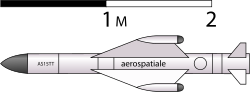
The missile consists of a long cylindrical main body ending in a pointed nose, with four fins arranged in a cruciform cross-section. Each fin has a pod on the tip containing either a radar receiver or a battery. From front to back the missile consists of the warhead and impact fuse and safety and arming mechanism. Next is the autopilot (EOP), altimeter, gyro, and radar receiver and a battery. Following that is the SNPE Acis CDB solid rocket sustainer motor, which exhausts through a small central nozzle. Behind the sustainer are the two solid rocket SNPE Anubis CMDB booster motors, which exhaust through two large nozzles. On the rear underside of the missile is a radar altimeter. On the rear of the missile are four inline control fins.

The guidance system of the missile is actually command guidance, as the missile doesn't have its own radar. It only follows orders provided by the onboard radar of the carrier/launcher helicopter, the Thomson-CSF I/J-band "Agrion 15". When this radar detects and identifies a suitable target, it switches to automatic tracking mode. Once the target is inside the missiles range it launches, the booster motors accelerate the missile to its cruise speed of 280 meters per second, after which the sustainer motor cuts in. The missile immediately begins descending to an altitude of around 3 to 5 meters.[2] The rocket motors have a combined burn time of around 45 seconds.

Bearing corrections are transmitted to the missile via the Agrion 15 radar and are picked up by the rearward-facing receiver units in two of the wing pods. The directional nature of the receivers makes jamming the command link difficult. On final approach to the target (about 1000 ft remaining to target), the missile descends to an altitude of around two meters. Its powerful warhead is able to perforate a 40 millimetres (1.6 in) thick steel armoured hull.[3]

The Agrion 15 radar is capable of detecting a large ship at a range of 150 kilometres (93 mi) and a smaller attack boat at a range of 100 kilometres (62 mi).

Service

[edit]

The missile entered service with Saudi Arabia in 1985, and 365 of the missiles were ordered.

The AS-15TT missile was relatively similar to the British Sea Skua missile; both were meant to replace the AS-12, both were very small anti-ship missiles, and up to four examples were used with small helicopters (Lynx and Dauphin). The AS-15TT, with a characteristic red colour (Sea Skua was often white), was, in comparison to the British rival, smaller, slimmer, lighter and with a different type of guidance. However, unlike Sea Skua, its only guidance was by the Agrion 15 radar, without the flexibility of the other system, and was, therefore, less successful in the market. Both the missiles were also offered unsuccessfully as surface-surface models (the Kuwaiti Navy being the only operator of either missile in the surface-to-surface role, using Sea Skuas aboard its fast attack craft).

Sea Skua also had the advantage of being 'combat proven' (Falklands) and in service with the Royal Navy, while the French Navy did not have it in service, so it was produced apparently only for Saudi Arabia.[4]

At war

[edit]

During the Gulf War, the Royal Saudi Navy reported firing 15 missiles against 5 Iraqi patrol boats.[1]

Operators

[edit]
Map with AS 15 TT operators in blue

Current operators

[edit]
Bahrain
20 missiles, for Dauphin helicopters aboard fast attack crafts.
Chile
For Dauphin helicopters.
France
The missile never entered service in its country of origin. Only about 32 missiles were bought for the French Navy, for trials.
Iraq
60 missiles ordered in 1989, probably never delivered.
Israel
For Dauphin helicopters.
Saudi Arabia
First order for 221 missiles in 1988, with a total delivery of 254. Used on AS565 Panther helicopters, aboard Al-Madinah-class frigates and shore bases.
United Arab Emirates
New order in 1994, to equip seven AS565 Panther helicopters.

Notes

[edit]

References

[edit]
Revisions and contributorsEdit on WikipediaRead on Wikipedia
from Grokipedia
The AS.15TT is a lightweight, all-weather developed by the French company in the 1980s as a successor to the earlier AS.12 . Designed primarily for deployment from naval helicopters, it features and a solid-fuel motor, enabling it to engage surface targets at ranges up to approximately 15 kilometers. With a length of 2.16 meters, a of 0.185 meters, a wingspan of 0.564 meters, and a launch weight of 96 kilograms, the AS.15TT was optimized for roles, particularly against small vessels and patrol boats. Developed in , the missile saw limited adoption by the for trials in the mid-1980s and was integrated onto platforms such as the Eurocopter AS.565 Panther helicopter for evaluation, while entering operational service primarily with export customers, such as in 1985. The "TT" designation stands for "Tous Temps," indicating its improved all-weather performance over the original AS.15, achieved through enhanced radar compatibility and command-link s that allow operation in adverse conditions. It carries a high-explosive weighing around 30 kilograms, sufficient for disabling lightly armored maritime targets. Production of the AS.15TT ceased by the late 1980s as it was gradually phased out in favor of more advanced s like the Sea Venom/ANL missile, which entered service with the in 2022; any remaining French stockpiles are from trial units as of 2025.

Design and development

Background and requirements

The development of the AS.15TT began in the mid-1970s as a replacement for the earlier , which was constrained by a maximum range of about 8 km and optical line-of-sight guidance that limited its reliability in poor visibility or adverse weather conditions. This successor aimed to extend operational reach while improving guidance robustness to meet evolving naval threats in contested maritime environments. The French Navy's requirements centered on a lightweight, helicopter-launched optimized for engaging small surface vessels, such as patrol boats, from platforms like the Naval Dauphin and . A key emphasis was on radio , which allowed for all-weather (Tous Temps, or TT) operation by eliminating the vulnerabilities of wire guidance and enabling control beyond direct visual range. In parallel with British efforts on the —a similarly compact intended to supplant the AS-12—the AS.15TT program prioritized advanced sea-skimming trajectories to evade radar detection and enhance survivability during low-altitude flight. This focus also ensured compatibility with existing , facilitating rapid integration without major modifications to airframes like the Dauphin. Core program goals established a target range of approximately 15 km—doubling the AS-12's capability—a total weight below 100 kg (achieved at 96 kg), and interoperability with frequency-agile surveillance radars such as the Agrion 15 for and control.

Development and production

The AS.15TT program was initiated by in the mid-1970s to address the need for an advanced as a successor to the AS.12, with development concentrating on the all-weather TT variant by 1979. Key phases involved the integration of radio for precise control during sea-skimming trajectories and the adaptation of 's technology for . Specifically, work began in 1975 on modifying the Iguane into the helicopter-compatible Agrion 15, which became integral to the missile's suite. The first live firing was conducted in 1981. Initial flight tests of the Agrion 15 radar and associated systems occurred in February 1982 aboard an SA.365N Dauphin 2 helicopter, marking the start of integrated trials. Unguided separation firings from ground launchers commenced in 1983, followed by successful demonstrations of the achieving hits at up to 15 km range. Live-fire trials from Dauphin helicopters took place between 1983 and 1984, validating the missile's performance in maritime environments and paving the way for certification of all-weather operational capability by 1985. Serial production of the AS.15TT began in 1984, primarily driven by export demands such as the Saudi "Sawari" contract, with responsible for avionics including the , of which 99 units were ultimately produced. The program experienced adaptations for international markets, such as the 1980 Saudi "Sawari" contract for arming 20 SA.365F Dauphin helicopters, with initial deliveries starting in July 1983. In July 1988, placed an order for six Dauphin 2 helicopters equipped with AS.15TT and Agrion 15 radars, though the delivery of these systems remains uncertain. Overall production focused on export variants, supporting integrations on platforms like the Dauphin and Panther helicopters for operators including and the .

Design

Airframe and propulsion

The AS.15TT missile has a compact cylindrical measuring 2.16 meters in , with a body diameter of 0.185 meters, a of 0.564 meters, and a launch weight of 96 kilograms. The design incorporates cruciform wings positioned mid-body for aerodynamic lift and stability, along with cruciform tail control surfaces that enable high maneuverability during the terminal phase. This configuration supports a non-rolling flight profile, which contributes to precise control and stability while sea-skimming at low altitudes. Bullet-shaped fairings on the wingtips accommodate antennas essential for guidance signal reception. Propulsion is provided by a two-stage solid-fuel rocket motor system, featuring two SNPE boosters for initial launch acceleration and an SNPE sustainer motor for the cruise phase. The combined burn time of these motors is approximately 45 seconds, propelling the at high subsonic speeds along a sea-skimming trajectory at altitudes of 5 to 10 meters. This low-altitude profile reduces detectability and enhances terminal accuracy against maritime targets.

Guidance and control systems

The AS.15TT utilizes radio command line-of-sight (CLOS) guidance, in which steering commands are transmitted from the launch to the via a radio uplink linked to the Agrion 15 system. This , developed by , detects and tracks the post-launch using an auxiliary antenna, while simultaneously monitoring the target to compute deviations in range and bearing, enabling precise command transmission through a pulse-coded link. The system supports automatic target tracking over distances up to 15 km, allowing engagement of surface vessels in various states. The missile's suite incorporates an onboard to maintain a sea-skimming flight profile, typically at 5-6 meters altitude during cruise and descending to 1-3 meters in the terminal phase within 300 meters of the target. Complementing this is the Agrion 15 's frequency-agile design and capabilities, which facilitate reliable even in poor visibility or adverse weather, such as storms, by detecting small surface targets like boats or . For command reception, the missile is equipped with antennas integrated into its structure to ensure stable communication with the radar platform. An system processes these commands to execute the low-altitude trajectory, enhancing survivability against radar detection. Flight control is achieved through four rear-mounted inline tail fins, which provide adjustments in pitch, yaw, and roll to follow the guidance instructions. These movable surfaces enable the non-spinning, roll-stabilized missile to maintain stability during its sea-skimming path. The overall design supports all-weather operations, with the Agrion 15's (TWS) technology and monopulse accuracy contributing to robustness in cluttered maritime environments. To counter electronic countermeasures, the guidance link employs frequency-modulated radio commands with rapid frequency hopping and , providing high resistance to jamming and interference from sea clutter. Additionally, the CLOS allows for operator override in manual mode, permitting real-time adjustments from the helicopter crew if automatic tracking is disrupted.

Warhead and performance

The AS.15TT features a 30 kg high-explosive semi-armor-piercing with an impact fuse incorporating a time delay, enabling it to penetrate up to 40 mm of hull plating before detonation. This design targets structural vulnerabilities in small warships and , inflicting damage through blast, fragmentation, and internal disruption upon breaching the hull. In terms of performance, the achieves a maximum range of 15 km, cruising at high subsonic speeds of approximately Mach 0.8 (around 1,000 km/h or 280 m/s) after booster ignition. It employs a sea-skimming flight profile, maintaining an altitude of 5-6 m during the mid-course phase to evade detection, before descending to 1-3 m in the terminal approach for precision impact. The AS.15TT is compatible with helicopter launch platforms, including the AS.365 Dauphin and AS.565 Panther, which typically carry up to four missiles in anti-ship configurations. Its radio command guidance system imposes operational limitations, such as dependency on line-of-sight from the launch platform and potential vulnerability to electronic jamming, particularly at extended ranges beyond 10 km, with no autonomous beyond-visual-range capability.

Operational history

Entry into service

The AS.15TT missile achieved initial operational status in 1985, following certification trials that commenced with unguided separation firings in 1983 and progressed to successful radio-command guidance demonstrations at ranges exceeding 15 km by 1984. In the , adoption was limited to trial purposes, with alongside the Agrion 15 on platforms such as the SA.365F Dauphin helicopter variant. This process emphasized compatibility with existing helicopter systems, enabling all-weather anti-ship capabilities that extended beyond the wire-guided AS.12 missile it was designed to succeed. Early operational integration focused on the AS.565 Panther, achieving full capability by the early 1990s through armament configurations that included up to four AS.15TT missiles per aircraft. Allied forces saw broader early adoption, with placing the initial major order in 1980 for 20 SA.365F Dauphins equipped with the and Agrion 15 , deliveries beginning in 1983 and totaling 221 missiles by 1988. integrated the AS.15TT on Dauphin helicopters for anti-ship roles. followed with a of AS.15TT missiles for six Dauphin 2 helicopters in 1989, though delivery status remains uncertain. Production totaled 429 units overall, including prototypes, with French involvement confined to trial stocks while export variants incorporated modifications for diverse integrations.

Deployments and combat use

The AS.15TT achieved its first and only documented combat use during the 1991 by the Royal Saudi Navy, which had integrated the weapon onto Dauphin 2 helicopters equipped with the Agrion 15 targeting radar. On January 30, 1991, during operations in the Bubiyan Channel, two Saudi helicopters fired eight AS.15TT s at Iraqi small craft attempting to flee , scoring two direct hits that sank two vessels. Three days later, on February 3, 1991, further engagements in the same area saw Saudi forces launch additional AS.15TT missiles, resulting in the sinking of three Iraqi patrol boats and effectively neutralizing threats to naval operations. These actions highlighted the missile's role in countering fast, small-surface threats in littoral environments, though its overall combat record remained limited to this conflict. In French Navy service, the AS.15TT was used primarily for testing and evaluation rather than widespread operational deployment, with no recorded combat engagements. The system participated in routine training and NATO exercises during the 1980s and 1990s to assess its performance against simulated targets, but details of specific drills like Exercise Mantis remain classified or sparsely documented. Production ceased in the 1990s, and by the early 2000s, the AS.15TT had been largely phased out, though limited stockpiles remained in service as of 2010; it is intended to be succeeded by advanced systems such as the Sea Venom missile for compatible platforms.

Operators

French Navy

The AS.15TT anti-ship missile was developed for the 's helicopter fleet in the 1980s as an all-weather successor to the AS.12, with only a modest number—approximately 32 missiles—procured primarily for evaluation and trials, rather than full operational integration. It was tested aboard platforms such as the AS.565 Panther, enhancing potential capabilities for carrier groups and amphibious operations. Limited operational evaluation supported rapid deployment from helicopter decks, aligning with the Navy's emphasis on versatile assets for protection. These trials occurred during the mid-1980s, enabling assessment on Panther helicopters. The modest inventory focused on supporting anti-ship roles in expeditionary scenarios, though production emphasized export variants. By the late 1980s, trial units were available for patrols, including those during the era, where French naval forces contributed to multinational operations in the region. As of 2025, the AS.15TT remains in limited active employment in the , primarily for training exercises or reserve configurations on legacy platforms such as patrol vessels, and is being phased out in favor of the advanced ANL (Anti-Navire Léger), known internationally as Sea Venom, which is undergoing trials and scheduled to enter full service in 2026 with improved range and guidance for modern threats. In French naval doctrine, the AS.15TT contributed to littoral defense strategies through trial demonstrations of quick-reaction, helicopter-launched engagements against coastal and near-shore targets, bolstering force projection in contested maritime environments. This role underscored its utility in amphibious and carrier-based operations, prioritizing precision strikes to neutralize enemy surface units from mobile platforms.

Export operators

The AS.15TT saw limited but notable export success, primarily to Middle Eastern nations seeking to enhance helicopter-based maritime strike capabilities compatible with French-designed platforms like the Dauphin and Panther. became the first export customer, contracting for 221 missiles delivered by 1988 to arm 20 of its 24 AS.365F Dauphin 2 helicopters operated by the Royal Saudi Naval Forces. These acquisitions supported regional , with the missiles integrated for all-weather operations from the helicopters. Iraq placed a 1988 order estimated at 206 missiles—likely including operational units and spares—to equip six AS.365N Dauphin helicopters acquired concurrently, with the total package valued at $131 million; however, deliveries appear to have been incomplete by August 1990 amid escalating regional tensions, and the post-1991 operational status of the missiles remains unclear due to subsequent conflicts and sanctions. acquired 20 missiles during the 1980s for integration with SA.365 Dauphin helicopters embarked on its Lürssen-class , enabling enhanced patrol and interdiction duties in the . The (Abu Dhabi) ordered an unspecified number of missiles in early 1995 for arming seven new AS.565 Panther helicopters and retrofitting five AS.550 , adapting the system for coastal defense roles in the Arabian Gulf. Overall, export production reached approximately 400 units across these customers by the early 2000s, reflecting adaptations for non-French while maintaining compatibility with similar to those in French service.
Add your contribution
Related Hubs
User Avatar
No comments yet.