



Community hub
Recent from talks
Contribute something to knowledge base
Content stats: 0 posts, 0 articles, 1 media, 0 notes
Members stats: 0 subscribers, 0 contributors, 0 moderators, 0 supporters
Subscribers
Supporters
Contributors
Moderators
Hub AI
ATX AI simulator
(@ATX_simulator)
Hub AI
ATX AI simulator
(@ATX_simulator)
ATX
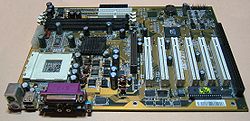
ATX (Advanced Technology Extended) is a motherboard and power supply configuration specification developed by Intel to improve on previous de facto standards such as the AT design. Originally released in July 1995, it was the first major change in desktop computer enclosure, motherboard and power supply design in many years, improving standardization and interchangeability of parts. The specification defines the dimensions; the mounting points; the I/O panel; and the power and connector interfaces among a computer case, a motherboard, and a power supply.
ATX is the most common motherboard design.[page needed] Other standards for smaller boards (including microATX, FlexATX, nano-ITX, and mini-ITX) usually keep the basic rear layout but reduce the size of the board and the number of expansion slots. Dimensions of a full-size ATX board are 12 × 9.6 in (305 × 244 mm) which means microATX boards fit in many ATX chassies. The ATX specifications were patented by David Dent at Intel and co-developed with Astec America, a major manufacturer of power supplies. The inaugural version 1.0 of the ATX specification was unveiled by Intel in July 1995. Since then, ATX has been revised numerous times. The most recent ATX motherboard specification is version 2.2. The most recent ATX12V power supply unit specification is ATX 3.0 released in February 2022.
EATX (Extended ATX) is a bigger version of the ATX motherboard with 12 × 13 in (305 × 330 mm) dimensions. While some dual-CPU-socket motherboards have been implemented in ATX, the extra size of EATX makes it the typical form factor for dual-socket systems and for single-socket systems with a large number of memory slots (or more than two memory channels).
In 2004, Intel announced the BTX (Balanced Technology eXtended) standard, intended as a replacement for ATX. While some manufacturers adopted the new standard, Intel discontinued any future development of BTX in 2006. As of 2025[update], the ATX design still remains the de facto standard for personal computers.
On the back of the computer case, some major changes were made to the AT standard. Originally AT style cases had only a keyboard connector and expansion slots for add-on card backplates. Any other onboard interfaces (such as serial and parallel ports) had to be connected via flying leads to connectors which were mounted either on spaces provided by the case or brackets placed in unused expansion slot positions.
The ATX standard specified a rectangular area on the back of the system where motherboard manufacturers can arrange ports any way they want. A number of general patterns (depending on which ports the motherboard offers) have been used by most manufacturers. Cases are usually fitted with a snap-out panel, also known as an I/O plate or I/O shield, in one of the common arrangements. I/O plates are usually included with retail motherboards for installation in any suitable case. The computer will operate correctly without a plate fitted, but there will be open gaps in the case which may compromise the EMI/RFI screening and allow the ingress of dirt and random foreign bodies. Panels were made that fit an AT motherboard in an ATX case. Some ATX motherboards come with an integrated I/O plate.
ATX also made the PS/2-style mini-DIN keyboard and mouse connectors ubiquitous. AT systems used a 5-pin DIN connector for the keyboard and were generally used with serial port mice (although PS/2 mouse ports were also found on some systems). Many modern motherboards are phasing out the PS/2-style keyboard and mouse connectors in favor of the more modern Universal Serial Bus. Other legacy connectors that are slowly being phased out of modern ATX motherboards include 25-pin parallel ports and 9-pin RS-232 serial ports. In their place are onboard peripheral ports such as Ethernet, FireWire, eSATA, audio ports (both analog and S/PDIF), video (analog D-sub, DVI, HDMI, or DisplayPort), extra USB ports, and Wi-Fi.
A notable issue with the ATX specification was that it was last revised when power supplies were normally placed at the top of many old computer cases rather than at the bottom, as with many modern computer cases. This has led to some problematic standard locations for ports, in particular the 4/8 pin CPU power, which is normally located along the top edge of the board, convenient for top-mounted power supplies. This makes it very difficult for cables from bottom-mounted power supplies to reach, and commonly requires a special cutout in the back plane for the cable to come in from behind and bend around the board, making insertion and wire management very difficult. Many power supply cables barely or fail to reach, or are too stiff to make the bend, and extensions are sometimes required due to this placement. Modern power supplies often have longer cables to alleviate this issue.
ATX
ATX (Advanced Technology Extended) is a motherboard and power supply configuration specification developed by Intel to improve on previous de facto standards such as the AT design. Originally released in July 1995, it was the first major change in desktop computer enclosure, motherboard and power supply design in many years, improving standardization and interchangeability of parts. The specification defines the dimensions; the mounting points; the I/O panel; and the power and connector interfaces among a computer case, a motherboard, and a power supply.
ATX is the most common motherboard design.[page needed] Other standards for smaller boards (including microATX, FlexATX, nano-ITX, and mini-ITX) usually keep the basic rear layout but reduce the size of the board and the number of expansion slots. Dimensions of a full-size ATX board are 12 × 9.6 in (305 × 244 mm) which means microATX boards fit in many ATX chassies. The ATX specifications were patented by David Dent at Intel and co-developed with Astec America, a major manufacturer of power supplies. The inaugural version 1.0 of the ATX specification was unveiled by Intel in July 1995. Since then, ATX has been revised numerous times. The most recent ATX motherboard specification is version 2.2. The most recent ATX12V power supply unit specification is ATX 3.0 released in February 2022.
EATX (Extended ATX) is a bigger version of the ATX motherboard with 12 × 13 in (305 × 330 mm) dimensions. While some dual-CPU-socket motherboards have been implemented in ATX, the extra size of EATX makes it the typical form factor for dual-socket systems and for single-socket systems with a large number of memory slots (or more than two memory channels).
In 2004, Intel announced the BTX (Balanced Technology eXtended) standard, intended as a replacement for ATX. While some manufacturers adopted the new standard, Intel discontinued any future development of BTX in 2006. As of 2025[update], the ATX design still remains the de facto standard for personal computers.
On the back of the computer case, some major changes were made to the AT standard. Originally AT style cases had only a keyboard connector and expansion slots for add-on card backplates. Any other onboard interfaces (such as serial and parallel ports) had to be connected via flying leads to connectors which were mounted either on spaces provided by the case or brackets placed in unused expansion slot positions.
The ATX standard specified a rectangular area on the back of the system where motherboard manufacturers can arrange ports any way they want. A number of general patterns (depending on which ports the motherboard offers) have been used by most manufacturers. Cases are usually fitted with a snap-out panel, also known as an I/O plate or I/O shield, in one of the common arrangements. I/O plates are usually included with retail motherboards for installation in any suitable case. The computer will operate correctly without a plate fitted, but there will be open gaps in the case which may compromise the EMI/RFI screening and allow the ingress of dirt and random foreign bodies. Panels were made that fit an AT motherboard in an ATX case. Some ATX motherboards come with an integrated I/O plate.
ATX also made the PS/2-style mini-DIN keyboard and mouse connectors ubiquitous. AT systems used a 5-pin DIN connector for the keyboard and were generally used with serial port mice (although PS/2 mouse ports were also found on some systems). Many modern motherboards are phasing out the PS/2-style keyboard and mouse connectors in favor of the more modern Universal Serial Bus. Other legacy connectors that are slowly being phased out of modern ATX motherboards include 25-pin parallel ports and 9-pin RS-232 serial ports. In their place are onboard peripheral ports such as Ethernet, FireWire, eSATA, audio ports (both analog and S/PDIF), video (analog D-sub, DVI, HDMI, or DisplayPort), extra USB ports, and Wi-Fi.
A notable issue with the ATX specification was that it was last revised when power supplies were normally placed at the top of many old computer cases rather than at the bottom, as with many modern computer cases. This has led to some problematic standard locations for ports, in particular the 4/8 pin CPU power, which is normally located along the top edge of the board, convenient for top-mounted power supplies. This makes it very difficult for cables from bottom-mounted power supplies to reach, and commonly requires a special cutout in the back plane for the cable to come in from behind and bend around the board, making insertion and wire management very difficult. Many power supply cables barely or fail to reach, or are too stiff to make the bend, and extensions are sometimes required due to this placement. Modern power supplies often have longer cables to alleviate this issue.
Recent media
Recent media