Hubbry Logo
A Time for ChoosingA Time for ChoosingMain
Open search
A Time for Choosing
Community hub
A Time for Choosing
logo
8 pages, 0 posts
0 subscribers
Be the first to start a discussion here.
A Time for Choosing
A Time for Choosing
from Wikipedia
"A Time for Choosing" speech
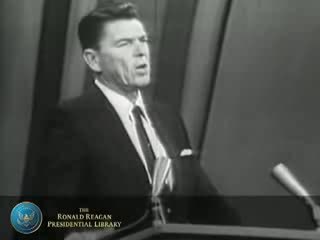
In support of Goldwater, Reagan delivers the address, "A Time for Choosing"—the speech launched Reagan to national prominence in politics
DateOctober 27, 1964 (1964-10-27)
Duration29:33
LocationLos Angeles County, California, U.S.
Also known as"The Speech"
TypeTelevised campaign speech
ParticipantsRonald Reagan
The full text of the speech at Wikisource

"A Time for Choosing", also known as "The Speech", was a speech presented during the 1964 U.S. presidential election campaign by future president Ronald Reagan on behalf of Republican candidate Barry Goldwater. "A Time for Choosing" launched Reagan into national prominence in politics. He uses antithesis and rhetorical questions to convey a serious tone to the audience.

Background

[edit]

Many versions of this speech exist since it was altered over many weeks. Contrary to popular belief, however, the speech was not given at the 1964 Republican National Convention in San Francisco, California as a nomination speech for presidential candidate Barry Goldwater; Everett Dirksen gave that nomination speech, while Richard Nixon introduced Goldwater prior to his acceptance speech. Reagan, though he campaigned for Goldwater, did not use "A Time for Choosing" until October 27, 1964, when it was part of a pre-recorded television program, Rendezvous with Destiny (the title of the program was used by Franklin D. Roosevelt in his June 27, 1936 speech to the 1936 Democratic National Convention).[1] In his autobiography, An American Life, Reagan recalled going to bed that night "hoping I hadn't let Barry down."[2]

Speaking for Goldwater, Reagan stressed his belief in the importance of smaller government. In the speech, Reagan revealed his ideological motivation: "The Founding Fathers knew a government can't control the economy without controlling people. And they knew when a government sets out to do that, it must use force and coercion to achieve its purpose. So we have come to a time for choosing."[3] He also said, "You and I are told we must choose between a left or right, but I suggest there is no such thing as a left or right. There is only an up or down. Up to man's age-old dream – the maximum of individual freedom consistent with law and order – or down to the ant heap of totalitarianism."[3][4] The speech raised $1 million for Goldwater's campaign,[5] and is considered the event that launched Reagan's political career.[6][7]

Aftermath and legacy

[edit]

"A Time for Choosing" has been considered one of the most effective speeches ever made by an eventual presidential candidate. Following "A Time for Choosing" in 1964, Washington Post reporter David S. Broder called the speech "the most successful national political debut since William Jennings Bryan electrified the 1896 Democratic Convention with his 'Cross of Gold' speech."[8] Nevertheless, Barry Goldwater lost the election by one of the largest margins in history. Soon afterward, Reagan was asked to run for Governor of California, which he did and won the election in 1966. When Reagan won the White House in 1980, George Will of The Washington Post referred back to "A Time for Choosing" and said, "Goldwater won the election of 1964... it just took sixteen years to count the votes."[8]

In 2014, Steven F. Hayward, Professor of Public Policy at Pepperdine University and Reagan biographer, looked back at the speech and said, "at the time, critics thought the speech was too emotional; while others thought it was too controversial. But after the speech, it was clear that Ronald Reagan and his ideas were simply irresistible."[9]

"A Time for Choosing" ushered in a conservative movement in American politics at a time when the country was looking for strong leadership following John F. Kennedy's assassination, and while experiencing both a growing welfare state and a raging Cold War.[8] Reagan's speech in 1964 not only made him the leader of this movement but also earned him the nickname "The Great Communicator" in recognition of his effective oratory skills.[citation needed] Among Reagan's admirers, "A Time for Choosing" is known simply as "The Speech".[10]

References

[edit]

Further reading

[edit]
Revisions and contributorsEdit on WikipediaRead on Wikipedia
from Grokipedia
"A Time for Choosing", also known simply as "The Speech", is a televised campaign address delivered by on October 27, 1964, endorsing the Republican presidential nominee against incumbent Democrat . In the 29-minute presentation, Reagan warned of the perils of unchecked government expansion, including high taxation, mounting national debt, and welfare programs that foster dependency rather than self-reliance, framing these as steps toward and erosion of individual freedoms. He advocated for intervention, robust free-market incentives, and resolute opposition to communist aggression, declaring that the nation faced a fundamental choice between preserving constitutional liberties or surrendering to centralized control. The speech raised about one million dollars for Goldwater's faltering campaign through viewer pledges, a significant sum at the time. Despite Goldwater's landslide defeat, the address elevated Reagan's visibility as an eloquent conservative voice, catalyzing his transition from Hollywood actor and spokesman to full-time politician, culminating in his 1966 election as and 1980 presidency. It became a foundational text for the modern American conservative movement, influencing subsequent Republican platforms emphasizing fiscal restraint, , and moral clarity in .

Historical Context

The 1964 U.S. Presidential Election

The 1964 United States presidential election occurred on November 3, 1964, pitting incumbent Democratic President Lyndon B. Johnson against Republican Senator Barry Goldwater of Arizona. Johnson secured a landslide victory, receiving 61.1% of the popular vote (43,129,566 votes) and 486 electoral votes, while Goldwater garnered 38.5% (27,175,754 votes) and 52 electoral votes from six states. This outcome marked one of the most lopsided margins in American electoral history, reflecting Johnson's broad appeal following John F. Kennedy's assassination and Goldwater's polarizing stances on limited government and aggressive anti-communism. Johnson's campaign emphasized expansion of federal domestic programs under his proposed initiative, which aimed to combat poverty, promote civil rights, and increase welfare spending through measures like Medicare and expanded education aid. In contrast, Goldwater advocated for reducing government intervention in the economy, , and a hawkish prioritizing victory over , as outlined in the Republican platform that aligned closely with his conservative principles. These positions highlighted a fundamental ideological divide: Johnson's vision of augmented federal authority to address social ills versus Goldwater's emphasis on individual liberty and fiscal restraint. Within the Republican Party, Goldwater's nomination exposed deep fissures between its conservative grassroots base and establishment moderates. Goldwater clinched the nomination at the in on July 15, 1964, after prevailing in key primaries through mobilized conservative support, despite opposition from figures like New York who viewed his ideology as too extreme for national appeal. The platform's rightward shift, endorsing Goldwater's views on and , further alienated party moderates and contributed to defections, setting the stage for the campaign's challenges.

Barry Goldwater's Campaign and Platform

Barry Goldwater's ideological foundation for his 1964 presidential bid drew heavily from his 1960 book , which articulated a commitment to confined by the U.S. Constitution, individual liberty, free-market economics, , and fiscal discipline through balanced budgets and rejection of welfare-state collectivism. The work criticized federal encroachments into areas like , labor unions, and agriculture subsidies as violations of and incentives for dependency, advocating instead for decentralized solutions rooted in personal responsibility and local control. The campaign's slogan, "In Your Heart, You Know He's Right," encapsulated Goldwater's direct appeal to voters favoring anti-statist conservatism over the perceived excesses of Lyndon B. Johnson's programs. Domestically, Goldwater opposed expansive federal interventions, exemplified by his Senate vote against the , which he contended exceeded Congress's authority by mandating private business compliance and eroding property rights and states' sovereignty, while affirming his support for equal legal protections without such centralized coercion. He had previously voted for the Civil Rights Acts of 1957 and 1960, which emphasized voting rights enforcement through judicial means rather than broad federal mandates. On , Goldwater prioritized confronting Soviet aggressively to secure U.S. victory rather than mere or , criticizing administrations for weakness that emboldened in regions like and . He advocated bolstering military readiness, including nuclear deterrence, while proposing cuts to non-strategic foreign aid that he viewed as subsidizing unaligned nations at American taxpayers' expense without advancing anti-communist goals. Goldwater clinched the Republican nomination on July 15, 1964, at the party's convention in , overcoming moderate opposition through grassroots mobilization and primary victories in states like and . In his acceptance address the following day, he rejected charges of leveled by Democrats, asserting that "extremism in the defense of is no vice... and moderation in the pursuit of justice is no virtue," thereby positioning his platform as a rigorous application of constitutional principles against both domestic overreach and international threats.

Ronald Reagan's Pre-Speech Political Journey

, born in 1911 in , initially aligned with the Democratic Party, supporting Franklin D. Roosevelt's policies during the and campaigning for Democratic candidates into the early . As an actor in Hollywood, Reagan's political engagement deepened through his leadership in the (SAG), where he served as president from 1947 to 1952 and again briefly in 1959–1960. In this capacity, he testified before the in 1947, warning of communist infiltration attempts within the guild and the entertainment industry, which he viewed as efforts to subvert unions for ideological purposes rather than workers' interests. Reagan advocated for loyalty oaths among members and supported the industry's blacklist of individuals suspected of communist affiliations, actions driven by his firsthand observations of organized efforts to influence SAG elections and strikes. Reagan's gradual shift toward accelerated during his tenure as a spokesperson for from 1954 to 1962, where he hosted the weekly television program and delivered over 300 speeches to employees at GE facilities across the . These addresses emphasized free-market principles, individual liberty, and the dangers of excessive intervention, drawing from Reagan's encounters with bureaucratic inefficiencies and welfare programs that he believed fostered dependency rather than . By the late , influenced by these experiences and interactions with leaders, Reagan began critiquing the Democratic Party's drift toward larger federal programs and accommodation of leftist elements, marking his intellectual departure from his earlier liberal anticommunism. His increasingly vocal opposition to big led GE to end the relationship in 1962, as company executives deemed his rhetoric too politically charged. Following his GE departure, Reagan relocated to a ranch near , in the early , purchasing property in 1951 but intensifying his focus on ranching and private life amid a waning film career. He expressed reluctance to pursue elective office, preferring to influence politics through commentary and endorsements, as evidenced by his private reservations about direct involvement despite growing conservative convictions. This stance changed with Barry Goldwater's 1964 Republican presidential nomination, which resonated with Reagan's anti-statist views; he formally endorsed Goldwater, registered as a Republican in 1962, and took a leading role in California support efforts, including as co-chair of Citizens for Goldwater-Miller to mobilize voters against perceived liberal overreach.

Content and Delivery of the Speech

Circumstances of Delivery

The speech was broadcast on October 27, 1964, one week before the , as a pre-recorded 29-and-a-half-minute television aired nationally on from . Unlike a live rally or convention , it was structured as a standalone sponsored program, allowing Reagan to speak directly to viewers without an audience or formal event setting. The broadcast originated as a strategic initiative by Barry Goldwater's California campaign supporters, who sought to bolster fundraising and sway undecided voters as national polls showed Goldwater trailing President by wide margins. Campaign affiliates, including automobile dealer Holmes Tuttle, secured private donations to purchase the half-hour prime-time slot, addressing the national campaign's funding shortages for such airtime. This effort capitalized on Reagan's background as a Hollywood actor and communicator to present conservative positions in an accessible, non-confrontational manner, distinct from Goldwater's more polarizing campaign rhetoric. Reagan, then a General Electric spokesman and host of the program General Electric Theater, had tested versions of the address at Republican fundraisers across states like New York, , and earlier that year, refining it before agreeing to the national taping. Campaign officials approached him to record the speech after positive responses at these events, viewing his rapport with audiences as key to humanizing platform amid the election's final push.

Core Arguments and Themes

Reagan's speech frames the central issue as a binary choice between advancing toward greater individual freedom or descending into through unchecked government expansion. He declares, "There's only an up or down—[up] toward man's age-old dream, the ultimate in individual freedom consistent with law and order, or down to the ant heap of ." This dichotomy underscores his critique of as inevitably coercive, contrasting voluntary cooperation under with enforced equality via centralized authority. A primary argument targets the welfare state's growth as a pathway to , citing $45 billion in annual federal welfare expenditures that fail to eradicate , delivering merely $600 in direct aid per needy family while administrative costs absorb the balance. Reagan contends this system undermines , transforming capable individuals into dependents, as exemplified by cases where welfare recipients lose motivation for work once aid exceeds potential earnings. He specifically critiques Social Security, projecting a $298 billion unfunded liability and characterizing contributions as taxes rather than premiums, with funds diverted to other uses rather than invested for beneficiaries, advocating voluntary options and fiscal to avert insolvency and restore personal agency. On foreign policy, Reagan rejects moral equivalence with , insisting on clear opposition to Soviet and dismissing or unilateral as paths to subjugation. He argues for "," warning that accommodating communist expansion risks ending the only through acceptance of "a not undemocratic ," equating concessions with choosing over survival. Domestically, he favors individual initiative over centralized , decrying $146 billion in foreign that fosters bureaucratic elites abroad—such as funding a $2 million yacht for Ethiopia's —mirroring inefficiencies at home and advocating tax reductions to unleash private enterprise rather than perpetuate coercive redistribution.

Rhetorical Techniques and Structure

Reagan organized the speech into an introduction that challenged the prevailing view of political complexity, a body that methodically escalated from threats to individual at home to existential dangers abroad, and a conclusion that framed the election as a pivotal moral decision. This progression created a logical escalation of stakes, guiding listeners from familiar personal impacts to broader geopolitical imperatives, thereby emphasizing the interconnectedness of domestic policy and global survival without relying on abstract theory. The rhetorical style favored narrative integration of illustrative stories with chains of logical inference, prioritizing evidence-based deductions over inflammatory to underscore conservative principles of and individual agency. Simple, declarative sentences permeated the address, rendering complex ideas accessible to a mass audience and directly rebutting claims by opponents that such matters exceeded ordinary comprehension. Repetition of key phrases, such as invocations of "" and the imperative to choose, reinforced thematic unity and memorability, while stark contrasts—pitting "we" (the American people) against "they" (bureaucratic elites and adversaries)—cultivated a and heightened urgency. Reagan's delivery, informed by his prior career as a actor, adopted a warm, conversational that simulated direct dialogue, enhancing by evoking trust and relatability rather than distant .

Immediate Aftermath

Fundraising and Electoral Impact

The televised airing of "A Time for Choosing" on October 27, 1964, generated an immediate surge in donations to Barry Goldwater's presidential campaign and the Republican Party, with over $1 million in pledges received in the hours and days immediately following the broadcast. This figure represented a dramatic outperformance relative to the modest initial sponsorship costs of approximately $100,000 covered by Goldwater supporters to produce and air the program nationwide. The response highlighted the speech's resonance with conservative donors, who responded enthusiastically to Reagan's articulation of and anti-communist themes, even as the late timing limited broader campaign adjustments. Despite the fundraising success, the speech did not reverse Goldwater's electoral fortunes in the November 3, , presidential election, where he carried only six states—Arizona and five Deep South states (, Georgia, , , and )—securing 52 electoral votes to Lyndon B. Johnson's overwhelming 486. Goldwater received 27,175,754 popular votes, or 38.5% of the total, reflecting broad national rejection of his platform amid Johnson's . Donations spiked to Republican candidates more generally, signaling pockets of heightened conservative enthusiasm, though overall down-ballot results saw net Republican losses in , with Democrats gaining 38 House seats and two seats. The episode empirically demonstrated the viability of direct appeals rooted in principled for activating financial support from bases, independent of prevailing electoral headwinds, as evidenced by the disproportionate donor response in a campaign otherwise starved for funds. This laid groundwork for assessing conservative organizational strength, revealing sustained donor interest despite Goldwater's defeat.

Contemporary Reception and Criticisms

Conservatives acclaimed the speech for its clear articulation of fusionist conservatism, integrating traditional values, free-market principles, and resolute as a unified response to perceived threats from big government and Soviet aggression. Figures within the Goldwater campaign and broader right-wing circles viewed Reagan as a refreshing communicator who distilled complex ideological commitments into accessible terms, energizing supporters amid the candidate's underdog status. In contrast, Democratic operatives and mainstream media outlets dismissed the address as emblematic of Goldwater's "extremist" platform, portraying its warnings about communist expansion—grounded in events like the 1962 Cuban Missile Crisis and Soviet interventions in Eastern Europe—as hawkish saber-rattling that risked nuclear escalation. Such critiques often equated principled opposition to welfare state growth and détente with retrograde isolationism or warmongering, overlooking causal links between unchecked statism and eroded individual liberties, as evidenced by rising federal spending under Johnson's Great Society initiatives that exceeded $1 billion annually by 1965. This framing aligned with broader campaign tactics, including the "Daisy" advertisement aired in September 1964, which implied Goldwater-backed positions advocated reckless confrontation. Public response reflected divided sentiments, with the speech resonating among ideologically committed voters but failing to shift broader opinion amid Johnson's commanding leads in late polls, such as Gallup's 58% to 36% advantage on October 25. While some independents reportedly found its logic persuasive against paternalistic overreach, the electorate's preference for stability and expanded social programs culminated in Johnson's 61.1% popular vote triumph on November 3, underscoring the speech's niche appeal over mass conversion. Mainstream portrayals, influenced by institutional biases favoring statist policies, tended to amplify fears of conservatism's anti-collectivist stance rather than engage its empirical critiques of fiscal irresponsibility, where federal deficits had ballooned to $5.9 billion by 1964.

Legacy and Influence

Reagan's Rise to Prominence

The "A Time for Choosing" speech, broadcast nationally on October 27, 1964, marked a decisive shift in Ronald Reagan's public profile, transforming him from a Hollywood actor and General Electric spokesman into a recognized conservative leader. Prior to the address, Reagan had limited political involvement beyond local speaking engagements and endorsements, but the speech's articulate defense of limited government and anti-communism drew immediate acclaim from Republican circles, generating over $1 million in donations for Barry Goldwater's campaign within hours of airing. This surge in visibility and financial response underscored voter and donor receptivity to Reagan's unapologetic rhetoric, positioning him as a viable alternative to the Republican establishment's more moderate voices that had distanced themselves from Goldwater. The speech's momentum directly facilitated Reagan's entry into elective office. Influential California Republicans, impressed by his performance, urged him to challenge incumbent Democratic Governor Edmund "Pat" Brown in 1966, bypassing traditional party insiders who favored figures like former Los Angeles Mayor Norris Poulson. Reagan announced his candidacy on January 4, 1966, after securing the Republican nomination in the June primary with 65% of the vote against George Christopher. In the November 8 general election, he defeated Brown by 991,837 votes (52.4% to 45.1%), a wide margin reflecting empirical support for his clear articulation of fiscal restraint and law-and-order themes echoing the 1964 speech. He was inaugurated as California's 33rd governor on January 2, 1967. Reagan's post-speech trajectory validated his approach over establishment moderation, as demonstrated in his presidential campaigns. The 1964 address became a foundational element of his branding, with its themes and excerpts referenced in later efforts to emphasize principled ; for instance, during the 1976 Republican primaries, Reagan mounted a strong challenge to incumbent President , capturing over 90% of delegates in key Southern states and nearly securing the nomination despite Ford's institutional advantages. This momentum carried into , where Reagan clinched the nomination on the first ballot and won the presidency with 50.7% of the popular vote against incumbent , evidencing sustained voter preference for the directness first showcased in "A Time for Choosing" over diluted party messaging.

Shaping the Modern Conservative Movement

Reagan's "A Time for Choosing," delivered on October 27, 1964, crystallized fusionist by integrating traditionalist commitments to moral order and with libertarian emphases on individual liberty and free markets, providing a coherent alternative to the expansive and establishing these as enduring GOP tenets. This framework rejected portrayals of Goldwater-era as marginal , instead demonstrating its broad appeal through Reagan's accessible rhetoric, which raised over $1 million in donations for the Republican campaign overnight and foreshadowed the party's ideological shift away from New Deal . The speech's critique of federal overreach directly informed opposition to welfare expansions, influencing the economic realignment that underpinned Nixon's 1968 , which leveraged growing regional discontent with Democratic policies to secure five states for the GOP ticket. The address's advocacy for supply-side principles, echoing Goldwater's flat-tax advocacy and warnings against fiscal redistribution, laid groundwork for the 1980s Reagan Revolution's tax cuts, which reduced top marginal rates from 70% to 28% and correlated with GDP growth averaging 3.5% annually from 1983 to 1989, validating empirical claims of incentives-driven prosperity over Keynesian demand management. By framing government as a threat to self-reliance rather than a benevolent provider, it countered narratives equating conservatism with austerity, instead highlighting data on program inefficiencies, such as Medicare's projected $1 billion annual cost ballooning to over $12 billion by 1990 due to unchecked entitlements. Reagan's resolute in the speech, decrying accommodation as enabling Soviet expansion, anticipated the USSR's 1991 dissolution, as subsequent policies rooted in ""—including defense spending increases to 6.2% of GDP—exerted economic pressure that validated resolve over without direct military confrontation. This predictive vindication bolstered conservative institutions, with the speech's blueprint echoed in outlets like National Review and think tanks such as (founded 1973), which advanced agendas and pro-defense postures, institutionalizing against regulatory .

Enduring Principles and Modern Resonances

Reagan's warnings in "A Time for Choosing" about the inexorable expansion of government eroding personal liberty remain central to debates over unchecked entitlements and regulatory proliferation. The speech highlighted how programs ostensibly aimed at compassion instead engender dependency, a principle echoed in analyses of 21st-century fiscal trajectories where mandatory spending on Social Security, Medicare, and Medicaid constitutes over 60% of the federal budget and drives deficits. Congressional Budget Office projections indicate federal debt held by the public will reach 156% of GDP by 2055 under current policies, underscoring the speech's prescience on unsustainable government growth crowding out private initiative and future prosperity. In reflections on the speech's 60th anniversary, conservative commentators drew parallels to contemporary battles against progressive overreach, framing resistance to expansive state interventions in culture, education, and economy as extensions of Reagan's call for choosing over collectivism. These include critiques of regulatory efforts targeting sectors, where antitrust actions and content moderation mandates risk supplanting market-driven with bureaucratic control, mirroring the speech's caution against centralized planning that diminishes individual agency. Empirical outcomes from policies aligned with the speech's philosophy, such as the 1981 Economic Recovery Tax Act, correlated with annualized GDP growth exceeding 3% through the decade amid recovery from , contrasting with the static poverty rates post-Great Society despite trillions expended. The initiatives critiqued in the speech empirically validated concerns over causal failures in alleviating through welfare expansion; out-of-wedlock births among black Americans surged from 25% in 1965 to over 70% by the 1990s, alongside persistent welfare rolls that entrenched intergenerational dependency rather than . This legacy informs modern arguments for entitlement reforms to avert fiscal collapse, affirming the speech's first-principles emphasis on as essential to preserving against the encroachments of unchecked state power.

Criticisms and Counterarguments

Critics of Reagan's speech have characterized its warnings about communist expansion as fearmongering, exaggerating the Soviet threat to stoke unnecessary alarmism amid the Cold War. This view posits that depictions of communism as an encroaching force eroding individual liberties overstated risks, ignoring diplomatic avenues for coexistence. However, declassified intelligence and historical records substantiate the speech's realism, revealing extensive Soviet espionage, subversion, and military adventurism in the 1960s, including the 1962 Cuban Missile Crisis where nuclear-armed missiles were deployed 90 miles from U.S. shores, confirming aggressive intent beyond mere rhetoric. The speech's critique of expansive welfare programs has drawn accusations of fostering inequality, with opponents arguing it dismissed social safety nets as pathways to dependency while shielding affluent interests from progressive ation. Empirical data counters this by illustrating welfare traps, where benefit cliffs impose effective marginal rates over 100% on low earners, disincentivizing and perpetuating cycles that hinder mobility, as quantified in state-level analyses of combined aid packages exceeding full-time minimum-wage earnings. Association with Barry Goldwater's campaign invited claims of racial dog-whistling, interpreting the speech's endorsement of limited federal power as coded support for opposition to civil rights enforcement. Goldwater's vote against the 1964 fueled this narrative, yet his record included affirmative votes for the 1957 and 1960 acts, with opposition rooted in constitutional objections to provisions infringing and states' prerogatives, not denial of equal liberty—a the speech advanced universally without racial specificity. Dismissals of the speech's limited-government ethos as archaic or divisive overlook its empirical validation through electoral outcomes, including Reagan's 1980 presidential triumph with 50.7% of the popular vote and 489 electoral votes against incumbent , reflecting broad voter endorsement of restrained over unchecked expansion. This margin, the largest since 1932 for a challenger, underscored the ideas' resonance amid and perceived overreach, undermining assertions of fringe irrelevance.

References

Add your contribution
Related Hubs
User Avatar
No comments yet.