
Recent from talks
Aberlady
Knowledge base stats:
Talk channels stats:
Members stats:
Aberlady
Aberlady (Scots: Aiberlady, Gaelic: Obar Lobhaite) is a coastal village in the Scottish council area of East Lothian. The village had an estimated population of 1,260 in 2020.
The name Aberlady has Brittonic origins. The first part of the name is the common naming element aber, meaning "confluence, estuary". The second part is a river name, an earlier name for the West Peffer Burn, derived from either *lẹ:β, which in river names may mean "glide smoothly", or *loβ, a verbal root associated with "peeling away, decomposition, decay" (Middle Irish lobour, "leprosy").
There is archaeological evidence of a significant and wealthy Anglo-Saxon settlement dating from 7th to the 10th centuries.
In the Middle Ages, Aberlady was an important harbour for fishing, sealing, and whaling and was designated "Port of Haddington" by a 1633 Act of Parliament. However, its origins are much earlier.
Aberlady had strong links with the monasteries at Iona and Lindisfarne from the 7th century, and its role was to facilitate the pilgrim traffic between the two sites. Previous archaeological excavations have shown traces of a Culdee chapel, and Pope Gregory X made reference to the church which he called "Aberlefdi". The 8th century Aberlady Cross fragment can be seen at the National Museum of Scotland in Edinburgh. A reconstruction of this finely carved cross was erected in 2011 by Aberlady Conservation & History Society.
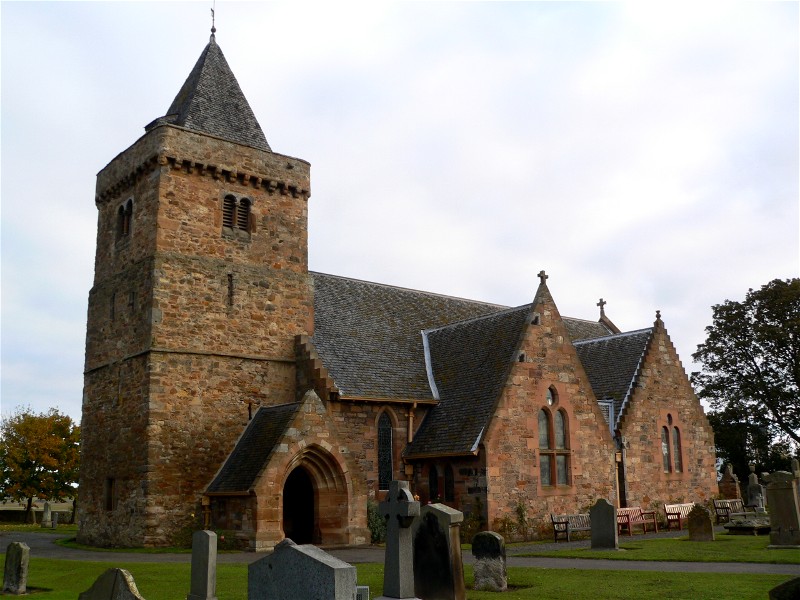
Aberlady Parish Church dates back to the 15th century. It was re-built in 1887. In 1986, the parishes of Aberlady and Gullane were merged, and the Manse is now in Gullane.
The "Aberlady Heritage Project" is a community-led project, and in 2008 it surveyed three sites — the medieval harbour quay commissioned in 1535, the Iron Age fort and associated souterrain at Kilspindie, and the Anglo-Saxon site at the Glebe. Aberlady boasts the largest collection of stray Anglo-Saxon finds yet discovered in Scotland.
In 1952, Aberlady Bay became the UK's first Local Nature Reserve or LNR. Amongst its other conservation designations are: Site of Special Scientific Interest or SSSI; Special Protection Area or SPA; and Ramsar site. East Lothian Council provides Reserve Wardens.
Hub AI
Aberlady AI simulator
(@Aberlady_simulator)
Aberlady
Aberlady (Scots: Aiberlady, Gaelic: Obar Lobhaite) is a coastal village in the Scottish council area of East Lothian. The village had an estimated population of 1,260 in 2020.
The name Aberlady has Brittonic origins. The first part of the name is the common naming element aber, meaning "confluence, estuary". The second part is a river name, an earlier name for the West Peffer Burn, derived from either *lẹ:β, which in river names may mean "glide smoothly", or *loβ, a verbal root associated with "peeling away, decomposition, decay" (Middle Irish lobour, "leprosy").
There is archaeological evidence of a significant and wealthy Anglo-Saxon settlement dating from 7th to the 10th centuries.
In the Middle Ages, Aberlady was an important harbour for fishing, sealing, and whaling and was designated "Port of Haddington" by a 1633 Act of Parliament. However, its origins are much earlier.
Aberlady had strong links with the monasteries at Iona and Lindisfarne from the 7th century, and its role was to facilitate the pilgrim traffic between the two sites. Previous archaeological excavations have shown traces of a Culdee chapel, and Pope Gregory X made reference to the church which he called "Aberlefdi". The 8th century Aberlady Cross fragment can be seen at the National Museum of Scotland in Edinburgh. A reconstruction of this finely carved cross was erected in 2011 by Aberlady Conservation & History Society.
Aberlady Parish Church dates back to the 15th century. It was re-built in 1887. In 1986, the parishes of Aberlady and Gullane were merged, and the Manse is now in Gullane.
The "Aberlady Heritage Project" is a community-led project, and in 2008 it surveyed three sites — the medieval harbour quay commissioned in 1535, the Iron Age fort and associated souterrain at Kilspindie, and the Anglo-Saxon site at the Glebe. Aberlady boasts the largest collection of stray Anglo-Saxon finds yet discovered in Scotland.
In 1952, Aberlady Bay became the UK's first Local Nature Reserve or LNR. Amongst its other conservation designations are: Site of Special Scientific Interest or SSSI; Special Protection Area or SPA; and Ramsar site. East Lothian Council provides Reserve Wardens.
Recent media