


Community hub
Recent from talks
Contribute something
Nothing was collected or created yet.
Avezzano
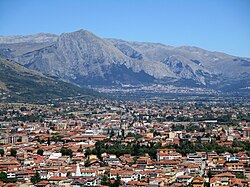
View on WikipediaAvezzano (Italian: [avetˈtsaːno] ⓘ or [avedˈdzaːno]; Marsicano: Avezzàne [avedˈdzɑːnə]) is a city and comune in the Abruzzo region, province of L'Aquila, Italy.[3] It is the second most populous municipality in the province and the sixth in the region. It is the main commercial, industrial and agricultural centre of the Marsica area, with important high-tech industries and the Fucino Space Centre.
Key Information


The city was destroyed by the earthquake of 1915. It was rebuilt after the 1944 Allied bombing. The city was decorated with the silver medal for civil merit, an award granted by the Italian Republic.[4][5]
History
[edit]Toponymy
[edit]There are different common etymologies for the name of the city: from "Avidianum" or "fundus Avidianus" which is derived from the noble Avidius ("Avidia gens") domiciled in the nearby ancient town of Alba Fucens; from "Ad Vettianum" which means a "to the Vettia family" ("Vettia gens") or for an unlikely hypothesis from "Ave Jane", an invocation to the Roman god Janus.[6][7]
Earliest history
[edit]The presence of hunters dates back to the palaeolithic period about 18,000 to 14,000 years ago. There are several sites that bear witness to the presence of humans in prehistoric times, as in the Cave of Ciccio Felice located just south of Avezzano.[8]
Traces of necropoleis dating to 8-5th centuries BC have emerged along the border between the Aequi and Marsi at Colle Sabulo, Cretaro-Brecciara and Valle Solegara.
Roman period
[edit]Avezzano was a rural area in the ager (state land) of Alba Fucens founded by Rome between 304-3 BC[9] after the Roman conquest and colonisation of the territory of the Aequi bordering that of the Marsi.
Several Roman villas have been found in the area. The remains of the so-called Villa of Avezzano of the 2nd century BC are along the ancient via Tiburtina Valeria. The grandiose remains of a Roman villa on terraces can be seen at S. Pelino with an aqueduct conduit upstream of the fountain with an opening on a beautiful wall in opus isodoma. Below the spring, a long terracing wall in opus cementicium is visible, 36 m long and preserved (for the first 8 m) to a height of 4.4 m: below is a curtain (2.60 m high) of blocks, molded in steps on the edges, in polygonal work 40 cm thick in six rows surmounted by a coating of opus reticulatum up to 1.8 m. On the slopes is a terrace wall about 5 m high with masonry 70 cm thick.[10]
Other villas of considerable size are at nearby Paterno, one on terraces in Panciano and another in the modern town. The first has a terrace wall in polygonal work, a conduit from a spring and a vast area of pottery fragments along the country road which joins S. Pelino Vecchio with medieval Paterno. Lower down on the Via Valeria is the "villa of Paterno" in the fundus Paternianus (of which there is evidence from the Middle Ages with the curtis de Paterno and its church of Sanctae Mariae in Paterniano) discovered in 1971 which included a baths with a room paved in cocciopesto, another with a hypocaust, while in a third the furnace was visible.
The fundus Avidianus was an estate owned by the Avidii family as attested by local inscriptions and attributable to the II-I century BC which would have included a villa.
The first major settlements in this area began after drainage of Lake Fucino by the Tunnels of Claudius from 52 AD.
Roman villa of Avezzano
[edit]

The Roman villa rustica in the locality of Macerine opened to the public in 2008. It was built in the 2nd century BC over an area of about 3,000 m2 belonging to the ager publicus of Alba Fucens. The farm was used by the settlers primarily for agricultural crops for the needs of the colony of Alba Fucens. The colony became a thriving and populous commercial centre and was connected to the surrounding area by a road paved with cobblestones.[11]
The entrance led into the atrium around which are rooms for the owner and servants. In the pars fructaria were cisterns and basins in which oil and wine were collected and grapes and olives were pressed.
A head of Apollo with hair of the Apollo Belvedere type of the Vatican dates from the period following the Social War (91–87 BC). The villa was enlarged over the centuries and enriched with private baths with hypocaust heating between the 2nd and 3rd century AD, with a mosaic floor with figurative motifs. The polychrome central panel represents the winged victory on a chariot pulled by two running horses.
Inhabited until the beginning of the sixth century AD, it was probably abandoned following an earthquake that shook the whole area.[12] Graves dating to the 5th-6th century AD have come to light again near the perimeter of the villa, containing objects used for the decoration of the deceased and for daily use.[13]
Middle Ages
[edit]In 591 in the area came under the control of Ariulf and the duchy of Spoleto. Charlemagne, after the mid-700s, donated Gastald of the Marsi and all the lands of the duchy to the papal states. So originated the county of the Marsi. In the Late Middle Ages the victory of Charles of Anjou led to the destruction of Albe and Pietraquaria whose people had sided in favor of Conradin, duke of Swabia, defeated after the battle of Tagliacozzo in 1268.[14][15] In the fourteenth century in Avezzano ended the process of aggregation of the various villages that make up the urban center.[16]
Early modern
[edit]
In the 15th century Avezzano was under Gentile Virginio Orsini, who built the castle in 1490. In the fifteenth century occurred the victory of the Colonna family over Orsini. Their lordship lasted about three centuries. The castle of Avezzano in 1565 was expanded by Marcantonio Colonna and was later converted into a fortified palace.[17]
Late modern and contemporary
[edit]Avezzano once lay on the shores of the largest lake in peninsular Italy, Lake Fucino, which was drained in the late 19th century. After the draining of the lake, wide fields became available for cultivation and the area underwent terrific growth. It was completely destroyed by one of the worst recorded earthquakes in the history of Italy on the early morning of January 13, 1915, with only Palazzi's house and a wing of Orsini-Colonna castle spared. More than 30,000 people died. The town streets were then completely rebuilt along straight, parallel lines, with wide green areas and villas in the Liberty style.[18]
During World War I and World War II, a concentration camp was located near the city, where foreign war prisoners were interned. During World War II, Avezzano was liberated by elements of the New Zealand Army (2nd New Zealand Division) on 10 June 1944.[19]
Geography
[edit]
The city is located north-west of the Fucino. It is dominated in the north by Monte Velino and west by Monte Salviano. Avezzano is considered "the city territory" of Marsica, Abruzzo sub-region that includes 37 municipalities, for a total of about 134,000 inhabitants.[20] The city is located about 100 kilometers east of Rome,[21] 110 km west of Pescara[21] and 55 km south of L'Aquila.[21]
Topography
[edit]The urban center of the old city revolves around the Castello Orsini-Colonna (''Orsini-Colonna Castle''). To the east the territory extends to the villages of San Pelino and Paterno. It is situated between 695 meters s.l.m. in the urban sector and 740 meters in the north, the land of which is a slight uphill slope to the north-northwest.
Neighbourhoods (alphabetical order): Barbazzano, Borgo Angizia, Borgo Pineta, Centro città, Cesolino, Chiusa Resta, Cupello, I Frati, La Pulcina, San Rocco, San Nicola, Sant'Andrea, Scalzagallo, Via Napoli.
Climate
[edit]Because of its geographical location, situated as it is in the former bed of the Fucino and surrounded by towering hills, Avezzano is characterized by a Mediterranean mountain climate. Based on climatic averages for the period 1951–2000 published by the agency ARSSA (Regione Abruzzo), and climatic averages related to thirty years of reference 1961–1990, the average temperature of the coldest month, January stood at +2,0 °C; that of the hottest month, August, +20.5 °C. In summer sometimes temperatures exceed 30 °C.[22] The Climate classification is: Zone E, 2561 GR / G.
| Climate data for Avezzano, elevation 708 m (2,323 ft), (1951–2000) | |||||||||||||
|---|---|---|---|---|---|---|---|---|---|---|---|---|---|
| Month | Jan | Feb | Mar | Apr | May | Jun | Jul | Aug | Sep | Oct | Nov | Dec | Year |
| Record high °C (°F) | 19.0 (66.2) |
21.6 (70.9) |
24.6 (76.3) |
28.6 (83.5) |
33.4 (92.1) |
35.5 (95.9) |
38.5 (101.3) |
37.5 (99.5) |
35.5 (95.9) |
30.0 (86.0) |
24.4 (75.9) |
18.5 (65.3) |
38.5 (101.3) |
| Mean daily maximum °C (°F) | 7.3 (45.1) |
8.8 (47.8) |
12.3 (54.1) |
15.7 (60.3) |
20.4 (68.7) |
24.4 (75.9) |
28.0 (82.4) |
28.3 (82.9) |
24.0 (75.2) |
18.8 (65.8) |
12.5 (54.5) |
8.2 (46.8) |
17.4 (63.3) |
| Daily mean °C (°F) | 2.9 (37.2) |
4.1 (39.4) |
6.9 (44.4) |
10.0 (50.0) |
14.3 (57.7) |
17.9 (64.2) |
20.9 (69.6) |
21.1 (70.0) |
17.6 (63.7) |
13.1 (55.6) |
7.8 (46.0) |
4.1 (39.4) |
11.7 (53.1) |
| Mean daily minimum °C (°F) | −1.5 (29.3) |
−0.6 (30.9) |
1.4 (34.5) |
4.3 (39.7) |
8.1 (46.6) |
11.4 (52.5) |
13.7 (56.7) |
13.9 (57.0) |
11.2 (52.2) |
7.4 (45.3) |
3.0 (37.4) |
0.0 (32.0) |
6.0 (42.8) |
| Record low °C (°F) | −21.0 (−5.8) |
−15.6 (3.9) |
−10.9 (12.4) |
−7.0 (19.4) |
−2.0 (28.4) |
2.0 (35.6) |
4.5 (40.1) |
4.1 (39.4) |
−1.5 (29.3) |
−4.0 (24.8) |
−10.5 (13.1) |
−14.0 (6.8) |
−21.0 (−5.8) |
| Average precipitation mm (inches) | 66.3 (2.61) |
71.4 (2.81) |
61.1 (2.41) |
60.0 (2.36) |
51.0 (2.01) |
44.0 (1.73) |
29.8 (1.17) |
37.5 (1.48) |
57.2 (2.25) |
77.6 (3.06) |
110.2 (4.34) |
99.3 (3.91) |
765.4 (30.14) |
| Average precipitation days | 7.8 | 8.3 | 8.4 | 8.7 | 7.9 | 6.4 | 4.1 | 4.5 | 6.0 | 7.8 | 9.2 | 9.7 | 88.8 |
| Source: Regione Abruzzo[23] | |||||||||||||
Main sights
[edit]


The city, having been completely destroyed by the earthquake of 1915, has no monuments of particular interest as do other locations in the region of Abruzzo. However, you can see some important remains of its ancient history.
Orsini-Colonna Castle
[edit]The castle was built in 1490 by Gentile Virginio Orsini, who had it built around a pre-existing medieval tower of the twelfth century; it is square, with round towers at the angles.[24] The castle project was probably led by the engineer Francesco di Giorgio Martini. In the sixteenth century the castle was expanded by the order of Marcantonio Colonna, becoming an elegant residence. Severely damaged by the earthquake of 1915, it was partially restored after 1990.[25]
Tunnels of Claudius
[edit]The tunnels are located south of the city. They were built by the emperor Claudius between 41 and 52 AD by which the emperor made the first attempts at draining the huge Lake Fucino. To create the tunnels and the main gallery, 25,000 slaves were needed. They dug 32 wells and six tunnels. The lake was largely drained, but with the fall of the Roman Empire the tunnels were obstructed and the lake returned to its previous levels. Many centuries later, Alessandro Torlonia completed the work by finally draining Lake Fucino, building on the original project of the emperor Claudius and turning the land under the great lake into a fertile plain. In 1977, the tunnels were opened as an archaeological park.[26]
Cathedral of San Bartolomeo
[edit]The Cathedral of St. Bartholomew was built in 1000 and documented in the thirteenth century. After its destruction as a result of the earthquake of 1915, it was rebuilt after 1940 in the new central square of Avezzano. The facade is neo-Renaissance travertine. The three portals are topped with mosaics depicting Christ and the two protectors of Avezzano, the Virgin Mary and St. Bartholomew. The church inside presents three large naves and a valuable organ placed in the church in 1955.[27]
Sanctuary of the Madonna di Pietraquaria
[edit]The original church was destroyed by Charles I of Anjou after the battle of Tagliacozzo in 1268 and rebuilt a few centuries later. In 1915, it did not suffer serious damage and was home to many survivors of the quake.[28]
Alba Fucens
[edit]7 kilometers north of the city is situated the Roman archaeological site of Alba Fucens. It was founded by Rome as a Latin colony between 304 and 303 BC in the territory of the Aequi, on the frontier of the Marsi, in a strategic position. It is on a hill just north of the Tiburtina-Valeria, the ancient road from Rome to the Adriatic regions. Excavations were carried out since 1949 by the University of Leuven in Belgium, led by professor Fernand De Visscher.[29]
Riserva Naturale di Monte Salviano
[edit]The nature reserve, established in 1999, covers 722 hectares west of the town of Avezzano on Monte Salviano. It has a rich variety of plants and different animal species that characterize its fauna and flora. At the center of the reserve is located the Sanctuary of the Madonna of Pietraquaria surrounded by numerous trails frequented by sportsmen and nature lovers.[30]
- Fucine Inlet
- Teatro dei Marsi
- Torlonia Palace
- Torlonia Square
- Church of San Giovanni
- Avezzano Town Hall
- Eclectic-neoclassical Courthouse
Economy
[edit]Agriculture
[edit]


Many farms in the plain of Fucino are distinguished by the quality of the vegetables. Particularly popular is the Fucino potato which obtained the recognition of the quality label "Protected Geographical Indication".[31] Several qualities of vegetables: carrot highland Fucino (PGI),[32] radishes, salads and all kinds of horticultural products. In Abruzzo, 25% of agricultural GDP comes from Fucino plain.[33]
Industry
[edit]Built in the 1970s just outside the city in the direction of Luco dei Marsi, the industrial park includes numerous industrial and manufacturing enterprises and is the economic engine of the province. Among these are Micron Technology and L-Foundry, electronics giants engaged in highly specialized manufacturing. Around 1,600 workers are employed at the fabrication center "Innovation & Technology" in Avezzano. Also located here are Arab TV, Kidco, the Burgo group, FIAMM, Saes, Presider, Presafer and several other specialized firms.[34] Nearby in the Fucino plain is located the Fucino Space Centre, one of the major global operators of satellite services.[35]
Commerce
[edit]Commerce plays a very important role for the city in retail trade, digital service industries and traditional service industries. Large commercial areas are located on the Tiburtina Valeria street, between Roma street and Cappelle dei Marsi and along XX Settembre street, just outside the city. The so-called "natural shopping center" consists of the activities in the city center.
Tourism
[edit]Near Avezzano there are parks, valleys, cities and the natural environment of the Abruzzi mountains: National Park of Abruzzo, Lazio and Molise, Sirente-Velino Regional Park, Fucino plain, Monte Velino, Ovindoli, Tagliacozzo, Giovenco valley, Roveto valley and Cavaliere plain.
Sports
[edit]The football squad is Avezzano Calcio who play at the Stadio dei Marsi-Sandro Cimarra. The rugby team is Avezzano Rugby. The athletics stadium is the Stadio dei Pini.
Notable people
[edit]- Daniel Ciofani, football player
- Paola Concia, politician
- Felice Orlandi, actor
- Ada Gentile, pianist and composer
- Lino Guanciale, actor
- Gianni Letta, politician and journalist
- Mario Pescante, politician and sports manager
- Vito Taccone, cyclist
International relations
[edit]Avezzano is twinned with:
 Ayacucho, Peru, for the sustainable development of protected areas near to urban areas[36]
 Belén, Argentina, for cooperation and exchange of tourism, export and import food industry[37]
 Câmpulung Moldovenesc, Romania, for cooperation and exchange of tourism[38]
- Santa María, Argentina, for cooperation and exchange of tourism, export and import food industry[37]


See also
[edit]References
[edit]- ^ "Comune di Avezzano" (in Italian). Comuni-Italiani.it (Prometheo Srl). Retrieved 22 November 2016.
- ^ "Bilancio demografico anno 2025 (dati provvisori) – Avezzano". ISTAT. 30 July 2025. Retrieved 7 October 2025.
- ^ "Avezzano" (in Italian). Il Portale d'Abruzzo. Archived from the original on 23 November 2016. Retrieved 22 November 2016.
- ^ "70 anni dalla liberazione (pag.30)" (PDF). ANPI. Archived from the original (PDF) on 2020-11-25. Retrieved 2016-01-21.
- ^ Palmieri, p. 106.
- ^ "Il nome Avezzano". Terre Marsicane (Giovanni Pagani). Archived from the original on 5 March 2016. Retrieved 20 January 2016.
- ^ Febonio, p. 70.
- ^ "Aspetti della morfologia carsica (anno 2006, pag.46)". Ezio Burri (C.Giraudi/L.Piccini/P.Messina).
- ^ L’ager Albensis e il fundus Avidianus https://comune.avezzano.aq.it/lager-albensis-e-il-fundus-avidianus/
- ^ L’ager Albensis e il fundus Avidianus https://comune.avezzano.aq.it/lager-albensis-e-il-fundus-avidianus/
- ^ "L'area archeologica". imarsiweb.it. Archived from the original on 2016-08-09. Retrieved 2023-08-26.
- ^ "Archeologia di un territorio" (PDF). regione.abruzzo.it (Emanuela Ceccaroni).
- ^ Villa romana – loc. Macerine di Avezzano, SS.Tiburtina Valeria km 12.500 http://archeoabruzzo.beniculturali.it/SettCult2011/VisiteGuidate/Villa%20romana%20localit%C3%A0%20Macerine%20Avezzano.pdf
- ^ "Gastaldato dei Marsi". Comune di Avezzano. Retrieved 21 January 2016.
- ^ "Contea dei Marsi". Pereto.info. Archived from the original on 2015-02-14. Retrieved 2016-01-21.
- ^ "Una missionaria nell'Avezzano del '700-Madre Maria Teresa Cucchiari e la sua opera (Giuseppe Grossi)" (PDF). Sobriaebbrezza.it. Archived from the original (PDF) on 2 February 2016. Retrieved 21 January 2016.
- ^ "Castello Orsini-Colonna". Regione Abruzzo. Archived from the original on 28 December 2014. Retrieved 21 January 2016.
- ^ "Touristic Guide of Avezzano". Comune di Avezzano. Retrieved 16 January 2016.
- ^ "1944 giugno". Associazione Nazionale Combattenti FF.AA. Retrieved 2 May 2017.
- ^ "Dati Popolazione, Superficie e Densità dei Comuni appartenenti alle Comunità Montane Abruzzesi" (PDF). Regione Abruzzo. Archived from the original (PDF) on 7 March 2016. Retrieved 22 January 2016.
- ^ a b c Distance provided by Google Maps: Fastest route
- ^ "Analisi spazio temporali delle precipitazioni nella Regione Abruzzo" (PDF). Regione Abruzzo. Archived from the original (PDF) on 9 March 2016. Retrieved 22 January 2016.
- ^ "VALORI MEDI CLIMATICI DAL 1951 AL 2000 NELLA REGIONE ABRUZZO" (PDF). Regione Abruzzo. Retrieved 30 June 2024.
- ^ Chisholm, Hugh, ed. (1911). . Encyclopædia Britannica. Vol. 3 (11th ed.). Cambridge University Press. p. 59.
- ^ "Castello Orsini-Colonna". Regione Abruzzo. 2006. Archived from the original on 28 December 2014. Retrieved 23 April 2018.
- ^ "Cunicoli di Claudio". Regione Abruzzo. Archived from the original on 21 February 2018. Retrieved 27 January 2016.
- ^ "Chiesa di San Bartolomeo in Avezzano". terremarsicane.it. Archived from the original on 2015-06-30.
- ^ "Santuario della Madonna di Pietraquaria". diocesidiavezzano.it. Archived from the original on 2015-09-25. Retrieved 3 February 2016.
- ^ "Alba Fucens". albafucens.info.
- ^ "Scrigno di biodiversità". tesoridabruzzo.com. Retrieved 3 February 2016.
- ^ "IGP Patata del Fucino". AgricolturaOggi.com. Archived from the original on 2015-09-21. Retrieved 2016-01-22.
- ^ "Abruzzo, il gusto della carota del Fucino (Ricette prodotti Igp Italia)". La Stampa (Turismo.it).
- ^ "Cuore d'Abruzzo: 25% PIL agricolo dal Fucino". Il Centro.
- ^ "Consorzio nucleo industriale di Avezzano". Consorzio nucleo industriale di Avezzano.
- ^ "Fucino: the largest civil space centre in the world". Telespazio.com.
- ^ "Gemellaggio tra la città di Avezzano e Ayacucho". TeleSirio. Archived from the original on 2016-01-29. Retrieved 21 January 2016.
- ^ a b Marsica Live. "Gemellaggio Avezzano-Belén-Santa María" (in Italian).
- ^ Marsica Live. "Patto di sviluppo tra i Comuni di Avezzano e Campulung Moldovenesc" (in Italian).
Bibliography
[edit]- Febonio, Muzio (1678). Historiae Marsorum (in Latin). Monaco di Baviera: Biblioteca Pubblica Bavarese.
- Palmieri, Eliseo (2006). Avezzano, un secolo di immagini (in Italian). Pescara: Paolo de Siena editore.
External links
[edit]

- Institutional website Comune di Avezzano (in Italian)
- Weather forecast Ministero della difesa – Aeronautica (in Italian)
| International | |
|---|---|
| National | |
| Geographic | |
| Other | |

Avezzano
View on GrokipediaHistory
Toponymy and origins
The name "Avezzano" has been subject to several etymological interpretations rooted in Latin influences. One prominent theory, proposed by the 17th-century historian Muzio Febonio, derives it from the Latin phrase "Ave Jane," an invocation to the god Janus associated with a temple at the town's gates; this evolved into "Aveanum" and eventually "Avezzano."[2] Another scholarly view, advanced by Professor Cesare Letta of the University of Pisa, links the name to "Avidianum" or "fundus Avidianus," referring to estates owned by a member of the noble Avidius family from nearby Alba Fucens, a connection supported by two ancient epigraphs discovered in the Alba Fucens territory.[2] The earliest historical mentions of Avezzano as a distinct settlement appear in late medieval documents, with the name recorded as a feudal residence in 1343 and formalized as a "universitas" (self-governing community) in 1360, indicating its coalescence from earlier village clusters by the end of the first millennium AD.[2] These derivations reflect possible pre-Roman Italic influences, particularly from the Marsi, an ancient Sabine-related tribe inhabiting the Marsica region around the Fucino Basin.[5] Archaeological evidence points to prehistoric human activity in the Fucino Basin, where Avezzano is located, dating back to the Paleolithic era and continuing into the Bronze Age. Sites such as Grotta Continenza, a key cave in the basin near Trasacco, reveal a continuous occupation sequence spanning over 8,500 years, serving as both dwellings and funerary locations from the Late Epigravettian (around 14,000–10,000 BC) through the Neolithic and into the Bronze Age (c. 2200–1450 BC).[6] Artifacts from these layers include laminar tools with sinuous profiles, microliths, and burial remains indicative of ritual practices, highlighting specialized lithic production and early community structures in the region.[7] Additional Bronze Age evidence from the basin encompasses faunal and plant remains in cave sites, suggesting exploitation of local ecosystems for sustenance and possibly trade networks linking central Italy.[8] These finds underscore the basin's role as a hub for early Italic populations, including the Marsi, prior to Roman integration. The Fucino Lake, a vast endorheic body of water that once dominated the basin until its drainage in the 19th century, profoundly shaped prehistoric settlement patterns and may have indirectly influenced toponymy through its geographical prominence. As a natural barrier spanning about 37 miles in circumference at elevations of 650–680 meters, the lake restricted movement and concentrated human activity along its fertile shores, where communities exploited fish, sandy soils, and wetland resources for subsistence.[9] Lake-level fluctuations during the Late Pleistocene and Holocene, driven by climatic changes rather than major tectonics, periodically flooded low-lying areas, prompting adaptive settlement strategies like elevated or cave-based sites and contributing to the basin's isolation, which preserved distinct cultural traits among groups like the Marsi.[10] This environmental context likely informed early naming conventions tied to the landscape, emphasizing the lake's centrality in regional identity before Roman engineering efforts began altering it.[11]Ancient and Roman periods
The territory encompassing modern Avezzano, part of the ancient Marsica region inhabited by the Marsi people, formed a formal alliance with Rome in 304 BC at the conclusion of the Second Samnite War, transitioning from initial hostilities to integration as socii (allied communities) within the Roman Republic. This pact, documented in sources like Livy, allowed the Marsi to retain local autonomy while contributing troops to Roman legions, fostering gradual cultural and administrative Romanization.[8] Archaeological evidence highlights key Roman sites in the area, including the rustic villa in the Macerine locality near Avezzano, constructed around 200 BC as a center for agricultural production. This estate featured intricate floor mosaics depicting geometric patterns and possibly mythological scenes, along with thermal baths indicative of elite leisure facilities integrated into productive farmland.[12] The villa complex, spanning several hectares, supported viticulture, olive cultivation, and cereal farming, exemplifying the latifundia system that dominated rural Roman economy in central Italy.[13] A monumental engineering feat was Emperor Claudius's emissarium, initiated in 41 AD and completed in 52 AD, designed to mitigate periodic flooding of Fucino Lake by channeling excess water through an underground tunnel into the Liri River. The main tunnel measured 5,670 meters in length, with a rectangular cross-section of 4.5 meters in height and 3.2 meters in width, engineered with a precise slope of 1 in 5,000 to ensure gravitational flow; it was excavated simultaneously from both ends using 32 vertical shafts for access and ventilation, involving an estimated 30,000 laborers over 12 years. This partial drainage lowered the lake level by approximately 4 meters, reclaiming thousands of hectares of arable land in the Fucino Basin and transforming the marshy terrain into productive fields.[14] Economically, the region played a vital role in Roman grain production, with the fertile alluvial soils of the Fucino Basin yielding substantial wheat harvests that contributed to central Italy's food supply and export to Rome.[15] Trade networks, anchored by the Via Tiburtina Valeria—a paved road extended from Rome through the Apennines—facilitated the transport of cereals, livestock, and other goods to urban markets, enhancing connectivity between Marsica's rural estates and the capital.[16] Under Roman administration, social structure in the area blended local Marsi traditions with imperial hierarchies: elites, known as meddices, oversaw oppida (fortified towns) as political centers, while quaestors managed smaller vici (hamlets) focused on agrarian labor; the population, primarily rural farmers and laborers, is estimated to have numbered in the tens of thousands across the broader Marsica territory, though precise figures for Avezzano's vicinity remain elusive due to its status as a dispersed ager (countryside).[8] The region's prosperity waned with the collapse of the Western Roman Empire in 476 AD, when the deposition of Emperor Romulus Augustulus by Odoacer triggered widespread instability, including Germanic invasions that disrupted trade routes and led to the abandonment of villas like Macerine and neglect of infrastructure such as the Claudian tunnels. This marked a shift to localized subsistence economies amid depopulation and economic fragmentation in central Italy.[8]Medieval and Renaissance eras
Following the fall of the Western Roman Empire, the Marsica region, encompassing Avezzano, experienced significant upheaval during the Lombard invasions of the 6th century. The Lombards arrived in the province of Valeria between 571 and 574, achieving full conquest by 592 under Ariulfo, Duke of Spoleto, after approximately two decades of conflict that devastated urban and rural settlements through looting and destruction.[17] By the early 7th century, they established a gastaldia centered at Civitas Marsicana (modern San Benedetto dei Marsi), allowing some continuity of local governance while integrating the area into the Lombard duchy of Spoleto; archaeological evidence, such as 6th-century African sigillata pottery found at sites like Milionia in Rivoli di Ortona dei Marsi, underscores this transition.[17] The Lombards Christianized by the mid-7th century, constructing churches such as those at Grotta di S. Angelo in Balsorano. In 774, the Frankish conquest under Charlemagne incorporated Marsica into the Franco-Lombard duchy of Spoleto, with local Lombard officials like sculdahis Garibaldo retaining influence until at least 879; a notable grant in 782 from Duke Ildebrando to Montecassino included the curtis of Paterno, spanning about 250 hectares.[17] The establishment of the County of Marsi in 926 marked a pivotal feudal development, granted by King Ugo d’Arles to Berardo il Francisco and Attone, a family of Lombard origin that ruled over Marsica, Reatino, Amiternino, Furconese, and Valvensi territories.[17] The counts solidified their power through alliances and donations, such as Rainaldo II's (970–985) gifts to Montecassino and Berardo III's (early 11th century) pact with the Normans during their conquest of southern Italy. The Norman arrival in the 11th century further integrated the region into the emerging Kingdom of Sicily, with Berardo III leveraging Norman support to maintain comital authority amid invasions like the Saracen raids of 880, which destroyed monasteries such as S. Vittorino in Telle and S. Maria in Apinianico, and Hungarian incursions in 937 near Forca Caruso.[17] These events fostered a fragmented feudal landscape, with Montecassino exerting significant influence over lands and ecclesiastical affairs. The Diocese of Marsi, established around 900 with its see initially at San Benedetto dei Marsi, saw medieval consolidation under bishops like Pandolfo (11th century), who resolved a schism in 1057 via papal intervention from Stefano IX, and San Berardo (1115), who defined diocesan boundaries through Pope Pasquale II’s bull; early ties to Avezzano emerged with a pre-1000 church dedicated to Sant’Antonio (later San Bartolomeo), elevated to royal chapel status in the 12th century.[18] The Black Death of 1348 severely impacted Abruzzo, including the Marsica region, initiating a series of plagues that decimated populations and disrupted recovery for generations, as documented in historical records of epidemics from 1348 to 1702.[19] Nearby L'Aquila suffered multiple outbreaks in 1348 and 1363, compounded by a 1349 earthquake, leading to substantial demographic decline and economic stagnation across the area.[20] Population recovery was gradual, supported by feudal restructuring under the Kingdom of Naples. In the 15th century, Avezzano transitioned into the Renaissance era under Aragonese rule within the Kingdom of Naples, established after Alfonso V of Aragon's conquest in 1442, which brought Spanish administrative influences to Abruzzo.[21] The town fell under the control of the Orsini family, with Gentile Virginio Orsini commissioning the Orsini-Colonna Castle in 1490 as a defensive stronghold on the remnants of an 1181 tower built by Gentile di Palearia; this structure symbolized the family's regional dominance amid ongoing feudal tensions.[22] The castle later passed to the rival Colonna family, who expanded it in the 16th century under Marcantonio II Colonna, victor at the Battle of Lepanto, reflecting its central role in the protracted power struggles between the Orsini and Colonna clans that shaped central Italian politics during the late medieval and early Renaissance periods.[22] These conflicts, rooted in papal and royal factions, influenced local governance and urban development in Avezzano, fostering a blend of defensive architecture and emerging Renaissance patronage.[23]Modern period to 19th century
During the 17th century, Avezzano fell under Spanish Habsburg rule as part of the Kingdom of Naples, where it was integrated into the feudal Duchy of the Marsi controlled by the Colonna family, subjecting the local population to heavy taxation and economic exploitation that contributed to regional decline.[24] The echoes of the Masaniello revolt in Naples (1647–1648) reached the Marsica area, including Avezzano, sparking local unrest against feudal lords and Spanish authorities amid invasions by brigands and soldiers.[24] Agrarian production remained subsistence-based, with feudal rents extracting resources from peasants, while piracy and wars further hampered trade and development.[24] The brief Austrian Habsburg interlude (1707–1734) following the War of the Spanish Succession brought limited attempts to curb baronial powers in Abruzzo, but these reforms proved largely ineffective in Avezzano, where feudal structures persisted.[24] With the Bourbon conquest in 1734, centralized authority strengthened under Charles of Bourbon, reducing some feudal influences and dedicating regional works like the Reggia Marsicana (1738) to the new king of Naples, Sicily, and Jerusalem.[24] Agrarian reforms, such as the incomplete catasto land survey of 1740–1741, aimed to modernize taxation but stalled due to noble resistance, leaving Avezzano's economy mired in stagnation with persistent contraband and poor agricultural yields noted by contemporaries like Bernardo Tanucci and Giuseppe Maria Galanti.[24] In the post-Napoleonic Bourbon restoration (1815–1860), brigandage surged in Abruzzo as a form of social and political resistance against restored absolutism, with bands operating in the Marsica region around Avezzano, often fueled by economic hardship and anti-French sentiments lingering from the Napoleonic era.[25] Napoleonic decrees had abolished feudal jurisdictions but preserved baronial land ownership, exacerbating tensions that manifested in localized unrest.[24] Agricultural stagnation persisted due to the unreclaimed Fucino Lake, which covered 140 km² and caused flooding, malaria, and limited arable land in the Avezzano basin until major drainage efforts began in 1854 under Prince Alessandro Torlonia, completing by 1875 and transforming the area into fertile plains.[10] Avezzano played a modest role in the Risorgimento, with local figures from nearby Rosciolo joining Garibaldi's Expedition of the Thousand in 1860, including families like the one with six garibaldini brothers who fought for unification.[26] Following the 1861 proclamation of the Kingdom of Italy, Avezzano integrated into the new province of L'Aquila, undergoing administrative reorganization that shifted from Bourbon feudal oversight to centralized Piedmontese governance, though southern brigandage continued as resistance to these changes.[27] By 1861, the population had grown to approximately 7,700, reflecting gradual urbanization amid these transitions.[28] Cultural developments included the establishment of basic schools under Bourbon enlightenment policies, promoting literacy among the emerging middle class, while weekly markets fostered local trade in grains and livestock despite agricultural constraints.[24] Early industrialization attempts were nascent, limited to small workshops processing local products, with more substantial efforts like the sugar factory emerging only post-drainage in the late 19th century.[2] The medieval castle, originally from the Renaissance era, continued serving administrative functions under Bourbon rule, symbolizing continuity amid political shifts.[24]20th century and recent developments
The devastating Avezzano earthquake of January 13, 1915, registered a magnitude of 7.0 and caused over 30,000 deaths across the Abruzzo region, with the town of Avezzano suffering near-total destruction where approximately 10,000 of its 13,000 inhabitants perished.[29][30][31] King Victor Emmanuel III provided immediate relief by visiting the site and coordinating national aid efforts, while reconstruction was spearheaded by Giacomo Acerbo, who served as the government's commissioner and oversaw the redesign of the town into a more modern urban layout.[32] During World War II, Avezzano experienced significant impacts from Allied bombings targeting rail infrastructure, including strikes on the Avezzano-Roccasecca and Avezzano-Popoli lines that disrupted transportation and caused civilian casualties.[33] Following the 1943 armistice, the area fell under German occupation, which involved requisitions of resources and fortifications along key routes, exacerbating local hardships until Allied liberation in 1944. In the post-war era, the full socio-economic benefits of the 19th-century Fucino Basin land reclamation materialized during the 1950s through Italy's land reform program (Riforma Fondiaria), which redistributed parcels to small farmers and boosted agricultural productivity around Avezzano, transforming the former lake bed into fertile arable land.[34] This period coincided with the Italian economic miracle of the 1950s-1970s, during which Avezzano saw industrial zoning initiatives that attracted manufacturing and improved living standards, with significant expansion in the 1960s and 1970s.[35] The region faced renewed seismic challenges with the 2009 L'Aquila earthquake (Mw 6.3), whose aftershocks extended to Avezzano, damaging buildings and prompting temporary evacuations despite the epicenter being about 30 km away.[36] Further seismic activity in 2016-2017, part of the Central Italy sequence including Mw 6.5 events, affected Avezzano's infrastructure, causing cracks in structures and disruptions to utilities.[37] Recent developments include the 2023 presentation of a refurbishment project for Avezzano's hospital, focusing on upgrading 1930s-era buildings with completion targeted for 2025 to enhance seismic resilience and capacity.[38] The Rome-Pescara railway upgrades, part of a broader doubling and electrification effort, reached the permitting stage for the Tagliacozzo-Avezzano section by 2025, aiming to reduce travel times.[39] Additionally, under Italy's National Recovery and Resilience Plan (NRRP), the European Rail Traffic Management System (ERTMS) was deployed along lines including Avezzano by mid-2025, covering over 1,400 km nationwide to improve safety and efficiency.[40][41]Geography
Location and topography
Avezzano is situated in the province of L'Aquila within the Abruzzo region of central Italy, specifically in the Marsica geographical area.[42] Its coordinates are approximately 42°02′N 13°25′E, and the municipality covers an area of about 104 km² at an elevation of 695 meters above sea level.[43][44] The city lies in the Fucino Basin, a tectonic depression that was once the bed of Lake Fucino, a large endorheic lake drained in the 19th century to create fertile agricultural land.[9] The topography of Avezzano is characterized by the flat expanse of the former lakebed in the Fucino Plain, surrounded by the rugged Apennine Mountains, particularly the Mount Velino-Sirente range to the north and east, which rises sharply to over 2,400 meters.[45] This intermontane basin setting contributes to the area's proneness to seismic activity, as it is bordered by active normal fault lines, including those of the Fucino fault system, responsible for significant historical earthquakes.[46] Hydrographically, the region features remnants of the ancient lake's drainage channels, now repurposed as irrigation canals like the Fucino collector, which manage water flow across the plain. The Giovenco River, originating from springs in the surrounding mountains, traverses the area before merging into these channels, supporting the basin's water distribution.[47] The soils in the Fucino Basin primarily consist of alluvial deposits from lacustrine and fluvial sedimentation, interspersed with volcanic tephra layers from distant eruptions, enhancing the area's fertility for agriculture.[48]Climate and environment
Avezzano features a Mediterranean climate with notable continental influences due to its inland position and elevation of approximately 680 meters, classified under the Köppen system as Csa. Summers are warm and dry, with average high temperatures ranging from 25°C to 30°C between June and August, while winters are cool and occasionally frosty, with averages between 0°C and 10°C from December to February. Annual precipitation totals around 700-800 mm, concentrated primarily in the fall and winter months, contributing to a relatively mild but variable weather pattern. The surrounding topography of the Fucino plain and adjacent mountains fosters localized microclimates, moderating extremes through sheltering effects.[49][50] Environmental challenges in Avezzano are shaped by its geological and historical context. The region lies in a high-seismic zone, exemplified by the catastrophic 1915 Avezzano earthquake, which registered a magnitude of 7.0 and caused over 30,000 fatalities, underscoring ongoing risks from tectonic activity along the Apennine fault lines. Air quality remains generally satisfactory but is impacted by emissions from nearby industrial zones, including manufacturing and chemical production, leading to periodic elevations in particulate matter. Water management poses persistent issues following the 19th-century drainage of Lake Fucino, which transformed the basin into arable land but resulted in groundwater overexploitation, aquifer depletion, and vulnerability to droughts exacerbated by climate variability.[51][52][15] Biodiversity thrives in the residual wetlands scattered across the reclaimed Fucino plain, which sustain diverse aquatic and avian species despite agricultural pressures. These habitats, remnants of the former lake ecosystem, support endemic flora and serve as critical corridors for regional wildlife. The Riserva Naturale Regionale del Monte Salviano, established on December 23, 1999, via Abruzzo Regional Law 134, encompasses 722 hectares on the western slopes overlooking Avezzano and safeguards ancient beech forests (Fagus sylvatica) alongside mixed woodlands that form vital refugia for species such as the endangered Marsican brown bear (Ursus arctos marsicanus), a subspecies endemic to the central Apennines.[53][54]Demographics
Population trends
Avezzano's population has undergone notable changes over time, shaped by historical events, migration, and socioeconomic factors. According to Italian National Institute of Statistics (ISTAT) census data, the town had 7,694 residents in 1861, growing steadily through the late 19th and early 20th centuries to reach 15,233 by 1911.[55] The 1915 Marsica earthquake drastically reduced the population, leaving approximately 3,000 survivors from a pre-event figure of about 13,000 in Avezzano alone. Reconstruction in the interwar period spurred recovery, with the population rebounding to 14,441 in the 1921 census and climbing to 19,658 by 1931.[56][55] Post-World War II, internal migration from surrounding rural areas drove significant expansion, as families sought opportunities in the burgeoning urban center. The population rose from 25,577 in 1951 to 30,072 in 1961, continuing to increase to a peak of 37,179 in 1991. This era reflected broader Italian trends of urbanization and industrialization attracting workers to Avezzano.[55]| Census Year | Population | Absolute Change from Previous Census |
|---|---|---|
| 1861 | 7,694 | - |
| 1911 | 15,233 | +7,539 |
| 1921 | 14,441 | -792 |
| 1951 | 25,577 | +11,136 |
| 1991 | 37,179 | +11,602 |
| 2011 | 40,744 | +3,565 |
| 2021 | 41,026 | +282 |
Ethnic and linguistic composition
Avezzano's population is overwhelmingly of Italian ethnicity, with over 90% of residents identifying as such based on citizenship data. The primary language is standard Italian, but the local Marsican dialect—a variant of the Central-Southern Abruzzese dialects—is widely spoken, particularly among older generations and in informal settings, reflecting the region's linguistic heritage. This dialect, rooted in the historical territories of the ancient Marsi tribe, maintains distinct phonetic and lexical features that distinguish it from northern Italian varieties.[59] Foreign-born communities represent a small but growing segment, comprising 9.4% of the total population of 40,887 residents as of early 2025. The largest groups hail from Morocco (approximately 32% of foreigners), Romania (approximately 24%), and Ukraine (approximately 7%), with smaller numbers from Albania and other nations contributing to the overall immigrant presence of 3,857 people. These communities, with a 2023 breakdown showing 1,090 Moroccans, 829 Romanians, and 244 Ukrainians, have integrated into the local economy, often in agriculture, services, and manufacturing, adding modest cultural diversity to the predominantly homogeneous fabric.[60][58] The ethnic makeup traces back to descendants of the pre-Roman Marsi, an Italic people known for their resilience and distinct cultural practices in the Marsica region, whose influences persist in local traditions and place names. Post-World War II reconstruction efforts, following the 1944 bombings and earlier 1915 earthquake devastation, drew internal migrants from southern Italian regions, bolstering the population and reinforcing Catholic cultural norms. Religiously, the community is predominantly Roman Catholic, with 90.9% affiliation within the Diocese of Avezzano, which serves 105,000 Catholics out of a total diocesan population of 115,500.[61][62] Social structure reflects balanced demographics and moderate family sizes. The gender ratio stands near parity, with 48.5% males and 51.5% females. Average household size is 2.3 persons, indicative of modern nuclear family trends amid Italy's aging population. Education levels are relatively high for the region, with regional ISTAT data for Abruzzo showing 54.1% of adults aged 25-64 holding at least an upper secondary (high school) diploma or higher in 2021, a figure supported by Avezzano's urban status and access to institutions like the University of L'Aquila.[63][64]Economy
Agriculture and land reclamation
The transformation of the Fucino Basin into fertile agricultural land began with the ambitious land reclamation project initiated by Prince Alessandro Torlonia in 1854 and completed by 1875. This engineering feat involved constructing an extensive network of tunnels and drainage canals, successfully draining the ancient Lake Fucino and reclaiming approximately 14,000 hectares of swampland for cultivation.[65][66][67] The project not only prevented recurrent flooding but also unlocked highly fertile alluvial soils, enabling the shift from marshy wasteland to productive farmland that now forms the economic backbone of Avezzano and the surrounding Marsica region. Today, the Fucino Plain supports intensive irrigated agriculture, relying on modern systems that include groundwater pumping, canal networks, and advanced drip irrigation to sustain high-yield crops across its 14,000 hectares. Key products include cereals such as wheat, fruits like apples and kiwis, a variety of vegetables like potatoes, tomatoes, carrots, lettuce, and fennel, as well as grapes for local wine production.[68][69][70] Agricultural cooperatives, such as OPOA-Marsia Società Cooperativa Agricola and Patapam Soc Coop Agricola, play a central role in organizing production, processing, and marketing, often leveraging European Union subsidies to modernize operations and promote sustainable practices like organic farming.[71][72] These funds, part of Italy's Common Agricultural Policy implementation, have supported initiatives in Abruzzo totaling millions of euros for irrigation upgrades and crop diversification.[73][74] Agriculture employs about 3-4% of Abruzzo's workforce, with approximately 80,000 individuals engaged in farming activities across the region as of 2023, though the sector's share rises in Avezzano due to its concentration of vegetable, fruit, and horticultural production.[75][76] However, the sector faces mounting challenges from climate change, including rising temperatures (up to 6°C per century in summer since the 1980s) and declining precipitation, particularly in winter, which have intensified droughts and reduced water availability for irrigation.[77] These shifts have led to greater yield variability for crops like wheat and grapes, with stronger negative correlations to summer droughts observed since 1983, while poor irrigation water quality poses risks of soil salinization in the reclaimed basin.[77][78] By 2025, ongoing drought episodes in the Fucino Plain have prompted calls for enhanced water management to mitigate these impacts.[79]Industry and high-tech sector
Avezzano's industrialization accelerated in the post-1950s period, driven by regional policies aimed at economic recovery and development in southern Italy, with a focus on manufacturing sectors including metalworking, electronics, and pharmaceuticals.[35] This growth was supported by the establishment of dedicated industrial zones, such as the one in Avezzano, which benefited from government incentives for business setup and expansion under national programs for the Mezzogiorno.[80] Key activities encompassed metalmeccanica operations for machinery and components, alongside pharmaceutical production, contributing to the area's transition from agriculture-dependent economy to diversified manufacturing.[81] The high-tech sector has emerged as a cornerstone, particularly through the Fucino Space Centre, established in 1963 and managed by Telespazio, a leading provider of satellite services.[82] Located in the Fucino plain near Avezzano, this facility serves as the world's largest civilian teleport, specializing in in-orbit satellite control, mission management, and telecommunications support for major operators including Eutelsat and the European Space Agency (ESA).[82][83][84] It handles satellite tracking and early orbit phase activities, enabling global connectivity and Earth observation services.[82] Recent advancements at the Fucino Space Centre include expansions into drone technology, aligning with growing demand for advanced air mobility solutions, as highlighted in Telespazio's participation in sector events projecting significant growth through 2025.[85] In parallel, traditional manufacturing has seen sustainability-focused developments, such as the Burgo Group's paper mill in Avezzano hosting the RicicloAperto event during Paper Week 2024, which showcased recycling processes and circular economy practices to the public.[86] These initiatives underscore Avezzano's evolving role in high-tech and industrial innovation, bolstered by post-1915 earthquake zoning that prioritized resilient urban and economic planning.[35]Commerce and services
Avezzano serves as the primary commercial hub for the Marsica region, hosting a variety of shopping districts that cater to local residents and surrounding areas. Key facilities include the Centro Commerciale I Marsi, a major retail complex opened in 2008 featuring supermarkets, clothing stores, and electronics outlets, strategically located near the A25 motorway for easy access.[87] Other prominent sites are the Shopping Park Ten, an open-air mall with diverse retail options, and the historic Piazza del Mercato, which supports traditional street vending.[88] Weekly markets further bolster this role, with fairs held every Wednesday and Saturday in the city center, offering fresh produce, clothing, and household goods to promote local trade.[89] The banking and insurance sectors form a cornerstone of Avezzano's service-oriented economy, providing essential financial support to businesses and households in Marsica. Local branches of national institutions, such as Banca Popolare di Lanciano e Sulmona and Banca Monte dei Paschi di Siena, offer retail banking, loans, and investment services tailored to the region's agricultural and industrial needs.[90] Insurance providers like Assicurazioni Unione Assicurazioni handle policies for property, vehicles, and business risks, contributing to economic stability amid the area's seismic history and industrial activities.[91] Services account for the dominant share of Avezzano's economy, reflecting a shift from traditional agriculture and manufacturing toward professional and support activities (as of 2011, the tertiary sector comprised approximately 50.6% of employment in non-trade services and contributed around 67% to local value added).[92][93] Healthcare services are prominent, anchored by the Ospedale SS. Filippo e Nicola, a key facility under ASL1 Avezzano-Sulmona-L'Aquila that delivers emergency care, oncology, and general medicine to over 150,000 residents; a new hospital project, presented in 2023 and approved for construction nearby in 2025, aims to expand capacity with modern vertical blocks within six years.[94][95] Education services, including vocational training centers and the presence of the University of L'Aquila's satellite programs, support workforce development in technical fields.[96] The digital economy in Avezzano is expanding, driven by high-speed internet infrastructure and proximity to the Fucino Space Centre, which facilitates e-commerce logistics for local retailers and high-tech firms. Broadband coverage supports online banking and virtual services, aligning with Abruzzo's ICT sector employing over 40% of its specialized workforce, though specific logistics hubs emphasize efficient distribution for regional commerce.[97] This growth enhances Avezzano's position as a service-oriented node, integrating digital tools to streamline retail and financial operations without relying heavily on manufacturing supply chains.Tourism and cultural economy
Avezzano's tourism sector has shown steady growth, with visitor numbers increasing by 12% in 2024 compared to 2023, reflecting a robust post-COVID recovery driven by domestic and regional travelers seeking cultural and historical experiences.[98] Key attractions, such as guided tours of historical sites and participation in local festivals, have been primary drivers of this uptick, contributing to enhanced economic activity in hospitality and related services. The sector benefits from its position in the Marsica region, where proximity to natural landscapes complements urban-based cultural tourism without relying on mass international inflows. The local tourism infrastructure supports this growth through a network of over 20 hotels and bed-and-breakfast establishments, alongside approximately 13 agritourism farms offering immersive rural stays.[99] These facilities cater to seasonal peaks, particularly during summer months and religious holidays like Easter and Christmas, when occupancy rates rise significantly due to family-oriented and event-based travel. Agritourism options often incorporate local agricultural products, such as saffron and wines, to promote food tourism experiences tied to the region's farming heritage. Tourism accounts for a notable portion of Avezzano's service-oriented economy, generating employment in hospitality, guiding, and retail sectors, with regional data indicating the broader Abruzzo tourism industry supporting over 5% annual growth in related jobs post-2023.[100] While exact local GDP figures are integrated into the area's commercial services, the sector's expansion has bolstered overall economic resilience, especially amid national recovery trends where tourism contributed 10.5% to Italy's GDP in 2023.[101] In 2025, Avezzano has advanced sustainable tourism initiatives through collaborations with nearby destinations like Fossacesia and Popoli Terme, focusing on wellness and eco-friendly promotion strategies funded partly by EU programs such as the Piano Strategico del Turismo 2023-2025.[102][103] These efforts emphasize reduced seasonality, green infrastructure upgrades, and EU-backed investments totaling over €51 million regionally via the PNRR, aiming to enhance long-term economic sustainability while preserving cultural assets.[104]Government and administration
Local governance
Avezzano's local governance operates under the framework of the Italian Testo Unico degli Enti Locali (D.Lgs. 267/2000), which defines the powers and organization of municipalities. The mayor serves as the chief executive, elected directly by citizens for a five-year term, and holds responsibility for administering public services, urban planning, public order, and representing the municipality in external relations. The current mayor, Giovanni Di Pangrazio, an independent politician, has been in office since October 2020 following a victory in the municipal elections with support from civic lists and center-left parties; his term ends in 2025, with municipal elections scheduled for that year.[105][106] The legislative body is the City Council (Consiglio Comunale), comprising 24 members elected through proportional representation every five years alongside the mayor. The council approves budgets, regulations, and major policies, while the executive Junta (Giunta Comunale), appointed by the mayor from council members, handles day-to-day administration and implements decisions. With a population of approximately 41,000, Avezzano falls into the category requiring 24 councilors under national law.[107][58] Following Italy's transition to a republic in 1946, Avezzano held its first post-war municipal elections in April of that year, amid national debates on monarchy versus republic, with local voters favoring the monarchy in the concurrent referendum. Post-war governance saw initial dominance by Christian Democrat figures, reflecting broader Italian trends, before shifting toward center-left influences in the late 20th century. Recent elections, including the 2020 contest, have featured independent candidates like Di Pangrazio backed by cross-party coalitions, indicating a move away from strict partisan control toward civic-oriented leadership.[108][109][110] The municipal budget follows a preventive (previsione) and conclusive (consuntivo) cycle, approved annually by the council to ensure financial equilibrium. For 2025-2027, the forecast projects revenues of nearly 27 million euros, primarily from taxes and transfers, supporting essential services, while allocating over 41 million euros for public works investments. Key taxes include the IMU (property tax) at base rates of 0.76% for primary residences with deductions, and TARI (waste tax) scaled by household waste production. The 2024 consolidated budget, encompassing the municipality and subsidiaries, was approved in September 2025 with minimal opposition.[111][112] Public services fall under municipal oversight, with waste management contracted to Tekneko Sistemi Ecologici Srl since 2024, targeting an 84% recycling rate through enhanced collection and controls. Public safety is managed by the Local Police Corps (Polizia Municipale), which enforces traffic regulations, administrative policing, and judicial support functions as defined by regional law. Avezzano's administration contributes to Abruzzo regional policies by coordinating on environmental initiatives, such as waste plans aligned with the regional strategy, and infrastructure projects funded through regional partnerships.[113][114][115]Administrative divisions and frazioni
Avezzano, a comune in the province of L'Aquila, encompasses an area of 104 km² divided into a central urban nucleus and peripheral frazioni, with the majority of its approximately 41,000 residents concentrated in the urban and semi-urban zones, while rural areas account for the expansive agricultural plains of the Fucino basin.[116][57] The municipality features eight principal frazioni, each with distinct historical and geographical characteristics, serving as extensions of the main settlement toward surrounding hills and plains:- Antrosano (population ~1,003 as of 2016), located on the slopes of Colle Albense, known for its rural landscape and proximity to prehistoric sites.[116][117]
- Castelnuovo (population ~170 as of 2016), a medieval fief beneath Monte Uomo, featuring sparse settlement and historical rural architecture.[116][117]
- Cese (population ~588 as of 2016), situated on the Piani Palentini under Monte Pietraquaria, with agricultural focus and access to hiking trails.[116][117]
- Paterno (population ~1,810 as of 2016), on the Fucino side of Monte Uomo, another medieval fief with mixed residential and farming uses.[116][117]
- San Pelino (population ~2,003 as of 2016), the largest frazione and a former settlement of Massa d’Albe, hosting commercial centers and serving as a suburban hub.[116][117]
- San Giuseppe di Caruscino (population ~1,569 as of 2016), along the Fucino plain near a medieval fishing site, emphasizing agricultural heritage.[116][117]
- Case Incile, at the entrance to the ancient Roman Emissary of Fucino, primarily rural with industrial adjacency.[116]
- Via Nuova, in the Fucino plain along a 16th-century Colonna-era road, functioning as a linear settlement with residential and commercial elements.[116]
Culture and landmarks
Orsini-Colonna Castle and historical sites
The Orsini-Colonna Castle, a prominent medieval fortress in Avezzano's historic center, originated as a sighting tower constructed in 1182 by Gentile de Palearia for defensive purposes.[118] In 1490, Count Virginio Orsini expanded it into a quadrangular fortified residence, enclosing the original tower with high perimeter walls and four corner towers to enhance its defensive capabilities against regional threats.[119] The structure's robust base, elevated on an embankment, underscores its military architecture, blending medieval fortification with Renaissance adaptations.[22] During the 16th century, Marcantonio Colonna, the renowned naval commander, transformed the castle into a more residential palace, adding loggias, a garden, and elegant interior features to reflect the era's aristocratic tastes.[120] The building served multiple civic roles over the centuries, including as a cloister, school, barracks, and courthouse, before passing to private ownership by the Spina family in 1905.[120] Severe damage from the 1915 Marsica earthquake reduced much of the structure to ruins, with further destruction from Allied bombings in 1943–1944 during World War II.[120] Restoration efforts began in the post-war period, with major reconstruction from 1958 to 1965 led by engineer Tommaso Orlandi under the Genio Civile, which rebuilt the perimeter walls using salvaged original materials to preserve the castle's historical integrity.[120] In 1994, architect Alessandro Del Bufalo oversaw further enhancements, integrating a modern steel-and-glass concert hall and gallery space while respecting the medieval core.[120] Today, the castle functions as a multifunctional civic center, housing a museum of modern art, exhibition spaces, and venues for concerts and conferences, drawing visitors to explore its layered history.[120] Among Avezzano's other built historical attractions, the Palazzo Torlonia stands as a neoclassical edifice from the late 19th century, originally constructed as part of Prince Alessandro Torlonia's estate amid the Fucino plain's agricultural transformation.[121] Nearly destroyed in the 1915 earthquake, it was rebuilt in a simplified form and now anchors the Torlonia Park, serving as a pavilion that highlights the area's 19th-century reclamation legacy.[121] The palace's surviving elements, including its symmetrical facade and surrounding gardens, exemplify the aristocratic architecture tied to the Torlonia family's influence on local development.[122] Avezzano's archaeological heritage is preserved in the Aia dei Musei complex, particularly its Marsican Lapidarium, which displays artifacts from the ancient Marsi people and Roman periods unearthed across the Marsica region.[123] Key holdings include Roman-era tombstones, funerary stelae, and cippi dating from the 1st century BCE to the Imperial period, such as inscribed stones from nearby settlements like Ortona dei Marsi, illustrating daily life, funerary customs, and Latin epigraphy.[124][125] The collection also features pre-Roman Marsi relics, including votive objects and architectural fragments, providing insight into the Italic tribe's cultural transition under Roman domination.[126] These exhibits, organized thematically under titles like "Le parole della pietra" (The Words of Stone), emphasize the epigraphic and material evidence of Avezzano's ancient roots without venturing into broader regional sites. As of 2025, the Lapidarium continues to host temporary exhibits on Marsican heritage.[125]Religious architecture
The religious architecture of Avezzano reflects a blend of medieval origins and post-earthquake reconstructions, with churches serving as central hubs for spiritual life and community rituals in the Marsica region.[2] Following the devastating 1915 earthquake, which severely damaged much of the city's ecclesiastical heritage, many structures were rebuilt in the interwar period, incorporating elements of Baroque and neoclassical styles while preserving historical artifacts.[127] These buildings not only house significant artworks but also play key roles in local religious observances, such as processions during Holy Week.[128] The Cathedral of San Bartolomeo, also known as the Cathedral of the Marsi, stands as the principal place of worship and seat of the Diocese of Avezzano. Its construction began in 1919 and was completed in the 1930s, featuring a smooth travertine marble façade with three unadorned doorways leading to three high naves illuminated by stained-glass windows.[2] The interior adopts a Baroque style, with the structure rebuilt on foundations dating back to a 12th-century royal chapel documented in a 1156 plaque.[129] Among its preserved artworks are 16th-century altarpieces salvaged from earlier iterations of the church, including pieces depicting saintly figures that highlight the region's artistic ties to Renaissance traditions.[130] The cathedral frequently hosts major liturgical events, underscoring its enduring role in Avezzano's faith community. The Sanctuary of the Madonna di Pietraquaria, perched on the cliffside of Mount Salviano at approximately 1,000 meters elevation, traces its origins to the late medieval period, with the current single-nave structure featuring a semicircular apse, barrel vault, and neoclassical façade adorned with half pilasters and golden mosaics.[131] Erected in honor of the Virgin Mary, who is venerated as the city's patroness since 1978, the site has been rebuilt multiple times, achieving its present rustic form after the 1915 destruction.[2] Inside, frescoes illustrate episodes from the Madonna's life, drawing pilgrims who ascend via the mountain's stations of the cross. The sanctuary is the focal point of annual pilgrimages, particularly the "Focaracci" festival from April 25 to 27, which includes bonfires, hymns, and processions attended by devotees from across Italy.[131] Other notable churches include the Church of San Giovanni Decollato, Avezzano's oldest parish, rebuilt on 14th-century foundations with a Baroque interior and a preserved 15th-century doorway exhibiting Romanesque elements.[2] These ecclesiastical sites collectively contribute to Avezzano's religious traditions, such as Holy Week observances, where processions of the Christ Morto and palm blessings originate from churches like San Giovanni and the cathedral, involving the entire community in solemn rites.[128]Natural and archaeological attractions
Avezzano's natural and archaeological attractions extend beyond the urban center, encompassing ancient Roman sites and protected landscapes that highlight the region's geological and historical depth. The archaeological ruins of Alba Fucens, located approximately 7 kilometers north of Avezzano, represent a prime example of Republican-era Roman engineering and urban planning. Founded as a Latin colony in 303 BC, Alba Fucens served as a strategic military outpost controlling access to the Fucino Plain and surrounding Apennine passes.[132] The site's extensive polygonal walls, stretching about 3 kilometers and featuring four main gates, enclose an area that once housed several thousand inhabitants, with remains of a forum, basilica, thermal baths, and a well-preserved amphitheater dating to the reign of Tiberius in the 1st century AD.[133] Excavations, initiated in 1949 by a Belgian archaeological mission, have uncovered only about 10% of the site, revealing artifacts and structures that underscore its role in the Social War and later Roman imperial administration. Today, the open-access ruins attract visitors for self-guided exploration, with the amphitheater occasionally hosting summer cultural events, though ongoing conservation efforts using advanced photogrammetry aim to mitigate seismic risks in this earthquake-prone area.[132][134] The Tunnels of Claudius, situated near Capistrello just south of Avezzano, exemplify Roman hydraulic ingenuity from the mid-1st century AD. Commissioned by Emperor Claudius around 52 AD, this underground aqueduct system—primarily a 5.5-kilometer main tunnel with auxiliary shafts—was designed to drain the periodically flooding Lake Fucino, reclaiming arable land for agriculture and preventing inundation of nearby settlements.[135] Engineers employed precise manual tunneling techniques through limestone mountains, utilizing vertical shafts for ventilation and material removal, a feat that required an estimated 30,000 laborers and marked one of antiquity's longest artificial tunnels until the 19th century.[135] Though the initial project faced challenges and was only fully realized in the 19th century under Prince Alessandro Torlonia, the tunnels' legacy endures as a testament to Roman water management innovation.[2] Guided tours, available on weekends with advance booking, allow visitors to traverse illuminated sections of the tunnels, offering insights into their construction and historical significance while emphasizing safety in the damp, subterranean environment.[136] Overlooking Avezzano to the east, the Mount Salviano Nature Reserve provides a contrasting natural attraction, blending karst topography with diverse ecosystems ideal for outdoor pursuits. Established to protect the area's unique biodiversity, the reserve spans karstic plateaus and pine forests, harboring species such as golden eagles, porcupines, and endemic flora adapted to the Mediterranean-montane transition zone.[137] Its limestone formations include karst caves and sinkholes formed by erosion over millennia, contributing to subterranean water systems that feed the Fucino basin.[137] The reserve features 12 well-marked hiking trails of varying difficulty, ranging from easy panoramic paths suitable for families to more challenging routes ascending to elevations over 1,900 meters, with viewpoints of the Fucino Plain and Velino-Sirente mountains.[137] These trails promote eco-tourism, encouraging low-impact activities that highlight the reserve's role in conserving Abruzzo's geological heritage and supporting local wildlife observation without extensive infrastructure.[137]Cultural events and festivals
Avezzano hosts the annual Marsi'n Jazz festival, an itinerant event that features international jazz artists and has been held since the early 2000s, evolving from the longstanding Celano Jazz tradition established in 1983.[138][139] Performances often take place in historic venues across the Marsica region, including Avezzano's Piazza Risorgimento, showcasing artists like Sarah Jane Morris and blending music with local culinary experiences.[140] The festival promotes cultural exchange through concerts, workshops, and collaborations with global musicians, drawing thousands of attendees each summer.[141] Religious celebrations form a core part of Avezzano's communal life, particularly the feast of the Madonna di Pietraquaria, the city's patroness, observed on April 27 with a traditional procession along Mount Salviano to the sanctuary, accompanied by bonfires known as "focaracci" lit throughout the town.[2] This pilgrimage, involving the Via Crucis and fireworks, underscores centuries-old devotion and attracts locals and visitors for reflection and festivity.[142] Carnival festivities in late February or early March feature colorful parades, masked groups from neighborhoods, and family-oriented events in Piazza Risorgimento, with 2025 celebrations including games, performances, and street spectacles.[143] Christmas markets under the "Magie di Natale" banner run from early December to early January, offering artisan stalls, seasonal foods, and live entertainment in the central square, fostering a festive atmosphere with lights and cultural shows.[144] In the broader Marsica area surrounding Avezzano, the October Chestnut Festival highlights local autumn traditions, with events like the Sagra della Castagna in nearby Sante Marie featuring roasted chestnuts, traditional dishes, and village animations that draw residents from Avezzano.[145] The arts scene thrives at Teatro dei Marsi, a 780-seat venue hosting year-round seasons of prose, music, and concerts, including 2025 performances by artists like Gianmarco Carroccia and the Dream Gospel Choir.[146] Local literature reflects the region's resilient identity, influenced by works tied to the 1915 earthquake, such as those in the Marsica literary corpus that explore popular memory and reconstruction.[147] Supporting these activities, 2025 regional funding under Abruzzo's Legge 55 allocates resources for cultural events, with Avezzano receiving contributions for initiatives like "Avezzano Città della Cultura in Movimento," aimed at enhancing artistic programs and community engagement.[148][149]Infrastructure and transport
Road and rail networks
Avezzano's road network is anchored by the A25 motorway (Autostrada del Gran Sasso e dei Laghi), which provides direct connectivity to Rome via the A24 and extends eastward to Pescara, facilitating regional and intercity travel through the Fucino plain and Apennine passes. The motorway features a key interchange at Avezzano, enabling efficient access to the city's urban core and surrounding industrial zones, with ongoing maintenance ensuring pavement integrity amid moderate traffic volumes that support both commuter and freight movement. Complementing this, the SS5 Via Tiburtina Valeria serves as a vital state road traversing the city, linking it to eastern Abruzzo and handling local traffic while integrating with urban planning initiatives that prioritize congestion reduction and sustainable mobility.[150][151] The railway infrastructure centers on Avezzano station, a major stop on the Rome-Pescara line, which spans approximately 200 km and connects the Tyrrhenian and Adriatic coasts through the Abruzzo hinterland. As part of a €1.6 billion upgrade project launched in 2021, the line—including the Tagliacozzo-Avezzano section—is undergoing track doubling, electrification enhancements, and speed increases to 200 km/h, with the goal of reducing Rome-Pescara travel times from over three hours to about two hours upon full completion, with major works ongoing as of 2025. The station itself comprises six passenger platforms with partial accessibility features, such as raised edges for easier boarding, and supports integration with regional services; recent technological potenziamento on the adjacent Avezzano-Roccasecca segment, valued at over €38 million, includes signaling improvements with partial completion and reopening in September 2025, ongoing until December 2025. Additionally, the European Rail Traffic Management System (ERTMS) has been installed along 1,400 km of Italy's network by mid-2025 under the National Recovery and Resilience Plan, enhancing safety and capacity on lines like Rome-Pescara.[39][152][153][41] Public transit in Avezzano relies on TUA (Società Unica Abruzzese di Trasporto), the regional operator providing bus services that connect the city to Rome Tiburtina (approximately 1.5 hours), Sulmona (1 hour 20 minutes), and local destinations like L'Aquila, with multiple daily routes supporting commuter needs. Bike paths are incorporated into the transport ecosystem, including paths adjacent to Avezzano station for last-mile connectivity and broader cycling networks around the Fucino area that promote eco-friendly urban mobility. Seismic retrofitting poses ongoing challenges, with post-2009 L'Aquila earthquake assessments confirming the resilience of road tunnels and rail structures in the region, though targeted upgrades to bridges and viaducts continue to address vulnerabilities in this high-risk seismic zone.[154][155][152][156]Fucino Space Centre and aviation
The Fucino Space Centre, located in the Fucino Valley near Avezzano, is one of Europe's premier facilities for satellite operations and control. Established in 1963 by Telespazio, it spans 370,000 square meters and features over 170 antennas dedicated to tracking and communicating with satellites in geostationary (GEO), medium Earth orbit (MEO), and low Earth orbit (LEO).[82] The centre supports operations for more than 50 satellites across various missions, including civil and military applications, making it the world's largest civilian teleport for satellite control.[82][157] A key component of the centre is the Galileo Control Centre Italy (GCC-I), which handles navigation signal processing, system performance monitoring, and coordination of the Galileo Data Dissemination Network comprising approximately 50 ground stations worldwide. This facility plays a critical role in the European Union's Galileo satellite navigation program, ensuring precise positioning, navigation, and timing services for over 3 billion users globally.[82][158] Additionally, the centre contributes to the Copernicus Earth observation program through management of Sentinel satellites, including orbital insertion and testing for missions like Sentinel-1D, which monitors environmental changes, natural disasters, and land use.[82] Operated by Telespazio in collaboration with the European Space Agency (ESA), the Fucino Space Centre employs around 250 specialists, including engineers, technicians, and operational staff, who manage in-orbit testing, mission planning, and telecommunications services.[82] These partnerships extend to private firms and international programs, fostering innovations in satellite telecommunications and Earth observation that support Avezzano's high-tech economy.[158] In the realm of aviation, the Avezzano area serves as a testing ground for advanced unmanned aerial systems, particularly through drone initiatives integrated with space technologies. The U-ELCOME project, coordinated by Telespazio at the Fucino Space Centre, demonstrates beyond-visual-line-of-sight (BVLOS) medical drone deliveries in Abruzzo's rural zones, including routes from Avezzano's hospital to remote pharmacies.[159][160] Launched in 2024 with operational flights in 2025, this initiative uses satellite connectivity for real-time navigation and enhances access to urgent medications in hard-to-reach areas. The project concluded on October 31, 2025, following final drone flight demonstrations.[161][162] The surrounding Fucino plain provides designated zones for such drone testing, leveraging low air traffic and proximity to space infrastructure for safe experimentation.[163] Telespazio's involvement in 2025 advanced air mobility events further highlights the region's growing role, with demonstrations of electric vertical takeoff and landing (eVTOL) systems for medical logistics, building on U-ELCOME's successes to integrate drones with broader urban air transport concepts.[85] These activities generate local employment in aerospace engineering and operations, complementing the space centre's contributions to technological innovation.[164]Sports and recreation
Major sports clubs
Avezzano's sports landscape is dominated by its football and rugby clubs, which compete at national levels and maintain robust youth development programs. The city's primary football club, Avezzano Calcio 1919, was established in 1919 and currently competes in Serie D, Group F, the fourth tier of Italian football.[165][166] The team plays its home matches at Stadio dei Marsi, a multi-purpose venue with a capacity of 3,692 spectators.[167] Over its history, the club has achieved promotions to higher divisions, including a stint in Serie C during the 1990s, though it has primarily operated in the lower professional and semi-professional ranks in recent decades.[166] Rugby holds significant prominence in Avezzano, with Avezzano Rugby, founded in 1977, serving as the leading club. The team participates in Serie A Elite, Italy's top rugby division, where it finished eighth in Group 1 during the 2024/25 season.[168][169] Known for its competitive edge in national championships, the club has earned promotions through the leagues, including ascents from Serie B in the early 2010s, and emphasizes a strong community presence in Abruzzo.[168] Avezzano Rugby's facilities support both senior and junior teams, contributing to the sport's growth in the region. Basketball is represented by local associations such as Infinity Sport Avezzano, which fields teams in regional competitions, including youth categories like Under 18.[170] These programs focus on grassroots development rather than professional leagues, fostering talent through structured training and tournaments within Abruzzo. Avezzano's sports ecosystem also includes youth academies affiliated with the major clubs, such as those under Avezzano Calcio and Avezzano Rugby, which nurture athletes in football, rugby, athletics, and fencing for potential advancement to national and Olympic pathways.[171][169] For instance, the rugby club's junior sector covers mini-rugby to under-18 levels, producing players for higher competitive stages.Facilities and events
Avezzano's sports facilities emphasize community engagement and accessibility, supporting a range of athletic activities from team sports to individual fitness. The primary venue for football is the Stadio dei Marsi, a stadium with a capacity of 3,692 spectators, originally opened in 1948 and serving as the home ground for local teams.[167] The Palestra Polivalente, located in via Primo Maggio, functions as a multi-purpose indoor gym hosting events such as anti-bullying awareness activities and various athletic practices.[172] Outdoor sports are facilitated through public parks, including the Pineta di Avezzano, which features equipped areas for running, calisthenics, and group exercises. Key annual events include the 21K Città di Avezzano, a half-marathon that draws professional and amateur runners, promoting health and community participation with routes through the city's streets.[173] Regional championships hosted in Avezzano encompass diverse disciplines, notably the 2025 UEC European Gravel Cycling Championships, which utilized local trails for elite competitions across multiple distances up to 148 km.[174] School programs integrate sports into education, with initiatives like those at local institutes fostering inclusivity through adapted physical activities for diverse student groups.[175] In the 2020s, facility upgrades have prioritized safety and broader access, such as the 2024 inauguration of a new outdoor fitness zone in the Pineta equipped with modern apparatus for all ages and abilities.[176] Additionally, the 2025 opening of the Campo Polivalente di Antrosano provides a secure multi-sport court for basketball and futsal, enhancing community recreation in peripheral areas.[177] These local clubs utilize these venues for training and matches, contributing to the region's athletic vibrancy.Notable people
Historical figures
One prominent historical figure associated with Avezzano is Gentile Virginio Orsini (c. 1440–1497), a member of the influential Orsini family who served as lord of the Avezzano fiefdom in the late 15th century. As a condottiero and feudal lord, Orsini commissioned the construction of the Castello Orsini in 1490, transforming an existing 12th-century medieval tower—originally built by Gentile di Palearia in 1181—into a Renaissance-style fortress to consolidate control over the Marsica territory amid regional power struggles between noble families. This architectural project not only fortified Avezzano against invasions but also symbolized the Orsini family's dominance in central Italy, contributing to the town's early urban development and defensive infrastructure.[178] In the 19th century, Prince Alessandro Torlonia (1800–1886), a Roman banker and engineer, played a pivotal role in Avezzano's transformation through the ambitious reclamation of Lake Fucino, the region's largest inland body of water. Between 1854 and 1876, Torlonia financed and oversaw the drainage project, employing Swiss and French engineers such as Jean François Mayor de Montricher and Alphonse Brisse to excavate a 6.3 km tunnel and upgrade ancient Roman conduits originally initiated by Emperor Claudius in the 1st century AD. This engineering feat, which cost over 15 million lire and displaced thousands of fishermen, converted the malarial lakebed into fertile arable land spanning 16,000 hectares, boosting agriculture in the Fucino plain and establishing Avezzano as an agricultural hub; in recognition, King Victor Emmanuel II granted Torlonia the title "Prince of Fucino" and ownership of the reclaimed territory.[179]Contemporary personalities
Lino Guanciale, born in Avezzano on May 21, 1979, is an acclaimed Italian actor known for his roles in television and theater. He graduated from the Accademia Nazionale d'Arte Drammatica Silvio d'Amico in 2003 and gained prominence with leading parts in series such as L'onore e il rispetto (2006–2017) and Il paradiso delle signore (2015–2022), earning him multiple awards including the Flaiano Prize for Best Actor in 2014. Paola Concia, born Anna Paola Concia in Avezzano on July 4, 1963, is a prominent Italian politician and LGBTQ+ rights activist. Elected to the Italian Chamber of Deputies in 2008 as a member of the Democratic Party, she became the first openly lesbian parliamentarian in Italy, advocating for civil unions and anti-discrimination laws during her tenure until 2013. In recent years, she has focused on education initiatives, including leading anti-gender-based violence projects in schools as of 2023.[180] Daniel Ciofani, born in Avezzano on July 31, 1985, is a professional footballer who has played as a forward in Serie A and Serie B leagues. Starting his career with Pescara, he achieved notable success with Frosinone, contributing to their promotion to Serie A in 2015 and scoring over 100 goals in more than 300 appearances across top Italian divisions before joining Cremonese in 2020.[181][182] Ada Gentile, born in Avezzano on July 26, 1947, is a distinguished Italian composer and pianist whose works blend classical traditions with contemporary elements. A graduate of the Santa Cecilia Conservatory in Rome, she has composed over 100 pieces, including operas, symphonies, and chamber music, and served as artistic director of Nuovi Spazi Musicali; her compositions have been performed internationally and recorded on labels like Divine Art.[183] Alberto Di Fabio, born in Avezzano in 1966, is a contemporary artist renowned for abstract paintings that integrate scientific motifs from biology and astronomy. Trained at the Academy of Fine Arts in Rome and Urbino, his vibrant, gestural works—often depicting cellular structures and cosmic patterns—have been exhibited at major galleries including Gagosian, earning acclaim for bridging art and science in collections worldwide.[184]Twin towns and international relations
Avezzano is twinned with:- Ayacucho, Peru (since 2002)[185]
- Belén, Catamarca, Argentina[186]
- Santa María, Catamarca, Argentina[186]
- Câmpulung Moldovenesc, Romania[187]
References
- https://commons.wikimedia.org/wiki/Data:Historical_population_Avezzano.tab