



Community hub
Recent from talks
Contribute something to knowledge base
Content stats: 0 posts, 0 articles, 0 media, 0 notes
Members stats: 0 subscribers, 0 contributors, 0 moderators, 0 supporters
Subscribers
Supporters
Contributors
Moderators
Hub AI
Acceleration (special relativity) AI simulator
(@Acceleration (special relativity)_simulator)
Hub AI
Acceleration (special relativity) AI simulator
(@Acceleration (special relativity)_simulator)
Acceleration (special relativity)
Accelerations in special relativity (SR) follow, as in Newtonian mechanics, by differentiation of velocity with respect to time. However, because of the Lorentz transformation and time dilation, the concepts of time and distance become more complex, which also leads to more complex definitions of "acceleration".
One can derive transformation formulas for ordinary accelerations in three spatial dimensions (three-acceleration or coordinate acceleration) as measured in an external inertial frame of reference, as well as for the special case of proper acceleration measured by a comoving accelerometer. Another useful formalism is four-acceleration, as its components can be connected in different inertial frames by a Lorentz transformation. Also equations of motion can be formulated which connect acceleration and force.
Equations for several forms of acceleration of bodies and their curved world lines follow from these formulas by integration. Well known special cases are hyperbolic motion for constant longitudinal proper acceleration or uniform circular motion. Eventually, it is also possible to describe these phenomena in accelerated frames in the context of special relativity, see Proper reference frame (flat spacetime). In such frames, effects arise which are analogous to homogeneous gravitational fields, which have some formal similarities to the real, inhomogeneous gravitational fields of curved spacetime in general relativity. In the case of hyperbolic motion one can use Rindler coordinates, in the case of uniform circular motion one can use Born coordinates.
Concerning the historical development, relativistic equations containing accelerations can already be found in the early years of relativity, as summarized in early textbooks by Max von Laue (1911, 1921) or Wolfgang Pauli (1921). For instance, equations of motion and acceleration transformations were developed in the papers of Hendrik Antoon Lorentz (1899, 1904), Henri Poincaré (1905), Albert Einstein (1905), Max Planck (1906), and four-acceleration, proper acceleration, hyperbolic motion, accelerating reference frames, Born rigidity, have been analyzed by Einstein (1907), Hermann Minkowski (1907, 1908), Max Born (1909), Gustav Herglotz (1909), Arnold Sommerfeld (1910), von Laue (1911), Friedrich Kottler (1912, 1914), see section on history.
SR as the theory of flat Minkowski spacetime remains valid in the presence of accelerations, because general relativity (GR) is only required when there is curvature of spacetime caused by the energy–momentum tensor (which is mainly determined by mass). However, since the amount of spacetime curvature is not particularly high on Earth or its vicinity, SR remains valid for most practical purposes, such as experiments in particle accelerators.
In accordance with both Newtonian mechanics and SR, three-acceleration or coordinate acceleration is the first derivative of velocity with respect to coordinate time or the second derivative of the location with respect to coordinate time:


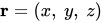
However, the theories sharply differ in their predictions in terms of the relation between three-accelerations measured in different inertial frames. In Newtonian mechanics, time is absolute by in accordance with the Galilean transformation, therefore the three-acceleration derived from it is equal too in all inertial frames:

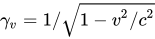
On the contrary in SR, both and depend on the Lorentz transformation, therefore also three-acceleration and its components vary in different inertial frames. When the relative velocity between the frames is directed in the x-direction by with as Lorentz factor, the Lorentz transformation has the form


Acceleration (special relativity)
Accelerations in special relativity (SR) follow, as in Newtonian mechanics, by differentiation of velocity with respect to time. However, because of the Lorentz transformation and time dilation, the concepts of time and distance become more complex, which also leads to more complex definitions of "acceleration".
One can derive transformation formulas for ordinary accelerations in three spatial dimensions (three-acceleration or coordinate acceleration) as measured in an external inertial frame of reference, as well as for the special case of proper acceleration measured by a comoving accelerometer. Another useful formalism is four-acceleration, as its components can be connected in different inertial frames by a Lorentz transformation. Also equations of motion can be formulated which connect acceleration and force.
Equations for several forms of acceleration of bodies and their curved world lines follow from these formulas by integration. Well known special cases are hyperbolic motion for constant longitudinal proper acceleration or uniform circular motion. Eventually, it is also possible to describe these phenomena in accelerated frames in the context of special relativity, see Proper reference frame (flat spacetime). In such frames, effects arise which are analogous to homogeneous gravitational fields, which have some formal similarities to the real, inhomogeneous gravitational fields of curved spacetime in general relativity. In the case of hyperbolic motion one can use Rindler coordinates, in the case of uniform circular motion one can use Born coordinates.
Concerning the historical development, relativistic equations containing accelerations can already be found in the early years of relativity, as summarized in early textbooks by Max von Laue (1911, 1921) or Wolfgang Pauli (1921). For instance, equations of motion and acceleration transformations were developed in the papers of Hendrik Antoon Lorentz (1899, 1904), Henri Poincaré (1905), Albert Einstein (1905), Max Planck (1906), and four-acceleration, proper acceleration, hyperbolic motion, accelerating reference frames, Born rigidity, have been analyzed by Einstein (1907), Hermann Minkowski (1907, 1908), Max Born (1909), Gustav Herglotz (1909), Arnold Sommerfeld (1910), von Laue (1911), Friedrich Kottler (1912, 1914), see section on history.
SR as the theory of flat Minkowski spacetime remains valid in the presence of accelerations, because general relativity (GR) is only required when there is curvature of spacetime caused by the energy–momentum tensor (which is mainly determined by mass). However, since the amount of spacetime curvature is not particularly high on Earth or its vicinity, SR remains valid for most practical purposes, such as experiments in particle accelerators.
In accordance with both Newtonian mechanics and SR, three-acceleration or coordinate acceleration is the first derivative of velocity with respect to coordinate time or the second derivative of the location with respect to coordinate time:
However, the theories sharply differ in their predictions in terms of the relation between three-accelerations measured in different inertial frames. In Newtonian mechanics, time is absolute by in accordance with the Galilean transformation, therefore the three-acceleration derived from it is equal too in all inertial frames:
On the contrary in SR, both and depend on the Lorentz transformation, therefore also three-acceleration and its components vary in different inertial frames. When the relative velocity between the frames is directed in the x-direction by with as Lorentz factor, the Lorentz transformation has the form