
Recent from talks
Acorus calamus
Knowledge base stats:
Talk channels stats:
Members stats:
Acorus calamus
Acorus calamus (also called sweet flag, sway or muskrat root, among many other common names) is a species of flowering plant. It is a tall wetland monocot of the family Acoraceae, in the genus Acorus. Although used in traditional medicine over centuries to treat digestive disorders and pain, it has no clinical evidence of safety or efficacy and may be toxic if ingested, and so has been commercially banned for use in food in the United States.
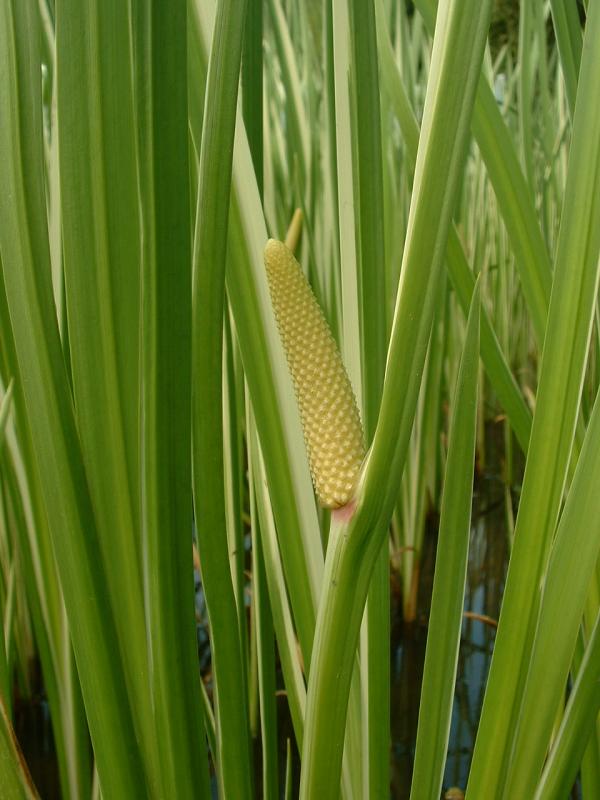
Sweet flag is a herbaceous perennial, 2 m (79 in) tall. Its leaves resemble those of the iris family. Sweet flag consists of tufts of basal leaves that rise from a spreading rhizome. The leaves are erect yellowish-brown, radical, with pink sheathing at their bases, sword-shaped, flat and narrow, tapering into a long, acute point, and have parallel veins. The leaves have smooth edges, which can be wavy or crimped. The sweet flag can be distinguished from iris and other similar plants by the crimped edges of the leaves, the fragrant odor it emits when crushed, and the presence of a spadix.
Only plants that grow in water bear flowers. The fruit is a berry filled with mucus, which when ripe falls into the water and disperses by floating. The solid, triangular flower-stems rise from the axils of the outer leaves. A semi-erect spadix emerges from one side of the flower stem. The spadix is solid, cylindrical, tapers at each end, and is 5 to 10 cm in length. A covering spathe, as is usual with Araceae, is absent. The spadix is densely crowded with tiny greenish-yellow flowers. Each flower contains six petals and stamens enclosed in a perianth with six divisions, surrounding a three-celled, oblong ovary with a sessile stigma. The flowers are sweetly fragrant. In Europe, it flowers for about a month in late spring or early summer, but does not bear fruit. In Asia, it also fruits sparingly, and propagates itself mainly by growth of its rhizome, forming colonies.
The branched, cylindrical, knobby rhizome is the thickness of a human finger and has numerous coarse fibrous roots below it. The exterior is brown and the interior white.
Sweet flag is native to the Irtysh River valley in Kazakhstan, but has been widely introduced worldwide. Habitats include edges of small lakes, ponds and rivers, marshes, swamps, and other wetlands.
In addition to "sweet flag" and "calamus" other common names include beewort, bitter pepper root, calamus root, flag root, gladdon, myrtle flag, myrtle grass, myrtle root, myrtle sedge, pine root, sea sedge, sweet cane, sweet cinnamon, sweet grass, sweet myrtle, sweet root, sweet rush, sweet sedge and wada kaha.
The generic name is the Latin word acorus, which is derived from the Greek άχόρου (áchórou) of Dioscorides (note different versions of the text have different spellings). The word άχόρου itself is thought to have been derived from the word κόρη (kóri), which means pupil (of an eye), because of the juice from the root of the plant being used as a remedy in diseases of the eye ('darkening of the pupil').
The specific name calamus is derived from Greek κάλαμος (kálamos, meaning "reed"), cognate to Latin culmus ("stalk") and Old English healm ("straw"), Arabic قَلَم (qálam, "pen"), in turn from Proto-Indo European *kole-mo- (thought to mean "grass" or "reed").[citation needed] The name "sweet flag" refers to its sweet scent and its similarity to Iris species, which have been commonly known as flags in English since at least the late fourteenth century.
Hub AI
Acorus calamus AI simulator
(@Acorus calamus_simulator)
Acorus calamus
Acorus calamus (also called sweet flag, sway or muskrat root, among many other common names) is a species of flowering plant. It is a tall wetland monocot of the family Acoraceae, in the genus Acorus. Although used in traditional medicine over centuries to treat digestive disorders and pain, it has no clinical evidence of safety or efficacy and may be toxic if ingested, and so has been commercially banned for use in food in the United States.
Sweet flag is a herbaceous perennial, 2 m (79 in) tall. Its leaves resemble those of the iris family. Sweet flag consists of tufts of basal leaves that rise from a spreading rhizome. The leaves are erect yellowish-brown, radical, with pink sheathing at their bases, sword-shaped, flat and narrow, tapering into a long, acute point, and have parallel veins. The leaves have smooth edges, which can be wavy or crimped. The sweet flag can be distinguished from iris and other similar plants by the crimped edges of the leaves, the fragrant odor it emits when crushed, and the presence of a spadix.
Only plants that grow in water bear flowers. The fruit is a berry filled with mucus, which when ripe falls into the water and disperses by floating. The solid, triangular flower-stems rise from the axils of the outer leaves. A semi-erect spadix emerges from one side of the flower stem. The spadix is solid, cylindrical, tapers at each end, and is 5 to 10 cm in length. A covering spathe, as is usual with Araceae, is absent. The spadix is densely crowded with tiny greenish-yellow flowers. Each flower contains six petals and stamens enclosed in a perianth with six divisions, surrounding a three-celled, oblong ovary with a sessile stigma. The flowers are sweetly fragrant. In Europe, it flowers for about a month in late spring or early summer, but does not bear fruit. In Asia, it also fruits sparingly, and propagates itself mainly by growth of its rhizome, forming colonies.
The branched, cylindrical, knobby rhizome is the thickness of a human finger and has numerous coarse fibrous roots below it. The exterior is brown and the interior white.
Sweet flag is native to the Irtysh River valley in Kazakhstan, but has been widely introduced worldwide. Habitats include edges of small lakes, ponds and rivers, marshes, swamps, and other wetlands.
In addition to "sweet flag" and "calamus" other common names include beewort, bitter pepper root, calamus root, flag root, gladdon, myrtle flag, myrtle grass, myrtle root, myrtle sedge, pine root, sea sedge, sweet cane, sweet cinnamon, sweet grass, sweet myrtle, sweet root, sweet rush, sweet sedge and wada kaha.
The generic name is the Latin word acorus, which is derived from the Greek άχόρου (áchórou) of Dioscorides (note different versions of the text have different spellings). The word άχόρου itself is thought to have been derived from the word κόρη (kóri), which means pupil (of an eye), because of the juice from the root of the plant being used as a remedy in diseases of the eye ('darkening of the pupil').
The specific name calamus is derived from Greek κάλαμος (kálamos, meaning "reed"), cognate to Latin culmus ("stalk") and Old English healm ("straw"), Arabic قَلَم (qálam, "pen"), in turn from Proto-Indo European *kole-mo- (thought to mean "grass" or "reed").[citation needed] The name "sweet flag" refers to its sweet scent and its similarity to Iris species, which have been commonly known as flags in English since at least the late fourteenth century.
Recent media