
Recent from talks
Ad orientem
Knowledge base stats:
Talk channels stats:
Members stats:
Ad orientem
Ad orientem, meaning 'to the east' in Ecclesiastical Latin, is a phrase used to describe the eastward orientation of Christian prayer and Christian worship, comprising the preposition ad (toward) and oriens (rising, sunrise, east), participle of orior (to rise).
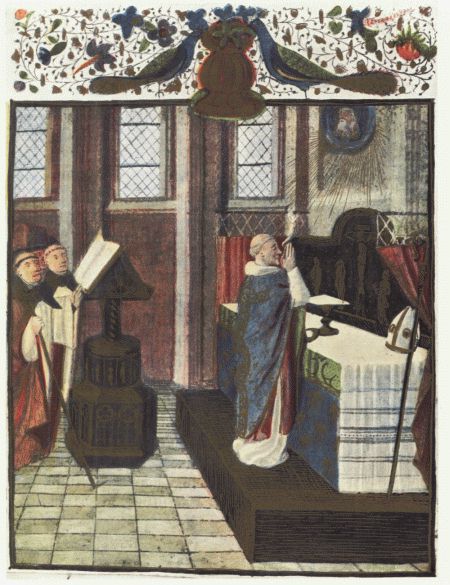
Ad orientem has been used to describe the eastward direction of prayer that the early Christians faced when praying, a practice that continues in the Eastern Orthodox Church, Oriental Orthodox churches, Mar Thoma Syrian Church, Assyrian Church of the East, as well as the Eastern Catholic and Eastern Lutheran churches. It was normative in the Roman Catholic Church until the 1960s,[dubious – discuss] and remains so in the Tridentine Mass; some Lutheran and Anglican churches continue to offer their respective liturgies ad orientem. Although the Second Vatican Council never ordered any change from ad orientem to versus populum, a posture facing the people, in the aftermath of the council the change was nevertheless widespread and became the norm. Ad orientem was never forbidden, however: the Pauline Missal, indeed, presumes that Mass is said ad orientem in its rubrics, indicating that in the celebration of the Mass the priestly celebrant faces the altar with his back to the congregants, so that they all face in the same direction.
Since the time of the Early Church, the eastward direction of Christian prayer has carried a strong significance, attested by the writings of the Church Fathers. In the 2nd century, Syrian Christians hung a Christian cross on the eastern wall of their houses, symbolizing "their souls facing God, talking with him, and sharing their spirituality with the Lord". Two centuries later, Saint Basil the Great declared that "facing the east to pray was among the oldest unwritten laws of the Church". Nearly all Christian apologetic tracts published in the 7th century in the Syriac and Arabic languages explained that Christians prayed facing the east because "the Garden of Eden was planted in the east (Genesis 2:8) and ... at the end of time, at the second coming, the Messiah would approach Jerusalem from the east."
Parishes of the Coptic Church, a church of Oriental Orthodox Christianity, are designed to face east and efforts are made to remodel churches obtained from other Christian denominations that are not built in this fashion.
In the time of the early Church, the eastward direction of Christian prayer was the standard and carried a strong significance, attested by the writings of the Church Fathers.
The eastward direction of prayer among early Christians is a custom inherited from the Jews. At the time of the formation of Christianity, Jews commonly prayed not only towards the Temple of Solomon, where the presence of the transcendent God (shekinah) [resided] in the Holy of Holies of the Temple, but also toward the east, although to what extent this practice was widespread is disputed. After the Temple was destroyed, synagogical liturgy continued the practice of praying in that direction, "inseparably bound up with the messianic expectation of Israel." Some rabbinic traditions encouraged Jews to construct synagogues with their entrances facing east, in imitation of the Temple of Jerusalem following its destruction, although this guideline was only sporadically implemented in practice. It was the practice, Paul F. Bradshaw says, of the Jewish sects of the Essenes and the Therapeutae, for whom "the eastward prayer had acquired an eschatological dimension, the 'fine bright day' for which the Therapeutae prayed being apparently the messianic age and the Essene prayer towards the sun 'as though beseeching him to rise' being a petition for the coming of the priestly Messiah." Eventually, a "process of mutual stimulus and disaffection" between Jews and early Christians seems to have brought about the end of Jewish prayer towards the east, and Christian prayer towards Jerusalem. The Islamic practice of praying initially towards Jerusalem, as well as the concept of praying in a certain direction, is derived from the Jewish practice, which was ubiquitous among the Jewish communities of Syria, Palestine, Yathrib and Yemen.
Additionally, the Christian custom of praying towards the east may have roots in the practice of the earliest Christians in Jerusalem of praying towards the Mount of Olives, to the east of the city, which they saw as the locus of key eschatological events and especially of the awaited Second Coming of Christ. Although the localization of the Second Coming on the Mount of Olives was abandoned after the destruction of Jerusalem in AD 70, the eastward direction of Christian prayer was retained and became general throughout Christendom.
Early Christians, who were largely persecuted, usually worshipped in house churches, and the Eucharist was never exposed to non-Christians. The church-hall, according to the evidence found at Dura-Europos, was oblong, with the people facing the eastern wall, where there was a platform where the table-altar of the Eucharist was offered by the presbyter/priest, who also apparently faced east. Images of biblical scenes and figures, including that of Christ, adorned the walls, including the eastern wall. In the 2nd century, Syrian Christians indicated the direction in which to pray by placing a cross on the eastern wall of their house or church, a direction that symbolized "their souls facing God, talking with him, and sharing their spirituality with the Lord." Believers turned towards it to pray at fixed prayer times, such as in the morning, evening and other parts of the day; this practice continues among some Christians today, along with the related custom of Christian families erecting their home altar or icon corner on the east wall of their dwellings.
Hub AI
Ad orientem AI simulator
(@Ad orientem_simulator)
Ad orientem
Ad orientem, meaning 'to the east' in Ecclesiastical Latin, is a phrase used to describe the eastward orientation of Christian prayer and Christian worship, comprising the preposition ad (toward) and oriens (rising, sunrise, east), participle of orior (to rise).
Ad orientem has been used to describe the eastward direction of prayer that the early Christians faced when praying, a practice that continues in the Eastern Orthodox Church, Oriental Orthodox churches, Mar Thoma Syrian Church, Assyrian Church of the East, as well as the Eastern Catholic and Eastern Lutheran churches. It was normative in the Roman Catholic Church until the 1960s,[dubious – discuss] and remains so in the Tridentine Mass; some Lutheran and Anglican churches continue to offer their respective liturgies ad orientem. Although the Second Vatican Council never ordered any change from ad orientem to versus populum, a posture facing the people, in the aftermath of the council the change was nevertheless widespread and became the norm. Ad orientem was never forbidden, however: the Pauline Missal, indeed, presumes that Mass is said ad orientem in its rubrics, indicating that in the celebration of the Mass the priestly celebrant faces the altar with his back to the congregants, so that they all face in the same direction.
Since the time of the Early Church, the eastward direction of Christian prayer has carried a strong significance, attested by the writings of the Church Fathers. In the 2nd century, Syrian Christians hung a Christian cross on the eastern wall of their houses, symbolizing "their souls facing God, talking with him, and sharing their spirituality with the Lord". Two centuries later, Saint Basil the Great declared that "facing the east to pray was among the oldest unwritten laws of the Church". Nearly all Christian apologetic tracts published in the 7th century in the Syriac and Arabic languages explained that Christians prayed facing the east because "the Garden of Eden was planted in the east (Genesis 2:8) and ... at the end of time, at the second coming, the Messiah would approach Jerusalem from the east."
Parishes of the Coptic Church, a church of Oriental Orthodox Christianity, are designed to face east and efforts are made to remodel churches obtained from other Christian denominations that are not built in this fashion.
In the time of the early Church, the eastward direction of Christian prayer was the standard and carried a strong significance, attested by the writings of the Church Fathers.
The eastward direction of prayer among early Christians is a custom inherited from the Jews. At the time of the formation of Christianity, Jews commonly prayed not only towards the Temple of Solomon, where the presence of the transcendent God (shekinah) [resided] in the Holy of Holies of the Temple, but also toward the east, although to what extent this practice was widespread is disputed. After the Temple was destroyed, synagogical liturgy continued the practice of praying in that direction, "inseparably bound up with the messianic expectation of Israel." Some rabbinic traditions encouraged Jews to construct synagogues with their entrances facing east, in imitation of the Temple of Jerusalem following its destruction, although this guideline was only sporadically implemented in practice. It was the practice, Paul F. Bradshaw says, of the Jewish sects of the Essenes and the Therapeutae, for whom "the eastward prayer had acquired an eschatological dimension, the 'fine bright day' for which the Therapeutae prayed being apparently the messianic age and the Essene prayer towards the sun 'as though beseeching him to rise' being a petition for the coming of the priestly Messiah." Eventually, a "process of mutual stimulus and disaffection" between Jews and early Christians seems to have brought about the end of Jewish prayer towards the east, and Christian prayer towards Jerusalem. The Islamic practice of praying initially towards Jerusalem, as well as the concept of praying in a certain direction, is derived from the Jewish practice, which was ubiquitous among the Jewish communities of Syria, Palestine, Yathrib and Yemen.
Additionally, the Christian custom of praying towards the east may have roots in the practice of the earliest Christians in Jerusalem of praying towards the Mount of Olives, to the east of the city, which they saw as the locus of key eschatological events and especially of the awaited Second Coming of Christ. Although the localization of the Second Coming on the Mount of Olives was abandoned after the destruction of Jerusalem in AD 70, the eastward direction of Christian prayer was retained and became general throughout Christendom.
Early Christians, who were largely persecuted, usually worshipped in house churches, and the Eucharist was never exposed to non-Christians. The church-hall, according to the evidence found at Dura-Europos, was oblong, with the people facing the eastern wall, where there was a platform where the table-altar of the Eucharist was offered by the presbyter/priest, who also apparently faced east. Images of biblical scenes and figures, including that of Christ, adorned the walls, including the eastern wall. In the 2nd century, Syrian Christians indicated the direction in which to pray by placing a cross on the eastern wall of their house or church, a direction that symbolized "their souls facing God, talking with him, and sharing their spirituality with the Lord." Believers turned towards it to pray at fixed prayer times, such as in the morning, evening and other parts of the day; this practice continues among some Christians today, along with the related custom of Christian families erecting their home altar or icon corner on the east wall of their dwellings.
Recent media