Hubbry Logo
Additive functionAdditive functionMain
Open search
Additive function
Community hub
Additive function
logo
7 pages, 0 posts
0 subscribers
Be the first to start a discussion here.
Additive function
Additive function
from Wikipedia

In number theory, an additive function is an arithmetic function f(n) of the positive integer variable n such that whenever a and b are coprime, the function applied to the product ab is the sum of the values of the function applied to a and b:[1]

Completely additive

[edit]

An additive function f(n) is said to be completely additive if holds for all positive integers a and b, even when they are not coprime. Totally additive is also used in this sense by analogy with totally multiplicative functions. If f is a completely additive function then f(1) = 0.

Every completely additive function is additive, but not vice versa.

Examples

[edit]

Examples of arithmetic functions which are completely additive are:

  • The restriction of the logarithmic function to
  • The multiplicity of a prime factor p in n, that is the largest exponent m for which pm divides n.
  • a0(n) – the sum of primes dividing n counting multiplicity, sometimes called sopfr(n), the potency of n or the integer logarithm of n (sequence A001414 in the OEIS). For example:
a0(4) = 2 + 2 = 4
a0(20) = a0(22 · 5) = 2 + 2 + 5 = 9
a0(27) = 3 + 3 + 3 = 9
a0(144) = a0(24 · 32) = a0(24) + a0(32) = 8 + 6 = 14
a0(2000) = a0(24 · 53) = a0(24) + a0(53) = 8 + 15 = 23
a0(2003) = 2003
a0(54,032,858,972,279) = 1240658
a0(54,032,858,972,302) = 1780417
a0(20,802,650,704,327,415) = 1240681
  • The function Ω(n), defined as the total number of prime factors of n, counting multiple factors multiple times, sometimes called the "Big Omega function" (sequence A001222 in the OEIS). For example;
Ω(1) = 0, since 1 has no prime factors
Ω(4) = 2
Ω(16) = Ω(2·2·2·2) = 4
Ω(20) = Ω(2·2·5) = 3
Ω(27) = Ω(3·3·3) = 3
Ω(144) = Ω(24 · 32) = Ω(24) + Ω(32) = 4 + 2 = 6
Ω(2000) = Ω(24 · 53) = Ω(24) + Ω(53) = 4 + 3 = 7
Ω(2001) = 3
Ω(2002) = 4
Ω(2003) = 1
Ω(54,032,858,972,279) = Ω(11 ⋅ 19932 ⋅ 1236661) = 4
Ω(54,032,858,972,302) = Ω(2 ⋅ 72 ⋅ 149 ⋅ 2081 ⋅ 1778171) = 6
Ω(20,802,650,704,327,415) = Ω(5 ⋅ 7 ⋅ 112 ⋅ 19932 ⋅ 1236661) = 7.

Examples of arithmetic functions which are additive but not completely additive are:

ω(4) = 1
ω(16) = ω(24) = 1
ω(20) = ω(22 · 5) = 2
ω(27) = ω(33) = 1
ω(144) = ω(24 · 32) = ω(24) + ω(32) = 1 + 1 = 2
ω(2000) = ω(24 · 53) = ω(24) + ω(53) = 1 + 1 = 2
ω(2001) = 3
ω(2002) = 4
ω(2003) = 1
ω(54,032,858,972,279) = 3
ω(54,032,858,972,302) = 5
ω(20,802,650,704,327,415) = 5
  • a1(n) – the sum of the distinct primes dividing n, sometimes called sopf(n) (sequence A008472 in the OEIS). For example:
a1(1) = 0
a1(4) = 2
a1(20) = 2 + 5 = 7
a1(27) = 3
a1(144) = a1(24 · 32) = a1(24) + a1(32) = 2 + 3 = 5
a1(2000) = a1(24 · 53) = a1(24) + a1(53) = 2 + 5 = 7
a1(2001) = 55
a1(2002) = 33
a1(2003) = 2003
a1(54,032,858,972,279) = 1238665
a1(54,032,858,972,302) = 1780410
a1(20,802,650,704,327,415) = 1238677

Multiplicative functions

[edit]

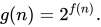
From any additive function it is possible to create a related multiplicative function which is a function with the property that whenever and are coprime then: One such example is Likewise if is completely additive, then is completely multiplicative. More generally, we could consider the function , where is a nonzero real constant.

Summatory functions

[edit]

Given an additive function , let its summatory function be defined by . The average of is given exactly as


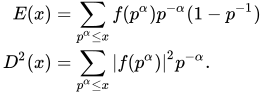
The summatory functions over can be expanded as where

The average of the function is also expressed by these functions as

There is always an absolute constant such that for all natural numbers ,

Let

Suppose that is an additive function with such that as ,

Then where is the Gaussian distribution function

Examples of this result related to the prime omega function and the numbers of prime divisors of shifted primes include the following for fixed where the relations hold for :

See also

[edit]

References

[edit]

Further reading

[edit]
Revisions and contributorsEdit on WikipediaRead on Wikipedia
from Grokipedia
In , an additive function is a function f:GHf: G \to H between abelian groups GG and HH that satisfies the f(x+y)=f(x)+f(y)f(x + y) = f(x) + f(y) for all x,yGx, y \in G. These functions preserve the additive structure of the domain and are fundamental in areas such as , linear algebra, and . When the domain and codomain are the real numbers R\mathbb{R}, additive functions form a vector space over the rationals Q\mathbb{Q}, and under the assumption of continuity (or other regularity conditions like measurability or monotonicity), all such functions are linear, i.e., of the form f(x)=cxf(x) = cx for some constant cRc \in \mathbb{R}. However, without such regularity assumptions and relying on the , there exist highly pathological additive functions that are not linear over R\mathbb{R}; these are constructed using a Hamel basis for R\mathbb{R} as a over Q\mathbb{Q}, which allows for arbitrary assignments of values on the basis elements while preserving additivity. Such non-measurable solutions highlight the distinction between intuitive linearity and the full scope of solutions to Cauchy's equation, and they play a role in counterexamples in . Additive functions also appear in broader contexts, such as additive group homomorphisms or in the study of arithmetical functions where additivity refers to f(mn)=f(m)+f(n)f(mn) = f(m) + f(n) for coprime positive integers mm and nn, though these are distinct from the general group-theoretic notion.

Definitions and Properties

Additive functions

In the context of , the term "additive function" refers to a class of arithmetic functions defined on the positive integers, distinct from the notion in where additive functions satisfy f(x+y)=f(x)+f(y)f(x + y) = f(x) + f(y) for all real numbers xx and yy. An f:NCf: \mathbb{N} \to \mathbb{C} is additive if f(mn)=f(m)+f(n)f(mn) = f(m) + f(n) whenever mm and nn are coprime positive integers, i.e., gcd(m,n)=1\gcd(m, n) = 1. A key property of additive functions is that f(1)=0f(1) = 0, which follows directly from the definition since gcd(1,n)=1\gcd(1, n) = 1 for any nn, yielding f(n)=f(1n)=f(1)+f(n)f(n) = f(1 \cdot n) = f(1) + f(n). Moreover, such functions are uniquely determined by their values on prime powers pkp^k, where pp is prime and k1k \geq 1. If n=ipikin = \prod_{i} p_i^{k_i} is the prime factorization of nn, then additivity implies f(n)=if(piki),f(n) = \sum_i f(p_i^{k_i}), as the prime power factors are pairwise coprime. The concept of additive functions in was introduced by and Aurel Wintner in 1939, in their work on the asymptotic distribution of such functions. Completely additive functions, a stricter subclass, satisfy f(mn)=f(m)+f(n)f(mn) = f(m) + f(n) for all positive integers mm and nn, without the coprimality requirement.

Completely additive functions

In , a completely additive ff is defined as a function from the positive integers to the complex numbers satisfying f(mn)=f(m)+f(n)f(mn) = f(m) + f(n) for all positive integers mm and nn. This condition is stronger than that for additive functions, which require the equality only when mm and nn are coprime. From the definition, it follows immediately that f(1)=0f(1) = 0, since f(1)=f(11)=f(1)+f(1)f(1) = f(1 \cdot 1) = f(1) + f(1). Every completely additive function is additive, as the universal additivity holds in particular for coprime arguments. However, the converse fails: there exist additive functions that are not completely additive. A distinctive structural property of completely additive functions is their behavior on prime powers: for any prime pp and positive integer k1k \geq 1, f(pk)=kf(p)f(p^k) = k f(p). This relation arises by repeated application of the defining equation, yielding f(pk)=f(pk1p)=f(pk1)+f(p)==kf(p)f(p^k) = f(p^{k-1} \cdot p) = f(p^{k-1}) + f(p) = \cdots = k f(p). For a general positive nn with prime n=ppkn = \prod_p p^k , where the product is over primes pp dividing nn and k1k \geq 1 is the exponent of pp, the value is given by f(n)=pknkf(p).f(n) = \sum_{p^k \| n} k f(p). This expression links f(n)f(n) directly to the total number of prime factors of nn counted with multiplicity, denoted Ω(n)=k\Omega(n) = \sum k, but weighted by the function values f(p)f(p) at each distinct prime. Consequently, every completely additive function is uniquely determined by its values on the primes; specifying f(p)f(p) arbitrarily for each prime pp extends the function to all positive integers via the above formula. For instance, the additivity ensures f(pq)=f(p)+f(q)f(pq) = f(p) + f(q) for distinct primes pp and qq, consistent with the broader property holding even when arguments are not coprime.

Characterization and Relations

Prime power decomposition

For an additive arithmetic function f:NCf: \mathbb{N} \to \mathbb{C}, the prime power decomposition arises from the unique prime factorization theorem, allowing the function's value at any positive integer nn to be expressed solely in terms of its values at s. Specifically, if n=i=1rpikin = \prod_{i=1}^r p_i^{k_i} where the pip_i are distinct primes and each ki1k_i \geq 1, then the s pikip_i^{k_i} are pairwise coprime, so f(n)=i=1rf(piki).f(n) = \sum_{i=1}^r f(p_i^{k_i}). This formula holds because the additivity property f(mn)=f(m)+f(n)f(mn) = f(m) + f(n) whenever gcd(m,n)=1\gcd(m,n)=1 applies directly to the product of these coprime factors. The decomposition demonstrates that any additive function ff is fully determined by specifying its values f(pk)f(p^k) arbitrarily for every prime pp and positive k1k \geq 1, with no further restrictions imposed by the additivity condition. This freedom contrasts with the stricter structure of completely additive functions, where f(pk)=kf(p)f(p^k) = k f(p) for all primes pp and k1k \geq 1, leading to the simplified form f(n)=i=1rkif(pi)f(n) = \sum_{i=1}^r k_i f(p_i). In general additive functions, however, the values f(pk)f(p^k) need not scale linearly with kk, allowing greater flexibility in defining the function on powers of individual primes. This prime power decomposition follows from repeated application of the coprime additivity property: starting with two coprime factors and inducting over the number of distinct primes in the . For illustration, consider n=12=223n = 12 = 2^2 \cdot 3; here, f(12)=f(22)+f(3)f(12) = f(2^2) + f(3), without requiring any specific relation between f(22)f(2^2) and f(2)f(2).

Connection to multiplicative functions

In the theory of arithmetic functions, a key connection between additive and multiplicative functions arises through . If ff is an additive function, meaning f(mn)=f(m)+f(n)f(mn) = f(m) + f(n) whenever gcd(m,n)=1\gcd(m, n) = 1, then for any constant c>0c > 0, the function g(n)=cf(n)g(n) = c^{f(n)} is multiplicative. This holds because, for coprime mm and nn, g(mn)=cf(mn)=cf(m)+f(n)=cf(m)cf(n)=g(m)g(n).g(mn) = c^{f(mn)} = c^{f(m) + f(n)} = c^{f(m)} \cdot c^{f(n)} = g(m) g(n). Such transformations leverage the prime power decomposition inherent to additive functions. When ff is completely additive, satisfying f(mn)=f(m)+f(n)f(mn) = f(m) + f(n) for all positive integers mm and nn, the corresponding g(n)=cf(n)g(n) = c^{f(n)} becomes completely multiplicative, as the equality g(mn)=g(m)g(n)g(mn) = g(m) g(n) extends beyond coprime arguments. The inverse relation also establishes a duality: the natural logarithm of a completely multiplicative function is completely additive. For a completely multiplicative gg with g(pk)=g(p)kg(p^k) = g(p)^k for each prime pp and positive integer kk, logg(n)=pklogg(p),\log g(n) = \sum_p k \log g(p), where the sum is over the exponents kk in the prime factorization of nn, preserving complete additivity. This interplay between addition and multiplication through exponentials and logarithms proves valuable in , particularly for analyzing , where multiplicative functions admit Euler product expansions that correspond to sums involving their additive logarithmic counterparts.

Examples and Constructions

Completely additive examples

One prominent example of a completely additive arithmetic function is the big omega function Ω(n)\Omega(n), which counts the total number of prime factors of a positive nn with multiplicity. For a pkp^k, Ω(pk)=k\Omega(p^k) = k, and thus for n=pikin = \prod p_i^{k_i}, Ω(n)=ki\Omega(n) = \sum k_i. This satisfies Ω(mn)=Ω(m)+Ω(n)\Omega(mn) = \Omega(m) + \Omega(n) for all positive integers mm and nn, regardless of coprimality. For instance, Ω(12)=Ω(223)=2+1=3\Omega(12) = \Omega(2^2 \cdot 3) = 2 + 1 = 3, and the values of Ω(n)\Omega(n) form the sequence A001222 in the Online Encyclopedia of Integer Sequences. Another fundamental completely additive function is the natural logarithm f(n)=lognf(n) = \log n, which arises from the property log(mn)=logm+logn\log(mn) = \log m + \log n holding for all positive integers mm and nn. In terms of prime factorization, logn=pknklogp\log n = \sum_{p^k \| n} k \log p, reflecting its complete additivity over the exponents. For n=20=225n = 20 = 2^2 \cdot 5, log202.9957\log 20 \approx 2.9957. More generally, any completely additive function ff is uniquely determined by its values on primes, with f(pk)=kf(p)f(p^k) = k f(p) for each prime pp and positive integer kk. If f(p)=1f(p) = 1 for all primes pp, then f(n)=Ω(n)f(n) = \Omega(n). If instead f(p)=pf(p) = p for each prime pp, the resulting function f(n)=pknkpf(n) = \sum_{p^k \| n} k p computes the sum of the prime factors of nn counted with multiplicity; for n=20=225n = 20 = 2^2 \cdot 5, this yields f(20)=22+15=9f(20) = 2 \cdot 2 + 1 \cdot 5 = 9.

Additive but not completely additive examples

A prominent example of an additive arithmetic function that is not completely additive is the ω(n)\omega(n), which counts the number of distinct prime factors of a positive nn. For any pkp^k with k1k \geq 1, ω(pk)=1\omega(p^k) = 1, as there is only one distinct prime involved. This function satisfies additivity because if mm and nn are coprime, their prime factors are disjoint, so ω(mn)=ω(m)+ω(n)\omega(mn) = \omega(m) + \omega(n). However, it fails complete additivity, since ω(p2)=12=ω(p)+ω(p)\omega(p^2) = 1 \neq 2 = \omega(p) + \omega(p) for any prime pp. For instance, ω(4)=ω(22)=1\omega(4) = \omega(2^2) = 1, but ω(2)+ω(2)=2\omega(2) + \omega(2) = 2. Another illustrative example is the sum of distinct prime factors function, often denoted sopf(n)\mathrm{sopf}(n) or a1(n)a_1(n), which sums the distinct primes dividing nn. It is defined such that sopf(pk)=p\mathrm{sopf}(p^k) = p for each prime pp and k1k \geq 1. Additivity holds for coprime arguments because the sets of distinct primes are disjoint, yielding sopf(mn)=sopf(m)+sopf(n)\mathrm{sopf}(mn) = \mathrm{sopf}(m) + \mathrm{sopf}(n) when gcd(m,n)=1\gcd(m,n) = 1. Yet, complete additivity does not, as sopf(p2)=p2p=sopf(p)+sopf(p)\mathrm{sopf}(p^2) = p \neq 2p = \mathrm{sopf}(p) + \mathrm{sopf}(p). To see this in action, consider n=12=223n=12=2^2 \cdot 3: sopf(12)=sopf(4)+sopf(3)=2+3=5\mathrm{sopf}(12) = \mathrm{sopf}(4) + \mathrm{sopf}(3) = 2 + 3 = 5, but sopf(4)=24=2sopf(2)\mathrm{sopf}(4) = 2 \neq 4 = 2 \cdot \mathrm{sopf}(2). In general, additive but not completely additive functions can be constructed by arbitrarily assigning values to f(pk)f(p^k) for each prime pp and exponent k1k \geq 1, ensuring the additivity condition holds via the decomposition while violating the complete additivity requirement for at least one . For a concrete arbitrary example, define f(2k)=k2f(2^k) = k^2, f(3k)=kf(3^k) = k, and f(pk)=0f(p^k) = 0 for all other primes p>3p > 3 and k1k \geq 1. This ff is additive, as values depend only on the distinct primes in the , but f(4)=f(22)=42=2f(2)f(4) = f(2^2) = 4 \neq 2 = 2 \cdot f(2), confirming it is not completely additive. Such constructions highlight the flexibility of additive functions beyond the stricter linearity of completely additive ones. The ω(n)\omega(n) exemplifies that additivity does not imply complete additivity, serving as a to the converse implication.

Analytic Aspects

Summatory functions

The summatory function of an additive arithmetic function ff is defined as Sf(x)=nxf(n),S_f(x) = \sum_{n \leq x} f(n), where the sum is over all positive integers nn up to the real number xx. This function captures the cumulative behavior of ff and is central to studying its average order and distribution properties. For an ff, the unique decomposition of integers allows the summatory function to be expressed explicitly in terms of contributions from each . Specifically, Sf(x)=pk1f(pk)(xpkxpk+1),S_f(x) = \sum_p \sum_{k \geq 1} f(p^k) \left( \left\lfloor \frac{x}{p^k} \right\rfloor - \left\lfloor \frac{x}{p^{k+1}} \right\rfloor \right), where the outer sum is over all primes pp. This formula arises because the term x/pkx/pk+1\left\lfloor x / p^k \right\rfloor - \left\lfloor x / p^{k+1} \right\rfloor counts the number of integers nxn \leq x for which the exact exponent of pp in the of nn is kk, and ff adds f(pk)f(p^k) independently for each such prime due to additivity. For completely additive functions, where f(pk)=kf(p)f(p^k) = k f(p) for each prime pp and k1k \geq 1, the inner sum simplifies further. Substituting this relation yields Sf(x)=pf(p)k1k(xpkxpk+1).S_f(x) = \sum_p f(p) \sum_{k \geq 1} k \left( \left\lfloor \frac{x}{p^k} \right\rfloor - \left\lfloor \frac{x}{p^{k+1}} \right\rfloor \right). The double difference telescopes to k1x/pk\sum_{k \geq 1} \left\lfloor x / p^k \right\rfloor, providing an equivalent form Sf(x)=pf(p)k1x/pkS_f(x) = \sum_p f(p) \sum_{k \geq 1} \left\lfloor x / p^k \right\rfloor, which emphasizes the role of higher prime powers in the total sum. The average order of ff, given by Sf(x)/xS_f(x)/x, often approximates pxf(p)/p\sum_{p \leq x} f(p)/p for many additive functions, particularly those where higher powers contribute negligibly compared to the linear terms in the . This reflects the dominant influence of primes up to xx in the , as seen in cases like the number of distinct prime factors.

Dirichlet series representations

For an additive ff, defined such that f(mn)=f(m)+f(n)f(mn) = f(m) + f(n) whenever gcd(m,n)=1\gcd(m,n) = 1, the associated is given by Df(s)=n=1f(n)ns=p(k=0f(pk)pks),D_f(s) = \sum_{n=1}^\infty \frac{f(n)}{n^s} = \prod_p \left( \sum_{k=0}^\infty \frac{f(p^k)}{p^{ks}} \right), where the product is over all primes pp, and f(1)=0f(1) = 0. This Euler product representation holds because the unique prime factorization of integers allows the series to factor into independent local factors at each prime, with convergence typically in the half-plane Re(s)>1\operatorname{Re}(s) > 1 for functions like the logarithm or bounded growth on primes. In the completely additive case, where f(mn)=f(m)+f(n)f(mn) = f(m) + f(n) for all positive integers m,nm, n, the values satisfy f(pk)=kf(p)f(p^k) = k f(p) for each prime pp and k1k \geq 1. The local factor then simplifies to k=1f(pk)pks=f(p)k=1kpks=f(p)ps(1ps)2,\sum_{k=1}^\infty \frac{f(p^k)}{p^{ks}} = f(p) \sum_{k=1}^\infty k p^{-ks} = f(p) \frac{p^{-s}}{(1 - p^{-s})^2}, yielding the full as p(f(p)ps(1ps)2)\prod_p \left( f(p) \frac{p^{-s}}{(1 - p^{-s})^2} \right), again converging for Re(s)>1\operatorname{Re}(s) > 1 under suitable growth conditions on f(p)f(p). This form highlights the connection to derivatives of and facilitates analytic continuations in specific examples. A prominent example of a function with a simple Dirichlet series representation is the Λ(n)\Lambda(n), defined as Λ(n)=logp\Lambda(n) = \log p if n=pkn = p^k for some prime pp and k1k \geq 1, and Λ(n)=0\Lambda(n) = 0 otherwise. Its Dirichlet series is n=1Λ(n)ns=ζ(s)ζ(s),\sum_{n=1}^\infty \frac{\Lambda(n)}{n^s} = -\frac{\zeta'(s)}{\zeta(s)}, where ζ(s)\zeta(s) is the ; this relation arises from taking the of the Euler product for ζ(s)\zeta(s), providing a key link in to the properties of ζ(s)\zeta(s). These representations extend to more general L-functions and play a crucial role in modern , particularly in methods for estimating prime gaps and distributions of primes in arithmetic progressions, as developed in frameworks combining with .
Add your contribution
Related Hubs
User Avatar
No comments yet.