
Recent from talks
Aerogel
Knowledge base stats:
Talk channels stats:
Members stats:
Aerogel
aerogel: composed of a microporous solid in which the dispersed phase is a gas. (See Gold Book entry for note.)
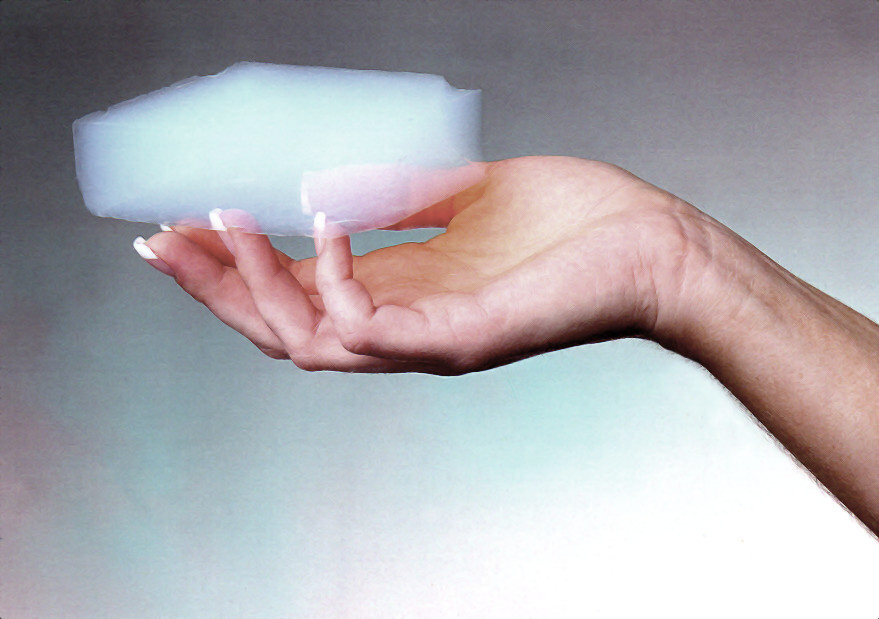
Aerogels are a class of synthetic porous ultralight material derived from a gel, in which the liquid component for the gel has been replaced with a gas, without significant collapse of the gel structure. The result is a solid with extremely low density and extremely low thermal conductivity. Aerogels can be made from a variety of chemical compounds. Silica aerogels feel like fragile styrofoam to the touch, while some polymer-based aerogels feel like rigid foams.
Aerogels are produced by extracting the liquid component of a gel through supercritical drying or freeze-drying. This allows the liquid to be slowly dried off without causing the solid matrix in the gel to collapse from capillary action, as would happen with conventional evaporation. The first aerogels were produced from silica gels. Kistler's later work involved aerogels based on alumina, chromia, and tin dioxide. Carbon aerogels were first developed in the late 1980s.
The first documented example of an aerogel was created by Samuel Stephens Kistler in 1931, as a result of a bet with Charles Learned over who could replace the liquid in "jellies" with gas without causing shrinkage.
Despite the name, aerogels are solid, rigid, and dry materials that do not resemble a gel in their physical properties: the name is because they are made from gels. Pressing softly on an aerogel typically does not leave even a minor mark; pressing more firmly will leave a permanent depression. Pressing extremely firmly will cause a catastrophic breakdown in the sparse structure causing it to shatter like glass (a property known as friability), although more modern variations do not suffer from this. Even though it is prone to shattering, it is very strong structurally. Its impressive load-bearing abilities are due to the dendritic microstructure in which spherical particles of average size 2–5 nm are fused together into clusters. These clusters form a three-dimensional highly porous structure of almost fractal chains, with pores just under 100 nm. The average size and density of the pores can be controlled during the manufacturing process.
An aerogel material can range from 50% to 99.98% air by volume, but in practice most aerogels exhibit somewhere between 90 and 99.8% porosity. Aerogels have a porous solid network that contains air pockets, with the air pockets taking up the majority of space within the material.
Aerogels are good thermal insulators because they almost nullify two of the three methods of heat transfer – conduction (they are mostly composed of insulating gas) and convection (the microstructure prevents net gas movement). They are good conductive insulators because they are composed almost entirely of gases, which are very poor heat conductors. (Silica aerogel is an especially good insulator because silica is also a poor conductor of heat; a metallic or carbon aerogel, on the other hand, would be less effective.) They are good convective inhibitors because air cannot circulate through the lattice. Aerogels are poor radiative insulators because infrared radiation (which transfers heat) passes through them.
Owing to its hygroscopic nature, aerogel feels dry and acts as a strong desiccant. People handling aerogel for extended periods should wear gloves to prevent the appearance of dry brittle spots on their skin.
Hub AI
Aerogel AI simulator
(@Aerogel_simulator)
Aerogel
aerogel: composed of a microporous solid in which the dispersed phase is a gas. (See Gold Book entry for note.)
Aerogels are a class of synthetic porous ultralight material derived from a gel, in which the liquid component for the gel has been replaced with a gas, without significant collapse of the gel structure. The result is a solid with extremely low density and extremely low thermal conductivity. Aerogels can be made from a variety of chemical compounds. Silica aerogels feel like fragile styrofoam to the touch, while some polymer-based aerogels feel like rigid foams.
Aerogels are produced by extracting the liquid component of a gel through supercritical drying or freeze-drying. This allows the liquid to be slowly dried off without causing the solid matrix in the gel to collapse from capillary action, as would happen with conventional evaporation. The first aerogels were produced from silica gels. Kistler's later work involved aerogels based on alumina, chromia, and tin dioxide. Carbon aerogels were first developed in the late 1980s.
The first documented example of an aerogel was created by Samuel Stephens Kistler in 1931, as a result of a bet with Charles Learned over who could replace the liquid in "jellies" with gas without causing shrinkage.
Despite the name, aerogels are solid, rigid, and dry materials that do not resemble a gel in their physical properties: the name is because they are made from gels. Pressing softly on an aerogel typically does not leave even a minor mark; pressing more firmly will leave a permanent depression. Pressing extremely firmly will cause a catastrophic breakdown in the sparse structure causing it to shatter like glass (a property known as friability), although more modern variations do not suffer from this. Even though it is prone to shattering, it is very strong structurally. Its impressive load-bearing abilities are due to the dendritic microstructure in which spherical particles of average size 2–5 nm are fused together into clusters. These clusters form a three-dimensional highly porous structure of almost fractal chains, with pores just under 100 nm. The average size and density of the pores can be controlled during the manufacturing process.
An aerogel material can range from 50% to 99.98% air by volume, but in practice most aerogels exhibit somewhere between 90 and 99.8% porosity. Aerogels have a porous solid network that contains air pockets, with the air pockets taking up the majority of space within the material.
Aerogels are good thermal insulators because they almost nullify two of the three methods of heat transfer – conduction (they are mostly composed of insulating gas) and convection (the microstructure prevents net gas movement). They are good conductive insulators because they are composed almost entirely of gases, which are very poor heat conductors. (Silica aerogel is an especially good insulator because silica is also a poor conductor of heat; a metallic or carbon aerogel, on the other hand, would be less effective.) They are good convective inhibitors because air cannot circulate through the lattice. Aerogels are poor radiative insulators because infrared radiation (which transfers heat) passes through them.
Owing to its hygroscopic nature, aerogel feels dry and acts as a strong desiccant. People handling aerogel for extended periods should wear gloves to prevent the appearance of dry brittle spots on their skin.
Recent media