Hubbry Logo
Spring-loaded camming deviceSpring-loaded camming deviceMain
Open search
Spring-loaded camming device
Community hub
Spring-loaded camming device
logo
8 pages, 0 posts
0 subscribers
Be the first to start a discussion here.
Spring-loaded camming device
from Wikipedia
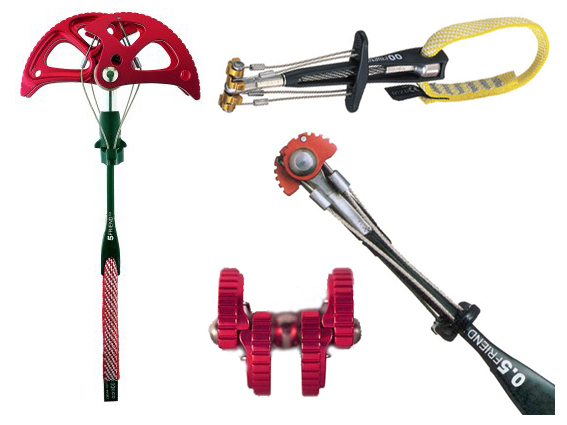
A selection of spring-loaded camming devices of differing sizes
Climbers often carry a large number of cams on traditional climbs.

A spring-loaded camming device (also SLCD, cam or friend) is a piece of rock climbing or mountaineering protection equipment. It consists of two, three, or four cams mounted on a common axle or two adjacent axles, so that pulling on the axle forces the cams to spread further apart. It is then attached to a sling and carabiner at the end of the stem. The SLCD is used by pulling on the "trigger" (a small handle) so that the cams retract together, then inserting it into a crack or pocket in the rock and releasing the trigger to allow the cams to expand. A pull on the rope, such as that generated by a climber falling, will cause a properly placed SLCD to convert the pulling force along the stem of the unit into outwards pressure on the rock, producing massive amounts of friction and preventing the removal of the unit from the rock. Due to the large forces exerted on the rock when an SLCD is fallen on, it is very important that SLCDs are only placed in solid, strong rock.[1]

History

[edit]

Vitaly Abalakov's invention of the Abalakov Cam was the first application to climbing of the principle of a cam to climbing equipment. His cams were sections cut out of a pulley wheel and bear a remarkable resemblance to today's tricams. Since these shapes were eccentric, the intercept angle of the cam changed as the cam rotates and expands.

In 1973, Greg Lowe filed for a patent for a cam that had a "constant intercept" angle. Using a logarithmic spiral[2] shape resulted in a uniform angle between the rock and each lobe of the cam; this constant angle is designed to always provide the necessary friction to hold a cam in equilibrium.[3] Designed so that a load produces a rotational force, the logarithmic cam shape allowed for a single device to fit securely in a range of crack sizes.

Modern SLCDs were invented by Ray Jardine in 1978 (US patent 4,184,657)[4] and sold under the brand name of "Friends". Ray designed a spring-loaded opposing multiple cam unit with a more stable 13.75 degree camming angle and an innovative triggering mechanism. (The term friend is widely used by climbers to refer to SLCDs in general, but properly speaking it refers to the brand popularized by Mark Vallance and manufactured by Wild Country). Other popular brands include Black Diamond Camalots, Metolius Power Cams, DMM 4CUs, Trango FlexCams, and CCH Aliens.

Modern use

[edit]
Use of a cam in a large crack

The invention of SLCDs revolutionized rock climbing because it meant that parallel and flaring cracks could be easily protected. Furthermore, unlike pitons, SLCDs can be removed easily without causing damage to the rock, which made clean climbing (climbing without damaging the rock) practical on many more climbs. Since the invention of the Technical Friend (that replaces the original one-piece machined alloy shaft with a brazed assembly incorporating a length of thick stainless-steel cable, which is better able to cope with loading over an edge), there has been a great deal of development of the SLCD by a variety of manufacturers. For example, the adoption of the dual axle design by Black Diamond, the invention of three-lobed camming units to fit smaller cracks, and the more recent invention of the Link Cam by Omega Pacific, a design that allows one SLCD to span an even larger range of crack sizes. SLCDs are sold in various sizes to fit a diverse range of cracks from about 6–300 millimetres (0.2–10 in) wide, though devices of below about 10 millimetres (0.4 in) or above about 100 millimetres (4 in) are not often seen. To fit non-parallel cracks, there are SLCDs with asymmetrical "offset" cams and devices that expand the lobes independently (Totem Cam).

Traditional climbers frequently climb with numerous and variously sized SLCDs to cover a wide range of crack sizes, often having multiples of the same size, depending on the protection requirements of the climb. Some popular climbing areas like Indian Creek, UT have extremely consistent feature sizes that require climbers to carry double-digit numbers of the same size SLCDs to properly protect a route.

References

[edit]
[edit]
Revisions and contributorsEdit on WikipediaRead on Wikipedia
from Grokipedia
A spring-loaded camming device (SLCD), commonly referred to as a cam or friend, is a specialized piece of active protection equipment used in and to anchor ropes and climbers into cracks and fissures in the rock. It consists of two to four spring-loaded lobes mounted on a central or stem, which can be retracted via a trigger mechanism for easy insertion into constrictions and then expanded to conform to irregular crack shapes, creating a secure camming action that grips the rock through friction and normal force without permanent damage. Invented in the early 1970s, SLCDs revolutionized by enabling reliable protection in parallel-sided cracks that were previously difficult or impossible to safeguard with passive devices like nuts or hexes, thus facilitating the ascent of steeper, more challenging routes at grades up to 5.14. Ray Jardine, a pioneering and engineer, conceptualized the modern design around 1971–1972, drawing inspiration from earlier prototypes like Greg Lowe's single-lobe Cam Nut introduced in 1972, and refined it through iterative testing to achieve a constant-angle lobe (often a 13.75-degree loxodrome spiral) for optimal holding power across a range of crack sizes. The first commercial SLCDs were sold by Jardine's company in , but widespread adoption came in when , under Mark Vallance and with Jardine's input, mass-produced the iconic "Friend" series using lightweight 7075-T6 aluminum alloys, leading to over 5,000 units sold in the first year and transforming free-climbing standards globally. Subsequent innovations include flexible or rigid stems for better placement in flared cracks, dual-axle designs for offset sizing, and enhanced trigger systems for one-handed operation, with modern cams capable of holding forces exceeding 10 kN (over 2,200 pounds) in tensile tests while weighing as little as 50 grams per unit. Today, SLCDs are essential for trad climbing, , and big-wall ascents, available in sets covering crack widths from 5 mm to over 20 cm, though users must regularly inspect them for wear on lobes, springs, and cables to prevent failure under repeated loading.

Introduction and Design

Definition and Purpose

A spring-loaded camming device (SLCD), commonly referred to as a cam or friend, is a mechanical anchor used in and to secure a to the rock face. It features two to four spring-loaded cams that expand radially to grip the walls of a crack, with the assembly connected to a sling or flexible stem for attachment to a . The primary purpose of an SLCD is to offer active, removable that minimizes damage to the rock while catching falls in parallel-sided or flaring cracks, where passive devices like nuts or hexes often fail to provide secure placement due to their reliance on constrictions. This expandible design allows for quick insertion and extraction, enabling climbers to protect routes efficiently without leaving permanent fixtures. SLCDs revolutionized in the late by expanding the range of safely protectable crack systems, building on early cam principles like those in Vitaly Abalakov's invention for rock protection. Available in sizes from micro units for cracks starting at approximately 6 mm to large offwidth models accommodating up to 300 mm, they cater to diverse terrain from finger cracks to wide fissures.

Components and Mechanics

A spring-loaded camming device (SLCD) consists of several interconnected components designed to provide secure, removable in rock cracks. The core elements include the cams, or lobes, which are typically three or four curved aluminum pieces mounted on a central . These cams feature surfaces shaped as logarithmic spirals to ensure consistent contact angles with the rock, allowing the device to adapt to varying crack widths while maintaining uniform force application; the spirals often follow a constant-angle , such as a 13.75-degree loxodrome, for optimal holding power. The , either single or dual, serves as the pivot point connecting the opposing cams, enabling them to rotate outward or inward as needed. Springs, integrated into the assembly, apply continuous tension to extend the cams to their fully expanded position, ensuring they press firmly against walls upon placement. The trigger, a spring-loaded wire mechanism, allows the user to retract the cams by compressing the springs, narrowing the device for insertion or removal from . Attached to the axle is the stem, a rigid or flexible extension—often single-cable or U-shaped—that aligns the load direction and connects to the sling for clipping the climbing rope. The sling, typically made from lightweight, high-strength materials such as or Dyneema (), loops around the stem to facilitate attachment and must meet UIAA certification standards for at least 22 kN of strength to ensure reliability under load. In operation, the mechanics of an SLCD rely on the interaction of expansion and forces. When inserted into a crack and the trigger released, the springs force the cams to expand, pressing their spiral-shaped lobes against the rock surfaces to generate a perpendicular to the walls. This creates frictional resistance that opposes downward pull; the holding power depends on the coefficient between the cam material and the rock, as well as the constant angle maintained by the , which translates axial loads into radial expansion for secure grip without slippage.

History

Early Concepts

The earliest precursor to modern spring-loaded camming devices (SLCDs) emerged in with Soviet mountaineer Vitaly Abalakov's invention of a rigid, passive camming device designed primarily for ice and snow anchors. This device, often called the Abalakov Cam, utilized eccentric pulleys or lobes that expanded to grip within cracks or holes without any spring mechanism, functioning more like a tricam by relying on manual insertion and rotation for placement. It represented an early application of the camming principle based on constant-angle curved surfaces to achieve secure friction, but its fixed, non-adjustable design limited its versatility in dynamic scenarios. Building on this foundation, American climber Greg Lowe advanced the concept in 1973 with his for an anchor device tailored for mountain climbing cracks (US Patent 3,877,679). Lowe's design incorporated logarithmic spiral-shaped cam lobes to maintain a constant camming angle—typically around 13.5 to 15 degrees—ensuring uniform friction and pressure distribution as the device expanded, which was a significant improvement for gripping irregular rock surfaces. This early active cam prototype used a single stem and lobe configuration, allowing for wedging into parallel or constricting cracks, though it still required manual adjustment rather than automatic retraction. These early designs highlighted key limitations that later innovations would address, including the absence of springs, which made placement and retrieval labor-intensive and prone to slippage during insertion. Without automatic expansion and contraction, climbers had to physically manipulate the cams, increasing the risk in precarious positions and restricting use to more static or preparatory anchoring. Nonetheless, the introduction of curved cam lobes in Abalakov's and work laid crucial groundwork for modern SLCDs by demonstrating how non-linear geometries could enhance grip in varied crack widths and shapes, influencing subsequent developments toward more reliable protection gear.

Invention and Patent

The modern spring-loaded camming device was developed by American climber and engineer Ray Jardine in the mid-1970s, inspired by Greg Lowe's spring-loaded single-lobe Cam Nut (1972-1973), marking a pivotal advancement in active rock protection by introducing retractable, spring-biased cams designed for quick and secure placement in irregular rock cracks. Jardine's motivation arose from his experiences free climbing challenging routes in , where passive nuts and hexes often failed to hold reliably in flaring or irregular cracks, limiting protection options and increasing risk on overhanging terrain. To address this, he prototyped the device—initially called "Friends"—handmade in a friend's using scavenged and readily available parts, with initial testing conducted in 1977 on demanding Yosemite cracks like The Phoenix (5.13a), the world's first free ascent of that grade using gear protection. Further refinements and field tests in 1978 confirmed the design's efficacy in expanding to fit a wide range of crack sizes while providing consistent holding power under load. Jardine filed for a patent on January 18, 1978 (application number 05/911,037), which was granted as US Patent 4,184,657 on January 22, 1980. The patent details a multi-lobe cam system mounted on a central spindle along a support bar, featuring two pairs of opposing cam members—each pair on either side of the bar—that pivot to adjust expansion. Coil springs positioned between the cam pairs bias the lobes toward an open, expanded configuration for jamming into cracks, while a sliding trigger bar connected to the cams via flexible wires allows the user to retract the lobes for insertion and retrieval. This mechanism ensures a constant camming angle of approximately 76 degrees across expansion ranges, enabling secure, non-damaging protection in both parallel and flaring cracks without the need for hammering.

Commercialization and Adoption

In 1977, British climber and gear manufacturer Mark Vallance founded and launched the first commercial spring-loaded camming devices based on Ray Jardine's prototype design developed in the mid-1970s, with sales beginning in 1977-1978. The initial lineup, branded as "Friends," consisted of six sizes numbered 0 through 5, covering a range of crack widths from approximately 0.5 to 4 inches, which quickly became a staple for protection in traditional . Jardine collaborated briefly with Vallance during production but received no formal licensing fee or equity stake, instead accepting partial funding for his climbing expeditions in exchange for the design rights. The 1980s marked a period of rapid adoption for SLCDs, coinciding with a surge in popularity, particularly in , , and gritstone crags across the . Climbers increasingly favored these active devices over passive nuts and chocks due to their superior holding power in irregular cracks and flares, enabling bolder ascents and reducing reliance on fixed aids. This shift contributed to an explosion in standards, with notable first ascents in Yosemite's big walls showcasing SLCD placements in previously unprotected terrain. Jardine's U.S. patent for the device, granted in January 1980 (US Patent 4,184,657), expired in 1997 after a 17-year term, opening the market to widespread competition. This led to the entry of rivals like Black Diamond's Camalots, introduced in 1987 with a dual-axle system for expanded placement range, and Metolius's curved-lobe cams, launched in the mid-1980s to address specific rock types. These innovations diversified options while building on the Friends' foundational mechanics, fostering a competitive industry that lowered prices and improved designs. The commercialization of SLCDs profoundly influenced culture, empowering big-wall and crack specialists to tackle routes with greater confidence and speed. Featured prominently in 1980s literature such as Pat Ament's updated editions of High Over Boulder (initially published 1970 but revised to reflect emerging gear trends), the devices symbolized a new era of protection that prioritized dynamic, removable anchors over invasive pitons.

Usage in Climbing

Placement and Retrieval

To place a spring-loaded camming device (SLCD), climbers first select an appropriate crack by gauging its width with their fingers or hands to match the cam's range, aiming for the largest size that fits securely without excessive force. The trigger is then pulled to retract the cam lobes, allowing the head to be inserted to the crack walls, typically at a depth that positions the lobes to engage the rock evenly. Upon release of the trigger, the internal springs expand the lobes against the crack sides, with the stem aligned in the direction of potential fall for optimal loading. For enhanced grip, the cam may be gently twisted to ensure the lobes contact the rock at an angle of 60 degrees or less between their edges, promoting even pressure distribution. Retrieval begins by pulling the trigger to retract the lobes, disengaging them from the crack. Climbers then wiggle the device side-to-side or bounce the attached rope lightly to loosen any friction, avoiding direct yanks that could damage the gear or rock. If the cam resists, a nut tool can be used to pry the lobes free gently, though persistent sticking may require leaving it in place. Effective placements require all four lobes to make solid contact with the rock, as this maximizes holding power through balanced expansion. Positioning the cam in or just above a in enhances stability by preventing slippage under load. Climbers should target 50-90% lobe retraction for ideal expansion range, indicated on some models by visual markers. Common errors include over-insertion in flaring cracks, where the lobes fail to grip uniformly and may tip out under tension. Placing in widening sections can lead to "walking," where the cam migrates upward during a fall, reducing effectiveness.

Applications and Terrain Suitability

Spring-loaded camming devices (SLCDs), commonly known as cams, are primarily used in traditional (trad) to provide active protection in rock cracks where passive gear like nuts may be less effective. They excel in environments featuring parallel-sided or slightly flaring cracks, such as the iconic sandstone splitters of Indian Creek in , where climbers rely on cams to protect hand and finger cracks during demanding jam techniques. In granite formations like those in , SLCDs are indispensable for securing placements in clean, vertical cracks on big walls and multi-pitch routes, enabling safer ascents of steep, exposed terrain. SLCDs are particularly suited to cracks ranging from approximately 0.5 cm to 10 cm in width, offering reliable holding power in parallel-sided features while accommodating slight flares through offset designs. They perform less effectively in extremely wide cracks, highly irregular or sections with sparse constrictions, or downward-flaring placements where the device may dislodge under load. For optimal suitability, climbers select cams based on rock type—sandstone's softer, gritty texture in areas like Indian Creek enhances cam friction, while Yosemite's smoother requires precise placement to avoid slippage in flared or polished cracks. In practice, SLCDs are often integrated into hybrid protection racks alongside passive gear such as nuts and hexes, allowing climbers to choose the best tool for varying crack geometries—nuts for tapering sections and hexes for widening or horizontal features. This combination is essential in , where cams provide quick, removable anchors in cracks during big wall ascents, supporting techniques like tension traverses or pendulum swings on routes such as those on . In modern climbing contexts, SLCDs support extended big wall expeditions by enabling efficient protection in multi-day pushes, while their versatility extends to sport-trad hybrid routes that blend bolted sections with natural crack pro. Additionally, the growing popularity of indoor crack walls has incorporated SLCD training setups, allowing climbers to practice placements and retrieval in simulated trad environments without outdoor risks.

Types and Variations

Standard SLCDs

Standard spring-loaded camming devices (SLCDs) employ a core design centered on a single that allows 3 to 4 symmetric lobes to expand and contract uniformly, providing reliable protection in parallel-sided cracks. These lobes are typically constructed from durable aluminum and connected to rigid or flexible stems, which facilitate precise placement and retrieval while minimizing binding in irregular rock features. Sizes are color-coded across major manufacturers for rapid identification during ascents, with the Wild Country Friends series spanning #0.4 (silver) to #6 (black), offering a consistent progression in expansion capability. The Wild Country Friends, as the original SLCD, set the benchmark for conventional designs with their four-lobe configuration and flexible wire stems, emphasizing simplicity and broad compatibility since their inception. Black Diamond's Camalot series, developed from the onward, builds on this foundation in the C3 and C4 lines; the C4 models feature four sculpted lobes on a single axle with rigid stems for larger sizes, delivering enhanced durability and a wide placement range. Metolius Power Cams introduce power-shaped lobes—curved for increased surface contact and holding power—while retaining a four-lobe, single-axle setup with flexible tubing stems and a U-shaped body for improved retraction control. Sizing in standard SLCDs varies to cover diverse crack widths, with micro units designed for narrow finger cracks (typically 6-20 mm expansion) and larger standard models accommodating hand jams up to 100 mm. For instance, Black Diamond C4 #0.3 expands from 13.8-23.4 mm, while Metolius Power Cam #8 reaches 48.5-71.5 mm. These devices generally weigh 50-150 g per unit, balancing portability with strength; examples include the Wild Country Friend #1 at 123 g and Metolius Power Cam #3 at 68 g. Retail prices typically range from $50 to $100, reflecting variations in size and materials, such as $69.95 for a Wild Country Friend #1 or $89.95 for a Black Diamond C4 #2.

Specialized Designs

Specialized designs of spring-loaded camming devices (SLCDs) have emerged since the to address limitations in standard configurations, particularly for irregular or challenging crack geometries. These innovations focus on enhancing placement reliability, expanding range, and reducing weight while maintaining holding strength. Dual-axle systems represent a key advancement, allowing independent movement of cam lobes to better conform to uneven cracks. For instance, the Black Diamond Camalot Z4, introduced in 2020, incorporates a double-axle mechanism in sizes down to 0.3, enabling a wider expansion range per unit and improved performance in small, irregular fissures compared to single-axle predecessors. This design facilitates smoother lobe adjustment, reducing the risk of cam walking in dynamic loads. Similarly, Wild Country's updated double-axle Friends, with refinements announced for 2026 models including enhanced head and trigger mechanisms, maintain the 13.75-degree constant cam angle for consistent bite while offering greater versatility in varied rock types. Offset cams address flaring or asymmetric cracks by featuring lobes of differing sizes, providing superior grip in pin scars or widening fissures where symmetric designs falter. Metolius Offset Master Cams, available since the early 2010s, employ two smaller and two larger lobes in a narrow head, optimizing fit for flared placements and achieving CE/UIAA certification for holding strengths exceeding 6 kN in tested sizes. Black Diamond's X4 Offset series, launched around 2014, uses asymmetric lobes to secure in oddly shaped cracks, with users reporting reliable performance in flaring pods that standard cams cannot hold effectively. These offsets expand the effective range by up to 20% in irregular features, making them essential for routes with inconsistent crack profiles. Beyond axle and lobe modifications, niche innovations include mechanisms for continuous adjustment. The Totem Cam, developed in the mid-2000s, utilizes a ball-and-socket joint connecting lobes to the stem, allowing angular flexibility and a broader continuous placement range in shallow or curved cracks, though it saw limited commercial adoption. Recent research in the 2020s has pursued lightweight topology-optimized designs to minimize mass without compromising structural integrity. A 2021 study optimized the internal cam shape of dual-axle SLCDs using finite element methods and SIMP topology optimization, achieving a weight-stiffness trade-off suitable for commercial prototypes with load capacities meeting industry standards like 14 kN maximum force. Building on this, a 2025 investigation applied multi-stage topology optimization to SLCD cams, reducing weight by 23.17% (from 34.1 g to 26.2 g) via additive manufacturing with AlSi10Mg alloy, while prototypes withstood over 5000 N per EN 12276, validating the approach for mountaineering gear. Developments from 2020 to 2025 have emphasized enhanced stem flexibility and sustainable materials to improve handling and environmental impact. Black Diamond's RigidFlex stems in the Z4 series provide rigidity during placement for precise insertion, then flex to follow angles and minimize walking, enhancing overall performance in overhead or wandering cracks. Eco-materials integration includes recycled Dyneema slings and PFC-free coatings in select models from brands like , aligning with broader gear trends to reduce environmental footprint without sacrificing durability.

Safety and Maintenance

Holding Strength and Testing

The holding strength of spring-loaded camming devices (SLCDs) is typically rated in kilonewtons (kN), with standard sizes ranging from 5 to 14 kN depending on the device size and design, reflecting the maximum static load the device can withstand before failure. Microcams often achieve 5-10 kN, while larger units reach up to 14 kN, ensuring they can arrest falls under controlled conditions. This rating is determined through standardized testing that simulates climbing loads, prioritizing the device's ability to generate outward force via cam lobes against crack walls. Testing protocols for SLCDs adhere to the European Norm EN 12276:2013 and UIAA Standard 125 for frictional , with UIAA imposing stricter requirements on EN 12276, such as a higher minimum static . EN 12276 requires a minimum static holding of 5 kN, while UIAA 125 requires 10 kN, applied parallel to the device's axis in horizontal and vertical orientations for both smallest and largest placement sizes, with no permanent deformation or slippage allowed. Dynamic tests under UIAA 125 involve dropping an 80 kg from a height simulating a fall factor of 1.0, requiring the device to arrest at least five consecutive falls with a maximum impact not exceeding 6 kN on the and 9 kN on the test , mimicking real-world impact without failure. EN 12276 has comparable dynamic testing but with slightly different parameters. These protocols use aluminum blocks or simulants to replicate crack conditions, ensuring consistent results across labs. As of November 2025, no major updates to these standards have altered SLCD testing requirements. Several factors influence SLCD holding strength beyond rated values, including rock type, placement angle, pull direction, and lobe contact. Rock type affects , with varying coefficients typically around 0.2-0.5 between cam lobes and surfaces, while softer rocks like may provide higher but risk flaking under load; parallel-walled cracks yield better holds than constrictions, where uneven force can reduce effectiveness by up to 50%. Optimal placement requires at least three lobes in contact for even load distribution, and the angle between lobes (typically 13.5-15 degrees) must align with the expected pull direction—misalignment, such as sideways loading, can cause "walking" and halve holding power. Certification involves for EN compliance and UIAA labeling for additional rigor, with manufacturers like Black Diamond conducting independent pull tests on production units to verify ratings exceed minimums (e.g., 10 kN for many models) before marking. Each device is individually inspected and batch-tested to half its rated strength, ensuring reliability in the field.

Limitations and Best Practices

Spring-loaded camming devices (SLCDs) exhibit several key limitations that can compromise their effectiveness in certain conditions. A primary failure mode is walker failure, where the cams rotate and walk out of the placement under upward pull or rope drag due to inadequate at the cam-rock interface. This occurs when the falls below the of the camming , leading to slippage rather than secure engagement. SLCDs also provide poor holding power in smooth or wet rock, as moisture reduces the of between the cam lobes and the surface, increasing the risk of dislodgement. Size mismatches further exacerbate issues, as placing an SLCD in a crack outside its optimal expansion range (typically 50-90% retracted) can result in ejection, where the device fails to grip and pops out under load due to insufficient contact area or improper seating. Significant risks arise from misuse or environmental factors that exceed the device's design parameters. Shock loading during short or static falls can generate forces well beyond the SLCD's rated holding strength—often 5-15 kN for standard models—potentially causing lobe deformation or complete , as the dynamic impact amplifies stress on the components. Environmental contaminants like or grit diminish cam-rock by filling lobe teeth and axles, reducing holding capacity and increasing slippage probability in dirty or flared cracks. To mitigate these limitations and risks, climbers should follow established best practices centered on proactive care and informed use. Regular inspection is essential, focusing on signs of wear such as cracks in the cam lobes, deformation, or spring fatigue indicated by uneven retraction; devices showing these issues must be retired immediately to avoid in-use . Cleaning SLCDs after every removes accumulated , sand, or mud from the lobes, axles, and springs using warm soapy water and a soft , preventing binding and maintaining reliable performance. multiple sizes across a range (e.g., doubles in common crack widths) ensures redundancy, allowing placement in varied terrain while minimizing reliance on a single device that might mismatch the crack. Maintenance routines further extend SLCD longevity and reliability. Lubricate moving parts sparingly with a dry, Teflon- or graphite-based cam lube applied to axles and springs, avoiding over-application that could attract more debris; perform this after but before storage. Store devices uncompressed in a cool, dry place to prevent spring deformation, and avoid exposure to saltwater or chemicals that accelerate . With diligent adherence to these practices, SLCDs typically last 5-10 years, though heavy use or prior shock loading may necessitate earlier retirement based on visual and functional checks. While holding ratings provide a baseline for expected performance, real-world falls often involve higher shock loads, underscoring the need for equalized, multi-point systems.

References

Add your contribution
Related Hubs
User Avatar
No comments yet.