Hubbry Logo
AlaiaAlaiaMain
Open search
Alaia
Community hub
Alaia
logo
8 pages, 0 posts
0 subscribers
Be the first to start a discussion here.
Alaia
Alaia
from Wikipedia
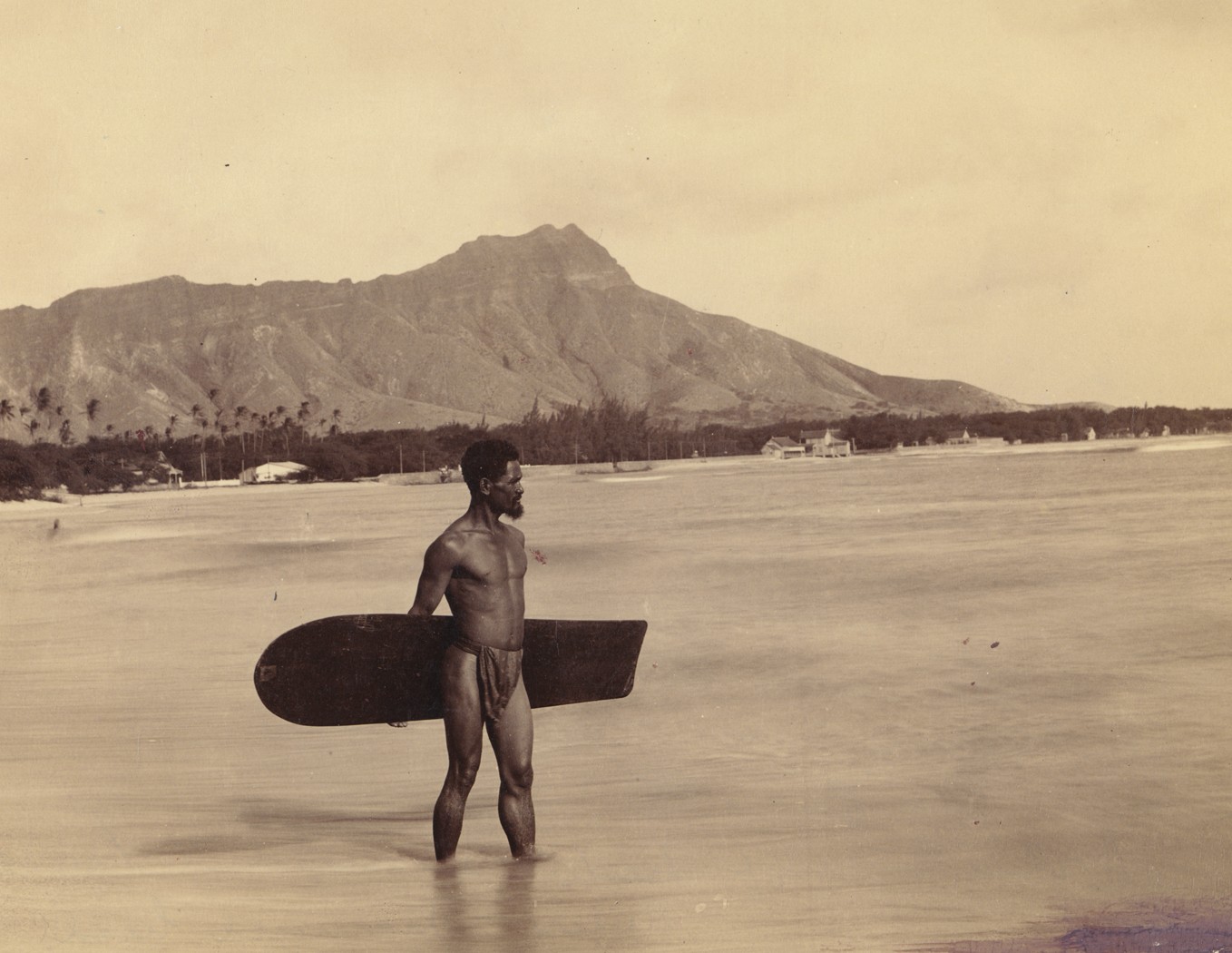
1898 photo of Hawaiian surfer Charles Kauha at Waikiki Beach, carrying what was described as one of the last alaia boards at the time

An alaia (pronounced /ɑːˈlɑː/,[1] Hawaiian: [əˈlɐjjə]) is a thin, round-nosed, square-tailed surfboard ridden in pre-20th century Hawaii. The boards were about 200 to 350 cm (7 to 12 ft) long, weighed up to 50 kg (100 lb), and generally made from the wood of the Koa Tree.[2] They are distinct from modern surfboards in that they have no ventral fins,[1] and instead rely on the sharpness of the edges to hold the board in the face of the wave.

Modern alaias are about 150 to 350 cm (5 to 12 ft) long and are the larger version of the Paipo board, used for knee or belly surfing, and the smaller version of the Olo board, generally between 550 and 750 cm (18 and 24 ft) long. All of these board types are similar in that each is made of wood and is ridden without a sharks fin/skeg.

History

[edit]

The alaia's roots span back a thousand years.[3] Lala is the Hawaiian word describing the action of riding an alaia surfboard. Lala is a word found in the Hawaiian dictionary meaning ‘the controlled slide in the curl when surfing on a board.'[4] Princess Kaʻiulani's alaia board, measuring 7ft 4in long, is preserved at the Bishop Museum.[5]

Alaia boards began making a comeback around 2006 when surfboard-shaper and experimenter Tom Wegener tested prototypes made of paulownia wood among pro-surfers.[6] The first contemporary professional surfers to master the skill of riding an alaia were documented in the Thomas Campbell surf film The Present. This appearance dramatically increased the popularity of the alaia board type.[3] Wegener used Australian surfer Jacob Stuth to test the first models, and over the next several years, he perfected the art of alaia design.

Shaper Donald Takayama furthered this movement with his designs under the Hawaiian Pro Designs label, shaped by Florida native, Brandon Russell.

Materials

[edit]

“Ancient Hawaiians made their boards out of local woods–‘ulu, and koa.”[7] Modern Alaia boards are made of many types of wood, including Redwood, Cedar, Pine and Balsa. Typically, commercially sold alaia boards are made of paulownia.

Paulownia is optimal for crafting surfboards in that it has a good weight to strength ratio, being lighter than other hardwoods and more durable than balsa. It also absorbs less salt water than many other types of wood and therefore does not require a hard resin or glass finish.[3][8]

Paulownia alaia boards are most often finished with a seed oil to further prevent water absorption and to prevent damage from the drying of salt and sun associated with surfing.

Environmental impact

[edit]

Many environmentalists are enthusiastic about the use of paulownia alaia boards because of their minimal impact on the environment, while fiberglass and epoxy surfboards are known for their many pollutants and long decomposition time.

Beyond avoiding fiberglass and epoxy resins, Wegener argues that modern Alaia boards have less impact on the environment based on the way the Paulownia wood is harvested, used and recycled. “Paulownia is plantation grown… The trees grow like weeds, about 25 ft (8 m) in three years and they are never from an old growth forest. Just sustainable tree farms…the leaves and flowers, is either fed to cattle or the dust and shavings are mulched… Paulownia dust (and shavings) is very good in the garden and breaks down quickly. Worms love it.”[8]

Wegener also states that paulownia is preferable over balsa regarding its impact on human health, because “balsa wood dust hurts your lungs.”[8] After construction, paulownia boards can be reshaped and repaired without use of more toxic materials. When cared for properly the boards can last a lifetime requiring less manufacturing, and when their usefulness has run out, simply discontinuing oil treatment to the board will allow it to decompose quickly without releasing harmful toxins found in foam and resin into the air and soil.[9]

References

[edit]
Revisions and contributorsEdit on WikipediaRead on Wikipedia
from Grokipedia
The alaia (or ʻalaia) is a thin, finless wooden originating from , featuring a rounded and square tail, typically measuring 7 to 12 feet (2.1 to 3.7 m) in length, 15 to 19 inches (38 to 48 cm) in width, and no more than 2 inches (5 cm) thick. Developed by ancient Hawaiians around the AD as part of the heʻe nalu (wave-sliding) , the alaia was crafted from single pieces of local woods such as , ʻulu (), or , and used by both commoners and (royalty) for standing rides on steep, fast-breaking waves using rail turns and speed for control. After declining in use by the early due to cultural suppression and modern board innovations, the alaia was revived in the early by shapers like Tom Wegener, who reintroduced it in 2005 using sustainable plantation woods like , fostering a resurgence in finless, traditional-style .

Origins and History

Ancient Hawaiian Development

The alaia was a thin, finless wooden surfboard characterized by a round nose and square tail, typically measuring 200 to 350 cm (7 to 12 ft) in length, 35 to 50 cm (14 to 20 in) in width at its broadest point near the nose, and 1 to 4 cm (0.4 to 1.5 in) thick, tapering toward the stern. Crafted from lightweight native woods such as koa (Acacia koa), breadfruit (Artocarpus altilis), or wiliwili (Erythrina sandwicensis), the board's double-convex cross-section and rounded edges allowed for buoyancy despite its minimal thickness, enabling riders to perform controlled sliding maneuvers known as lala, which involved side-slipping along the wave face. The alaia emerged over 1,000 years ago in as part of the broader Polynesian wave-riding traditions brought by voyaging ancestors from western around 300–800 CE, with practices evolving alongside canoe and island settlement. Evidence from preserved boards in collections like the , early European explorer accounts from the 18th century (such as Captain James Cook's 1778 observations), and Hawaiian oral histories—including chants and legends—confirm the alaias widespread use by the 1700s, though its roots predate written records. Archaeological finds, such as wooden fragments and shaping tools from pre-contact sites, further link the alaia to Polynesian , underscoring its role in sustaining maritime skills during long voyages. In ancient Hawaiian society, the alaia was primarily used by commoners (maka'āinana), while chiefs (ali'i) typically rode larger olo boards. However, after the abolition of the kapu system in 1819, royalty such as Princess Kaʻiulani (1875–1899) also used alaia boards, as evidenced by her 7 ft 4 in (224 cm) koa alaia preserved at the . Surfing on the alaia was integral to skill-building from childhood, fostering balance and wave reading essential for and . The alaias use was deeply embedded in the kapu system, a complex of religious and social taboos that regulated Hawaiian life until its abolition in , dictating who could access prime surf sites, the rituals preceding rides (such as offerings to ensure safe waves), and competitions that reinforced social hierarchies. High-status ali'i hosted he'e nalu contests at sacred (temples) or coastal breaks, where alaia riders vied for prestige through endurance and stylistic flair, with victors gaining favor or marriage alliances; violations of kapu, like commoners encroaching on chiefly waves, could result in severe penalties, including death. This framework elevated to a national pastime, intertwining physical mastery with spiritual harmony and communal identity across class lines.

Modern Revival

The modern revival of the alaia surfboard began in the mid-2000s, driven by Australian shaper Tom Wegener's research into ancient Hawaiian designs. After visiting the Museum in in 2004 to measure traditional boards, Wegener launched his first contemporary alaia on March 5, 2005, his 40th birthday, crafting it from sustainable wood to emphasize environmental compatibility and historical fidelity. This experimentation marked a pivotal shift, reintroducing the finless, thin wooden board after nearly a century of obscurity in favor of foam constructions. The alaia's resurgence gained momentum through cultural touchstones and media exposure. Thomas Campbell's 2009 surf film The Present prominently featured Wegener's alaias, showcasing riders like Rasta performing dynamic maneuvers at Sunset Beach, which ignited global curiosity and positioned the board as a bridge between surfing's past and innovative present. This visibility extended to surf publications such as SURFER Magazine, which in 2009 named Wegener Shaper of the Year for pioneering the wooden alaia movement, and The New York Times, which by late 2009 reported its adoption by elite surfers amid a broader renaissance in traditional styles. Key figures propelled the alaia's refinement and dissemination. Wegener led design iterations, focusing on concave bottoms and lightweight woods to enhance speed and maneuverability while staying true to ancient forms. His brother Jon Wegener collaborated early, producing initial prototypes in 2005 that demonstrated the board's viability in modern conditions. Shapers like Chris Christenson contributed by exploring finless wooden variants, integrating alaia principles into broader experimental lines that appealed to performance-oriented riders. Community-driven initiatives, including workshops at venues like Grain Surfboards—where participants build alaias under guidance from Wegener family members—and events such as the Noosa Festival of Surfing's fins-free contests starting in 2011, fostered hands-on learning and widespread adoption. By the 2010s, the alaia had expanded from Hawaiian origins to international surf cultures, with professional endorsements accelerating its popularity. Riders like incorporated alaias into diverse quiver sets, praising their agility for small-wave sessions and cultural resonance, as seen in his versatile board selections during global travels. This timeline reflects a grassroots-to-global trajectory, with alaia workshops and competitions emerging in and by mid-decade, solidifying its place in contemporary . In recent years, the alaia has seen further with boards crafted from invasive species like for sustainability, and dedicated divisions in international competitions as of 2024.

Design and Materials

Physical Characteristics

The alaia surfboard is defined by its slender, finless profile, with traditional dimensions ranging from 200 to 350 cm (7 to 12 feet) in length, widths of 15 to 20 inches for a narrow to moderate stance that prioritizes speed, and a thickness of 1 to 2 inches to ensure minimal and high maneuverability. These proportions allowed the board to slice through waves efficiently, with the overall form tapering from a thicker center to razor-thin edges. Modern recreations often scale down to 150 to 240 cm (5 to 8 feet) while retaining similar width and thickness ratios to suit contemporary wave conditions and rider preferences. The board's shape emphasizes simplicity and functionality, featuring a rounded for smooth entry into the wave face and a square tail that provides inherent stability during directional changes, complemented by straight or subtly curved rails that enhance edge control. This thin, convex profile—historically weighing 20 to 45 kg (45 to 100 pounds) due to construction—evolved in modern versions to a lightweight under 5 kg (10 pounds) through the use of lighter timbers, preserving the flexible, responsive feel without added volume. Ancient alaia designs were entirely finless, depending on rail engagement and board flex for steering, though some modern interpretations incorporate subtle, glassed-in single fins positioned near the tail to aid control in steeper waves while maintaining the authentic, low-drag sensation. Variations among traditional boards included the shorter omo (a commoner’s alaia, around 210 to 300 cm or 7 to 10 feet) versus longer elite versions like the olo (approximately 6 to 8 m or 20 to 26 feet, reserved for nobility), with evolutionary refinements to nose curvature and rail rounding improving turn initiation and wave adaptability over time. These boards were typically hewn from dense woods like koa for durability in ancient Hawaiian contexts.

Construction Techniques and Materials

Traditional Hawaiian alaias were crafted from dense, water-resistant woods such as (Acacia koa) and ‘ulu (), selected for their fine grain and durability in marine environments. These materials provided the necessary and strength for the thin, finless boards, which could weigh over 100 pounds despite their slender profile. Construction began with careful log selection to ensure straight grain and minimal defects, followed by rough shaping using stone adzes—blunt, axe-like tools carved from —to hew the wood into a basic plank form. Fine finishing involved sanding and polishing the surface with rough heads or to achieve a smooth, hydrodynamic finish that enhanced water flow and reduced drag. No synthetic sealants were used; instead, the natural oils in the wood were relied upon for protection, emphasizing the artisanal, labor-intensive process that could take weeks. In contemporary revivals, shapers favor lightweight, sustainable woods like for its exceptional strength-to-weight ratio and low water absorption rate (under 5% saturation), alongside alternatives such as redwood, cedar, , or balsa, chosen for similar low absorption and buoyancy properties. These materials allow for thinner boards (often 0.5 inches at the center, tapering to 0.25 inches at the rails) while maintaining performance. Modern construction starts with selecting or gluing planks (sometimes with a central stringer for added rigidity), followed by drawing the outline and rough cutting with a or jigsaw. The blank is then planed and shaped using drawknives or electric planers to refine the rocker and contours, with hand tools ensuring the wood grain's integrity is preserved. Final sanding employs progressive grits for smoothness, and purist builds apply natural finishes like boiled mixed with mineral spirits (in multiple coats) or , avoiding to retain the board's organic feel and environmental compatibility. This evolution from ancient adzes to powered tools streamlines production while honoring hand-finishing traditions.

Riding and Performance

Surfing Techniques

Riding an alaia requires precise body control and intimate wave interaction, as the finless design demands reliance on rail engagement and for and direction. Core techniques emphasize , where surfers use arms and core muscles to generate initial speed to catch waves. This allows for greater board flex under body weight, creating reverse rocker for enhanced glide, particularly in small surf. The "lala" slide, an maneuver adapted from ancient Hawaiian practices, involves subtle weight shifts to carve turns without foot straps, enabling sideways progression across the wave face while maintaining trim. Paddling on an alaia involves efficient, angled strokes to position for waves typically 1-4 feet high, with the board's minimal rocker facilitating quick plane-out. Surfers catch waves by dashing ahead of the swell, then transition rapidly from prone to kneeling or standing, pressing the chest down to lift the and generate speed as builds. This drop-in demands immediate rail digging with the inside rail to establish control, using hands on the wave face as temporary "fins" to stabilize and guide the board. Specific maneuvers highlight the alai's responsiveness, with cross-stepping along the length of the board allowing surfers to adjust weight for pivot turns and maintain balance during direction changes. Rail engagement is key for bottom turns, where leaning the board's edges—often with a dragged foot or hand assist—initiates carving paths, drawing directly from he'e nalu traditions of edge-leaning for agile control on steep faces. The board's thin profile and parabolic rails aid this maneuverability by providing grip without fins. Skill progression begins with beginners focusing on balance drills in shallow , practicing prone rail engagement and basic weight shifts to build and wave feel. Advanced riders progress to dynamic maneuvers like aerial re-entries, leveraging the board's flex for launches off the , and tube riding on finless models by tucking into barrels with precise rail hold and body compression. Consistent practice in controlled conditions is essential, as the mirrors relearning fundamentals.

Performance Attributes

The alaia's performance in water is defined by its emphasis on speed and glide, facilitated by a thin profile that promotes efficient planing and reduced hydrodynamic resistance in specific conditions. (CFD) analyses indicate that the board can achieve top speeds of up to 8 m/s (approximately 18 mph) during cruising phases on suitable waves, with simulations testing conditions at 4 m/s (9 mph) for paddling and higher velocities for planing. This design excels particularly in small, steep waves, where the flat bottom and lack of fins allow for smooth and rapid velocity buildup without the drag induced by protrusions. Stability on the alaia relies on its square , which offers a broad planing surface to enable controlled slides and maintain balance during straight-line runs. The minimal rocker contributes to this by prioritizing forward momentum over , though it necessitates precise from the rider to avoid instability, as pressure distributions in CFD models show uneven loading that demands constant adjustments. Compared to modern thruster configurations, the alaia is less forgiving due to its finless nature, which reduces lateral hold and increases the risk of lateral slips, while offering quicker initial acceleration than traditional longboards in comparable small-wave scenarios. Key limitations stem from the board's low buoyancy, resulting from its thin construction (typically under 1 inch thick), which restricts its effectiveness to waves under 6 feet and makes paddling into waves more challenging than on higher-volume boards. Finless iterations are particularly prone to pearling—nose-diving into the wave—in hollow or steeper sections, as the absence of stabilizing fins exacerbates forward pitching under dynamic loads. Overall, while CFD comparisons reveal higher drag coefficients for the alaia relative to curved modern shortboards (due to greater wetted surface area), its simplicity yields a direct, responsive ride suited to skilled users in controlled environments.

Cultural and Environmental Significance

Cultural Role in Hawaiian Tradition

In ancient Hawaiian , he'e nalu (wave sliding), the traditional practice of on alaia boards, served as a vital communal activity that fostered social bonds across classes. Surfing sessions often occurred near (sacred temples), where participants gathered to honor the and demonstrate skill, while ali'i (chiefs) hosted competitions to showcase prowess and resolve disputes. The alaia, a finless board typically 7 to 12 feet long crafted from wood, functioned as a for maka'āinana (commoners), signifying mastery and community standing, whereas larger olo boards were reserved for ali'i. Board-making involved elaborate ceremonies, including the placement of a kūmū (ritual fish) at the tree's base before felling and subsequent blessings to dedicate the board to protective deities, embedding the alaia in s that reinforced social cohesion. Spiritually, the alaia and he'e nalu were intertwined with Hawaiian cosmology, linking practitioners to deities and the volcanic forces embodied by Pele, the and creation, whose sister Namakaokaha'i governed the sea and generated waves through her power. Surfers invoked blessings from these (gods) before entering the water, viewing the po'ina nalu () as a sacred realm where human skill harmonized with divine will. The kapu system imposed strict restrictions, prohibiting commoners from certain premier waves reserved for ali'i and enforcing gender and class hierarchies to maintain spiritual and social order, with violations punishable by death to preserve the sacred balance. The cultural legacy of the alaia faced severe challenges in the due to influences, which discouraged he'e nalu as frivolous and sinful amid concerns over associated and traditional practices, contributing to its near alongside colonial pressures, from diseases, and land privatization. Modern preservation efforts honor early surfing legends like through institutions such as the Hawaii Waterman Hall of Fame at the Outrigger Canoe Club, while the alaia has been revitalized since the by shapers like Bob Pearson and Tom Wegener, bridging ancient techniques with global awareness and reinvigorating the practice within Hawaiian communities. The alaia's role extends to broader Polynesian narratives, as he'e nalu traditions arrived with migrant voyagers around 400–1000 CE, symbolizing navigational expertise and oceanic kinship that shaped Hawaiian identity. In the contemporary of the 1970s onward, the alaia has become a emblem of cultural reclamation, inspiring movements to restore indigenous , , and practices amid ongoing efforts.

Sustainability and Environmental Impact

The traditional construction of alaia surfboards from native Hawaiian woods such as emphasized regenerative harvesting practices that aligned with the ahupua'a system, a holistic framework dividing resources from mountains to sea to ensure sustainability. trees, integral to watershed protection by capturing rain and mist, were selectively felled in upland forest zones (wao nahele) without depleting stands, supporting long-term balance. Hand-carving techniques minimized waste, with shavings repurposed as for tree regeneration, reducing environmental footprint compared to modern . In contemporary alaia production, woods like offer significant eco-advantages due to their rapid growth—reaching harvestable size in 3-5 years, far outpacing balsa's 5-7 years—and high rates due to rapid biomass accumulation. These solid-wood boards biodegrade naturally at end-of-life without or , avoiding the volatile organic compounds (VOCs) emitted during polyurethane (PU) foam production for conventional shortboards. Chemical-free finishes, such as , further limit ocean pollution from resin runoff. Lifecycle assessments indicate alaia boards have lower overall emissions than epoxy shortboards, with wood-based construction reducing carbon footprints by approximately 30-50% through avoided manufacturing and transport-intensive imports. For instance, a typical PU surfboard generates 170-250 kg of CO2 equivalents, while sustainably sourced wooden alternatives like paulownia alaias cut this by leveraging local, fast-growing materials. Despite these benefits, challenges persist, particularly with overharvesting, which has reduced native forests to about 10% of their original extent due to historical and land conversion. Initiatives like the 2016 Koa Action Plan promote sustainable harvesting through , disease-resistant planting, and to control , aiming to regenerate stands at rates matching or exceeding removals. Modern efforts include (FSC) certification for used in alaias, ensuring managed plantations, alongside community programs such as Bizia Surf's use of invasive wood to restore native habitats while shaping boards.

References

Add your contribution
Related Hubs
User Avatar
No comments yet.