Hubbry Logo
YancaiYancaiMain
Open search
Yancai
Community hub
Yancai
logo
8 pages, 0 posts
0 subscribers
Be the first to start a discussion here.
Yancai
Yancai
from Wikipedia
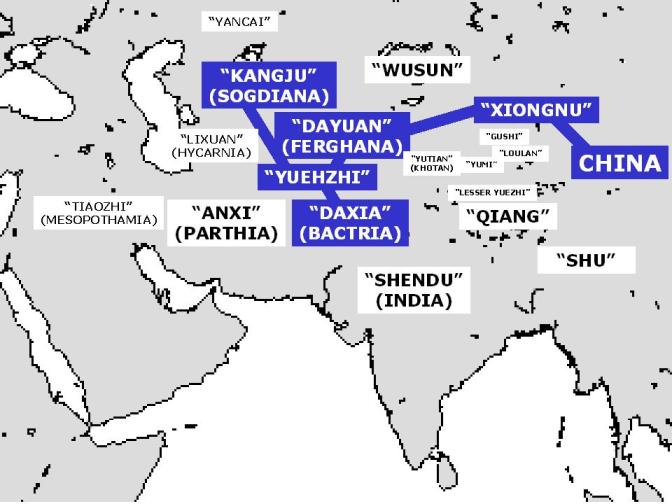
Countries described in Zhang Qian's report. Visited countries are highlighted in blue.

Yancai (Chinese: 奄蔡; pinyin: Yǎncài; Wade–Giles: Yen-ts’ai; lit. 'Vast Steppe' < LHC *ʔɨamA-C < OC (125 BCE) *ʔɨam-sɑs, a.k.a. 闔蘇 Hésū < *ĥa̱p-sa̱ĥ; compare also Latin Abzoae[1][2][3][4][5]) was the Chinese name of an ancient nomadic state centered near the Aral Sea during the Han dynasty period (206 BC—220 AD). They are generally considered to have been an Iranian people of the Sarmatian group. After becoming vassals of the Kangju in the 1st century BC, Yancai became known as Alan (Chinese: 阿蘭; pinyin: Ālán; Wade–Giles: A-lan). Yancai 奄蔡 is often connected to the Aorsi of Roman records,[6] while 阿蘭 Alan has been connected to the later Alans.[a]

History

[edit]

Yancai is first mentioned in Chapter 123 of the Shiji (whose author, Sima Qian, died c. 90 BC), based on the travels of 2nd century BC Chinese diplomat Zhang Qian:

Yancai lies some 2,000 li [832 km][10] northwest of Kangju. The people are nomads and their customs are generally similar to those of the people of Kangju. The country has over 100,000 archer warriors, and borders on a great shoreless lake.[11]

The people of Yancai are usually considered an Iranian people of the Sarmatian group.[12] They are often connected to the Aorsi of Roman records, who dominated the area between the Don and the Aral Sea and were both a wealthy mercantile people and a powerful military force.[12][13] According to Chinese sources, Yancai belonged to the northern part of the Silk Route, known as the Northern Route.[12] The Chinese sent embassies to Yancai and actively promoted trading relations.[12]

The Later Han dynasty Chinese chronicle, the Hou Hanshu, 88 (covering the period 25–220 and completed in the 5th century), mentioned a report that Yancai was now as vassal state of the Kangju known as Alanliao:

The kingdom of Yancai [lit. ‘Vast Steppe’] has changed its name to the kingdoms of Alan [and] Liao. They occupy the country and the towns. They are dependencies of Kangju [the Talas basin, Tashkent and Sogdiana]. The climate is mild. Wax trees, pines, and ‘white grass’ [aconite] are plentiful. Their way of life and dress are similar to those of Kangju.[14]

Y. A. Zadneprovskiy writes that the subjection of Yancai by the Kangju occurred in the 1st century BC.[12] The westward expansion of the Kangju obliged many of the Sarmatians to migrate westwards, and this contributed significantly to the Migration Period in Europe, which played a major role in world history.[15] The name Alanliao has been connected by modern scholars with that of the Alans.[12]

Yancai is last mentioned in the 3rd century Weilüe:

Then there is the kingdom of Liu, the kingdom of Yan [to the north of Yancai], and the kingdom of Yancai [between the Black and Caspian Seas], which is also called Alan. They all have the same way of life as those of Kangju. To the west, they border Da Qin [Roman territory], to the southeast they border Kangju [the Chu, Talas, and middle Jaxartes basins]. These kingdoms have large numbers of their famous sables. They raise cattle and move about in search of water and fodder. They are close to a large shoreless lake. Previously they were vassals of Kangju [the Chu, Talas, and middle Jaxartes basins]. Now they are no longer vassals.[16][17]

In the 1st and 2nd centuries AD, the Alans emerged as the dominant people of the Sarmatians either through conquering or absorbing other tribes.[13] At this time they migrated westwards to Southern Russia and frequently raided the Parthian and Roman Empire.

See also

[edit]

Notes

[edit]

References

[edit]
Revisions and contributorsEdit on WikipediaRead on Wikipedia
from Grokipedia
Yancai (Chinese: 奄蔡; : Yān cài), meaning "Vast ," was the name given in ancient Chinese records to a nomadic Iranian people and their confederation located in the steppe regions north of the and along the lower River during the (206 BCE–220 CE). This state, first described in the Shiji by as one of the "moving nations" (行国) encountered during Zhang Qian's missions to the around 139–126 BCE, was situated approximately 2,000 li (about 832 km) northwest of the kingdom of near modern-day . The people of Yancai were pastoral nomads who raised cattle and horses, migrating seasonally in search of water and grass, with customs closely resembling those of their southeastern neighbors in . With an army of trained bowmen, Yancai initially maintained but became a vassal of by the 1st century BCE, reflecting the fluid alliances and dominations among Central Asian nomadic groups. Its position underscored its place on the fringes of the trade networks, which extended westward to the distant lands of Da Qin (the ). By the CE, as recorded in the Hou Hanshu, Yancai had undergone significant changes: its name shifted to Alanliao (阿蘭聊), aligning it with the —an Iranic nomadic group of Sarmatian origin—who expanded westward beyond the and into the . This transformation marked Yancai's integration into broader migrations of Indo-Iranian tribes, contributing to the of the Alans known in Roman and medieval sources.

Name and Etymology

Chinese Terminology

The Chinese name for the ancient nomadic group known as Yancai is rendered as 奄蔡 (Yàncài) in classical texts. This designation first appears in Sima Qian's Shiji (Records of the Grand Historian), compiled around 90 BCE, drawing from the exploratory reports of the Han diplomat Zhang Qian during his missions to Central Asia in the 2nd century BCE. The Shiji describes Yancai as a distinct entity among western nomadic polities, highlighting its role in early Han understandings of frontier interactions. Linguistically, 奄蔡 is interpreted by scholars as a descriptive term meaning "vast " or "extensive grasslands," potentially evoking the open, landscapes associated with the group's , though it primarily functions as a of a foreign . Phonetic reconstructions place the Later Han of 奄蔡 as approximately *ʔɨamᴮ-sɑᴄ, which aligns with efforts to approximate non-Chinese names from Iranian-speaking nomadic contexts. By the Later Han period, the name evolves in historical records to 阿蘭聊 (Ālánliáo), as documented in the (Book of the Later Han), reflecting political changes including Yancai's status as a dependency of the and subsequent alliances or mergers with Alan tribes. This shift in terminology, appearing around the 1st century CE, underscores the fluid nature of Chinese for nomadic entities, where 阿蘭聊 incorporates elements suggestive of integration with groups bearing Iranian-derived names like "Alan." The thus marks a key juncture in the terminological adaptation, emphasizing relational dynamics over static ethnic labels.

Identifications with Other Cultures

Scholars have identified the Yancai with the Aorsi, a nomadic Sarmatian tribe described in Roman sources as powerful warriors controlling territories east of the Caspian Sea and between the Don and Aral Seas. In Ptolemy's Geography (Book III), the Aorsi are placed in the region north of the Caspian, aligning with Chinese records of Yancai's location in the Shiji and Hanshu, where they are depicted as a large nomadic group with around 100,000 bow-wielding fighters. This equivalence is supported by geographic overlap and shared nomadic lifestyles, as noted in Strabo's Geography (XI.2.1, 5-8), which describes the Aorsi as dominant in trade routes along the Caspian coast. Early 20th-century analyses, such as those by Shiratori Kurakichi, further corroborate this link by comparing Yancai's position north of the Aral Sea with Ptolemy's mapping of the Aorsi. The Yancai's later name change to Alanliao in the Hou Hanshu (ch. 88) has been connected to the (Latin: Alani), an Iranic nomadic group known for their westward migrations across the Pontic-Caspian . This shift, occurring around the CE, suggests an alliance or integration with Alan tribes extending west of the Caspian, as evidenced by synchronized appearances in Chinese and Roman records like ' accounts of Alan incursions by A.D. 72/73. Modern scholarship, including Pulleyblank's 1963 study, attributes this to shared migratory patterns and the Alans' emergence as a dominant force among Sarmatians, replacing earlier Scythian groups in the region. Debates persist on whether Yancai represented a confederation of Sarmatian tribes, with linguistic evidence pointing to similarities between "Yancai" and terms denoting "people" or tribal collectives in . Proponents, drawing from (III.5) and Pliny, argue that Yancai encompassed groups like the Aorsi and early , unified by and military prowess, as seen in Strabo's Geography (XI.2.1) describing their 200,000 horsemen under leaders like Spadines. Linguistic analyses, such as those by H.W. Bailey (1937), link "Yancai" etymologically to -Iranian roots, suggesting it transcribed a term akin to aurusa for light-skinned nomads, reinforcing Sarmatian confederative structures. Critics, however, note inconsistencies in name transcriptions across sources, questioning a single confederation versus fluid tribal alliances. 20th-century scholarship has highlighted links between Yancai and the Asii tribe's westward migration, positing that Asii nomads from the Ili and Chu valleys merged with Caspian-area groups around 177-176 B.C., contributing to Yancai's formation. In Ptolemy's Geography (5.9.16, 6.14.10), the Asaioi and Asiōtai appear among Sarmatians near the Don and north of the Caspian, paralleling Yancai's described sphere in the Hanshu (ch. 96). Edwin G. Pulleyblank's 1970 analysis traces Asii movements from the Tarim Basin steppe routes to the Aral-Caspian region, integrating with Iranic nomads and possibly evolving into Alan subgroups by the 1st century A.D. This migration, driven by pressures from the Da Yuezhi, is seen as a key factor in Yancai's ethnogenesis, with debates centering on whether the Asii formed a ruling elite within the confederation or a distinct Saka-related component.

Geography

Location and Borders

Yancai was an ancient nomadic state centered near the northern shore of the , positioned approximately 2,000 li (about 832 km) northwest of , a federation located in the modern border regions of Kazakhstan and . This placement situated Yancai in the expansive Central Asian steppes, with its core territory encompassing areas north of the basin during the period. The borders of Yancai were defined relative to neighboring entities and geographic features: to the south lay , forming a direct adjacency; to the east, the territory extended toward the mountain range; to the west, it reached toward the ; and to the north, it merged into the boundless regions. These boundaries reflected the fluid nature of nomadic domains rather than fixed demarcations. Ancient Chinese records, particularly the Shiji, describe Yancai as adjacent to a "great shoreless lake," which modern scholars interpret as encompassing both the and the , given their proximity and the limited geographical knowledge of Han explorers. Han envoy reports, as recorded in the Shiji, estimated Yancai's scale as a vast supporting over 100,000 households, underscoring its significant population and extent across the landscape. This size highlights Yancai's role as a major nomadic power in the region, with its holdings sustained by pastoral mobility rather than sedentary .

Environmental Context

The territory associated with Yancai encompassed an arid and semi-desert landscape encircling the northern and eastern shores of the , characterized by vast open grasslands interspersed with saline marshes and zones of seasonal flooding from river deltas. This environment, part of the broader Central Asian lowland, featured low-relief terrain with sparse vegetation adapted to low levels of approximately 100-200 mm annually, fostering a marked by extreme temperature variations. The saline nature of the Aral Sea itself contributed to the formation of salt-encrusted flats and marshes, while episodic flooding from inflows created temporary wetlands that influenced water-dependent habitation patterns in the vicinity. Positioned along the fringes of the pathways through the Eurasian s, the Yancai region was exposed to prevailing westerly winds that carried storms across the semi-arid expanses, particularly during dry seasons, and endured harsh winters with temperatures dropping below -20°C, constraining year-round to mobile or resilient forms. These climatic extremes, including periodic mobilization from exposed soils, shaped the environmental pressures on any settlements or transient in the area. The landscape's proximity to neighboring polities like further integrated it into a network of steppe corridors vulnerable to such weather phenomena. Key natural resources in the Yancai environs included extensive salt deposits derived from the evaporative concentration in the basin, alongside expansive grazing lands supporting herbaceous cover for pastoral viability and intermittent freshwater access from rivers like the , whose delta provided critical inflows to the sea. These resources, however, were tempered by the basin's overall , limiting reliable beyond riverine zones. Paleolimnological records reveal that the underwent Holocene-level fluctuations, including episodes of shrinkage during antiquity around 2,000-4,000 years ago, driven by climatic variability and reduced river discharge, which diminished water availability and expanded marginal deserts, thereby intensifying challenges to habitation in the surrounding steppes. Such regressions altered the sea's shoreline and amplified salinization of adjacent lands, affecting the ecological for human presence in the region.

Society and Culture

Ethnic Composition

The people of Yancai were primarily Iranic-speaking nomads affiliated with the Sarmatian tribes, forming part of the expansive Scythian-Sarmatian cultural complex that dominated the Eurasian steppes from the late first millennium BCE. Scholars identify them closely with the Aorsi and early , Sarmatian groups known from classical sources for their pastoralist society and prowess. Their language belonged to the eastern branch of , as evidenced by linguistic reconstructions linking them to later Ossetic dialects spoken by Alan descendants. Archaeological findings from kurgan burials in the regions around the and northern Caspian provide key insights into their demographic makeup, revealing a warrior elite characterized by burials, weapons, and ornate artifacts. Skeletal remains from these sites typically exhibit Europoid (Caucasian) physical traits consistent with Iranic steppe populations, including robust builds suited to mounted warfare. Accompanying , such as gold plaques and jewelry featuring the "animal style" art motif—depictions of griffins, , and stags—align with broader Sarmatian , underscoring their ethnic ties to other Iranic nomads. Chinese historical records estimate Yancai's population at over 100,000 households of trained archers, indicating a loose tribal composed of multiple clans rather than a monolithic ethnic entity. This structure likely incorporated allied groups sharing similar nomadic traditions, though the dominant cultural and linguistic imprint remained Iranic-Sarmatian, with parallels in customs to neighboring .

Nomadic Lifestyle and Economy

The Yancai engaged in pastoral nomadism, herding , sheep, , and other across the vast steppes near the , migrating seasonally in pursuit of water and pasturelands. Their lifestyle closely resembled that of neighboring groups such as the , with whom they shared customs including nomadic mobility and reliance on animal resources for sustenance and mobility. This herding economy supported a capable of fielding around trained archers, emphasizing the centrality of in daily life and warfare. The economy centered on , producing dairy, meat, and hides, while supplemented by raiding, from dependents, and limited cultivation along riverine areas where the mild allowed for some settled activities like growing wax trees and gathering aconite. played a key role, with exports of furs, , and horses facilitating exchanges along early Silk Route networks, often mediated through their dependency on . though primary wealth derived from pastoral products. Socially, the Yancai organized as a tribal under , reflecting their Iranic ethnic roots and loose hierarchical structure typical of societies. Women held prominent roles, akin to Sarmatian traditions where females trained as fighters and participated in combat, as evidenced by archaeological finds of armed burials. included portable felt tents for shelter, woolen and felt garments suited to harsh climates, and composite bows for hunting and defense, underscoring their adaptation to nomadic existence.

History

Early Mentions in Chinese Records

The earliest references to Yancai appear in the Shiji (Records of the Grand Historian), compiled by Sima Qian around 94 BCE, specifically in Chapter 123, "The Account of Dayuan." This account draws primarily from the reports of the Han diplomat Zhang Qian, who was dispatched westward by Emperor Wu of Han in 138 BCE on a mission lasting until 126 BCE to seek alliances against the Xiongnu confederation. Zhang Qian's journey, though interrupted by Xiongnu captivity, provided the Han court with foundational intelligence on Central Asian polities, including indirect knowledge of distant nomadic groups like Yancai. In the Shiji, Yancai is portrayed as a powerful, independent nomadic state located approximately 2,000 li northwest of and the kingdom of , with its territory bordering a vast shoreless lake often interpreted as the Caspian or . The people of Yancai are described as nomads who follow water and pasture, sharing customs with neighboring groups such as the and . Their military capacity is emphasized as substantial, with over 100,000 archer warriors, underscoring Yancai's status as a formidable entity in the steppe networks northwest of . These details reflect the broader context of Han exploratory efforts in the late BCE, aimed at circumventing dominance and forging connections to the for strategic and economic gains. However, had no direct contact with Yancai; the information was gathered second-hand through intermediaries such as the during his travels, highlighting the limitations of early Han reconnaissance beyond immediate frontiers.

Vassalage and Name Change

By the late , the kingdom of Yancai had become a of , a powerful Central Asian state centered in the valley, as documented in Chinese historical records. This subjugation led to Yancai being redesignated as Alanliao, meaning "old Yancai" or "Alan Yancai," reflecting its diminished status and possible integration of Alan tribes. The Hou Hanshu (), in its account of the , states: "The country of Yancai has changed its name to the country of Alanliao, residing in a walled city, belonging to ." The primary drivers of this vassalage were Kangju's westward expansion amid the shifting power dynamics on the Eurasian steppe, exacerbated by the ongoing Han-Xiongnu wars. As the Han dynasty intensified military campaigns against the Xiongnu from the mid-2nd century BC onward, the Xiongnu's control over western steppe territories weakened, creating opportunities for regional powers like Kangju to assert dominance over neighbors such as Yancai. Scholar Yuri Zadneprovskiy notes that this subjugation occurred during the 1st century BC, aligning with Kangju's territorial ambitions and alliances, including temporary cooperation with Xiongnu remnants against Han-aligned groups like the Wusun. Evidence for Yancai's loss of autonomy comes from reports by Han envoys, who observed that Yancai's rulers paid to kings and were subject to their oversight. These accounts, compiled in the Hou Hanshu based on missions such as that of Gan Ying in 97 AD, describe Yancai's forces—previously numbering around 100,000 trained bowmen—as now integrated into 's sphere, with the kingdom located approximately 2,000 li (about 832 km) northwest of near the marshes. This timeline places the vassalage around 50 BC, coinciding with broader Sarmatian migrations that saw groups like the pressing westward, further pressuring Yancai's position.

Decline and Later References

By the 5th-century compilation of the Hou Hanshu, Yancai—now known as Alanliao following its 1st-century BCE vassalage to —is described based on earlier reports like that of Ban Yong (94–125 CE), which reflect Han awareness of the name change from missions beginning around 73 CE. This account places Alanliao under the nominal influence of but notes a gradual westward expansion of its domain, from the region toward the northern shores of the . The shift underscores a loss of full independence, as Alanliao maintained over 100,000 families and engaged in trade along routes connecting to Roman territories, yet remained tethered to Kangju's sphere. The 3rd-century Weilüe provides one of the final detailed references to Yancai, now fully identified as Alanliao, situating it between the and Caspian Seas on the Great Marsh (likely the northern coast). Unlike earlier Han records, it describes Alanliao as no longer a vassal of , signaling fragmentation and a push toward amid regional upheavals. This is attributed to internal consolidation and external displacements, with the exceeding 100,000 households and customs mirroring those of neighboring nomadic groups. The text highlights Alanliao's adjacency to () in the west and in the southeast, emphasizing its role in transcontinental exchanges before its cohesion eroded. Yancai's decline in the 2nd–3rd centuries CE stemmed primarily from migratory pressures exerted by expanding nomadic powers, including Kangju's westward push and the encroaching , which compelled the Upper Aorsi (associated with Yancai) to relocate from the Aral-Caspian littoral to the steppes around 50–58 CE. These movements, driven by competition for lands and dominance rather than documented shifts, led to dispersal and the dilution of Yancai's distinct identity. Earlier displacements by groups like the Da Yuezhi and had already fragmented Sarmatian confederations in the region, setting the stage for Alanliao's absorption. The last explicit mentions of Yancai/Alanliao appear around 200 CE in the Weilüe, after which it vanishes from Chinese records as an independent entity, fully integrated into broader Alan confederations by the early . This absorption marked the endpoint of Yancai's traceable history, with its people contributing to the ' subsequent migrations and interactions across the Pontic-Caspian steppes.

Foreign Relations

Interactions with Han China

The interactions between Yancai and Han China were primarily indirect, mediated through intermediaries like the kingdom of , and focused on diplomatic outreach and trade along the northern branches of the . During the Western Han period, explorer Zhang Qian's reports from his missions in the BCE first described Yancai as a nomadic realm northwest of , prompting the Han court to recognize its potential as a trading partner and strategic ally in the western regions. In the Eastern Han era, the court actively dispatched embassies to Yancai to establish and promote commercial ties, exchanging Chinese and other goods for steppe products such as horses, which were vital for Han military needs, and gathering intelligence on distant western lands. These missions, often routed through , facilitated trade exchanges. Archaeological evidence underscores these exchanges, with Chinese artifacts such as bronze mirrors discovered in graves around the region dating to the 1st–2nd centuries CE, indicating the dissemination of Han among Yancai elites. Strategically, the Han viewed Yancai as a against nomadic threats from the west and north, including remnants of influence, leading to overtures for alliances to secure the flanks against common adversaries.

Ties to Neighboring Nomadic Powers

In the 1st century BCE, Yancai fell under the subjugation of the neighboring Kangju kingdom, becoming a vassal state that paid tribute in the form of furs to its overlord. This dependency is recorded in the Hou Han-shu, which notes that Yancai's domain was associated with the name Alanliao during the period of Kangju influence. Yancai's position as a minor nomadic power placed it within the intricate confederation politics of the Eurasian steppes, where larger entities like Kangju and the distant Xiongnu vied for dominance. By the 3rd century CE, Yancai had regained independence from Kangju, as noted in later sources, enabling it to navigate alliances more autonomously while remaining vulnerable to pressures from expansive steppe confederations. This fluidity exemplified the precarious role of tribes like Yancai, often caught between tributary obligations and the need to balance relations with multiple nomadic powers to secure pastures and resources. Trade networks further intertwined Yancai with neighboring tribes, facilitating exchanges of , furs, and possibly weapons along proto-Silk Road routes. These interactions, documented in Han geographical accounts, underscored Yancai's integration into regional economies where nomadic groups bartered animal products for agricultural goods and from settled peripheries. Such not only bolstered Yancai's resilience but also embedded it in the web of inter-tribal dependencies that characterized during the Han era.

Legacy

Role in Silk Road Trade

Yancai occupied a strategic position on the , serving as a vital link between and by controlling trade routes that extended from the Black Sea region through to Chinese territories. This location facilitated the flow of luxury goods such as from Han , glassware from Roman-influenced areas, and spices originating from Indian trade networks, enabling cross-cultural exchanges across during the period. As nomadic intermediaries, the Yancai tribes protected and relayed caravans traversing the arid steppes and oases around the , ensuring the continuity of overland commerce despite environmental challenges. The Yancai exported key commodities including horses, furs such as sables and hides, and cattle, which were highly valued in Central Asian and Mediterranean markets for their utility in warfare, clothing, and agriculture. Yancai primarily exported horses, furs such as sables, and cattle to Han China, which were valued for military and economic purposes. These goods were transported via camel caravans. In return, Yancai imported Indian and Babylonian merchandise via alliances with neighboring powers like the Armenians and Medes, as well as silk and other goods from Han China and products from western regions, acquired through established mart cities like Tanaïs on the Don River; these exchanges were bolstered by Han embassies dispatched around 130 BCE to promote diplomatic and commercial ties. This trade activity generated substantial wealth for Yancai, derived from tolls on passing , protective services, and occasional raids on rival groups, which in turn supported a formidable force of over 100,000 bow-wielding warriors. The economic prosperity is evidenced by the adoption of golden ornaments among Yancai elites, reflecting their dominance over Caspian coastal trade and integration into broader Eurasian networks during the 2nd century BCE to 1st century CE.

Connections to Alans and Sarmatians

The Yancai, by the 2nd century AD, underwent a unification process that transformed their political identity, adopting the name Alanliao in Chinese records, which scholars identify as the ethnonym for the Alans. This shift, documented in the Hou Hanshu, marked the integration of Yancai tribes with western Alan groups extending beyond the Caspian Sea, laying the groundwork for subsequent Alan migrations southward into the Caucasus and westward into Europe during the Migration Period. The resulting Alan confederation facilitated expansive movements, with groups crossing the Don River and contributing to the dynamic nomadic networks of late antiquity. Yancai's cultural heritage intertwined deeply with that of the , sharing a warrior ethos centered on and elite tactics, including scale-armored cataphracts that emphasized mobility and shock combat. This shared tradition, evident in Roman accounts of Sarmatian-Alan alliances, influenced interactions with sedentary powers and other nomads; for instance, Alan units allied with Gothic forces against the in the 4th–5th centuries, notably at the in 451 AD, where they bolstered federate armies. Such military synergies extended Sarmatian-Yancai influences into broader Eurasian conflicts, shaping the tactical evolution of warfare. Archaeological evidence reinforces these ethnic continuities through similar kurgan burial practices featuring catacomb graves, which span from the Aral Sea region to the Don River basin. These mound burials, common among early Sarmatian and Alan sites, include wooden crypts with niches, supine or contracted bodies, and grave goods like horse harnesses, weapons, and pottery, reflecting a consistent ritual landscape from the 6th century BC to the 4th century AD. Sites in the Volga-Don interfluve and North Caucasus, such as the Nartan II Cemetery, exhibit these catacomb features under small embankments, underscoring the spatial and temporal links between Yancai territories and later Alan settlements. Modern scholarship positions Yancai as a proto-Alan state, viewing its unification and name evolution to Alanliao as a pivotal stage in the formation of the Alan ethnic complex, which directly contributed to the origins of the Ossetians. Linguistic evidence, particularly the Ossetian language's descent from medieval Alanian (an eastern Iranian dialect preserving Scytho-Sarmatian elements), supports this continuity, with Ossetians representing the mountain-dwelling remnants of Alan groups that migrated into the Caucasus. Influential studies, including those by V.I. Abaev and Richard Foltz, emphasize how Yancai's Iranian nomadic roots informed Alan social structures, mythology (e.g., the Nart epic), and genetic profiles, linking them to contemporary Ossetian identity amid historical disruptions like Mongol invasions.

References

Add your contribution
Related Hubs
User Avatar
No comments yet.