


Community hub
Recent from talks
Contribute something
Nothing was collected or created yet.
Alberto Errera
View on Wikipedia
Alberto Israel Errera[1] (Greek: Αλβέρτος Ερρέρα, 15 January 1913 – August 1944) was a Greek-Jewish officer and a member of the anti-Nazi resistance. He was a member of the Sonderkommando in Auschwitz-Birkenau from May to August 1944.
Key Information


He took part in the preparation of the Sonderkommando Uprising of 1944. He is one of the possible authors of the Sonderkommando photographs. Errera died in Auschwitz-Birkenau.
Biography
[edit]Errera was born in Thessaloniki, Greece. Before the war, he was a soldier in the Hellenic Army, where he was promoted to officer and achieved the rank of captain.[2] He married a woman called Matthildi[3] from Larissa, where he settled and owned a supermarket. He joined the partisans and the Greek People's Liberation Army during the German occupation of Greece, working as a food supplier. He took the Christian name Alex (Alekos) Michaelides, or, according to his nephew, Alexandros Alexandris.[4] On the night of 24 March 1944, he was arrested by the Germans in Larissa, in addition to a group of 225 Jews,[5] and then jailed in the Haidari concentration camp.[6] According to his nephew, he was captured, not as a Jew, but as a leftist.[4] He was deported from Athens on 2 April and arrived at Auschwitz on 11 April, at which point he was one of the 320 Greek (assigned serial numbers from 182,440 to 182,759) selected for labor. His number was 182,552. After spending two days in the Zentral Sauna in Birkenau, he and the other Greek men lived in the Block 12 of the Männerquarantäne Lager from April 13 to May 11. Then he was selected, along with 100 Greeks, to be part of the Sonderkommando.[7] He was assigned the job of a Heizer ("stoker"), a member of the Sonderkommando assigned to the crematorium furnace, in Birkenau Krematorium V. Alter Fajnzylberg talks about his athletic build[8] and Leon Cohen describes his unusual strength.[9] According to Filip Müller,[10] Leon Cohen,[9] and the historian and fellow prisoner Hermann Langbein,[11] Errera was among those who actively participated in the preparations for the Sonderkommando Uprising, alongside Yaacov Kaminski, Jankiel Handelsmann, Jukl Wrobel, Josef Warszawski, a man named Władek, Giuseppe Baruch and Zalman Gradowski,[12] among others.
According to Izack Cohen, who worked in the Kanada Kommando, Errera was the leader of the Greek resistance group in Krematorium V. He tried to recruit Izack Cohen in the resistance group.[13]
Through the testimony of Alter Fajnzylberg,[8][14] it has been revealed that it was Errera who took the famous "Sonderkommando photographs" in the beginning of August 1944,[15][16][17] with the help of Dawid Szmulewski,[18][19] another member of the resistance, and three other members of the Sonderkommando, Szlama Dragon, his brother, and Alter Fajnzylberg, who kept watch.[20] After taking the photographs, Errera buried the camera in the soil at the camp, for retrieval and discovery later.
On 9 August 1944,[21] during the transport from the crematoria of ash that was to be discharged into the Vistula, Errera tried to convince his three co-detainees (including Hugo Baruch Venezia and Henri Nechama Capon) to escape, but they refused. Once on site, Errera stunned the accompanying two Schupos with a shovel and plunged into the Vistula. He was caught during the next two or three days, tortured and killed. As was usual when a fugitive was caught, Errera's body was exposed at the men's camp entrance (BIId[22]) as an example to the other inmates.
Errera was awarded by the Greek government in the 1980s for his contribution in the Greek resistance during World War II.[23]
Sonderkommando photographs
[edit]For many years, the author of the Sonderkommando photographs was unknown. The photographs were credited as anonymous or, by default, assigned to Dawid Szmulewski, who himself mentioned a Greek Jew named Alex. The story of these photos was recorded in the writings of Alter Fajnzylberg, who evokes the figure of the Greek Jew named Alex (although he forgot the surname). In May 1978, Fajnzylberg answered a letter from the Auschwitz-Birkenau Museum, about the photographs. He wrote:
It was Alex from Greece, but I do not remember his name, who took the photographs. He died during an escape during the transport of ash from incinerated people. These ashes were regularly dumped in the Sola or in the Vistula. Alex disarmed both SS escort[s] and threw their rifles into the Vistula. He died during the pursuit. I do not remember where the camera and other documents were buried because it [was] Alex who performed this work.[24]
However, in his diaries written immediately after the war, Fajnzylberg mentions the attempted escape of a Greek Jew named Aleko Errera. His escape struck Fajnzylberg was also told by several surviving witnesses: Errikos Sevillias,[25] Shlomo Venezia,[26] Leon Cohen,[9] Marcel Nadjary,[27] Dr. Miklos Nyiszli,[28] Alter Fajnzylberg,[29] Henryk Mandelbaum,[30] Albert Menasche,[31] Daniel Bennahmias[32] and Eddy de Wind.[33]
-
 No. 283 Sonderkommando in Auschwitz-Birkenau, August 1944 (clandestine photo) Picture pointed too high
 -
 No 282 Sonderkommando in Auschwitz-Birkenau, August 1944 (clandestine photo) Women being undressed before going into Gas Chambers
 -
![No 281 Sonderkommando in Auschwitz-Birkenau, August 1944 (clandestine photo) Burning of the dead bodies [part of 282 seen at left]](//upload.wikimedia.org/wikipedia/commons/thumb/5/50/Auschwitz_Resistance_281.jpg/120px-Auschwitz_Resistance_281.jpg) No 281 Sonderkommando in Auschwitz-Birkenau, August 1944 (clandestine photo) Burning of the dead bodies [part of 282 seen at left]
No 281 Sonderkommando in Auschwitz-Birkenau, August 1944 (clandestine photo) Burning of the dead bodies [part of 282 seen at left] -
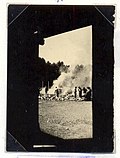 No 280 Sonderkommando in Auschwitz-Birkenau, August 1944 (clandestine photo) Burning of the dead bodies


![No 281 Sonderkommando in Auschwitz-Birkenau, August 1944 (clandestine photo) Burning of the dead bodies [part of 282 seen at left]](https://en.wikipedia.org/wiki/File:Auschwitz_Resistance_281.jpg)

References
[edit]- ^ "Εβραϊκό Μουσείο Ελλάδος". www.jewishmuseum.gr. Archived from the original on 6 November 2014. Retrieved 8 November 2014.
- ^ "«Ερευνητικά Προγράμματα•Βιογραφικά σημειώματα, Ερρέρα, Αλβέρτος» ("Research Programs: Biographical Notes, Errera, Alberto")", Hellenic Literary and Historical Archive (in Greek), Athens and Thessaloniki: National Bank of Greece Cultural Foundation, archived from the original on 19 April 2015, retrieved 9 March 2017
- ^ She died in 1980 in Larissa.
- ^ a b See interview of his nephew : Alberto Errera photograph 280 Sonderkommando Auschwitz. Alexandros Alexandridis was the code name of the brother of Alberto Errera, Samuel Errera, who died as a resistance fighter in Thebes, Greece, in an airstrike.
- ^ Gideon Greif, We wept without tears, Yale University Press, 2005, p. 375.
- ^ Marcel Nadjary, Χρονικό 1941–1945 [Chronicle], Ιδρυμα Ετσ - Αχα'ι'μ, Thessaloniki, 1991, p. 36.
- ^ See Auschwitz by Tal Bruttmann : as early as 16 May 1944, four convoys, each carrying 3,000 Jews from Hungary in 45 wagons, had to leave Hungary daily for Auschwitz. After being removed from Auschwitz in November 1943 by order of Himmler, Rudolf Höss was called back to the camp commandment to prepare the site for the scheduled mass arrival (Aktion Höss). On 9 May, orders were given to increase the number of prisoners of the Sonderkommando and Kanada Kommando (see Auschwitz Chronicle by Danuta Czech). In mid-April, the number of Sonderkommando prisoners stood at 207. On May 15, a contingent of 100 men was taken from the quarantine camp among the Greek Jews selected on April 11.
- ^ a b Alter Fajnzylberg, Les cahiers d'Alter Fajnzylberg : ce que j'ai vu à Auschwitz, Éditions Rosiers, 2014.
- ^ a b c Leon Cohen, From Greece to Birkenau : the crematoria workers'uprising, Salonika Jewry Research Center, 1996.
- ^ See Filip Müller, Eyewitness Auschwitz: Three Years in the Gas Chambers, Stein and Day, 1979.
- ^ Hermann Langbein, People in Auschwitz, p. 217 : Kaminski and two Greeks who had participated in an earlier discussion of these plans with Porebski decided to organize a rebellion of the Sonderkommando, which had nothing to lose. The name of one of the two Greeks has been passed along; Eduard de Wind writes about Errera from Larissa and Albert Menasche mentions Alexander Hereirra. While Paisikovic does not remember the name, he does recall that a very intelligent Greek who was known on the detail for his beautiful singing took part in the preparatory work. The second Greek is probably Giuseppe Baruch, aka Pepo.
- ^ (in French) Zalmen Gradowski, Au cœur de l’enfer, Tallandier, 2009.
- ^ From Erich Kulka's notes. See the testimony in Auschwitz Sonderkommando channel's video
- ^ "Écrire la destruction du monde judéo-polonais (3/7) : Ecrits au coeur de la catastrophe (2/2), actualité Écrire la destruction du monde judéo-polonais (1945-1960)". www.akadem.org.
- ^ About these photographs, see Georges Didi-Huberman, Images in Spite of All: Four Photographs from Auschwitz, University of Chicago Press, 2008, first published as Images malgré tout Les Éditions de Minuit, 2003.
- ^ Spicer, Gary P. "THE SONDERKOMMANDO PHOTOGRAPHS". www.academia.edu.
- ^ Steven Bowman, The Agony of Greek Jews, 1940–1945, Stanford University Press, 2009, p. 95
- ^ "See the testimony of Szmulewski in Jean-Claude Pressac, Technique and operation of the gas chambers, Beate Klarfeld Foundation, 1989. Online". Archived from the original on 15 August 2014. Retrieved 8 November 2014.
- ^ "AUSCHWITZ: Technique and Operation of the Gas Chambers ©". The Holocaust History Project (in Polish). 11 September 1985. Retrieved 17 June 2023.
- ^ Hermann Langbein, People in Auschwitz , The University of North Carolina Press, 2004.
- ^ Fondation Auschwitz (31 October 2013). "I. Bartosik - Évasions du Sonderkommando d'Auschwitz - 2013-05" – via YouTube.
- ^ according to Professor Kabeli, a Greek detainee of the Sonderkommando, in (in French) Eddy de Wind, Terminus Auschwitz, Michel Lafon, 2020.
- ^ Sonderkommando Auschwitz (19 August 2018). "Sonderkommando Auschwitz Alberto Errera Part 3" – via YouTube.
- ^ "Ecrits au coeur de la catastrophe". akadem.org. Retrieved 17 June 2023.
- ^ Errikos Sevillias, Athens-Auschwitz, Lycabettus Press, 1983.
- ^ Shlomo Venezia & Béatrice Prasquier, Inside the Gas Chambers: Eight Months in the Sonderkommando of Auschwitz , Polity, 2011.
- ^ (in Greek) Marcel Nadjary, Χρονικό 1941–1945 [Chronicle], Ιδρυμα Ετσ - Αχα'ι'μ, Thessaloniki, 1991.
- ^ Miklos Nyiszli, Auschwitz: A Doctor's Eyewitness Account, Arcade Publishing, 2011.
- ^ (in French) Alter Fajnzylberg, Les cahiers d'Alter Fajnzylberg : ce que j'ai vu à Auschwitz, Éditions Rosiers, 2014.
- ^ (in French) Igor Bartosik et Adam Willma, Dans les crématoires d'Auschwitz – Entretien avec Henryk Mandelbaum, Auschwitz-Birkenau State Museum, 2012.
- ^ Albert Menasche, Birkenau (Auschwitz II): Memories of an eyewitness : how 72,000 Greek Jews perished, Isaac Saltiel, New York, 1947
- ^ Rebecca Camhi-Frome, The Holocaust odyssey of Daniel Bennahmias, Sonderkommando, University of Alabama Press, 1993.
- ^ (in French) Eddy de Wind, Terminus Auschwitz, Michel Lafon, 2020. (in Dutch) Eddy de Wind, Eindstation Auschwitz, Republiek der Letteren, 1946.
External links
[edit] Media related to Alberto Errera at Wikimedia Commons
| International | |
|---|---|
| People | |


Alberto Errera
View on GrokipediaEarly Life
Origins and Pre-War Career
Alberto Israel Errera was born on 15 January 1913 in Larissa, Greece, to a Jewish family.[1][5] As a Greek Jew, he belonged to one of the longstanding Sephardic communities in the country, though specific details about his early family background or upbringing remain limited in historical records.[1] Prior to the Second World War, Errera served in the Hellenic Army, enlisting as a soldier and advancing through the ranks to become a captain.[6] His military training and experience in the Greek armed forces positioned him as an officer during the period leading up to the Axis invasion of Greece in 1941.[3]Resistance in Occupied Greece
Military Background and Anti-Nazi Activities
Alberto Errera served as a soldier in the Hellenic Army prior to and during the early stages of World War II, eventually rising to the rank of captain.[6][7]
Following the Axis occupation of Greece in April 1941, Errera joined the Greek People's Liberation Army (ELAS), the principal communist-led resistance organization, adopting the alias Aleksos (Alex) Michaelides to conceal his Jewish identity while conducting anti-Nazi operations.[6]
He was arrested by German forces in March 1944 in Larissa for his leftist resistance activities and deported to Auschwitz-Birkenau the following month along with hundreds of other Greek Jews.[6] In recognition of his contributions to the Greek resistance, the Greek government posthumously honored Errera in the 1980s.[6]
Deportation and Auschwitz
Transport to the Camp and Initial Experiences
Errera was arrested by German forces on the night of 24 March 1944 in Larissa, Greece, as part of a roundup of approximately 225 Jews suspected of leftist resistance activities.[7] He was then transferred to Haidari concentration camp near Athens for detention pending deportation.[8] In early April 1944, Errera was deported from Athens to Auschwitz-Birkenau via rail transport, a standard method for conveying prisoners from occupied territories to extermination camps, arriving around 11 April.[9] The journey involved overcrowded freight cars with minimal provisions, typical of Nazi deportation practices that aimed to maximize mortality en route through starvation, dehydration, and exposure.[6] Upon arrival at Birkenau, Errera underwent the camp's selection process on the ramp, where SS physicians divided arrivals based on perceived fitness for labor versus immediate extermination in gas chambers. As a 31-year-old former naval officer in good physical condition, he was spared gassing and registered as prisoner number 182,552.[6] He was immediately assigned to the Sonderkommando, a forced labor unit of Jewish prisoners compelled to operate crematoria, dispose of bodies, and handle gas chamber operations under constant threat of death.[10] Initial experiences in the Sonderkommando exposed Errera to the industrial-scale extermination process, including the herding of victims into undressing rooms, gassing with Zyklon B, and subsequent body removal for incineration or pit burning. The unit operated in isolation within the crematoria compounds, subjected to brutal oversight by SS guards and kapos, with periodic liquidations of entire shifts to eliminate witnesses. Errera's assignment leveraged his strength for heavy labor but immersed him in unrelenting psychological trauma from direct participation in concealing Nazi crimes.[6]Sonderkommando Role
Assignment and Daily Operations
Alberto Errera arrived at Auschwitz-Birkenau on April 11, 1944, as part of a Greek Jewish transport and was registered under prisoner number 182552. In May 1944, he was selected for assignment to the Sonderkommando, a prisoner unit compelled to labor in the camp's extermination facilities, primarily Crematorium V in Birkenau. Selection for this role typically favored physically capable inmates, and Errera's background as a naval officer likely contributed to his designation, though specific criteria were determined by SS overseers upon evaluation of new arrivals.[2] Daily operations for Sonderkommando members, including Errera, entailed direct participation in the disposal of victims gassed in adjacent chambers. Tasks included entering the gas chambers post-execution to extract corpses, searching bodies for valuables such as gold teeth and jewelry, shearing hair, and transporting remains to ovens or open-air pyres for cremation. These activities occurred under relentless SS guard, with failure or resistance punishable by immediate death, and the unit's composition was periodically liquidated to eliminate witnesses.[11][12] Errera's tenure from May to August 1944 aligned with the height of operations during the Hungarian deportations, when daily victim numbers exceeded thousands, overwhelming crematoria capacities and necessitating mass outdoor burnings. Beyond routine disposal, Sonderkommando prisoners sorted confiscated belongings, cleaned gas chamber interiors with water and disinfectant, and performed maintenance on equipment, all while enduring malnutrition, beatings, and psychological torment inherent to their coerced proximity to the killing process.[11]The August 1944 Photographs
Circumstances and Execution
On August 1944, Alberto Errera, using the alias Alex, clandestinely photographed scenes of mass murder and cremation at Auschwitz-Birkenau with the assistance of fellow Sonderkommando members, amid heightened risks as the camp's operations intensified with Hungarian Jewish transports.[4][13] The effort was motivated by a desire to document Nazi atrocities for potential postwar evidence, coordinated secretly within the Sonderkommando unit forced to handle gas chamber and cremation duties.[13] Errera obtained a smuggled camera resembling a German Leica, likely procured through camp resistance networks, and positioned himself near or inside Crematorium V to capture the images without precise aiming, shooting from the hip to minimize detection.[4][13] Lookouts including Alter Fajnzylberg, Shlomo Dragon, Josel Dragon, and David Szmulewski monitored for approaching SS guards or unauthorized personnel, enabling a brief window of 15 to 30 minutes for the four exposures despite the peril of immediate execution if discovered.[4][10] The photographs depicted women being led undressed toward gas chambers and bodies burning in open pits adjacent to the crematoria, providing rare visual testimony from the extermination process.[4][13] Following the exposures, the film was retrieved and concealed, later smuggled out of the camp by Polish resistance contacts such as Helena Dantón, who hid it in a toothpaste tube, accompanied by a note dated September 4, 1944, before reaching external networks for development and dissemination.[4][13] This operation underscored the Sonderkommando's limited agency in bearing witness, conducted under constant surveillance and with the understanding that their unit faced imminent liquidation.[10]Content and Technical Details
The four clandestine photographs taken by Alberto Errera on August 4, 1944, provide rare visual documentation of the extermination process at Auschwitz II-Birkenau, specifically near Crematorium V during the gassing of Hungarian Jewish women. Numbered 280 through 283, these images were captured in rapid succession within 15 to 30 minutes, likely between 4:00 and 5:00 PM, amid the arrival of deportation trains from Hungary.[4][10] Photo 280 depicts Sonderkommando prisoners maneuvering wheeled carts loaded with corpses toward open-air pyres, where bodies are visible amid flames and dense smoke rising from the pits used to dispose of gassed victims when crematoria capacity was overwhelmed.[4] Photo 282 shows a group of naked women, shortly after forced undressing, walking in a line toward the gas chamber entrance, escorted by SS guards, with wooden barracks and the crematorium structure in the background.[4] Photo 283 captures a distant view intended to show the overall scene but is misframed, pointing too high and partially obscuring the intended subjects with sky and rooftops, likely due to the photographer's haste in adjusting the concealed camera.[10] Photo 281 serves as a variant or preparatory exposure, showing similar pyre activity but with less clarity. These images starkly illustrate the mechanics of mass murder, including victim processing and body disposal, without depicting the gassing itself, which occurred indoors.[4] Technically, the photographs were exposed using a smuggled German-made camera, concealed within the Sonderkommando's restricted workshop area near Crematorium V, with Errera operating from a hidden vantage point such as an attic or through a small opening to avoid detection by guards.[10] The 35mm film, obtained covertly, was developed on-site in an improvised darkroom using pilfered chemicals, a process facilitated by fellow Sonderkommando members who distracted guards and provided cover.[4] The resulting prints and negatives exhibit blur from rapid handheld shooting, suboptimal afternoon lighting filtered through smoke, and the primitive setup, underscoring the extreme risk: discovery would have meant immediate execution. The materials were sealed in a metal canister with a handwritten Greek-language note identifying the photographers and date, then buried near the camp's fence for later recovery by Polish resistance contacts.[10][4] This preservation effort ensured the images' survival, surfacing postwar as key forensic evidence of Nazi crimes.[10]Uprising Participation
Events of October 7, 1944
On October 7, 1944, Sonderkommando prisoners at Auschwitz II-Birkenau launched a coordinated revolt against their SS overseers, driven by fears of imminent liquidation following the recent execution of approximately 200 fellow Sonderkommando members in September.[14] [15] The uprising centered on the crematoria complex, where prisoners had secretly amassed gunpowder smuggled by female inmates from the nearby Union-Werke munitions factory, fashioning it into makeshift explosives over preceding months.[14] [15] The revolt ignited around 1:00 p.m. during a roll call and selection at Crematorium IV, where SS personnel began segregating prisoners for execution.[14] Armed primarily with improvised weapons such as picks, axes, hammers, shovels, and stones—supplemented by the explosives—Sonderkommando members overwhelmed and killed three SS guards, then detonated charges that set Crematorium IV ablaze, causing partial structural collapse and temporarily halting operations there.[14] [15] Simultaneously, prisoners at adjacent Crematorium II attacked their guards, killing two more SS men and briefly cutting through the perimeter fence in an attempt to flee toward the nearby Rajsko village.[14] SS forces quickly mobilized, suppressing the uprising with machine-gun fire, hand grenades, and attack dogs within hours; escaping prisoners were hunted down and executed, including some burned alive in a granary.[14] [15] Casualties included roughly 250 Sonderkommando killed during the fighting, with leaders such as Zalmen Gradowski and Józef Deresiński among the dead; over 10 SS personnel were wounded, alongside the three fatalities.[15] In reprisal, the SS later gassed additional Sonderkommando selections and publicly hanged four women implicated in smuggling the explosives on January 6, 1945.[14] [15] Though ultimately quelled, the action damaged key extermination infrastructure and represented one of the few overt armed resistances within the camp, reducing the Sonderkommando workforce to about 105 survivors who were later compelled into evacuation marches.[14]Errera's Specific Contributions
Errera served as the leader of the Greek Jewish prisoners in the Sonderkommando unit assigned to Crematorium V, where he organized resistance activities among his contingent, drawing on his prior experience as a Hellenic Navy officer.[6] This leadership role fostered coordination and resolve within the group, contributing to the broader Sonderkommando efforts that enabled the October 7, 1944, uprising against the SS guards.[1] Although Errera himself was executed on or around August 9, 1944, following a failed escape attempt during an ash transport detail—where he attacked guards with a shovel before fleeing toward the Vistula River—the Greek Sonderkommando under his prior influence actively participated in the revolt.[2] [1] On October 7, these prisoners in Crematorium V joined the coordinated assault by wielding improvised weapons such as picks, axes, and hammers to overpower overseers, aiming to disrupt operations and link up with the explosive demolition at adjacent Crematorium IV.[6] Their actions inflicted casualties on SS personnel and exemplified the defiant spirit Errera had helped instill, despite the ultimate suppression of the revolt and execution of most participants.Death
Fate During the Revolt
Alberto Errera perished on August 9, 1944, during an attempted escape from Auschwitz-Birkenau, several weeks before the Sonderkommando uprising of October 7.[2] He was shot by SS guards while trying to flee the camp, an act stemming from his ongoing resistance activities within the Sonderkommando.[10] Accounts indicate that Errera had struck an SS officer prior to his execution, reflecting his defiance amid the camp's brutal regime.[4] Although some references associate Errera with the broader prisoners' uprising in Auschwitz-Birkenau, his death preceded the organized Sonderkommando revolt, precluding direct participation in its events.[1] His earlier contributions, including the clandestine documentation of atrocities in late July 1944, supported resistance networks by providing visual evidence smuggled out of the camp.[4] Errera, aged 31, left no surviving records of the escape attempt itself, but his actions aligned with the escalating defiance among Greek Jewish prisoners in the Sonderkommando units at Crematoria IV and V.[2]Legacy
Recognition and Historical Impact
Errera's clandestine photographs, captured on August 23, 1944, near crematoria IV and V in Auschwitz-Birkenau, constitute the only known images taken by camp prisoners depicting the mass cremation of victims and women being led toward gas chambers, providing irrefutable visual evidence of the extermination process.[10][2] These four exposures, smuggled out via Polish resistance contacts and recovered post-liberation, corroborated survivor accounts and served as primary documentation in Holocaust historiography, distinguishing them from perpetrator-recorded images by their perspective from within the victim ordeal.[4][10] Posthumously identified through Sonderkommando survivor testimony, Errera's role gained formal recognition from the International Auschwitz Committee, which honored him on July 26, 2024, as a resistance fighter who documented Nazi crimes at grave personal risk, emphasizing his naval officer background and alias "Alex."[1][6] His images have influenced cultural remembrance, inspiring Gerhard Richter's Birkenau series of paintings unveiled in 2014 and housed in a dedicated pavilion at the Auschwitz-Birkenau site, opened February 9, 2024, to amplify their testimonial power.[10][16] The photographs' historical impact endures in educational and memorial contexts, exhibited in institutions such as the Jewish Museum of Greece and referenced in analyses of Holocaust visual evidence, underscoring Errera's contribution to bearing witness amid systemic secrecy and destruction of records.[2][9] They symbolize prisoner agency in resistance, countering narratives of passive victimhood by evidencing deliberate acts of subversion under duress, and continue to inform genocide studies by illustrating the mechanics of industrialized murder.[6][4]References
- https://commons.wikimedia.org/wiki/Category:Alberto_Errera