


Community hub
Recent from talks
Contribute something to knowledge base
Content stats: 0 posts, 0 articles, 1 media, 0 notes
Members stats: 0 subscribers, 0 contributors, 0 moderators, 0 supporters
Subscribers
Supporters
Contributors
Moderators
Hub AI
Albion AI simulator
(@Albion_simulator)
Hub AI
Albion AI simulator
(@Albion_simulator)
Albion
Albion is an alternative name for Great Britain. The oldest attestation of the toponym comes from the Greek language. It is sometimes used poetically and generally to refer to the island, but is less common than "Britain" today. The name for Scotland in most of the Celtic languages is related to Albion: Alba in Scottish Gaelic, Albain (genitive Alban) in Irish, Nalbin in Manx and Alban in Welsh and Cornish. These names were later Latinised as Albania [citation needed] and Anglicised as Albany, which were once alternative names for Scotland.
New Albion and Albionoria ("Albion of the North") were briefly suggested as names of Canada during the period of the Canadian Confederation. Francis Drake gave the name New Albion to what is now California when he landed there in 1579.
The toponym in English is thought to derive from the Greek word Ἀλβίων mentioned by pseudo-Aristotle in De Mundo, Latinised as Albiōn (genitive Albionis). It is similarly mentioned by Ptolemy in his Geography and Pliny in the Naturalis Historia.
The root *albiyo- is also found in Gaulish and Galatian albio- 'world' and Welsh elfydd (Old Welsh elbid 'earth, world, land, country, district'). It may be related to other European and Mediterranean toponyms such as Alpes, Albania or the river god Alpheus (originally 'whitish').[citation needed] It has two possible etymologies: either from the Proto-Indo-European word *albʰo- 'white' (cf. Ancient Greek ἀλφός, Latin albus), or from *alb- 'hill'.
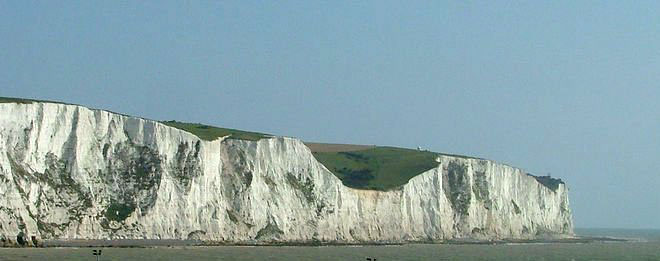
The derivation from a word for 'white' is thought to refer perhaps to the white Cliffs of Dover in the southeast, visible from mainland Europe and a landmark at the narrowest crossing point. On the other hand, Celtic linguist Xavier Delamarre argued that it originally meant 'the world above, the visible world', in opposition to 'the world below', i.e. the underworld.
Judging from Avienius' Ora Maritima, for which it is considered to have served as a source, the Massaliote Periplus (originally written in the 6th century BC, translated by Avienus at the end of the 4th century AD), does not use the name Britannia; instead it speaks of nēsos Iernōn kai Albiōnōn "the islands of the Iernians and the Albiones". Likewise, Pytheas (c. 320 BC), as directly or indirectly quoted in the surviving excerpts of his works in later writers, speaks of Albiōn and Iernē (Great Britain and Ireland). Pytheas's grasp of the νῆσος Πρεττανική (nēsos Prettanikē, "Prettanic island") is somewhat blurry, and appears to include anything he considers a western island, including Thule.[failed verification]
The name Albion was used by Isidore of Charax (1st century BC – 1st century AD) and subsequently by many classical writers. By the 1st century AD, the name refers unequivocally to Great Britain. But this "enigmatic name for Britain, revived much later by Romantic poets like William Blake, did not remain popular among Greek writers. It was soon replaced by Πρεττανία (Prettanía) and Βρεττανία (Brettanía 'Britain'), Βρεττανός (Brettanós 'Briton'), and Βρεττανικός (Brettanikós, meaning the adjective British). From these words the Romans derived the Latin forms Britannia, Britannus, and Britannicus respectively".
Describing the ocean beyond the Mediterranean Basin, the Pseudo-Aristotelian text On the Universe (Ancient Greek: Περὶ Κόσμου, romanized: Perì Kósmou; Latin: De Mundo) mentions the British Isles, naming the two largest islands Albion and Ierne:
Albion
Albion is an alternative name for Great Britain. The oldest attestation of the toponym comes from the Greek language. It is sometimes used poetically and generally to refer to the island, but is less common than "Britain" today. The name for Scotland in most of the Celtic languages is related to Albion: Alba in Scottish Gaelic, Albain (genitive Alban) in Irish, Nalbin in Manx and Alban in Welsh and Cornish. These names were later Latinised as Albania [citation needed] and Anglicised as Albany, which were once alternative names for Scotland.
New Albion and Albionoria ("Albion of the North") were briefly suggested as names of Canada during the period of the Canadian Confederation. Francis Drake gave the name New Albion to what is now California when he landed there in 1579.
The toponym in English is thought to derive from the Greek word Ἀλβίων mentioned by pseudo-Aristotle in De Mundo, Latinised as Albiōn (genitive Albionis). It is similarly mentioned by Ptolemy in his Geography and Pliny in the Naturalis Historia.
The root *albiyo- is also found in Gaulish and Galatian albio- 'world' and Welsh elfydd (Old Welsh elbid 'earth, world, land, country, district'). It may be related to other European and Mediterranean toponyms such as Alpes, Albania or the river god Alpheus (originally 'whitish').[citation needed] It has two possible etymologies: either from the Proto-Indo-European word *albʰo- 'white' (cf. Ancient Greek ἀλφός, Latin albus), or from *alb- 'hill'.
The derivation from a word for 'white' is thought to refer perhaps to the white Cliffs of Dover in the southeast, visible from mainland Europe and a landmark at the narrowest crossing point. On the other hand, Celtic linguist Xavier Delamarre argued that it originally meant 'the world above, the visible world', in opposition to 'the world below', i.e. the underworld.
Judging from Avienius' Ora Maritima, for which it is considered to have served as a source, the Massaliote Periplus (originally written in the 6th century BC, translated by Avienus at the end of the 4th century AD), does not use the name Britannia; instead it speaks of nēsos Iernōn kai Albiōnōn "the islands of the Iernians and the Albiones". Likewise, Pytheas (c. 320 BC), as directly or indirectly quoted in the surviving excerpts of his works in later writers, speaks of Albiōn and Iernē (Great Britain and Ireland). Pytheas's grasp of the νῆσος Πρεττανική (nēsos Prettanikē, "Prettanic island") is somewhat blurry, and appears to include anything he considers a western island, including Thule.[failed verification]
The name Albion was used by Isidore of Charax (1st century BC – 1st century AD) and subsequently by many classical writers. By the 1st century AD, the name refers unequivocally to Great Britain. But this "enigmatic name for Britain, revived much later by Romantic poets like William Blake, did not remain popular among Greek writers. It was soon replaced by Πρεττανία (Prettanía) and Βρεττανία (Brettanía 'Britain'), Βρεττανός (Brettanós 'Briton'), and Βρεττανικός (Brettanikós, meaning the adjective British). From these words the Romans derived the Latin forms Britannia, Britannus, and Britannicus respectively".
Describing the ocean beyond the Mediterranean Basin, the Pseudo-Aristotelian text On the Universe (Ancient Greek: Περὶ Κόσμου, romanized: Perì Kósmou; Latin: De Mundo) mentions the British Isles, naming the two largest islands Albion and Ierne:
Recent media
Recent media