Recent from talks
Contribute something
Nothing was collected or created yet.
Instant messaging
View on Wikipedia

Instant messaging (IM) technology is a type of synchronous computer-mediated communication involving the immediate (real-time) transmission of messages between two or more parties over the Internet or another computer network. Originally involving simple text message exchanges, modern instant messaging applications and services (also variously known as instant messenger, messaging app, chat app, chat client, or simply a messenger) tend to also feature the exchange of multimedia, emojis, file transfer, VoIP (voice calling), and video chat capabilities.
Instant messaging systems facilitate connections between specified known users[1] (often using a contact list also known as a "buddy list" or "friend list") or in chat rooms, and can be standalone apps or integrated into a wider social media platform, or in a website where it can, for instance, be used for conversational commerce. Originally the term "instant messaging" was distinguished from "text messaging" by being run on a computer network instead of a cellular/mobile network, being able to write longer messages, real-time communication, presence ("status"), and being free (only cost of access instead of per SMS message sent).[2][3][4]
Instant messaging was pioneered in the early Internet era; the IRC protocol was the earliest to achieve wide adoption.[5] Later in the 1990s, ICQ was among the first closed and commercialized instant messengers, and several rival services appeared afterwards as it became a popular use of the Internet.[6] Beginning with its first introduction in 2005, BlackBerry Messenger became the first popular example of mobile-based IM, combining features of traditional IM and mobile SMS.[7][8] Instant messaging remains very popular today; IM apps are the most widely used smartphone apps: in 2018 for instance there were 980 million monthly active users of WeChat and 1.3 billion monthly users of WhatsApp, the largest IM network.
Overview
[edit]Instant messaging (IM), sometimes also called "messaging" or "texting", consists of computer-based human communication between two users (private messaging) or more (chat room or "group") in real-time, allowing immediate receipt of acknowledgment or reply. This is in direct contrast to email, where conversations are not in real-time, and the perceived quasi-synchrony of the communications by the users[9] (although many systems allow users to send offline messages that the other user receives when logging in).
Earlier IM networks were limited to text-based communication, not dissimilar to mobile text messaging. As technology has moved forward, IM has expanded to include voice calling using a microphone, videotelephony using webcams, file transfer,[10] location sharing, image and video transfer, voice notes, and other features.[8]
IM is conducted over the Internet or other types of networks (see also LAN messenger).[11] Depending on the IM protocol, the technical architecture can be peer-to-peer (direct point-to-point transmission) or client–server (when all clients have to first connect to the central server). Primary IM services are controlled by their corresponding companies and usually follow the client-server model.[12]
At one point, the term "Instant Messenger" was a service mark of AOL Time Warner and could not be used in software not affiliated with AOL in the United States.[13] For this reason, in April 2007, the instant messaging client formerly named Gaim (or gaim) announced that they would be renamed "Pidgin".[14]
Clients
[edit]This section needs additional citations for verification. (August 2024) |

Modern IM services generally provide their own client, either a separately installed application or a browser-based client. They are normally centralised networks run by the servers of the platform's operators, unlike peer-to-peer protocols like XMPP. These usually only work within the same IM network, although some allow limited function with other services (see #Interoperability). Third-party client software applications exist that will connect with most of the major IM services. There is the class of instant messengers that uses the serverless model, which doesn't require servers, and the IM network consists only of clients. There are several serverless messengers: RetroShare, Tox, Bitmessage, Ricochet, Ring. See also: LAN messenger.
Some examples of popular IM services today include Signal, Telegram, WhatsApp Messenger, WeChat, QQ Messenger, Viber, Line, and Snapchat.[citation needed] The popularity of certain apps greatly differ between different countries. Certain apps have an emphasis on certain uses - for example, Skype focuses on video calling, Slack focuses on messaging and file sharing for work teams, and Snapchat focuses on image messages. Some social networking services offer messaging services as a component of their overall platform, such as Facebook's Facebook Messenger, who also own WhatsApp. Others have a direct IM function as an additional adjunct component of their social networking platforms, like Instagram, Reddit, Tumblr, TikTok, Clubhouse and Twitter; this also includes for example dating websites, such as OkCupid or Plenty of Fish, and online gaming chat platforms.
Features
[edit]This section needs additional citations for verification. (August 2024) |

Private and group messaging
[edit]Private chat allows users to converse privately with another person or a group. Privacy can also be enhanced in several ways, such as end-to-end encryption by default. Public and group chat features allow users to communicate with multiple people simultaneously.
Calling
[edit]Many major IM services and applications offer a call feature for user-to-user voice calls, conference calls, and voice messages. The call functionality is useful for professionals who utilize the application for work purposes and as a hands-free method. Videotelephony using a webcam is also possible by some.
Games and entertainment
[edit]Some IM applications include in-app games for entertainment. Yahoo! Messenger, for example, introduced these where users could play a game and viewed by friends in real-time.[15] MSN Messenger featured a number of playable games within the interface. Facebook's Messenger has had a built-in option to play games with people in a chat, including games like Tetris and Blackjack.[16] Discord features multiple games built inside the "activities" tab in voice channels.[17]
Payments
[edit]A relatively new feature to instant messaging, peer-to-peer payments are available for financial tasks on top of communication. The lack of a service fee also makes these advantageous to financial applications. IM services such as Facebook Messenger[18] and the WeChat[19] 'super-app' for example offer a payment feature.
History
[edit]| 1988 | Internet Relay Chat |
|---|---|
| 1989–1995 | |
| 1996 | ICQ |
| 1997 | AIM |
| 1998 | Yahoo! Messenger |
| 1999 | XMPP MSN Messenger |
| 2000–2002 | |
| 2003 | Xfire |
| 2004–2008 | |
| 2009 | |
| 2010 | Kik Messenger |
| 2011 | Facebook Messenger Snapchat |
| 2012 | |
| 2013 | Telegram |
| 2014 | Signal |
| 2015 | Discord |
| 2016 | Riot.im/Element |
Early systems
[edit]
Though the term dates from the 1990s, instant messaging predates the Internet, first appearing on multi-user operating systems like Compatible Time-Sharing System (CTSS) and Multiplexed Information and Computing Service (Multics)[20][21] in the mid-1960s. Initially, some of these systems were used as notification systems for services like printing, but quickly were used to facilitate communication with other users logged into the same machine. CTSS facilitated communication via text message for up to 30 people.[22]
Parallel to instant messaging were early online chat facilities, the earliest of which was Talkomatic (1973) on the PLATO system, which allowed 5 people to chat simultaneously on a 512 x 512 plasma display (5 lines of text + 1 status line per person). During the bulletin board system (BBS) phenomenon that peaked during the 1980s, some systems incorporated chat features which were similar to instant messaging; Freelancin' Roundtable was one prime example. The first[23] such general-availability commercial online chat service (as opposed to PLATO, which was educational) was the CompuServe CB Simulator in 1980,[24] created by CompuServe executive Alexander "Sandy" Trevor in Columbus, Ohio.
As networks developed, the protocols spread with the networks. Some of these used a peer-to-peer protocol (e.g. talk, ntalk and ytalk), while others required peers to connect to a server (see talker and IRC). The Zephyr Notification Service (still in use at some institutions) was invented at MIT's Project Athena in the 1980s to allow service providers to locate and send messages to users.

Early instant messaging programs were primarily real-time text, where characters appeared as they were typed. This includes the Unix "talk" command line program, which was popular in the 1980s and early 1990s. Some BBS chat programs (i.e. Celerity BBS) also used a similar interface. Modern implementations of real-time text also exist in instant messengers, such as AOL's Real-Time IM[25] as an optional feature.[26]
In the latter half of the 1980s and into the early 1990s, the Quantum Link online service for Commodore 64 computers offered user-to-user messages between concurrently connected customers, which they called "On-Line Messages" (or OLM for short), and later "FlashMail." Quantum Link later became America Online and made AOL Instant Messenger (AIM, discussed later). While the Quantum Link client software ran on a Commodore 64, using only the Commodore's PETSCII text-graphics, the screen was visually divided into sections and OLMs would appear as a yellow bar saying "Message From:" and the name of the sender along with the message across the top of whatever the user was already doing, and presented a list of options for responding.[27] As such, it could be considered a type of graphical user interface (GUI), albeit much more primitive than the later Unix, Windows and Macintosh based GUI IM software. OLMs were what Q-Link called "Plus Services" meaning they charged an extra per-minute fee on top of the monthly Q-Link access costs.
Development of the Internet Relay Chat (IRC) protocol began in 1989, and this would become the Internet's first widespread instant messaging standard.[28]
Graphical messengers
[edit]
Modern, Internet-wide, GUI-based messaging clients as they are known today, began to take off in the mid-1990s with PowWow, ICQ, and AOL Instant Messenger (AIM). Similar functionality was offered by CU-SeeMe in 1992; though primarily an audio/video chat link, users could also send textual messages to each other. AOL later acquired Mirabilis, the authors of ICQ; establishing dominance in the instant messaging market.[22] A few years later ICQ (then owned by AOL) was awarded two patents for instant messaging by the U.S. patent office. Meanwhile, other companies developed their own software; (Excite, Microsoft (MSN), Ubique, and Yahoo!), each with its own proprietary protocol and client; users therefore had to run multiple client applications if they wished to use more than one of these networks. However, the open protocol IRC continued to be popular by the millennium, and its most popular graphical app was mIRC.[28]
While instant messaging was mainly in use for consumer recreational purposes, in 1998, IBM launched their Lotus Sametime instant messenger software, the first popular example of enterprise-grade instant messaging.[29] In 2000, an open-source application and open standards-based protocol called Extensible Messaging and Presence Protocol (XMPP) was launched, initially branded as Jabber. XMPP servers could act as gateways to other IM protocols, reducing the need to run multiple clients.[30]
Video calling using a webcam also started taking off during this time. Microsoft's NetMeeting, which was focused on business "web conferencing", was one of the earliest; the company then launched Windows Messenger, coming preloaded on Windows XP, featuring video capabilities.[31] Yahoo! Messenger added video capabilities in 2001;[32] by 2005, such features were built-in also in AIM, MSN Messenger, and Skype.[33]
There were a reported 100 million users of instant messaging in 2001.[34] As of 2003, AIM was the globally most popular instant messenger with 195 million users and exchanges of 1.6 billion messages daily.[2] By 2006, AIM controlled 52 percent of the instant messaging market, but rapidly declined shortly thereafter as the company struggled to compete with other services.[22]
Integrated IM and mobile
[edit]
Instant messaging integrated in other services started picking up pace in the late 2000s. Myspace, the then-largest social networking service, launched Myspace IM in 2006, shortly after Google's Gtalk, which was integrated into its Gmail webmail interface. Facebook Chat launched in 2008, providing IM to users of the social network.[35] By 2010, traditional instant messaging was in sharp decline in favor of these new messaging features on wider social networks, which at the time were not normally called IM.[36] For instance, AIM's userbase had declined by more than half throughout the year 2011.[37]
Standalone instant messenger services were revived, evolving into becoming primarily being used on mobile due to the increasing use of Internet-enabled cell phones and smartphones. Often called "chat apps", to distinguish it from cellular-based SMS and MMS "texting" services, these newer services were specially designed to be run on mobile platforms, as opposed to older services like AIM and MSN; BlackBerry Messenger, released in 2005, was one of the influential pioneers of mobile IM,[7] and led to other companies launching services with proprietary protocols, such as WhatsApp.[22] Mobile instant messaging surpassed SMS in global message volume by 2013.[22][38] While SMS relied on traditional paid telephone services, IM apps on mobile were available for free or a minor data charge.[39][40]
Older IM services were eventually shut, including AIM[41] and Yahoo! Messenger, and also Windows Live Messenger, which merged into Skype in 2013. In 2014, it was reported that instant messaging had more users than social networks.[42] Concurrently, rising use of instant messaging at workplaces led to the creation of new services (enterprise application integration (EAI)) often integrated with other enterprise applications such as workflow systems, for example in Skype for Business, Slack and Microsoft Teams.[43] Meanwhile, the launch of Discord in 2015 has marked a notable new example of traditional IM originally designed for desktops.[44]
Interoperability
[edit]
Most IM protocols are proprietary and are not designed to be interoperable with others, meaning that many IM networks have been incompatible and users have been unable to reach users on other networks.[45] As of 2024, fragmentation of IM services means that a typical user is likely to have to use more networks than ever, including the need to download the apps and signing up, to stay in touch with all their contacts.[46] However, there had been attempts for solutions.[8]
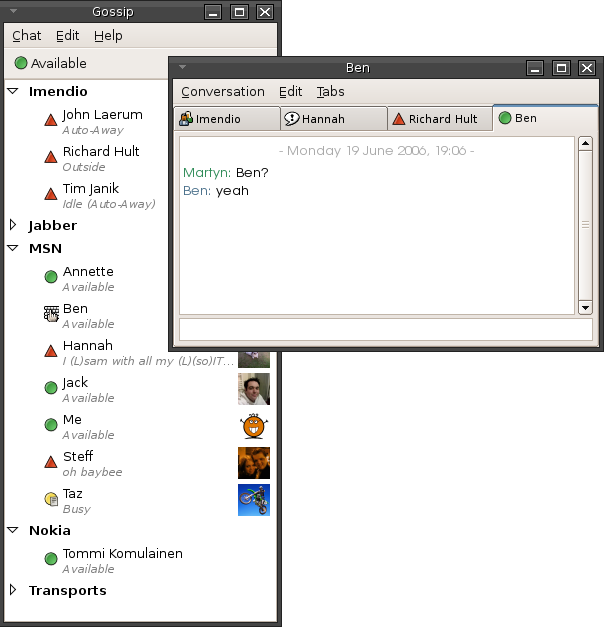
Multi-protocol clients can use any of the IM protocols by using additional local libraries for each protocol. Examples of multi-protocol instant messenger software include Pidgin and Trillian,[8] and more recently Beeper. These third-party clients have often been unable to keep up due to proprietary protocol restrictions and getting locked out of it.[8] For instance, in 2015, WhatsApp started banning users who were using unofficial clients.[47] Major IM providers usually cite the need for formal agreements, and security concerns as reasons for making changes.
Attempted open standards
[edit]There have been several attempts in the past to create a unified standard for instant messaging, including:
- IETF's Session Initiation Protocol (SIP) and SIP for Instant Messaging and Presence Leveraging Extensions (SIMPLE)
- Application Exchange (APEX),
- Instant Messaging and Presence Protocol (IMPP),
- Extensible Messaging and Presence Protocol (XMPP), based on XML, and
- Open Mobile Alliance's Instant Messaging and Presence Service (IMPS), developed specifically for mobile devices.
History and agreements
[edit]Critics say AOL's slowness in embracing interoperability has caused setbacks to other companies trying to grow their businesses. AOL has said it supports the development of an interoperable system for all IM networks but has cited privacy and security concerns as the reasons it's taking its time. Competitors have labeled that argument a "smoke screen."
In the early 2000s, when instant messaging was quickly growing, most attempts at producing a unified standard for the-then major IM providers (AOL, Yahoo!, Microsoft) had failed. There was a "bitter row" between AOL and its rivals regarding the opening up of their networks.[50] In 2000, U.S. regulatory Federal Communications Commission (FCC) proposed, and supported by Microsoft chairman Bill Gates, that AOL providing interoperability of its AIM and ICQ instant messengers with Microsoft's MSN Messenger was a condition for the forthcoming AOL-Time Warner merger.[51]
However, in 2004, Microsoft, Yahoo! and AOL agreed to a deal in which Microsoft's enterprise IM server Live Communications Server 2005 would have the possibility to talk to their rival counterparts and vice versa.[52] On October 13, 2005, Microsoft and Yahoo! announced that their IM networks would soon be interoperable, using SIP/SIMPLE. This was finally rolled out to Windows Live Messenger and Yahoo! Messenger users in July 2006.[53] Additionally, in December 2005 by the AOL and Google strategic partnership deal, it was announced that AIM and ICQ users would be able to communicate with Google Talk users.[54] However this feature took until December 2007 to roll out.[55] XMPP provided the best example of open protocol interoperability, having had gateways that connected to Google Talk, Lotus Sametime and others.[56]
Later, RCS was developed by telecommunication companies as an instant messaging protocol to replace SMS under a unified standard. In 2022, the European Union passed the Digital Markets Act, which largely came into effect in early 2023. Among other things, the legislation mandates certain interoperability between the largest IM platforms in use in Europe.[57] As a result, in March 2024, Meta Platforms opened up its WhatsApp and Messenger networks to be interoperable.[58]
Technical
[edit]There are two ways to combine the many disparate protocols:
- Combine the many disparate protocols inside the IM client application.
- Combine the many disparate protocols inside the IM server application. This approach moves the task of communicating with the other services to the server. Clients need not know or care about other IM protocols. For example, LCS 2005 Public IM Connectivity. This approach is popular in XMPP servers; however, the so-called transport projects suffer the same reverse engineering difficulties as any other project involved with closed protocols or formats.
Some approaches allow organizations to deploy their own, private instant messaging network by enabling them to restrict access to the server (often with the IM network entirely behind their firewall) and administer user permissions. Other corporate messaging systems allow registered users to also connect from outside the corporation LAN, by using an encrypted, firewall-friendly, HTTPS-based protocol. Usually, a dedicated corporate IM server has several advantages, such as pre-populated contact lists, integrated authentication, and better security and privacy.[citation needed]
Effects of IM on communication
[edit]Workplace communication
[edit]Instant messaging has changed how people communicate in the workplace. Enterprise messaging applications like Slack, Symphony, Teamnote and Yammer allow companies to enforce policies on how employees message at work and ensure secure storage of sensitive data.[59] They allow employees to separate work information from their personal emails and texts.
Messaging applications may make workplace communication efficient, but they can also have consequences on productivity. A study at Slack showed on average, people spend 10 hours a day on Slack, which is about 67% more time than they spend using email.[60]
Instant messaging is implemented in many video-conferencing tools. A study of chat use during work-related videoconferencing found that chat during meetings allows participants to communicate without interrupting the meeting, plan action around common resources, and enables greater inclusion.[61] The study also found that chat can cause distractions and information asymmetries between participants.
Language
[edit]
Users sometimes make use of internet slang or text speak to abbreviate common words or expressions to quicken conversations or reduce keystrokes. The language has become widespread, with well-known expressions such as 'lol' translated over to face-to-face language.
Emotions are often expressed in shorthand, such as the abbreviation LOL, BRB and TTYL; respectively laugh(ing) out loud, be right back, and talk to you later. Some, however, attempt to be more accurate with emotional expression over IM. Real time reactions such as (chortle) (snort) (guffaw) or (eye-roll) have been popular at one point. Also there are certain standards that are being introduced into mainstream conversations including, '#' indicates the use of sarcasm in a statement and '*' which indicates a spelling mistake and/or grammatical error in the prior message, followed by a correction.[62]
Business application
[edit]Instant messaging products can usually be categorised into two types: Enterprise Instant Messaging (EIM)[63] and Consumer Instant Messaging (CIM).[64] Enterprise solutions use an internal IM server, however this is not always feasible, particularly for smaller businesses with limited budgets. The second option, using a CIM provides the advantage of being inexpensive to implement and has little need for investing in new hardware or server software. IM is increasingly becoming a feature of enterprise software rather than a stand-alone application.[citation needed]
Instant messaging has proven to be similar to personal computers, email, and the World Wide Web, in that its adoption for use as a business communications medium was driven primarily by individual employees using consumer software at work, rather than by formal mandate or provisioning by corporate information technology departments. Tens of millions of the consumer IM accounts in use are being used for business purposes by employees of companies and other organizations. The adoption of IM across corporate networks outside of the control of IT organizations creates risks and liabilities for companies who do not effectively manage and support IM use.[citation needed] IM was initially shunned by the corporate world partly due to security concerns, but by 2003 many had started embracing these new services.[65]
Software
[edit]In response to the demand for business-grade IM and the need to ensure security and legal compliance, a new type of instant messaging, called "Enterprise Instant Messaging" ("EIM") was created when Lotus Software launched IBM Lotus Sametime in 1998. Microsoft followed suit shortly thereafter with Microsoft Exchange Instant Messaging, later created a new platform called Microsoft Office Live Communications Server, and released Office Communications Server 2007 in October 2007. Oracle Corporation also jumped into the market with its Oracle Beehive unified collaboration software.[66]
Both IBM Lotus and Microsoft have introduced federation between their EIM systems and some of the public IM networks so that employees may use one interface to both their internal EIM system and their contacts on AOL, MSN, and Yahoo. As of 2010, leading EIM platforms include IBM Lotus Sametime, Microsoft Office Communications Server, Jabber XCP and Cisco Unified Presence.[independent source needed] Industry-focused EIM platforms such as Reuters Messaging and Bloomberg Messaging also provide IM abilities to financial services companies.[independent source needed]
Security and archiving
[edit]Crackers (malicious or black hat hackers) have consistently used IM networks as vectors for delivering phishing attempts, drive-by URLs, and virus-laden file attachments, with over 1100 discrete attacks listed by the IM Security Center[67] in 2004–2007. Hackers use two methods of delivering malicious code through IM: delivery of viruses, trojan horses, or spyware within an infected file, and the use of "socially engineered" text with a web address that entices the recipient to click on a URL connecting him or her to a website that then downloads malicious code.[citation needed]
IM connections sometimes occur in plain text, making them vulnerable to eavesdropping. Also, IM client software often requires the user to expose open UDP ports to the world, raising the threat posed by potential security vulnerabilities.[68]
In the early 2000s, a new class of IT security providers emerged to provide remedies for the risks and liabilities faced by corporations who chose to use IM for business communications. The IM security providers created new products to be installed in corporate networks for the purpose of archiving, content-scanning, and security-scanning IM traffic moving in and out of the corporation. Similar to the e-mail filtering vendors, the IM security providers focus on the risks and liabilities described above.[69][70][71]
With the rapid adoption of IM in the workplace, demand for IM security products began to grow in the mid-2000s. By 2007, the preferred platform for the purchase of security software had become the "computer appliance", according to IDC, who estimated that by 2008, 80% of network security products would be delivered via an appliance.[72]
By 2014, however, instant messengers' safety level was still extremely poor. According to a scorecard by the Electronic Frontier Foundation, only 7 out of 39 instant messengers received a perfect score. In contrast, the most popular instant messengers at the time only attained a score of 2 out of 7.[73][74] A number of studies have shown that IM services are quite vulnerable for providing user privacy.[75][76]
In 2023, cybersecurity researchers discovered that numerous malicious "mods" exist of the Telegram instant messenger, which is freely available for download from Google Play.[77]
Message history
[edit]Instant messages are often logged in a local message history, similar to emails' persistent nature. IM networks may store messages with either local-based device storage (e.g. WhatsApp, Viber, Line, WeChat, Signal etc. software) or cloud-based server storage provided by the service (e.g. Telegram, Skype, Facebook Messenger, Google Meet/Chat, Discord, Slack etc.). Although cloud-based storage is advertised to offer encrypted messages, it poses an increased risk that the IM provider may have access to the decryption keys and view the user's saved messages.[78]
This requires users to trust IM servers and providers because messages can generally be accessed by the company. Companies may be compelled to reveal their user's communication and suspend user accounts for any reason.[79]
Tracking and spying
[edit]News reports from 2013 revealed that the NSA is not only collecting emails and IM messages but also tracking relationships between senders and receivers of those chats and emails in a process known as metadata collection.[80] Metadata refers to the data concerned about the chat or email as opposed to contents of messages. It may be used to collect valuable information.[81]
In January 2014, Matthew Campbell and Michael Hurley filed a class-action lawsuit against Facebook for breaching the Electronic Communications Privacy Act.[82] They alleged that the information in their supposedly private messages was being read and used to generate profit, specifically "for purposes including but not limited to data mining and user profiling".
In corporate use of IM, organizational offerings have become very sophisticated in their security and logging measures. An employee or organization member must be granted login credentials and permission to use the messaging system. Creating a specific account for each user allows the organization to identify, track and record all use of their messenger system on their servers.[83]
Encryption
[edit]Encryption is the primary method that instant messaging apps use to protect user's data privacy and security. For corporate use, encryption and conversation archiving are usually regarded as important features due to security concerns.[84] There are also a bunch of open source encrypting messengers.[85]
IM does hold potential advantages over SMS. SMS messages are not encrypted, making them insecure, as the content of each SMS message is visible to mobile carriers and governments and can be intercepted by a third party,[86] may leak metadata (such as phone numbers),[86] or be spoofed and the sender of the message can be edited to impersonate another person.[86]
Current instant messaging networks that use end-to-end encryption include Signal,[87][88] WhatsApp, Wire and iMessage.[86][89][90] Signal and iMessage have started using Post-quantum cryptography in September 2023[91][92][93] and April 2024[94][95][96] respectively. Applications that have been criticized for lacking or poor encryption methods include Telegram and Confide, as both are prone to error or not having encryption enabled by default.[86][97]
Compliance risks
[edit]In addition to the malicious code threat, using instant messaging at work creates a risk of non-compliance with laws and regulations governing electronic communications in businesses. In the United States alone, there are over 10,000 laws and regulations related to electronic messaging and records retention.[98] The better-known of these include the Sarbanes–Oxley Act, HIPAA, and SEC 17a-3.
Clarification from the Financial Industry Regulatory Authority (FINRA) was issued to member firms in the financial services industry in December 2007, noting that "electronic communications", "email", and "electronic correspondence" may be used interchangeably and can include such forms of electronic messaging as instant messaging and text messaging.[99] Changes to Federal Rules of Civil Procedure, effective December 1, 2006, created a new category for electronic records which may be requested during discovery in legal proceedings.[citation needed]
Most nations also regulate electronic messaging and records retention similarly to the United States. The most common regulations related to IM at work involve producing archived business communications to satisfy government or judicial requests under law. Many instant messaging communications fall into the category of business communications that must be archived and retrievable.[citation needed]
Current user base
[edit]As of May 2025, the most used instant messaging apps and services worldwide include: Signal with 100 million, Line with 197 million, Viber with 260 million, QQ with 562 million, Snapchat with 900 million, Telegram with 1 billion, Facebook Messenger with 1.3 billion, WeChat with 1.39 billion, and WhatsApp with 3 billion users.[100][101]
There are 25 countries in the world where WhatsApp messenger is not the market leader in IM, such as the United States, Canada, Australia, New Zealand, Denmark, Norway, Sweden, Hungary, Lithuania, Poland, Slovakia, Philippines, and China.[100][102]
IM apps have varying levels of adoption in different countries. As of April 2022:[103][104]
- WhatsApp by Meta Platforms is the most popular instant messaging network in several countries in South America, Western Europe, Africa, Middle East, South Asia, and Southeast Asia.
- Facebook Messenger by Meta Platforms is the most popular instant messaging network in North America, Northern Europe, some Central Europe countries, and Oceania.
- Telegram is the most popular instant messaging app in several Eastern Europe countries, and the second preferred option after WhatsApp in several countries in Western Europe, Middle East, South Asia, Southeast Asia, Africa, Central and South America.
- Viber by Rakuten has a strong presence in Central and Eastern Europe (Bulgaria, Greece, Serbia, Ukraine, Russia). It is also moderately successful in Philippines and Vietnam.[105][106][107]
- Line by Naver Corporation is used widely in some countries in Asia (Japan, Taiwan, Thailand).
- Instant messaging apps and services that are predominately used in only one country include: KakaoTalk in South Korea, Zalo in Vietnam, WeChat in China, and imo in Qatar.
- While not the dominant app for one-to-one messaging in any country, Discord is commonly used among online communities due to its ability to support chats with a large amount of members, topic-based channels, and cloud-based storage. Signal, favoured for its privacy-focused approach, is among the top three preferred option in the Netherlands, Sweden, and Finland.[103]
See also
[edit]Terms
[edit]- Ambient awareness – Term used to describe a form of peripheral social awareness
- Communication protocol – System for exchanging messages between computing systems
- Mass collaboration – Many people working on a single project
- Message-oriented middleware – Type of software or hardware infrastructure
- Operator messaging – Messaging answer service
- Social media – Virtual online communities
- Text messaging – Act of typing and sending a brief, digital message
- SMS – Text messaging service component
- Unified communications – Business and marketing concept / Messaging
Lists
[edit]- Comparison of cross-platform instant messaging clients
- Comparison of instant messaging protocols
- Comparison of user features of messaging platforms
Other
[edit]- Code Shikara – Family of malware worms that spreads through instant messaging
- Meatspace Chat
References
[edit]- ^ "What is Instant Messaging? - Definition from SearchUnifiedCommunications". Unified Communications. Retrieved 2023-07-22.
- ^ a b "Will instant messaging be the new texting?". 2003-06-30. Retrieved 2024-08-05.
- ^ "MMS-multi media messaging and MMS-interconnection". Electronic Communications Committee (ECC). 2004.
- ^ Foderaro, Lisa W. (2005-01-09). "Young Cell Users Rack Up Debt, a Message at a Time". The New York Times. ISSN 0362-4331. Retrieved 2024-08-05.
- ^ "History of IRC". 4 January 2021. Archived from the original on 15 August 2021. Retrieved 1 August 2021.
- ^ "The Evolution of Instant Messaging". 17 November 2016.
- ^ a b "How BlackBerry Messenger Forever Changed the Way We Text". Inverse. 2023-05-09. Retrieved 2024-08-05.
- ^ a b c d e "RIP, ICQ: Why all instant messaging disappears (in the end)". ZDNET. Retrieved 2024-08-06.
- ^ "8 Examples of Instant Messaging | ezTalks". www.eztalks.com. Retrieved 2020-08-06.
- ^ Clifford, Catherine (2013-12-11). "Top 10 Apps for Instant Messaging (Infographic)". Entrepreneur. Retrieved 2020-08-06.
- ^ "Part 1. Introduction: The basics of instant messaging". Pew Research Center: Internet, Science & Tech. 2004-09-01. Retrieved 2023-10-27.
- ^ "How Instant Messaging Works". HowStuffWorks. 2001-03-28. Retrieved 2023-10-27.
- ^ "Summary of Final Decisions Issued by the Trademark Trial and Appeal Board" (PDF). Archived from the original (PDF) on 8 October 2012. Retrieved 2012-05-11.
- ^ "Important and Long Delayed News". April 6, 2007. Archived from the original on April 8, 2007.
- ^ "Yahoo! Messenger Launches "Imvironments™" with Next Generation of Yahoo! Messenger Service | Altaba Inc".
- ^ "How to play ALL of Facebook Messenger's new games". Digital Spy. 2019-01-30. Retrieved 2024-08-06.
- ^ "Discord Activities: Play Games and Watch Together". discord.com. Retrieved 2024-08-06.
- ^ "Facebook". www.facebook.com. Retrieved 2024-08-06.
- ^ vincithevin (2024-08-02). "Beijing Visitor's Guide: A Guide to Payment Services in the Capital". www.thebeijinger.com. Retrieved 2024-08-06.
- ^ Fetter, Mirko (2019). New Concepts for Presence and Availability in Ubiquitous and Mobile Computing. University of Bamberg Press. p. 38. ISBN 9783863096236.
The basic concept of sending instantaneously messages to logged in users came with ... CTSS ...
- ^ Tom Van Vleck. "Instant Messaging on CTSS and Multics". Multicians.org. Retrieved 2012-05-11.
- ^ a b c d e "A Brief History of Chat Apps · Guide to Chat Apps". towcenter.gitbooks.io. Retrieved 2020-03-23.
- ^ CompuServe Innovator Resigns After 25 Years, The Columbus Dispatch, May 11, 1996, p. 2F
- ^ Wired and Inspired, The Columbus Dispatch (Business page), by Mike Pramik, November 12, 2000
- ^ "AOL Instant Messenger's Real-Time IM feature". Help.aol.com. Archived from the original on March 12, 2012. Retrieved May 11, 2012.
- ^ "RealJabber.org's animation of real-time text". Realjabber.org. Archived from the original on 2013-10-26. Retrieved 2012-05-11.
- ^ "Screenshot of a Quantum Link OLM". Archived from the original on June 19, 2012. Retrieved May 11, 2012.
- ^ a b Andrei, Mihai (2018-11-09). "The Internet Relay Chat (IRC) turned 30 -- and it probably changed our lives". ZME Science. Retrieved 2024-08-06.
- ^ Tay, Liz (2008-07-08). "IBM touts unification of consumer and business communication tools". iTnews. Retrieved 2024-08-06.
- ^ "XMPP". xmpp.org. Retrieved 2024-08-06.
- ^ "New Yahoo IM chats up broadband". CNET. 2002-08-15. Retrieved 2024-08-06.
- ^ "Yahoo! Messenger offers video option - Jun. 26, 2001". money.cnn.com. Retrieved 2024-08-06.
- ^ "Skype adds in video to net calls". 2005-12-01. Retrieved 2024-08-06.
- ^ "Messaging in an instant". 2001-09-09. Retrieved 2024-08-06.
- ^ Bergfeld, Carlos (2008-04-17). "Facebook Chat: Reports of AIM's Death Greatly Exaggerated - CBS News". www.cbsnews.com. Retrieved 2024-08-06.[dead link]
- ^ Kelly, Jon (24 May 2010). "Instant messaging: This conversation is terminated". BBC. Retrieved 14 March 2018.
- ^ Carlson, Nicholas. "In The Biggest Blown Opportunity Ever, AOL Instant Messenger Has Utterly Collapsed". Business Insider. Retrieved 2024-08-06.
- ^ "Chat apps surpass SMS for the first time, study finds". 29 April 2013.
- ^ Ling, Rich; Lai, Chih-Hui (2016-10-01). "Microcoordination 2.0: Social Coordination in the Age of Smartphones and Messaging Apps". Journal of Communication. 66 (5): 834–856. doi:10.1111/jcom.12251. ISSN 0021-9916.
- ^ Horwitz, Josh (25 August 2015). "Why WhatsApp bombed in the US, while Snapchat and Kik blew up". Quartz. Retrieved 2020-04-01.
- ^ "AIM has been discontinued as of December 15, 2017". help.aol.com. Archived from the original on 15 December 2017.
- ^ "The rise of messaging platforms". The Economist, via Chatbot News Daily. 2017-01-22. Archived from the original on 2023-01-17. Retrieved 14 March 2018.
- ^ "Business Use of Instant Messaging on the Rise, Email Still Primary Survey Finds". 2017-06-09. Archived from the original on 2024-08-06. Retrieved 2024-08-06.
- ^ "Third-party Discord app brings back MSN Messenger but there's a catch". Dexerto. 2024-04-05. Retrieved 2024-08-06.
- ^ "A Brief History of Chat Services" (PDF). sameroom.io. 19 April 2023.
- ^ "The best all-in-one messaging apps in 2024". zapier.com. Retrieved 2024-08-06.
- ^ "WhatsApp Permanently Bans Users of Unofficial Clients".
- ^ "AOL, Time Warner complete merger with FCC blessing". CNET.
- ^ "Green light for AOL-Time Warner merger". ZDNET.
- ^ "AOL wins instant messaging case". 2002-12-19. Retrieved 2024-08-06.
- ^ "Gates Adds His Voice To Instant Messaging". Forbes. Retrieved 2024-08-06.
- ^ Hicks, Matthew (2004-07-15). "Microsoft Opens IM Server to AOL, Yahoo". eWeek. Retrieved 2024-08-06.
- ^ "Microsoft, Yahoo connect IM services". CNET. Retrieved 2024-08-06.
- ^ Bylund, Anders (2005-12-21). "Google buys 5 percent of AOL; Google Talk and AIM to chat it up". Ars Technica. Retrieved 2024-08-06.
- ^ Schwartz, Barry (2007-12-05). "Google Talk Meets AOL Instant Messager: Time Warner & Google Complete AIM Integration Deal". Search Engine Land. Retrieved 2024-08-06.
- ^ "Jabber gateway aims to link XMPP, SIMPLE". InfoWorld. Retrieved 2024-08-06.
- ^ Claburn, Thomas. "EU mandated interoperable messaging not so simple: Paper". www.theregister.com. Retrieved 2023-11-11.
- ^ Jowitt, Tom (2024-03-13). "Meta Messaging Interoperability Whatsapp, Messenger". Silicon UK. Retrieved 2024-08-06.
- ^ "Text Messaging Apps Are Transforming Workplace Communications". TeleMessage. Retrieved 2020-04-01.
- ^ Kashyap, Vartika. "Are Messaging Apps at Work Affecting Team Productivity?". learn.g2.com. Retrieved 2020-04-01.
- ^ Sarkar, Advait; Rintel, Sean; Borowiec, Damian; Bergmann, Rachel; Gillett, Sharon; Bragg, Danielle; Baym, Nancy; Sellen, Abigail (2021-05-08), "The promise and peril of parallel chat in video meetings for work", Extended Abstracts of the 2021 CHI Conference on Human Factors in Computing Systems, New York, NY, USA: Association for Computing Machinery, pp. 1–8, doi:10.1145/3411763.3451793, ISBN 978-1-4503-8095-9, S2CID 233987188, retrieved 2021-11-01
- ^ instant messaging Archived February 12, 2010, at the Wayback Machine, NetworkDictionary.com.
- ^ "Better Business IMs - Business Technology". Im.about.com. 2012-04-10. Archived from the original on 2011-04-30. Retrieved 2012-05-11.
- ^ "Reader Questions IM Privacy at Work". Im.about.com. 2008-03-15. Archived from the original on 2010-08-25. Retrieved 2012-05-11.
- ^ "Message in a bottleneck". CNET. Retrieved 2024-08-06.
- ^ "Oracle Buzzes with Updates for its Beehive Collaboration Platform". CMSWire. May 12, 2018. Retrieved October 16, 2018.
- ^ "IM Security Center". Archived from the original on October 22, 2016. Retrieved May 13, 2007.
- ^ "Why just say no to IM at work". Blog.anta.net. October 29, 2009. ISSN 1797-1993. Archived from the original on July 26, 2011. Retrieved October 29, 2009.
- ^ Evers, Joris (2005-06-06). "Akonix ships IM security appliance". ZDNET. Retrieved 2025-10-07.
- ^ "Akonix L7 Enterprise". PCMAG. 2003-11-11. Retrieved 2025-10-07.
- ^ Hu, Jim (2002-11-12). "MS corporate IM touts security, archives". ZDNET. Retrieved 2025-10-07.
- ^ Chris Christiansen and Rose Ryan, International Data Corp., "IDC Telebriefing: Threat Management Security Appliance Review and Forecast"
- ^ Dredge, Stuart (2014-11-06). "How secure is your favourite messaging app? Today's Open Thread". the Guardian. Retrieved May 16, 2015.
- ^ "Secure Messaging Scorecard". Electronic Frontier Foundation. Archived from the original on November 15, 2016. Retrieved May 16, 2015.
- ^ Saleh, Saad (2015). IM Session Identification by Outlier Detection in Cross-correlation Functions. Conference on Information Sciences and Systems (CISS). doi:10.13140/RG.2.1.3524.5602.
- ^ Saleh, Saad (December 2014). Breaching IM Session Privacy Using Causality. IEEE Global Communications Conference (Globecom). doi:10.13140/2.1.1112.2244.
- ^ Baran, Guru (2023-09-11). "Weaponized Telegram App Infected Over 60K Android Users". Cyber Security News. Retrieved 2024-08-06.
- ^ Doffman, Zak. "No, Don't Quit WhatsApp To Use Telegram Instead—Here's Why". Forbes. Retrieved 2024-08-06.
- ^ "Skype hauled into court after refusing to hand call records to cops". The Register. 26 May 2015. Retrieved 17 March 2017.
- ^ Risen, James; Poitras, Laura (28 September 2013). "N.S.A. Gathers Data on Social Connections of U.S. Citizens". The New York Times. Retrieved 2015-10-11.
- ^ "A Primer on Metadata: Separating Fact from Fiction - Privacy By Design". Privacybydesign.ca. 2013-07-17. Archived from the original on 2014-02-26. Retrieved 2015-10-11.
- ^ Grove, Jennifer (2014). Facebook Sued for Allegedly Intercepting Private Messages. Mobile World Congress. Retrieved from Cnet.com
- ^ "Cisco WebEx Messenger: Enterprise Instant Messaging through a Commercial-Grade Multilayered Architecture" (PDF). Cisco.com. Retrieved 2015-10-11.
- ^ Schneier, Bruce; Seidel, Kathleen; Vijayakumar, Saranya (11 February 2016). "Multi-Encrypting Messengers – in: A Worldwide Survey of Encryption Products" (PDF). Retrieved 28 March 2017.
- ^ Adams, David; Maier, Ann-Kathrin (6 June 2016). "Big Seven Study, open source crypto-messengers to be compared – or: Comprehensive Confidentiality Review & Audit: Encrypting E-Mail-Client & Secure Instant Messenger, Descriptions, tests and analysis reviews of 20 functions of the applications based on the essential fields and methods of evaluation of the 8 major international audit manuals for IT security investigations including 38 figures and 87 tables" (PDF). Retrieved 22 March 2017.
- ^ a b c d e "Cybersecurity 101: How to choose and use an encrypted messaging app". TechCrunch. 25 December 2018. Retrieved 2020-04-01.
- ^ "The Best Private Instant Messengers". Privacy Guides. Retrieved 2025-07-05.
- ^ "Communicating With Others". ssd.eff.org. Electronic Frontier Foundation. Retrieved 2025-07-05.
- ^ "iMessage security overview". Apple Support. Retrieved 2025-07-05.
- ^ "Best WhatsApp Alternatives". Tuta. 24 February 2024. Retrieved 2024-05-13.
- ^ "Quantum Resistance and the Signal Protocol". Signal Messenger. Retrieved 2025-07-05.
- ^ Goodin, Dan (2023-09-20). "The Signal Protocol used by 1+ billion people is getting a post-quantum makeover". Ars Technica. Retrieved 2025-07-05.
- ^ "Signal adds quantum-resistant encryption to its E2EE messaging protocol". BleepingComputer. Retrieved 2025-07-05.
- ^ Goodin, Dan (2024-02-22). "iMessage gets a major makeover that puts it on equal footing with Signal". Ars Technica. Retrieved 2025-07-05.
- ^ Burgess, Matt. "Apple's iMessage Is Getting Post-Quantum Encryption". Wired. ISSN 1059-1028. Retrieved 2025-07-05.
- ^ "iMessage with PQ3: The new state of the art in quantum-secure messaging at scale". security.apple.com. Apple, Inc. 21 February 2024.
- ^ Jakobsen, Jakob; Orlandi, Claudio (2016). "On the CCA (in)security of MTProto" (PDF). Proceedings of the 6th Workshop on Security and Privacy in Smartphones and Mobile Devices. Aarhus University. p. 6. doi:10.1145/2994459.2994468. ISBN 978-1-4503-4564-4.
- ^ "ESG compliance report excerpt, Part 1: Introduction". Archived from the original on July 16, 2012. Retrieved May 13, 2007.
- ^ FINRA, Regulatory Notice 07-59, Supervision of Electronic Communications, December 2007
- ^ a b "Messaging App Usage Statistics Around the World". MessengerPeople. 2020-02-12. Retrieved 2020-04-01.
- ^ "The most popular messaging apps in the world by country". Sinch. 2025-05-29.
- ^ "11 New People Join Social Media Every Second (And Other Impressive Stats)". Archived from the original on 2018-01-30.
- ^ a b "Most Popular Messaging Apps by Country". Similarweb.
- ^ "Most Popular Messaging Apps: Top Messaging Apps 2021". Respond.io.
- ^ "Viber usage spikes as pandemic strikes". The Philippine Star. 29 January 2021.
- ^ "Viber expands foothold in the Philippines in 2021". BusinessMirror. 18 December 2021.
- ^ "When chatting apps can be overwhelming". VnExpress International.
External links
[edit]Instant messaging
View on GrokipediaFundamentals
Definition and Core Principles
Instant messaging (IM) constitutes the exchange of near-real-time text messages between two or more users via dedicated software applications or integrated network services, enabling synchronous communication over the internet or other digital networks.[9][10] This differs fundamentally from asynchronous email by prioritizing immediacy, where messages are delivered and acknowledged with minimal latency, often within seconds.[11] Core to IM is the integration of presence awareness, which informs users of contacts' online status, availability, and activity levels through server-mediated signals, facilitating context-aware initiation of conversations.[12][5] At its foundation, IM operates on client-server architectures or peer-to-peer models, where client applications authenticate users, establish persistent connections, and route messages via standardized or proprietary protocols.[13] The Extensible Messaging and Presence Protocol (XMPP), formalized as an IETF standard, exemplifies open IM principles by using XML streams for extensible, federated message exchange, presence notifications, and session management across disparate servers.[14][15] This protocol supports core functions like one-to-one chats, group messaging, and extensions for multimedia, ensuring interoperability while allowing proprietary enhancements for features such as end-to-end encryption.[6] Reliability in IM derives from transport mechanisms like TCP for ordered delivery and acknowledgments, mitigating packet loss in real-time scenarios, though early systems like IRC relied on simpler, channel-based broadcasting without inherent presence.[16] Causal realism in IM design emphasizes low-latency feedback loops—such as typing indicators and read receipts—to mimic face-to-face interaction, reducing miscommunication from delayed responses.[17] Empirical data from protocol implementations show that effective IM systems balance scalability with security; for instance, XMPP's decentralized federation prevents single-point failures but introduces complexity in trust verification compared to centralized alternatives.[18] User authentication via credentials or tokens underpins privacy, though historical vulnerabilities highlight the need for ongoing cryptographic upgrades to counter interception risks in unencrypted transmissions.[19]Underlying Technologies
Instant messaging systems predominantly employ a client-server architecture, in which end-user clients connect to servers that route messages, manage presence information, and queue undelivered messages for offline recipients. This model facilitates centralized authentication, scalability through server federation, and reliable delivery via persistent connections or polling mechanisms.[2][6] Peer-to-peer architectures, where clients communicate directly after initial server rendezvous, offer lower latency and reduced server dependency but face challenges with firewall traversal, dynamic IP handling, and consistent presence tracking, limiting their adoption in mainstream implementations.[20] At the transport layer, Transmission Control Protocol (TCP) ensures reliable, ordered packet delivery for text-based exchanges, while User Datagram Protocol (UDP) supports low-latency applications like voice or video extensions. Web-based clients leverage WebSockets for full-duplex communication over a single TCP connection, bypassing limitations of HTTP polling or long-polling techniques.[6] Application-layer protocols define message structure, routing, and features like presence stanzas. The Extensible Messaging and Presence Protocol (XMPP), standardized in RFC 6120 for core stream management and RFC 6121 for instant messaging and presence, employs XML-formatted streams transmitted over TCP, enabling federated interoperability across independent servers.[21][14] Other foundational protocols include Internet Relay Chat (IRC), which uses plain-text commands over TCP for multi-user channels, and SIP for Instant Messaging and Presence Leveraging Extensions (SIMPLE), building on Session Initiation Protocol (SIP) for signaling.[16][22] Proprietary systems, such as those in WhatsApp, adapt XMPP with custom binary encoding and server-side optimizations for high-scale mobile usage.[23] Security protocols layer encryption atop these foundations: Transport Layer Security (TLS) secures client-server channels against interception, while end-to-end encryption (E2EE) protects message content from server access using asymmetric cryptography and key ratcheting. In XMPP, the OMEMO extension implements E2EE via the Signal Protocol's double-ratchet algorithm, providing forward secrecy and deniability for multi-device synchronization.[24] Mobile deployments integrate push notification services, such as Apple's Push Notification service or Firebase Cloud Messaging, to deliver alerts without maintaining constant connections, thereby optimizing battery life and network efficiency.[23]Historical Development
Origins in Early Computing
The precursors to modern instant messaging emerged in early multi-user timesharing systems of the 1960s, which enabled real-time interaction among logged-in users on shared mainframe computers.[25] These systems, such as MIT's Compatible Time-Sharing System (CTSS) introduced in 1961, laid the groundwork by allowing multiple terminals to access a central processor, fostering rudimentary forms of synchronous communication beyond batch processing.[26] A pivotal development occurred with the PLATO (Programmed Logic for Automatic Teaching Operations) system at the University of Illinois, operational since 1960 but gaining communication features by the early 1970s. In 1973, programmers Doug Brown and David Woolley developed Talkomatic, recognized as the first multi-user chat room application, which divided the screen into horizontal windows for up to five participants to engage in simultaneous text-based conversations across multiple rooms.[27] [28] PLATO also featured Term-Talk, a one-to-one instant messaging tool invoked by pressing the TERM key and entering "talk," enabling direct peer-to-peer exchanges among users on the system.[29] In parallel, Unix-based environments introduced the 'talk' command in the early 1980s, providing a command-line interface for real-time text communication between users on the same host or networked systems.[30] This tool employed a split-screen format, displaying the sender's and recipient's inputs side-by-side, and became a standard utility on Unix-like operating systems for intra-system messaging before the rise of networked protocols.[31] These early innovations demonstrated the feasibility of low-latency, text-based interpersonal communication in computing, influencing subsequent protocols despite limitations in scalability and graphical interfaces.[32]Pre-Graphical Internet Protocols
Thetalk protocol, integrated into Unix systems via the talk command, facilitated direct, real-time text-based communication between two users across networked machines. Released as part of 4.2BSD in August 1983, it operated over UDP and displayed incoming messages on a split terminal screen, allowing simultaneous typing and viewing without interrupting the conversation.[33] This point-to-point protocol required users to know each other's login names and hostnames, initiating sessions by inviting the remote party, who could accept or decline.[34]
Subsequent enhancements addressed limitations of the original implementation. The ntalk variant, introduced in later BSD releases such as 4.3BSD around 1986, refined the protocol for better compatibility across multi-homed systems and incorporated a more robust negotiation mechanism, though it remained incompatible with the 4.2BSD version.[35] Tools like ytalk, developed in the early 1990s, extended the protocol to support multi-user conversations in a terminal-based interface, splitting the screen into multiple panes for group interaction.[36] These protocols were inherently insecure, transmitting unencrypted plain text over networks and vulnerable to eavesdropping, reflecting the era's minimal emphasis on privacy in academic and research environments.[37]
A significant advancement came with the Internet Relay Chat (IRC) protocol in 1988, created by Jarkko Oikarinen at the University of Oulu to enable multi-user discussions replacing slower BITNET relays.[38] Operating over TCP on port 6667 (standardized later), IRC supported channels for group chats, private messaging, and operator controls, with text-based clients like ircII providing command-line access.[39] Its client-server architecture allowed scalable federation across networks, handling thousands of users, though early deployments faced challenges like net splits due to unstable connections.[40] IRC's plain-text nature enabled simple parsing and extension but exposed it to similar security risks as earlier protocols, including channel flooding and unauthorized access.[41]
These pre-graphical protocols laid foundational mechanics for instant messaging, emphasizing low-latency text exchange over IP networks but lacking features like persistent identities or multimedia, which emerged later with graphical clients. Their terminal-centric design suited command-line environments prevalent in Unix-dominated research institutions during the 1980s.[26]
Emergence of Consumer Clients
The emergence of consumer-oriented instant messaging clients occurred in the mid-1990s, coinciding with the expansion of graphical user interfaces and broader home internet adoption via dial-up services. ICQ, developed by the Israeli firm Mirabilis, launched in November 1996 as the first widely accessible standalone application for real-time text communication over the internet, featuring a user-friendly GUI, unique numerical user identifiers (UINs), buddy lists for presence awareness, and server-mediated message routing that enabled cross-user connections without requiring simultaneous logins for notifications.[42] Unlike earlier command-line tools, ICQ prioritized ease of use for non-technical users, rapidly attracting millions worldwide by emphasizing simplicity and the novelty of instant, asynchronous alerts—such as the iconic "uh-oh" sound for incoming messages—fostering viral adoption through word-of-mouth and free distribution.[43] This breakthrough spurred competition, as established internet portals sought to capture the growing market of personal computing households. AOL Instant Messenger (AIM) debuted on May 1, 1997, initially as a Windows download extending AOL's proprietary ecosystem but soon opening to non-subscribers, introducing customizable away messages, file sharing, and emoticon support that enhanced social expressiveness and tied into AOL's vast user base of over 10 million dial-up subscribers at the time.[44] Yahoo Pager, rebranded as Yahoo Messenger, followed on March 9, 1998, integrating with Yahoo's web portal to offer voice chat prototypes and webcam support earlier than rivals, capitalizing on the search engine's traffic to build a user base rivaling ICQ's.[45] Microsoft entered with MSN Messenger on July 22, 1999, leveraging Windows integration for seamless startup and .NET Passport authentication, which prioritized enterprise-like reliability and later evolved to include emoticon packs and basic encryption amid antitrust scrutiny over interoperability.[46] These clients' success stemmed from network effects: each achieved critical mass through exclusive protocols that locked users into siloed ecosystems, deterring cross-network communication despite early federation attempts, while features like status indicators and typing notifications addressed causal demands for low-latency social coordination in an era of sporadic connectivity. By 1998, AOL acquired Mirabilis for approximately $407 million, reflecting ICQ's explosive growth to over 100 million registered users by 2001, though exact 1996-1997 figures remain anecdotal due to limited tracking; this consolidation intensified proprietary development over open standards.[47] The proliferation marked a shift from niche protocols to mass-market tools, embedding instant messaging in daily consumer routines and presaging mobile dominance, albeit with emergent privacy risks from persistent online presence.[48]Mobile Integration and Dominance
The integration of instant messaging into mobile devices accelerated with the introduction of BlackBerry Messenger (BBM) in 2005, which leveraged push notification technology to deliver real-time text messaging on BlackBerry handsets. BBM gained prominence as BlackBerry captured over 50% of the U.S. smartphone market by 2009 and 20% globally, appealing to users with features such as typing indicators, read receipts, and group chats that preceded similar functionalities in later apps.[49][50] The launch of app stores for iOS in 2008 and Android shortly thereafter enabled widespread adoption of cross-platform instant messaging apps, shifting usage from carrier-dependent SMS—which originated in 1992 but incurred per-message fees—to data-based services. WhatsApp, founded in February 2009 by Jan Koum and Brian Acton, exemplified this transition by offering free, internet-protocol messaging with end-to-end encryption added in 2016, rapidly scaling to 400 million monthly active users by December 2013 amid falling mobile data costs and smartphone proliferation in emerging markets.[51][52] BlackBerry's market share eroded to under 1% by 2016 due to its slower adaptation to open app ecosystems and touchscreen interfaces, leading to BBM's decline and service shutdown in 2019.[50][53] Mobile dominance solidified in the 2010s as proprietary integrations like Apple's iMessage (introduced in 2011 with iOS 5) reinforced ecosystem loyalty, while apps such as WeChat (2011) dominated in China through super-app features. By 2024, mobile messaging apps served nearly 4 billion users worldwide, representing the primary medium for personal and group communication, with WhatsApp alone at 3 billion monthly active users, far outpacing desktop counterparts that had peaked in the early 2000s.[54][55] This supremacy stems from smartphones' portability, always-on connectivity via Wi-Fi and cellular data, and advanced features like voice/video calls and rich media sharing, which rendered legacy desktop protocols like OSCAR or IRC obsolete for consumer use.[56]Privacy-Centric Evolutions
The disclosures of widespread government surveillance programs in 2013, revealed by Edward Snowden, catalyzed a shift toward privacy-enhanced instant messaging protocols, prompting developers to prioritize end-to-end encryption (E2EE) to prevent intermediary access to message contents.[57] Prior to this, most consumer apps like early versions of AIM and MSN Messenger relied on server-side encryption vulnerable to provider subpoenas or breaches, but post-2013 innovations emphasized client-side keys inaccessible to operators.[58] Signal, originally launched as TextSecure in 2010 by Whisper Systems, emerged as a benchmark for privacy-centric design after its 2014 rebranding and open-sourcing of the Signal Protocol, which provides forward secrecy and deniability alongside E2EE for text, voice, and video.[57] This protocol's adoption extended to WhatsApp in 2016, securing over 2 billion users' communications against server interception, though metadata like timestamps and contacts remained collectible by Meta. By 2023, Meta enabled default E2EE in Messenger for private chats, covering billions of interactions but excluding group features initially.[59] Further evolutions addressed metadata leakage and centralization risks, with decentralized protocols gaining traction to distribute control and enhance resilience. Matrix, introduced in 2014, enables federated servers where users can self-host, supporting E2EE via the Olm library derived from Signal's double-ratchet mechanism, and has been used in privacy-sensitive deployments like government communications.[60] Apps like Session, launched in 2018, employ onion routing over a blockchain-inspired network to anonymize IP addresses and eliminate phone number requirements, storing no user data centrally and relying on decentralized nodes for message relay.[61] Older federated standards like XMPP, extensible since 1999, incorporated optional E2EE via plugins such as OMEMO (2015), allowing server diversity but facing challenges from fragmented implementations and discovery issues.[5] These developments reflect a causal progression: E2EE mitigated content exposure, while decentralization targeted surveillance vectors like compelled server data handover, though adoption lags due to usability trade-offs and network effects favoring centralized incumbents.[62] Signal's 2024 introduction of usernames further reduced phone number linkage, underscoring ongoing refinements in anonymity.[63]Features and Functionality
Basic Text and Group Messaging
Instant messaging's core functionality revolves around the real-time exchange of short text messages between users connected via internet protocols, enabling near-instantaneous delivery upon transmission. Defined technically as the transfer of content—primarily textual—among participants with minimal latency, basic text messaging operates through client-server or peer-to-peer architectures where a sender's client encodes the message (typically in UTF-8 for Unicode support) and dispatches it to a recipient's inbox or endpoint.[64] This contrasts with store-and-forward systems like email by prioritizing immediate push notification to online recipients, often supplemented by presence awareness to confirm availability.[65] Messages appear in a persistent, chronological chat interface, fostering synchronous conversation without the delays inherent in cellular SMS, which relies on telephony networks rather than IP.[11] In practice, basic text supports one-to-one exchanges where users compose messages via keyboard input, with protocols like SIP using MESSAGE requests to encapsulate and route payloads as small, identifiable data units.[64] Delivery succeeds if the recipient is online, with offline queuing in some systems to store undelivered texts until reconnection. Enhancements such as delivery receipts or typing indicators—signaling active composition—emerge from protocol extensions but remain optional in minimal implementations.[66] Character limits vary by service, historically capped low (e.g., 140-1024 characters in early protocols) to mimic SMS constraints, though modern clients accommodate longer inputs by segmenting or expanding fields.[67] Group messaging extends one-to-one text by broadcasting a single message to multiple designated participants within a shared conversation channel, distributing it via multicast or server-side replication to all members' clients. This enables collective real-time interaction, where replies append to a common thread visible to the group, supporting coordination among small teams or social circles.[68] Protocols handle group dynamics through dedicated identifiers or rooms, ensuring atomic delivery attempts to all subscribers while managing joins, leaves, and moderation via administrative controls. Early group features, as in protocols like IRC derivatives, emphasized public channels, but proprietary IM evolved to private, invitation-based groups with persistent histories. Scalability limits group sizes—typically 10-250 users in consumer apps—to prevent overload, with larger setups risking latency from fan-out distribution.[17] Unlike basic pairwise chats, groups introduce challenges like message threading for attribution and notification filtering to avoid spam, yet they underpin collaborative use cases without requiring voice or media.[69]Multimedia Extensions
Multimedia extensions in instant messaging enable the sharing of images, audio, video, documents, and other non-text files, augmenting basic text exchanges with richer content. These features emerged progressively, starting with rudimentary file transfers in early protocols and evolving into seamless media handling in contemporary applications.[38][70] File transfer capabilities appeared early, with ICQ introducing direct file exchange upon its 1996 release, allowing users to send binaries including images and executables alongside messages.[38] AOL Instant Messenger similarly incorporated file sharing from its inception in 1997, often linking it to email for broader utility, though without initial virus scanning at firewalls.[70][71] Protocols like XMPP, formalized in the early 2000s, supported extensible file transfers via extensions such as HTTP File Upload, facilitating metadata-protected sharing in federated environments.[5] In the mobile domain, WhatsApp pioneered voice messaging in August 2013, permitting users to record and transmit short audio clips up to 15 seconds initially, which proved popular for nuanced communication in text-limited scenarios.[72][73] Image and video attachments followed suit, with apps like Kik adding multimedia cards for sketches and searches by 2012.[74] Animated content gained prominence later; Facebook Messenger integrated a GIF search button in June 2015, enabling rapid sharing of short looping videos amid the format's resurgence.[75] These extensions, while enhancing expressiveness, introduced challenges like increased bandwidth demands and security risks from unverified media.[71]
Automation and Third-Party Integrations
Many instant messaging platforms provide application programming interfaces (APIs) that enable automation, allowing developers to create bots for tasks such as responding to queries, scheduling messages, and integrating with external services. These features emerged prominently in the mid-2010s as platforms sought to extend functionality beyond peer-to-peer communication, supporting use cases like customer support and workflow automation. For instance, Telegram's Bot API, an HTTP-based interface launched in June 2015, permits bots to interact with users via messages, inline keyboards, and payments, facilitating applications from news alerts to interactive games.[76] Similarly, WhatsApp's Business API, introduced in 2018, supports automated messaging flows, including notifications and chatbots for handling inquiries without human intervention.[77] Third-party integrations further expand automation by linking instant messaging to disparate systems, often through no-code platforms like Zapier and IFTTT. Zapier, for example, connects Telegram to over 8,000 apps, enabling triggers such as posting Slack updates to Telegram channels or syncing CRM data into WhatsApp notifications, with workflows processing millions of tasks daily across integrated services.[78] IFTTT similarly automates Telegram actions, like sending messages based on external events (e.g., weather alerts or calendar reminders), leveraging the platform's bot infrastructure for seamless execution.[79] These tools abstract API complexities, allowing non-developers to build conditional automations, though they impose rate limits and dependency on platform policies to prevent abuse. In open-protocol systems like XMPP (used in clients such as Pidgin), automation has long been possible via extensions for bot scripting, predating proprietary APIs, but adoption remains niche due to fragmentation. Enterprise-oriented messengers, including Slack and Microsoft Teams, offer robust webhook and app marketplaces for integrations with tools like Google Workspace or Salesforce, automating notifications and data syncing in professional environments. However, privacy-focused platforms like Signal limit such features to minimize metadata exposure, prioritizing end-to-end encryption over extensibility. Automation's efficacy depends on API stability and compliance; for WhatsApp, business accounts require Meta approval and template pre-approvals to curb spam, with non-compliance risking suspension.[80] Overall, these capabilities have driven instant messaging toward hybrid human-machine interaction, though they introduce risks like bot-driven misinformation if not moderated.Interoperability and Standards
Proprietary Lock-In
Proprietary instant messaging platforms often rely on closed, non-standardized protocols that confine communication to users within the same service, creating significant barriers to entry for competitors and high switching costs for users. This vendor lock-in is primarily driven by direct network effects, where the utility of the service scales with the size of its user base, making it socially and practically difficult for individuals to migrate without losing connectivity to their contacts. For instance, users face the dilemma of fragmented conversations across multiple apps if they attempt to switch, as proprietary systems like those from Meta or Apple do not natively interoperate.[81][82] Apple's iMessage exemplifies this dynamic, as its proprietary implementation—introduced in 2011—prioritizes seamless, feature-rich experiences exclusively among iOS devices, while reverting to unencrypted SMS for Android users, marked by green bubbles that signal inferior quality and lack of end-to-end encryption. This visual and functional distinction has been identified as a deliberate lock-in mechanism, reinforcing ecosystem loyalty by imposing social penalties on non-Apple users, such as reduced message quality and exclusion from features like effects and read receipts. Critics argue this contributes to Apple's market dominance in the U.S. smartphone segment, where iMessage's network effects deter users from alternatives despite superior hardware competition from Android devices.[83][83] WhatsApp, owned by Meta, similarly leverages proprietary protocols to sustain over 2 billion monthly active users globally, where network effects amplify lock-in through ubiquitous adoption in regions like India and Europe, rendering alternatives inviable due to incomplete contact networks and data migration challenges. Regulatory scrutiny has highlighted how these effects, combined with data sharing policies, entrench dominance by raising barriers for new entrants and complicating user exodus, as evidenced in competition probes finding abuse via privacy policy updates that indirectly bolster retention.[82][82] Efforts to mitigate proprietary lock-in include the European Union's Digital Markets Act (DMA), enacted in 2022 and fully applicable from 2024, which designates "gatekeeper" services like WhatsApp and iMessage as requiring interoperability with third-party messaging apps for core functions such as text and voice calls, aiming to erode closed ecosystems while preserving end-to-end encryption. Gatekeepers must respond to interoperability requests within three months, with phased rollout starting March 7, 2024, though implementation poses technical hurdles like protocol bridging without compromising security. Meta has proposed opt-in mechanisms for third-party access to WhatsApp, emphasizing user safeguards, yet skeptics note that voluntary compliance may underdeliver compared to mandated standards.[84][85][86][87]Open Protocols and Federation Attempts
The Extensible Messaging and Presence Protocol (XMPP), originally developed by the open-source Jabber community in 1999, serves as a foundational open standard for decentralized instant messaging.[88] Formalized by the Internet Engineering Task Force (IETF) through RFCs such as 6120 and 6121 in 2011, XMPP enables federation among independent servers, allowing users on different XMPP servers to exchange messages and presence information seamlessly, analogous to email federation via SMTP.[5] This architecture supports extensibility through XML streams, facilitating features like multi-user chat and file transfer, and has been implemented in clients such as Pidgin and Gajim.[89] Matrix, an open protocol initiated in 2014 by the Matrix.org foundation, represents a modern effort to standardize secure, decentralized real-time communication, including instant messaging.[60] It employs a federated model where homeservers synchronize event histories across the network, enabling interoperability between disparate services via bridges to protocols like IRC or Slack.[90] Matrix emphasizes end-to-end encryption by default and has gained traction in enterprise and open-source communities, though its resource-intensive synchronization can pose scalability challenges compared to centralized alternatives.[91] Other open protocols, such as the Session Initiation Protocol for Instant Messaging and Presence Leveraging Extensions (SIMPLE) based on SIP, have seen limited adoption due to complexity and lack of widespread server federation.[6] Internet Relay Chat (IRC), dating to 1988, supports server linking but prioritizes channel-based group communication over one-to-one messaging federation.[92] Attempts to impose federation on proprietary platforms have primarily arisen from regulatory pressures rather than voluntary adoption. Under the European Union's Digital Markets Act (DMA), effective March 2024, designated gatekeepers like Meta must enable interoperability between their services—such as WhatsApp and Facebook Messenger—and third-party messaging apps by 2025, potentially via standardized APIs while attempting to maintain end-to-end encryption.[87] However, implementation faces technical hurdles, including metadata leakage risks and spam proliferation, with Meta emphasizing user opt-in and security audits to mitigate vulnerabilities inherent in bridging siloed ecosystems.[87] Historical efforts, like Google's temporary XMPP federation in Google Talk until its 2013 discontinuation, illustrate how proprietary providers often abandon open interoperability to consolidate user data and enhance proprietary features.[93] These dynamics underscore that while open protocols enable federation in principle, network effects and control incentives have confined their success to niche, technically oriented user bases.Technical Barriers and Solutions
Instant messaging services face significant technical barriers to interoperability due to proprietary protocols and divergent architectural designs. Unlike email, which relies on standardized protocols like SMTP, most popular messaging applications employ closed systems that prevent seamless cross-platform communication without specialized intermediaries. This fragmentation stems from centralized server architectures in services like WhatsApp and Telegram, which prioritize control over user data and features, contrasting with federated models that distribute servers across multiple operators.[94] A primary challenge arises from end-to-end encryption (E2EE) implementations, where incompatible key exchange mechanisms and authentication schemes hinder secure message routing between services. For instance, E2EE requires mutual trust in cryptographic primitives, but differing approaches—such as Signal Protocol's double-ratchet versus proprietary variants—complicate federation without exposing metadata or weakening security. Additional barriers include mismatched data formats for multimedia, spam mitigation strategies that block unknown federated traffic, and scalability issues in bridging high-volume exchanges, potentially leading to latency or reliability failures.[95][96] Solutions to these barriers emphasize open standards and bridging technologies. The Extensible Messaging and Presence Protocol (XMPP), standardized by the IETF in 2004, enables federation through decentralized servers, allowing real-time messaging across compatible clients while supporting extensions for E2EE via protocols like OMEMO. Similarly, the Matrix protocol, launched in 2014, facilitates interoperability via homeservers that federate events and supports bridges to proprietary networks, such as WhatsApp and Discord, translating messages without full protocol convergence. The IETF's More Instant Messaging Interoperability (MIMI) working group, active since 2023, develops frameworks for E2EE federation using Messaging Layer Security (MLS) for group key agreement, addressing cryptographic mismatches.[97][98][99] Regulatory mandates have accelerated adoption of practical solutions. Under the EU's Digital Markets Act (DMA), effective March 2024, gatekeeper services like WhatsApp must enable interoperability with third-party apps for basic text messaging within three months of a request, extending to voice and video by 2025, often via API-based integrations that preserve E2EE where feasible. These approaches, while not eliminating all silos, mitigate lock-in by standardizing interfaces, though they require ongoing standardization to handle advanced features without compromising security.[87][85]Security and Privacy
Encryption Mechanisms
End-to-end encryption (E2EE) in instant messaging applications ensures that only the communicating parties can decrypt message content, excluding intermediaries such as service providers. This typically involves asymmetric cryptography for initial key exchange—often using elliptic curve Diffie-Hellman variants like Curve25519—and symmetric algorithms like AES-256 in GCM mode for bulk message encryption, combined with message authentication via HMAC-SHA256. Forward secrecy is achieved through ratcheting mechanisms that derive ephemeral session keys per message, preventing past communications from being compromised if long-term keys are exposed.[100][101][102] The Signal Protocol, developed by Open Whisper Systems and released in 2013, exemplifies a robust E2EE framework using X3DH for asynchronous key agreement and the Double Ratchet Algorithm for ongoing secrecy and deniability. It employs Curve25519 for elliptic curve operations, providing 128 bits of security, and has been formally verified for security properties including post-compromise security. Adopted widely, it underpins the Signal app's default encryption since its inception, WhatsApp's full E2EE rollout on April 5, 2016, covering over a billion users, and Meta's Messenger implementation starting in 2023 for selected chats.[100][103][104][105] Alternative mechanisms include Telegram's MTProto 2.0, a proprietary protocol using AES-256 for server-client encryption in standard "cloud" chats, with optional E2EE in "secret chats" via an additional Diffie-Hellman-based layer; however, default chats lack E2EE, exposing content to Telegram servers, and MTProto has faced criticism for insufficient peer review compared to standards like Signal. Apple's iMessage employs the Elliptic Curve Integrated Encryption Scheme (ECIES) with Curve25519 or RSA for pairwise encryption since iOS 13 in 2019, upgraded to the PQ3 protocol in February 2024, which integrates post-quantum key encapsulation (Kyber) alongside classical methods, mandatory rekeying every 28 days, and enhanced post-compromise recovery to resist quantum threats.[106][107][108][109] For open protocols, OMEMO extends XMPP with Signal-inspired Double Ratchet for multi-device E2EE, encrypting payloads in AES-128-GCM and supporting forward secrecy since its specification in XEP-0384 in 2015. The Messaging Layer Security (MLS) protocol, standardized as RFC 9420 in July 2024 by the IETF, addresses group messaging scalability using asynchronous tree-based keying for E2EE among large, dynamic sets, offering forward secrecy and post-compromise security; early adopters include Wire's implementation in 2025. These mechanisms prioritize content confidentiality but generally leave metadata—such as participant identities and timestamps—vulnerable to collection, underscoring that E2EE alone does not equate to comprehensive privacy.[24][110][111]| Protocol | Key Algorithms | Forward Secrecy | Default E2EE in Major Apps | Standardization |
|---|---|---|---|---|
| Signal | Curve25519, AES-256, Double Ratchet | Yes (per-message) | Yes (Signal, WhatsApp) | Open-source, peer-reviewed |
| MTProto 2.0 | AES-256, Diffie-Hellman | Partial (secret chats only) | No (Telegram cloud chats) | Proprietary |
| PQ3 (iMessage) | Kyber, Curve25519, ECIES | Yes (with rekeying) | Yes (Apple ecosystem) | Apple proprietary |
| MLS | Tree-based DH, AES | Yes (group async) | Emerging (e.g., Wire groups) | IETF RFC 9420 |
| OMEMO | Double Ratchet, AES-128-GCM | Yes | Yes (XMPP clients like Conversations) | XMPP XEP-0384 |
Vulnerabilities and Exploitation
Instant messaging applications, despite employing end-to-end encryption in many cases, remain susceptible to a range of technical vulnerabilities that enable exploitation by attackers, including state-sponsored actors and cybercriminals. Common issues include buffer overflows in media processing, cryptographic implementation flaws, and zero-click exploits that compromise devices without user interaction, often targeting the apps' handling of incoming messages, calls, or attachments. These vulnerabilities can lead to arbitrary code execution, spyware deployment, or data interception, bypassing encryption by infecting the endpoint device.[112][113] A prominent example is the 2019 WhatsApp vulnerability exploited by NSO Group's Pegasus spyware, which used missed VoIP calls to trigger a zero-click buffer overflow, infecting iOS and Android devices and enabling full surveillance of targeted users, including over 1,400 journalists, activists, and politicians. The flaw stemmed from a heap-based buffer overflow in WhatsApp's call processing code, allowing remote code execution without any user action; WhatsApp patched it in early May 2019 after discovering the attacks, which had been ongoing since at least 2018. In 2025, a U.S. court ruled NSO Group liable for hacking WhatsApp under U.S. laws, ordering over $167 million in damages and a permanent ban on targeting the service, highlighting how such exploits facilitate mercenary spyware operations by authoritarian regimes.[114][115][116] Telegram has faced multiple protocol-level encryption weaknesses and client-side exploits, such as the 2021 discovery of four cryptographic flaws in its MTProto protocol, including malleable encryption that allowed message tampering and replay attacks in group chats lacking end-to-end encryption by default. More recently, in July 2024, the EvilVideo zero-day vulnerability in Telegram's Android app enabled attackers to send malicious files disguised as videos, exploiting media preview rendering to execute arbitrary code and install malware, with the exploit advertised for sale in underground forums before Telegram issued patches. These issues underscore Telegram's risks from its custom cryptography and optional secret chats, which leave standard chats vulnerable to server-side access or client compromises.[117][118][119] Apple's iMessage has been targeted by sophisticated zero-click exploits, including the 2023 BlastPass chain discovered by Citizen Lab, which used two zero-day vulnerabilities in iMessage's image rendering and WebKit to deploy Pegasus spyware via a malicious photo attachment processed silently on iOS 16.6 devices. In June 2025, the NICKNAME exploit abused iMessage's contact profile update mechanism to cause memory corruption, potentially enabling spyware delivery against high-value targets in politics without user clicks; Apple responded with emergency patches in iOS updates. Such attacks exploit iMessage's integration with iOS, where vulnerabilities in BlastDoor sandboxing or attachment handling allow kernel-level access, though Apple's rapid patching and Lockdown Mode mitigate ongoing threats for aware users.[120][121] Even robust apps like Signal encounter risks, primarily from user errors or rare implementation bugs, as evidenced by U.S. government warnings in early 2025 about vulnerabilities enabling account compromises, including a code injection flaw patched promptly after disclosure that could allow remote execution via malformed messages. Russian state-aligned actors have increasingly targeted Signal accounts through phishing and SIM-swapping to bypass encryption, rather than app flaws, demonstrating that endpoint security and user practices often represent the weakest links in otherwise secure systems. Exploitation across platforms frequently involves chaining app vulnerabilities with OS-level privileges for persistent access, emphasizing the need for timely updates to counter evolving threats from advanced persistent threats.[122][123][124]Surveillance Risks and Government Access
Instant messaging platforms face significant surveillance risks from government agencies, primarily through legal compulsion, direct access to unencrypted data, and collection of metadata. In non-end-to-end encrypted (E2EE) systems, such as early versions of Facebook Messenger or proprietary enterprise tools, governments can obtain message content via court orders or national security letters under laws like the U.S. Patriot Act or Foreign Intelligence Surveillance Act (FISA). For instance, the NSA's PRISM program, revealed in 2013, enabled collection of communications data—including instant messages—from major U.S. providers like Microsoft, Yahoo, and Skype by compelling cooperation or upstream interception from internet backbones.[125][126] This access targeted foreign intelligence but incidentally captured domestic communications, highlighting causal vulnerabilities in centralized servers where providers retain plaintext copies. Even E2EE platforms like Signal, WhatsApp, and Telegram limit content access but expose metadata—such as user contacts, message timestamps, IP addresses, and device information—which governments exploit for network analysis and profiling. A 2021 FBI document details that, with subpoenas or warrants, agencies can retrieve from WhatsApp subscriber info, service usage records, and undelivered message backups stored on provider servers, though live E2EE chats remain inaccessible without user device compromise.[127] Signal provides minimal metadata, such as account creation dates and last connection times, but no contacts or group info, due to its decentralized architecture; however, U.S. authorities have subpoenaed it over 60 times since 2018, yielding only basic registration data in each case.[127] Telegram, with optional E2EE, has faced criticism for storing non-secret chats in plaintext on servers, enabling Russian and Iranian governments to request and receive user data in thousands of cases annually. Government efforts to mandate backdoors in E2EE messaging have persisted but largely failed due to technical infeasibility and export control risks, as weakening encryption universally undermines security against non-state threats. In the U.S., no federal law explicitly requires IM backdoors, though bills like the 2016 Apple-FBI dispute over iPhone access underscored tensions; courts ruled against compelled decryption absent user keys.[128] Internationally, authoritarian regimes like China's exert total control over apps like WeChat via mandatory data localization and real-time scanning, censoring 1.3 million posts daily as of 2023, while democracies like Australia and the UK passed laws (e.g., 2018 Assistance and Access Act) allowing technical capability notices, though implementation has been limited to metadata tweaks rather than full decryption.[128] These measures reflect a trade-off: metadata surveillance enables mass correlation of communications patterns—who talks to whom and when—revealing social graphs without content, as empirically demonstrated in NSA's XKEYSCORE tool, which queried billions of metadata records yearly pre-2013 reforms.[125] Provider cooperation varies by jurisdiction and business incentives; Meta (WhatsApp/Facebook) complied with 80% of U.S. government requests for data in 2023, providing metadata and stored content where available, while privacy-focused firms like Signal resist, notifying users of legal demands when possible. Bulk collection programs persist post-Snowden, with Section 702 of FISA renewed in 2024 authorizing warrantless metadata grabs from U.S. firms for foreign targets, incidentally sweeping IM traffic. Empirical evidence from leaks shows this yields actionable intelligence but at the cost of overcollection, with 3.4 million civil liberties violations reported in 2021 FISA audits alone, underscoring systemic risks beyond targeted access.[126] Users in high-surveillance environments, such as dissidents in Russia or Iran, face device seizures or carrier-level interception, where metadata alone suffices for arrests based on association patterns.Mitigation Strategies for Users
Users can mitigate security and privacy risks in instant messaging by selecting applications that implement end-to-end encryption (E2EE), which ensures that only the communicating parties can access message contents, preventing interception by service providers or intermediaries.[129] Government agencies such as the U.S. Cybersecurity and Infrastructure Security Agency (CISA) recommend adopting free E2EE-enabled apps for secure communications, as these protocols have been shown to withstand common interception methods when properly implemented.[129] However, users must verify that E2EE is actively enabled for specific chats, using features like safety numbers or encryption indicators provided in apps like Signal, to confirm no man-in-the-middle attacks are occurring.[130] Enabling multi-factor authentication (MFA) adds a critical layer of account protection by requiring a second verification factor beyond passwords, significantly reducing risks from credential theft or SIM-swapping attacks.[131] Security experts emphasize using app-specific authenticators rather than SMS-based 2FA, as the latter remains vulnerable to telephony exploits.[113] Complementing this, users should employ strong, unique passwords for each messaging service and avoid password reuse across platforms to prevent cascading breaches.[132] Regularly updating messaging applications and underlying operating systems is essential to address known vulnerabilities, as patches often fix exploits that could enable unauthorized access or malware injection.[113] The Canadian Centre for Cyber Security notes that outdated software accounts for a substantial portion of exploited flaws in mobile communications.[113] Additionally, configuring disappearing or self-destructing messages where available limits the persistence of sensitive data, reducing exposure from device compromises or data requests.[133] To counter metadata leakage—which reveals communication patterns even in E2EE systems—users should minimize sharing of identifiable details, limit group sizes, and consider apps designed to obscure sender-recipient links, though no solution fully eliminates network-level observability without additional tools like VPNs.[130] Auditing backups is also crucial, ensuring they are encrypted and stored securely, as unencrypted cloud backups can undermine E2EE protections.[133] For high-threat environments, the Electronic Frontier Foundation advises cross-verifying app security through independent audits and open-source code reviews, prioritizing protocols that resist compelled key disclosure under legal pressure.[134]Societal Impacts
Shifts in Communication Norms
Instant messaging platforms have accelerated communication rhythms, fostering norms of near-instantaneous replies over deliberate, asynchronous delays characteristic of email or letters. A 2023 study reported that email communication among employees declined by 50% following widespread IM adoption, as users preferred its brevity and immediacy for routine exchanges.[135] This shift reflects a broader causal adaptation to digital affordances, where low-friction tools prioritize efficiency, reducing tolerance for extended response times. Empirical analysis of digital interactions confirms acceleration as an inherent outcome, with messages exchanged at rates far exceeding pre-digital baselines.[136] Linguistic norms have evolved toward informality, incorporating abbreviations, emojis, and phonetic spellings optimized for speed. Reviews of studies from 2010 to 2020 on texting and IM effects found no consistent evidence of literacy decline, countering public perceptions; instead, users demonstrate code-switching between formal and digital variants without impairment.[137] For instance, adolescents' text content analysis over high school years revealed persistent informal patterns, such as frequent use of connectors and thematic shifts mirroring spoken discourse.[138] This adaptation stems from character limits and real-time constraints, driving lexical innovations like "lol" for emotional cues, which enhance expressivity in constrained mediums.[139] Social expectations now embed "chronemic urgency," where response delays signal relational neglect, amplified by features like read receipts. Research on instant messaging interprets even brief pauses as reducing conversational involvement, establishing norms of perpetual accessibility.[140] Senders and receivers alike overestimate urgency, with recipients assuming faster replies are demanded than senders intend, perpetuating a cycle of heightened pressure.[141] In professional settings, this has normalized IM for relational maintenance, boosting perceived intimacy through frequent, low-stakes interactions over sporadic formal contacts.[142] Overall, these norms prioritize volume and velocity, reshaping interpersonal dynamics toward fragmented yet persistent connectivity.Productivity and Workplace Dynamics
Instant messaging platforms have become integral to workplace communication, enabling real-time exchanges that supplement or replace email and phone calls in many organizations. Tools such as Slack and Microsoft Teams facilitate threaded discussions, file sharing, and integrations with productivity software, allowing teams to coordinate tasks asynchronously or synchronously without formal meetings. Adoption surged post-2020 due to remote work demands, with studies indicating that workers increasingly rely on these systems for daily interactions, often spending substantial time engaged. For instance, among Slack's paying customers, users average over nine hours connected daily across devices, with more than 90 minutes of active usage per workday.[143][144] Benefits include accelerated information sharing and decision-making, as instant messaging supports presence detection and reduces response times compared to email, fostering quicker resolutions to queries. Research shows that effective real-time communication via such platforms can boost team productivity by up to 25%, particularly in frontline or distributed teams where rapid updates minimize delays. Additionally, instant messaging enhances communication quality by enabling informal rapport-building, which correlates with greater trust among colleagues and improved collaboration on complex projects. In office environments, it lessens email overload, allowing workers to handle more interactions efficiently—studies attribute up to a 66% perceived productivity gain to these efficiencies in some contexts.[145][146][147][148] However, these tools introduce drawbacks through frequent interruptions, as notifications disrupt focused work and induce context-switching costs that can reduce overall output. Empirical analyses link instant messaging to technostress, where constant connectivity elevates stress levels and impairs performance, with polychronic messaging patterns exacerbating employee fatigue in high-volume environments. Surveys reveal that 57% of workers use instant messaging regularly, yet this often leads to fragmented attention, with digital interruptions accounting for significant productivity losses—equivalent to hours of lost deep work daily in extreme cases. Post-COVID research underscores how reliance on workplace instant messaging for virtual connectivity, while necessary, heightens vulnerability to these disruptions, particularly for lower-hierarchy employees receiving high message volumes.[149][150][151][152][153] Workplace dynamics shift toward "always-on" cultures, where instant messaging blurs boundaries between tasks and promotes informal hierarchies based on response speed, potentially amplifying power imbalances. Enterprise deployments mitigate some issues via features like do-not-disturb modes and channel-based organization, but evidence suggests net effects depend on usage policies—organizations enforcing structured protocols see balanced outcomes, while unchecked adoption correlates with diminished well-being and output. Longitudinal studies emphasize that while instant messaging adoption drives informational benefits, its interruption mechanics impose causal costs on sustained cognitive effort, necessitating deliberate management to maximize productivity gains.[135][154][155]Psychological Effects and Addiction
Excessive use of instant messaging has been associated with heightened levels of anxiety and depression, particularly among adolescents and young adults, due to the constant anticipation of notifications and fear of missing out (FOMO) on social interactions.[156] [157] A 2023 systematic review found that smartphone-based communication, including instant messaging, correlates with increased mental distress and self-harming behaviors in teenagers, with daily messaging exceeding 2 hours linked to a 20-30% higher risk of depressive symptoms compared to lighter users.[157] This stems from disrupted sleep patterns caused by late-night exchanges and the pressure of immediate responsiveness, which elevates cortisol levels and impairs emotional regulation.[158] Instant messaging fosters nomophobia, defined as irrational anxiety from being separated from one's phone or unable to access messaging apps, affecting up to 70% of young adults in surveyed populations.[159] Empirical data from a 2022 longitudinal study during a social media outage showed a 15-25% surge in nomophobic symptoms, including irritability and panic, directly attributable to disrupted messaging access, highlighting the conditioned dependence on real-time connectivity.[160] Notifications trigger dopamine release in the brain's reward pathways, similar to gambling cues, reinforcing habitual checking; neuroimaging studies indicate that receiving texts activates the nucleus accumbens, with repeated exposure leading to tolerance and escalated use.[161] [162] Addiction-like behaviors in instant messaging manifest as compulsive usage exceeding 3-4 hours daily, correlating with reduced prosocial behavior and increased aggression in clinical samples.[163] Peer-reviewed interventions, such as cognitive-behavioral therapy targeting messaging habits, have demonstrated moderate efficacy in reducing symptoms, with effect sizes of 0.4-0.6 for anxiety reduction after 8 weeks, underscoring the behavioral addiction framework.[164] However, correlational evidence predominates, with causation debated; longitudinal analyses suggest bidirectional effects where pre-existing vulnerabilities amplify messaging dependency rather than usage solely inducing pathology.[165] Despite potential for social support—e.g., messaging groups aiding emotional disclosure—net effects lean negative for heavy users, as evidenced by meta-analyses showing small but consistent inverse links (r = -0.05 to -0.15) between messaging volume and well-being metrics.[166]Facilitation of Misinformation and Coordination
Instant messaging platforms, characterized by end-to-end encryption and large group capabilities, enable the rapid dissemination of unverified information within closed networks, often bypassing public fact-checking mechanisms. Features such as message forwarding and multimedia sharing amplify reach, with users trusting personal contacts over institutional sources, fostering echo chambers that prioritize emotional appeal over evidence. A 2021 study found that exposure to COVID-19 misinformation, including false claims about vaccines and treatments like ivermectin, was prevalent across apps like WhatsApp and Telegram, correlating with reduced adherence to public health guidelines.[167][168] In India, WhatsApp rumors alleging child kidnappings incited mob violence, resulting in at least 25 lynchings by August 2018, as false messages spread unchecked in rural groups with limited media literacy.[169] Authorities responded with forwarding limits and awareness campaigns, yet a 2019 analysis linked the platform's virality—driven by cheap data and Hindu nationalist content—to sustained fake news proliferation.[170] Peer-reviewed research highlights how motivations like socialization and entertainment in WhatsApp groups exacerbate sharing, with trust in group members overriding verification.[171] These platforms also facilitate coordination of collective actions, from protests to riots, via real-time channels, location sharing, and anonymity. In the UK, following the July 2024 Southport stabbings, far-right Telegram networks with tens of thousands of members organized unrest, sharing riot videos, anti-migrant rhetoric, and targeting instructions, contributing to widespread violence.[172][173] Similarly, Telegram channels coordinated the January 2023 Brazil capital riots, using coded language to mobilize supporters of former President Jair Bolsonaro against electoral outcomes.[174] Encryption's resistance to moderation allows such groups to evade detection, enabling scalable, decentralized planning that outpaces law enforcement responses.[175]Economic Aspects
Market Growth and Key Players
The global instant messaging market was valued at USD 58.69 billion in 2024 and is projected to reach USD 121.86 billion by 2033, reflecting a compound annual growth rate (CAGR) of approximately 8.5%.[176] Alternative estimates place the 2023 market size at USD 39.8 billion, expanding to USD 89.6 billion by 2032 at a CAGR of 9.4%, driven by rising mobile internet penetration and demand for real-time, multimedia-enabled communication.[177] Growth has accelerated post-2020 due to remote work trends and pandemic-induced shifts toward digital interaction, with annual user adoption increasing by over 10% in emerging markets like India and Brazil.[54] Key factors fueling expansion include widespread smartphone ownership, exceeding 6.8 billion devices globally in 2024, and the integration of instant messaging into e-commerce, payments, and enterprise tools.[178] Revenue streams such as in-app advertising and premium features have compounded this, with the sector's overall user base surpassing 5 billion monthly active users (MAU) across platforms by mid-2025.[54] Regional disparities persist, with Asia-Pacific accounting for over 50% of market revenue due to super-apps like WeChat, while North America emphasizes privacy-focused alternatives amid regulatory scrutiny.[179] Dominant players include Meta's WhatsApp and Facebook Messenger, which together command a significant share through network effects and cross-platform synergies. WhatsApp leads with over 3 billion MAU as of 2025, primarily in Europe, Latin America, and India, where it handles over 100 billion messages daily.[178][180] WeChat, developed by Tencent, follows with 1.41 billion MAU, entrenched in China as a multifunctional platform integrating messaging, social networking, and financial services.[178] Telegram has grown to 1 billion MAU by 2025, appealing to users prioritizing end-to-end encryption and large group capabilities, particularly in regions with censorship concerns.[55]| Platform | Parent Company | Monthly Active Users (2025 est.) | Primary Markets |
|---|---|---|---|
| Meta | 3 billion | Global, esp. India, Brazil, Europe | |
| Tencent | 1.41 billion | China, East Asia | |
| Facebook Messenger | Meta | 1.01 billion | North America, Southeast Asia |
| Telegram | Independent | 1 billion | Russia, Middle East, global privacy users |
Revenue Models
Instant messaging applications predominantly operate on freemium models, offering core messaging services at no cost to users while generating revenue through ancillary features, business-oriented tools, and ecosystem integrations. This approach sustains massive user bases—nearing four billion globally in 2024—by prioritizing accessibility and network effects, with monetization layered atop to avoid alienating consumers who expect ad-free private communication.[54][182] A primary strategy involves business APIs and enterprise services, enabling companies to integrate messaging for customer interactions. WhatsApp, for instance, derives nearly all its revenue from the WhatsApp Business API, which charges medium and large enterprises per message or conversation after initial free tiers, facilitating scaled outreach without direct consumer ads in chats. This model contributed to Meta estimating WhatsApp's annual revenue potential at $3–5 billion by 2025 through emerging ad placements in non-conversational tabs like Status updates, though core privacy commitments limit broader advertising.[183][184][185] Subscription-based premium tiers represent another key avenue, unlocking enhanced functionalities for paying users. Telegram's Premium service, launched in 2022 and priced at $4.99 monthly, provides benefits such as increased channel limits, faster downloads, and exclusive stickers, propelling the platform past $1 billion in 2024 revenue while maintaining ad-free private chats; sponsored messages appear only in large public channels with opt-out options for creators. Similarly, apps like LINE generate significant in-app purchase (IAP) revenue—around $18 million monthly in 2025—from virtual goods and subscriptions tied to entertainment features.[186][187][188] Integrated services and advertising within super-apps form a hybrid model prevalent in regions like Asia. WeChat, under Tencent, monetizes through a vast ecosystem including payments via WeChat Pay (with 25% transaction volume growth in Q1 2023), mini-programs for e-commerce and gaming, and targeted ads, contributing to Tencent's social networks segment yielding $16.4 billion in 2022 revenue, or 19% of the company's total. This contrasts with privacy-focused alternatives like Signal, a non-profit reliant on user donations covering operational costs—$35.75 million in 2023 revenue, bolstered by a $50 million initial investment from co-founder Brian Acton—eschewing ads or data sales entirely to prioritize end-to-end encryption.[189][190][191]| App | Primary Revenue Streams | 2024/Recent Figures |
|---|---|---|
| Business API, emerging status ads | $3–5B potential annually by 2025[185] | |
| Telegram | Premium subscriptions, sponsored public messages | >$1B total revenue[187] |
| Payments, ads, gaming/e-commerce | $16.4B social segment (2022)[189] | |
| Signal | Donations | $35.75M (2023)[192] |
Enterprise Deployment
Enterprise instant messaging deployment emphasizes scalable, secure platforms tailored for organizational communication, often integrating with broader collaboration suites to support internal teams, remote workforces, and customer interactions. Leading solutions include Microsoft Teams, which holds a dominant position with approximately 26% market share in enterprise messaging platforms due to its deep integration with Microsoft 365 ecosystems, and Slack, favored for its developer-friendly APIs and channel-based organization.[193] Other notable deployments feature self-hosted options like Mattermost and Rocket.Chat for data sovereignty needs, alongside Cisco Webex and open-source alternatives such as Zulip, which prioritize compliance features like message retention and e-discovery.[194] These systems typically deploy via cloud-based SaaS models for rapid scalability or on-premises installations to meet strict regulatory requirements, with hybrid approaches gaining traction for balancing accessibility and control.[195] Deployment benefits include accelerated decision-making through real-time threading and file sharing, which reduces reliance on asynchronous email and fosters cross-functional collaboration; for instance, organizations report quicker query resolution and enhanced team connectivity as primary gains.[196] Integration with enterprise tools like CRM systems (e.g., Salesforce) and productivity software enables workflow automation, contributing to productivity boosts estimated at 20-30% in adopting firms via streamlined notifications and searchable archives.[197] However, causal factors such as network latency and device fragmentation can undermine these advantages if not addressed through robust infrastructure, underscoring the need for first-principles evaluation of vendor SLAs over vendor marketing claims. The global enterprise messaging segment, part of the broader instant messaging market valued at around USD 31.58 billion in 2025, reflects growing adoption driven by hybrid work mandates post-2020.[198] Security and compliance form core deployment considerations, prioritizing auditability over consumer-grade end-to-end encryption to enable legal holds and regulatory adherence under frameworks like GDPR and HIPAA. Platforms must support data loss prevention (DLP) policies, encryption at rest and in transit (e.g., AES-256 standards), and role-based access controls to mitigate risks from insider threats or breaches, as evidenced by enterprise-grade tools incorporating detailed logging for forensic analysis.[199] Challenges persist in combating shadow IT—unauthorized use of personal apps like WhatsApp for business—which exposes firms to unmonitored data exfiltration; surveys indicate up to 70% of employees engage in such practices, necessitating governance policies and endpoint management.[200] Deployment often requires assessing source credibility in vendor audits, as mainstream providers may understate integration complexities or overpromise on uptime, informed by independent benchmarks rather than self-reported metrics. Overall, successful enterprise IM hinges on aligning technical capabilities with organizational risk tolerance, avoiding over-reliance on hype-driven tools lacking verifiable compliance proofs.[201]Regulatory Environment
Data Protection Laws
The General Data Protection Regulation (GDPR), effective May 25, 2018, imposes stringent requirements on instant messaging providers operating in the European Union, mandating explicit consent for data processing, transparency in data usage, and robust security measures such as pseudonymization and encryption. Apps like WhatsApp have faced significant enforcement; in September 2021, Ireland's Data Protection Commission fined WhatsApp €225 million for violations including inadequate transparency on data sharing with Meta platforms and insufficient information on lawful bases for processing user data.[202] A subsequent 2023 inquiry by the same commission resulted in an additional €5.5 million fine for breaches related to data transfers and processing grounds, highlighting ongoing scrutiny of metadata collection and cross-border data flows in messaging services.[203][204] These penalties underscore GDPR's emphasis on accountability, requiring providers to conduct data protection impact assessments for features involving personal data like contacts, location, and usage patterns, even in end-to-end encrypted chats where content is protected but metadata remains accessible.[205] In the United States, the California Consumer Privacy Act (CCPA), enacted in 2018 and effective January 1, 2020, grants residents rights to access, delete, and opt out of the sale of their personal information, directly affecting instant messaging apps that collect identifiers such as IP addresses, device info, and behavioral data.[206] Compliance challenges arise for services like iMessage or enterprise deployments of Slack, where users must be notified of data practices and provided mechanisms for data portability or erasure requests, particularly in contexts involving marketing or analytics tied to chat interactions.[207] The California Privacy Rights Act (CPRA) amendments, effective January 1, 2023, expanded these obligations to include limiting sensitive data use and establishing opt-out signals for automated profiling, compelling apps to implement "Do Not Sell My Personal Information" links and honor Global Privacy Control browser signals.[208] Non-compliance risks fines up to $7,500 per intentional violation, as enforced by the California Attorney General, though federal fragmentation leaves gaps, with no comprehensive national privacy law as of 2025.[206] Globally, analogous frameworks like Brazil's Lei Geral de Proteção de Dados (LGPD), effective September 2020, mirror GDPR by requiring consent and data subject rights for messaging apps with Brazilian users, while India's Digital Personal Data Protection Act (DPDP), passed in 2023, mandates verifiable parental consent for minors and data localization in some cases, pressuring platforms like Telegram to enhance compliance amid regulatory scrutiny.[209] These laws collectively drive instant messaging providers toward privacy-by-design principles, such as default data minimization and regular audits, but tensions persist between user privacy expectations—bolstered by end-to-end encryption in apps like Signal—and demands for lawful access, with enforcement varying by jurisdiction and often targeting non-EU servers or inadequate breach notifications.[210] Providers must navigate these regimes through localized privacy policies and legal bases like legitimate interest, though appeals and inconsistencies, as seen in WhatsApp's challenge to its GDPR fine, reveal interpretive disputes over what constitutes sufficient transparency.[205]Censorship and Content Controls
Instant messaging platforms implement content controls primarily through user-reported mechanisms, such as blocking contacts, reporting abusive messages, and automated filters for spam or explicit content, though end-to-end encryption in apps like Signal and WhatsApp limits proactive scanning of private communications.[127] These controls aim to mitigate harassment and illegal content without compromising message integrity, but platforms face pressure to expand moderation for public channels or groups.[211] Governments worldwide have sought to impose censorship via demands for access to encrypted messages, often citing national security or crime prevention. In China, WeChat employs real-time surveillance and censorship, deleting sensitive content like images related to political dissent before delivery to domestic users, with mechanisms extending influence to international accounts communicating with China.[212] This includes keyword filtering and user self-censorship due to monitored group chats, enabling state control over discourse.[213] India's 2021 Information Technology Rules mandate "significant social media intermediaries"—those with over 5 million users, including WhatsApp—to enable traceability of message originators for serious crimes, effectively requiring modifications to end-to-end encryption.[214] WhatsApp challenged this in court, arguing it breaks encryption and exposes all users to surveillance, as selective tracing would necessitate identifying first senders across chains.[215] Similar pressures appear in Western nations; France's proposed narcotraffic bill and Australia's laws have prompted Signal to threaten market exit rather than introduce backdoors.[216] Telegram's CEO Pavel Durov stated in April 2025 that the app would withdraw from markets demanding encryption undermining.[211] In the European Union, the Digital Services Act (DSA), effective from 2024, requires platforms to remove illegal content swiftly and report systemic risks, applying to messaging intermediaries through enhanced transparency on moderation decisions.[217] Proposals like "Chat Control" have raised alarms by advocating client-side scanning of private messages for child exploitation material prior to encryption, potentially affecting apps like WhatsApp and Signal, though opposed for weakening privacy guarantees.[218] U.S. authorities, per FBI disclosures, access metadata from encrypted apps but not content, underscoring limits without backdoors.[127] These tensions highlight a core conflict: encryption enables private communication but hinders law enforcement access, leading platforms to balance user privacy against regulatory compliance, often resulting in geofenced features or service withdrawals.[219] Apps resisting mandates, such as Signal, prioritize unbreakable encryption, arguing backdoors create universal vulnerabilities exploitable by adversaries beyond governments.[220]Antitrust Scrutiny
Instant messaging platforms operated by dominant technology firms have faced increasing antitrust scrutiny from regulators in the United States and European Union, primarily over acquisitions that allegedly eliminated nascent competitors, network effects that entrench market power, and refusals to enable interoperability between services.[221][222] Concerns center on how closed ecosystems, such as Apple's iMessage and Meta's WhatsApp, leverage user lock-in via proprietary protocols and social pressures, potentially stifling competition from smaller or cross-platform alternatives.[223] Meta Platforms' 2014 acquisition of WhatsApp for $19 billion, initially approved by U.S. and EU regulators, has been retroactively challenged by the Federal Trade Commission (FTC) in a lawsuit filed in 2020 and amended in 2021. The FTC alleges that the deal, alongside the 2012 purchase of Instagram, constituted an illegal strategy to neutralize potential rivals in social networking and messaging markets, where WhatsApp had grown to over 450 million monthly active users by the time of acquisition.[224][225] A federal trial began in April 2025, with FTC experts testifying that Meta lacked immediate monetization plans for WhatsApp, suggesting the purchase prioritized elimination of competition over integration synergies.[226] Meta contends the acquisitions enhanced user value through scaled infrastructure and features, arguing that hindsight antitrust reviews undermine past merger approvals.[227] In the U.S., the Department of Justice (DOJ) sued Apple in March 2024, accusing it of monopolizing the smartphone market through conduct including the design of iMessage, which uses end-to-end encryption and visual distinctions (blue bubbles for iOS users, green for Android) to create switching costs.[221][223] The complaint claims iMessage's network effects, where interoperability limitations degrade experience for cross-platform messaging, contribute to Apple's control of over 50% of the U.S. high-end smartphone market.[228] A federal judge allowed the case to proceed in July 2025, rejecting Apple's motion to dismiss and finding plausible allegations of monopoly maintenance.[228] Apple maintains that its privacy-focused architecture, including selective encryption, protects users rather than excludes rivals.[223] Under the European Union's Digital Markets Act (DMA), effective from March 2024, gatekeeper firms including Apple and Meta must enable interoperability for messaging services to reduce silos.[229] The European Commission ruled in April 2025 that both companies breached DMA obligations, with Apple facing mandates to open iMessage to third-party apps and Meta cited for consent practices in its "pay or consent" model affecting services like WhatsApp.[222] Apple has challenged these requirements legally, arguing in December 2024 filings that Meta submitted 15 interoperability requests seeking broad access to iOS features, potentially compromising device security without commensurate benefits.[230][231] Proponents view DMA interoperability as a pro-competitive remedy, while critics, including Apple, warn it could expose users to risks from less secure protocols.[232]Contemporary Landscape
User Adoption Statistics
As of 2025, instant messaging platforms collectively serve over 3 billion monthly active users worldwide, reflecting widespread adoption driven by smartphone penetration and the shift from traditional SMS.[54] This figure encompasses diverse applications, with usage varying by region: high in emerging markets like India and Brazil due to affordable data plans, and integrated into daily communication in developed economies. Adoption has grown steadily, with mobile messaging users increasing year-over-year, though saturation in mature markets tempers global expansion rates to around 2-3% annually.[233] WhatsApp leads with more than 3 billion monthly active users as of mid-2025, accounting for roughly one-quarter of the global population and dominating in over 100 countries, particularly in Europe, Latin America, and South Asia.[234] [178] In the United States, it has surpassed 100 million monthly users, up from prior years, fueled by business features and international connectivity.[180] Telegram follows with over 1 billion monthly active users by early 2025, appealing to users seeking privacy and large group capabilities, with strong growth in regions like India and Russia despite regulatory hurdles elsewhere.[235] [236] Facebook Messenger maintains approximately 1 billion active users, integrated within Meta's ecosystem and popular in North America and Southeast Asia, though its standalone downloads have declined amid competition.[237] WeChat, primarily China-centric, reports 1.34 billion users, nearly all domestic, where it functions as a super-app for payments, social networking, and messaging, with limited global reach outside Chinese diaspora communities.[189] Privacy-focused alternatives like Signal lag with 70-100 million monthly active users, attracting niche audiences concerned with end-to-end encryption but struggling with network effects requiring widespread adoption.[238]| App | Monthly Active Users (2025) | Primary Regions of Strength |
|---|---|---|
| >3 billion | Global, esp. Europe, Latin America, India | |
| Telegram | >1 billion | India, Russia, privacy-focused users |
| Facebook Messenger | ~1 billion | North America, Southeast Asia |
| 1.34 billion | China | |
| Signal | 70-100 million | Privacy advocates worldwide |
