


Community hub
Recent from talks
Contribute something
Nothing was collected or created yet.
All-Clad
View on Wikipedia |
All-Clad Metalcrafters, LLC is an American cookware manufacturer headquartered in Canonsburg, Pennsylvania.[1] The company markets its cookware to department stores and specialty stores in the United States, Australia, Canada, Germany, and the UK, along with All-Clad bonded ovenware, kitchen tools, and kitchen accessories.
Key Information


History
[edit]
The business was founded by metallurgist John Ulam, in 1967, as a manufacturer of bonded metals, including coinage for the U.S. Mint, avionics, and ballistics.[1] The company was instrumental in the shift to bonded metal coins.[1]
The company's move to cookware happened by accident, when Ulam made a pan for his personal use.[1] All-Clad Metalcrafters was established in 1971 to sell this cookware.[2] Bloomingdale's picked up the brand two years later, for its upscale housewares department. In 1988, All-Clad Metalcrafters was purchased by Pittsburgh Annealing Box Co.[3] and in 2004, it was bought by the French conglomerate Groupe SEB.[2]
In 2000, All-Clad partnered with television chef and personality Emeril Lagasse to develop a line of cookware named "Emerilware".[4]
In 2014 All-Clad partnered with Chef Thomas Keller to produce the All-Clad TK[5] that feature bonded aluminum and stainless with a copper core.
United States patents
[edit]At the time of its founding, All-Clad used a patented "roll bonding" process by which metals are sandwiched together and then formed into a cooking vessel. The company derived its name from this cladding process, which is applied not only on the bottom but extends all the way up the sides of each cooking vessel. The company has been issued several patents by the United States Patent and Trademark Office (USPTO).[citation needed]
Production
[edit]The firm purchases some of its metals from United States-based suppliers, including Pennsylvania Steel Company.[1]
Cookware
[edit]Interior finishes
[edit]The cooking surface is made from Type 304 stainless steel. Some products include a nonstick coating on top of the stainless steel.[6]
All stainless steel used by the company is certified to meet ISO 9000 and ASTM A240 standards for type 304 stainless steel intended for use with food.[6]
Exterior finishes
[edit]The cookware is available in a combination of exterior metal finishes including stainless steel, brushed stainless steel, brushed aluminium alloy, black hardcoat anodized aluminium, copper, and copper core.[citation needed]
Comparison Chart
[edit]| Feature | Stainless Steel (D3) | d5 Brushed Stainless | Copper Core | Hard Anodized | Specialty |
|---|---|---|---|---|---|
| Rolled Brim | No | Yes | Yes | No | No |
| Induction | Yes | Yes | Yes | No | No |
| Ply | 3 Ply | 5 Ply | 5 Ply | 1 Ply | 1 Ply |
| Exterior Material | Magnetic Stainless Steel | Magnetic Stainless Steel | Magnetic Stainless Steel | Hard Anodized | Stainless Steel |
| Cooking Surface | 18/10 Stainless Steel | 18/10 Stainless Steel | 18/10 Stainless Steel | PFOA Free Nonstick | 18/10 Stainless Steel |
| Core | Aluminum | Aluminum & Stainless Steel | Aluminum & Copper | Aluminum | 18/10 Stainless Steel |
| Dishwasher Safe | Yes | Yes | No | No | Yes |
| Oven Safe | 600 degrees | 500 degrees | 500 degrees | 450 degrees | 500 degrees |
| Made In | USA | USA | USA | China | China |
Semiannual factory sale
[edit]Each year in June and December, All-Clad Metalcrafters holds a factory seconds sale near their headquarters in Canonsburg.[7]
Gallery
[edit]-
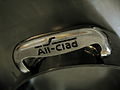 All-Clad handles
 -
 All-Clad roasting pan
 -
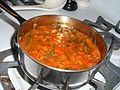 With sauce
 -
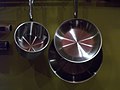 Hanging pans


References
[edit]- ^ a b c d e Weaver, Rachel (August 14, 2012). "Innovations by All-Clad spur revolution in cookware". Pittsburgh Tribune-Review. Retrieved August 15, 2012.
- ^ a b "Our History". all-clad.com. Archived from the original on 2012-01-11. Retrieved January 3, 2012.
- ^ Coates, Claudia (November 18, 1998). "TV, Good Name Light a Fire Under All-Clad Pans". Los Angeles Times. Retrieved January 3, 2012.
- ^ "What is the Difference Between Emeril's Cookware & All Clad?".
- ^ "Thomas Keller Launches All-Clad Cookware Collection". 24 July 2014.
- ^ a b "All-Clad Frequently Asked Question #15". all-clad.com/. Retrieved September 6, 2009.
- ^ Crompton, Janice (June 4, 2009). "Annual cookware seconds sale draws thousands". Pittsburgh Post-Gazette.
External links
[edit]- Official All-Clad Website at all-clad.com
All-Clad
View on GrokipediaHistory
Founding and Early Development
John Ulam, a renowned metallurgist with over 75 patents in metal crafting for applications such as car parts, airplanes, and coins, applied his expertise to innovate in cookware during the late 1960s.[1] While working on bonding technologies, Ulam formed an alliance with Alcoa in 1967 to develop Clad-Metals, Inc., where he invented a method to bond layers of stainless steel and aluminum, creating durable composites that addressed common issues in cookware like uneven heating and warping.[9] This breakthrough in multi-ply construction laid the foundation for high-performance bonded cookware.[10] In 1971, Ulam founded All-Clad Metalcrafters in Canonsburg, Pennsylvania, establishing a small factory near his hometown in Western Pennsylvania to produce his innovative designs.[1] The company initially focused on professional-grade pots and pans, emphasizing fully bonded construction for superior heat distribution and durability, which quickly appealed to chefs seeking reliable tools.[11] Early sales targeted professional kitchens and select retailers, with Ulam promoting the products at trade shows to build interest among culinary experts.[11] During the 1970s, All-Clad secured its first major retail partnerships, marking the beginning of broader market penetration despite a slow start in the nascent years.[12] By the 1980s, the company had expanded its product range beyond basic pots and pans, incorporating additional items while leveraging Pennsylvania's metal fabrication heritage to fuel steady growth, with annual increases averaging around 25% through the decade.[13] This period solidified All-Clad's reputation for quality craftsmanship in the premium cookware segment.[1]Ownership Transitions
In 1988, All-Clad Metalcrafters was acquired by the Pittsburgh Annealing Box Company, led by Sam Michaels.[14] This acquisition marked a shift toward enhanced marketing efforts and broader distribution channels, moving All-Clad from a niche supplier to a more prominent player in the premium cookware market.[15] In 1999, Waterford Wedgwood PLC purchased All-Clad for $110 million, with Michaels retaining a 25% stake.[16] The acquisition facilitated All-Clad's expansion into international markets, leveraging Waterford Wedgwood's global distribution network to increase its presence beyond the United States.[11] However, Waterford Wedgwood encountered significant financial difficulties in the early 2000s, including mounting debt exceeding €380 million and losses driven by a weaker U.S. dollar and reduced luxury goods demand, which prompted strategic divestitures.[17][18] By 2004, Waterford Wedgwood sold All-Clad to the French conglomerate Groupe SEB for $250 million in an all-cash transaction, yielding a substantial return on the initial investment while helping to alleviate the parent's debt burden.[19] Under Groupe SEB, All-Clad benefited from the group's extensive international infrastructure, enabling scaled global operations and wider market reach without relocating its core production.[20] At the time of the acquisition, All-Clad employed approximately 370 people at its Pennsylvania headquarters and factory.[20] Since the 2004 acquisition, All-Clad has been fully integrated into Groupe SEB's portfolio of premium brands, benefiting from the parent's resources for research and development initiatives that drive product innovation.[3] These efforts have supported ongoing advancements in cookware technology while preserving All-Clad's commitment to U.S.-based manufacturing in Canonsburg, Pennsylvania, ensuring its "Made in USA" status as of 2025.[1] Ownership under Groupe SEB has contributed to operational expansion, with approximately 350 employees as of 2012 and supporting broader global activities as of 2025.[21][22]Manufacturing
Production Facilities
All-Clad's primary production facility is located in Canonsburg, Pennsylvania, where manufacturing operations have been based since the company's founding in 1971. This site was chosen for its proximity to the founder's hometown and the region's longstanding expertise in metalworking and steel production. The facility has undergone expansions over the years to support growing demand, enabling increased production capacity for bonded cookware.[1][5] The production workflow at the Canonsburg plant starts with sourcing premium raw materials, including stainless steel and aluminum cores, which are processed through bonding, forming, and machining stages before reaching final assembly and polishing. Skilled craftspeople perform many handcrafted steps, such as riveting handles and ensuring precise quality checks, to maintain the brand's standards of durability and performance. All bonded cookware products are fully manufactured in this U.S. facility.[23][5][1] The plant employs approximately 110 workers as of 2025 who contribute to an annual output focused on high-end stainless steel cookware lines. All-Clad, under ownership by Groupe SEB since 2004, continues to prioritize domestic production at this site.[24][21][23] Sustainability efforts at the facility include the use of recycled hard-anodized aluminum and recycled stainless steel in select product lines, alongside broader commitments to reducing environmental impact through durable, long-lasting designs that minimize waste. Energy-efficient practices are integrated into operations as part of Groupe SEB's group-wide initiatives.[25][26]Construction Techniques
All-Clad employs a proprietary bonded construction process that fuses multiple layers of metal through roll-bonding, where cleaned sheets are stacked and passed through heavy rollers under high pressure and controlled heat to achieve a metallurgical bond without seams or welds.[5] This technique, refined by metallurgist founder John Ulam in the early 1970s, ensures the layers integrate at the atomic level for structural integrity.[23] The standard configurations include 3-ply construction, consisting of an aluminum core sandwiched between two layers of stainless steel, which provides basic even heating across the cooking surface.[4] For enhanced performance, 5-ply designs alternate multiple layers of stainless steel and aluminum—or incorporate a copper core in specialized lines—delivering superior temperature control and responsiveness.[27] In both setups, the aluminum or copper core facilitates rapid and uniform heat conduction due to their high thermal conductivity, while the exterior and interior stainless steel layers offer durability, resistance to corrosion, and non-reactivity with food acids.[4] Quality control in the construction process involves rigorous testing for warping resistance, achieved through precise layer adhesion and balanced thickness—typically around 2.5-3 mm at the base—to maintain flatness under thermal stress.[28] Uniformity of layer thickness is verified during production to prevent hot spots, with each piece undergoing final inspections before receiving a limited lifetime warranty that underscores the reliability of the bonded structure.[4] Since its inception in the 1970s, All-Clad's techniques have evolved from manual bonding operations to incorporating modern precision machinery, such as automated rolling mills and advanced heat treatment ovens, while preserving the core principles of multi-layer fusion for consistent performance.[5] This progression has enabled the expansion from foundational 3-ply designs to more complex multi-ply variants without compromising the seamless integration that defines the brand's engineering.[29]Innovations
Patent Portfolio
All-Clad's patent portfolio traces its origins to founder John Ulam, a metallurgist who held over 75 personal patents in metal crafting and bonding technologies, several of which were assigned to the company after its founding in 1971.[1] These early assignments included innovations in clad metal products, such as U.S. Patent 4,103,076 (granted 1978), which covers a composite of copper, aluminum, and stainless steel for durable, lightweight construction suitable for cookware applications. Ulam's work laid the foundation for All-Clad's core bonding techniques, protecting the diffusion and roll-bonding methods that enable multi-layer metal composites.[30] Key U.S. patents issued to All-Clad highlight advancements in design and materials. For instance, U.S. Patent D813,595 (granted 2018) protects the ornamental design of an ergonomic handle for cooking utensils, featuring a contoured grip for improved user comfort and heat resistance during prolonged use. Earlier patents, such as U.S. Patent 4,246,045 (granted 1981), detail methods for producing multiple-member clad metal products using aluminum alloy sheets bonded to copper or other cores, emphasizing lightweight yet robust sheets for efficient heat distribution in cookware.[30] These patents underscore All-Clad's focus on integrating disparate metals without compromising structural integrity. The portfolio's themes center on bonding processes, ergonomic handles, non-stick integrations, and heat-resistant materials. Bonding innovations, like those in U.S. Patent 10,478,012 (granted 2019), describe solid-state methods for creating uniform multi-ply assemblies under pressure and heat, ensuring seamless layer adhesion for even cooking performance, with features such as spaced-apart bubbles on the cooking surface to enhance heat conductivity and reduce hot spots.[31] Ergonomic handle designs prioritize balanced, stay-cool grips that enhance handling safety. Non-stick integrations focus on durable coatings compatible with bonded constructions to reduce food adhesion while maintaining performance. Heat-resistant materials are addressed in U.S. Patent 10,081,163 (granted 2018), featuring a graphite core encapsulated between metal layers for superior thermal stability and warp resistance at high temperatures.[32] As of 2025, All-Clad holds over 20 company-specific U.S. patents issued by the USPTO, spanning cookware construction, utensils, and accessory designs, with ongoing filings to safeguard evolving technologies.[33] The expiration of original bonding patents from the 1970s, such as U.S. Patent 4,246,045 (expired around 2001), has allowed industry competitors to replicate basic cladding techniques, prompting All-Clad to pursue new patents on advanced composites and features to sustain its competitive advantage.[11] These protections extend to recent products like the HA1 line, where non-stick coatings integrate with bonded bases for enhanced release properties.[34]Technological Breakthroughs
All-Clad's multi-layer construction represents a significant advancement in cookware performance, particularly through its 5-ply Copper Core design, which integrates a highly conductive copper core between layers of aluminum and stainless steel. This configuration delivers rapid and even heat distribution, superior responsiveness to temperature adjustments, and exceptional retention for tasks like searing proteins or braising meats, minimizing hot spots and ensuring consistent results.[27] In non-stick innovations, the HA1 line employs hard-anodized aluminum reinforced with a warp-resistant stainless steel base and a three-layer PFOA-free PTFE coating, providing scratch-resistant durability, effortless food release, and compatibility with all cooktops including induction, while supporting oven use up to 500°F. Complementing this, the G5 Graphite Core series introduces a 5-ply structure with a graphite center—more thermally conductive than copper—for faster preheating, uniform heating without hot spots, and quicker cooldown, all in a lightweight stainless steel format that enhances handling without relying on chemical non-stick surfaces.[34][35][36] A more recent advancement is the NS Pro Nonstick line, launched in 2024, featuring an upgraded multi-layer PTFE coating on hard-anodized aluminum with a stainless steel base for superior scratch resistance, metal-utensil safety, and easy cleaning, earning recognition as a 2024 Kitchen Gear Award winner.[6][37] Functional upgrades across All-Clad's designs include ergonomic, stay-cool handles that remain comfortable during extended stovetop use and sloped, flared rims for drip-free pouring, facilitating seamless transitions in professional workflows. Additionally, magnetic stainless steel bases ensure full induction compatibility, expanding versatility for modern cooking methods. These features are safeguarded by key patents in All-Clad's portfolio.[27][38][34] As part of Groupe SEB, All-Clad's research and development efforts have driven these material and design breakthroughs, with the G5 line marking an evolution in sustainable, high-performance heating introduced in 2021. These innovations have established All-Clad as the industry benchmark for clad cookware, influencing competitors by raising standards for durability, precision, and professional-grade results in both commercial and home settings.[39][40][41]Products
Cookware Collections
All-Clad's cookware collections encompass a range of bonded stainless steel and nonstick lines designed for diverse cooking needs, from everyday versatility to professional precision. These collections feature multi-ply constructions that integrate layers of stainless steel, aluminum, copper, or graphite to optimize heat distribution and retention, with common items including fry pans, saucepans, stockpots, and multi-piece sets typically starting at $300 or more.[6] The D3 Stainless collection utilizes a 3-ply fully clad construction of stainless steel and aluminum, providing even heat distribution without hotspots for versatile everyday cooking tasks such as sautéing, simmering, and frying. This line is ideal for home cooks seeking durable, warp-resistant performance across all cooktops, including induction, and includes staples like 8- and 10-inch fry pans, 1.5- and 3-quart saucepans, and 8-quart stockpots.[6] In contrast, the D5 Brushed collection employs a 5-ply design with alternating layers of stainless steel and aluminum, enabling superior heat control and elimination of hotspots for professional-level applications like precise searing and braising. Its brushed exterior offers a modern aesthetic while maintaining high durability, with available pieces encompassing fry pans up to 12 inches, saucepans in 2- and 4-quart sizes, and larger stockpots for soups and stocks.[42] The Copper Core collection features a 5-ply bonded structure with a responsive copper center surrounded by aluminum and stainless steel layers, delivering the fastest heat response and recovery for advanced gourmet techniques such as rapid deglazing and temperature adjustments. This line excels in high-heat cooking and is compatible with all stovetops, offering items like 10- and 12-inch fry pans, 3-quart sauté pans, and 6-quart stockpots.[27] For nonstick options, the HA1 Hard Anodized collection, launched in 2021, consists of lightweight hard-anodized aluminum exteriors with PTFE nonstick interiors for quick heating and easy release, making it suitable for low-oil cooking and effortless cleanup in daily use. It includes compact sets with 8- and 10-inch fry pans, 2-quart saucepans, and sauté pans, oven-safe up to 500°F.[34] Additional lines include the budget-friendly Essentials Nonstick collection, which prioritizes affordability and convenience with PTFE-coated aluminum for basic tasks like egg frying and vegetable stir-frying, featuring nesting designs for storage efficiency. The Pro Nonstick collection offers a durable hybrid of stainless steel bases and reinforced nonstick surfaces for versatile, professional-grade performance in high-volume cooking. Complementing these, the G5 Graphite Core collection incorporates a 5-ply graphite-infused core for faster heating and lighter weight, enhancing maneuverability for dynamic cooking methods across fry pans, saucepans, and stockpots.[36]Bakeware and Accessories
All-Clad's bakeware line features stainless steel products constructed with tri-ply bonded design, incorporating an aluminum core between layers of stainless steel for superior heat conduction and resistance to warping.[43] This construction ensures even baking results and allows the pieces to be oven-safe up to 600°F, supporting high-heat applications like roasting and broiling.[44] Representative items include heavy-duty roasting pans with high sides, sturdy handles, and removable racks to elevate food for better air circulation and fat drainage, as well as half-sheet and quarter-sheet baking pans ideal for cookies, vegetables, or sheet pan meals.[45] For muffin tins, All-Clad offers Pro-Release nonstick versions made from heavy-gauge aluminized steel with ceramic-reinforced coatings, providing easy release and durability up to 450°F, though the brand's core stainless bakeware emphasizes the tri-ply format for versatile, oven-to-table use.[46] The company's utensils complement its cookware with professional-grade stainless steel tools, often featuring silicone components for enhanced functionality.[47] Items such as turners, solid and slotted spoons, and ball whisks are available in sets with heat-resistant silicone heads rated up to 450°F, preventing scratches on nonstick surfaces while offering flexibility and a secure grip.[48] These tools maintain their shape under high temperatures and provide precise control for tasks like flipping, stirring, or whisking, with ergonomic designs that align aesthetically with All-Clad's stainless steel collections.[49] Durability is prioritized through robust stainless steel construction, ensuring longevity in demanding kitchen environments. Accessories from All-Clad extend the brand's focus on durability and cohesive kitchen aesthetics, utilizing high-quality materials like acacia wood for cutting boards that are knife-friendly and resistant to wear.[50] Knife sets, forged from high-carbon German stainless steel (X50CrMoV15), undergo cryogenic hardening for enhanced edge retention, corrosion resistance, and reliability, available in configurations like 3-piece starter sets or 7-piece blocks.[51] These items, along with organizational solutions like 4-slot stainless steel cookware holders, promote efficient storage while matching the polished look of All-Clad products.[52] Under its ongoing sustainability efforts, All-Clad has introduced sustainably sourced wood tools for prep and serving, emphasizing eco-friendly materials to reduce environmental impact without compromising performance.[53]Kitchen Electrics
All-Clad's kitchen electrics lineup includes precision slow cookers, immersion blenders, electric griddles, and multi-cookers, designed to complement the brand's renowned bonded cookware. The Gourmet Plus Slow Cooker, for instance, features a 7-quart capacity with all-in-one browning capabilities, allowing users to sear and slow-cook in a single vessel for tender results on roasts and stews.[54] The immersion blender offers 600 watts of power with variable speed controls and a turbo function, encased in durable stainless steel for blending soups and sauces directly in pots. Electric griddles, such as the XL model, provide versatile countertop grilling, while the 7-in-1 multi-cooker supports functions like slow cooking, steaming, sautéing, rice cooking, and simmering in a compact stainless steel unit.[55][56] These appliances integrate seamlessly with All-Clad's core lines through stainless steel exteriors that match the brand's signature aesthetic, ensuring a cohesive kitchen look. Programmable controls are a hallmark, with digital timers and temperature settings on slow cookers and multi-cookers enabling precise, hands-off operation for professional-grade outcomes, such as maintaining low-and-slow temperatures for up to 10 hours. The electric griddle incorporates AutoSense technology, which automatically adjusts cooking time based on food thickness for even results without constant monitoring. High-wattage heating elements, like the 1700W in the electric deep fryer variant, deliver consistent, rapid heat distribution that mimics the evenness of All-Clad's bonded cookware bases.[55][57][56] Innovations in the electrics portfolio emphasize reliability and user convenience, though as of 2025, All-Clad has not introduced app-connected models, focusing instead on robust, standalone performance aligned with smart kitchen trends through intuitive interfaces. The lineup's expansion into electrics began in the 2010s, influenced by parent company Groupe SEB's expertise in small appliances, broadening All-Clad's offerings beyond traditional cookware to appeal to culinary enthusiasts. Priced in the premium range of $100 to $400, these products target serious home cooks seeking durable, high-performance tools that endure daily use.[39][55][54]Finishes and Comparisons
Interior and Exterior Options
All-Clad cookware features a variety of interior finishes designed for optimal cooking performance and food safety. The standard interior surface across most stainless steel lines, such as D3 and D5, is highly polished 18/10 stainless steel, which provides a non-reactive cooking environment that prevents metallic flavors from imparting to food and allows for effective browning and searing.[58] For lines requiring easier food release, such as HA1 Hard Anodized Nonstick and Pro Nonstick, the interior is coated with a multi-layer PFOA-free PTFE nonstick surface bonded to an aluminum base, enabling low-fat cooking and simple cleanup for delicate items like eggs or fish.[34] These nonstick interiors are engineered to withstand medium heat without degrading quickly when paired with non-abrasive utensils.[59] Exterior finishes on All-Clad products emphasize durability, aesthetics, and practical handling. Brushed stainless steel, featured prominently in the D5 Brushed line, offers a matte texture that resists fingerprints, smudges, and minor scratches, making it ideal for everyday use while maintaining a modern appearance.[42] In nonstick collections like HA1, the exterior is hard-anodized aluminum, which provides a sleek, corrosion-resistant surface that enhances heat conductivity and simplifies maintenance.[34] Premium lines, including Copper Core, incorporate polished stainless steel exteriors accented with a visible copper band at the base, combining elegance with superior thermal responsiveness.[27] These finishes deliver key functional benefits, including stain resistance from the brushed and anodized surfaces, which reduces discoloration from spills or high-heat use, and ease of cleaning facilitated by the nonstick interiors and smooth stainless exteriors.[42] Most All-Clad pieces, particularly stainless steel models, are oven-safe up to 600°F (315°C), allowing seamless transitions from stovetop to oven, while nonstick options like HA1 are rated up to 500°F to preserve coating integrity.[27] Maintenance varies by finish to ensure longevity. Stainless steel interiors and exteriors, including brushed and polished variants, are generally dishwasher-safe, though hand-washing with mild detergent is recommended to preserve the finish and avoid potential pitting over time.[60] Nonstick surfaces in HA1 and Pro lines should be hand-washed only, using soft sponges to prevent scratching the coating.[34] For copper-accented exteriors in Copper Core, hand-washing is essential to minimize oxidation of the exposed copper, with periodic polishing advised for sustained shine.[27] Variations in finishes appear across product lines to suit different aesthetics and needs; for instance, the D5 collection offers both polished stainless for a reflective, traditional look and brushed stainless for a contemporary matte effect that hides wear better in busy kitchens.[61]Product Line Comparison
All-Clad's cookware lines vary in multi-ply construction, thermal properties, and suitability for different cooking needs, allowing users to select based on performance priorities like responsiveness, weight, and cost. The core D3 line provides a balanced entry point with tri-ply bonding, while premium options like D5, Copper Core, and G5 Graphite Core incorporate additional layers for enhanced control and efficiency. Nonstick variants such as HA1 cater to low-maintenance tasks. Key metrics are summarized below for representative 10-inch fry pans (approximate weights as of November 2025), drawing from construction details and performance tests. Note: Weights may vary slightly by exact model (fry pan vs. skillet).| Line | Ply Count | Core Material | Heat Performance | Approximate Weight | Price Range (USD) | Induction/Oven Compatibility | Warranty |
|---|---|---|---|---|---|---|---|
| D3 Stainless | 3 | Aluminum | Even, quick heating (aluminum conductivity ~237 W/mK) | 2.1–3 lbs | $100–$150 | Yes / 600°F | Limited lifetime |
| D5 | 5 | Alternating aluminum/stainless | Superior even distribution, stable temperature | 2.5–3 lbs | $200–$300 | Yes / 600°F | Limited lifetime |
| Copper Core | 5 | Copper | Ultra-responsive, fast heating/cooling (copper conductivity ~401 W/mK) | 3–4 lbs | $250–$400 | Yes / 600°F | Limited lifetime |
| HA1 Hard Anodized | 3 (bonded nonstick) | Aluminum | Even on low-medium heat, suitable for delicate foods | 2–2.5 lbs | $80–$120 | Yes / 500°F | Limited lifetime |
| G5 Graphite Core | 5 | Graphite | Rapid heating/cooling, faster than traditional aluminum-core lines | 2–2.5 lbs (20% lighter than D5) | $200–$300 | Yes / 600°F | Limited lifetime |