


Community hub
Recent from talks
Contribute something
Nothing was collected or created yet.
Almond potato
View on Wikipedia| Potato 'Almond' | |
|---|---|
 'Almond' potatoes | |
| Species | Solanum tuberosum |
| Cultivar | 'Almond' |
| Origin | Finland, Sweden, Norway |
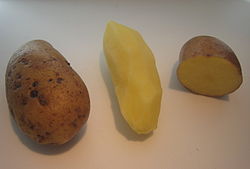
The almond potato (Norwegian: Mandelpotet,[1] Swedish: Mandelpotatis,[2] Finnish: puikulaperuna[3]), also called Mandel potato or Swedish peanut fingerling,[4][5][6] is a potato known since the 19th century.[7][8] Almond potatoes are yellow or white; in rare cases a variety called blue almond (Blå mandel in Swedish) can be found which has yellow-white flesh with blue skin. Its shape is oval and somewhat resembles an almond, hence the name. Blue almond is an old variety which was grown in the northern regions of Sweden before the yellow-peeled almond potato was introduced.[9]
It is considered a delicacy in Norway,[10] Finland and Sweden, where it is most commonly grown in the northern regions.[11] It can be grown better in the north, since the variety is susceptible to plant diseases in the south.[12] Finnish Lapland puikula (Lapin puikula) has a European Union and UK Protected Designation of Origin.[13][14]
References
[edit]- ^ Norway. Landbruksdepartementet (1943). Melding om de offentlige tiltak til ophjelp av landbruket: Meldinger fra statens forsøksstasjoner i plantekultur (in Norwegian). Grøndahl & Søns. pp. 60–.
For feltet på Stor-Elvdal kommunegård artet tørr-råteangrepet seg noe liknende, om ikke fullt så galt. Her var Mandelpotet medtatt istedenfor Sagerud, og den ble først og sterkest angrepet. Etter siste kontroll den 15. september stod Arnica og ...
- ^ Meddelande - Statens vaxtskyddsanstalt. 101-107 (in Swedish). 1964. pp. 268–.
Mandelpotatis synes ha funnits i Sverige under lika lang tid som Magnum bonum. Sålunda anfor H. von Post 1889 i en "Studie over Potatisvarieteterna" resultaten av flerariga prov med några sorter, varibland . . .
- ^ János Gulya (2002). Konfrontation und Identifikation: Die finnisch-ugrischen Sprachen und Völker im europäischen Kontext (in German). Harrassowitz. pp. 95–. ISBN 978-3-447-04656-5.
Im Rahmen des Namenschutzes für geographisch gebundene Nahrungsmittel ist die rundovale Kartoffelsorte Lapin puikulaperuna für den finnischen Markt per EU- Gesetz geschützt. Sie gedeiht nur in nördlichen Gegenden von Finnland und ...
- ^ Nærstad, R.; Hermansen, A.; Bjor, T. (2006). "Exploiting host resistance to reduce the use of fungicides to control potato late blight". Plant Pathology. 56 (1): 156–166. doi:10.1111/j.1365-3059.2006.01491.x.
- ^ Sue Stickland (1998). Heirloom Vegetables: A Home Gardener's Guide to Finding and Growing Vegetables from the Past. Fireside Books. pp. 151–. ISBN 978-0-684-83807-6.
Swedish Peanut Fingerling A dry golden-fleshed late season variety, grown by Swedish settlers in about 1900. Crescent shaped potatoes are great baked or roasted, they set and store well, and are ...
- ^ Growing for Market: News and Ideas for Market Gardeners. Fairplain Publications. 2000. pp. 143–.
Swedish Peanut Fingerling also has an interesting history. "This variety was brought to Alaska by Swedish Settlers in 1910-15, and was called Mandelpotatis," related Gerritsen. "I received seed for Swedish Peanut Fingerling from a friend, Bill ...
- ^ Journal of the Royal Horticultural Society. Royal Horticultural Society. 1896. pp. 406–.
- ^ Journal of the Royal Agricultural Society of England. Royal Agricultural Society of England. 1898. pp. 590–.
- ^ "Blå mandel / Potato / Plant material / Innehåll / Plants / NordGens webbplats - NordGen". Archived from the original on 2017-02-19. Retrieved 2017-02-18.
- ^ "A Taste of Norwegian Fall". Royal Norwegian Embassy in Washington. Retrieved 11 March 2010.
- ^ Kirsten Dreyer (1 January 1994). Kamma Rahbeks Brevveksling Med Chr. Molbech (in Danish). Museum Tusculanum Press. pp. 77–. ISBN 978-87-7289-245-0.
Frem til idag kendes "Mandel potatis" og "Mandel potet" fra dyrkning i dalene i Nordsverige og Nordnorge (venligst oplyst af direktør Karl Tolstrup, Landbrugets Kartoffelfond, Vandel)
- ^ Anton Letnes (1966). Potetboka (in Norwegian). Bøndenes Forlag. pp. 36–.
Mandelpotet er en gammel landsort som dyrkes i de øverste dalfører og nord i landet. Den har en middels høg, sluttet og overhengende risvekst. Stenglene har en sterk svartbrun farge og er gjerne greinet. Bladene er mørkegrønne og middels ...
- ^ Official Journal of the European Communities: Legislation. Office for Official Publications of the European Communities. 1997. pp. 22–.
- ^ Graeme Thomas; Giulio Sansonetti (13 January 2009). New light on a hidden treasure: International Year of the Potato 2008, an end-of-year review. Food and Agriculture Organization of the United Nations. pp. 21–. ISBN 978-92-5-106142-8.
.jpg)
 | This potato-related article is a stub. You can help Wikipedia by adding missing information. |
Almond potato
View on GrokipediaDescription
Physical characteristics
The almond potato is distinguished by its small, very elongated tubers that are slightly flattened and often somewhat crooked, giving them an oval to almond-like shape that sets them apart from rounder or longer potato varieties.[1] The skin is thin and smooth, usually white or light yellow, which facilitates easy peeling. Variants exist with red or dark blue skin, such as the traditional Blå mandel landrace. Flower colors include white or violet.[1] The flesh is yellow and firm, exhibiting a floury texture.[1][2]Varieties
The almond potato, primarily known as Mandelpotet in Norwegian and Mandelpotatis in Swedish, is characterized by its consistent yellow flesh and distinctive oval or almond shape, making it a staple heirloom variety in Scandinavia.[2][1] This subtype is cultivated for its mealy texture and buttery flavor.[2] A rare variant, Blå mandel (blue almond), features yellow flesh and dark blue skin, originating as an old landrace in the Swedish provinces of Västerbotten, Norrbotten, and Lappland.[1] This subtype retains the oval form but remains uncommon even within Sweden.[1] In Norway, regional subtypes of almond potatoes include variations under the names Langpotet or Krokeple, which exhibit slight differences in tuber elongation due to local cultivation in areas like Østerdalen and Gudbrandsdalen, but share the core yellow-fleshed profile.[1] These are grown as specialty crops, often with marginally longer forms compared to Swedish counterparts.[1] Almond potato varieties are predominantly available in Scandinavia, where they are a traditional delicacy, but remain limited outside the region due to their heirloom status and specific growing conditions.[2][4]History and origin
Development and breeding
The almond potato, known locally as mandelpotatis, originated in Scandinavia during the 19th century through traditional farmer-led selection of native potato strains adapted to northern growing conditions.[5][6] It was first documented in Sweden in 1845 as one of nine cultivated potato varieties, including types like paltpotatis and rosenpotatis, reflecting early efforts to develop regionally suitable cultivars.[6][7] Breeding goals for the almond potato focused on achieving its characteristic oval, slightly curved shape—reminiscent of an almond—along with a floury texture that made it ideal for boiling and mashing, while enhancing suitability for the short growing seasons in northern Sweden and Norway.[8][9] By the late 19th century, selective propagation emphasized high dry matter content, contributing to its status as a delicacy in these regions.[5] Key contributions to its development came from Swedish agricultural programs, including work at the Swedish Seed Association (Sveriges Utsädesförening), which began formal potato breeding in 1903, laying the groundwork for quality control and preservation across the Nordic countries.[10][1] Researchers Eric Hellbo and Harald Esbo played a pivotal role in the early 20th century by systematically classifying and documenting almond potato varieties in their 1942 publication Systematisk behandling av våra potatissorter, recognizing "Mandel" as a collective term for several old, almond-shaped cultivars with white or yellow flesh.[8][1] This work led to formal registration of specific strains in the mid-20th century.[11] By 1935, cultivation of the northern variant, Norrländsk mandelpotatis, was widespread from Härjedalen to Hornavan, solidifying its place in Scandinavian agriculture.[5]Cultural significance in Scandinavia
The almond potato, known locally as Mandelpotet in Norway and mandelpotatis in Sweden, is regarded as a delicacy in both countries, valued for its elongated, almond-shaped tubers and firm, flavorful flesh that suits traditional preparations.[12][13] This old landrace, documented since the early 19th century, represents a key element of Nordic agricultural heritage, with its cultivation reflecting historical exchanges across borders.[1] In Norway, it symbolizes regional identity in mountainous areas like Nord-Østerdalen, Gudbrandsdalen, and Oppdal, where variants such as Fjellmandel fra Oppdal hold protected geographical indication status granted in 2006, underscoring local pride in sustainable, high-altitude farming traditions.[14][15][1] In Norway, the almond potato features prominently in holiday traditions, particularly Christmas (jul), where it is the preferred variety for festive meals due to its versatility in boiling or mashing alongside dishes like ribbe (roast pork belly). A 2016 survey indicated that 65% of Norwegians make a conscious choice of potatoes for Christmas dinner, with 70% of those selecting almond potatoes, highlighting its status in national cuisine and the growing demand for local, heritage varieties promoted by agricultural organizations since the mid-20th century.[16][17] Farming cooperatives and growers' associations, such as the Alvdal Mandelpotetdyrkerlag, have played a pivotal role in its revival and commercialization, boosting production from niche mountain farms to wider markets while preserving genetic diversity through genebanks.[18][1] In Sweden, the almond potato embodies cultural ties to Norrland's northern provinces, including Västerbotten, Norrbotten, and Lappland, where it has been traditionally grown for its sensory qualities that distinguish it from southern variants, fostering a sense of regional terroir and culinary identity.[13][1] Its integration into everyday and festive foods underscores its enduring role in Scandinavian self-sufficiency narratives, from 19th-century staple cultivation to modern appreciation in heritage cooking. Contemporary celebrations amplify its cultural footprint, notably through the annual Norsk Mandelpotetfestival in Alvdal, Norway, organized by local growers since 1998, which draws visitors for markets, tastings, and events honoring potato farming heritage.[19][20] This festival, held in late September, promotes community pride and educates on the variety's history, aligning with broader Nordic efforts to safeguard traditional crops amid climate challenges. While less formalized in Sweden, the potato's prominence in regional festivals echoes similar themes of agricultural legacy.[14]Cultivation
Growing requirements
Almond potatoes thrive in cool temperate climates typical of northern Scandinavia, where long daylight hours during the summer months compensate for relatively low temperatures, allowing cultivation as far north as 70°N latitude. The variety exhibits optimal tuber yield at soil temperatures around 14.6°C, with vegetative growth peaking at approximately 22.6°C, aligning well with daytime temperatures of 15–20°C during Scandinavian summers.[21] Suitable soils for almond potato cultivation are well-drained sandy loams with moderate fertility and a pH range of 5.5–6.5, which support root development and prevent issues like common scab. These conditions ensure adequate aeration and nutrient availability without excessive moisture retention.[22][23] To ensure timely emergence in the short northern growing season, seed tubers are pre-sprouted for about 4 weeks at around 12°C before planting.[21] Planting occurs in spring, typically April to May in northern latitudes, once soil temperatures reach at least 8–10°C to avoid rot. Seed tubers are spaced 20–35 cm apart within rows, with row spacing of 50–70 cm, promoting uniform growth and ease of hilling.[24] Consistent soil moisture is essential throughout the growing season to support tuber bulking, but waterlogging must be avoided through well-drained sites and irrigation management. Nitrogen-rich fertilizers, applied at planting and during early vegetative stages, provide the necessary boost for foliage and tuber initiation, typically at rates balanced with phosphorus and potassium based on soil tests.[23]Harvesting and storage
Almond potatoes are typically harvested in late summer to early autumn, from August to September in Scandinavian regions, once the foliage has naturally died back, signaling tuber maturity.[25][26] Harvesting can be performed manually by hand-digging or using mechanical equipment such as potato diggers, with particular emphasis on gentle handling to minimize damage to the thin epidermis, which is prone to bruising and cracking.[2][27] The almond-shaped tubers facilitate relatively straightforward extraction from the soil without excessive fragmentation.[2] Post-harvest, almond potatoes are cured briefly in a cool, ventilated area to toughen the skin before storage. Optimal storage conditions include temperatures of 4-10°C, high humidity (around 90-95%), and complete darkness to inhibit sprouting and maintain quality, allowing a shelf life of up to 6 months under ideal circumstances.[28][29][30] Under optimal growing conditions in northern Scandinavia, almond potato yields range from 15-25 tons per hectare, reflecting the variety's adaptation to cooler climates and its high dry matter content.[31][26]Culinary uses
Preparation techniques
Almond potatoes, characterized by their floury texture and high dry matter content, are well-suited to cooking methods that highlight their soft, creamy breakdown upon heating.[2] Boiling: Almond potatoes, being very floury, may break down during cooking but are simmered gently for about 15 minutes in lightly salted water (about 1 teaspoon of salt per liter), avoiding vigorous boiling to prevent skin cracking; finishing in residual heat ensures even cooking without over-softening.[2] Mashing: The floury interior produces a creamy mash with minimal additives, requiring only butter or milk for a smooth, buttery purée that benefits from their natural starchiness.[2] Frying: Almond potatoes excel when deep-fried into chips or cut into wedges, where their low moisture content yields crisp results; thin slices can be fried for 5-7 minutes at 180°C or baked as crisps at 175°C for about 10 minutes after peeling.[2] Their thin skin facilitates easy peeling with a vegetable peeler, though it can be left on for rustic preparations; to avoid oxidation after cutting, submerge pieces in cold water immediately. In Scandinavian cuisine, mashing remains a preferred technique to showcase their subtle nutty flavor.[2]Traditional dishes
In Norway, almond potatoes (mandelpotet) are a preferred variety for making raspeballer, a traditional potato dumpling dish also known as komle or klubb. The potatoes are grated raw and combined with boiled potatoes, barley flour, wheat flour, and salt to form a dough, which is then shaped into balls, boiled in salted water, and typically served with butter, salted meat, or a side of swede mash for a hearty meal.[32] A staple in Swedish cuisine, potatisgratäng features almond potatoes (mandelpotatis) sliced thinly and layered in a baking dish with cream, milk, garlic, salt, and pepper, then topped with grated cheese and baked until golden and creamy. This comforting gratin serves as a versatile side dish, often accompanying roasted meats during family gatherings.[33] During holidays in Scandinavia, almond potatoes play a key role in festive meals, such as boiled alongside lutefisk in Norwegian Christmas traditions, where the potatoes' firm texture absorbs the accompanying mustard or butter sauce.[34] Contemporary adaptations highlight almond potatoes in upscale Nordic restaurants, such as gourmet fries or crisps paired with smoked fish and roe, leveraging the variety's nutty flavor and high starch content for crispy textures in innovative presentations.[35]Nutritional profile
Composition and nutrients
The almond potato (Solanum tuberosum 'Mandelpotatis') has a nutritional profile typical of starchy potato varieties, with a composition dominated by water and carbohydrates. Per 100 grams of raw almond potato, it contains approximately 75.8 grams of water, making up the majority of its weight, alongside 18.1 grams of carbohydrates—predominantly starch at 17.1 grams—2.2 grams of protein, and a negligible 0.1 grams of fat.[36] Dietary fiber is present at 2.7 grams, contributing to its moderate fiber content.[36] In terms of micronutrients, almond potatoes are notably rich in vitamin C at 24.5 milligrams per 100 grams, alongside 0.22 milligrams of vitamin B6 and 29.5 micrograms of folate. Potassium is abundant at 437 milligrams, supporting its role as a good source of this mineral, with additional contributions from phosphorus (45 milligrams), magnesium (28 milligrams), and zinc (0.33 milligrams).[36] The caloric value of raw almond potato is approximately 89 kilocalories per 100 grams, primarily derived from its carbohydrate content.[36] Compared to other potato varieties, almond potatoes exhibit slightly higher starch content, which accounts for their floury texture, along with elevated levels of carbohydrates, protein, and fiber relative to average autumn-harvested types.[36]| Nutrient Category | Key Components per 100g Raw | Value |
|---|---|---|
| Macronutrients | Water | 75.8 g |
| Carbohydrates (total) | 18.1 g | |
| Starch | 17.1 g | |
| Protein | 2.2 g | |
| Fat | 0.1 g | |
| Fiber | 2.7 g | |
| Micronutrients | Vitamin C | 24.5 mg |
| Vitamin B6 | 0.22 mg | |
| Potassium | 437 mg | |
| Energy | Calories | 89 kcal |