Hubbry Logo
AlquerqueAlquerqueMain
Open search
Alquerque
Community hub
Alquerque
logo
8 pages, 0 posts
0 subscribers
Be the first to start a discussion here.
Alquerque
Alquerque
from Wikipedia
Alquerque
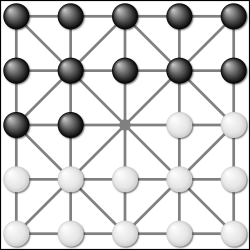
Alquerque starting position
Genres
Players2
Setup time~1 minute
ChanceNone
SkillsStrategy, tactics
SynonymsQirkat

Alquerque (also known as al-qirkat from Arabic: القرقات) is a strategy board game that is thought to have originated in the Middle East. It is considered to be the parent of draughts (US: checkers) and Fanorona and the diagonals of its grid are the predecessor of the checkering of the draughts board.[citation needed]

History

[edit]
An illustration of the game in Libro de los juegos ('book of games')

The game first appears in literature late in the 10th century when Abu al-Faraj al-Isfahani mentioned qirkat in his 24-volume work Kitab al-Aghani ("Book of Songs"). This work, however, made no direct mention of the rules of the game, most likely because it is poetry and they would have been common knowledge in the context the book originated in.

In Board and Table Games from Many Civilizations, R. C. Bell writes that "when the Moors invaded Spain they took El-quirkat with them".[1] Rules are included in Libro de los juegos ("Book of games") commissioned by Alfonso X of Castile in the 13th century.

Spanish settlers in New Mexico introduced a four-player variant of alquerque to the Zuni.

Rules

[edit]
An empty abstract alquerque board
This board graphic displays Moorish design elements relating to the origin of Alquerque. The algebraic notation facilitates move annotation and gameplay discussion.

Before starting, each player places their twelve pieces in the two rows closest to them and in the two rightmost spaces in the center row. The game is played in turns, with one player taking white and the other black.

  • A piece can move from its point to any empty adjacent point that is connected by a line. Note that this is only the normal rule used at the Castilian court, as Xiangqi, Janggi, Javanese Surakarta and other, more obscure, board games allow diagonal movement without explicitly marking the relevant diagonal segment.
  • A piece can jump over an opposing piece and remove it from the game, if that opposing piece is adjacent and the point beyond it is empty.
  • Multiple capturing jumps are permitted, and indeed compulsory if possible.
  • If a capture is possible it must be made, or else the piece is removed (or huffed).

The goal of the game is to eliminate the opponent's pieces.

Additional rules

[edit]

R. C. Bell developed additional rules, saying those given by Alfonso X, in his opinion, "are not sufficient to play a game".[1] These extra rules are:

  • A piece cannot move backward (e.g., a piece in the middle of an empty board would have five available moves).
  • No piece can return to a point it has previously occupied.
  • Once a piece has reached the opponent's back row it can only move to capture opposing pieces.
  • The game is won when either:
    • The opponent has lost all of their pieces.
    • None of the opponent's pieces are able to move.

Bell also includes a scoring system for rating games.

See also

[edit]

References

[edit]
[edit]
Revisions and contributorsEdit on WikipediaRead on Wikipedia
from Grokipedia
Alquerque is a two-player abstract of the capture variety, played on a board consisting of 25 points arranged in a 5×5 grid and connected by horizontal, vertical, and diagonal lines, with each player starting with 12 pieces placed in specific positions leaving the center empty. The objective is to capture all of the opponent's pieces or block them from making any legal moves, through non-capturing moves along the lines to adjacent empty points or compulsory capturing jumps over adjacent enemy pieces to vacant points beyond, allowing chains of multiple jumps in a single turn. The game traces its documented origins to the , with the earliest written reference appearing under the Arabic name "quirkat" in the 10th-century Book of Songs by , and it was introduced to by the Moors in , where it is detailed in King Alfonso X's from 1283, illustrating its rules and popularity in medieval courts. Archaeological evidence suggests similar board games may date back to around 1400 BCE, with boards and pieces found in digs from 600 BCE and depictions in temple carvings, though the precise evolution to the known form of Alquerque remains linked to its medieval attestation. Alquerque significantly influenced the development of modern draughts (), serving as its direct precursor by combining with the 8×8 structure by the 12th century, and it spread across , the Mediterranean, and , evolving into variants like in while retaining core mechanics of linear movement and leaping captures. Today, it is preserved as a historic game, often played with simple counters on reproduced medieval boards, emphasizing strategic positioning and forced captures that demand tactical foresight from players.

History

Origins and Early Evidence

Alquerque, known in its early Arabic form as qirkat or quirkat, has its earliest documented textual reference in the 10th-century Arabic compilation ("Book of Songs") by the scholar (897–967 CE), where it is mentioned as a popular pastime without detailed rules. This reference situates the game within the cultural milieu of the , a period of flourishing scholarship and intellectual exchange in the , where strategy games like qirkat were associated with leisure among elites and commoners alike. Archaeological evidence points to even earlier origins predating , with proto-forms of Alquerque linked to ancient Egyptian gaming traditions through board similarities. Excavations at in uncovered seven gaming boards dating to approximately 1400 BCE, including an unfinished example resembling the Alquerque layout, suggesting the game's conceptual foundations in during the New Kingdom period. These finds indicate that Alquerque's precursors emerged in pre-Islamic Middle Eastern and n contexts, possibly evolving from broader abstract strategy games that prioritized positional tactics over chance. While direct links to specific Egyptian games like remain tentative due to differing mechanics—Senet focusing on linear racing rather than leaping captures—the shared use of line-based boards in underscores Alquerque's deep regional roots. This early evidence establishes Alquerque as one of the oldest known draughts-like games, with its transmission through Islamic scholarship paving the way for later adaptations.

Spread to Europe and Evolution

Alquerque was introduced to Europe through Al-Andalus, the Muslim-ruled regions of the Iberian Peninsula, during the 8th to 13th centuries, as Arab and Berber influences facilitated the transmission of games and cultural practices from the Islamic world. Its first detailed European documentation appears in King Alfonso X of Castile's Libro de los juegos (1283), which includes rules and illustrations for the game, confirming its popularity in medieval courts. Archaeological evidence, including board drawings etched into stone in over 98 locations across Spain, attests to its presence and adaptation in this period, reflecting integration into local customs amid the Reconquista's cultural exchanges. By the 13th century, Alquerque appeared in European textual references, such as those in Catalan and French sources, indicating its growing familiarity beyond Islamic territories. For instance, rules for the game, known then as alquerque or variants like fierges, were documented in , where it merged with local board designs. Its appeal extended to the nobility, earning it a reputation as a strategic pursuit akin to a "game of kings," played in courts and among elites for intellectual diversion. The game's evolution diverged in different regions: in Madagascar, Arab traders carried Alquerque around the 14th to 15th centuries, where it developed into by expanding the board and refining capture mechanics to suit local playstyles. In , by the 16th century, Alquerque transformed into early forms of draughts () through innovations like piece promotion to powerful "kings" upon reaching the opponent's back row, as seen in Spanish and French treatises such as Antonio de Torquemada's 1547 manual. This addition, along with an 8x8 chessboard adaptation, made the game more dynamic and accessible. Alquerque's prominence in Europe waned by the 18th century, overshadowed by the rising popularity of draughts variants, which offered enhanced strategic depth and compulsory capture rules that became standardized in French and English play. While preserved in some rural or traditional contexts, it largely yielded to these evolved forms across the continent.

Equipment

Board Design

The standard Alquerque board is structured as a 5×5 grid comprising 25 intersection points, interconnected by horizontal, vertical, and diagonal lines that form a distinctive star-like . This layout includes orthogonal lines forming the primary grid, supplemented by two full diagonals running from corner to corner and four short diagonal lines connecting the midpoints of the outer edges to create an inner square configuration. Key elements of the design emphasize a central hub point at the board's core, which remains unoccupied at the start, surrounded by radiating diagonals that extend to the periphery, enabling a networked for . The outer boundary forms a square with corner-to-corner diagonals, while inner lines converge to produce a symmetrical, interconnected web resembling a stylized star or cross. Historically, Alquerque boards exhibited variations in materials and construction, often carved or incised into stone for durability in archaeological contexts, such as fragments discovered in medieval Scottish monastic sites like . Wooden boards were also common in portable sets, reflecting everyday use in by the medieval period, though ivory examples are rarer and primarily associated with high-status artifacts. By the 13th century, the 5×5 point design had become standardized, as illustrated in the manuscript commissioned by in 1283, which depicts the board in a consistent form across its representations. For analytical purposes, board positions are frequently labeled or numbered sequentially (e.g., 1 through 25, starting from the top-left corner) in modern reconstructions to reference starting placements, such as the 12 positions occupied by each player's pieces.

Pieces and Setup

Alquerque is played with 12 pieces per player, typically identical in shape such as discs or counters, distinguished only by color—usually for one player and for the other. These pieces represent simple men with no differentiation in type or rank at the start of the game, and unlike in derived games such as , there is no mechanism for promotion to more powerful pieces during play. Historical artifacts indicate that playing pieces were crafted from various materials, including and , as evidenced by medieval examples preserved in collections like those at the Historical Museum in , , dating to the 13th century. Some reconstructions suggest was also used, often left in natural tones or dyed for distinction between players. The initial setup positions the pieces symmetrically on the board's 25 intersection points, with each player occupying 12 specific points on their respective half, leaving the central point empty. One player places their pieces on the first two full rows of five points each (totaling 10 pieces) plus the two rightmost points on the middle row from the player's perspective, forming a configuration that includes horizontal rows and diagonal alignments; the opponent mirrors this arrangement on the opposite side, using their own rightmost points. This setup ensures an even starting balance, with pieces poised along the board's lines for the opening moves.

Rules

Basic Movement

In Alquerque, pieces move by sliding one step along the connecting lines of the board—horizontal, vertical, or diagonal—to an adjacent empty intersection point. This movement is unrestricted by direction, allowing pieces to advance forward, retreat backward, shift sideways, or proceed diagonally as permitted by the board's inscribed lines. All non-capturing moves must follow the board's drawn lines precisely, preventing any free movement across open spaces or deviations from the predefined paths. Players alternate turns, with each turn limited to a single action: either one non-capturing move of a chosen piece or a capturing sequence if applicable. No stacking of pieces is allowed, as each intersection can hold only one piece at a time, and multiple non-capturing moves per turn are prohibited to maintain the game's balanced pace. These fundamental , derived from the earliest known rules, emphasize strategic positioning over rapid advancement.

Capturing Mechanics

In Alquerque, capturing is achieved by a short leap over an adjacent opponent's piece along a connecting line to an empty intersection point immediately beyond, after which the jumped piece is removed from the board. This mechanic, documented in the 13th-century by , emphasizes direct confrontation and mirrors early forms of draughts but occurs in any direction along the board's lines. A single piece may perform multiple captures in succession during one turn, provided each subsequent leap lands adjacent to another capturable opponent's piece; direction can change between jumps to maximize removals. These multi-jumps are not only permitted but required if available after the initial capture, allowing a player to chain actions strategically while adhering to the short-leap rule for each step. Capturing is mandatory whenever possible; a player must execute an available capture rather than opting for a non-capturing move. Failing to capture when able results in the removal (huffing) of the offending piece, as specified in the ; some modern interpretations also include forfeiture of the turn as a penalty. Unlike (draughts), Alquerque features no piece promotion or specialized kings; all pieces retain equal capturing capabilities throughout the game, promoting balanced strategy without hierarchical advancements. This uniformity, rooted in the game's medieval origins, ensures that capturing relies solely on positional opportunity rather than piece type.

Winning the Game

The primary way to win a game of Alquerque is to capture all 12 of the opponent's pieces, thereby leaving them with none to move. Alternatively, a player achieves by maneuvering their pieces to block all possible legal moves for the opponent, even if some pieces remain on the board. This immobilization condition ensures the game cannot continue indefinitely, as the unable player forfeits their turn and the . A or occurs if neither player can make a legal move despite having pieces remaining, or if mutual blocking prevents further captures without either side achieving immobilization. In such scenarios, players may agree to end the game, with outcomes sometimes determined by the number of surviving pieces if no captures are feasible. Alquerque games typically last 5 to 20 minutes and end when one side is fully immobilized. Historical reconstructions, such as those from the 13th-century by Alfonso X, emphasize capturing all pieces as the core victory, with blocking as a derived condition in later interpretations.

Variants

Traditional Regional Forms

Alquerque de doze, the standard form of the game using 12 pieces per player, emerged as a prominent variant in medieval and following its introduction by Moorish traders. Documented in the (1283), a commissioned by , it features a 5x5 grid of 25 points connected by orthogonal and diagonal lines, with players starting pieces along the outer edges opposite each other. This version retained the core jumping capture mechanics but gained popularity through graffiti boards etched in churches, castles, and public spaces across the , indicating widespread play among diverse social classes from the 13th to 15th centuries. In , the game was known as quirkat, first referenced in the 10th-century Arabic text by , where it is mentioned without rules. The form spread through trade routes, influencing subsequent European adaptations while maintaining 12 pieces per side and linear movement rules. Archaeological evidence of an unfinished Alquerque board, featuring a standard 5x5 grid of 25 points connected by orthogonal and diagonal lines, was carved into a roofing slab at the temple in around 1400 BCE. This indicates the game was played in a form similar to the later attested standard, with 12 pieces per player. A notable 15th-century Malagasy , considered a precursor to , expanded the Alquerque framework on a larger 5x9 rectangular board with 45 points and 22 pieces per player, introduced via maritime trade. Retaining jump captures, it incorporated unique "percussion" (forward elimination) and "aspiration" (backward capture) methods, allowing chained removals along axes, as seen in the oldest surviving board from dated 1500–1600 CE.

Modern and Derived Games

Alquerque served as the foundational precursor to modern (also known as draughts), with the key evolutionary adaptations occurring in 16th-century and , where the game transitioned to an 8x8 checkered board, introduced promotion to kings for enhanced mobility, and shifted the initial setup to the back row for both players. This French variant, documented in early printed rulebooks around 1535, retained Alquerque's core mechanics of orthogonal movement and short jumps for captures but added long-range moves and mandatory captures, marking a significant departure toward the family. In the early 20th century, , the second World Chess Champion, invented in 1911 as a more complex variant inspired by (itself derived from Alquerque). Played on a 7x7 board with 11 identical pieces (men) per side, Lasca features compulsory multi-jumps, promotion to kings, and a stacking mechanic where captured pieces are placed under the capturer to form columns, adding strategic depth through varying piece powers based on stack composition while echoing Alquerque's jumping captures. Lasker's design aimed to create a game with greater tactical variety, and it has been published in various editions, including modern reprints by publishers. Since the 2000s, Alquerque has seen renewed interest through commercial reconstructions and standardized rule sets in collections, often bundled with other abstract strategy games to preserve its historical form while making it accessible to contemporary players. Publishers like those on platforms such as and dedicated historical game shops offer handcrafted wooden sets with engraved boards, typically using 12 neutral pieces per side and rules faithful to medieval descriptions, facilitating easy integration into modern tabletop gaming. Experimental digital adaptations have further extended its reach, with platforms and mobile apps providing AI opponents, multiplayer modes, and occasional board size variations that maintain the essential short-leap captures and elimination objective. For instance, browser-based versions allow AI versus AI simulations, enabling analysis of perfect play, while collections like Tabletopia's "Alquerque & Friends" include inspired variants with minor tweaks for replayability.

Strategy

Opening Moves

In Alquerque, the opening phase focuses on securing positional advantages while minimizing vulnerabilities, as the board's dense initial setup limits options and invites early captures. The first player begins by moving one of the three pieces adjacent to the central to occupy that key empty point, establishing immediate central control. This mandatory opening move is essential because serves as a connecting multiple lines—orthogonal and diagonal—allowing greater mobility and potential for subsequent turns. According to historical analyses, this step prioritizes central dominance to facilitate future threats, though it often leaves the piece exposed to the second player's response. Piece development in the opening involves carefully advancing pieces from the peripheral rows toward the interior, aiming to align them for potential captures without stretching the formation too thin. Players typically shift edge pieces along available lines to positions where they can threaten opponent pieces orthogonally or diagonally, creating setups while maintaining defensive cohesion. Overextension is risky, as it can position pieces for easy counter-jumps; thus, development emphasizes incremental progress, such as moving a second-row piece to an adjacent inner point on the second or third turn, to build threats gradually. This approach draws from traditional play observations, where safe advancement supports long-term board control over hasty aggression. Common opening sequences often revolve around the initial central occupation followed by responsive maneuvers that either reinforce the center or probe the opponent's flanks. For instance, after the first player's center move (e.g., advancing the central piece from the middle row's left or right), the second player may counter by jumping over it if aligned, capturing and repositioning to disrupt white's structure— a sequence seen in early medieval depictions. Alternatively, players might initiate a diagonal push by shifting a corner or side piece along a diagonal line on the second turn (e.g., 1. center occupation; 2. diagonal advance from b2 to c3; 3. supporting move to d4), threatening an early capture while contesting central lines. A side flank variant could involve the first three moves prioritizing lateral development: 1. center; 2. horizontal shift from the edge row; 3. another side advance to encircle potential jumps, forcing the opponent to defend peripherally. These patterns, limited by the board's constraints, typically unfold over the first three to five moves and set the tone for midgame exchanges. Balancing aggression is paramount in openings, as pursuing early captures can backfire by exposing pieces to retaliatory jumps, given the compulsory capture rule. Players are advised to avoid forcing unnecessary engagements that leave their own pieces isolated, instead opting for moves that threaten without committing—such as positioning near but not over an opponent until a safe landing spot is secured. This cautious approach helps preserve material equality in the initial 10 moves, preventing the first player's inherent disadvantage from escalating into a lost position.

Midgame Tactics

In the midgame of Alquerque, the board becomes more fluid as initial positions open up, allowing players to execute combinatory plays that leverage compulsory captures and positional control to gain material advantage. Forcing chains are a key tactic, where a player maneuvers to initiate a sequence of multi-jumps, capturing two or more opponent pieces in a single turn by exploiting the mandatory nature of jumps. This is facilitated by the rules permitting jumps in any orthogonal or diagonal direction, with subsequent jumps able to change direction, creating opportunities for extended capture sequences that force the opponent into vulnerable positions. Blocking and forking maneuvers emphasize defensive positioning to restrict the opponent's mobility while simultaneously threatening multiple targets. By occupying key intersection points on the 5x5 grid, a player can deny the opponent access to safe movement lines, compelling them to expose pieces for capture, while a positions a single piece to attack two or more enemy pieces at once, forcing the opponent to choose which to save. These tactics are particularly effective after early exchanges, as the reduced piece count increases the board's openness and amplifies the impact of central control. Trade evaluation involves assessing when to sacrifice a piece to achieve a net gain in material or position, such as baiting an opponent into a capture that enables a counter-jump capturing two of their pieces. In Alquerque, this decision weighs the immediate loss against the potential for multi-jump retaliation, guided by the huffing rule that penalizes missed captures by removing the offending piece. Reinforcement learning analyses of the game highlight how prioritizing such trades—rewarding captures while penalizing losses—leads to superior policies, with AI agents achieving high win rates by favoring aggressive exchanges in fluid board states. Common pitfalls in the midgame include overcommitting pieces to one flank, which isolates them from support and exposes them to counterattacks or multi-jumps. This often occurs when players aggressively pursue captures without securing central or rear positions, leading to pieces stranded on the board's edges where mobility is limited and recapture risks increase. Additionally, failing to anticipate huffing by missing an available jump can result in self-inflicted losses, disrupting momentum and handing initiative to the opponent.

Endgame Principles

In the endgame of Alquerque, where few pieces remain on the board, players must adapt to the absence of promotion mechanics by emphasizing mobility and precise positioning rather than enhanced piece power. Remaining pieces are maneuvered to centralize on key points, allowing greater range for orthogonal and diagonal moves while restricting the opponent's options. This prioritizes fluid movement to outmaneuver isolated enemy pieces, as seen in analyses where advancing pieces forward or sideways enhances control without backward retreats. Players employ king-like maneuvers with their surviving pieces to corner and immobilize opponents, often without needing complete captures. By leveraging the board's interconnected lines, a piece can be positioned to threaten jumps while blocking escape routes, forcing the adversary into vulnerable alignments. This tactical approach turns ordinary pieces into versatile controllers, similar to how endgame databases in related games highlight the value of such positional dominance even with numerical parity. Zugzwang avoidance is central to endgame success, where careful blocking creates situations in which the opponent has no legal moves. Through deliberate placement that limits the enemy's mobility on the 5x5 grid, a player can immobilization, securing without further captures. Self-learning algorithms demonstrate that such blocking strategies lead to high efficacy in reduced-piece scenarios, rendering opponents unable to respond effectively.

References

Add your contribution
Related Hubs
User Avatar
No comments yet.