Hubbry Logo
CheckersCheckersMain
Open search
Checkers
Community hub
Checkers
logo
8 pages, 0 posts
0 subscribers
Be the first to start a discussion here.
Checkers
Checkers
from Wikipedia

Checkers
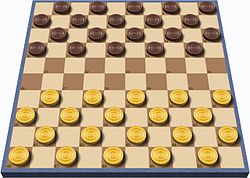
Starting position for American checkers on an 8×8 checkerboard; Black (red) moves first.
Years activeat least 5,000
Genres
Players2
Setup time< 1 min
Playing timeCasual games usually last 10 to 30 minutes; tournament games last anywhere from about 60 minutes to 3 hours or more.
ChanceNone
Age range6+
SkillsStrategy, tactics
Synonyms
  • Draughts
  • Drafts
  • Chequers

Checkers[note 1] (North American English), also known as draughts (/drɑːfts, -æ-/; British English), is a group of strategy board games for two players which involve forward movements of uniform game pieces and mandatory captures by jumping over opponent pieces. Checkers is developed from alquerque.[1] The term "checkers" derives from the checkered board which the game is played on, whereas "draughts" derives from the verb "to draw" or "to move".[2]

The most popular forms of checkers in Anglophone countries are American checkers (also called English draughts), which is played on an 8×8 checkerboard; Russian draughts, Turkish draughts and Armenian draughts, all of them on an 8×8 board; and international draughts, played on a 10×10 board – with the latter widely played in many countries worldwide. There are many other variants played on 8×8 boards. Canadian checkers and Malaysian/Singaporean checkers (also locally known as dam) are played on a 12×12 board.

American checkers was weakly solved in 2007 by a team of Canadian computer scientists led by Jonathan Schaeffer. From the standard starting position, perfect play by each side will result in a draw.

General rules

[edit]

Checkers is played by two opponents on opposite sides of the game board. One player has dark pieces (usually black); the other has light pieces (usually white or red). The darker color moves first, then players alternate turns. A player cannot move the opponent's pieces. A move consists of moving a piece to an adjacent unoccupied square. All pieces move forward only at the beginning of the game. At the beginning of a player's turn, if the adjacent square of a player's piece (in the player's forward direction) contains an opponent's piece, and the square immediately beyond it is vacant, the piece may be captured (must be captured in most international rules) by jumping over it.[3] The captured piece is then removed from the board.

Only the dark squares of the checkerboard are used. A piece can only move into an unoccupied square. When capturing an opponent's piece is possible, capturing is mandatory in most official rules. If the player does not capture, the other player can remove the opponent's piece as a penalty (or muffin), and where there are two or more such positions the player forfeits pieces that cannot be moved (although some rule variations make capturing optional). In almost all variants, a player with no valid move remaining loses. This occurs if the player has no pieces left, or if all the player's pieces are obstructed from moving by opponent pieces.[3]

Pieces

[edit]

Man

[edit]

An uncrowned piece (man) moves one step ahead and captures an adjacent opponent's piece by jumping over it and landing on the next square. Multiple enemy pieces can be captured in a single turn provided this is done by successive jumps made by a single piece; the jumps do not need to be on the same diagonal direction and may "zigzag" (change direction). In American checkers and Spanish draughts, men can jump only forwards; in international draughts and Russian draughts, men can jump both forwards and backwards.

King

[edit]
Example of a game of international draughts (10×10 board), showcasing the flying king (the move "Les Blancs prennent 6 pions...")

When a man reaches the farthest row forward, known as the kings row or crown head, it becomes a king. It is marked by placing an additional piece on top of, or crowning, the first man. The king has additional powers, namely the ability to move any amount of squares at a time (in international checkers), move backwards and, in variants where men cannot already do so, capture backwards. Like a man, a king can make successive jumps in a single turn, provided that each jump captures an enemy piece.

In international draughts, kings can move any number of squares, forward or backward. Kings with such an ability are also informally called flying kings. They may capture an opposing man, regardless of distance, by jumping to any of the unoccupied squares immediately past the man. Because jumped pieces remain on the board until the turn is completed, it is possible to reach a position in a multi-jump move where the flying king is blocked from capturing further by a piece already jumped.

Flying kings are not used in American checkers; a king's only advantage over a man is the additional ability to move and capture backwards.

Naming

[edit]

In most non-English languages (except those that acquired the game from English speakers), checkers is called dame, dames, damas, or a similar term that refers to ladies. The pieces are usually called men, stones, "peón" (pawn) or a similar term; men promoted to kings are called dames or ladies. In these languages, the queen in chess or in card games is usually called by the same term as the kings in checkers. A case in point includes the Greek terminology, in which checkers is called "ντάμα" (dama), which is also one term for the queen in chess.[citation needed]

History

[edit]

Ancient games

[edit]
Men in medieval clothing playing checkers

Similar games have been played for millennia.[2] A board resembling a checkers board was found in Ur dating from 3000 BC.[4] In the British Museum are specimens of ancient Egyptian checkerboards, found with their pieces in burial chambers, and the game was played by the pharaoh Hatshepsut.[2][5] Plato mentioned a game, πεττεία or petteia, as being of Egyptian origin,[5] and Homer also mentions it.[5] The method of capture was placing two pieces on either side of the opponent's piece. It was said to have been played during the Trojan War.[6][7] The Romans played a derivation of petteia called latrunculi, or the game of the Little Soldiers. The pieces, and sporadically the game itself, were called calculi (pebbles).[5][8] Like the pawn in chess, alquerque was probably derived from πεττεία and latrunculi by removing the necessity for two pieces to cooperate to capture one, although, like Ghanaian draughts, the game could still be declared lost by a player with only one piece left.

Alquerque

[edit]
Alquerque board and setup

An Arabic game called Quirkat or al-qirq, with similar play to modern checkers, was played on a 5×5 board. It is mentioned in the tenth-century work Kitab al-Aghani.[4] Al qirq was also the name for the game that is now called nine men's morris.[9] Al qirq was brought to Spain by the Moors,[10] where it became known as Alquerque, the Spanish derivation of the Arabic name. It was maybe a derivation of latrunculi, or the game of the Little Soldiers, with a leaping capture, which could, like modern Argentine, German, Greek, Kenyan and Thai draughts, have flying kings which had to stop on the next square after the captured piece, which is just one step long of the displacement capture of backgammon and chess and its variants, but pieces could only make up to three captures at once, or seven if all directions were legal, or pieces had to change directions in the course of a multiple capture. That said, even if playing al qirq inside the cells of a square grid was not already known to the Moors who brought it, which it probably was, either via playing on a chessboard (in about 1100, probably in the south of France, this was done once again using backgammon pieces,[11] thereby each piece was called a "fers", the same name as the chess queen, as the move of the two pieces was the same at the time)[12] or adapting Seega using jumping capture. The rules are given in the 13th-century book Libro de los juegos.[4]

Crowning

[edit]

The rule of crowning was used by the 13th century, as it is mentioned in the Philippe Mouskés's Chronique in 1243[4] when the game was known as Fierges, the name used for the chess queen (derived from the Persian ferz, meaning royal counsellor or vizier). The pieces became known as "dames" when that name was also adopted for the chess queen.[12] The rule forcing players to take whenever possible was introduced in France in around 1535, at which point the game became known as Jeu forcé, identical to modern American checkers.[4][13] The game without forced capture became known as Le jeu plaisant de dames, the precursor of international checkers.

The 18th-century English author Samuel Johnson wrote a foreword to a 1756 book about checkers by William Payne, the earliest book in English about the game.[5]

Invented variants

[edit]
Dameo starting position
  • Blue and Gray: On a 9×9 board, each side has 17 guard pieces that move and jump in any direction, to escort a captain piece which races to the centre of the board to win.[14]
  • Cheskers: A variant invented by Solomon Golomb. Each player begins with a bishop and a camel (which jumps with coordinates (3,1) rather than (2,1) so as to stay on the black squares), and men reaching the back rank promote to a bishop, camel, or king.[15][16]
  • Damath: A variant utilizing math principles and numbered chips popular in the Philippines.[17]
  • Dameo: A variant played on an 8×8 board that utilizes all 64 squares and has diagonal and orthogonal movement. A special "sliding" move is used for moving a line of checkers similar to the movement rule in Epaminondas. By Christian Freeling (2000).[18][19][20]
  • Hexdame: A literal adaptation of international draughts to a hexagonal gameboard. By Christian Freeling (1979).[21]
  • Lasca: A checkers variant on a 7×7 board, with 25 fields used. Jumped pieces are placed under the jumper, so that towers are built. Only the top piece of a jumped tower is captured. This variant was invented by World Chess Champion Emanuel Lasker.[22]
  • Loca: A checkers variant with pieces, including men, that move short but capture long. By Christian Freeling (2020).
  • Philosophy shogi checkers: A variant on a 9×9 board, game ending with capturing opponent's king. Invented by Inoue Enryō and described in Japanese book in 1890.[23]
  • Suicide checkers (also called Anti-Checkers, Giveaway Checkers or Losing Draughts): A variant where the objective of each player is to lose all of their pieces.[24][25]

Computer checkers

[edit]
Christopher Strachey's Checkers (1952), an early video game
Scott M Savage's checkers (1983) the first robot game

American checkers has been the arena for several notable advances in game artificial intelligence. In 1951 Christopher Strachey created Checkers, a simulation of the board game. The checkers game tried to run for the first time on 30 July 1951 at NPL, but was unsuccessful due to program errors. In the summer of 1952 he successfully ran the program on Ferranti Mark 1 computer and played the first computer checkers and one of the first video games according to many definitions. In the 1950s, Arthur Samuel created one of the first board game-playing programs of any kind. More recently, in 2007 scientists at the University of Alberta[26] developed their "Chinook" program to the point where it is unbeatable. A brute force approach that took hundreds of computers working nearly two decades was used to solve the game,[27] showing that a game of checkers will always end in a draw if neither player makes a mistake.[28][29] The solution is for the checkers variation called go-as-you-please (GAYP) checkers and not for the variation called three-move restriction checkers, however it is a legal three-move restriction game because only openings believed to lose are barred under the three-move restriction. As of December 2007, this makes American checkers the most complex game ever solved.

In November 1983, the Science Museum Oklahoma (then called the Omniplex) unveiled a new exhibit: Lefty the Checker Playing Robot. Programmed by Scott M Savage, Lefty used an Armdroid robotic arm by Colne Robotics and was powered by a 6502 processor with a combination of Basic and Assembly code to interactively play a round of checkers with visitors to the museum. Originally, the program was deliberately simple so that the average museum visitor could potentially win, but over time was improved. The improvements however proved to be more frustrating for the visitors, so the original code was reimplemented.[30]

Computational complexity

[edit]

Generalized Checkers is played on an M × N board.

It is PSPACE-hard to determine whether a specified player has a winning strategy. And if a polynomial bound is placed on the number of moves that are allowed in between jumps (which is a reasonable generalisation of the drawing rule in standard Checkers), then the problem is in PSPACE, thus it is PSPACE-complete.[31] However, without this bound, Checkers is EXPTIME-complete.[32]

However, other problems have only polynomial complexity:[31]

  • Can one player remove all the other player's pieces in one move (by several jumps)?
  • Can one player king a piece in one move?

National and regional variants

[edit]

Flying kings; men can capture backwards

[edit]
International draughts / American Pool checkers family
National variant Board size Pieces per side Double-corner or light square on player's near-right? First move Capture constraints Notes
International draughts (or Polish draughts) 10×10 20
(originally, 15)
Yes White A sequence must capture the maximum possible number of pieces. Pieces promote only when ending their move on the final rank, not when passing through it. It is mainly played in the Netherlands, Suriname, France, Belgium, some eastern European countries, some parts of Africa, some parts of the former USSR, and other European countries.
Ghanaian draughts (or damii) 10×10 20 No[33] White Any sequence may be chosen, as long as all possible captures are made. Overlooking a king's capture opportunity leads to forfeiture of the king. Played in Ghana. Having only a single piece remaining (man or king) loses the game. It is similar to 10×10 Czech Draughts, but has backwards capture and allows winning by removing all but one piece, similar to Latrunculi.
Frisian draughts 10×10 20 Yes White A sequence of capture must give the maximum "value" to the capture, and a king (called a wolf) has a value of less than two men but more than one man. If a sequence with a capturing wolf and a sequence with a capturing man have the same value, the wolf must capture. The main difference with the other games is that the captures can be made diagonally, but also straight forwards and sideways. Played primarily in Friesland (Dutch province) historically, but in the last decade spreading rapidly over Europe (e.g. the Netherlands, Belgium, Italy, Czech Republic, Ukraine and Russia) and Africa, as a result of a number of recent international tournaments and the availability of an iOS and Android app "Frisian Draughts". Also most likely a descendant of German Englisch and Swedish Engelska via Swedish Marquere and Danish Makvar/Makvær.
Canadian checkers 12×12 30 Yes White A sequence must capture the maximum possible number of pieces. International rules on a 12×12 board. Played mainly in Canada.
South African draughts 14×14 42 Yes White A sequence must capture the maximum possible number of pieces. International rules on a 14×14 board. Played mainly in South Africa.
Brazilian draughts (or damas) (or Minor Polish draughts) 8×8 12 Yes White A sequence must capture the maximum possible number of pieces. Played in Brazil. The rules come from international draughts, but board size and number of pieces come from American checkers.
Filipino Checkers (or dama) 8×8 12 Two variations exist: one with the double-corner on player's near-right and the other on player's near-left. White A sequence must capture the maximum possible number of pieces. Played in the Philippines. Similar to Brazilian Draughts but with some specifics. Usually played on a dama matrix (crossed lined board representing only the diagonals) and comes in two orientations.
Pool checkers 8×8 12 Yes Black Any sequence may be chosen, as long as all possible captures are made. Also called Spanish Pool checkers. It is mainly played in the southeastern United States; traditional among African American players. A man reaching the kings row is promoted only if he does not have additional backwards jumps (as in international draughts).[1][2]

In an ending with three kings versus one king, the player with three kings must win in thirteen moves or the game is a draw.

Jamaican draughts/checkers 8×8 12 No Black Any sequence may be chosen, as long as all possible captures are made. Similar to Pool checkers with the exception of the main diagonal on the right instead of the left. A man reaching the kings row is promoted only if he does not have additional backwards jumps (as in international draughts).

In an ending with three kings versus one king, the player with three kings must win in thirteen moves or the game is a draw.

Russian draughts 8×8 12 Yes White Any sequence may be chosen, as long as all possible captures are made. Also called shashki or Russian shashki checkers. It is mainly played in the former USSR and in Israel. Rules are similar to international draughts, except:
  • a man that enters the kings row during a jump and can continue to jump backwards, jumps backwards as a king, not as a man;
  • choosing a sequence that captures the maximum possible number of pieces is not required.

There is also a 10×8 board variant (with two additional columns labelled i and k)[34] and the give-away variant Poddavki. There are official championships for shashki and its variants.

Mozambican draughts/checkers 8×8 12 No White A sequence must capture the maximum possible number of pieces. Although, a king has the weight of two pieces, this means with two captures, one of a king and one of a piece, one must choose the king; two captures, one of a king and one of two pieces, the player can choose; two captures with one of a king and one of three pieces, the player must capture the three pieces; two captures, one of two kings and one of three pieces, one must choose the kings... Also called "Dama" or "Damas". It is played along all of the region of Mozambique. In an ending with three kings versus one king, the player with three kings must win in thirteen moves or the game is a draw.
Kenyan checkers 8×8 12 Yes White Any sequence may be chosen, as long as all possible captures are made. Kings (must capture in order to move multiple squares and) when they capture, must stop directly after the captured piece, and may begin a new capture movement from there.

With this rule, there is no draw with two kings versus one, or even one versus one if the kings must capture in order to move multiple squares.

Tobit 6×4
grid
12 White Mandatory Capture and Maximum Capture Played on a unique non-rectangular or square board of grids with 20 grid points and 18 endpoints. Played in the Republic of Khakassia. Movement and capture is orthogonal with backwards capture. The "Tobit," a promoted piece, moves like the King in Turkish draughts.
Keny 8×8 16 Variable; Most rules have mandatory capture without maximum capture Keny (Russian: Кены) is a draughts game played in the Caucasus and nearby areas of Turkey. It is played on an 8×8 grid with orthogonal movement. It is similar to Turkish Draughts, but has backwards capture and allows for men to jump over friendly pieces without capturing them similar to Dameo.

Flying kings; men cannot capture backwards

[edit]
Spanish draughts family
National variant Board size Pieces per side Double-corner or light square on player's near-right? First move Capture constraints Notes
Spanish draughts 8×8 12 Light square is on right, but double corner is on left, as play is on the light squares. (Play on the dark squares with dark square on right is Portuguese draughts.) White A sequence must capture the maximum possible number of pieces, and the maximum possible number of kings from all such sequences. Also called Spanish checkers. It is mainly played in Portugal, some parts of South America, and some Northern African countries.
Argentinian draughts 8×8
10×10
12
15
No White The rules are similar to the Spanish game, but a sequence that the king can capture must be captured first of all sequences of the same number of pieces.[3] The rules are similar to the Spanish game, but the king, when it captures, must stop directly after the captured piece, and may begin a new capture movement from there.

With this rule, there is no draw with two kings versus one.

Malaysian/Singaporean checkers 12×12 30 Yes Not fixed Captures are mandatory. Failing to capture results in forfeiture of that piece (huffing). Mainly played in Malaysia, Singapore, and the region nearby. Also known locally as "Black–White Chess". Sometimes it is played on an 8×8 board when a 12×12 board is unavailable; a 10×10 board is rare in this region.
Czech draughts

Slovak draughts

8×8
10×10
12
15
Yes White If there are sequences of captures with either a man or a king, the king must be chosen. After that, any sequence may be chosen, as long as all possible captures are made. This variant is from the family of the Spanish game. Slovak variant is occasionally mislabeled as Hungarian
Hungarian Highlander draughts 8×8 8 White All pieces are long-range. Jumping is mandatory after first move of the rook. Any sequence may be chosen, as long as all possible captures are made. The uppermost symbol of the cube determines its value, which is decreased after being jumped. Having only one piece remaining loses the game.
Thai draughts 8×8 8 Yes Black Any sequence may be chosen, as long as all possible captures are made. During a capturing move, pieces are removed immediately after capture. Kings stop on the square directly behind the piece captured and must continue capturing from there, if possible, even in the direction where they come from.
German draughts (or Dame) 8×8 12 Yes Black Any sequence may be chosen, as long as all possible captures are made. In Germany, pieces may further be required to take the longest sequence. Kings stop on the square directly behind the piece captured and must continue capturing from there as long as possible.

Though called German, it is actually popular not so much in Northern Germany, but in Denmark and Finland.

Turkish draughts 8×8 16 White A sequence must capture the maximum possible number of pieces. Captured pieces are removed immediately so that a sequence may even continue in the direction where the capturing piece comes from Also known as Dama. Men move straight forwards or sideways, instead of diagonally. When a man reaches the last row, it is promoted to a flying king (Dama), which moves like a rook (or a queen in the Armenian variant). The pieces start on the second and third rows.

It is played in Turkey, Kuwait, Israel, Lebanon, Syria, Jordan, Greece, and several other locations in the Middle East, as well as in the same locations as Russian checkers. There are several variants in these countries, with the Armenian variant (called tama) allowing also forward-diagonal movement of men and the Greek requiring the king to stop directly after the captured piece. With this rule, there is no draw with one king and men versus one king.

Myanmar draughts 8×8 12 White A sequence must capture the maximum possible number of pieces. Players agree before starting the game between "Must Capture" or "Free Capture". In the "Must Capture" type of game, a man that fails to capture is forfeited (huffed). In the "Free Capture" game, capturing is optional.
Tanzanian draughts 8×8 12 Yes Not fixed Any sequence may be chosen, as long as all possible captures are made.

No flying kings; men cannot capture backwards

[edit]
American straight checkers / English draughts family
National variant Board size Pieces per side Double-corner or light square on player's near-right? First move Capture constraints Notes
American checkers 8×8
10×10
12
15
20
Yes Black Any sequence may be chosen, as long as all possible captures are made. Also called "straight checkers" in the United States, or "English draughts" in the United Kingdom.
Italian draughts 8×8
10×10
12
15
20
No White Men cannot jump kings. A sequence must capture the maximum possible number of pieces. If more than one sequence qualifies, the capture must be done with a king instead of a man. If more than one sequence qualifies, the one that captures a greater number of kings must be chosen. If there are still more sequences, the one that captures a king first must be chosen. It is mainly played in Italy and some North African countries. Old French draughts is the same game without the obligation to jump kings with a king. Thus it was most likely first played in the Piedmont and the Aosta Valley, near the French border.

This is possibly the same game as the Marella that Pietro Carrera mentions in passing in his Il Gioco degli scacchi (1617),[35] notwithstanding a strange earlier reference to a Smarella played on an 8x6 checkered board with 12 pieces on a side.[36]

Gothic checkers (or Altdeutsches Damespiel or Altdeutsche Dame) 8×8 16 White Captures are mandatory. All 64 squares are used, dark and light. Men move one cell diagonally forward and capture in any of the five cells directly forward, diagonally forward, or sideways, but not backward. Men promote on the last row. Kings may move and attack in any of the eight directions. There is also a variant with flying kings.

Russian Column draughts

[edit]

Column draughts (Russian towers), also known as Bashni, is a kind of draughts, known in Russia since the beginning of the nineteenth century, in which the game is played according to the usual rules of Russian draughts, but with the difference that the captured man is not removed from the playing field: rather, it is placed under the capturing piece (man or tower).

The resulting towers move around the board as a whole, "obeying" the upper piece. When taking a tower, only the uppermost piece is removed from it: and the resulting tower belongs to one player or the other according to the color of its new uppermost piece.

Bashni has inspired the games Lasca and Emergo.

Championships

[edit]

Federations

[edit]

Games sometimes confused with checkers variants

[edit]
  • Halma: A game in which pieces move in any direction and jump over any other piece, friend or enemy (but with no captures), and players try to move them all into an opposite corner.
  • Chinese checkers: Based on Halma, but uses a star-shaped board divided into equilateral triangles.
  • Kōnane: "Hawaiian checkers".

See also

[edit]

Notes

[edit]

References

[edit]
[edit]
Revisions and contributorsEdit on WikipediaRead on Wikipedia
from Grokipedia
Checkers, also known as English draughts or American checkers, is a two-player played on an 8×8 checkered board with alternating light and dark squares, where each player controls 12 pieces, typically red and black, starting on the three rows closest to them on the dark squares. The objective is to capture all of the opponent's pieces or block them from making any legal moves, with pieces moving diagonally forward one square at a time unless capturing, in which case they jump over an adjacent opponent's piece to an empty square beyond, removing the captured piece from the board. Captures are mandatory, and multiple jumps in a single turn are required if available, while a piece reaching the opponent's back row becomes a , gaining the ability to move and capture diagonally in any direction. The game's origins trace back to the ancient board game , evidenced by carvings from 1400 BCE in Egyptian temples and archaeological finds from around 600 BCE in the and Mediterranean, later spreading to other regions including , where pieces moved along diagonal lines on a 5×5 grid. Modern checkers evolved in the in , likely by adapting to an 8×8 and using pieces, initially known as fierges or ferses before being renamed jeu de dames by the . The oldest known printed reference appears in Antonio de Torquemada's 1547 work in , , and rules such as compulsory capture—known as jeu forcé—were standardized in during the . Checkers spread across and to the , with the English version solidifying around 1800 and becoming popular in , later promoted through organizations such as the American Checker Federation (founded in 1948), which maintains official rules and organizes tournaments. Variations exist worldwide, including on a 10×10 board and adapting 10×10 rules to an 8×8 setup in , but the 8×8 format remains the most widely played, valued for its simplicity and depth in tactics like forking and pinning. The game has been referenced in ancient texts by and and enjoyed by historical figures such as and , underscoring its enduring cultural significance.

Rules and Gameplay

Board and Setup

The standard checkers board is an 8×8 grid comprising 64 squares in alternating light and dark colors, with gameplay restricted to the 32 dark squares. The board is positioned so that a dark square occupies the bottom-left corner from each player's viewpoint, ensuring consistent orientation for both sides. Each player deploys 12 pieces, referred to as men, on the dark squares within the three rows nearest their edge of the board, leaving the central four rows empty. For the player with black pieces, these occupy squares numbered 1 through 12 starting from their left; the opposing player with white pieces places theirs on squares 21 through 32. At setup, all pieces are identical men, with no kings present initially. Pieces are distinguished by color, commonly black versus white or black versus red, to clearly identify ownership. The player controlling the darker-colored pieces (black) initiates the game, after which turns alternate between opponents. While the 8×8 board defines standard play, non-standard setups for introductory purposes may employ smaller grids to accommodate beginners, though such variations deviate from official configurations.

Pieces and Movement

In standard American checkers, also known as English draughts, there are two types of pieces: men, which are the standard uncrowned pieces, and kings, which are promoted pieces with enhanced capabilities. Each player begins with 12 men, placed on the dark squares of the board. Men can only move diagonally forward, advancing one square at a time to an adjacent empty dark square. This forward-only restriction limits their mobility to progressing toward the opponent's side of the board. In contrast, kings possess greater versatility, allowing them to move one square diagonally in any direction—either forward or backward—to an adjacent empty dark square. This backward movement enables kings to control more of the board and respond to threats from multiple angles. Promotion occurs when a man reaches any of the four dark squares on the opponent's back row, known as the king row. Upon arrival, the man is immediately crowned as a king, often visually represented by stacking another piece on top or using a distinct marker, and it may not continue moving on that turn. This promotion mechanic introduces strategic depth, as advancing a man to the king row can significantly alter the balance of power in the game.

Capturing Mechanics

In checkers, capturing occurs when a player's piece jumps diagonally over an adjacent opponent's piece to an unoccupied square immediately beyond it, provided the landing square is empty. This mechanic applies to both men (regular pieces) and kings, though men can only jump forward while kings may jump in any diagonal direction. The jumped-over piece is thereby captured and removed from play. Capturing is mandatory under official rules; if a capture is available, the player must execute it rather than making a non-capturing move. When multiple capturing options exist, the player may select any legal sequence without obligation to choose the one that maximizes the number of captures. In a single turn, a piece may perform multiple jumps if additional captures become available after landing, and the player must continue jumping until no further captures are possible from the current position. Captured pieces are removed from the board only after the completion of the entire multi-jump sequence, ensuring the full path is assessed before clearance. Historically, failing to capture when required could result in a "huffing" penalty, where the opponent removes the offending piece as punishment, but this rule is rarely enforced in modern play and has been largely supplanted by simply requiring the correct move to be made.

Endgame and Winning

In standard English draughts, also known as checkers, a player achieves victory by capturing all of the opponent's pieces or maneuvering their own pieces to leave the opponent without any legal moves, effectively blocking all possible advances or captures. This win condition emphasizes the importance of material superiority and positional control, particularly as the board clears in the later stages of play. Draws occur when neither player can force a win, with specific rules governing such outcomes to ensure fair play. These include mutual agreement by both players at any point, the of the exact same position (verified by a in tournaments), or the passage of 40 consecutive moves without any uncrowned piece (man) advancing toward the king row or any captures taking place. Insufficient material, such as both sides possessing only kings that cannot compel a capture due to their positioning, typically results in a draw under the 40-move rule, as no progress toward a win is possible. Basic endgame tactics in checkers revolve around simplified positions where kings dominate, adapting concepts like opposition and from chess to the draughts board. Opposition refers to the strategic alignment of kings to seize control of central or critical squares, restricting the opponent's king mobility and often forcing it into a vulnerable corner or edge; for example, in a two-kings-versus-one endgame, gaining opposition allows the superior side to trap the lone king without allowing escape. , meanwhile, arises when a player must move but any available option weakens their position, ceding the initiative and potentially enabling the opponent to execute a decisive capture or block; this is particularly potent in king endgames where space is limited and every move counts. These tactics prioritize precise king coordination over aggressive captures, as endgames often hinge on who controls the and last move. In competitive checkers, time controls add pressure to endgame decisions, potentially forcing hasty moves that lead to losses. Under World Checkers/Draughts Federation guidelines for English draughts tournaments, players face an initial control of 30 moves per hour, followed by 15 moves every subsequent half-hour; exceeding the allotted time results in an automatic loss, even if the position on the board favors the timed-out player. This system encourages efficient play in drawn-out endgames, where calculating opposition or avoiding requires careful .

History and Origins

Ancient Predecessors

, the primary ancient predecessor to checkers, originated around 1400 BCE, with evidence from carvings in Egyptian temples and archaeological finds dating to approximately 600 BCE in the , Mediterranean, and . The game was played on a 5×5 grid where pieces moved diagonally along lines and captured by short jumps over adjacent opponents into empty spaces, establishing the core of diagonal movement and jumping captures central to checkers. Known in as quirkat, it emphasized strategic capturing with multiple jumps allowed in a single turn.

Medieval Development

Alquerque spread to medieval primarily through Islamic during the period of Moorish rule (711–1492 CE), where cultural exchanges facilitated its integration into Christian kingdoms, and further disseminated via interactions during the and . By the 12th and 13th centuries, it adapted to an 8x8 checkered board borrowed from chess, transforming into a diagonal-play variant often called fierges or ferses in southern France and , with pieces starting on dark squares and capturing by leaping forward. This shift allowed for more complex positions while retaining Alquerque's core jumping rules, marking a synthesis of ancient influences with emerging European board game traditions. The promotion mechanic—or crowning—emerged in 13th-century European play, enabling a piece reaching the opponent's back row to become a with enhanced mobility, including backward movement, adding depth to endgame tactics and distinguishing the evolving game from its roots. Key documentation of these early rules appears in the 13th-century Spanish , commissioned by in 1283, which describes alquerque de doze—a version with 12 pieces per player on a lined board—outlining setup, diagonal jumps for captures, and the absence of huffing penalties, providing the earliest comprehensive European record of proto-checkers . This treatise not only preserved the game's mechanics but also illustrated its cultural significance in medieval courts, bridging Islamic scholarly traditions with Castilian scholarship. In the , the game saw further development in , with the oldest known printed reference in Antonio de Torquemada's 1547 work in Valencia, . Rules such as compulsory capture—known as jeu forcé—were standardized during this period, solidifying the mechanics of mandatory jumps.

Modern Standardization

The standardization of English draughts emerged in the 18th century through key publications that codified rules for the game on an 8×8 board, building on medieval practices such as crowning pieces upon reaching the opponent's baseline. Charles Cotton's The Compleat Gamester (1674) included one of the earliest printed descriptions of draughts in English, outlining basic movement, capturing by jumping, and the huffing rule for failing to capture, thereby helping to formalize play among British audiences. This work marked an initial step toward consistency, though regional variations persisted. By mid-century, William Payne, an English mathematician, published An Introduction to the Game of Draughts in 1756, the first dedicated rulebook for the game, which detailed strategies, select games, and refined mechanics like mandatory captures, establishing a reference that influenced subsequent editions and players across Britain. In the , the game's spread to America led to divergences from British norms, with regional adaptations emerging amid growing popularity in taverns and homes. American checkers retained the 8×8 board but incorporated subtle rule variations, such as preferences for "short" kings (limited to one square diagonally) in some areas, diverging from the more flexible English style. A notable offshoot was pool checkers, played on an 8×8 board with backward movement and captures allowed for men and flying kings, believed to trace back to the era of in the American . Formal organizations arose to further codify rules and promote competitive play. The English Draughts Association was established in 1898 following a meeting in , aiming to unify standards, organize tournaments, and publish official guidelines that resolved ambiguities in capturing sequences and endgame conditions, solidifying English draughts as a structured pursuit. Twentieth-century efforts focused on global unification, particularly for the 10×10 international variant, which had gained traction in since the late . The Fédération Mondiale du Jeu de Dames (FMJD), founded on , 1947, in by federations from , the , , and , standardized rules for , including long-range king movements and the maximum capture rule, fostering worldwide championships and reducing national discrepancies.

Variants and Regional Forms

International Draughts

, also known as Draughts-64 or 10×10 draughts, is the most prominent international variant of the game, governed by the Fédération Mondiale du Jeu de Dames (FMJD). It is played on a square board divided into 100 equal squares, alternately colored black and white, with only the 50 dark squares used for play. The board is oriented such that each player has a long diagonal of 10 squares to their left. At the start, each player deploys 20 men—black or dark-colored for one side and white or light-colored for the other—positioned on squares numbered 1 through 20 for black and 31 through 50 for white, with the white player moving first. In terms of movement, ordinary pieces, referred to as men, advance diagonally forward one square to an unoccupied dark square in the next row. Upon reaching the opponent's promotion line (squares 1–5 for or 46–50 for ), a man is crowned a and gains enhanced mobility. Kings, often called flying kings due to their extended range, can move diagonally forward or backward any number of successive empty squares along the diagonal they occupy, effectively traversing multiple squares in a single turn. This contrasts sharply with the 8×8 variants like English draughts, where kings are limited to single-square diagonal moves; the larger 10×10 board in accommodates these long-range maneuvers, fostering more strategic depth and positional complexity. Capturing is a mandatory element of gameplay, with both men and kings able to jump over an opponent's piece diagonally to an empty square beyond, removing the captured piece from the board only after the full move concludes. Men may capture either forward or backward, a rule that extends their tactical options compared to some 8×8 forms where men capture only forward. Multiple jumps are obligatory if available, and the player must select the sequence that captures the maximum number of opponent pieces, prioritizing quantity over other factors like positioning. This maximum capture rule, enforced strictly, often leads to intricate combinations and is a hallmark of the variant's dynamic play. The variant enjoys widespread popularity across and , where it serves as a competitive standard. The FMJD, founded in 1947, oversees its global promotion and tournaments, with 32 member federations in —including powerhouses like the , , and —and 16 in , such as , Côte d'Ivoire, and , reflecting strong regional engagement and frequent hosting of international events.

American Checkers and English Draughts

American checkers, also known as English draughts, is a two-player strategy played on an 8×8 consisting of 64 alternating light and dark squares, with gameplay restricted to the 32 dark squares. Each player begins with 12 uncrowned pieces, called men, positioned on the three rows closest to them: for the player with dark-colored pieces (who moves first), the men occupy squares 1 through 12, while the opponent's lighter-colored men start on squares 21 through 32. The board is oriented such that each player's bottom-left corner is a dark square, ensuring consistent setup. This configuration emphasizes tactical positioning and diagonal maneuvers, distinguishing it from variants like , where kings possess greater mobility over multiple squares. Men move diagonally forward one square to an adjacent empty dark square during non-capturing turns, advancing toward the opponent's baseline. Capturing is compulsory and occurs by jumping over an adjacent opponent's man to an empty square immediately beyond it, with the captured piece removed from the board; men can only capture forward, not backward, and multiple jumps must continue if available, potentially forming chains in a single turn. A man reaching the opponent's last row is crowned a , gaining the ability to move or capture diagonally in any direction—but only one square at a time, unlike the long-range capabilities in international play. Kings likewise must capture when possible and can chain jumps across the board, but their short-range limitation keeps games focused on close-quarters strategy rather than sweeping advances. In some traditional American play, particularly in informal or historical contexts, the "blowback" or huffing rule applies: if a player fails to make a compulsory capture, the opponent may remove (huff) the offending piece before their turn, enforcing strict adherence to jumping requirements. This rule, also known as blowing, has largely been abolished in official competitions by organizations like the American Checker Federation, replaced by simply requiring the missed capture to be replayed, but it persists in casual settings to maintain game integrity. The game ends in victory for the player who captures all opposing pieces or blocks them from any legal move; draws occur by mutual agreement or repetition of positions. English draughts and American checkers share deep cultural roots in Anglo-American social life, particularly from the 19th to early 20th centuries, when the game was a staple in British pubs as a low-stakes diversion for patrons and in American parlors as a relaxing or social pursuit. In Britain, draughts complemented pub traditions of communal games like and cards, fostering conversation over ale in alehouses dating back to the . Across the Atlantic, it featured prominently in middle-class homes and soldierly pastimes during the 1800s, valued for its simplicity and strategic depth amid the era's growing interest in board games as moral entertainments. These settings underscored the game's accessibility, bridging classes and generations in everyday leisure.

Other National Variants

Turkish Draughts, also known as Dama, is played on an 8×8 checkered board with orthogonal movement rather than diagonal, distinguishing it from many other variants. Each player begins with 16 men placed in the two rows closest to them, leaving the back row empty, and the lighter-colored side moves first. Men move one square orthogonally forward or sideways but cannot move or capture backward or diagonally. Capturing is mandatory and occurs by jumping orthogonally over an adjacent opponent's piece to an empty square immediately beyond, with men limited to forward or sideways jumps only. A man promotes to a king upon reaching the opponent's back row, and kings move any number of unobstructed squares orthogonally in any direction, like a chess rook, allowing long-range mobility. Kings capture in all orthogonal directions by jumping over an opponent's piece from any distance, landing on any empty square beyond it, and multiple captures must maximize the number of pieces taken, with captured pieces removed immediately. The game ends in victory for the player who captures all opponent's pieces or blocks them from moving, though draws can occur via threefold repetition. Brazilian Draughts represents a hybrid variant influenced by international rules but adapted to an 8×8 board, making it more accessible while retaining complex capturing dynamics. Each player starts with 12 men on the dark squares of rows 1–3 (for white) and 6–8 (for black), leaving rows 4–5 empty, and play proceeds diagonally on the 32 dark squares. Men move one square diagonally forward to an empty adjacent square but can capture both forward and backward by jumping over an opponent's piece to an empty square beyond. Promotion to king occurs when a man reaches the opponent's back row, and kings move any number of squares diagonally forward or backward, stopping on any empty square. Capturing is compulsory, requiring the sequence that takes the maximum number of pieces, with men and kings able to jump in any diagonal direction during multi-captures; however, men do not promote mid-capture unless landing on the promotion row at the sequence's end. This backward-capturing ability for men adds aggression compared to some traditional forms, and the game concludes with the capture of all opponent's pieces or immobilization. Russian Draughts, a widely played 8×8 variant, emphasizes dynamic captures with rules that allow men to engage more aggressively than in English draughts. Players start with 12 men each on the dark squares of rows 1–3 and 6–8, moving diagonally on those squares, with the lighter pieces going first. Men advance one square diagonally forward but capture by jumping forward or backward over an adjacent opponent's piece to an empty square beyond, enabling backward captures uncommon in some variants. Upon reaching the opponent's back row, a man becomes a king, which can then move and capture any number of squares diagonally forward or backward, functioning as a long-range piece. Captures are mandatory but allow player choice among equal options, and multi-capture sequences can promote a man to king mid-turn if it lands on the promotion row, continuing the sequence if possible. While the standard setup is uniform, some regional play incorporates column-specific piece arrangements for variety, though official rules maintain the conventional positioning. Victory is achieved by capturing all opponent's pieces or leaving them without legal moves. In African traditions, Fanorona from Madagascar exemplifies a culturally rooted variant with multi-directional capturing, diverging from board-based jumping mechanics toward line-based removals. Played on a 9×5 grid of points connected by lines (in the common Fanoron-Tsivy form), each player deploys 22 pieces filling the board except the center, with white moving first and all initial moves being captures. Non-capturing moves (paika) allow sliding one piece to an adjacent empty intersection along a line, but capturing is mandatory if available and occurs in two modes: by approach (moving next to an unbroken line of opponent's pieces to remove them) or by withdrawal (moving away from such a line to remove it). Captures can chain multiple times in a turn but prohibit revisiting points or repeating directions, emphasizing strategic positioning over simple jumps. This contact-based system, akin to but more fluid than checkers captures, aims to eliminate all opponent's pieces, with the game's depth arising from its interconnected board geometry.

Invented and Non-Traditional Variants

, invented by Dan Troyka in 2000, is an that modifies traditional checkers mechanics on an 8x8 board to emphasize pawn promotion races. In this variant, each player starts with 16 pieces on the first two rows, and pieces move one square forward or diagonally forward to an empty space, or capture by advancing diagonally to replace an adjacent opponent's piece, removing it from the board. There are no kings or backward moves, and the objective is to reach any square on the opponent's back row with , making draws impossible under perfect play. This design shifts focus from capturing all opponents to breakthrough advancement, rewarding aggressive forward play. Suicide checkers, also known as giveaway checkers or anti-checkers, inverts the standard winning condition while retaining core movement and capture rules on an board. Players must capture when possible, but the goal is to lose all one's own pieces first or leave the opponent unable to move, often by maneuvering to force captures on vulnerable squares like 14 or 19 for . Described by Richard L. Frey as a of limited , it disrupts conventional tactics by encouraging sacrificial positions over defensive ones. Dameo, a 2000 invention by Christian Freeling, reimagines rules with orthogonal movements and captures on an board, promoting fluidity in piece advancement. Men move one square orthogonally forward or sideways, while kings move any distance orthogonally; captures occur by short or long jumps orthogonally, with priority to multiple captures. Promotion happens upon reaching the opponent's back row, and the game ends by capturing all opponent pieces or immobilizing them. This variant draws from Turkish dama's sideways mobility but eliminates diagonal restrictions for broader tactical options. Hexdame, created by Christian Freeling in the early 1980s, adapts to a hexagonal board of 66 hexes, arranged in 11 rows of alternating lengths to counter draw-heavy play. Pieces move forward to adjacent hexes (up to three directions) and capture by jumping over an adjacent opponent to an empty hex beyond, with men unable to retreat until promoted. Kings move and capture in any direction any number of hexes, and the win condition mirrors standard draughts: capture all opponents or block moves. The hexagonal geometry introduces unique opposition dynamics and side-edge advances, distinguishing it from square-board traditions.

Naming and Cultural Aspects

Global Names and Terminology

The game known as checkers in the United States and draughts in the and other English-speaking countries outside reflects a key linguistic divide in Anglophone . In the U.S., "checkers" emerged around as a reference to the checkered board on which the pieces are played. By contrast, the British term "draughts" dates to circa 1400, deriving from the "dreaht" or "dræht," meaning a pull or drag, alluding to the movement of pieces across the board or an earlier association with chess moves involving drawing pieces. Globally, the game bears diverse names rooted in , often centered on the concept of "ladies" or promoted pieces. In , it is called "dames" or "jeu de dames," a term recorded as early as the late and linked to the promotion of pieces to queen-like status. The Swedish equivalent is "damspel," directly translating to "ladies' game," emphasizing similar promotional mechanics. In and former Soviet states, the predominant variant is known as "shashki," a term specific to the board version played there. Spanish- and Portuguese-speaking regions refer to it as "dama," again evoking the promoted piece, with this name applying to both standard and flying-king variants. Regional slang adds further variation, particularly in informal or variant-specific contexts. In the , especially among African American communities, the game is commonly called "pool checkers," a nod to its popularity in social settings like pool halls. In European contexts, particularly French-speaking areas, the 10x10 international variant is frequently termed "international dames," distinguishing it from smaller-board forms. These colloquialisms highlight how local culture and rule adaptations influence everyday terminology without altering the core game's identity.

Piece Designations and Strategies

In checkers, unpromoted pieces are designated as "men," while promoted pieces become "kings." Capturing occurs via a "jump," where a man or king leaps over an adjacent opponent's piece to an empty square beyond it, removing the jumped piece from the board; jumps are mandatory when available. A "multi-jump" extends this by allowing the capturing piece to continue jumping over additional opponent pieces in the same turn if possible, potentially chaining several captures. The term "fork" describes a tactical position where a single piece threatens to jump two or more opponent pieces simultaneously, forcing the defender into a disadvantageous response. Basic strategies in checkers emphasize control of the board's for greater mobility and options, piece trades to gain advantage in kings or positioning, and early king development to dominate endgames. Cultural literature from the mid-20th century, such as Millard Hopper's Win at Checkers (1956), popularized these terms and concepts among English-language players, illustrating forks and multi-jumps through annotated games to teach positional play. Across variants, terminology varies; for instance, in , the promoted piece is known as a "flying king," which moves any number of unoccupied squares diagonally, enhancing its strategic reach compared to the short-range kings in American checkers. The game has also appeared in Renaissance art as "jeu de dames," often symbolizing social interactions or courtly themes.

Competitive and Organizational Landscape

Major Championships

The World Checkers Championship in the 8x8 English draughts variant traces its origins to the mid-19th century, with informal competitions emerging in the 1840s among players in Britain and the . The first formal international match occurred in 1905 between representatives from and the , establishing a tradition of title matches that evolved into recognized world championships across variations like 3-move restriction and go-as-you-please (GAYP). Notable champions include Alex Moiseyev of the , who dominated the 3-move world title from 2003 to 2013, securing five championships in 2002, 2003, 2005, 2009, and 2011, and also claimed the GAYP title after defeating Ron King of in 2000. Other prominent figures, such as , held multiple titles in the mid-20th century, underscoring the event's prestige in North American and British checkers circles. The World Championship, governed by the World Draughts Federation (FMJD), began in 1885 with the inaugural tournament in , , and has been held biennially since the late , primarily as matches or tournaments on the 10x10 board. Early dominance by French and Dutch players gave way to broader international participation after FMJD's in 1948. Recent men's winners include Yuriy Anikeev of in 2023 via tournament in , and Jan Groenendijk of the , who claimed the title in both 2024 (match against Anikeev in the ) and 2025 (tournament in , ). In the women's division, Viktoriya Motrichko of emerged as champion in 2025 during the event in , continuing a lineage of strong Eastern European and Central Asian competitors. The National Tournament, organized annually by the American Checker Federation (ACF), serves as a key domestic competition in English draughts, featuring divisions for 3-move, GAYP, and other formats since the early . It includes dedicated women's and junior events to promote inclusivity and youth development, with the National Youth Tournament held concurrently for players under 21. Recent 3-move winners include Alex Moiseyev in 2012 and co-champion Lubabalo Kondlo () in 2014, while GAYP titles went to Richard Beckwith in 2013 and 2015; in 2025, Crispin Odhiambo claimed the 3-move national crown at the event. Women's highlights feature Wilma Wolverton as a multi-time champion in the early 2000s, and juniors like Yevhen Bohush, the 2024 US National Youth Champion. These tournaments culminate in qualifiers for world-level play, fostering a robust competitive pipeline. Post-COVID adaptations have influenced major checkers events, with federations like FMJD and ACF incorporating formats for qualification and select championships in to accommodate global participation amid lingering travel restrictions. For instance, FMJD's world title match between Groenendijk and Anikeev utilized hybrid elements, while platforms hosted ongoing tournaments that bridged in-person gaps; by 2025, most events reverted to fully in-person formats, such as the tournament, though digital tools persist for broader accessibility.

International Federations

The World Draughts Federation (FMJD), founded in September 1947 in Paris by the national federations of France, the Netherlands, Belgium, and Switzerland, acts as the principal international governing body for international draughts, also known as ten-by-ten checkers. It standardizes rules across member nations, regulates anti-doping through adherence to World Anti-Doping Agency (WADA) principles, and promotes the sport by organizing world championships in categories such as men, women, youth, and veterans while pursuing Olympic recognition via affiliations with the International Mind Sports Association (IMSA). As of 2025, the FMJD includes 74 member federations representing over 80 countries. In the 2020s, the FMJD has emphasized and inclusivity, launching an portal for exclusive registrations to streamline global participation and developing social programs with multilingual educational resources and low-cost events to broaden for diverse players. In 2023, the federation relocated its headquarters to , , enhancing its administrative framework for international coordination. The American Checker Federation (ACF), formed in 1947 from the merger of the American Checker Association (established 1906) and a rival founded in 1937, serves as the primary U.S. body for English draughts, enforcing standardized rules and maintaining official player ratings. It promotes the game domestically through annual national and youth tournaments, a bimonthly bulletin featuring strategies and news, and international outreach to players in countries like and . The English Draughts Association (EDA), established in 1898 to advance draughts across British territories, functions as a longstanding authority for English draughts in the , organizing regional events and preserving historical playing conventions. Over its 125-year history, the EDA has focused on and rule consistency, supporting British participation in sanctioned international competitions.

Computational and Theoretical Dimensions

AI and Computer Programs

The development of for checkers, particularly English draughts, has been a significant milestone in , demonstrating advances in search algorithms, , and game-solving techniques. Early efforts in the 1980s and 1990s focused on search methods to create competitive programs, with checkers serving as a domain simpler than chess yet complex enough to challenge computational resources. The Chinook program, developed at the starting in 1989 under Jonathan Schaeffer, represents a landmark in checkers AI. Initially designed to defeat the human world champion, Chinook employed alpha-beta pruning and endgame databases to achieve superior play. In August 1994, it won the Man-Machine World Checkers Championship against reigning champion after six draws, when Tinsley forfeited due to illness, marking the first time a computer program defeated a human world champion in a . By 1996, Chinook was awarded the title of world man-machine champion, solidifying its dominance. A major achievement came in 2007, when the Chinook team announced that English draughts had been solved through exhaustive computation, proving that perfect play by both sides results in a draw. This involved 18 years of parallel computing to build endgame databases and prove the initial position is a draw with perfect play, evaluating approximately 10^{14} positions. The solution highlighted the practical challenges of checkers' vast state space, estimated at 10^20 positions. Post-2017 advancements have incorporated deep neural networks inspired by , which uses and (MCTS) to self-train without human knowledge. For instance, adaptations for Russian checkers and have shown these methods achieving strong performance by evaluating board states through policy and value networks, often surpassing traditional engines in unseen positions. Since English draughts was solved, AI research has advanced engines for unsolved variants like , with programs such as Aurora Borealis achieving superhuman performance in championships as of 2025. In the , open-source and engines like KingsRow, updated as recently as 2024, have integrated techniques such as neural networks for position evaluation, enabling high-level play in English and international variants. Milestones in accessibility include mobile applications that incorporate AI opponents for training, such as AI Factory's Checkers app, which offers adjustable difficulty levels, game review, and classic openings to help users improve strategy. By 2025, integrations with virtual reality platforms have emerged, allowing immersive AI versus human play; for example, the , Chess & Checkers VR app on Meta Quest features AI opponents at varying difficulties in a 3D courtyard environment.

Game Complexity and Solvability

Checkers is a finite, impartial game of perfect information between two players, with no elements of chance, where the objective is to capture or block the opponent's pieces on a checkered board. The state-space complexity, representing the total number of reachable legal positions from the starting configuration, quantifies the scale of the game's positional variety. For English draughts—the predominant 8×8 variant also known as American checkers—this complexity is estimated at 5×10205 \times 10^{20} positions, a figure derived from exhaustive computational analysis that accounts for board symmetries, piece promotions, and mandatory captures. In 2007, English draughts was weakly solved through a landmark computation by Jonathan Schaeffer and his team at the using the Chinook program, which exhaustively explored the game's database to determine that perfect play by both sides results in a draw from the standard opening position. This solution required evaluating approximately 101410^{14} positions across 18 years of , establishing checkers as the most complex popular solved to date under standard rules. The achievement highlights the feasibility of solving games with moderate state-space sizes using , where endgame databases are built backward from terminal positions. International draughts, the 10×10 variant governed by the World Draughts Federation, presents significantly greater challenges and remains unsolved as of , with ongoing human championships underscoring its open strategic depth. Its state-space is estimated at approximately 102810^{28} positions, over a million times larger than English draughts due to the expanded board and increased piece mobility, rendering full enumeration beyond current computational capabilities. From a theoretical perspective, generalized versions of checkers—allowing arbitrary board sizes n×nn \times n—belong to the PSPACE-complete, meaning that determining the winner under optimal play requires polynomial space but potentially exponential time, as proven via reduction from known PSPACE-complete problems like Bipartite Planar Geography. This classification applies similarly to generalized draughts variants, emphasizing the inherent hardness of impartial capturing games even as specific instances like English draughts prove tractable.

Similar Capturing Games

Fox and Geese is an asymmetric capturing game typically played on a cross-shaped or radial board, where one player controls a single piece and the other manages multiple . The fox captures by jumping over an adjacent goose into an empty space beyond it, removing the jumped goose from the board, with multiple consecutive jumps permitted in a single turn if opportunities arise. This jumping mechanic parallels the capture system in checkers, though the geese cannot capture the fox and instead seek to block its movement through numerical superiority. features a board with triangular home areas, where pieces advance toward the opponent's corner without capturing, but employ leaping moves over adjacent pieces—friendly or enemy—into vacant squares immediately beyond. Multiple leaps can chain together in one turn, changing directions freely, which resembles the multi-capture sequences in checkers but serves relocation rather than removal. In the Super Halma variant, leaps extend over pieces at any distance along a straight line, provided the landing mirrors the approach distance, further emphasizing extended jump chains without elimination. Lasca, invented by chess champion in 1911, adapts checkers' jumping captures on an 11x11 board but introduces stacking: a capturing piece lands atop the opponent's, trapping only the top enemy piece while lower ones remain playable. Captures are mandatory, with multi-jumps required if available, directly mirroring checkers' compulsory huffing and removal enforcement to prevent missed opportunities. This creates dynamic sheep-like herding tactics, as stacked pieces influence future mobility without full board clearance. Modern hybrids like Hive, released in 2001, shift capturing to a tile-laying system on a hexagonal grid, where insect-themed pieces surround and immobilize opponents rather than jumping. Victory occurs by encircling the enemy's , preventing its movement, which evokes checkers' positional control but through adjacency and organic expansion instead of linear jumps.

Distinct but Overlapping Board Games

is a two-player played on a board consisting of 24 triangular points arranged in four quadrants, where each player controls 15 pieces known as checkers that are moved according to dice rolls with the goal of bearing them off the board. Unlike checkers, which involves diagonal movement and capturing by jumping, backgammon emphasizes positioning, hitting opponents' checkers to send them to the bar, and re-entering them, with no promotion to "kings" but the use of a doubling cube—a die marked with powers of two—to propose increasing the stakes during play. This shared terminology of "checkers" for pieces and occasional inclusion in combined sets can lead to superficial confusion, though backgammon's linear layout and probabilistic elements make it mechanically distinct. Chinese Checkers, despite its name, is an for two to six players on a hexagonal star-shaped board with 121 positions, using colored marbles that players advance toward the opposite star point by single steps or non-capturing hops over adjacent pieces. Originating as Stern-Halma in in 1892—a multi-player adaptation of the earlier game —it was renamed "Chinese Checkers" in 1928 by American publishers Bill and Jack Pressman as an exotic marketing tactic, unrelated to traditional checkers or Chinese origins, leading to widespread misidentification as a checkers variant in the United States due to the inclusion of "checkers" and visually similar round pieces. The game's lack of captures, removal of pieces, or adversarial mechanics further distinguishes it, focusing instead on efficient and blocking. Parcheesi, often regionally known as , is a four-player adapted from the ancient Indian , featuring a cross-shaped board with 68 spaces, colored home areas, and safe zones, where players roll dice to propel four pawns around the perimeter to their goal, permitting stacking of multiple pawns on safe squares for protection against opponents' captures by landing on the same space. This visual overlap with checkers—through the use of disc-like pawns that can occupy shared spaces and frequent bundling in reversible or multi-game wooden sets—occasionally results in mistaken assumptions of similarity, but Parcheesi prioritizes dice-driven progression, home entry requirements, and non-diagonal movement without the jumping captures central to checkers.

References

Add your contribution
Related Hubs
User Avatar
No comments yet.