
Hubbry Logo
Altered scaleAltered scaleMain
Open search
Altered scale
Community hub
Altered scale
logo
7 pages, 0 posts
0 subscribers
Be the first to start a discussion here.
Contribute something
Altered scale
Altered scale
from Wikipedia
Altered scale
ModesI, II, III, IV, V, VI, VII
Component pitches
C, D, E, F, G, A, B
Qualities
Number of pitch classes7
Forte number7-34
Complement5-34

In jazz, the altered scale, altered dominant scale, or super-Locrian scale (Locrian 4 scale) is a seven-note scale that is a dominant scale where all non-essential tones have been altered. The triad formed from the root of the altered scale creates a diminished triad, but due to the inclusion of a diminished 11th, the scale comprises the three irreducibly essential tones that define a dominant seventh chord, which are root, major third, and minor seventh and that all other chord tones have been altered. These are:

  • the fifth is altered to a 5
  • the ninth is altered to a 9
  • the eleventh is altered to a 11 (equivalent to a major third)
  • the thirteenth is altered to a 13 (equivalent to a 5)
  • and the minor third can be considered a 9

The altered forms of some of the non-essential tones coincide (augmented eleventh with diminished fifth and augmented fifth with minor thirteenth) meaning those scale degrees are enharmonically identical and have multiple potential spellings. The natural forms of the non-essential tones are absent in the scale, thus it lacks a major ninth, a perfect eleventh, a perfect fifth, and a major thirteenth.

This is written below in musical notation with the essential chord tones coloured black and the non-essential altered chord tones coloured red.
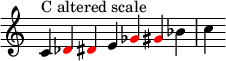
 {
\override Score.TimeSignature #'stencil = ##f
\relative c' { 
  \clef treble \time 7/4 c4^\markup { C altered scale }
  \override NoteHead.color = #red des dis
  \override NoteHead.color = #black e
  \override NoteHead.color = #red ges gis
  \override NoteHead.color = #black bes c
  }
}

The altered scale is made by the sequence:

Half, Whole, Half, Whole, Whole, Whole, Whole

The abbreviation "alt" (for "altered") used in chord symbols enhances readability by reducing the number of characters otherwise needed to define the chord and avoids the confusion of multiple equivalent complex names. For example, "C7alt" supplants "C759911", "C7−5+5−9+9", "Caug7−9+9+11", etc.

This scale has existed for a long time as the 7th mode of the ascending melodic minor scale.

Enharmonic spellings and alternate names

[edit]

The C altered scale is also enharmonically equivalent to the C Locrian mode with F changed to F. For this reason, the altered scale is sometimes called the Locrian 4 scale.[1]

It is also enharmonically the seventh mode of the ascending melodic minor scale. The altered scale is also known as the Pomeroy scale after Herb Pomeroy,[2][3] the Ravel scale after Maurice Ravel, and the diminished whole tone scale due to its resemblance to the lower part of the diminished scale and the upper part of the whole tone scale.[4]

The super-Locrian scale (enharmonically identical to the altered scale) is obtained by flattening the fourth note of the diatonic Locrian mode. For example, flattening the fourth note of the C Locrian scale gives us the C altered scale:
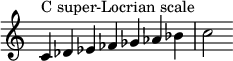
 {
\override Score.TimeSignature #'stencil = ##f
\relative c' { 
  \clef treble \time 7/4
  c4^\markup { C super-Locrian scale } des es fes ges aes bes c2 }
}

The altered scale can also be achieved by raising the tonic of a major scale by a half step. For instance, raising the tonic of the C major scale by a half step (here spelled as an augmented unison) produces the scale C-D-E-F-G-A-B-C:

 {
\override Score.TimeSignature #'stencil = ##f
\relative c' { 
  \clef treble \time 7/4
  cis4 d e f g a b cis2 }
}

The altered scale can also be the major scale with all of the notes except the tonic being flattened. For example, taking the C major scale and flattening all of the notes except the tonic produces the C altered scale (see above).

Common usage

[edit]

Because it contains the essential notes of a dominant seventh chord, it can be used to create melodies over the dominant chord in a jazz context. The added dissonance of the altered notes creates extra tension on the dominant.

See also

[edit]

References

[edit]

Further reading

[edit]
[edit]
Revisions and contributorsEdit on WikipediaRead on Wikipedia
from Grokipedia
The altered scale, also known as the super or the seventh mode of the melodic , is a seven-note musical scale characterized by a sequence of intervals: half step, whole step, half step, whole step, whole step, whole step, half step. It is derived by starting on the seventh degree of the melodic built a half step above the —for example, the C altered scale uses the notes of the D♭ melodic (C, D♭, E♭, E, G♭, A♭, B♭). This structure incorporates altered tones such as the ♭9, ♯9, ♭5, and ♭13 relative to the , which distinguish it from the standard major or Mixolydian scales. In theory and , the altered scale is primarily employed over dominant seventh chords with alterations, often notated as "7alt" or "7♯9♭13," to generate tension that resolves strongly to the tonic chord in progressions like ii-V-I. Its dissonant qualities arise from the inclusion of both thirds, as well as clashing ninths and fifths, making it ideal for creating "outside" sounds that heighten emotional intensity before resolution. Unlike the whole-tone or half-whole diminished scales, which it may resemble, the altered scale avoids the natural fifth and thirteenth, emphasizing chromatic alterations for a more targeted dissonant effect over altered dominants. The scale emerged during the bebop era in the 1940s, as jazz musicians began incorporating melodic minor modes to expand improvisational possibilities beyond diatonic frameworks. It is frequently taught in jazz education contexts for its versatility in both major and minor keys, with practical applications in standards such as "All the Things You Are" or "Autumn Leaves," where it targets V7 chords leading to resolution.

Theory and Construction

Definition and Characteristics

The is a comprising seven distinct pitches, primarily utilized in and modern music to produce tension and dissonance when improvising over s. This scale is derived from the dominant seventh chord by altering its non-essential tones, specifically incorporating the flat ninth (♭9), sharp ninth (♯9), flat fifth (♭5), and sharp eleventh (♯11) as key tension elements that enhance harmonic instability. In musical set theory, the altered scale is identified by its pitch-class set, which carries the Forte number 7-34, denoting its unique interval structure among heptatonic collections. Its overall sound profile is markedly dissonant and tense, stemming from the inclusion of intervals like the minor second, augmented fourth, and relative to the , which create clashing half-step relationships and unresolved ambiguities. The altered scale is equivalently recognized as the seventh mode of the melodic minor scale, built a half-step above the target root.

Interval Structure and Formula

The altered scale follows a specific interval pattern consisting of a half step (H), whole step (W), half step (H), whole step (W), whole step (W), whole step (W), and whole step (W). This sequence creates a symmetrical yet dissonant structure that distinguishes it from diatonic scales. The numeric formula, starting from the root, includes the degrees 1, ♭2 (#9 enharmonically), #2 (♭3 enharmonically), 3, ♭5 (#11 enharmonically), ♭6 (#5 enharmonically), and ♭7. For instance, the altered scale rooted on C comprises the pitches C, D♭, E♭, E, G♭, A♭, and B♭. These scale degrees correspond to the (1), minor second (♭2), (♭3), (3), [diminished fifth](/page/perfect fifth) (♭5), (♭6), and (♭7). Notably, the structure excludes the , natural ninth, eleventh, and thirteenth, which accentuates the scale's altered tensions over dominant harmonies.

Relationships to Other Scales

Mode of the Melodic Minor Scale

The altered scale is the seventh mode of the ascending , derived by starting on the seventh scale degree of that parent scale. This relationship integrates the altered scale into the broader family of melodic minor modes used in theory. The ascending melodic minor scale follows the formula 1–2–♭3–4–5–6–7, where the sixth and seventh degrees are raised from the natural minor's ♭6 and ♭7 to create a major sixth and interval, respectively. When extracting the seventh mode, these unaltered ascending pitches are rotated to emphasize tension-building intervals relative to the new . To construct an altered scale on a specific root, such as G for a G7 chord, musicians build the melodic minor scale starting a half step above that root—in this case, the A♭ melodic minor scale (A♭–B♭–B–D♭–E♭–F–G)—and begin on its seventh degree (G). This modal positioning highlights the ♭2, ♯2 (enharmonically ♭3), and ♭5 degrees prominently, generating dissonance that resolves effectively over dominant seventh chords. The melodic minor mode system, including the altered scale, offers a cohesive theoretical framework for selecting scales in various key centers, enabling improvisers to navigate harmonic progressions with consistent intervallic relationships.

Comparisons with Diminished and Whole-Tone Scales

The altered scale shares structural elements with the half-whole diminished scale, particularly in its initial pitches, but diverges in symmetry and key intervals. Both scales begin with the same first five notes—for instance, in the key of C, the altered scale (C–D♭–E♭–E–G♭–A♭–B♭) matches the half-whole diminished scale (C–D♭–E♭–E–G♭–G–A–B♭) up to the ♭5 (G♭), incorporating the ♭9 (D♭) and ♭5 for tension over dominant chords. However, the altered scale includes a major third (E) while omitting the natural 5th (G) and 6th (A) present in the diminished scale, resulting in a less symmetric structure compared to the half-whole diminished's repeating half-whole pattern (H–W–H–W–H–W–H–W). This asymmetry in the altered scale enhances its directional pull toward resolution, distinguishing it from the more evenly distributed diminished scale. In contrast to the , which consists entirely of whole steps (W–W–W–W–W–W) to produce an ambiguous, augmented sound, the altered scale integrates minor intervals and a ♭7 for greater tension and resolution tendency. For example, the last five notes of the C altered scale (E♭–E–G♭–A♭–B♭) align with a subset of the whole-tone scale's pitches, evoking similar augmented and diminished sonorities, but the inclusion of the ♭7 (B♭) and half steps (such as E♭ to E) adds a dominant function absent in the purely whole-step whole-tone scale. Both scales can imply augmented/diminished harmonies, yet the altered scale's mixed intervals provide a more targeted suited to altered dominants. The altered scale contains pitch subsets from both symmetric scales, such as the augmented by the ♭7 and ♭2, or the diminished tetrad formed by D♭–E–G♭–A♭ in the C altered scale, which embeds a fully diminished sonority for added dissonance. Functionally, the altered scale targets specific alterations on dominant 7th chords (e.g., ♭9, ♯9, ♭5, ♯5), whereas the half-whole diminished scale supports iiø–V progressions with its octatonic , and the emphasizes augmented chords through its even-step construction. These distinctions highlight the altered scale's unique role as a melodic minor derivative bridging symmetric scale properties without full .

Historical Development

Origins in Classical and Early 20th-Century Music

The altered scale, characterized by its dissonant tensions such as the flat ninth, sharp ninth, flat fifth, and sharp fifth over a , found early precursors in the chromatic harmonic practices of 19th-century Romantic composers, particularly in the works of . In Wagner's opera (1859), the famous ""—comprising the notes F, B, D♯, and G♯—functions as an altered dominant harmony, incorporating appoggiaturas and chromatic alterations that evoke the b9 and #11 tensions akin to those in the altered scale. This chord, often analyzed as a French augmented sixth or half-diminished seventh in a dominant context, prefigures the scale's use for heightened expressivity and delayed resolution, extending beyond traditional tonal harmony to create ambiguous, yearning progressions. In the late Romantic and Impressionist eras of the early 20th century, composers like Claude Debussy and Maurice Ravel further explored such altered dominant collections for their coloristic potential, integrating them into non-functional, evocative textures without explicit scale nomenclature. Debussy employed melodic minor-derived (acoustic) scales over dominants to generate dissonance; for instance, in L’Isle Joyeuse (1904), measures 99–159 feature a G♯ acoustic scale functioning as an altered dominant to C♯, blending whole-tone elements with chromatic tensions to blur tonal boundaries and enhance atmospheric ambiguity. Similarly, Ravel incorporated explicit altered scale patterns in his opera L’enfant et les sortilèges (1925), where at rehearsal 39, piano runs outline the C♯ altered scale (diminished-whole tone, the seventh mode of D melodic minor), creating unstable, polychordal dominant harmonies with ♯9, ♭5, and ♯5 alterations for dramatic effect. These instances reflect Impressionist priorities of timbre and suggestion over resolution, using altered dominants to evoke exotic or dreamlike qualities. Although these harmonic practices implicitly utilized the pitch collections of the altered scale during the 1900–1930 period, the scale itself was not theoretically recognized or named as such until mid-20th-century developments, remaining embedded in classical composers' experimental approaches to and modal mixture. This pre- foundation established the altered scale's roots in Western art music's shift toward expanded .

Adoption and Evolution in Jazz

The chromatic tensions later systematized as the altered scale gained prominence in jazz during the mid-1940s with the advent of , where musicians such as and employed these tense, chromatic qualities to improvise over altered dominant seventh chords, particularly the V7 in ii-V-I progressions, creating heightened dissonance and resolution that defined the era's harmonic sophistication. Bebop pioneers integrated altered tensions—such as the flat 9, sharp 9, flat 5, and flat 13—to navigate rapid chord changes, marking a shift from swing-era consonance toward more complex, intellectually demanding . In the 1950s, as jazz education formalized at institutions like , trumpeter and educator Herb Pomeroy played a key role in theorizing the scale, naming it the Pomeroy scale in his teaching to emphasize its utility for dominant chord alterations. By the 1970s, educators including further advanced its theoretical framework by explicitly connecting it to the seventh mode of the ascending melodic , systematizing chord-scale relationships in pedagogical texts that influenced generations of jazz students. This linkage highlighted the scale's , enabling musicians to derive improvisational material from melodic minor structures for greater harmonic flexibility, with formal recognition emerging in jazz education from the 1950s onward. The scale's adoption evolved alongside jazz subgenres, transitioning from bebop's structured lines into explorations in the mid-1950s to , where it added chromatic tension to static modal backdrops. In the , free jazz innovators expanded its application to incorporate extended tensions and atonal freedoms, while fusion artists in the ensuing decade blended it with rock and electric elements for bolder, genre-blurring solos. By 1980, Dan Haerle's influential textbook The Jazz Language cemented the altered scale—also termed super-Locrian—as a cornerstone of pedagogy, standardizing its teaching and ensuring its enduring role in and composition curricula.

Practical Applications

Use Over Dominant Chords

The altered scale is primarily employed over altered dominant seventh chords, denoted as V7alt, to generate heightened tension that resolves strongly to the ensuing tonic chord. For instance, in the key of or minor, the G7alt chord—featuring alterations such as ♭9, ♯9, ♭5, and ♯11 (e.g., (♭9♭5♯9♯11))—pairs with the G altered scale (G A♭ B♭ C♭ D♭ E♭ F) to emphasize dissonant tones that pull toward C. This application stems from chord-scale theory in , where the scale's structure aligns with the chord's extended tensions, facilitating smooth during resolution. Within the altered dominant chord, the , , and serve as stable chord tones that anchor the , while the altered extensions—♭9, ♯9, ♭5 (equivalent to ♯11 enharmonically), and ♭13—function as tensions designed for chromatic resolution. These tensions create dissonance against the root and third, enhancing the dominant function's pull; for example, the ♭9 resolves downward to the tonic's root, and the ♭5 leads to the tonic's fifth. This selective emphasis on tensions distinguishes the altered scale from mixolydian modes, prioritizing instability for dramatic effect in contexts. In common jazz progressions like the ii-V7-I, the altered scale is ideal for the V7 chord when maximum resolution is desired, such as in Dm7-G7alt-CMaj7, where the G altered scale amplifies the tritone between the third (B) and seventh (F) while introducing surrounding chromatics for color. This setup is prevalent in standards like "," where the V7alt heightens the pivot to the I chord, often resolving the tensions in parallel motion (e.g., ♯9 to 1, ♭5 to 5). Such usage underscores the scale's role in creating forward momentum within functional harmony. Even over unaltered dominant seventh chords (e.g., plain ), musicians may substitute the altered scale to imply tensions for added color, treating the chord as functionally altered without explicit notation; this approach relies on selective note choice to avoid clashing with the while incorporating ♭9 or ♯9 for subtle dissonance. In lead sheets and fake books, altered dominant chords are commonly notated as "alt" or "7alt" to indicate the use of the altered scale, signaling improvisers to draw from its full palette of tensions without specifying every alteration. To illustrate practical voicings, a G7alt chord might be voiced as G-B-D♭-F-A♭ (root-3rd-♭5-♭7-♭9) in close position, or more openly as B-F-A♭-D♭-E♭ (3rd-♭7-♭9-♭5-♭13) to highlight tensions; these configurations allow the altered scale to target the upper extensions during comping or solo accompaniment, promoting to the resolving CMaj7 (e.g., C-E-G-B).

Techniques in Improvisation and Composition

In , the altered scale is frequently employed to generate tension over dominant chords by emphasizing altered tones such as the ♭9 and ♭5, which resolve effectively to chord tones like the major 3rd and ♭7, respectively, creating a sense of forward momentum and release. For instance, approaching the major 3rd from the #9 (e.g., from A♯ to B in a context) produces a half-step tension that mimics the pull of a leading tone, while the ♭5 (e.g., D♭ in ) resolves downward to the ♭7 (F), enhancing the dominant's instability before resolution to the tonic. Additionally, chromatic approach notes from the ♭2 (equivalent to ♭9) allow improvisers to navigate outside the chord briefly, adding color without disrupting the harmonic flow; this technique, often derived from the scale's inherent half-step intervals, facilitates smooth integration into melodic lines. Common patterns in altered scale improvisation include enclosures, where target chord tones are surrounded by notes above and below from the scale or chromatically, providing rhythmic variety and precision in bebop-style phrasing. For example, enclosing the root or 3rd with a combination of ♭9, #9, and scale steps creates a bracketed approach that heightens expressiveness. Bebop-style runs incorporating the #9 and ♭5 often feature eighth-note triplets or scalar segments that highlight these tensions, as seen in lines that ascend through the scale's b3 to #9 before descending to the ♭7, maintaining even pulse while building dissonance. A classic example from Charlie Parker's improvisation appears in his solo on "," where over a altered dominant, he employs a lick featuring the #9 (A#) and b9 (A♭) resolving toward the 3rd (B), transcribed approximately as: starting on the ♭7 (F), ascending chromatically via A♭-A-A# to B, then dropping to the root (G) for resolution—this enclosure uses altered tensions to escape diatonic constraints and add urgency. In composition, the altered scale contributes to suspenseful atmospheres in film scores by layering its dissonant intervals over sustained dominants, evoking uncertainty through unresolved tensions like the ♭5 and #9. In rock fusion, it is applied over power chords to infuse jazz-inflected dissonance, as in John McLaughlin's lines on Mahavishnu Orchestra recordings, where altered scale fragments over dominant voicings create propulsive, outside textures. Modern metal compositions leverage the scale for heightened dissonance, particularly in progressive or subgenres, where riffs incorporating ♭9 and ♭5 over distorted dominants amplify aggression and instability, as demonstrated in guitar solos that blend it with palm-muted chugs for a chaotic edge. To master these techniques, musicians practice by transposing the altered scale to all 12 keys, starting with simple scalar runs and gradually incorporating arpeggios from the altered dominant chord (e.g., root-3rd-♭5-♭7) to internalize its sound and facilitate fluid application across harmonic contexts.

Nomenclature and Variants

Alternate Names

The , a of , bears several alternate names that underscore its theoretical construction, historical usage, and modal relationships across different musical traditions. The most common designation in jazz contexts is simply the "," which highlights its role in modifying the standard by incorporating non-diatonic tensions such as the ♭9, ♯9, ♭5, and ♯11. A closely related term, "altered dominant scale," emphasizes its specific application over altered dominant chords, distinguishing it from other melodic minor modes and reinforcing its in creating dissonance that resolves to a target chord. In jazz pedagogy, particularly from mid-20th-century American institutions, the scale is also referred to as the "Pomeroy scale," named after Herb Pomeroy, a trumpeter, , and educator at who contributed to its systematization in theory during the 1950s and 1960s. Another jazz-specific name is "super Locrian," which arises from its intervallic similarity to the —sharing the characteristic ♭2 (minor second) for a tense, unstable sound—but with an additional ♭4 (equivalent to ♯11 in chordal terms), making it "super" in its extremity compared to the standard Locrian. This nomenclature gained traction in academic and European circles, where of the melodic is emphasized, often appearing in texts from the late 20th century onward. Beyond jazz, the scale is known as the "diminished whole tone scale," a name that describes its intervallic pattern beginning with a half step (like the diminished scale) followed by a whole step, then shifting into a series of whole tones that evoke an augmented or whole-tone quality in the upper register. This term appears in broader music theory discussions, particularly those bridging classical and modern idioms. Additionally, it is called the "Ravel scale" in reference to French composer Maurice Ravel's employment of similar pitch collections in works like Daphnis et Chloé (1912), where half-whole diminished patterns create exotic, dissonant colors akin to the altered scale's structure. From a modal perspective, the scale is designated "Locrian ♭4," indicating its derivation from the of the with the fourth degree further flattened, resulting in a heightened sense of instability suitable for dominant resolutions. The evolution of these names reflects the scale's integration into education during the 1950s, when "altered" became the prevailing U.S. term through pedagogical materials at schools like Berklee, while "super Locrian" emerged later in more formal, mode-centric analyses in European and academic settings.

Enharmonic Spellings and Equivalents

The altered scale admits various enharmonic respellings to optimize notation for specific keys, voice leading, or instrumental readability, while preserving its core interval pattern of half-whole-half-whole-whole-whole-whole steps. In the key of C, the standard flat-based notation is C–D♭–E♭–E–G♭–A♭–B♭, but it can be enharmonically respelled as C–C♯–D♯–E–F♯–G♯–A♯ using sharp accidentals, which facilitates smoother melodic contours by aligning note names with ascending sharp progressions and reduces ledger-line awkwardness in sharp-heavy contexts. Similarly, selective respellings within the scale, such as changing E♭ to D♯ or A♭ to G♯ while retaining others like D♭ and G♭, can minimize leaps in polyphonic writing or orchestration by promoting stepwise motion between voices. All transpositions of the altered scale across the 12 keys maintain the identical interval structure, but enharmonic adjustments are essential for legibility; for instance, the F♯ altered scale (F♯–G–A–B–C–D–E–F♯) naturally avoids flats, whereas in flat keys like B♭, the notation B♭–B–D♭–D–E–G♭–G–B♭ benefits from selective to integrate with surrounding harmonic material. These respellings are particularly useful in lead sheets and orchestral scores to prevent notational clutter, such as excessive that could disrupt performer . The pitch-class set {0,1,3,4,6,8,10} (normalized to start at 0 for C) is invariant under transposition and identical to the set of all melodic minor modes, underscoring its modal equivalence within that parent scale. Theoretically, the altered scale has no distinct enharmonic equivalents outside its modal rotations, as its pitch content is uniquely defined by the melodic minor parent; however, its tones overlap significantly with subsets of the (e.g., sharing the half-whole diminished pattern's initial intervals but incorporating a major third for dominant chord compatibility). This overlap allows the altered scale to function as an adjusted octatonic subset in improvisational contexts, emphasizing altered chord tones like ♭9, ♯9, ♭5, and ♭13 without the full symmetric collection. In practice, such enharmonic flexibility aids by enabling composers to select spellings that avoid augmented intervals or parallel fifths in multi-voice textures.

References

Add your contribution
Related Hubs
Contribute something
User Avatar
No comments yet.