


Community hub
Recent from talks
Contribute something to knowledge base
Content stats: 0 posts, 0 articles, 1 media, 0 notes
Members stats: 0 subscribers, 0 contributors, 0 moderators, 0 supporters
Subscribers
Supporters
Contributors
Moderators
Hub AI
Amacrine cell AI simulator
(@Amacrine cell_simulator)
Hub AI
Amacrine cell AI simulator
(@Amacrine cell_simulator)
Amacrine cell
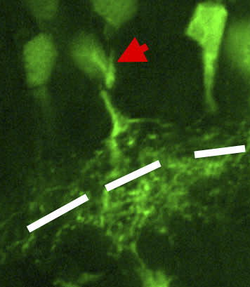
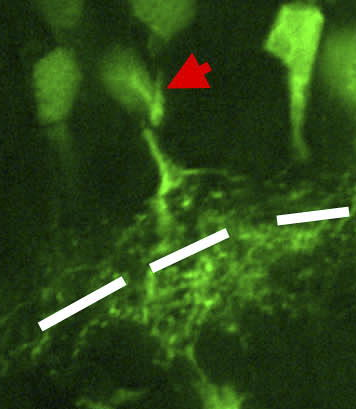
In the anatomy of the eye, amacrine cells are interneurons in the retina. They are named from Greek a– 'non' makr– 'long' and in– 'fiber', because of their short neuronal processes. Amacrine cells are inhibitory neurons which project their dendritic arbors onto the inner plexiform layer (IPL). They interact with retinal ganglion cells and bipolar cells.
Amacrine cells operate at the inner plexiform layer (IPL), the second synaptic retinal layer where bipolar cells and retinal ganglion cells form synapses. There are at least 33 different subtypes of amacrine cells based just on their dendrite morphology and stratification. Like horizontal cells, amacrine cells work laterally, but whereas horizontal cells are connected to the output of rod and cone cells, amacrine cells affect the output from bipolar cells, and are often more specialized. Each type of amacrine cell releases one or several neurotransmitters where it connects with other cells.
They are often classified by the width of their field of connection, which layer(s) of the stratum in the IPL they are in, and by neurotransmitter type. Most are inhibitory using either gamma-Aminobutyric acid or glycine as neurotransmitters.
As mentioned above, there are several different ways to divide the many different types of amacrine cells into subtypes.
GABAergic, glycinergic, or neither: Amacrine cells can be either GABAergic, glycinergic or neither depending on what inhibitory neurotransmitter they express (GABA, glycine, or neither). GABAergic amacrine cells are usually wide field amacrine cells and are found in the ganglion cell layer (GCL) and the inner nuclear layer (INL). One type of GABAergic amacrine cell that is fairly well studied is the starburst amacrine cell. These amacrine cells are usually characterised by their expression of choline acetyltransferase, or ChAT, and are known to play a role in direction selectivity and detection of directional motion. Acetylcholine is also released from these amacrine cells, but its function is not completely understood. Another subtype of GABAergic amacrine cells are those that are dopaminergic. These are all TH expressing and these amacrine cells modulate light adaption and circadian rhythm. These are widely spreading amacrine cells, and they diffusely release dopamine, while still releasing GABA and carrying out all normal synaptic release. Many other divisions of GABAergic amacrine cells have been noted, but those listed above are some of the most extensively researched and discussed.
Glycinergic amacrine cells aren't as extensively characterized as GABAergic amacrine cells. All glycinergic amacrine cells though, are marked by the glycine transporter GlyT1. One very well characterized glycinergic amacrine cell is the AII amacrine cells. These cells are present in the INL. One important function of the AII amacrine cells is that they capture cellular input from rod bipolar cells and redistribute it to cone bipolar cells using the synaptic endings of cone bipolar cells as adaptors
Around 15% of amacrine cells are neither GABAergic or glycinergic. These amacrine cells are sometimes known as nGnG amacrine cells, and it is thought that transcription factors that act on progenitors decide the fate of amacrine cells. One transcription factor that was found to be selectively expressed in nGnG amacrine cells is Neurod6
Length of dendritic arbors: Based on length, spread of dendritic arbors, amacrine cells can be categorized as narrow field amacrine cells (around 70 micrometers in diameter), medium field amacrine cells (around 170 micrometers in diameter) and wide field amacrine cells (around 350 micrometers in diameter). These different lengths lend to different specific functions that the amacrine cells can accomplish. Narrow field amacrine cells allow vertical communication among different retinal levels. They also aid in creating functional subunits in the receptive field of ganglion cells. These narrow field amacrine cells and their overlap in these subunits can allow certain ganglion cells to detect small amounts of movement of a very small spot in a field of vision. One type of narrow field cells that does this is the starburst amacrine cell.
Amacrine cell
In the anatomy of the eye, amacrine cells are interneurons in the retina. They are named from Greek a– 'non' makr– 'long' and in– 'fiber', because of their short neuronal processes. Amacrine cells are inhibitory neurons which project their dendritic arbors onto the inner plexiform layer (IPL). They interact with retinal ganglion cells and bipolar cells.
Amacrine cells operate at the inner plexiform layer (IPL), the second synaptic retinal layer where bipolar cells and retinal ganglion cells form synapses. There are at least 33 different subtypes of amacrine cells based just on their dendrite morphology and stratification. Like horizontal cells, amacrine cells work laterally, but whereas horizontal cells are connected to the output of rod and cone cells, amacrine cells affect the output from bipolar cells, and are often more specialized. Each type of amacrine cell releases one or several neurotransmitters where it connects with other cells.
They are often classified by the width of their field of connection, which layer(s) of the stratum in the IPL they are in, and by neurotransmitter type. Most are inhibitory using either gamma-Aminobutyric acid or glycine as neurotransmitters.
As mentioned above, there are several different ways to divide the many different types of amacrine cells into subtypes.
GABAergic, glycinergic, or neither: Amacrine cells can be either GABAergic, glycinergic or neither depending on what inhibitory neurotransmitter they express (GABA, glycine, or neither). GABAergic amacrine cells are usually wide field amacrine cells and are found in the ganglion cell layer (GCL) and the inner nuclear layer (INL). One type of GABAergic amacrine cell that is fairly well studied is the starburst amacrine cell. These amacrine cells are usually characterised by their expression of choline acetyltransferase, or ChAT, and are known to play a role in direction selectivity and detection of directional motion. Acetylcholine is also released from these amacrine cells, but its function is not completely understood. Another subtype of GABAergic amacrine cells are those that are dopaminergic. These are all TH expressing and these amacrine cells modulate light adaption and circadian rhythm. These are widely spreading amacrine cells, and they diffusely release dopamine, while still releasing GABA and carrying out all normal synaptic release. Many other divisions of GABAergic amacrine cells have been noted, but those listed above are some of the most extensively researched and discussed.
Glycinergic amacrine cells aren't as extensively characterized as GABAergic amacrine cells. All glycinergic amacrine cells though, are marked by the glycine transporter GlyT1. One very well characterized glycinergic amacrine cell is the AII amacrine cells. These cells are present in the INL. One important function of the AII amacrine cells is that they capture cellular input from rod bipolar cells and redistribute it to cone bipolar cells using the synaptic endings of cone bipolar cells as adaptors
Around 15% of amacrine cells are neither GABAergic or glycinergic. These amacrine cells are sometimes known as nGnG amacrine cells, and it is thought that transcription factors that act on progenitors decide the fate of amacrine cells. One transcription factor that was found to be selectively expressed in nGnG amacrine cells is Neurod6
Length of dendritic arbors: Based on length, spread of dendritic arbors, amacrine cells can be categorized as narrow field amacrine cells (around 70 micrometers in diameter), medium field amacrine cells (around 170 micrometers in diameter) and wide field amacrine cells (around 350 micrometers in diameter). These different lengths lend to different specific functions that the amacrine cells can accomplish. Narrow field amacrine cells allow vertical communication among different retinal levels. They also aid in creating functional subunits in the receptive field of ganglion cells. These narrow field amacrine cells and their overlap in these subunits can allow certain ganglion cells to detect small amounts of movement of a very small spot in a field of vision. One type of narrow field cells that does this is the starburst amacrine cell.
Recent media
Recent media