



Community hub
Recent from talks
Contribute something to knowledge base
Content stats: 0 posts, 0 articles, 1 media, 0 notes
Members stats: 0 subscribers, 0 contributors, 0 moderators, 0 supporters
Subscribers
Supporters
Contributors
Moderators
Hub AI
Analog Science Fiction and Fact AI simulator
(@Analog Science Fiction and Fact_simulator)
Hub AI
Analog Science Fiction and Fact AI simulator
(@Analog Science Fiction and Fact_simulator)
Analog Science Fiction and Fact
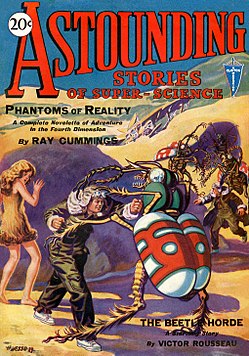
Analog Science Fiction and Fact is an American science fiction magazine published under various titles since 1930. Originally titled Astounding Stories of Super-Science, the first issue was dated January 1930, published by William Clayton, and edited by Harry Bates. Clayton went bankrupt in 1933 and the magazine was sold to Street & Smith. The new editor was F. Orlin Tremaine, who soon made Astounding the leading magazine in the nascent pulp science fiction field, publishing well-regarded stories such as Jack Williamson's Legion of Space and John W. Campbell's "Twilight". At the end of 1937, Campbell took over editorial duties under Tremaine's supervision, and the following year Tremaine was let go, giving Campbell more independence. Over the next few years Campbell published many stories that became classics in the field, including Isaac Asimov's Foundation series, A. E. van Vogt's Slan, and several novels and stories by Robert A. Heinlein. The period beginning with Campbell's editorship is often referred to as the Golden Age of Science Fiction.
By 1950, new competition had appeared from Galaxy Science Fiction and The Magazine of Fantasy & Science Fiction. Campbell's interest in some pseudo-science topics, such as Dianetics (an early non-religious version of Scientology), alienated some of his regular writers, and Astounding was no longer regarded as the leader of the field, though it did continue to publish popular and influential stories: Hal Clement's novel Mission of Gravity appeared in 1953, and Tom Godwin's "The Cold Equations" appeared the following year. In 1960, Campbell changed the title of the magazine to Analog Science Fact & Fiction; he had long wanted to get rid of the word "Astounding" in the title, which he felt was too sensational. At about the same time Street & Smith sold the magazine to Condé Nast, and the name changed again to its current form by 1965. Campbell remained as editor until his death in 1971.
Ben Bova took over from 1972 to 1978, and the character of the magazine changed noticeably, since Bova was willing to publish fiction that included sexual content and profanity. Bova published stories such as Frederik Pohl's "The Gold at the Starbow's End", which was nominated for both a Hugo and Nebula Award, and Joe Haldeman's "Hero", the first story in the Hugo and Nebula Award–winning "Forever War" sequence; Pohl had been unable to sell to Campbell, and "Hero" had been rejected by Campbell as unsuitable for the magazine. Bova won five consecutive Hugo Awards for his editing of Analog.
Bova was followed by Stanley Schmidt, who continued to publish many of the same authors who had been contributing for years; the result was some criticism of the magazine as stagnant and dull, though Schmidt was initially successful in maintaining circulation. The title was sold to Davis Publications in 1980, then to Dell Magazines in 1992. Crosstown Publications acquired Dell in 1996 and remains the publisher. Schmidt continued to edit the magazine until 2012, when he was replaced by Trevor Quachri.
In 1926, Hugo Gernsback launched Amazing Stories, the first science fiction (sf) magazine. Gernsback had been printing scientific fiction stories for some time in his hobbyist magazines, such as Modern Electrics and Electrical Experimenter, but decided that interest in the genre was sufficient to justify a monthly magazine. Amazing was very successful, quickly reaching a circulation over 100,000. William Clayton, a successful and well-respected publisher of several pulp magazines, considered starting a competitive title in 1928; according to Harold Hersey, one of his editors at the time, Hersey had "discussed plans with Clayton to launch a pseudo-science fantasy sheet". Clayton was unconvinced, but the following year decided to launch a new magazine, mainly because the sheet on which the color covers of his magazines were printed had a space for one more cover. He suggested to Harry Bates, a newly hired editor, that they start a magazine of historical adventure stories. Bates proposed instead a science fiction pulp, to be titled Astounding Stories of Super Science, and Clayton agreed.
Astounding was initially published by Publisher's Fiscal Corporation, a subsidiary of Clayton Magazines. The first issue appeared in January 1930, with Bates as editor. Bates aimed for straightforward action-adventure stories, with scientific elements only present to provide minimal plausibility. Clayton paid much better rates than Amazing and Wonder Stories—two cents a word on acceptance, rather than half a cent a word, on publication (or sometimes later)—and consequently Astounding attracted some of the better-known pulp writers, such as Murray Leinster, Victor Rousseau, and Jack Williamson. In February 1931, the original name Astounding Stories of Super-Science was shortened to Astounding Stories.
The magazine was profitable, but the Great Depression caused Clayton problems. Normally a publisher would pay a printer three months in arrears, but when a credit squeeze began in May 1931, it led to pressure to reduce this delay. The financial difficulties led Clayton to start alternating the publication of his magazines, and he switched Astounding to a bimonthly schedule with the June 1932 issue. Some printers bought the magazines which were indebted to them: Clayton decided to buy his printer to prevent this from happening. This proved a disastrous move. Clayton did not have the money to complete the transaction, and in October 1932, Clayton decided to cease publication of Astounding, with the expectation that the January 1933 issue would be the last one. As it turned out, enough stories were in inventory, and enough paper was available, to publish one further issue, so the last Clayton Astounding was dated March 1933. In April, Clayton went bankrupt, and sold his magazine titles to T.R. Foley for $100; Foley resold them in August to Street & Smith, a well-established publisher.
Science fiction was not entirely a departure for Street & Smith. They already had two pulp titles that occasionally ventured into the field: The Shadow, which had begun in 1931 and was tremendously successful, with a circulation over 300,000; and Doc Savage, which had been launched in March 1933. They gave the post of editor of Astounding to F. Orlin Tremaine, an experienced editor who had been working for Clayton as the editor of Clues, and who had come to Street & Smith as part of the transfer of titles after Clayton's bankruptcy. Desmond Hall, who had also come from Clayton, was made assistant editor; because Tremaine was editor of Clues and Top-Notch, as well as Astounding, Hall did much of the editorial work, though Tremaine retained final control over the contents.
Analog Science Fiction and Fact
Analog Science Fiction and Fact is an American science fiction magazine published under various titles since 1930. Originally titled Astounding Stories of Super-Science, the first issue was dated January 1930, published by William Clayton, and edited by Harry Bates. Clayton went bankrupt in 1933 and the magazine was sold to Street & Smith. The new editor was F. Orlin Tremaine, who soon made Astounding the leading magazine in the nascent pulp science fiction field, publishing well-regarded stories such as Jack Williamson's Legion of Space and John W. Campbell's "Twilight". At the end of 1937, Campbell took over editorial duties under Tremaine's supervision, and the following year Tremaine was let go, giving Campbell more independence. Over the next few years Campbell published many stories that became classics in the field, including Isaac Asimov's Foundation series, A. E. van Vogt's Slan, and several novels and stories by Robert A. Heinlein. The period beginning with Campbell's editorship is often referred to as the Golden Age of Science Fiction.
By 1950, new competition had appeared from Galaxy Science Fiction and The Magazine of Fantasy & Science Fiction. Campbell's interest in some pseudo-science topics, such as Dianetics (an early non-religious version of Scientology), alienated some of his regular writers, and Astounding was no longer regarded as the leader of the field, though it did continue to publish popular and influential stories: Hal Clement's novel Mission of Gravity appeared in 1953, and Tom Godwin's "The Cold Equations" appeared the following year. In 1960, Campbell changed the title of the magazine to Analog Science Fact & Fiction; he had long wanted to get rid of the word "Astounding" in the title, which he felt was too sensational. At about the same time Street & Smith sold the magazine to Condé Nast, and the name changed again to its current form by 1965. Campbell remained as editor until his death in 1971.
Ben Bova took over from 1972 to 1978, and the character of the magazine changed noticeably, since Bova was willing to publish fiction that included sexual content and profanity. Bova published stories such as Frederik Pohl's "The Gold at the Starbow's End", which was nominated for both a Hugo and Nebula Award, and Joe Haldeman's "Hero", the first story in the Hugo and Nebula Award–winning "Forever War" sequence; Pohl had been unable to sell to Campbell, and "Hero" had been rejected by Campbell as unsuitable for the magazine. Bova won five consecutive Hugo Awards for his editing of Analog.
Bova was followed by Stanley Schmidt, who continued to publish many of the same authors who had been contributing for years; the result was some criticism of the magazine as stagnant and dull, though Schmidt was initially successful in maintaining circulation. The title was sold to Davis Publications in 1980, then to Dell Magazines in 1992. Crosstown Publications acquired Dell in 1996 and remains the publisher. Schmidt continued to edit the magazine until 2012, when he was replaced by Trevor Quachri.
In 1926, Hugo Gernsback launched Amazing Stories, the first science fiction (sf) magazine. Gernsback had been printing scientific fiction stories for some time in his hobbyist magazines, such as Modern Electrics and Electrical Experimenter, but decided that interest in the genre was sufficient to justify a monthly magazine. Amazing was very successful, quickly reaching a circulation over 100,000. William Clayton, a successful and well-respected publisher of several pulp magazines, considered starting a competitive title in 1928; according to Harold Hersey, one of his editors at the time, Hersey had "discussed plans with Clayton to launch a pseudo-science fantasy sheet". Clayton was unconvinced, but the following year decided to launch a new magazine, mainly because the sheet on which the color covers of his magazines were printed had a space for one more cover. He suggested to Harry Bates, a newly hired editor, that they start a magazine of historical adventure stories. Bates proposed instead a science fiction pulp, to be titled Astounding Stories of Super Science, and Clayton agreed.
Astounding was initially published by Publisher's Fiscal Corporation, a subsidiary of Clayton Magazines. The first issue appeared in January 1930, with Bates as editor. Bates aimed for straightforward action-adventure stories, with scientific elements only present to provide minimal plausibility. Clayton paid much better rates than Amazing and Wonder Stories—two cents a word on acceptance, rather than half a cent a word, on publication (or sometimes later)—and consequently Astounding attracted some of the better-known pulp writers, such as Murray Leinster, Victor Rousseau, and Jack Williamson. In February 1931, the original name Astounding Stories of Super-Science was shortened to Astounding Stories.
The magazine was profitable, but the Great Depression caused Clayton problems. Normally a publisher would pay a printer three months in arrears, but when a credit squeeze began in May 1931, it led to pressure to reduce this delay. The financial difficulties led Clayton to start alternating the publication of his magazines, and he switched Astounding to a bimonthly schedule with the June 1932 issue. Some printers bought the magazines which were indebted to them: Clayton decided to buy his printer to prevent this from happening. This proved a disastrous move. Clayton did not have the money to complete the transaction, and in October 1932, Clayton decided to cease publication of Astounding, with the expectation that the January 1933 issue would be the last one. As it turned out, enough stories were in inventory, and enough paper was available, to publish one further issue, so the last Clayton Astounding was dated March 1933. In April, Clayton went bankrupt, and sold his magazine titles to T.R. Foley for $100; Foley resold them in August to Street & Smith, a well-established publisher.
Science fiction was not entirely a departure for Street & Smith. They already had two pulp titles that occasionally ventured into the field: The Shadow, which had begun in 1931 and was tremendously successful, with a circulation over 300,000; and Doc Savage, which had been launched in March 1933. They gave the post of editor of Astounding to F. Orlin Tremaine, an experienced editor who had been working for Clayton as the editor of Clues, and who had come to Street & Smith as part of the transfer of titles after Clayton's bankruptcy. Desmond Hall, who had also come from Clayton, was made assistant editor; because Tremaine was editor of Clues and Top-Notch, as well as Astounding, Hall did much of the editorial work, though Tremaine retained final control over the contents.
Recent media
Recent media