Hubbry Logo
Anu (Irish goddess)Anu (Irish goddess)Main
Open search
Anu (Irish goddess)
Community hub
Anu (Irish goddess)
logo
8 pages, 0 posts
0 subscribers
Be the first to start a discussion here.
Anu (Irish goddess)
Anu (Irish goddess)
from Wikipedia

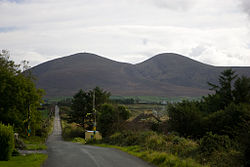
Paps of Anu

Anu or Ana (sometimes given as Anann or Anand) is the name of a goddess mentioned briefly in Irish mythology.

Myths and sources

[edit]

The 9th century Sanas Cormaic (Cormac's Glossary) says in its entry for her:

"Ana – mother of the gods of Ireland; well did she feed the gods".

She may be a goddess in her own right,[1] or an alternate name for Danu. In the Lebor Gabála Érenn, Anand is given as another name for The Morrígan.[2] As her name is often conflated with a number of other goddesses, it is not always clear which figure is being referred to if the name is taken out of context.[1] The name may be derived from the Proto-Celtic theonym *Φanon-.[3][4]

Anu has particular associations with Munster: the pair of breast shaped hills known as the Paps of Anu (Dá Chích Anann or "the breasts of Anu")[5] in County Kerry are said to have been named after her.[2]

Her name has the meaning of "wealth, riches, and prosperity." Leaving her with a title of being the goddess of "good fortune and prosperity" in the land of Munster. [6]

While an Irish goddess, in Scotland (Alba) a similar figure is referred to as “Gentle Annie”, in an effort to avoid offence, a tactic which is similar to referring to the fairies as “The Good People”.[7]

References

[edit]

Bibliography

[edit]
[edit]
Revisions and contributorsEdit on WikipediaRead on Wikipedia
from Grokipedia
Anu, also known as Ana or Anann, is a proposed in Irish , often equated with or seen as a form of the goddess Danu—after whom the are named—and regarded by some as the progenitor of this semi-divine tribe of gods and heroes central to Ireland's mythological tradition. Scholarly views on Anu's distinct identity remain debated, with her role largely inferred from conflations with Danu and limited direct attestations in medieval texts. She is associated with , abundance, and the , with her name etymologically linked to concepts of and . In medieval texts such as the (Book of Invasions), she is described as the mother of three sons—, Iuchar, and Iucharba—who represent key divine figures among the Tuatha. Her associations were particularly prominent in , where she is linked to the landscape as a and , providing nourishment, , and prosperity to the land and its people. The pair of breast-shaped hills in , known as the (Dá Chích Anann), are attributed to her form in folklore, symbolizing fertility and the generative power of the goddess; these peaks, topped with prehistoric cairns likely dating to the , may have served as sites for rituals, including Bealtaine festivals honoring seasonal renewal and cattle blessings. Though direct references to appear relatively late in written sources, such as manuscripts from the 9th century onward, her draws from pre-Christian indigenous beliefs, possibly influenced by Indo-European and deities, with parallels to continental figures like the Gallic Dana or even broader riverine goddesses tied to waterways like the . In later , she merges with other maternal entities, such as the queens or land spirits, underscoring her enduring role as a symbol of Irish divine and the sacred bond between people, kingship, and the natural world.

Name and Etymology

Linguistic Origins

The name of the Irish goddess derives from the Old Irish term ánu, denoting "wealth, riches, or ," as attested in medieval linguistic sources. This form is possibly linked to the Proto-Celtic root an-, which conveys notions of "abundance." Some scholars propose an alternative derivation from Proto-Celtic *Φanon- meaning "," aligning with her role as a maternal figure. In medieval Irish manuscripts, such as Cormac's Glossary (9th–10th century), the name appears primarily in its genitive form Anann, influencing place names like Dá Chích Anann (the "Two Breasts of Anann"), referring to the hills in . The historical linguistic evolution of Anu reflects broader Celtic developments, with potential influences from dialects evident in related terms for prosperity and territorial abundance, such as riverine and earth-associated nomenclature in continental Celtic regions.

Interpretations and Meanings

The name Anu, from Old Irish ánu, carries connotations of "wealth" and "abundance," positioning the goddess as an embodiment of good fortune, prosperity, and the earth's bounty within the Celtic worldview, where such attributes symbolize the nurturing forces that sustain life and community. This interpretation aligns with broader themes of fertility and material wealth, reflecting how natural abundance was personified in divine feminine figures to represent the land's generative power. Medieval glosses, notably in the 9th–10th-century Sanas Cormaic (Cormac's Glossary), portray Ana as the "mother of the gods of " who "nurtured and fed the gods well," emphasizing her role in providing nourishment and evoking the productivity of the land as a source of divine and earthly sustenance. Variations of the name, including Anann and Ana, reinforce her as a maternal earth-goddess, with Ana directly implying a nourisher or provider whose essence ties to cycles of growth, harvest, and communal well-being in Irish tradition. In the cultural context of , deities' names often encapsulate their primary domains, as seen in figures like ("good god") associated with abundance; thus, Anu's nomenclature underscores her symbolic oversight of , , and the land's inherent productivity, integrating her into narratives of and natural harmony.

Identity and Associations

Relation to Danu

In the , scholars drew from medieval genealogical traditions to portray and Danu as maternal figures to the Irish gods of the , positioning Anu as a nurturing earth goddess associated with abundance and , while Danu was seen as the eponymous ancestress of the , the "people of the goddess Danu." These views were based on compilations from manuscripts like the and , suggesting a dual mother archetype reflecting the tribe's origins. Textual evidence from the (Book of the Taking of Ireland), a 11th-century pseudo-historical compilation, explicitly names Danu (or Danand in genitive form) as the mother of key deities such as Brian, Iuchar, and Iucharba, sons of Delbaeth, establishing her as the divine ancestress of the without mention of in this role. appears separately in the text, with six occurrences typically linked to a Munster-based figure or conflated once with "Danann" elements, such as in triad descriptions involving war goddesses like and , but she is absent from the core genealogies of the Danann tribe. This scarcity of direct overlap indicates early medieval scribes occasionally merged the names, possibly due to phonetic similarities or regional variants, as edited in R.A.S. Macalister's critical edition. Linguistically, Danu derives from Proto-Indo-European *dānu- or *deh₃nu-, meaning "flowing" or "river," reflecting her associations with and , and serving as the for the in a manner akin to river-goddess names across Indo-European traditions, such as the . In contrast, Anu connects to themes of abundance, potentially from roots like án ("wealth" or "plenty"), and is interpreted as an for geographical features like the hills, though both names have been retroactively linked to the Danann collective in later interpretations. Despite these parallels, scholars emphasize that such eponymous roles do not imply identity, with Danu's form appearing only in the Lebor Gabála materials from the 11th century onward. Modern scholarship views as a localized variant or from place-names like Dá Chích Anann, distinct from the more abstract, reconstructed Danu, with conflations arising from post-medieval scholarly traditions rather than original mythology. Figures like Proinsias Mac Cana argue that no intrinsic link exists between the two, reinforcing Anu's role as a regional separate from Danu's tribal ancestress function.

Connections to Other Deities

Anu is frequently identified with the names Ana and Anann, which appear in medieval Irish texts as designations for a singular mother goddess figure associated with the Tuatha Dé Danann. In the Lebor Gabála Érenn, Anann is listed alongside Badb and Macha as daughters of the goddess Ernmas, forming a triad of sovereignty and war deities that underscores shared themes of land fertility and protection. These variant names suggest potential links to broader Celtic traditions, including the Welsh figure Anna, interpreted by some scholars as a cognate earth mother, and Gaulish earth goddesses embodying abundance and nurturing. Anu's connections to the Morrígan arise through overlapping motifs of , prosperity, and the earth's generative power, with Anu posited as an ancestral form or epithet of in certain reconstructions. As part of the triad, Anann complements (a crow-associated war aspect of ) and (linked to territorial dominion), reflecting a collective of female divine authority over fertility and conflict. This association highlights Anu's role in themes of land prosperity, akin to 's dual capacity for nurturing and destruction in Irish lore. Scholars draw comparisons between Anu and continental Celtic deities, particularly the Matres, a group of Gaulish mother goddesses revered for fertility, protection, and milk-giving attributes mirrored in Anu's hill associations and nourishing epithets. Similarly, shared fertility motifs connect Anu to , the Gaulish horse and abundance goddess, through intermediary figures like , who embodies equine symbolism and agrarian prosperity in Irish texts. These parallels emphasize Anu's place within a pan-Celtic network of earth-centered divinities focused on sustenance and growth. Within the , Anu functions as a collective mother archetype, nursing the gods and symbolizing primordial fertility, though direct textual evidence remains sparse and interpretive. This role positions her as an overarching maternal presence, distinct from but inclusive of specific progeny like the triad daughters, without explicit genealogical listings in primary sources.

Mythological Role

Attributes and Domains

Anu is primarily recognized as a in , embodying the nurturing essence of the earth and serving as the progenitor of the divine . Known from medieval texts such as Cormac's Glossary, where she is explicitly called "mater deorum Hibernensium" or "mother of the Irish gods," Anu represents a foundational figure of sustenance and continuity. Her role as a "Mother Earth" underscores her connection to the natural world's regenerative powers, positioning her as a benevolent force that ensures the vitality of both land and community. Central to Anu's domains are fertility and earthly abundance, where she oversees the productivity of the soil and the cycles of growth essential to agricultural societies. In sources like Cóir Anmann, she is depicted as the "goddess of prosperity," fostering the wealth derived from bountiful harvests and natural resources, including cattle as symbols of economic and nutritional prosperity in ancient Ireland. This extends to health and well-being, with Anu symbolizing regeneration and protection against affliction, providing comfort and vitality to her people through the earth's life-sustaining gifts. Unlike the warlike deities such as the Morrígan, who embody conflict and destruction, Anu's attributes emphasize a peaceful, sustaining influence that promotes communal harmony and enduring plenty. Her symbolic nurturing of the land ties directly to the rhythms of Irish lore, where seasonal agricultural cycles reflect her influence in renewing fertility after periods of dormancy. This maternal oversight ensures not only physical abundance but also the spiritual health of communities dependent on the earth's benevolence.

Mentions in Ancient Texts

Anu receives scant direct mention in surviving medieval Irish literature, with references primarily confined to glossaries, pseudohistorical compilations, and toponymic lore rather than narrative myths. The earliest explicit reference appears in the 9th-century Sanas Cormaic (Cormac's Glossary), where she is described as "Ana, mother of the gods of Ireland; well did she feed the gods." This entry portrays Anu as a nurturing maternal figure associated with abundance and links her to the Paps of Anu (Dá Chích Anann) in County Kerry, though no further mythological details are provided. Anu, often equated with Danand or Anand in later texts, appears in euhemerized genealogies of the , recast as historical figures rather than deities. In the (Book of Invasions, compiled 11th–12th centuries), she is presented as Danand, daughter of , mother of the chieftains , Iuchar, and Iucharba, with the Paps named after her as "the two Paps of Dana" in Luachair. This account integrates her into the invasion mythos as a mortal queen among the Tuatha, highlighting the Christian rationalization of pagan elements. Similar glosses occur in manuscripts like the (12th century), where Anu features in lists of progenitors, reinforcing her maternal lineage without narrative depth. Notably absent from major mythological cycles, such as the or , Anu's mentions underscore her marginal status compared to more prominent figures like or , with no attested tales of her deeds or worship in these corpora.

Geography and Worship

The Paps of Anu

The , known in Irish as Dá Chích Anann, are a pair of breast-shaped hills in the Derrynasaggart Mountains on the eastern edge of , Ireland, near the border with . The western peak rises to 690 meters, while the eastern summit reaches 694 meters; both are crowned by cairns that enhance their distinctive, rounded silhouettes visible across the Sliabh Luachra landscape. These hills symbolize the nurturing and maternal form of the goddess , embodying themes of and abundance in Irish mythological tradition, where they are interpreted as her breasts providing sustenance to the land. associates the peaks directly with Anu's physical body, portraying them as sacred sites where her presence ensures prosperity for the surrounding fertile valleys; local legends describe her as a protective mother figure tied to the . Rituals linked to the hills traditionally involved offerings for , such as depositing flowers, ribbons, or other items at the cairns, possibly dating back to pre-Christian practices aimed at invoking bountiful harvests and health. Archaeologically, the cairns atop the Paps are attributed to the or , around 2500 BC, and may have served as passage tombs or ceremonial markers; nearby features include ring forts, pre-bog walls, fulachta fiadh cooking sites, and the stone enclosure of Cathair Crobh Dearg with its megalithic tomb, stone, and , suggesting a broader complex of veneration sites in the vicinity. Today, the function as a key cultural , drawing hill-walkers and tourists along the Blackwater Way trail for panoramic views and historical exploration, with ongoing preservation efforts maintaining access while respecting the site's ecological sensitivity; annual events like gatherings continue to highlight its enduring spiritual allure.

Evidence of Veneration

Direct archaeological evidence for the veneration of , the Irish mother goddess associated with and abundance, is notably scarce, with no inscriptions, statues, or dedicated temples explicitly linked to her cult. However, inferences can be drawn from broader patterns of votive offerings at sites across interpreted as earth-mother sanctuaries, such as bog deposits and spring locations where symbols like phallic stones and animal bones were ritually deposited during the , suggesting communal appeals to nurturing deities akin to . These practices, documented in excavations at sites like Loughnashade in , indicate a widespread Celtic tradition of honoring land-based goddesses through material tributes for agricultural prosperity, though none directly name . Potential connections exist between Anu's domain of abundance and localized variants of seasonal festivals celebrating and , similar to the pan-Celtic but adapted in regional contexts to invoke earth-mother figures for bountiful yields. In , particularly Kerry, such rites may have emphasized prosperity through communal gatherings at natural features, reflecting Anu's role as a provider of nourishment as described in early medieval texts. Oral traditions and folk customs in Kerry preserve echoes of Anu's veneration through prosperity-oriented practices, including storytelling and offerings at landscape features symbolizing her nurturing form, often syncretized with later saintly or lore. For instance, customs around the involve tales of the goddess ensuring land , with historical accounts in regional collections. Comparative evidence from other Celtic regions supports patterns of earth-goddess worship that align with Anu's attributes, such as Gaulish sites dedicated to figures like Nantosuelta, where altars and votive plaques depict maternal abundance and receive offerings for and . In Britain, similar insular traditions at sacred groves and wells, including animal sacrifices and grain deposits, mirror Irish practices potentially tied to , emphasizing a shared Indo-European reverence for regenerative female divinities across the Celtic world.

Scholarly Perspectives

19th-Century Interpretations

In the mid-19th century, Irish scholars such as Eugene O'Curry contributed to the study of ancient Irish history through lectures delivered during the 1855–1856 sessions at the Catholic University of Ireland and published posthumously in 1873 as On the Manners and Customs of the Ancient Irish. These works emphasized the divine lineage within the and drew from place-name , such as the in , as evidence of pre-Christian cosmology despite sparse textual references. This interpretation emerged amid the that characterized 19th-century Irish intellectual life, a movement that revived pagan mythological figures to foster cultural pride and resist the dominance of and British colonial influence. Scholars sought to reclaim Ireland's ancient heritage through and studies, positioning deities like as symbols of indigenous sovereignty and fertility against a backdrop of political subjugation. John O'Donovan, a prominent philologist and topographer, further contributed to these views in his 1840s letters for counties Kerry and Limerick, where he linked the —twin hills resembling breasts—to pre-Christian sovereignty myths, suggesting they embodied the goddess's protective role over the land and its rulers. O'Donovan's annotations connected to broader narratives of divine kingship, interpreting local traditions as remnants of goddess worship tied to territorial legitimacy. These 19th-century constructions of as a distinct have faced criticism for their speculative nature, often relying on folk etymologies and medieval glosses like Cormac's Glossary without robust primary textual support for her independent mythology.

Modern Debates and Neopagan Views

In the , scholars such as Myles Dillon highlighted the scant evidence for as a distinct , noting in his analysis of that the name Danu—often equated with —appears primarily in the collective designation (" of the Danu"), with "nothing further... known" about her, suggesting the figure may derive more from interpretive invention tied to geographical features like the rather than robust mythic tradition. This perspective contributed to viewing as a pseudodeity, potentially fabricated from place names such as Dá Chích Anann without a solid basis in ancient narratives. Ongoing scholarly debates center on whether Anu embodies a genuine pre-Christian tradition or results from with Danu, a hypothesized possibly rooted in central European river cults but sparsely attested in Irish texts beyond glosses like Cormac's. Experts question if she represents a composite of tribal divinities symbolizing and or a symbolic collective rather than an individual entity, with limited primary sources complicating resolution and linking her ambiguously to figures like or the Deae Matres. Recent scholarship as of the 2020s reinforces this view, emphasizing Anu/Danu's role as a reconstructed with minimal independent attestation in medieval manuscripts, often tied to landscape features rather than developed narratives. These discussions contrast with 19th-century romanticizations, emphasizing evidential gaps over speculative grandeur. In Neopagan and Wiccan circles, is revived as a powerful embodying , , and maternal abundance, often invoked in rituals to connect with the land's nurturing essence. Practitioners portray her as a feminist symbol of and ecological , aligning her with modern earth-centered worship that honors cycles of growth and regeneration, distinct from scholarly skepticism. Post-2000 publications have amplified Anu's role in eco-spiritual contexts, with works like Patricia Monaghan's Encyclopedia of Celtic Mythology and Folklore (2004) underscoring her as an enduring earth mother in contemporary , while explorations in titles such as Karen Ward's Glorious Goddesses of Ancient Ireland (2021) integrate her into feminist and environmental narratives, promoting rituals tied to landscape veneration and . Online resources from organizations like the Order of Bards, Ovates & Druids further emphasize her as a land guardian in eco-feminist practices, fostering community engagements with Irish sacred sites.

References

Add your contribution
Related Hubs
User Avatar
No comments yet.