Hubbry Logo
WariniWariniMain
Open search
Warini
Community hub
Warini
logo
8 pages, 0 posts
0 subscribers
Be the first to start a discussion here.
Warini
Warini
from Wikipedia
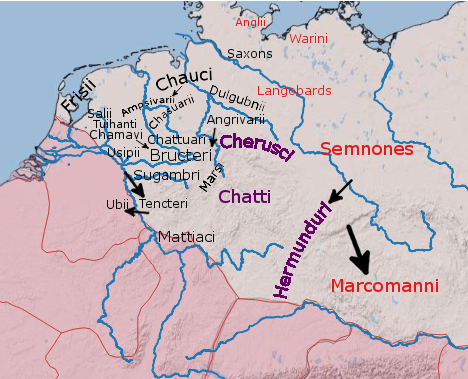
The approximate positions of some Germanic peoples reported by Graeco-Roman authors in the 1st century. Suevian peoples in red, and other Irminones in purple.

The Varini, Warni or Warini were one or more Germanic peoples who originally lived in what is now northeastern Germany, near the Baltic Sea.

They are first named in the Roman era, and appear to have survived into the Middle Ages. It is proposed that in Old English they were called Werns or Warns.

Name and etymology

[edit]

Tacitus spelled the name as Varini, Pliny the Elder as Varinnae, Ptolemy as Viruni (Ούίρουνοι), Procopius as Varioi (Οὐάρνων). Later attestations include Wærne or Werne in the Old English Widsith, and Warnii in the Lex Thuringorum.

The name supposedly meant either "defenders" or "living by the river" (from the Indo-European root *uer- "water, rain, river").[1]

Attestations

[edit]

Classical

[edit]

The earliest mention of this tribe appears in Pliny the Elder's Natural History (published about 77 AD). He wrote that there were five Germanic races, and one of these were the Vandals. These included the Burgodiones, the Varinnae, the Charini (not known from any other record) and the Gutones (Goths).[2]

Tacitus (about AD 56 – 120) gave more information about the early Varini in his Germania. In contrast to Pliny he mentioned them as one of a group of remote Suevian peoples, living beyond (east and possibly also north of) the Semnones and Langobardi who lived near the Elbe, and apparently close to the "Ocean" (which could be the Baltic Sea). He did not mention that they were Vandili.

(English translation) (Original Latin)
"Next come the Reudigni, the Aviones, the Anglii, the Varini, the Eudoses, the Suardones, and Nuithones who are fenced in by rivers or forests. "Reudigni deinde et Aviones et Anglii et Varini et Eudoses et Suarines et [2] Nuitones fluminibus aut silvis muniuntur.
None of these tribes have any noteworthy feature, except their common worship of Ertha [the Latin says Nerthus], or mother-Earth, and their belief that she interposes in human affairs, and visits the nations in her car. nec quicquam notabile in singulis, nisi quod in commune Nerthum, id est Terram matrem, colunt eamque intervenire rebus hominum, invehi populis arbitrantur.
In an island of the ocean there is a sacred grove, and within it a consecrated chariot, covered over with a garment. Only one priest is permitted to touch it. est in insula Oceani castum nemus, dicatumque in eo vehiculum, veste contectum; [3] attingere uni sacerdoti concessum.
He can perceive the presence of the goddess in this sacred recess, and walks by her side with the utmost reverence as she is drawn along by heifers. is adesse penetrali deam intellegit vectamque bubus feminis multa cum veneratione prosequitur.
It is a season of rejoicing, and festivity reigns wherever she deigns to go and be received. laeti tunc dies, festa loca, quaecumque [4] adventu hospitioque dignatur.
They do not go to battle or wear arms; every weapon is under lock; peace and quiet are known and welcomed only at these times, till the goddess, weary of human intercourse, is at length restored by the same priest to her temple. non bella ineunt, non arma sumunt; clausum omne ferrum; pax et quies tunc tantum nota, tunc tantum amata, donec idem sacerdos satiatam [5] conversatione mortalium deam templo reddat.
Afterwards the car, the vestments, and, if you like to believe it, the divinity herself, are purified in a secret lake.
Slaves perform the rite, who are instantly swallowed up by its waters.
mox vehiculum et vestis et, si credere velis, numen ipsum secreto lacu abluitur. servi ministrant, quos statim idem lacus haurit.
Hence arises a mysterious terror and a pious ignorance concerning the nature of that which is seen only by men doomed to die. arcanus hinc terror sanctaque ignorantia, quid sit illud quod tantum perituri vident.
This branch indeed of the Suevi stretches into the remoter regions of Germany." Et haec quidem pars Sueborum in secretiora Germaniae porrigitur"
The Varini in the actual north Germany.

Surviving versions of a third source, the second century Geography by Ptolemy, included the Viruni (Greek Ούίρουνοι) in their description of eastern Germania, but these are difficult to interpret and have apparently become corrupted. These describe the Viruni as being near the otherwise unknown Teutonoari. Gudmund Schütte suggested that this name is an error combining the Teutones and "Aoaroi", and would equate the later to the Varini (Ouarni) as a doubling-up error.[5] Together these two peoples were surrounded by:[6]

  • The Elbe to their west. Schütte (e.g. p. 34) reconstructs Ptolomy's intentions in such a way that the Langobards were living in this area.
  • A river called the Chalusus to the east, beyond which the surviving versions of Ptolemy's Geography name the Teutones and Avarni. Schütte (p. 44) proposes this to be another doubling-up of two peoples, caused by misunderstandings of copyists. East of them, in turn is another unknown river the "Suevos" and a people called the Aelvaeones.
  • Saxons to their north, between the Elbe and Chalusus rivers. Some scholars such as Matthias Springer believe the text originally said "Aviones".[7] To the east of these Saxons over the Chalusus, are the Farodini (otherwise unknown).
  • The Semnones, a large Suevian people, lay to their south. Their territory stretches east of the Chalusus, as far as the Suevos.

The three accounts appear to describe a similar area, east of the Elbe. It is perhaps in the area of Mecklenburg, where one of the main rivers is called the Warnow and a town is called Warnemünde.[8]

Ptolemy also plotted the position of a town named Virunum at 40°30' longitude and 55° latitude using his system. This can however be interpreted as east of the Chalusus River, between the "Suevus" and "Viadua" rivers, which both lay between the Chalusus and the Vistula according to him. The town Οὐιρουνον (Virunum) has been identified as somewhere near modern-day Drawsko Pomorskie.[citation needed][9]

Late antiquity

[edit]

From the time of Theoderic the Great and Clovis I, a letter has been preserved which Theoderic wrote to the kings of the Warni, Heruls and Thuringians.

The Warini were mentioned by Procopius in the 6th century, implying that the Varini had a very large territory in his time. Procopius situates the Varni bordering the Franks, with only the river Rhine between them, but also stretching to the coast. Their king Hermegisclus had made a strategic alliance with the Frankish ruler Theudebert I (ruler Austrasia 533-547), marrying his sister Theudechild. However, in contrast he had engaged his son with the sister of the Anglian ruler. Before his death he expressed the wish to have his son married to his stepmother Theudechild instead. As a result when king Hermegisclus died, the Warinis compelled his son Radigis to marry his stepmother. The maiden, who is not named in the story, did not accept this, and crossed the North Sea with an army of 400 ships and 100,000 men, seeking retaliation. After a battle won by the Anglians, Radigis was caught hiding in a wood not far from the mouth of the Rhine and had no other choice than to marry his fiancée.[10]

He also wrote in passing that when the Heruls (Eruli) had been defeated by the Lombards, some of them moved to Scandinavia (which he called Thule). When other Heruls sought to find them years later, they crossed the Danube (Ister), went through the lands of the Slavs (Sclaveni) and after a barren region, they came to the land of the Warni. After these Warni they passed through the land of the Danes, and then crossed the sea from there to Scandinavia, where they found them living with the Geats (Gautoi).[11]

Others, however, question Procopius's reliability for this northern region.[12] Modern scholars claim that the area north of the Rhine may have been under Frankish control during the greater parts of the 6th and 7th centuries, at least since the defeat of the Danish sea-king Hygelac in 526.[13]

According to the chronicle of Fredegar the Varni or Warni rebelled against the Merovingian Franks in 594 and were bloodily defeated by Childebert II in 595 (the year he died) "so that few of them survived".[14] Many modern historians believe that this is likely to refer to the Thuringians.

The Warini also appear in the title of a 9th-century legal codex, Lex Angliorum et Werinorum hoc est Thuringorum (Law of the Angles and Warini, that is, of the Thuringians), which has much in common with Frankish, Frisian and Saxon law codes.

Recent research suggests that they were part of a Thuringian federation, which dominated Northern Germany from Attila's death in 453 to the middle of the 6th century when they were crushed by the Franks. Their military fame might explain why the names of the Warini and Thuringians have been mentioned in a much wider area, extending even beyond the Rhine.[15][16] Their home country seems to have been the district between the rivers Saale and Elster, which was called Werenofeld (around Eisleben).

When the region east of the Elbe became Slavic-speaking, a group in this region continued to be called Warnabi, perhaps representing assimilated Varni.

The Warini are mentioned in the Anglo-Saxon poem Widsith as the Wærne or Werne.

lines 24–27:
Þeodric weold Froncum, þyle Rondingum, Theodric ruled the Franks, Thyle the Rondings,
Breoca Brondingum, Billing Wernum. Breoca the Brondings, Billing the Werns.
Oswine weold Eowum ond Ytum Gefwulf, Oswine ruled the Eow and Gefwulf the Jutes,
Fin Folcwalding Fresna cynne. Finn Folcwalding the Frisian-kin.

The name Billing, mentioned in Widsith, might be related to the ancestors of the Saxon Billung-family.

See also

[edit]

References

[edit]
[edit]
Revisions and contributorsEdit on WikipediaRead on Wikipedia
from Grokipedia
The Warini, also known as the Varini or Warni, were an ancient Germanic tribe that inhabited coastal regions along the in what is now northeastern , particularly , during the early centuries of the . First attested in Roman sources around the AD, they were part of the broader Suebic confederation of tribes and are noted for their relative stability in settlement compared to more migratory Germanic groups. The Warini appear in classical Roman as one of the northern dwelling near the (). In his Germania (c. 98 AD), the Roman historian lists the Varini alongside tribes such as the Reudigni, Aviones, Anglii, and others, describing them as inhabiting the shores of the Baltic and sharing cultural similarities with the Suiones (early ) in terms of environment, forests, and soil. Earlier, (c. 77 AD) referenced them directly as the Varinnae within the Vandili, a Suebic group, while Ptolemy's (c. 150 AD) positioned the Varini (as Viruni) north of the River, in the region of present-day , suggesting possible early migrations from southern . Their tribal name, derived from Proto- roots possibly meaning "to protect" or "defenders," persists today in names like Werner. Throughout the (4th–6th centuries AD), the Warini maintained a semi-autonomous presence in their territories, east of the Angles and , and gradually became a client tribe of the expanding . They feature in poetry, such as the (c. 5th–6th century), which mentions kings like Billing, Hagena, and Hermegisl (fl. c. 500–540 AD), portraying them as rulers in a network of Germanic alliances. In the mid-, following the death of King Hermegisel, the Warini compelled his son Radigis (fl. c. 550s) to marry the princess Theudechild, though she fled to the ; Radigis had previously been betrothed to an Anglian princess. According to the Chronicle of Fredegar, the Warini rebelled against the Merovingian in 594 AD, but were subdued by forces under the following year, leading to the dispersal of survivors and their assimilation by incoming Slavic settlers, who renamed the region Varnes or Warnia. of Caesarea (c. 550s AD) provides one of the last contemporary accounts, noting the Warini as a distinct group amid the collapsing Western Roman world. The Warini's historical legacy lies in their role as a bridge between Scandinavian and continental Germanic cultures, with possible cultural influences in the region assimilated by incoming Slavic groups like the . General archaeological evidence from , including fortified settlements and burial sites, supports the presence of Suebic-related warrior societies in the area, though specific artifacts directly linked to the Warini remain elusive due to overlapping tribal identities.

Etymology

Name Variations

The name of the Warini tribe appears in multiple forms across ancient and early medieval sources, reflecting variations in Latin, Greek, and vernacular orthography as well as potential linguistic evolutions. In the 1st century CE, the Roman historian Tacitus referred to them as Varini in his ethnographic work Germania, listing them among the Suebic peoples near the Baltic coast. Similarly, Pliny the Elder, writing around the same period, described them as Varinnae in Book IV of his Natural History, classifying them as a subgroup of the Vandili. The 2nd-century geographer recorded the name as Viruni (Greek: Οὐίρουνοι) in Book II of his Geography, placing their settlements in Magna east of the River. By the 6th century, the Byzantine historian mentioned them as Varioi (Greek: Οὐάρνων) in Books V and VI of his History of the Wars, associating them with Gothic and other northern barbarian groups during Justinian's campaigns. In early medieval texts, the name shifted toward vernacular forms. The 10th-century poem (preserved in the ) refers to them as Wærne and Wernum, portraying a ruler named Billing over the Wærnum. The 8th-century Lex Thuringorum (also known as Lex Angliorum et Werinorum hoc est Thuringorum), a Frankish legal code, uses Werinorum and Warnen to denote the tribe alongside the Angles in Thuringian territories. These later variants, such as Warni, Warnii, and Warini, appear in Carolingian annals and charters, indicating continuity into the .

Linguistic Interpretations

The name Warini (also attested as Varini in classical sources) is derived from Proto-Germanic *warinaz, an adjective meaning "defender" or "protector," stemming from the verb *warjaną "to defend, to protect." This etymology aligns with the tribe's characterization in ancient texts as a group emphasizing martial vigilance, consistent with broader Germanic naming conventions that often reflected societal roles or attributes. The root *wer- (covering or guarding) is a common Proto-Indo-European element preserved in various Germanic languages, underscoring themes of safeguarding territory or kin. Linguistically, Warini exemplifies the formation of tribal ethnonyms through agentive suffixes, where *-inaz denotes a collective of individuals embodying the quality of protection, akin to other Germanic groups like the ("warrior band") or ("the good ones"). The name's survival is evident in personal names such as Old High German (modern Werner), combining warin "protector" with hari "army," literally "protecting warrior" or "army defender." This connection suggests the Warini may have been perceived as a defensive confederation within the Suebic alliance, a notion reinforced by their geographical position near the Baltic frontier. Alternative interpretations propose links to *warô "aware" or "cautious," implying vigilance rather than active defense, though the protective predominates in scholarly consensus due to phonetic and semantic parallels across East and West Germanic dialects. No direct evidence ties the name to non-Germanic substrates, such as Baltic or Slavic influences, despite later assimilations in the region.

Geography and Origins

Scandinavian Roots

The Warini, also known as the Varini or Warni, are believed to trace their origins to southern , particularly the historical province of Värend in present-day , . This connection is supported by the linguistic similarity between the tribal name "Varini" and "Värend," suggesting the region served as an early homeland before southward migrations during the pre-Roman and early Roman Iron Age. The name itself likely derives from a Proto-Germanic root *warjaną, meaning "to defend" or "protectors," which may reflect their martial traditions or role in tribal alliances. Archaeological and historical evidence indicates that the Warini participated in the broader expansion of from , initially settling in the Jutland peninsula of alongside tribes such as the Charudes and Eudoses around the first century BC. This phase of movement positioned them as part of the Ingaevonic or Suebic confederations, facilitating further migration to the continental mainland amid climatic changes, resource competition, and inter-tribal dynamics. By the first century AD, they had established themselves in the coastal areas of northeastern , near the in , marking a transition from their Scandinavian base to a more permanent European foothold. Early Roman ethnographers documented the Warini in these continental territories, providing indirect confirmation of their northern roots through descriptions of their cultural practices and geography. , in Naturalis Historia (c. 77 AD), enumerates the Varinnae among the Vandilii peoples inhabiting the eastern Baltic shores, emphasizing their role in a network of seafaring Germanic groups. , writing in (98 AD), further locates the Varini among the , noting their worship of a akin to and their position between the and rivers, which aligns with migration routes from . These accounts, while focused on contemporary observations, underscore the Warini's Scandinavian heritage as part of the proto-Germanic cultural continuum originating in the .

Migration to Continental Europe

The Warini, known in classical sources as the Varini, are hypothesized to have originated in southern , specifically the region of Värend in present-day , where linguistic parallels between the tribal name and local toponyms suggest an early homeland. This connection aligns with broader patterns of Germanic tribal movements from during the late , driven by population pressures, resource competition, and climatic factors. Archaeological evidence from southern Swedish sites, including fortified settlements and ironworking remains, supports the presence of proto-Germanic groups in the area around the 1st century BCE, though direct attribution to the Warini remains inferential. From their Scandinavian base, the Warini migrated southward across the Baltic and into the peninsula of , likely in the 1st century BCE, where they briefly settled alongside related tribes such as the Charudes and Eudoses. This phase of movement is part of the expansive Suebic migrations, as the Warini appear affiliated with the Suevi confederation in early Roman accounts. Ptolemy's Geography (c. 150 CE) situates them east of the River, indicating a consolidation in this transitional zone between and the continent. By the early CE, the Warini had advanced further into , establishing a primary territory in the Mecklenburg region of northeastern , along the Baltic coast. describes them in his Naturalis Historia (c. 77 CE) as part of the Vandilii group, located beyond the tribe and near the Gutones, emphasizing their position in the coastal lowlands east of the . corroborates this in (98 CE), listing the Varini among northern tribes near the ocean, including the Anglii and Aviones, who shared a cult of the goddess and maintained a priest-led, non-monarchical structure. This settlement marked their integration into the continental Germanic landscape, where they interacted with neighboring Suebic and Ingaevonic groups, contributing to the cultural mosaic of the amber trade routes. The migration route likely followed maritime and overland paths via , facilitated by advanced seafaring capabilities evidenced by bog finds of clinker-built boats in the region. While the exact triggers remain debated, Roman expansion and inter-tribal conflicts may have accelerated the shift from insular to continental bases. Later attestations, such as in ' Gothic Wars (c. 550 CE), show Warini remnants persisting in the same eastern territories before partial assimilation during the Slavic incursions of the .

Historical Attestations

Classical Sources

The earliest classical reference to the Warini, spelled as Varinnae, appears in Pliny the Elder's Naturalis Historia (Book IV, Chapter 99), composed around AD 77. Pliny classifies them as one of the subgroups within the broader Vandili federation of , alongside the Burgodiones, Charini, and Gutones. He situates these tribes generally in the northern regions beyond the , emphasizing their role in the ethnic mosaic of Magna without providing specific geographical coordinates or cultural details. Approximately two decades later, Tacitus mentions the Warini, under the name Varini, in his ethnographic treatise Germania (Chapter 40), written circa AD 98. Tacitus lists the Varini among a cluster of Suevian tribes in the northern reaches of Germania, including the Reudigni, Aviones, Anglii, Eudoses, Suardones, and Nuithones, noting that they are protected by natural barriers such as rivers and forests. This passage immediately follows his description of the Nerthus cult practiced by these groups, suggesting a shared religious tradition involving a veiled goddess figure whose wagon procession brought fertility to the land before its ritual cleansing in a sacred lake. Tacitus portrays the Varini as part of a more remote and less militarized Suevian contingent, contrasting them with the more aggressive southern Suebi. The third major classical attestation comes from Claudius Ptolemy's Geographia (Book II, Chapter 11, §17), compiled around AD 150. refers to the as Viruni (Οὐιρουνί), placing them north of the (modern ) in the region corresponding to present-day , near the Baltic coast. As part of his systematic catalog of coordinates for over 8,000 places, integrates them into his broader mapping of Germanic and Sarmatian territories east of the . This reference provides the most precise locational data among classical sources, though it lacks ethnographic insights.

Late Antique and Early Medieval Sources

The Warini, also known as Varini or Warni, appear in late antique sources primarily through diplomatic and ethnographic references that underscore their position among northern Germanic tribes. In the Variae of Senator, a collection of official correspondence compiled around 537–538 CE, a letter attributed to Ostrogothic King Theoderic the Great (r. 493–526) addresses the kings of the , Warni, and Thuringians. Dated to circa 507 CE, this epistle urges these rulers to form a in support of Visigothic King against the expanding under , emphasizing shared Germanic kinship and mutual defense against Romanized threats. The letter portrays the Warni as distant but allied potentates capable of contributing to a broader Teutonic alliance, reflecting Theoderic's strategy of imitatio imperii to legitimize Gothic rule through Roman-style . Procopius of Caesarea, in his History of the Wars (written circa 550–552 CE), offers a detailed late antique description of the Varini, situating them geographically and narrating a specific incident of tribal interaction. In Book VI (Gothic War II), Procopius locates the Varini near the Baltic Sea in their homeland, while noting their territory as a route for migrating groups like the Heruli. He further recounts, in Book VIII, the story of Varini king Radigis, who was betrothed to an Anglian princess from Brittia (likely southern Scandinavia) but dissolved the union to ally with the Franks; in retaliation, the jilted princess led a fleet of 400 ships, defeated the Varini in battle, captured Radigis, and enforced the marriage. This anecdote illustrates the Varini's involvement in inter-tribal marriages, conflicts, and shifting alliances amid the upheavals following the Heruli's defeat by the Lombards around 508 CE. Procopius highlights their role as a buffer people in northern Europe. Early medieval sources shift focus to the Warini's cultural memory amid their assimilation. The Old English heroic poem Widsith, likely composed in the late 6th or early and preserving oral traditions from circa 500 CE, enumerates the Warini among the of a mythicized heroic age. The poet lists kings such as Billing, Hagena (fl. circa 500), and Hermegisl (or Ermengist, fl. circa 540), associating the Warini with and portraying them as hosts to wandering poets and warriors in a landscape of tribal feuds and gift-giving. This literary attestation underscores the Warini's cultural significance in Anglo-Saxon memory, linking them to Suebic origins and Scandinavian ties. By the , Carolingian annals document the subjugation of the territories formerly held by the Warini, now inhabited by Slavic groups following the tribe's dispersal in the late . The Royal Frankish Annals (covering 741–829 CE) record under the year that after campaigning in , Charlemagne advanced into the lands of the Slavic Wilzi (in the region) and , who submitted to Frankish authority, paying tribute and accepting Christian oversight. Einhard's (circa 817–830 CE), drawing on the annals, echoes this by noting Charlemagne's reduction of various through repeated expeditions, framing their pacification as a key achievement in extending Frankish eastward. These accounts reflect the incorporation of the former Warini homeland into the Carolingian realm as a zone against Slavic incursions.

Culture and Society

Religious Practices

The Warini, an ancient Germanic tribe also attested as the Varini in classical sources, adhered to the polytheistic traditions of , with their religious practices centered on the worship of , identified as Mother Earth. According to the Roman historian in his (ca. 98 CE), the Varini shared this cult with neighboring tribes including the Reudigni, Aviones, Anglii, Eudoses, Suarines, and Nuitones, viewing as a who actively intervened in human affairs by traveling among the peoples. This shared veneration underscores the interconnected religious landscape of these northern Germanic groups in the late CE. The core ritual associated with involved a ceremonial originating from a on an island in the ocean, likely in the region near southern . A consecrated , covered with a cloth robe, was housed there and could be touched only by a designated , who discerned the 's presence through signs of reverence. The was then drawn by heifers to various settlements deemed worthy, fostering an atmosphere of and festivity: during this time, the tribes suspended warfare, stored their weapons, and embraced tranquility as the mingled with society. Upon completion, the escorted the , its coverings, and—according to some interpretations—the of the herself back to a secluded lake for by slaves, who were subsequently drowned in the waters, imbuing the rite with an aura of terror and sacred secrecy. Scholarly analysis positions this as a and earth-mother worship typical of early Germanic religion, potentially rooted in traditions of processional rites to ensure and communal . Tacitus's account, while invaluable as the primary attestation, reflects Roman ethnographic perspectives and may incorporate hearsay from traders or auxiliaries, yet it remains the foundational description of Varini religious observance without later medieval sources providing additional specifics for the tribe. By the early medieval period, as the Warini assimilated into broader Frankish or Slavic contexts, their pagan practices likely transitioned toward , though no direct evidence survives of this shift for the group.

Social and Political Organization

The Warini, identified as part of the Suebian confederation by the Roman historian in his (c. 98 CE), exhibited a social and political organization characteristic of early Germanic tribes. Kings were selected from noble birth lines but held advisory roles rather than absolute power, guiding their people through counsel to prevent perceptions of tyranny; separate war leaders were elected based on demonstrated valor in combat. Political decisions occurred in communal assemblies called the thing, attended by free men who convened at sacred intervals such as the new or ; resolutions were ratified collectively by clashing spears in approval, emphasizing consensus over unilateral rule. was divided into a of birth, free commoners who participated in assemblies and fare, and slaves acquired through or debt; freedmen occupied an intermediate but subordinate status, while personal loyalty bound in retinues to chiefs, fostering a ethos central to tribal cohesion. By the mid-6th century, the Byzantine historian referenced the Varini (Warini) as a settled tribe in the northern regions near the Dani during accounts of the Eruli's migration to , portraying them as a cohesive group involved in regional barbarian networks, though without detailing internal governance. The heroic poem (c. 5th–6th century CE), preserved in the , attests to monarchical leadership among the Wærne (Warini), naming Billing as ruler of the Wernum and implying a courtly structure with poets and retainers. Similar traditions in associate figures like Hagena with the tribe, highlighting enduring royal lineages amid the upheavals.

Interactions and Legacy

Relations with Neighboring Tribes

The Varini, as described in classical sources, inhabited coastal regions near the in the AD, forming part of a cluster of tribes that included the Reudigni, Aviones, Anglii, Eudoses, Suarines, and Nuitones. These groups were noted for their shared religious practices, particularly the communal worship of the goddess , whose cult involved processions across their territories in a sacred , suggesting close cultural ties and possibly cooperative alliances among them. The Varini were positioned immediately adjacent to the Anglii, indicating frequent interactions, including potential military coordination against external threats like Roman incursions. Pliny the Elder further contextualized the Varini within the broader Vandilii federation, grouping them alongside the Burgodiones, Charini, and Gutones as subgroups of this eastern Germanic alliance. This classification implies early economic and migratory relations with Vandalic peoples, who dominated inland areas to the south and east, facilitating trade along routes and shared resistance to Sarmatian pressures from the east. By the mid-6th century, the Varini had shifted southward to the , where they bordered the expanding kingdom directly across the river, extending their territory to the coast. This proximity led to both diplomatic and tense interactions; In the mid-6th century, King Hermegisclus (fl. c. 540) allied with the king by marrying his sister Theudechild, which strengthened ties between the Varini and but later led to tensions following Theudebert's death. noted the Varini's strategic position, which exposed them to Frankish raids and influence, while also positioning them as intermediaries in conflicts involving the Angles and other northern groups. Relations with the deteriorated into open conflict in the late . In 594, the Varini rebelled against Merovingian overlordship, likely resenting demands and territorial encroachments. The uprising was swiftly crushed by King in 595, resulting in a bloody defeat that decimated their forces and reinforced Frankish control over the region. This event marked the culmination of increasingly hostile interactions, paving the way for the Varini's subjugation and eventual assimilation amid Frankish expansion.

Assimilation and Modern Traces

Following their subjugation by the in the 4th and 5th centuries, the Warini came under increasing Frankish influence along the . By the late 6th century, they rebelled against Merovingian authority, prompting a decisive response. In 595, during the third year of Childebert II's reign in , Frankish forces under his command engaged the Warini in battle; the conflict resulted in heavy casualties among the rebels, with the Chronicle of Fredegar noting that "so many Warni fell that few survived." This near-annihilation marked the effective end of the Warini as an independent entity, with surviving members likely integrated into the broader Frankish society through servitude, resettlement, or intermarriage. The assimilation process accelerated in the 7th and 8th centuries amid the Slavic migrations into northeastern Germany. As West Slavic groups, particularly the Obotrites, settled the lands east of the Elbe—formerly held by Germanic tribes including the Warini—the region's Germanic population dwindled through displacement, warfare, and cultural absorption. Remnants of the Warini in areas like Mecklenburg were incorporated into emerging Slavic polities, contributing to a hybrid socio-cultural landscape. The West Slavic Warnabi (also known as Warnavi or Varnes), a subgroup of the Obotrite confederation active from the 9th to 12th centuries, occupied territories in what is now Mecklenburg-Vorpommern; their tribal name appears to be a Slavic adaptation or corruption of the earlier Germanic "Varini" or "Werini," suggesting either direct descent from assimilated Warini elements or appropriation of the toponym for political legitimacy. Today, direct ethnic descendants of the Warini are indistinguishable due to centuries of intermixing, but linguistic legacies persist. The tribal , derived from Proto-Germanic *warjaz meaning "to defend" or "protector," endures in the widespread Germanic Werner (Old High German ), composed of warin ("guard") and heri ("army"), implying "protecting warrior" or "army defender." This name remains common in German-speaking regions and has spread to Dutch and English variants like Warner. Place names in , such as the Warnow River and the port town of , also reflect the Warini's historical presence, preserving echoes of their territorial footprint amid the later Slavic and German resettlements.

References

Add your contribution
Related Hubs
User Avatar
No comments yet.