



Community hub
Recent from talks
Knowledge base stats:
Talk channels stats:
Members stats:
Ansari X Prize
The Ansari X Prize was a space competition in which the X Prize Foundation offered a US$10,000,000 (equivalent to $20,048,801 in 2024) prize for the first non-government organization to launch a reusable crewed spacecraft into space twice within two weeks. It was modeled after early 20th-century aviation prizes, and aimed to spur development of low-cost spaceflight.
Created in May 1996 and initially called just the "X Prize", it was renamed the "Ansari X Prize" on May 6, 2004, following a multimillion-dollar donation from entrepreneurs Anousheh Ansari and Amir Ansari.
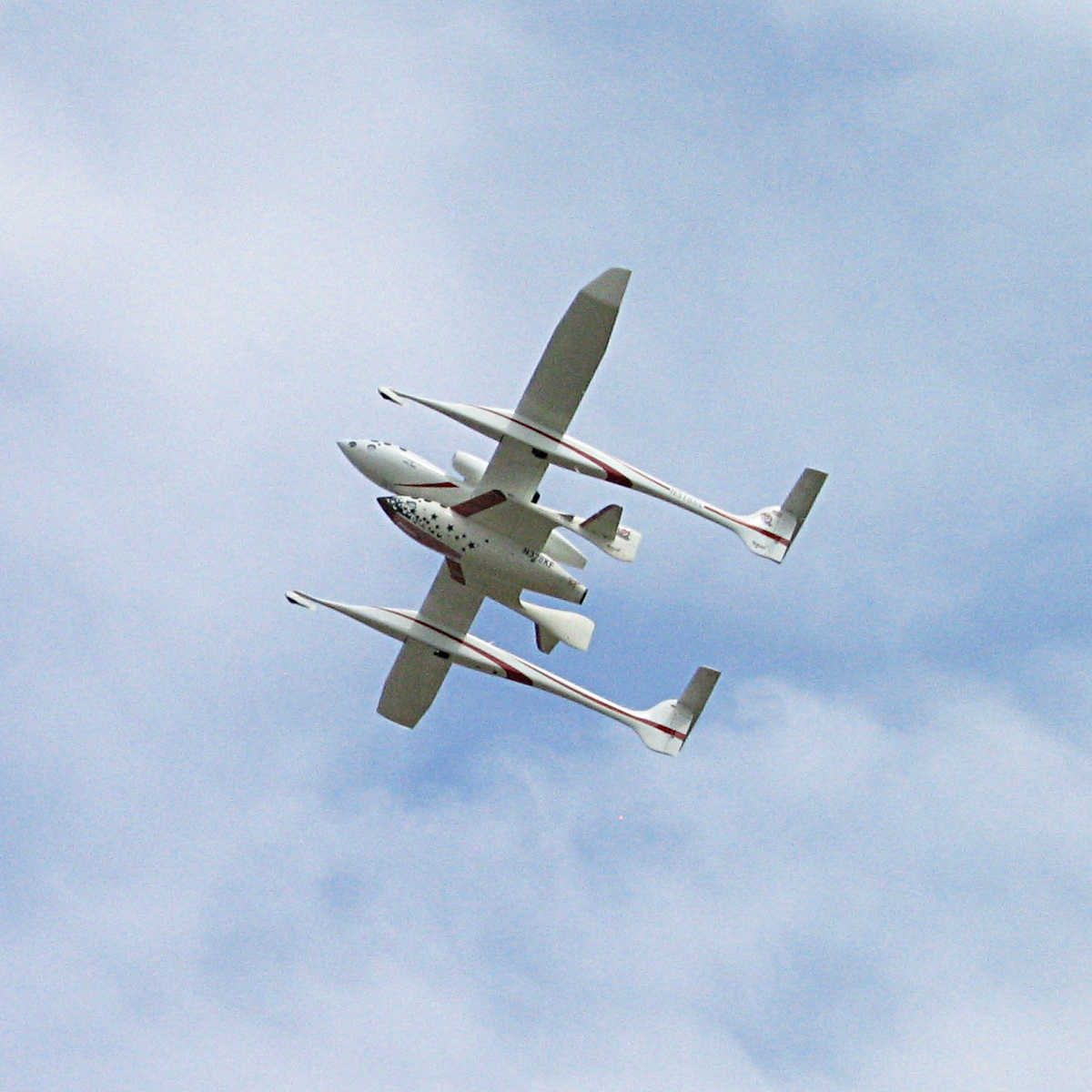
The prize was won on October 4, 2004, the 47th anniversary of the Sputnik 1 launch, by the Tier One project designed by Burt Rutan and financed by Microsoft co-founder Paul Allen, using the experimental spaceplane SpaceShipOne. $10 million was awarded to the winner, and more than $100 million was invested in new technologies in pursuit of the prize.
Several other X Prizes have since been announced by the X Prize Foundation, promoting further development in space exploration and other technological fields.
The X Prize was inspired by the Orteig Prize—the 1919 prize worth 25,000 dollars offered by New York hotel owner Raymond Orteig that encouraged a number of intrepid aviators in the mid-1920s to fly across the Atlantic Ocean from New York to Paris—which was ultimately won in 1927 by Charles Lindbergh in his aircraft Spirit of St. Louis. In reading the 1953 book, The Spirit of St. Louis during 1994, Peter Diamandis realized that "such a prize, updated and offered ... as a space prize, might be just what was needed to bring space travel to the general public, to jump-start a commercial space industry."
Diamandis developed a fully formed idea for a "suborbital space barnstorming prize", and set an initial goal of finding backers to support a US$10 million prize. He named it the X Prize, in part because "X" could serve as a variable for the name of the person who might later back the prize; any craft built to win the prize would be experimental, and a long line of experimental aircraft built for the US Air Force had been so designated, including the X-15 that was, in 1963, the first government-built craft to carry a human into space; and because "Ten is the Roman numeral X".
The X Prize was publicly proposed by Diamandis in an address to the NSS International Space Development Conference in 1995. The competition goal was adopted from the SpaceCub project, demonstration of a private vehicle capable of flying a pilot to the edge of space, defined as 100 km altitude. This goal was selected to help encourage the space industry in the private sector, which is why the entries were not allowed to have any government funding. It aimed to demonstrate that spaceflight can be affordable and accessible to corporations and civilians, opening the door to commercial spaceflight and space tourism. It is also hoped that competition will breed innovation, introducing new low-cost methods of reaching Earth orbit, and ultimately pioneering low-cost space travel and unfettered human expansion into the Solar System.
NASA is developing a similar prize program called Centennial Challenges to generate innovative solutions to space technology problems.
Hub AI
Ansari X Prize AI simulator
(@Ansari X Prize_simulator)
Ansari X Prize
The Ansari X Prize was a space competition in which the X Prize Foundation offered a US$10,000,000 (equivalent to $20,048,801 in 2024) prize for the first non-government organization to launch a reusable crewed spacecraft into space twice within two weeks. It was modeled after early 20th-century aviation prizes, and aimed to spur development of low-cost spaceflight.
Created in May 1996 and initially called just the "X Prize", it was renamed the "Ansari X Prize" on May 6, 2004, following a multimillion-dollar donation from entrepreneurs Anousheh Ansari and Amir Ansari.
The prize was won on October 4, 2004, the 47th anniversary of the Sputnik 1 launch, by the Tier One project designed by Burt Rutan and financed by Microsoft co-founder Paul Allen, using the experimental spaceplane SpaceShipOne. $10 million was awarded to the winner, and more than $100 million was invested in new technologies in pursuit of the prize.
Several other X Prizes have since been announced by the X Prize Foundation, promoting further development in space exploration and other technological fields.
The X Prize was inspired by the Orteig Prize—the 1919 prize worth 25,000 dollars offered by New York hotel owner Raymond Orteig that encouraged a number of intrepid aviators in the mid-1920s to fly across the Atlantic Ocean from New York to Paris—which was ultimately won in 1927 by Charles Lindbergh in his aircraft Spirit of St. Louis. In reading the 1953 book, The Spirit of St. Louis during 1994, Peter Diamandis realized that "such a prize, updated and offered ... as a space prize, might be just what was needed to bring space travel to the general public, to jump-start a commercial space industry."
Diamandis developed a fully formed idea for a "suborbital space barnstorming prize", and set an initial goal of finding backers to support a US$10 million prize. He named it the X Prize, in part because "X" could serve as a variable for the name of the person who might later back the prize; any craft built to win the prize would be experimental, and a long line of experimental aircraft built for the US Air Force had been so designated, including the X-15 that was, in 1963, the first government-built craft to carry a human into space; and because "Ten is the Roman numeral X".
The X Prize was publicly proposed by Diamandis in an address to the NSS International Space Development Conference in 1995. The competition goal was adopted from the SpaceCub project, demonstration of a private vehicle capable of flying a pilot to the edge of space, defined as 100 km altitude. This goal was selected to help encourage the space industry in the private sector, which is why the entries were not allowed to have any government funding. It aimed to demonstrate that spaceflight can be affordable and accessible to corporations and civilians, opening the door to commercial spaceflight and space tourism. It is also hoped that competition will breed innovation, introducing new low-cost methods of reaching Earth orbit, and ultimately pioneering low-cost space travel and unfettered human expansion into the Solar System.
NASA is developing a similar prize program called Centennial Challenges to generate innovative solutions to space technology problems.