


Community hub
Recent from talks
Contribute something
Nothing was collected or created yet.
Antonis Mor
View on WikipediaAnthonis Mor, also known as Anthonis Mor van Dashorst and Antonio Moro (c. 1517 – 1577), was a Netherlandish portrait painter, much in demand by the courts of Europe. He has also been referred to as Antoon, Anthonius, Anthonis or Mor van Dashorst, and as António Mouro, Anthony More, etc., but signed most of his portraits as Anthonis Mor.[1]
Key Information


Mor developed a formal style for court portraits, largely based on Titian, that was extremely influential on court painters across Europe, especially in the Iberian Peninsula, where it created a tradition that led to Diego Velázquez. His works can include considerable psychological penetration, especially in portraits of men, but always gives the subject a grand and self-possessed air.
Early life and education
[edit]Mor was born in Utrecht, Netherlands, by some estimation between 1516 and 1520. Little is known about his early life, except that his artistic education commenced under Jan van Scorel. His earliest known work is a portrait which is now in a collection in Stockholm, dated 1538.[2]
Painting career
[edit]
A group of Knights of St. John at Utrecht, supposed to have been painted about 1541; and a picture of two pilgrims at the Gemäldegalerie, Berlin, dated 1544; and the portrait of an unknown woman, in the Palais des Beaux-Arts de Lille, were probably among his earliest works. Their authenticity has not been established.[citation needed]
Antwerp
[edit]
In 1547 Mor was received as a member of the Venerable Guild of St. Luke at Antwerp, and shortly afterwards (about 1548) he attracted the attention of Cardinal Antoine Perrenot de Granvelle, Bishop of Arras, who became his steady patron. Of the portraits executed during the early period of his career as de Granvelle's protégé, two are especially notable: one of the bishop himself (in the Kunsthistoriches Museum in Vienna), and one of the Duke of Alba, which now belongs to the Hispanic Society of America. Between 1549 and 1550 Philip, Prince of Asturias (1527–1598) traveled around the Netherlands to present himself as the future ruler. Mor painted his portrait in Brussels in 1549. He probably visited Italy (when exactly is not known), where he copied some works by Titian, notably the Danaë[citation needed]
Portugal
[edit]In the middle of 1550 Mor left for Lisbon with a commission from Mary of Hungary to portray the Portuguese branch of the family. Mor probably traveled via Valladolid, where he painted the portraits of Maximilian II and his wife Maria of Austria, their daughter Anna and the son of Philip II of Spain, Don Carlos. In Lisbon, Mor portrayed King John III, Queen Catherine, Prince João Manuel and Philip II's future wife, Princess Maria. Little more is known about Mor's stay in Portugal, but he was definitely back in Brussels by November 1553.[citation needed]
England
[edit]After the sudden death of the king of England, Edward VI, in July 1553, Charles V, Holy Roman Emperor now saw the possibility of an alliance between Spain and England. The engagement between Philip and his Portuguese princess was broken and negotiations started for a marriage with the successor to the English throne, Mary Tudor. During these negotiations, Mor was sent to England to paint a portrait of Mary, but the exact date of the painting is unknown. This portrait was much appreciated in England and Mor made at least three versions, which became much the best-known likeness of the Queen. On 20 December 1553, Philip officially appointed Mor as painter in his service.[3]
Brussels / Utrecht
[edit]In October 1555, Charles V abdicated from the throne. During the ceremonies and festivities surrounding the coronation of his son Philip as king of Spain, Mor would have received many commissions for paintings. Unfortunately, many of these paintings are lost or only known through copies.
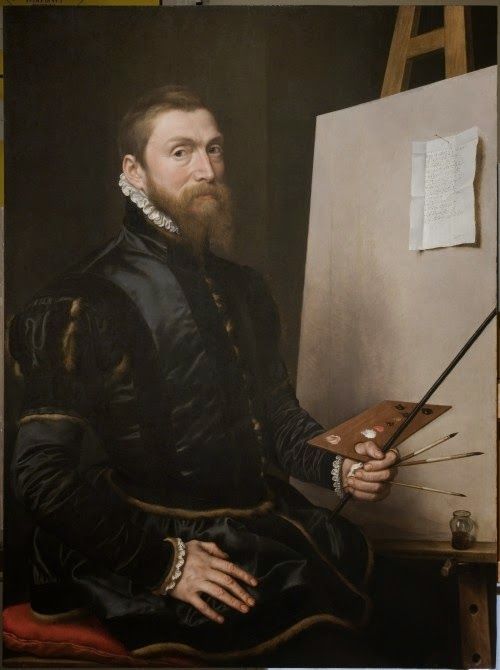
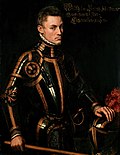
Mor was very productive after Philip's ascension to the throne, and produced some of his most important portraits in this period, such as the portrait of Prince William I van Oranje-Nassau (William the Silent) (1555), the portrait of Alessandro Farnese (1557) and a new portrait of Philip II. Other important works from this period include the portrait of Jane Dormer (1558), the portraits of Jean Lecocq and his wife (1559), and the portrait of Jan van Scorel (1559), which was at a later time to be hung at his tomb and now belongs to the Society of Antiquaries of London. Following the death of Mary Tudor in 1558, King Philip was remarried in June 1559 to Elisabeth of Valois, whom Mor portrayed ca. 1561. This portrait appears to have been lost. Also from this period dates the only known self-portrait of Mor, now in the Uffizi gallery, and one of his (presumed) wife, now in the Prado (see image gallery below).[citation needed]
The Spanish Court
[edit]It seems likely that Mor accompanied King Philip on his return to Spain in 1559. That Mor stayed at the Spanish court is confirmed by the letters which Philip regularly sent to Mor after he had left again in 1561. In his letters, Philip requested Mor's return to court several times, but the painter never complied with his repeated requests. Among the works which Mor supposedly painted in Spain are the Portrait of Juana of Austria and the Portrait of Don Carlos. A much-praised work from this period is the Portrait of Pejerón, the fool of the Duke of Benavente and the Duke of Alba. There has been extensive speculation about the reason for Mor's departure from the Spanish court. According to Carel van Mander, Mor became too confidential with the King and this aroused the suspicion of the Inquisition. He may also have been alarmed by the increasingly repressive Counter-Reformation tenor of the Spanish court.[4] Mor's pupil Alonso Sánchez Coello continued to work in his master's style, and replaced him as the Spanish court painter.[citation needed]
Return to the Netherlands
[edit]
On his return to the Netherlands, Mor probably traveled back and forth between Utrecht, Antwerp and Brussels. In this period he was in regular contact with de Granvelle and also worked at the Dutch court, where he portrayed Margaret of Parma. After his return, Mor focused on the portrayal of citizens, especially of merchants and their wives in Antwerp. In addition to portraits like these (which included the Portrait of Thomas Gresham), he also painted artisans, such as the goldsmith Steven van Herwijck (1564). These works are markedly different from the paintings Mor produced for the court, showing off another side of his talent. When de Granvelle returned to France and the Netherlands showed increasing social and political unrest, Mor experienced some financial hardship. His financial problems were partially solved when the Duke of Alba granted him commissions and favors. He is not known to have been in Utrecht after 24 July 1567 and from 1568 onwards Mor lived in Antwerp where, in 1572, he registered as a master with the Antwerp guild. At Antwerp he painted a Venus and Adonis for the new Stadhuis. It is possible that he visited England once again in 1568, judging from the Portrait of a Nobleman with Dog and of the Portrait of Sir Henry Lee, which have been attributed to him. In 1559 and 1562 Mor painted two portraits of Margaret of Parma. On her way to Spain, Anne of Austria spent some time in Antwerp, where she was painted by Mor in 1570. Mor's portrait of Anna is his last-known court painting, although he was still being referred to as Philip II's court painter in 1573.
Little is known about Mor's life and career after 1570. It seems likely that he lost custom, maybe as result of competition by painters such as Adriaen Thomasz Key, Frans Pourbus the Elder (1545–1581) and Frans Floris (1519/20-1570). The last portrait attributed to Mor is the Portrait of Hubertus Goltzius, dated 1576. Toward the end of his life, Mor focused on history paintings of religious and mythological subjects, but in this field of work he would never equal his earlier success as a portrait painter. He is believed to have been working on a Circumcision for the Cathedral of Antwerp when he died in 1576.[5]
Main works
[edit]

_-_Anthonis_Mor.png)
Many of Mor's portraits were copied by others. Among those whose works have been confused with Mor's are Alonso Sánchez Coello, Francisco de Holanda, and Cristóvão Lopes. A large number of engravings based on his work also circulated.
NB: Some attributions and locations may be out of date.
- Portrait of Philip II[6] (c. 1549–1550) - Oil on oak, 107.5 x 83.3 cm, Bilbao Fine Arts Museum
- Portrait of Cardinal Antoine Perrenot de Granvelle (1549) - Oil on panel, 107 x 82 cm, Kunsthistorisches Museum, Vienna. See image above
- Cardinal Granvelle's Dwarf with a Dog (1549–1553) - Oil on canvas, 126 x 92 cm, Louvre, Paris
- Portrait of a Man Pointing at a Table Clock (c. 1550) - Oil on canvas, 100 x 80 cm, Louvre, Paris
- Portrait of a Giovanni Battista di Castaldo (c. 1550)[7] - Oil on panel, 107.6 x 82.2 cm, Museo Thyssen-Bornemisza, Madrid
- Portrait of John III of Portugal (c. 1550)[8] - Oil on canvas, 101 x 81 cm, Lázaro Galdiano Museum, Madrid; see image gallery below.
- Portrait of Catherine of Austria (c. 1552)[9] - Oil on panel, 107 x 84 cm, Museo del Prado, Madrid, inv. 2109; see image gallery below.
- Portrait of João Manuel, Prince of Portugal (c. 1552) Oil on panel, 107 x 84 cm, Hampton Court Palace.
- Portrait of Infanta Maria, Lady of Viseu (c. 1552)[10] - Oil on canvas, 100 x 87 cm, Convent of Las Descalzas Reales, Madrid, inv. PN822.
- Portrait of Isabel, Duchess of Guimarães (1552)[11] - Oil on panel, 55 x 50 cm, Private collection, Germany.
- Portrait of Prince William I of Orange/Nassau (c. 1554) - Oil on panel, 105 x 81.5 cm, Staatliche Museen, Kassel; see image gallery below.
- Portrait of a Man (c. 1555-1560) - Oil on wood, 97.8 x 71.2 cm, National Gallery of Canada, Ottawa
- Portrait of Philip II of Spain in Armor (c. 1557)[12] - Oil on canvas, 186 x 82 cm, Monasterio de San Lorenzo, El Escorial, inv. 1653; see image gallery below.
- Portrait of a Man in Armor (1558)[13] - Oil on canvas, 111 x 80 cm, J. Paul Getty Museum, Los Angeles
- Portrait of a Young Man [by an anonymous follower of Mor] (1558) - Oil on panel, 97.5 x 69.9 cm, National Gallery of Art, Washington
- Self-portrait (1558) -Oil on wood, 113 x 84 cm, Uffizi, Florence; see image above
- Portrait of Simon Renard (1560) - Oil on canvas, Musée du Temps, Besançon.
- Portrait of a Lady (c. 1560) - Oil on oak, 116.8 x 86.9 cm, National Gallery of Canada, Ottawa
- Portrait of Philip de Montmorency, Count of Hoorn (c. 1560) - Oil on panel. Present location not known.
- Portrait of Sir Thomas Gresham (1560–1565) - Oil on panel, 90 x 75.5 cm, Rijksmuseum, Amsterdam; see image above
- Portrait of Lady Gresham (Anne Femely) (1560–1565) - Oil on oak, 88 x 75.5 cm, Rijksmuseum, Amsterdam
- Portrait of Metgen, wife of the artist (also known as Portrait of a married woman) (c. 1560-1565)- Oil on panel, 100 x 80 cm, Museo del Prado, Madrid, inv. 2114; see image gallery below.
- Portrait of Spanish Nobleman, (c. 1560) - National Museum of Serbia, Belgrade, Oil on canvas 130 x 90 cm[14]
- Portrait of a Man (1560–1577) - Oil on oak, 49.5 x 40.6 cm, National Gallery, London
- Portrait of a Nobleman, said to be Hernán Cortés (date unknown) - Lobkowicz Palace, Prague
- Portrait of Margaret, Duchess of Parma (c. 1562) - oil on canvas, Gemäldegalerie, Berlin, inv. L310A; see image gallery below.
- Portrait of Jeanne Lullier (1563) - Oil on canvas, Musée du Temps, Besançon.
- Portrait of Maria of Portugal, Princess of Parma (c. 1565)[15] - Oil on panel, 35 x 15 cm, Museo del Prado, Madrid, inv. 2117.
- Portrait of Sir Henry Lee of Ditchley (1568) - Oil on panel, 64.1 x 53.3 cm, National Portrait Gallery, London; see image gallery below.
- Portrait of a Gentleman (1569) - Oil on canvas, 119.7 x 88.3 cm, National Gallery of Art, Washington
- Portrait of Hendrik Goltzius (c. 1570) - Oil on wood, 66 x 50 cm, Royal Museums of Fine Arts of Belgium, Brussels
- Portrait of a Gentleman (c. 1570) - Oil on panel, 122 x 98.5 cm, North Carolina Museum of Art
- Portrait of Mary I of England (date unknown - Oil on wood, 109 x 84 cm, Museo del Prado, Madrid; see image above
- Portrait of a Lady - Oil on wood panel, 107 x 72.1 cm, National Gallery of Victoria.
- Portrait of Margaret, Duchess of Parma (date unknown) - oil on panel transferred on canvas, 97.8 x 71.7 cm, Philadelphia Museum of Art.
- Portrait of Jane Dormer (?) - Museo del Prado, Madrid; see image above.
- Portrait of Jan Scorel (1559–1560), oil on panel. Society of Antiquaries of London
Gallery
[edit]-
 King John III of Portugal
 -

-
-
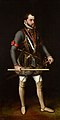 Philip II of Spain in armour
 -
 Metgen Mor, the artist's wife
 -

-


See also
[edit]References and sources
[edit]References
- ^ "ULAN Full Record Display (Getty Research)". www.getty.edu.
- ^ "Catholic Encyclopedia: Antonis Van Dashort Mor". New Advent. Retrieved February 24, 2019.
- ^ Woodall, Joanna (1991). "An Exemplary Consort: Antonis Mor's Portrait of Mary Tudor". Art History. 14 (2): 192–224. doi:10.1111/j.1467-8365.1991.tb00432.x. ISSN 0141-6790 – via EBSCO.
- ^ Trevor-Roper:45 believes so, following Richard Ford.
- ^ The dictionary of art. Turner, Jane, 1956-. New York: Grove. 1996. pp. 65. ISBN 1884446000. OCLC 34409675.
{{cite book}}: CS1 maint: others (link) - ^ Annemarie Jordan, Retrato de Corte em Portugal. O Legado de António Moro (1552-1572) (Lisbon: Quetzal Editores, 1994), p. 17
- ^ Castaldo (1500-1562) was a soldier of Neapolitan origin who took part in the Battle of Pavia, the Sack of Rome, the Battle of Mühlberg etc. Charles V rewarded him with various titles and honors.
- ^ Jordan, p. 32.
- ^ Jordan, p. 31.
- ^ Jordan, pp. 36, 163.
- ^ Jordan, pp. 61, 164.
- ^ Jordan, p. 97; P. G. Matthews, “Portraits of Philip II of Spain as King of England,” Burlington Magazine, vol. 142, no. 1162 (Jan. 2000), p. 17.
- ^ J. Paul Getty Museum. Portrait of a Man in Armor. Retrieved 4 September 2008.
- ^ "Collective Database for Cultural Heritage - Artist - object: 845". www.culturalheritage.cc.
- ^ Jordan, pp. 70, 168.
Sources
- Annemarie Jordan, Retrato de Corte em Portugal. O Legado de António Moro (1552-1572, (Lisbon: Quetzal Editores, 1994)
- Annemarie Jordan, La Reina María de Inglaterra, segunda mujer de Felipe II, Antonio Moro, Museo del Prado, Enciclopedia Online
- Annemarie Jordan, Antonio Moro. Anton van Dashort Mor, Museo del Prado, Enciclopedia Online
- Georges Marlier, Anthonis Mor van Dashorst (Antonio Moro), Académie royale de Belgique, Classe des beaux-arts, Mémoires (Brussels: M. Hayez, 1934).
- Trevor-Roper, Hugh; Princes and Artists, Patronage and Ideology at Four Habsburg Courts 1517-1633, Thames & Hudson, London, 1976, ISBN 0-500-23232-6
- Joanna Woodall, Anthonis Mor; Art and Authority (Zwolle: Waanders Publishers, 2008).
- Marieke van Wamel Pictor regis. Anthonis Mor van Dashorst and his position as painter at the Habsburg court., Thesis BA University of Amsterdam, June 2009 Pictor regis - Van Wamel[permanent dead link]
- Marieke van Wamel Plumas y pinceles / Pennen en pinceelen. The portraits by Anthonis Mor van Dashorst and the treatises by Francisco de Holanda and Felipe de Guevara; a study into the mutual influences and the exchange of ideas on sixteenth century painting and portraiture. University of Amsterdam, thesis Researchmaster June 2011
External links
[edit] Media related to Anthonis Mor at Wikimedia Commons
- Portrait by Antonis Mor at National Gallery, London
- Portrait of a man in armour at the Paul Getty Museum


Antonis Mor
View on GrokipediaAnthonis Mor (c. 1519 – 1576), also known as Antonio Moro or Anthonis Mor van Dashorst, was a Netherlandish portrait painter active in the mid-16th century, specializing in precise, psychologically insightful depictions of European elites.[1][2] Born in Utrecht, he trained under Jan van Scorel and gained prominence through commissions from Habsburg courts, serving as official painter to Philip II of Spain from 1554 onward.[3] His career spanned the Netherlands, England, Spain, and Italy, where he executed works for monarchs and nobles, including portraits of Mary I of England during her 1554 visit and Philip II in armor, establishing his reputation for technical mastery in rendering fabrics, jewelry, and expressions.[4][5] Mor's innovations in portraiture, such as detailed three-quarter views and naturalistic lighting, influenced subsequent generations of artists, though his output was limited by court demands and travels.[6]
Early Life and Formation
Birth and Origins
Anthonis Mor, also known as Anthonis Mor van Dashorst or Antonio Moro, was born in Utrecht, a city in the northern Netherlands, around 1517.[4][7] The precise date remains uncertain, with scholarly estimates varying between the early 1510s and early 1520s based on limited archival evidence and career timelines.[8] Little is documented about his family background or immediate origins, though the "van Dashorst" suffix in his name suggests a connection to the village of Dashorst near Utrecht, a common convention for indicating paternal lineage or place of ancestry in the Low Countries. He emerged from the urban artisan class typical of Utrecht, a center of artistic activity under Habsburg influence, where painting guilds fostered talents like his own. No records detail his parents or siblings, reflecting the scarcity of personal archives for non-noble figures of the era.[9] Utrecht's position as an ecclesiastical principality within the Seventeen Provinces provided a formative environment, blending Northern Renaissance traditions with emerging Italian influences, which would shape Mor's early exposure to portraiture and humanism.[10] His Netherlandish roots, distinct from Flemish counterparts, aligned him with the Utrecht school's emphasis on detailed realism, evident in later works.[11]Training with Jan van Scorel
Anthonis Mor commenced his artistic training as an apprentice to Jan van Scorel in Utrecht around 1535, where he later served as an assistant by 1540.[12][7] Scorel, a leading Netherlandish painter known for integrating Italian Renaissance techniques into Northern art after his travels to Rome, provided Mor with foundational instruction in portraiture and the Romanist style, emphasizing balanced compositions and classical proportions.[13][14] Mor's early works, such as a portrait dated 1538 now held in a Stockholm collection, demonstrate Scorel's direct influence through meticulous detail in facial features and drapery, reflecting the master's emphasis on realism derived from antique models and High Renaissance sources.[15] This apprenticeship equipped Mor with skills in oil painting and humanistic portrait conventions, which he adapted for courtly subjects, though Scorel's own output prioritized religious themes over the secular focus Mor later pursued.[16] Under Scorel's guidance, Mor contributed to workshop productions, honing techniques that bridged Netherlandish tradition with Italianate sophistication, as evidenced by the enduring stylistic echoes in Mor's mature portraits.[11]Initial Career in the Low Countries
Antwerp Activities
In 1547, Anthonis Mor registered as a master in the Guild of Saint Luke in Antwerp, marking his formal establishment as an independent artist capable of taking on apprentices and commissions in the city's vibrant artistic milieu.[17][11] This step followed his training under Jan van Scorel and a formative trip to Italy, positioning Antwerp as a hub for his emerging professional network amid the Low Countries' economic and cultural ascent.[17] Though Mor maintained a preference for residence in Utrecht, his Antwerp affiliation from 1547 to 1549 facilitated key connections, including entry into the patronage of Cardinal Antoine Perrenot de Granvelle, a prominent Habsburg advisor active in the region.[17][11] Under Granvelle's sponsorship, Mor produced notable early portraits, such as that of the cardinal himself (Kunsthistorisches Museum, Vienna), which showcased his meticulous rendering of attire, expression, and psychological depth, traits that would define his courtly success.[11] These Antwerp years laid the groundwork for Mor's transition to international service, as Granvelle's influence opened doors to royal commissions, though specific local merchant or civic portraits from this precise period remain undocumented in surviving records.[17] His guild status and initial outputs emphasized portraiture over altarpieces, aligning with Antwerp's role as a commercial center demanding realistic depictions for elite clientele.[10]Early Italian Exposure
Mor is documented to have traveled to Italy during his youth, likely before 1544, including a stay in Rome, which provided direct exposure to Renaissance artistic practices.[11][7] This journey followed his training under Jan van Scorel, whose own Italian experiences had already introduced Mor to Romanist styles emphasizing clarity, proportion, and classical motifs.[13] In Italy, Mor studied and copied works by leading Venetian and Roman artists, notably reproductions of Titian's paintings and engravings after Raphael's compositions, fostering a more humanist approach to portraiture that integrated psychological depth with idealized form.[18] These encounters refined his technique, evident in early Antwerp works where Italianate elements—such as enriched color palettes and balanced compositions—began to supplant purely Northern traditions.[12] By 1547, upon returning to the Low Countries and registering as a master in Antwerp's Guild of Saint Luke, Mor's style reflected this synthesis, positioning him for court commissions.[12]International Court Service
Service in Portugal
In 1552, Anthonis Mor arrived in Lisbon to paint official portraits of the Portuguese royal family, a commission linked to diplomatic efforts between the Habsburg and Portuguese courts.[19] He was hosted at the summer palace of Almeirim near Santarém, where he produced detailed likenesses emphasizing regal authority and dynasty. Mor's principal subjects included King John III, depicted in a three-quarter length pose with symbols of sovereignty such as a chain of office and a table signifying majesty, completed around 1552.[19][20] He also portrayed Queen Catherine of Austria, John III's consort, in a similar format dated 1552–1553, standing beside a table that underscored her status.[20][21] Additional works from this period feature Infanta Maria of Portugal, intended to highlight familial connections and support Habsburg alliances.[22][23] These portraits employed Mor's characteristic technique of precise rendering and psychological depth, adapting to the court's preference for austere yet imposing representations.[11] Mor departed Portugal by late 1553, returning to the Low Countries after fulfilling the commission.[11]Portraiture in England
Anthonis Mor arrived in England in 1554, commissioned by Philip II of Spain to paint a portrait of Queen Mary I as part of the marriage negotiations between the two monarchs.[24] The resulting work, executed in oil on panel measuring approximately 109 x 84 cm, depicts Mary I in a three-quarter-length pose, seated with a richly embroidered sleeve and a necklace featuring her likeness in profile, emphasizing her royal dignity and the political union.[25] This portrait, now housed in the Museo del Prado, was dispatched to Philip II and served as the primary likeness of Mary disseminated across Europe, with multiple versions produced by Mor and his workshop to meet demand among courts and collectors.[26] The portrait exemplifies Mor's mastery of Netherlandish portrait techniques, characterized by precise rendering of textures, subtle psychological insight, and a balanced composition that conveys authority without ostentation.[26] Historical accounts indicate that Mor's service in England earned him recognition, including knighthood, as noted in contemporary and later biographical sources, reflecting the high esteem for his diplomatic artistry in facilitating the Anglo-Spanish alliance.[9] While his stay lasted into 1555, records primarily highlight the Mary I commission, with limited evidence of additional English sitters during this period, underscoring the portrait's centrality to his brief but influential tenure.[11] Subsequent attributions, such as possible portraits of English courtiers like Jane Dormer around 1558, likely postdate his departure and connect more to his Spanish court affiliations.[27]Appointment at the Spanish Court
Anthonis Mor was officially appointed as court painter to Philip II of Spain in 1554, following his established reputation through prior Habsburg commissions and portraits executed for the royal family.[28][29] This appointment came after discrepancies in earlier accounts, with archival evidence confirming the date amid his transitions between courts; predecessor claims of service under Charles V in 1552–1553 appear tied to informal roles rather than formal title under Philip.[29] The role positioned Mor primarily in Brussels, serving the Spanish Habsburg administration in the Low Countries, where he benefited from patronage networks including Cardinal Antoine Perrenot de Granvelle.[29] In this capacity, Mor produced key portraits reinforcing Philip's image as a Renaissance monarch, such as the depiction of the king in armor, emphasizing martial prowess and regal authority through precise rendering of textiles, armor details, and psychological depth.[30][31] His service extended to other court figures, including the Duke of Alba, solidifying his status amid the Habsburgs' European influence, though he later resisted summons to Madrid proper.[32][33] This phase marked a peak in Mor's international career, leveraging his technical innovations in portraiture for diplomatic and propagandistic purposes.[28]Later Professional Phases
Periods in Brussels and Utrecht
Upon returning from Madrid in 1561, Mor resettled in Utrecht, his native city, where he retained his status as pictor regis for Philip II and executed portraits dispatched to the Spanish court despite the geographical separation.[28][11] This phase, lasting until at least July 24, 1567, saw limited documented local commissions, as Mor navigated financial difficulties amid the escalating religious and political unrest in the northern Netherlands, with no evidence of significant patronage from Dutch burghers or institutions during this time.[6] In 1567, Mor was summoned to Brussels by Fernando Álvarez de Toledo, 3rd Duke of Alba, whom Philip II had dispatched as governor to suppress rebellion in the Netherlands.[34] Alba provided Mor with lucrative commissions and favors, resolving his monetary strains and marking a brief resurgence in courtly work within the Habsburg orbit.[6] Key among these was a full-length portrait of Alba himself, painted in oil on canvas measuring 94 x 76 cm and now housed in the Museo Nacional del Prado (P002107), which captures the duke in armor emblematic of his military authority. The 17th-century art historian Karel van Mander recorded that Mor produced additional portraits of figures in Alba's entourage during this Brussels sojourn, including women associated with the duke's household.[34] These activities represented Mor's last documented service to Spanish Habsburg governance in the Low Countries, after which he departed for Antwerp by 1568, severing ties with Utrecht.[34]Return and Final Years in the Netherlands
Following his departure from the Spanish court in autumn 1561, Mor returned to the Netherlands, where he divided his time between Utrecht—where he owned a house—and the southern Low Countries, including Antwerp and Brussels.[35][11] By 1567, he had established residence in Antwerp, declining Philip II's invitation to return to Spain in 1570 and remaining there until his death.[36] In these years, Mor continued portraiture, shifting focus to local subjects such as merchants, artists, and humanist intellectuals rather than royal commissions. Notable among these is his portrait of engraver and numismatist Hubert Goltzius, dated 1573–1574 and now in the Musées Royaux des Beaux-Arts de Belgique, Brussels, which exemplifies his refined late style emphasizing psychological depth and meticulous detail.[11] In 1567, he briefly worked in Brussels, producing portraits of the mistresses of Fernando Álvarez de Toledo, Duke of Alba, reflecting his ongoing ties to Habsburg circles despite his return to the Low Countries.[36] Mor's final commission involved a painting of the Circumcision for Antwerp Cathedral, on which he was engaged in 1576.[37] He died in Antwerp between April 17, 1576, and May 12, 1577, marking the end of a career that had elevated Netherlandish portraiture through international exposure.[36][38]Artistic Style and Methods
Portrait Techniques and Innovations
Anthonis Mor specialized in oil portraits on panel or canvas, emphasizing meticulous rendering of textures such as velvet, embroidery, and jewels to convey the opulence of his sitters.[26] His training under Jan van Scorel instilled principles of technique and aesthetics derived from Italian models, enabling precise depiction of noble and royal figures.[13] Working from life, Mor captured acute observations of facial traits, as seen in his 1554 portrait of Mary I, where subtle expressions of will and impatience emerge through understated modeling.[26] Mor's techniques featured fine brushwork and layered applications to achieve depth and tonal gradations, often leaving initial paint layers visible for naturalistic effects in skin tones and fabrics.[39] He employed chiaroscuro for soft light modeling on faces, enhancing psychological depth and reserve in subjects.[28] In compositions, he innovated by adopting seated three-quarter profiles inspired by Raphael, diverging from standing poses common in English court portraiture to emphasize authority and dynastic symbolism.[26] A key innovation lay in Mor's synthesis of Titian's Venetian colorito—rich hues and painterly textures—with Northern European naturalism, producing portraits of heightened realism and insight that influenced court painters across Europe.[28] This approach, evident in works like the portrait of Antoine Perrenot de Granvelle, prioritized vivid costume details alongside introspective character studies, setting a standard for Habsburg court portraiture.[28]Key Influences and Departures
Antonis Mor received his early training under the Netherlandish painter Jan van Scorel, whose exposure to Italian Renaissance principles shaped Mor's foundational approach to portraiture, emphasizing structured composition and realistic depiction.[40] Following a professional journey to Italy around the 1540s, Mor encountered the works of Venetian masters, particularly Titian, whose fluid brushwork and psychological depth in royal portraits profoundly influenced his development of a formal court style.[18][13] He actively copied Titian's paintings during his Roman sojourn, adapting the Italian master's coloristic richness and pose conventions to suit Habsburg patronage demands.[18] In parallel, Mor drew from Hans Holbein's linear precision and objective rendering of textures, evident after his Italian trip, which allowed him to merge English-German portrait traditions with southern warmth.[40] This synthesis marked a key departure from pure Italianism: while emulating Titian's painterly looseness, Mor retained Northern meticulousness, producing surfaces with heightened polish and intricate detail in fabrics, jewelry, and flesh tones that exceeded Titian's broader strokes.[28][41] His portraits thus achieved a ceremonious austerity ideal for Spanish court etiquette, prioritizing majesty and detachment over narrative flourish, which contrasted with Titian's more dynamic, humanistic expressions.[11] Mor's innovations extended to texture and color modulation, pioneering a hybrid that influenced subsequent European court painters by balancing opulent materiality with psychological reserve, as seen in his Habsburg commissions from the 1550s onward.[28] This departure from antecedents fostered a standardized formula for aristocratic likenesses, emphasizing symbolic attributes like armor and books to convey status, while avoiding the anecdotal elements common in earlier Netherlandish works.[13]Principal Works and Attributions
Major Royal Portraits
Mor executed several significant royal commissions during his 1552 stay in Portugal, including portraits of King John III, Queen Catherine of Austria (his consort), and their son John, Prince of Portugal. The portrait of King John III, completed in 1552, depicts the monarch in formal attire on a canvas measuring 101 x 81 cm and is housed in the Museo Lázaro Galdiano in Madrid.[42] Queen Catherine's portrait from the same period emphasizes her Habsburg lineage and royal eligibility.[18] The original likeness of Prince John, painted when he was 14 years old, survives only in contemporary replicas, such as one in the Royal Collection Trust, originally owned by Mary of Hungary.[43] In 1554, while in England at the invitation of Queen Mary I, Mor produced a renowned portrait of the queen, rendered in oil on oak panel and now in the Isabella Stewart Gardner Museum.[44] This work captures Mary in a stiff, upright pose with meticulous attention to her jewelry and fur-trimmed gown, reflecting her restoration of Catholicism and political vulnerabilities amid dynastic pressures.[26] Mor's Spanish court appointment yielded multiple portraits of Philip II, beginning with depictions of the prince in the late 1540s and extending into his reign. A 1549 portrait shows the young Philip in royal dress, emphasizing his stature as heir.[45] By 1557, Mor painted Philip in armor, a 186 x 82 cm oil on canvas at the Monasterio de San Lorenzo de El Escorial, highlighting martial prowess with precise rendering of metallic textures and insignia.[30] An earlier version from around age 22, held by the Bilbao Fine Arts Museum, features Philip in black-and-yellow attire, a style associated with Mor's workshop for diplomatic dissemination.[31]Other Notable Commissions
Mor executed a portrait of William I, Prince of Orange, in 1555, depicting the sitter in the armor of an imperial commander under Charles V, reflecting his recent appointment to that role following the abdication of the emperor.[46] The painting emphasizes William's status through detailed rendering of military attire and a resolute gaze, characteristic of Mor's ability to convey authority without ostentation. This commission underscores Mor's connections to Habsburg nobility beyond the immediate royal family.Among his notable non-royal works is the double portrait of English financier Sir Thomas Gresham and his wife Anne Fernely, dated circa 1560–1565 during Mor's residence in England. Gresham, a prominent merchant and advisor to Elizabeth I, is shown in a three-quarter view with a fur-lined robe, symbolizing wealth and influence, while Anne's pendant portrait complements it with similar attention to fabrics and jewelry. These panels, now in the Rijksmuseum, highlight Mor's appeal to mercantile elites seeking to immortalize their status amid Tudor England's economic rise. Mor also painted Margaret of Parma, illegitimate daughter of Charles V and regent of the Netherlands, around 1562. The oil-on-canvas work, housed in Berlin's Gemäldegalerie, captures her in black attire with a white ruff, conveying poise and Habsburg lineage through precise facial modeling and subtle emblematic details like a chain of office. This portrait, produced amid her governance role, exemplifies Mor's later Brussels period commissions from administrative figures in the Spanish Netherlands.
Reception and Legacy
Contemporary Recognition
Antonis Mor garnered substantial acclaim during the mid-16th century as a preeminent portraitist, primarily through patronage from Habsburg monarchs and European courts that sought his services for official likenesses. In 1554, Philip II of Spain formally appointed him court painter, entrusting him with depictions of the king and his family to project royal authority across realms. This role, sustained into the 1570s, involved meticulous renderings that emphasized regal poise and detail, as seen in studies for Philip's portrait produced before 1557. His expertise drew commissions from diverse locales, including Portugal for King John III and his heirs around 1552–1554, underscoring his mobility and demand among elites.[28][47][18] Mor's dispatch to England in 1554, at Philip II's behest, to portray Mary I further highlighted his prestige; the resulting image, commissioned by Charles V to mark the royal marriage, captured the queen's somber dignity and was valued for diplomatic dissemination. Such assignments reflect contemporaries' trust in his capacity to convey political alliances through naturalistic yet idealized features. Humanist Dominicus Lampsonius extolled this vivacity in epigrams, asserting that Mor's paintings "do not lack language—they could even speak," a testament to their perceived eloquence.[26][25][48] Giorgio Vasari, in the 1568 edition of Lives of the Most Excellent Painters, Sculptors, and Architects, lauded Mor as "greatly admired" among Dutch artists, praising the enamel-like sheen of his colors that enhanced lifelike quality. This inclusion in Vasari's influential compendium, facilitated by mutual contacts like Cardinal Granvelle, affirmed Mor's standing beyond Northern Europe, positioning him as a bridge between Netherlandish precision and Italianate sophistication. Despite occasional court intrigues, such as rumored jealousy prompting his 1561 departure from Spain, his lifetime output sustained his reputation as a virtuoso of authoritative portraiture.[49][6][35]Long-term Influence on Portraiture
Mor's synthesis of Titian-derived Venetian colorito with the precise naturalism of Northern traditions—characterized by acute attention to textures, costumes, and reserved expressions—pioneered a hybrid approach that underpinned a renewed phase of portraiture in the Low Countries during the late 16th century.[28] This fusion resolved tensions between mimetic detail and idealized interiority, portraying sitters as embodiments of inherent authority rather than symbolic constructs, a method informed by Italian theoretical texts like Francisco de Holanda's Diálogos da Pintura Antiga.[50] In the Spanish Habsburg court, where Mor served Philip II intermittently from 1552 to 1561, his emphasis on austere formality and unadorned physical majesty transformed official portrait conventions, prioritizing the sovereign's tangible presence over extraneous allegory.[11] This paradigm was directly adopted by Alonso Sánchez Coello, Mor's primary successor as court painter, who perpetuated its restrained elegance and psychological depth in works for subsequent generations of Spanish nobility into the early 17th century.[11][50] Similarly, Italian painter Sofonisba Anguissola, active at the Spanish court from 1559, incorporated Mor's naturalistic conveyance of noble gravitas in her portraits of Philip II's family, extending his influence across linguistic and stylistic boundaries.[50] Within the Netherlands, Mor's Antwerp-period innovations in underdrawing and layered glazing influenced workshop practices, as evidenced by shared technical conventions with artists like Joachim Beuckelaer, fostering a lineage of detailed, psychologically probing portraits that persisted amid the Dutch Golden Age.[10] In England, his 1553–1554 sojourn and 1560s commissions, including the 1564 paired portraits of Sir Thomas Gresham and Anne Fernely, introduced comparable refinements to Tudor conventions, informing later Elizabethan painters through imported patterns and stylistic emulation.[10] Overall, Mor's court-oriented realism bridged regional divides, elevating portraiture as a vehicle for unallegorized power and individuality across Europe until the Baroque shift.[50]References
- https://en.wikisource.org/wiki/Dictionary_of_National_Biography%2C_1885-1900/More%2C_Anthony
- https://en.wikisource.org/wiki/Lives_of_the_Most_Excellent_Painters%2C_Sculptors%2C_and_Architects/Divers_Flemish_Artists