Hubbry Logo
Antisec MovementAntisec MovementMain
Open search
Antisec Movement
Community hub
Antisec Movement
logo
8 pages, 0 posts
0 subscribers
Be the first to start a discussion here.
Antisec Movement
Antisec Movement
from Wikipedia

The Anti Security Movement (also written as antisec and anti-sec) is a movement opposed to the computer security industry. Antisec is against full disclosure of information relating to software vulnerabilities, exploits, exploitation techniques, hacking tools, attacking public outlets and distribution points of that information. The general thought behind this is that the computer security industry uses full disclosure to profit and develop scare-tactics to convince people into buying their firewalls, anti-virus software and auditing services.

Key Information

Movement followers have identified as targets of their cause:

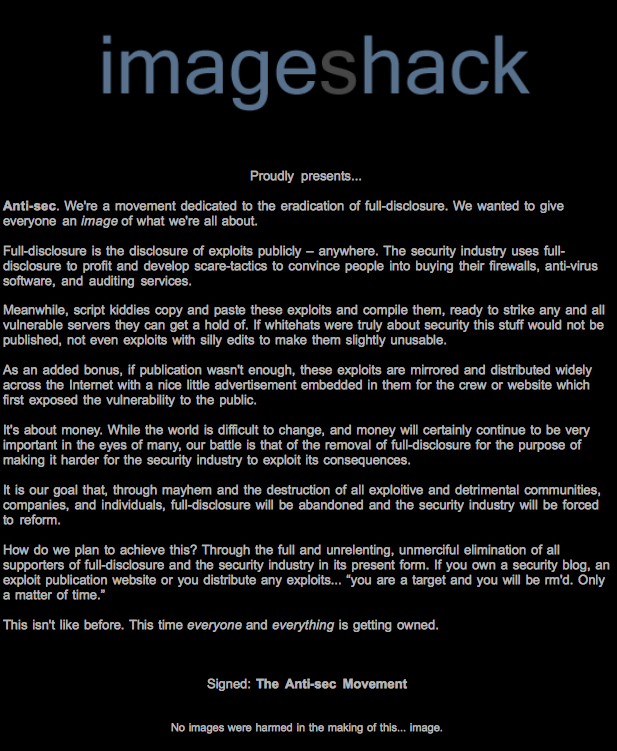
In 2009, attacks against security communities such as Astalavista[1] and milw0rm,[2] and the popular image-host ImageShack,[3][4] have given the movement worldwide media attention.

History

[edit]

The start of most public attacks in the name of the anti-security movement started around 1999. The "anti-security movement" as it is understood today was coined by the following document which was initially an index on the anti.security.is website.[5][6][7][8]

The purpose of this movement is to encourage a new policy of anti-disclosure among the computer and network security communities. The goal is not to ultimately discourage the publication of all security-related news and developments, but rather, to stop the disclosure of all unknown or non-public exploits and vulnerabilities. In essence, this would put a stop to the publication of all private materials that could allow script kiddies from compromising systems via unknown methods.

The open-source movement has been an invaluable tool in the computer world, and we are all indebted to it. Open-source is a wonderful concept which should and will exist forever, as educational, scientific, and end-user software should be free and available to everybody.

Exploits, on the other hand, do not fall into this broad category. Just like munitions, which span from cryptographic algorithms to hand guns to missiles, and may not be spread without the control of export restrictions, exploits should not be released to a mass public of millions of Internet users. A digital holocaust occurs each time an exploit appears on Bugtraq, and kids across the world download it and target unprepared system administrators. Quite frankly, the integrity of systems world wide will be ensured to a much greater extent when exploits are kept private, and not published.

A common misconception is that if groups or individuals keep exploits and security secrets to themselves, they will become the dominators of the "illegal scene", as countless insecure systems will be solely at their mercy. This is far from the truth. Forums for information trade, such as Bugtraq, Packetstorm, www.hack.co.za, and vuln-dev have done much more to harm the underground and net than they have done to help them.

What casual browsers of these sites and mailing lists fail to realize is that some of the more prominent groups do not publish their findings immediately, but only as a last resort in the case that their code is leaked or has become obsolete. This is why production dates in header files often precede release dates by a matter of months or even years.

Another false conclusion by the same manner is that if these groups haven't released anything in a matter of months, it must be because they haven't found anything new. The regular reader must be made aware of these things.

We are not trying to discourage exploit development or source auditing. We are merely trying to stop the results of these efforts from seeing the light. Please join us if you would like to see a stop to the commercialization, media, and general abuse of infosec.

Thank you.

~el8

[edit]

~el8 was one of the first anti-security hacktivist groups. The group waged war on the security industry with their popular assault known as "pr0j3kt m4yh3m". pr0j3kt m4yh3m was announced in the second issue of ~el8. The idea of the project was to eliminate all public outlets of security news and exploits. Some of ~el8's more notable targets included Theo de Raadt, K2, Mixter, Ryan Russel (Blue Boar), Gotfault (also known as INSANITY), Chris McNab (so1o), jobe, rloxley, pm, aempirei, broncbuster, lcamtuf, and OpenBSD's CVS repository.

The group published four electronic zines which are available on textfiles.com.[9]

pHC

[edit]

pHC[10] is an acronym for "Phrack High Council". This group also waged war against the security industry and continued to update their website with news, missions, and hack logs.[11]

Less recent history

[edit]

Most of the original groups such as ~el8 have grown tired of the anti-security movement and left the scene. New groups started to emerge.

dikline

[edit]

dikline kept a website[12] which had an index of websites and people attacked by the group or submitted to them. Some of the more notable dikline targets were rave, rosiello, unl0ck, nocturnal, r0t0r, silent, gotfault, and skew/tal0n.[13]

More recent history

[edit]

giest

[edit]

In August 2008, mails were sent through the full-disclosure mailing list from a person/group known as "giest".

Other targets include mwcollect.org in which the group released a tar.gz containing listens of their honeypot networks.[14][15]

ZF0

[edit]

ZF0 (Zer0 For Owned) performed multiple attacks in the name of pr0j3kt m4yh3m in 2009. They took targets such as Critical Security, Comodo and various others. They published 5 ezines in total.[16] July 2009, Kevin Mitnick's website was targeted by ZF0, displaying gay pornography with the text "all a board the mantrain."[17]

AntiSec Group

[edit]

A group known as the "AntiSec Group"[18] enters the scene by attacking groups/communities such as an Astalavista,[1] a security auditing company named SSANZ and the popular image hosting website ImageShack.[3]

Graffiti reading "Antisec"[18] began appearing in San Diego, California in June 2011 and was incorrectly[19] associated with the original Antisec[18] movement. According to CBS8, a local TV affiliate "People living in Mission Beach say the unusual graffiti first appeared last week on the boardwalk." They also reported "...it was quickly painted over, but the stenciled words were back Monday morning." It was later realized[by whom?] to be related to the new Anti-Sec movement started by LulzSec and Anonymous.[20]

On April 30, 2015 the AntiSec Movement reappeared and started doxing police officers by hacking their databases. On April 30, 2015 they hacked into Madison Police Department and released officers names, address, phone numbers, and other personal data in relation to an Anonymous operation.[21][22]

References

[edit]
Revisions and contributorsEdit on WikipediaRead on Wikipedia
from Grokipedia
The AntiSec Movement, short for Anti-Security, was a loose collective of dedicated to undermining the industry by rejecting full disclosure of software vulnerabilities and condemning researchers as collaborators with corporations and governments. Originating around 2009 with a decrying "white hat" practices that allegedly aid authorities in suppressing underground hacking, AntiSec positioned itself as a defender of hacker autonomy against what it viewed as a professionalized apparatus that prioritizes patching over exploitation. The movement surged in visibility during 2011's , a collaborative campaign with and Anonymous targeting banks, government agencies, and police databases to expose perceived overreach and . Key actions included defacing websites, leaking user data from platforms like , and infiltrating private intelligence firm to release over five million emails, which highlighted corporate and political influence peddling. Despite these disruptive feats, AntiSec's defining controversy emerged from internal betrayal: core member , known as Sabu, cooperated with the FBI after his 2011 arrest, providing intelligence that facilitated the capture of associates like , who received a 10-year sentence for the breach. This infiltration underscored the movement's operational fragility and reliance on unvetted participants, contributing to its effective dismantling by 2013.

Overview

Definition and Core Tenets

The AntiSec movement is a fringe ideology within the hacker community that emerged in the early 2000s as a direct counter to the growing professionalization of computer security and the adoption of full disclosure policies for software vulnerabilities. It posits that the infosec industry, comprising consultants, vendors, and researchers, sustains itself by amplifying disclosed flaws into crises that necessitate ongoing purchases of tools, audits, and services, rather than fostering inherently robust systems through better engineering practices from the outset. Proponents view this industry as an elitist cadre that hoards knowledge for profit while decrying amateur hackers, thereby stifling genuine progress toward secure computing. A foundational tenet of AntiSec is the outright rejection of full disclosure—the practice of publicly detailing vulnerabilities, proofs-of-concept exploits, and remediation steps—as inherently counterproductive. Advocates contend that such transparency disproportionately benefits skilled attackers, who can weaponize information faster than vendors patch systems or users apply fixes, leading to net increases in successful breaches and data compromises. This stance traces back to the movement's origins as a backlash against forums like Bugtraq, where early full disclosure advocates argued for openness to pressure manufacturers, but AntiSec countered that it democratizes offense more than defense, empowering "script kiddies" and cybercriminals over the broader ecosystem. Another core principle involves actively undermining the industry through targeted hacks, data leaks, and disruptions to expose its own vulnerabilities and hypocrisies, with the ultimate aim of demonstrating that comprehensive is a unattainable in an adversarial environment. By attacking firms purporting to offer ironclad protections, AntiSec seeks to erode public and corporate faith in commercial safeguards, encouraging a toward of vendor assurances and emphasis on opacity or "" where disclosure would invite exploitation. This disruptive ethos, articulated in early manifestos decrying the industry as fear-mongers, prioritizes first-principles scrutiny of claims over incremental patching cycles. The Antisec movement, particularly in its 2011 resurgence, diverged from traditional by centering its efforts on ideological opposition to the infosec industry rather than broader political or social campaigns. Hacktivist groups like Anonymous typically pursued targeted disruptions, such as the December 2010 Operation Payback DDoS attacks against Visa and for blocking donations, aiming to influence policy or expose corruption through symbolic actions. In contrast, Antisec operations, including the June 2011 hacks of firms like Federal, sought to undermine the credibility of practices by publicly dumping unpatched exploits and internal data, arguing that the industry perpetuated a false sense of for profit. Unlike ethical or white-hat hacking communities, which emphasize responsible disclosure—privately notifying vendors of vulnerabilities to allow patching before public release, as codified in frameworks like CERT's guidelines—Antisec rejected this as a mechanism enabling industry collusion and delay. Antisec advocates, including figures like Sabu, promoted immediate full disclosure of flaws, tools, and techniques to render systems "insecure by design," believing it would compel genuine fixes over superficial vendor responses and expose the limitations of proprietary security models. This stance positioned Antisec against programs adopted by firms like starting in the early 2000s, which Antisec viewed as prioritizing corporate interests over transparency. Antisec also contrasted with black-hat or criminal hacking, where motivations center on financial gain, data theft for sale, or deployment, as seen in operations by groups like extracting over $1 billion from banks between 2013 and 2018. Antisec actions, such as the August 2011 release of 1.7 million law enforcement records via exploits, eschewed monetization in favor of philosophical disruption, aiming to erode trust in institutional security rather than exploit it for personal enrichment. This ideological purity distinguished it from profit-driven , though overlaps occurred in tactics like unauthorized access. While sharing roots with early full disclosure advocates like the Cult of the Dead Cow's 1996 GOBBLES exploit release against , Antisec radicalized the approach by explicitly rejecting any form of "responsible" containment, viewing even those efforts as insufficiently aggressive against industry entrenchment. In its mid-2000s fragmentation and 2011 Anonymous affiliation, Antisec evolved beyond mere vulnerability publishing to direct attacks on security professionals, such as doxxing and server compromises, to illustrate that no entity—including self-proclaimed experts—could achieve true security.

Ideology and Philosophy

Critique of the Infosec Industry

The Antisec movement levels sharp criticism at the information security (infosec) industry, portraying it as a profit-driven entity that exacerbates vulnerabilities rather than mitigating them. Proponents argue that the industry engages in and media sensationalism of security issues, transforming legitimate concerns into marketable products and services. This perspective holds that infosec professionals prioritize revenue generation over systemic improvements, fostering dependency on proprietary solutions while failing to address root causes of insecurity. A core tenet of the critique is opposition to full disclosure policies, which Antisec views as enabling widespread exploitation by unskilled attackers, or "script kiddies." By publicly releasing unknown exploits and vulnerabilities, the industry allegedly triggers a "digital holocaust," where unprepared system administrators face mass compromises as novices download and deploy tools indiscriminately. The slogan "save a , save a life" encapsulates this stance, advocating non-disclosure to prevent such chaos and preserve bugs as potential defensive tools rather than offensive weapons handed to adversaries. Critics within Antisec contend that full disclosure serves the industry's interests by creating urgency and justifying expenditures on patches, audits, and consulting, without evidence of net gains. Antisec accuses the infosec sector of co-opting underground s into corporate roles, thereby betraying and bolstering the very infrastructure they oppose. Groups like ~el8 launched Project Mayhem in explicitly to wage war on white-hat s employed by firms, launching denial-of-service attacks and website defacements against industry targets to disrupt operations. This campaign framed such professionals as enablers of a false sense of , where the industry generates hype around threats it claims to counter, yet achieves little beyond financial enrichment over two decades. In this view, the proliferation of vendors and certifications perpetuates a cycle of vulnerability disclosure followed by paid remediation, benefiting insiders while leaving broader ecosystems exposed. The movement's rhetoric highlights perceived hypocrisies, such as the industry's reliance on obscurity and non-disclosure in its own practices while preaching transparency to clients. Antisec maintains that true security arises from selective secrecy and internal fixes, not the vendor-fueled of public alerts and exploits. Despite these attacks, the infosec industry has dismissed Antisec as counterproductive, arguing that withholding hinders collective defense against sophisticated threats. However, Antisec counters that the industry's growth correlates with rising incidents, attributing this to disclosure-driven proliferation of attack tools rather than inherent systemic flaws.

Advocacy for Insecurity and Full Disclosure

The Antisec movement's advocacy for insecurity centers on the belief that the computer security industry perpetuates vulnerabilities for profit rather than resolving them, rendering comprehensive security unattainable and undesirable. Proponents argue that software and systems are inherently flawed due to complexity, and efforts to "secure" them only create illusory protections that benefit vendors and consultants. This philosophy posits that true progress in computing arises not from patching disclosed flaws but from redesigning systems with robustness in mind from inception, often encapsulated in the slogan "Save a bug, save a life," which humorously critiques the overzealous eradication of software imperfections. Central to this stance is opposition to full disclosure of vulnerabilities, which Antisec adherents view as a mechanism that sustains the infosec economy by publicizing exploits, prompting rushed fixes, and driving demand for proprietary tools and services. They contend that revealing zero-day vulnerabilities empowers attackers while allowing the industry to market incremental solutions without addressing root causes, such as poor or incentives. Instead, Antisec advocates maintaining around exploits to deny the security sector exploitable that fuels its growth, asserting that "full disclosure" primarily serves practitioners seeking to build careers on repeated cycles rather than fostering genuine resilience. This anti-disclosure ethic extends to a broader rejection of coordinated reporting, with figures in the movement like those associated with early texts decrying it as complicit in industrializing insecurity. By withholding details on hacking tools, techniques, and exploits, Antisec aims to undermine the of knowledge, believing that public archives like enable the very ecosystem they oppose. Critics within circles, however, argue this approach risks unchecked exploitation by malicious actors, though Antisec counters that non-disclosure prevents the of attacks that full disclosure ostensibly enables while ignoring systemic flaws. In practice, this advocacy manifests in manifestos and online declarations from the late 1990s onward, such as the 2001 "Anti Security" text questioning the justification for disclosure and promoting bug preservation as a form of resistance against . The movement's texts emphasize that insecurity, when not artificially amplified by industry hype, encourages users to adopt and toward vendor promises, potentially leading to more sustainable paradigms over perpetual remediation. This position, while niche, influenced hacker subcultures by framing as a false idol, prioritizing individual autonomy and critique over collective defense mechanisms.

Historical Development

Origins in the Late 1990s and Early 2000s

The AntiSec movement originated in the late amid growing tensions within the hacker underground over the professionalization of and the rise of full disclosure practices. Hackers viewed the emerging infosec industry—comprising vendors, researchers, and forums—as perpetuating vulnerabilities for profit while publicly advocating transparency that they argued armed attackers without sufficiently addressing root causes. This critique manifested in targeted disruptions of security outlets, beginning around 1999, as a response to the perceived of "white-hat" experts who monetized insecurity through conferences, antivirus sales, and vulnerability databases. Pioneer groups like ~el8 initiated public actions against security targets, hosting operations from domains such as el8.ru and focusing on defacements and exposures of industry figures. By early 2002, ~el8 escalated with Project Mayhem, a campaign that hacked servers of prominent researchers, leaked personal files including emails, and aimed to undermine trust in white-hat credentials. These efforts highlighted the movement's early tactics of direct confrontation, including denial-of-service attacks and site compromises, to protest what participants saw as an industry reliant on unpatched flaws. The Phrack High Council (pHC), an influential collective tied to the venerable magazine, amplified the ideological push in 2002 through public statements rejecting full disclosure mailing lists like Bugtraq and framing infosec professionals as enablers of systemic weakness. pHC's rhetoric positioned AntiSec as a counterforce to "" sold by corporations, urging hackers to withhold exploits from public view to prevent widespread abuse. Similarly, dikline operated as a clearinghouse, maintaining online indexes of compromised security sites and individuals to coordinate and publicize strikes against outlets disseminating vulnerability data. These entities, active primarily in underground forums and zines, laid the groundwork for AntiSec's philosophy before broader fragmentation in the mid-2000s.

Mid-2000s Evolution and Fragmentation

In the mid-2000s, the Antisec movement evolved amid the burgeoning professionalization of vulnerability disclosure practices, exemplified by iDefense's launch of a paid Vulnerability Contributor Program in 2002 and TippingPoint's Zero Day Initiative in 2005, which monetized hacker discoveries through coordinated reporting to vendors rather than immediate public release. These shifts drew some hackers into industry-aligned models, exacerbating tensions with Antisec's core opposition to security profiteering and preference for raw exposure of systemic flaws to compel foundational software redesign. This period marked fragmentation as early drivers disengaged; groups linked to pioneers like ~el8 reportedly fatigued with persistent scene dynamics and receded from visibility, diminishing coordinated action. Emerging independents, including ZF0 and the AntiSec Group, sustained sporadic critiques through targeted disruptions against security portals and firms, but operated in decentralized isolation rather than unified campaigns, reflecting eroded collective impetus amid rising legal pressures and commercial alternatives. The movement's headline activity, prominent in the early , notably waned, setting the stage for later revivals.

2011-2012 Peak and Association with Anonymous

The AntiSec movement achieved its most prominent visibility during –2012 through , a hacking campaign initiated on June 14, 2011, by members of in coordination with Anonymous affiliates, targeting government agencies, databases, and financial institutions to expose perceived vulnerabilities and "profiteering" in the sector. This period saw a surge in high-profile intrusions, including the compromise of an FBI on January 17, 2012, revealing discussions on Anonymous investigations, and attacks on websites on February 17, 2012. AntiSec's actions explicitly invoked Anonymous rhetoric, such as demands for full disclosure of flaws and critiques of "infosec gluttons," while sharing tactics like exploits and data dumps, which blurred lines between the groups. A pivotal event was the December 2011 breach of , a private intelligence firm, where AntiSec actors accessed over 200,000 accounts, 3.6 million emails, and details from approximately 7,500 subscribers, subsequently donating $50,000 in stolen funds to charities like the Red Cross and . The group claimed responsibility on December 24, 2011, framing the hack as retaliation against corporate , with leaked documents published via and torrents, amplifying AntiSec's anti-establishment narrative aligned with Anonymous's broader hacktivist ethos. This operation underscored the movement's peak operational tempo, involving overlapping personnel from Anonymous subgroups, though some Anonymous members publicly distanced themselves from the elements. The association with Anonymous was reinforced by shared leadership figures, notably Hector Xavier Monsegur (alias "Sabu"), a core Anonymous operative who bridged and AntiSec activities before his June 7, 2011, arrest and subsequent FBI cooperation, which facilitated indictments of AntiSec participants like for the intrusion. AntiSec communiqués frequently referenced Anonymous solidarity, such as post-Stratfor statements reaffirming ties to and Anonymous while targeting over one million victims' data in coordinated releases. However, Monsegur's informant role, exposed in March 2012, eroded trust and contributed to the movement's fragmentation, as evidenced by internal Anonymous channels ejecting suspected collaborators and halting joint operations. By mid-2012, federal charges against six hackers, including Hammond's 10-year sentence in 2013, marked the effective end of this collaborative peak, highlighting vulnerabilities to infiltration despite the ideological overlap.

Key Figures and Groups

Early Pioneers (~el8, pHC, Dikline)

~el8 emerged as one of the earliest groups associated with the antisec movement, publishing electronic zines that critiqued the industry and advocated against public disclosure of vulnerabilities. In early , the group initiated "pr0j3kt m4yh3m," a coordinated campaign targeting firms, researchers, and disclosure platforms through defacements, denial-of-service attacks, and leaks aimed at disrupting what they viewed as profiteering from insecurity. This effort, detailed in the second issue of the ~el8 zine, positioned the group as a proponent of maintaining exploits in private circles rather than commercializing them via advisories or tools. The Phrack High Council (pHC), linked to the longstanding underground publication , formalized its antisec stance in August 2002 through a public declaration on the Full Disclosure mailing list, explicitly aligning with the "anti-sec / anti-whitehat movement." pHC criticized white-hat practices such as vulnerability publishing and consulting as betrayals of , urging the destruction of security research outlets to prevent their exploitation by authorities or vendors. The group maintained an active website updating missions against the industry, contributing to the movement's fragmentation by escalating rhetoric against perceived sellouts in the community. Dikline operated as a lesser-documented but complementary entity, hosting a website that cataloged antisec-aligned attacks on security-related targets, including submissions from affiliates targeting sites like exploit archives and researcher pages. Active in the early alongside ~el8 and pHC, dikline focused on aggregating and publicizing successful operations to amplify pressure on the infosec sector, though specific dates and individual actions remain sparsely archived due to the ephemeral nature of underground hosting. These pioneers collectively laid groundwork for antisec by prioritizing black-hat exclusivity over broad disclosure, influencing later waves through shared manifestos and tactical inspirations.

Later Participants (Giest, ZF0, AntiSec Group)

In August 2008, an individual or group operating under the handle Giest initiated actions aligned with Antisec principles by sending emails via the , critiquing disclosure practices. Giest subsequently targeted mwcollect.org, a honeypot monitoring service, and released a tar.gz archive containing lists of associated honeypot networks, aiming to expose and disrupt security research infrastructure. ZF0, short for Zer0 For Owned, conducted a series of attacks in 2009 under the banner of pr0j3kt m4yh3m, focusing on professionals and sites. In July 2009, ZF0 compromised Kevin Mitnick's website, defacing it with gay pornography overlaid with the message "all a board the mantrain by ZF0," as a provocative strike against prominent figures in the infosec community. The group released multiple issues of an e-zine titled Zero For 0wned, documenting compromises of servers, including high-profile icons' email spools and , while mocking professional auditing practices. ZF0's operations extended to sites like invisiblethingslab.com (associated with researcher Rutkowska) and contributed to the takedown of -focused forums such as DarkMindZ. The AntiSec Group, active around 2009, explicitly opposed full-disclosure policies by targeting exploit-sharing and security communities, including defacements of Astalavista, nowayout, SSANZ, and . In July 2009, the group escalated by attacking blackhat-forums.com, a popular site for script kiddies and exploit discussions, as part of broader efforts to dismantle platforms enabling vulnerability publication. Their , posted on the hacked ImageShack.us, advocated eliminating exploit dissemination to undermine the infosec industry's reliance on secrecy. By early 2010, the group suffered a reversal when it was itself compromised, exposing leader rome0 and leading to arrests of members.

Major Operations and Tactics

Attacks on Security Infrastructure

The Antisec movement targeted components of the infosec industry, including auditing firms, researcher websites, and exploit-sharing platforms, through defacements, , and backdoor installations to undermine what adherents viewed as profiteering from withheld vulnerabilities. These actions, often executed by groups like the AntiSec Group and ZF0, emphasized symbolic disruption over data theft, aligning with the movement's for insecurity as a counter to commercialized security practices. In mid-2009, the AntiSec Group compromised the website of SSANZ, a New Zealand-based auditing company, erasing data and installing a backdoor, as confirmed by the firm's own announcement on its homepage. The intrusion exploited a in the site's configuration, highlighting the attackers' critique of auditing firms for prioritizing client over disclosure. Around June 5, 2009, Astalavista.com, a long-standing repository for security exploits and hacking tools founded in 1997, was defaced and partially shut down by AntiSec-affiliated hackers, who exposed server details and criticized it as a hub for low-quality, commercialized security content. The attack involved exploiting a Litespeed webserver flaw, leading to the site's temporary erasure of content and redirection efforts by operators. In July 2009, ZF0, a group aligned with Antisec principles, targeted the website of security consultant , defacing it with explicit content to mock prominent figures in the industry. Similar tactics were applied to sites of researchers and Julien Tinnes, part of a broader "skiddie " campaign against whitehat communities perceived as elitist. These incidents, documented in underground eZines like Zero For 0wned, involved and other basic exploits to demonstrate the irony of insecure security infrastructures. Later efforts extended to defense contractors with infosec ties, such as the July 2011 breach of IRC Federal, an FBI partner, where AntiSec extracted emails and hashes via , exposing operational weaknesses in contractor systems. Such attacks, while less frequent than those on , reinforced the movement's narrative against institutional security silos.

High-Profile Hacks and Data Releases

One of the most notable operations attributed to AntiSec occurred on December 24, 2011, when members infiltrated the systems of , a Texas-based private intelligence firm specializing in geopolitical analysis. Hackers accessed over 200,000 emails spanning 2004 to 2011, along with data from approximately 30,000 credit cards, which they used to make fraudulent donations totaling over $50,000 to organizations including the Red Cross and . The stolen emails were released publicly via torrent and provided to , which published them as the "Global Intelligence Files," exposing Stratfor's client relationships with entities like the U.S. government and corporations, as well as internal discussions on global events. This breach, linked to and facilitated by informant (Sabu), highlighted vulnerabilities in private intelligence operations and led to Hammond's 10-year prison sentence in 2013. In August 2011, AntiSec released approximately 10 GB of data from various U.S. agencies, including internal documents from the and other police servers, as retaliation for arrests of alleged members in the U.S. and U.K. The dump included sensitive operational details, such as tactics and handling, obtained through and other exploits targeting government-affiliated websites. A controversial data release came on September 4, 2012, when AntiSec published 1,000,001 Unique Device Identifiers (UDIDs) from a purported trove of 12 million Apple device records, claiming the data was stolen from the laptop of FBI Supervisory Special Agent Richard Hickey during a March 2012 exploit. The group asserted the breach exposed flaws in mobile device tracking for law enforcement purposes, but the FBI denied possessing or losing such data, stating it could not verify the release's authenticity. Subsequent investigations traced the records to a Florida-based mobile forensics firm, not directly from federal sources, underscoring discrepancies in AntiSec's attribution claims. These incidents exemplified AntiSec's tactic of targeting perceived symbols of authority and corporate overreach, often amplifying releases through and to maximize publicity, though many operations overlapped with broader Anonymous or efforts.

Controversies and Criticisms

Informant Infiltration and Arrests

Hector Xavier Monsegur, known online as "Sabu," was arrested by the FBI on June 7, 2011, in on charges related to hacking activities associated with Anonymous, , and the emerging AntiSec operations. Immediately following his arrest, Monsegur began cooperating with authorities, providing extensive information on the structure, methods, and participants in these groups, including AntiSec's anti-security campaigns. This infiltration marked a pivotal disruption, as Monsegur remained active online under FBI supervision, logging conversations and identifying co-conspirators in real-time. Monsegur's cooperation directly facilitated multiple arrests tied to AntiSec and affiliated activities. In particular, it contributed to the March 5, 2012, arrest of , alias "Anarchaos," in for his role in the December 2011 Stratfor hack conducted under the AntiSec banner, which compromised emails and credit card data of approximately 860,000 users. Hammond's involvement was uncovered through chat logs Monsegur provided, revealing coordination on the intrusion and . Additional arrests in March 2012 targeted members with AntiSec overlaps, including charges against and Jake Davis for hacks affecting over one million victims, enabled by Monsegur's disclosures. Federal prosecutors later credited Monsegur's efforts with preventing or detecting at least cyberattacks and leading to the dismantling of key hacking cells, including those pursuing AntiSec objectives against security firms and infrastructure. In May 2014, Monsegur received a sentence of for his "extraordinary" assistance, avoiding further incarceration despite his prior leadership in operations that released sensitive data under AntiSec claims. This case highlighted vulnerabilities in loosely organized collectives to informant-driven , though it also raised questions about the of allowing a cooperating to incite further crimes under supervision. The Antisec movement's advocacy for undermining security measures through unauthorized intrusions and public data releases precipitated numerous legal prosecutions, predominantly under the U.S. (CFAA), which imposes penalties including fines and imprisonment for intentional unauthorized computer access. Key figures faced federal indictments for hacking government and corporate systems, with operations often resulting in the compromise of sensitive affecting over one million victims. , operating as "Sabu" and linked to Antisec via overlapping activities, was arrested by the FBI on June 7, 2011, and agreed to inform the next day, aiding in the prevention of at least 300 hacks targeting military, congressional, and private entities. His cooperation yielded a 2014 sentence of , but facilitated broader crackdowns. These legal actions underscored the movement's vulnerability to law enforcement infiltration, as Monsegur's role exposed operational details and backdoors, leading to arrests like that of in December 2011 for hacks tied to Antisec tactics, resulting in a 10-year term. Internationally, participants faced and charges under analogous statutes, with CFAA violations carrying up to five years per count for first offenses, escalating for aggravated cases involving or government targets. Ethically, Antisec's philosophy—opposing "security theater" by prioritizing offensive hacks over defensive practices—drew rebukes for fostering recklessness, as data dumps exposed vulnerabilities without coordinated remediation, potentially enabling further exploitation by criminals rather than improving systems. Critics, including security professionals, highlighted a deficit in moral accountability, arguing that the movement's pursuit of disruption ignored collateral risks to innocent parties, such as breaches from leaked databases that could endanger officers or informants. The internal fallout from informants like Monsegur further eroded ethical cohesion, revealing tensions between ideological solidarity and , with some viewing as pragmatic survival amid inevitable legal pursuit, while others decried it as undermining anti-authority . This duality—claiming public benefit through exposure yet operating outside consent-based norms—invited scrutiny over whether such justified violations of property rights and .

Impact and Legacy

Influence on Hacking Culture

The Antisec Movement exerted a profound influence on hacking culture by challenging the growing of hacking skills and the practice of full vulnerability disclosure. Emerging in the late and early 2000s through early groups like ~el8, which launched assaults such as "pr0j3kt m4yh3m" against firms, Antisec positioned itself as a defender of underground autonomy against what it viewed as the co-optation of exploits by commercial interests. This ideology rejected the notion that hackers should contribute to defensive industries, instead advocating for withholding or weaponizing knowledge to disrupt profiteering entities. Antisec's tactics, including direct hacks on security researchers and companies to expose their vulnerabilities, fostered an adversarial ethos within the hacker community, highlighting perceived hypocrisies in the security sector. Groups associated with the movement, such as pHC and later participants like Dikline, amplified this by targeting "professional hackers" who sold vulnerabilities to governments or firms, thereby reinforcing a cultural divide between "true" underground hackers and those entering legitimate cybersecurity roles. This approach inspired subsequent operations, notably LulzSec's 2011 , which leaked over 200,000 passwords from and data from firms like , embodying the movement's disruptive spirit and blurring lines between , lulz, and protest. Despite ultimate operational failures and internal infiltrations, Antisec's principles became touchstones for debates on , influencing a persistent undercurrent of toward full disclosure and market-driven practices. It encouraged a return to emphasizing peer-exclusive knowledge sharing and resistance to institutional capture, shaping grey-hat and black-hat subcultures that prioritize over collaboration with authorities or corporations.

Long-Term Effects on Security Practices

The AntiSec movement's operations, particularly the 2011 breaches of databases in states like and New York, revealed persistent weaknesses such as exposed vulnerabilities and reliance on outdated hashing for passwords, which were easily crackable and exposed of officers. These incidents compelled affected agencies to and fortify database configurations, shifting toward more robust input validation and transitioning to stronger hashing methods like or to mitigate brute-force attacks. However, the public data dumps often amplified damage without prior coordination, contrasting with responsible disclosure practices that prioritize vendor patching before exposure. In the hack of December 2011, AntiSec affiliates exploited poor to access over 800,000 subscribers' details, using them for unauthorized donations totaling around $50,000 to various charities. This event highlighted deficiencies in industry standard (PCI DSS) adherence, including unmonitored third-party integrations like , prompting intelligence firms and similar entities to adopt stricter controls such as tokenization of sensitive data and real-time transaction monitoring. Post-incident analyses emphasized isolating payment systems from core networks, influencing advisory guidelines for handling financial data in high-risk sectors. The movement's manifesto and actions reinforced skepticism toward the professional security industry's full-disclosure model, portraying it as a profit-driven "scare tactic" rather than a pathway to systemic fixes. This stance arguably perpetuated underground withholding of exploits, delaying patches in some cases and complicating collaborative vulnerability management, as evidenced by ongoing debates where chaotic releases prioritized disruption over remediation. Over time, while not catalyzing widespread policy shifts, AntiSec exposures contributed to incremental hardening of public-sector defenses, including mandatory cybersecurity training for agencies, though vulnerabilities in similar infrastructures persisted due to resource constraints and legacy systems.

References

Add your contribution
Related Hubs
User Avatar
No comments yet.