Hubbry Logo
ArlbergArlbergMain
Open search
Arlberg
Community hub
Arlberg
logo
8 pages, 0 posts
0 subscribers
Be the first to start a discussion here.
Arlberg
Arlberg
from Wikipedia

The Arlberg (German: [ˈaʁlˌbɛʁk] , also: Arlberg Pass) is a mountain pass between states of Tyrol and Vorarlberg in Austria. Ski resorts at the Arlberg include Lech, Zürs, Stuben, St. Christoph, St. Anton, Oberlech, Stubenbach, Zug, and Warth. It is the mountain pass from which the Austrian State of Vorarlberg, meaning 'before the Arl mountain', gets its name.

Key Information

Geography

[edit]

The Arlberg connects the Klostertal Valley in the west with the Stanzer Valley in the east. Together with the Flexenpass, it borders three mountain groups: the Verwall in the south, the Lechquellen mountains in the northwest, and the Lechtal Alps in the northeast. The Valluga, which stands as the highest mountain of the Arlberg, and the Trittkopf, southwest of the Lechtal Alps, dominate the pass. Four communities meet: on the Vorarlberg side, Lech and Klösterle–Stuben; on the Tyrol side, Kaisers and St. Anton. The watershed between the Rhine and the Danube rivers runs south from the Albonagrat to the Passhöhe, over the Valluga and Trittkopf, to the Flexenpass, and it traces from the Flexenspitz the southern edge of the Lechquellen mountains westward to the Klostertal.

Pass roads and the Arlberg tunnel

[edit]

The old pass route was known since the 14th century in the form of a narrow mule track when people began to trade salt in the region. However, because the Arlberg was very poorly developed, for centuries people avoided the route and took detours over the Fern Pass or Immenstadt for trading. The development of the textile industry and of the postal service, however, led to the roads being surfaced in 1824.

With the rise of motor traffic in the 20th century, however, this became inadequate. It was decided that a 14-kilometre-long (9-mile) Arlberg Road Tunnel would be built between Langen and St. Anton. On July 5, 1974, the work began and the passage was opened to traffic on December 1, 1978. The tunnel has a toll; however, the old road over the 1,800 m (5,906 ft) pass is toll-free. A peculiarity of the tunnel is that it actually consists of two tunnels. On the Tyrolian side it is built over the Rosanna Gorge before the actual massif rises up in the direction of Vorarlberg over the tunnel.

Arlberg Railway

[edit]

The Arlberg railway connects Innsbruck with Bludenz. Between St. Anton and Langen it runs through the 10.25 kilometres (6.37 miles) long Arlbergtunnel.

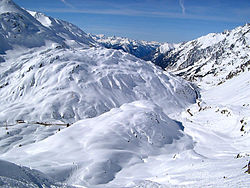
View from the Schindlerspitze

Tourism

[edit]

Tourism is the main source of income for Arlberg villages and their inhabitants and plays a vital role in the region.[1]

Today, "Arlberg" is a brand for the winter sports areas around the Arlberg Pass, in particular the ski areas of Lech, Zürs, Stuben, Klösterle and St. Christoph, St. Anton am Arlberg.

The area is known for its long winter sports tradition. As early as 1901, the Arlberg ski club was founded and two years later a first club competition was held. In 1904 the first general Arlberg race took place, 1928 the first of the famous Arlberg Kandahar races. In 1921, under the leadership of Hannes Schneider, the ski school Arlberg was the first ski school in the region.[2]

In 1937, the first lifts were built in St. Anton and in Zürs. It was the first ski-lift built by Konrad Doppelmayr and Sepp Bildstein. With the 2001 FIS Ski World Cup in St. Anton, alpine ski racing came back to the Arlberg and thus to its roots. In 2021, St. Anton am Arlberg will be holding a combination ski race with a slalom and a super-G on January 9 and 10 as part of the FIS Alpine Skiing World Cup 2020–21.[3]

Today, the contiguous ski resorts on three mountains around Lech and Zürs, the Arena on Gampen, Kapall, Galzig and Valluga above St. Anton and St. Christoph, form a ski resort with 87 lifts, 305 km of groomed slopes and 200 km of deep snow slopes.[2] Thanks to the many winter sports enthusiasts, tourism at the Arlberg is of great importance. Between 1 November 2001 and 31 October 2002, more than one million overnight stays were counted for the first time.

Ski Arlberg: View from the Sonnenkopf

Ski Arlberg

[edit]

Ski Arlberg is the biggest connected ski resort in Austria, consisting of the villages of Lech, Oberlech, Zürs and Zug, which were linked to Warth and Schröcken in 2013–14.[4] The ski area comprises 15 aerial tramways, 45 chairlifts and 28 drag lifts.[5]
The White Ring, the world's longest ski circuit (22 km), is located within the Ski Arlberg area. Since 2005–06, annual White Ring races have been held.[6]

See also

[edit]

References

[edit]
Revisions and contributorsEdit on WikipediaRead on Wikipedia
from Grokipedia
The Arlberg is a high in the Austrian , located at an elevation of 1,793 meters (5,883 feet) along the border between the federal states of and Tyrol, serving as a vital east-west transport link traversed by Federal Highway B 197 and the Arlberg railway. It encompasses a rugged with peaks rising to 2,811 meters at Valluga, its , and is celebrated worldwide as the birthplace of modern , featuring Austria's largest connected with 300 kilometers of groomed pistes, over 200 kilometers of off-piste terrain, and 85 modern lifts and cable cars serving villages such as St. Anton, Lech, Zürs, St. Christoph, and Stuben. Geographically, the Arlberg region spans altitudes from 1,304 to 2,811 meters, benefiting from a northwest weather pattern that ensures reliable snowfall, with an average of up to 9 meters annually in some areas, making it one of Europe's most snow-sure destinations. The pass has historically facilitated trade and travel since the 14th century, but its prominence surged with the opening of the Arlberg railway tunnel in 1884 by Emperor Franz Josef I, which enhanced accessibility and spurred tourism. The Arlberg's legacy in skiing began in the late 19th century, when skis for sport were introduced by a Norwegian engineer in 1885 near Langen, followed by Pastor bringing the first pair to the western Arlberg in 1894 for practical travel between Warth and Lech. Key milestones include the founding of the Ski Club Arlberg in 1901 in St. Christoph—one of the oldest ski clubs in the —the first documented ski race in St. Anton in 1904, and the establishment of the inaugural ski school in Zürs in 1905 by Viktor Sohm. In 1921, Hannes Schneider opened the world's first professional ski school in St. Anton, pioneering the influential Arlberg technique that revolutionized parallel turns and maneuvers, and he later starred in 15 ski films to promote the sport. Infrastructure innovations further solidified its status: Austria's first drag lift appeared in Zürs in 1937, alongside the Galzigbahn—the world's first winter-only cable car—in St. Anton, while systems were introduced in 1983 and heated chairlifts in 2004. The 2016 opening of the Flexenbahn connected previously separate areas, expanding the resort to its current scale as one of Europe's largest ski areas. Today, the region offers diverse terrain for all skill levels, including snow parks, race courses, and heli-skiing in Zürs, complemented by a high concentration of acclaimed dining—over 30 points and four Michelin-starred restaurants—alongside car-free zones like Oberlech. Accessible by car, train, or bus from nearby airports, Arlberg remains a premier destination for enthusiasts, blending historical significance with cutting-edge facilities.

Geography

Location and Topography

The Arlberg is a prominent in western , located at an elevation of 1,793 meters (5,883 feet) above , functioning as a low rather than a distinct mountain or range. It lies at coordinates approximately 47°08′N 10°13′E and serves as a natural divide connecting the Klostertal valley in the state of to the west with the Stanzer valley in Tyrol to the east. This positioning places the Arlberg within the broader , where it forms a transitional saddle between the Verwall Alps, the Lechquellen Mountains, and the Lechtal Alps. The pass delineates key boundaries in the Alpine landscape while encompassing rugged terrain characterized by steep slopes and deep valleys. The surrounding area includes several notable villages and ski resorts, such as , Lech, Zürs, Stuben, and St. Christoph, which cluster along the pass's approaches and contribute to its role as a central hub in the region. The highest peak in the immediate vicinity is the Valluga, rising to 2,811 meters (9,222 feet), offering panoramic views over the interconnected alpine massifs. Geologically, the Arlberg region originated from the during the period, involving intense tectonic compression that folded and thrust ancient sedimentary layers into their current configuration. Dominant rock types include middle-Triassic limestones and , such as the Hauptdolomit formation, which exhibit strong folding and steep northward dips visible in roadside outcrops along the pass. These carbonate formations, typical of the Northern Calcareous Alps, underpin the area's karstic features and resilient topography.

Climate and Environment

The Arlberg region exhibits a classic characterized by cold, snowy winters and mild summers, influenced by its high elevation ranging from 1,300 to over 2,800 meters. At the pass elevation of approximately 1,800 meters, average low winter temperatures typically range from -5°C to -10°C (23°F to 14°F), with January often the coldest month at around -11°C. Summers are temperate, with average highs of 10-15°C (50-59°F) in , though nights remain cool. This climatic pattern supports the region's reputation for reliable winter conditions but also presents challenges such as and exposure at higher altitudes. Annual in Arlberg averages 1,200-1,500 mm (47-59 inches), predominantly falling as during the winter months from to , contributing to heavy snowfall accumulations of up to 10 meters (33 feet) in favorable years. This is unevenly distributed due to microclimates shaped by orientations and orographic effects, with northern slopes receiving more from Atlantic systems. The resulting cover enhances the area's ecological and recreational value but heightens risks associated with natural hazards. Environmentally, Arlberg features significant protected areas, including the Verwall site, Vorarlberg's largest at about 120 km², which preserves diverse habitats from alpine meadows to coniferous s. Biodiversity thrives here, with notable species such as chamois (Rupicapra rupicapra), golden eagles (Aquila chrysaetos), , and a variety of alpine flora including edelweiss and gentians adapted to rocky terrains. However, the heavy snowfall and steep topography pose substantial risks, particularly on slopes above 30 degrees; mitigation efforts include permanent avalanche barriers, early warning systems established since the early , and protected zones covering 85% of certain areas to stabilize . Climate change is profoundly impacting Arlberg, with nearby glaciers experiencing approximately 20% volume loss since 1980 (as of 2015) due to accelerated melting from rising temperatures, reducing overall snow reliability and shortening natural snow seasons. Austrian alpine glaciers have lost about 22% of their volume over the last three decades (as of ~2015), exacerbating and habitat shifts. As of 2024, Austrian glaciers retreated by an average of 23.9 meters, with projections indicating the country could be largely ice-free within 45 years under moderate warming scenarios. In response, initiatives in the ski areas include powering all lifts and with 100% renewable energy sources like , alongside efforts to reduce energy consumption by modernizing infrastructure, achieving up to 20% savings industry-wide in . These measures aim to balance with the region's economic reliance on winter .

History

Early Use as a Pass

The Arlberg Pass likely saw early human use during prehistoric times and the Roman era, serving as a secondary route for trade connecting to the region, though no concrete evidence of formalized roads from these periods has been uncovered. While the nearby was the primary transalpine pathway developed by the Romans for military and commercial purposes, the Arlberg's rugged topography made it a less frequented alternative for local exchanges. Medieval development of the pass accelerated in the 13th century with the establishment of rest stops, such as in Stuben, which functioned as the final shelter for travelers, muleteers, and merchants before crossing. In 1218, the of St. John founded an accommodation facility in Stuben under orders from Count Hugo I von Montfort, providing basic refuge with fire, water, and shelter. By 1330, the site was documented as a post station and inn, known as the "Emperor's highest room," marking one of the earliest recorded references to organized crossings. The 14th century saw the creation of a narrow mule track specifically for the salt trade between Tyrol and , facilitating the transport of this vital commodity across the divide. Within the Habsburg Empire, the Arlberg route played a crucial economic role as a vital link for regional , supporting the movement of goods like salt and sustaining local economies through associated tolls and services at inns along the path. These facilities, including historic establishments like the "" and "Mondschein" in Stuben, not only offered respite but also generated revenue via levies on passing traders. However, the pass's significance remained limited due to its perilous nature. Travel across the Arlberg was fraught with challenges, including , frequent , and risks from , which deterred widespread use and confined traffic primarily to hardy mule caravans until improvements in the . The high-altitude terrain, prone to landslides and snowslides, claimed numerous lives, as recorded in local death registers, underscoring the route's reputation as a formidable barrier despite its strategic value.

Modern Development and Skiing Origins

The construction of the Arlberg Railway Tunnel, measuring 10.6 kilometers in length, occurred between 1880 and 1884 as a key engineering feat to connect Tyrol and . The tunnel was officially inaugurated on September 20, 1884, by Emperor Franz Joseph I, marking the completion of the Arlberg Railway line. This development dramatically enhanced accessibility to the region, spurring from 1885 onward as the first visitors arrived by train, transforming the remote pass into a gateway for leisure travelers. The early 20th century saw the emergence of organized skiing in Arlberg, beginning with the founding of the Ski Club Arlberg in 1901 by a group of local pioneers from St. Anton. The club quickly advanced the sport, hosting its inaugural public ski race in St. Anton on January 5–6, 1904, which drew participants for alpine, cross-country, and events. In 1921, Schneider established Austria's first formal ski school in St. Anton, introducing structured instruction that emphasized progressive skill-building for downhill skiing. Parallel to these recreational innovations, road infrastructure evolved to support increasing visitation. In the early , the historic pass road, including sections like the Flexenstrasse, underwent widening and surfacing improvements to handle rising motor traffic, laying the groundwork for broader accessibility. Hannes Schneider's Arlberg technique, developed during this period, featured controlled stem turns and weight transfer that became a global standard for instruction, influencing schools and racers worldwide through its emphasis on natural, efficient movement. The 1930s brought further advancements with the installation of early ski lifts, such as the Galzigbahn cable car in St. Anton in 1937, which reduced the physical demands of ascent and expanded skiing's appeal. World War II halted much of this progress, with military use and economic constraints disrupting and infrastructure projects across the region. Postwar recovery in the late and fueled a rapid resurgence, as improved road networks and renewed investment tied directly into the expanding ski culture, drawing international crowds and solidifying Arlberg's role as a premier winter destination.

Transportation

Road Infrastructure and Arlberg Road Tunnel

The Arlberg Pass road, designated as the B197 (also known as Arlbergstraße), serves as the historic toll-free alternative route crossing the Arlberg mountain range between Tyrol and in . This winding mountain road reaches a summit elevation of 1,793 meters and spans approximately 15 kilometers over the pass itself, offering scenic views but challenging driving conditions due to its steep gradients and sharp curves. It remains open year-round, though temporary closures can occur during severe winter weather, particularly due to risks. In contrast, the modern Arlberg Road Tunnel provides a direct, high-capacity vehicular link under the pass as part of the S16 Arlberg Schnellstraße expressway. Constructed between 1974 and 1978 and officially opened on December 1, 1978, the tunnel is a single-bore structure 13.972 kilometers in length, carrying the expressway with one lane in each direction for bidirectional traffic, from the western portal near Langen am Arlberg to the eastern portal near ; it is Austria's longest road tunnel. Operated by , the tunnel requires a toll payment of €12.50 (as of 2025) collected at the eastern portal, with annual usage by roughly 3 million vehicles, based on an average daily traffic of about 8,000 vehicles peaking during holiday seasons. The tunnel features two lanes total (one per direction), a maximum of 100 km/h, emergency breakdown bays equipped with activation systems that reduce speeds to 60 km/h upon use, and advanced monitoring including video surveillance and call stations. Cross-passages connect to the parallel Arlberg railway tunnel for enhanced evacuation options. Renovations from 2023 to 2024, with additional in 2025, focused on improving and infrastructure after 45 years of operation, including roadway resurfacing, drainage system renewal, tunnel lining upgrades, new lighting, enhanced ventilation, and electronic enhancements to meet European standards; these works were completed in November 2024. They necessitated significant closures, such as full bidirectional shutdowns from April 24 to October 6 in 2023 and from April 15 to November 22 in 2024 for major construction, night-time closures from September 22 to 26, 2025, for routine , and a complete closure on October 25, 2025, from 15:00 to 23:00 for a large-scale emergency drill involving 400 participants, during which traffic was diverted to the B197 pass road.

Arlberg Railway and Tunnel

The Arlberg railway, known as the Arlbergbahn, spans approximately 137 km from in Tyrol to in , forming a vital east-west corridor through the Austrian as part of the broader rail network linking to . Electrified in 1925 with a 15 kV, 16.7 Hz AC system, the line facilitates both passenger transport and freight services, supporting regional economies and cross-border trade via connections in . Its challenging mountainous terrain, including avalanche-prone sections, underscores its role as one of Europe's highest standard-gauge railways. Central to the route is the Arlberg Railway Tunnel, a 10.25 km single-track bore constructed from 1880 to 1884 that pierces the Arlberg massif at a maximum elevation of 1,310 m. The tunnel links the stations of Langen am Arlberg and , enabling seamless passage over what was historically a formidable barrier for transalpine travel. Originally an engineering feat that reduced journey times significantly, it has undergone periodic modernizations, including slab track installations in the tunnel to enhance stability and clearance. Daily operations on the line accommodate up to 100 trains, encompassing regional, long-distance, and freight movements, with high-speed services providing key international links such as to . These trains operate year-round, navigating the line's steep gradients and curves while serving as an essential artery for both domestic mobility and European connectivity. In 2025, implemented major upgrades for safety and reliability, including a 29-day full closure from October 6 to November 3 between and to lay 21.7 km of new track, install 16,500 sleepers and 15,700 tonnes of , modernize overhead lines, inspect 30 tunnels, and construct a 90 m digital-monitored gallery at Löcherwald; services resumed on November 3, 2025. These enhancements form part of the ongoing Arlberg Line project, which bolsters Swiss connectivity through the upgraded St. Margrethen–Lauterach section, featuring half-hourly services to St. Gallen and modernized stations like the new facility with improved accessibility and flood .

Tourism

Winter Sports and Ski Arlberg

Ski Arlberg stands as the largest interconnected ski area in and ranks fifth globally among ski resorts by piste length. It spans 300 km of groomed s and over 200 km of off-piste , linking key villages including St. Anton, Lech, Zürs, Stuben, St. Christoph, and Warth-Schröcken. The area is served by 85 modern lifts, comprising 17 gondola cableways, 43 chairlifts, and 25 drag lifts, enabling seamless access across the expansive for skiers of all levels. A highlight of the resort is the renowned White Ring circuit, a 22 km panoramic ski route that challenges participants with a total vertical of 5,500 m across ascents and descents via six lifts and five downhill sections. The elevation range extends from 1,300 m in the valley to 2,811 m at the highest point, providing diverse skiing opportunities from gentle blues to steep blacks. Reliability is bolstered by extensive snowmaking infrastructure, with 1,107 snow cannons covering 74% of the pistes to maintain conditions throughout the season. Significant expansions occurred between 2013 and 2016, culminating in the 2016 opening of the Flexenbahn gondola, which fully linked the Lech-Zürs and Stuben areas to create a complete circular ski network. St. Anton hosts annual FIS Alpine World Cup events, including the historic Arlberg Kandahar races featuring downhill and competitions on challenging runs like the . The 2024/25 season commenced on December 4, 2024, with enhanced operations supporting early openings and extended coverage. The resort draws over 1 million skier days each year, underscoring its status as a premier winter destination. , particularly , drives the regional economy through employment, accommodations, and related services.

Summer Activities and Cultural Attractions

In summer, the Arlberg region transforms into a haven for outdoor enthusiasts, offering over 400 kilometers of marked trails that traverse alpine meadows, high plateaus, and rugged peaks, all certified with the Tirolean Hiking Seal of Quality. These paths cater to various skill levels, from gentle valley walks to challenging ascents, allowing visitors to explore the diverse mountain landscapes. A highlight is the Arlberg Trail, a 52-kilometer multi-day route spanning three stages that connects five villages—St. Anton, St. Christoph, Lech, Zürs, and Stuben—over approximately 18 hours of walking with a total elevation gain of 4,730 meters, often assisted by cable cars for accessibility. Mountain biking adds adrenaline to the summer pursuits, with around 200 kilometers of well-signposted routes winding through forests, along ridges, and past wildflower-strewn slopes, suitable for both e-bikes and traditional mountain bikes. For thrill-seekers, the Arlberg via ferrata on Valluga provides a demanding 3-kilometer secured climbing route reaching up to 2,500 meters, featuring ladders, cables, and bridges amid dramatic glacial views, accessible via the Vallugabahn cable car. Beyond trails, flights from launch sites in Lech and St. Anton offer soaring perspectives over the Lechtal Alps, with tandem options for beginners providing safe, guided experiences lasting 20 to 30 minutes. In Lech, the 9-hole invites players to tee off amid panoramic mountain backdrops, combining sport with scenic relaxation. Resorts emphasize wellness through spas like the Arlberg WellCom in St. Anton, featuring pools, saunas, and treatments drawing on local herbal traditions, while summer-operated lifts such as the Galzigbahn and Rendlbahn grant access to high-altitude viewpoints without strenuous effort. Cultural attractions enrich the summer experience, showcasing Arlberg's heritage through sites like the Museum St. Anton am Arlberg, housed in the historic Villa Trier—an Art Nouveau Tyrolean mansion built in 1912—that displays artifacts on local skiing pioneers, including Hannes Schneider's influential Arlberg technique, alongside exhibits on regional customs and art. Traditional Tyrolean architecture, characterized by wooden chalets with intricate carvings and steep roofs adapted to alpine conditions, dots the villages, preserving the region's rustic charm. Festivals animate the season, such as the annual Lech Classic Festival in late July or early August, featuring classical music concerts by renowned soloists in alpine settings like Lechwelten, and the Tanzcafé Arlberg Music Festival, a multi-day event in July blending jazz, swing workshops, and performances across hotels and mountain huts in St. Anton, Lech, and Zürs. Recent developments enhance eco-tourism, with initiatives in the promoting sustainable exploration through guided low-impact hikes and education, tying into the Arlberg's protected natural areas. In 2025, the Hotel Kristberg in Lech is scheduled to reopen in following an 18-month renovation, introducing modern eco-friendly design with handcrafted and elements that blend into the , boosting year-round accommodations.

References

Add your contribution
Related Hubs
User Avatar
No comments yet.