


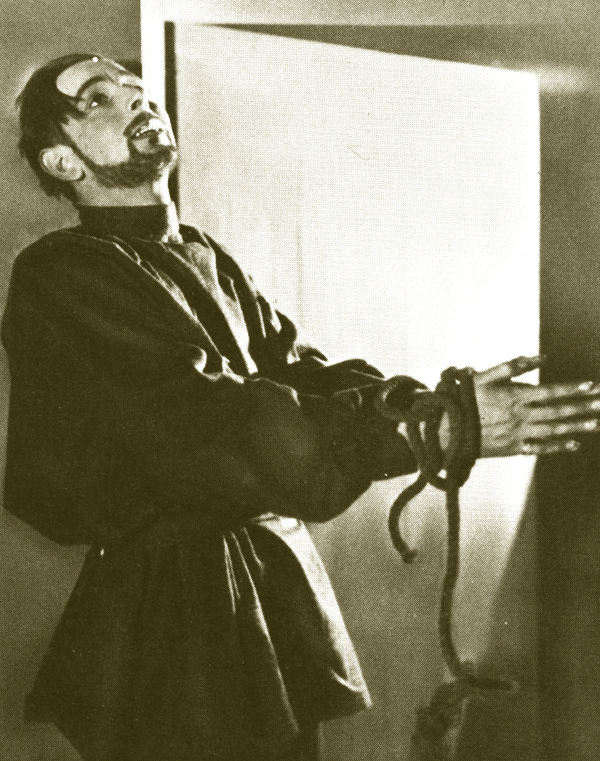
Community hub
Recent from talks
Contribute something
Nothing was collected or created yet.
Arthur Hohl
View on Wikipedia
Arthur Hohl (May 21, 1889 – March 10, 1964) was an American stage and motion-picture character actor.
Key Information


Formative years and family
[edit]Born in Pittsburgh, Pennsylvania on May 21, 1889, Hohl began appearing in films during the early 1920s. He played a great number of villainous or mildly larcenous roles, although his screen roles usually were small, but he also played a few sympathetic characters.[citation needed]
In 1920, Hohl married Jessie E. Gray, who survived him when he died in 1964. The couple had no children.[1]
Career
[edit]Hohl's two performances seen most often today are as Pete, the nasty boat engineer who tells the local sheriff about Julie (Helen Morgan) and her husband (Donald Cook)'s secret interracial marriage in Show Boat (1936), and as Mr. Montgomery, the man who helps Richard Arlen and Leila Hyams make their final escape in Island of Lost Souls (1932). He also played Brutus opposite Warren William's Julius Caesar in Cecil B. DeMille's version of Cleopatra (1934), starring Claudette Colbert.
Among his other notable roles were as Olivier, King Louis XI's right-hand man, in The Hunchback of Notre Dame (1939), as the real estate agent in Charlie Chaplin's Monsieur Verdoux (1947), and as Journet, a bereaved innkeeper who seeks to avenge his daughter's murder in the Basil Rathbone Sherlock Holmes film The Scarlet Claw (1944). Hohl also played a Christian named Titus in Cecil B. DeMille's religious epic The Sign of the Cross (1932).
Many sources claim that Hohl played a monk in the 1943 film classic The Song of Bernadette, but he is nowhere to be seen in the finished film.
Hohl also appeared on the Broadway stage in plays by William Shakespeare, George Bernard Shaw, and Henrik Ibsen. Some of his stage roles, such as Sir Andrew Aguecheek in a 1930 Broadway revival of Twelfth Night,[2] were considerably larger than his film roles.
Filmography
[edit]- Wolfe and Montcalm (1924) as Gen. James Wolfe
- The Puritans (1924)
- It Is the Law (1924) as Albert Woodruff / Sniffer
- The Cheat (1931) as Defense Attorney (uncredited)
- The Night of June 13 (1932) as Prosecuting Attorney
- The Sign of the Cross (1932) as Titus
- Island of Lost Souls (1932) as Montgomery
- The Crime of the Century (1933) as Announcer (uncredited)
- Infernal Machine (1933) as Ship's Captain
- The Life of Jimmy Dolan (1933) as Herman Malvin
- The Silk Express (1933) as Wallace Myton
- Private Detective 62 (1933) as Hogan
- The Narrow Corner (1933) as Captain Nichols
- Baby Face (1933) as Ed Sipple
- Captured! (1933) as Cocky
- Brief Moment (1933) as Steve Walsh
- Wild Boys of the Road (1933) as Dr. Heckel
- Footlight Parade (1933) as Frazer
- The Kennel Murder Case (1933) as Gamble - the Butler
- Man's Castle (1933) as Bragg
- College Coach (1933) as Seymour Young
- The World Changes (1933) as Mr. Patten
- Massacre (1934) as Dr. Turner
- As the Earth Turns (1934) as George
- Jimmy the Gent (1934) as Joe
- A Modern Hero (1934) as Homer Flint
- The Defense Rests (1934) as James Randolph
- Bulldog Drummond Strikes Back (1934) as Dr. Sothern
- Girl in Danger (1934) as Albert Beckett
- Among the Missing (1934) as Gordon
- Cleopatra (1934) as Brutus
- Lady by Choice (1934) as Kendall
- Against the Law (1934) as Kelly
- Jealousy (1934) as Mike Callahan
- Romance in Manhattan (1935) as Halsey J. Pander
- The Whole Town's Talking (1935) as Detective Sergeant Boyle
- In Spite of Danger (1935) as Steve Lynch
- I'll Love You Always (1935) as Jergens
- Eight Bells (1935) as Williams
- One Frightened Night (1935) as Arthur Proctor
- Village Tale (1935) as Elmer Stevenson
- Unknown Woman (1935) as Lansing
- After the Dance (1935) as Louie
- Atlantic Adventure (1935) as Frank Julian
- Case of the Missing Man (1935) as Steve
- Guard That Girl (1935) as Reynolds
- Super Speed (1935) as Philip Morton
- We're Only Human (1935) as Conroy (uncredited)
- If You Could Only Cook (1935) as Lawyer John Martin
- The Lone Wolf Returns (1935) as Undetermined Supporting Role (scenes deleted)
- It Had to Happen (1936) as Honest John Pelkey
- Show Boat (1936) as Pete
- Forgotten Faces (1936) as Hi-Jack Eddie
- The Devil-Doll (1936) as Victor Radin
- Lloyd's of London (1936) as First Captain
- The Road Back (1937) as Heinrich
- Slave Ship (1937) as Grimes
- Mountain Music (1937) as Prosecuting Attorney (uncredited)
- Trapped by G-Men (1937) as Henchman Blackie
- Hot Water (1937) as Walter Whittaker
- The Bad Man of Brimstone (1937) as 'Doc' Laramie
- Penitentiary (1938) as Finch (uncredited)
- Kidnapped (1938) as Riach
- Crime Takes a Holiday (1938) as Joe Whitehead
- Stablemates (1938) as Mr. Gale
- Boy Slaves (1939) as Sheriff
- You Can't Cheat an Honest Man (1939) as Burr
- Help Wanted (1939) as Graham - Head of Employment Agency (uncredited)
- They Shall Have Music (1939) as Miller
- Fugitive at Large (1939) as Curtis
- The Adventures of Sherlock Holmes (1939) as Bassick
- Blackmail (1939) as Rawlins
- Two Thoroughbreds (1939) as Thaddeus Carey
- The Hunchback of Notre Dame (1939) as Olivier
- 20 Mule Team (1940) as Salters
- Blondie Has Servant Trouble (1940) as Eric Vaughn
- Men of Boys Town (1941) as Guard
- Ride on Vaquero (1941) as Sheriff Johnny Burns
- We Go Fast (1941) as Hold-Up Man
- Son of Fury: The Story of Benjamin Blake (1942) as Captain Greenough
- Moontide (1942) as Jennings
- Whispering Ghosts (1942) as Inspector Norris
- City Without Men (1943) as Convict (uncredited)
- Idaho (1943) as Spike Madagan
- The Woman of the Town (1943) as Robert Wright
- The Spider Woman (1944) as Adam Gilflower
- The Scarlet Claw (1944) as Emile Journet
- The Eve of St. Mark (1944) as Sheep-Wagon Driver (uncredited)
- Shadows in the Night (1944) as Riggs (uncredited)
- Irish Eyes Are Smiling (1944) as Barker (uncredited)
- Mystery of the River Boat (1944) as Clayton
- Salome, Where She Danced (1945) as Bartender
- The Thin Man Goes Home (1945)
- The Frozen Ghost (1945) as Skeptic
- Love Letters (1945) as Jupp (uncredited)
- Our Vines Have Tender Grapes (1945) sa Dvar Svenson (uncredited)
- The Yearling (1946) as Arch Forrester (uncredited)
- Monsieur Verdoux (1947) as Real Estate Agent
- It Happened on 5th Avenue (1947) as Brady - Gates Patrolman (uncredited)
- The Vigilantes Return (1947) as Sheriff
- The Three Musketeers (1948) as Dragon Rouge Host (uncredited)
- You Gotta Stay Happy (1948) as Cemetery Man
- Down to the Sea in Ships (1949) as Blair (uncredited) (final film role)
References
[edit]- ^ "Arthur Hohl – Broadway to Hollywood, Double-Dealers All the Way". Immortal Ephemera. May 21, 2015.
- ^ "Twelfth Night – Broadway Play – 1930 Revival | IBDB".
External links
[edit]
- Arthur Hohl at IMDb
- Arthur Hohl at the Internet Broadway Database
| International | |
|---|---|
| National | |
| Other | |

Arthur Hohl
View on GrokipediaEarly life
Family background
Arthur Hohl was born on May 21, 1889, in Pittsburgh, Pennsylvania, to immigrant parents.[4] His father, Leonard Hohl, was a Swiss immigrant who arrived in the United States in 1883, while his mother, Christine Metzger, was a German immigrant who arrived in 1882; the couple married in 1884.[5] The family, which included an older brother named Leonard born in 1884, relocated from Pittsburgh to Butte County, California, shortly after Arthur's birth, providing the setting for his early upbringing in the state's Central Valley.[1] No other siblings are recorded in available family records.Military service
Arthur Hohl was inducted into the United States Army in May 1918, shortly after his 29th birthday, and served during the final months of World War I. He was deployed overseas to France, where he performed ground duties from July 31, 1918, until July 25, 1919. In May 1919, Hohl was promoted to the rank of Second Lieutenant before receiving an honorable discharge upon his return to the United States.[1] Hohl's experiences in France fostered a strong respect for African American troops, whose bravery he witnessed firsthand amid the chaos of battle. He later recounted the emotional impact of retrieving a bloodstained uniform from a fallen Black soldier, an act that symbolized the shared sacrifices of all servicemen regardless of race. This wartime camaraderie made it challenging for Hohl to embody antagonistic racial portrayals in his acting career, such as the character Witzel—a self-proclaimed "Negro-hater"—in the 1923 Broadway production of White Cargo, a role he described as conflicting with the unity he observed among diverse troops.[1]Stage career
Early performances
Arthur Hohl began his theatrical career with a debut in 1910, performing with a stock company in San Francisco. This initial foray into professional acting provided him with foundational experience in repertory theater, where performers often took on multiple roles across a season of productions.[1] In 1911, Hohl appeared in a regional production of William Shakespeare's Julius Caesar in Oakland, California, where he portrayed the title character. The role marked an early highlight in his stage work, showcasing his versatility in classical drama during his formative years in West Coast theater.[1] Before achieving prominence on Broadway, Hohl accumulated practical knowledge through extensive involvement in stock theater companies and by serving as a stage manager. These pre-Broadway roles honed his skills in production logistics and performance, laying the groundwork for his later success as a character actor. His early momentum was briefly halted by U.S. Army service during World War I from 1918 to 1919, after which he recommenced his stage endeavors with renewed focus.[1]Broadway roles
Arthur Hohl made his Broadway debut in 1914, portraying Chal Fisher in the original production of The Dummy, a play that ran for 200 performances at the Hudson Theatre.[6] Throughout the 1910s and early 1920s, Hohl appeared in several notable revivals of classic works, establishing himself as a versatile character actor. In 1916, he took on the role of Pastor Manders in Henrik Ibsen's Ghosts, a production that enjoyed a substantial run of more than a year at the Comedy Theatre.[7] Two years later, in 1918, he played Mr. Praed in George Bernard Shaw's Mrs. Warren's Profession, a controversial revival that highlighted his ability to handle complex supporting characters in socially provocative dramas.[8] Hohl's breakthrough came in 1924 when he replaced A.E. Anson in the long-running hit White Cargo by Leon Gordon, assuming the role of Witzel, the hard-drinking plantation overseer, in a production that ran for 257 performances, transferring to Daly's Theatre.[1][9][10] During this period, Hohl expressed personal discomfort with the character's racial attitudes, describing Witzel as a "Negro-hater" and linking his unease to wartime experiences that left him averse to such portrayals, though the role's demands also contributed to his exhaustion.[1] That same year, while performing nightly as Witzel, Hohl took on dual roles—Albert Woodruff and Sniffer Evans—in the film adaptation of It Is the Law (1924) by Elmer Rice, demonstrating his capacity for multitasking in a grueling schedule.[1] In the late 1920s, Hohl continued to build his reputation with prominent supporting parts in popular melodramas. He portrayed District Attorney Galway in The Trial of Mary Dugan (1927–1928), a courtroom thriller starring Ann Harding that ran for 437 performances at the National Theatre and solidified his typecasting as authoritative figures.[11] By the early 1930s, Hohl tackled Shakespearean comedy as Sir Andrew Aguecheek in a 1930 revival of Twelfth Night at the Maxine Elliott Theatre, showcasing his comedic timing opposite Jane Cowl.[12] His final major Broadway appearance came in 1932 as Harris Wolfhill in the original drama Distant Drums by Dan Totheroh, a short-lived production that marked the end of his stage prominence before transitioning to film work.[13][1]Film career
Transition to cinema
Hohl began his film career in the early 1920s, making initial appearances in silent movies while still active on Broadway. By 1930, he had completed several silent films, including It Is the Law (1924), Wolfe and Montcalm (1924), and The Puritans (1924).[2] After wrapping up his stage commitments, Hohl relocated to Los Angeles in 1931, purchasing a home on Coldwater Canyon Road and committing fully to Hollywood.[1] The skills honed in Broadway character roles translated effectively to screen work, where Hohl quickly adapted to the demands of sound production. His first major sound film appearances came that same year, with parts in The Cheat and The Night of June 13th (1932), launching a steady output that encompassed nearly 100 films by his retirement in 1949.[1][2]Notable films and roles
Arthur Hohl was often typecast in sound-era films during the 1930s and 1940s as cowardly villains, double-dealers, humorless prosecutors, or sympathetic criminals, his gaunt physique and stern expression lending authenticity to these morally complex archetypes.[1] This typecasting drew from his stage experience, which honed his ability to deliver nuanced character performances in cinema.[1] Hohl's career peaked in the 1930s, when he maintained a demanding schedule appearing in multiple films annually across major studios like Warner Bros., Paramount, and RKO, showcasing his reliability in supporting roles that added tension or pathos to narratives.[1] By the 1940s, his output declined, with fewer and smaller parts reflecting the shifting demands of Hollywood's post-war landscape.[1] Among his standout villainous turns, Hohl portrayed the duplicitous Mr. Montgomery, assistant to the mad scientist Dr. Moreau, in Island of Lost Souls (1932), where his character's internal conflict provided a human counterpoint to the film's grotesque horrors.[14] In Cecil B. DeMille's epic The Sign of the Cross (1932), he embodied the steadfast yet doomed Christian leader Titus, a sympathetic figure persecuted amid Roman decadence.[15] His role as the scheming Captain Nichols in The Narrow Corner (1933), adapted from Somerset Maugham, highlighted his skill in depicting opportunistic seafarers entangled in moral dilemmas.[16] Hohl's collaboration with James Cagney in Jimmy the Gent (1934) further exemplified his type as a double-dealing con artist, while as Brutus in Cleopatra (1934), he delivered a terse portrayal of the assassin's betrayal opposite Claudette Colbert's queen.[17][18] Hohl also excelled in roles blending antagonism with vulnerability, such as the corrupt politician Ed Sipple in Baby Face (1933), whose lecherous advances underscored the film's critique of power dynamics, and the callous Dr. Heckel in William Wellman's Wild Boys of the Road (1933), a prosecutor whose indifference amplified the Depression-era plight of youth.[19][20] In Frank Borzage's Man's Castle (1933), his Bragg served as a predatory drifter threatening the fragile romance at the story's core.[21] Later, Hohl brought gruff authenticity to the boat engineer Pete in the musical Show Boat (1936), a collaboration with Irene Dunne and Allan Jones that marked one of his more grounded antagonistic figures.[22] His work with Wallace Beery and Mickey Rooney in Stablemates (1938) as the skeptical Mr. Gale added comic edge to the horse-racing drama.[23] In the 1940s, Hohl's performances often featured sympathetic undertones, as seen in his Olivier, a loyal but beleaguered courtier, in The Hunchback of Notre Dame (1939) alongside Charles Laughton, and as the henchman Bassick in The Adventures of Sherlock Holmes (1939), aiding George Zucco's Moriarty in a plot against Basil Rathbone's detective.[24][25] He portrayed the innkeeper Emile Journet in the Sherlock Holmes mystery The Scarlet Claw (1944), contributing to the film's atmospheric tension with Basil Rathbone and Nigel Bruce.[26] Notable later collaborations included the rural Swede Dvar Svenson in Our Vines Have Tender Grapes (1945), a gentle giant in Edward Ludwig's family drama with Edward G. Robinson, and Charlie, a gossipy villager, in The Thin Man Goes Home (1945), enhancing the comedic sleuthing of William Powell and Myrna Loy.[27] Finally, in Charlie Chaplin's Monsieur Verdoux (1947), Hohl played a sleazy real estate agent, his oily demeanor perfectly suiting the satirical takedown of bourgeois hypocrisy.[1]Personal life and death
Marriage and residences
Arthur Hohl married Jessie E. Gray, an English woman ten years his senior, on April 27, 1920, at New York City's Hall of Records.[1] This union, which took place amid the early stages of his Broadway career, produced no children and lasted until Hohl's death in 1964.[1] The couple initially resided in a home valued at $15,000 in Queens, New York, where they settled during Hohl's stage acting years in the 1920s.[1] In 1931, as Hohl transitioned to Hollywood, they relocated to Los Angeles and purchased a house on Coldwater Canyon Road.[1] Jessie Hohl outlived her husband by several years, passing away in December 1972 in Dorset, England, at the age of 93.[1]Later years and passing
Following his final film role in Down to the Sea in Ships (1949), where he appeared uncredited as Blair, Arthur Hohl retired from acting and did not pursue any subsequent work in television or radio.[28][2] Hohl spent his post-retirement years living quietly in Los Angeles, with scant public records detailing his activities during this period.[1] He passed away on March 10, 1964, in Los Angeles County, California, at the age of 74; the cause of death was not publicly documented, and no obituaries were published at the time.[2] Despite appearing in nearly 100 films over nearly two decades, Hohl remains a prolific yet underremembered character actor, his contributions largely overshadowed by leading performers of the era.[1]Works
Stage credits
Arthur Hohl began his stage career with stock performances in San Francisco in 1910.[1] In 1911, he appeared as Casca in a production of Julius Caesar in Oakland, California.[29] His Broadway debut came in 1914 as Chal Fisher in The Dummy. Hohl portrayed Pastor Manders in Henrik Ibsen's Ghosts revival in 1916. He played Mr. Praed in George Bernard Shaw's Mrs. Warren's Profession revival in 1918.[8] In 1922, Hohl appeared as Albert Woodruff in It Is the Law. He took the role of Witzel in White Cargo in 1924.[9] From 1927 to 1928, Hohl performed as District Attorney Galway in The Trial of Mary Dugan. In 1930, he played Sir Andrew Aguecheek in William Shakespeare's Twelfth Night revival.[12] Hohl's final listed Broadway credit was as Harris Wolfhill in Distant Drums in 1932.[13] Hohl appeared in productions by Shakespeare, Shaw, and Ibsen, including the roles noted above.[30] His stage work in It Is the Law overlapped with early film, as he reprised the role in the 1924 silent adaptation.[31]Film credits
Arthur Hohl appeared in nearly 100 films between 1924 and 1949, transitioning from silent cinema to sound pictures and often playing supporting roles in dramas, adventures, and comedies.[2] The following table provides a chronological selection of his film credits, representing key examples from his career.| Year | Title |
|---|---|
| 1925 | The Monster |
| 1929 | The Desert Song |
| 1930 | Going Wild |
| 1932 | Island of Lost Souls |
| 1932 | The Sign of the Cross |
| 1933 | Baby Face |
| 1933 | The Kennel Murder Case |
| 1933 | Man's Castle |
| 1933 | Private Detective 62 |
| 1933 | The Narrow Corner |
| 1933 | Wild Boys of the Road |
| 1934 | Cleopatra |
| 1934 | Jimmy the Gent |
| 1935 | One Frightened Night |
| 1935 | Romance in Manhattan |
| 1935 | The Whole Town's Talking |
| 1935 | Village Tale |
| 1936 | It Had to Happen |
| 1936 | Show Boat |
| 1938 | Crime Takes a Holiday |
| 1938 | Kidnapped |
| 1938 | Stablemates |
| 1939 | The Adventures of Sherlock Holmes |
| 1939 | Blackmail |
| 1939 | Fugitive at Large |
| 1939 | The Hunchback of Notre Dame |
| 1939 | They Shall Have Music |
| 1939 | Two Thoroughbreds |
| 1940 | 20 Mule Team |
| 1940 | Blondie Has Servant Trouble |
| 1941 | Men of Boys Town |
| 1942 | Moontide |
| 1942 | Whispering Ghosts |
| 1943 | Idaho |
| 1944 | Mystery of the River Boat |
| 1944 | Sherlock Holmes and the Spider Woman |
| 1944 | The Scarlet Claw |
| 1944 | The Thin Man Goes Home |
| 1945 | Our Vines Have Tender Grapes |
| 1947 | Monsieur Verdoux |
| 1948 | The Three Musketeers |
| 1948 | You Gotta Stay Happy |
| 1949 | Down to the Sea in Ships |