Recent from talks
Nothing was collected or created yet.
Azabu
View on Wikipedia35°39′16.7256″N 139°44′13.5″E / 35.654646000°N 139.737083°E

Azabu (麻布) is an area in Minato, Tokyo, Japan. Built on a marshy area of foothills south of central Tokyo, its coverage roughly corresponds to that of the former Azabu Ward, presently consisting of nine official districts: Azabu-Jūban, Azabudai, Azabu-Nagasakachō, Azabu-Mamianachō, Minami-Azabu, Nishi-Azabu, Higashi-Azabu, Moto-Azabu and Roppongi. It is known as one of Tokyo's most expensive and upscale residential districts with many artists, business people, and celebrities residing there. It is also known for its large foreign population, due in part to a number of foreign embassies present in the area.
Etymology
[edit]The name Azabu (麻布) literally means “hemp cloth.” It first appears in records from 1559 as “阿佐布,” with several variant writings used through the Edo period. The present form (麻布) came into regular use by the mid-17th century, and is thought to derive from local farmers in Moto-Azabu who produced hemp cloth.[1]
History
[edit]Until the early Edo period, the area was agricultural. Archaeological evidence indicates that the area was inhabited as far back as the Jōmon period. The Juban Inari shrine (formerly known as Takechiyo Inari) was constructed in AD 712, the temple of Zenpuku-ji in 824, and the Hikawa Shrine in 939 (on orders of Minamoto no Tsunemoto).
The area became urbanized in the 17th century, after Tokugawa Ieyasu established his seat of government in nearby Edo. Azabu soon became home to the Juban Horse Grounds, Edo's largest horse market. In 1859, the first United States delegation in Japan was established at Zenpuku-ji.
Azabu (including the adjacent district of Roppongi) was a ward of Tokyo from 1878 to 1947. During the industrialization of the Meiji era, Azabu was connected to Tokyo by horse-drawn trams. The lowlands became light commercial areas, while the hilltops became prime residential areas. Later, during the Taishō period, Azabu was overrun with theaters, department stores, and red-light districts, becoming one of Japan's best-known entertainment districts.
Much of Azabu was destroyed during the firebombing of Tokyo in 1945, although a special bunker created for the privileged classes that lived there saved many lives, including Yoko Ono's.[2] Azabu's commercial areas were not revived after the war, and the area is mainly a residential district today. Following the merger of Azabu Ward into Minato Ward in 1947, the Azabu ward office located in Roppongi was converted into a branch office of the Minato ward government.
Notable residents
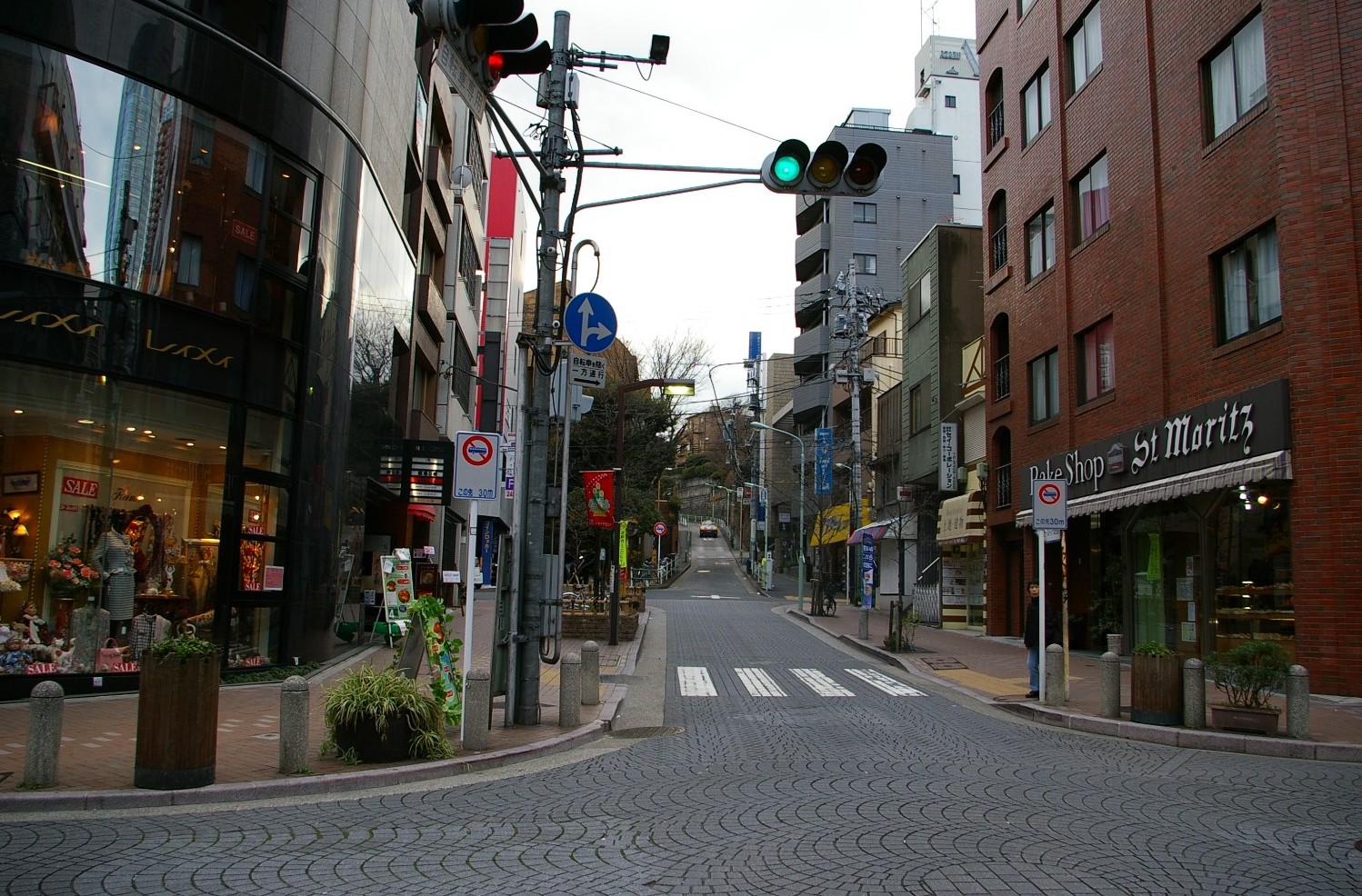
[edit]This is the district of Tokyo where manga artist Naoko Takeuchi resides, and the Azabu-Jūban area is the setting of her fictional Sailor Moon series. The internationally acclaimed vocalist Ayumi Hamasaki resides in a penthouse apartment in Minami-Azabu. Azabu is also the location of many international embassies and consulates, as well as a large foreign population. Azabu-Jūban, with its unique cobbled high-street, also hosts the popular annual Azabu-Jūban Matsuri, a food festival with a variety of local vendor stalls and carnival games which attract large crowds every summer.
Places in Azabu
[edit]Azabu contains a concentration of foreign embassies including those of Afghanistan, Russia, China, Germany, Austria, Switzerland, Slovakia, Taiwan, Norway, Philippines, Finland, South Korea, Iran, France, Romania, Greece and Portugal.
Among the area's historic religious sites is Zenpuku-ji, a temple which housed the first legation of the United States in Japan during the 19th century. Nearby Hikawa Shrine serves as a focal point for local festivals.
Azabu also hosts major community institutions. The Mindan (Korean Residents Union in Japan) has its headquarters here, reflecting the area’s role as a hub for Tokyo’s Korean population. The district also contains the long-standing Azabu-Jūban shopping street, Azabu High School, and several international schools, contributing to its reputation as a cosmopolitan neighborhood.
Companies based in Azabu
[edit]- Fujifilm, located in Nishi-Azabu
Subway stations
[edit]- Akabanebashi Station (Toei Oedo Line)
- Azabu-Jūban Station (Namboku Line, Toei Oedo Line)
- Hiroo Station (Hibiya Line)
Education
[edit]Schools
[edit]The City of Minato (The Minato Ward) Board of Education operates local public elementary and junior high schools. Tokyo Metropolitan Government Board of Education operates local public high schools.
- Roppongi High School, a public school, located in Roppongi (former district in Azabu Ward).
- Toyo Eiwa Jogakuin, a private girls school, located in Roppongi (former district in Azabu Ward).
- Azabu Junior and Senior High School, a private boys school, located in Moto-Azabu.
- Hiroo Gakuen Junior and Senior High School, a private school, located in Minami-Azabu.
- Kōryō Junior High School, a public school, located in Nishi-Azabu.
- Azabu Elementary School, a public school, located in Azabu-Dai.
- Nanzan Elementary School, a public school, located in Moto-Azabu.
- Kōgai Elementary School, a public school located in Nishi-Azabu, which has "Nihongo Gakkyu (Japanese language class)" for foreign students and returnee.[3][4]
- Higashimachi Elementary School, a public school, located in Azabu-Jūban.
- Honmura Elementary School, a public school, located in Minami-Azabu.
- Nishimachi International School, a private school located in Moto-Azabu.[5]
- Tokyo International School, a private school located in Minami-Azabu.
- Chateau School, a private pre school, located in Nishi-Azabu.
- Ohana International School in Tokyo, a small preschool, located in the centre of Azabu-Jūban.
- The Montessori School of Tokyo, a private school, located in Minami-Azabu.
Public libraries
[edit]- Tokyo Metropolitan Central Library, located in Arisugawa-no-miya-Kinen Kōen (Arisugawa-no-miya Memorial Park), Minami-Azabu.
- The Azabu Library exists in Azabu-Juban.[6]
References
[edit]- ^ "地名の歴史(麻布地区)" (in Japanese). Minato City. Retrieved September 24, 2025.
- ^ Mission to Tokyo: The American Airmen Who Took the War to the Heart of Japan By Robert F. Dorr, p 167.
- ^ Minato public elementary and junior high school guidebook [PDF] www.city.minato.tokyo.jp › sentaku
- ^ The Japanese Department at Kogai Elementary School 1 2 3 4 5 6 [PDF] kougai-es.minato-tky.ed.jp › nihongogakkyu
- ^ "About Page". Nishimachi International School. Retrieved 18 November 2019.
- ^ "Minato City - City libraries". Archived from the original on 2008-05-24. Retrieved 2008-08-27.
See also
[edit]Azabu
View on GrokipediaOverview
Etymology
The name Azabu (麻布), written with kanji meaning "hemp cloth," derives from the area's early agricultural economy centered on the cultivation of hemp (asa) and the weaving of cloth (nu) from its fibers.[7][8][9] This etymology reflects the region's pre-urban development as a rural district where such textile production was prominent, with historical records indicating hemp farming and fabric manufacturing as key local activities by at least the Edo period (1603–1868).[2] Earlier variant spellings, such as Asabu or Asao, suggest phonetic evolution from terms denoting fertile land suitable for hemp growth, which gradually standardized to Azabu by the late 17th century.[10][11] Folk traditions occasionally attribute the name to a legendary rain of hemp fibers on a local mountain, but these lack empirical support and are secondary to the documented agrarian origins.[12][13]Administrative Status
Azabu constitutes a district within Minato Ward (Minato-ku), one of the 23 special wards of Tokyo Metropolis, Japan, which collectively form the core urban area equivalent to former Tokyo City and possess municipal autonomy under the Local Autonomy Law, including elected mayors and assemblies responsible for local governance, taxation, and services.[14][15] Prior to this structure, Azabu operated as an independent ward, Azabu-ku, until its merger with Akasaka Ward and Shiba Ward on March 15, 1947, to create Minato-ku amid post-war administrative consolidations aimed at streamlining Tokyo's governance following the 1943 fusion of Tokyo City and Prefecture into Tokyo Metropolis.[16][17][18] Today, Azabu lacks separate administrative autonomy and falls under Minato-ku's unified administration, with local services delivered through district-level offices; the former Azabu Ward office in Roppongi now serves as a branch for Minato-ku operations in the area.[19] Minato-ku delineates Azabu as one of its five key districts—alongside Shiba, Akasaka, Takanawa, and Shibaura-Konan—for urban planning, community engagement, and infrastructure management.[19] The district encompasses multiple neighborhoods (chō), including Azabudai, Azabu-Jūban, Azabu-Nagasakachō, Higashi-Azabu, Minami-Azabu, Moto-Azabu, and Nishi-Azabu, each with postal addresses tied to Minato-ku but retaining historical place names for local identity and zoning.[5][20]History
Origins and Pre-Edo Development
The name Azabu (麻布), literally "hemp cloth," originates from the local production of cloth made from asa (hemp or ramie fiber) by farmers in the Moto-Azabu area during pre-modern times.[21] This etymology reflects the region's early economic focus on agriculture and textile crafting, with historical records noting such activities prior to widespread urbanization.[2] Prior to the Edo period (1603–1868), Azabu formed part of the rural landscape in Musashi Province, characterized by scattered settlements, farmland, and limited infrastructure. The area saw minimal development, serving mainly as an agricultural hinterland removed from major political centers like Kyoto. Archaeological and historical indications suggest human activity dating back potentially to prehistoric eras, though documented evidence emphasizes Heian-period (794–1185) religious establishments as key markers of organized presence.[22] A pivotal early development was the founding of Zenpuku-ji Temple (also known as Azabu-san Zenpuku-ji) in 824 CE by the monk Kūkai (Kōbō Daishi), founder of the Shingon school of esoteric Buddhism. Originally established in its current Moto-Azabu location during the Heian era's Tenchō period, the temple underscores the introduction of Buddhist institutions to the region, which provided spiritual and communal anchors amid otherwise agrarian isolation. Over centuries, it transitioned affiliations, including to the Jōdo Shinshū sect by the Kamakura period (1185–1333), but retained its status as one of Tokyo's oldest temples after Sensō-ji.[23][24] Other ancient shrines and temples dotted the landscape, fostering modest cultural continuity, yet Azabu remained predominantly rural with low population density until the Tokugawa shogunate's influence spurred growth.[24]Edo Period Expansion
During the Edo period (1603–1868), Azabu experienced rapid urbanization as Edo expanded under Tokugawa rule, shifting from agricultural and marshy foothills to a district dominated by samurai residences and religious institutions. After Tokugawa Ieyasu established the shogunate in 1603, the area attracted hatamoto—direct vassals of the shogun—who built yashiki (mansions) there, drawn by its elevated terrain south of Edo Castle, which offered defensibility and proximity to the administrative center.[25] This development accelerated in the 17th century, with daimyo (feudal lords) also constructing secondary residences, transforming Azabu into a key outer residential zone for the warrior class.[1][2] The district's growth was supported by infrastructure improvements, including roads and the Azabu River, which facilitated transport of building materials like stone from Kanagawa Prefecture quarries for yashiki and fortifications.[26] Temples and shrines, many predating the period, proliferated alongside these secular estates, with Azabu hosting numerous such sites by the mid-18th century amid the sankin-kōtai system that swelled Edo's population beyond one million.[25][27] This expansion reflected broader patterns of "Greater Edo," where peripheral areas like Azabu filled with retainers' compounds, merchants' quarters, and support economies, though the district retained some rural pockets until later shogunate policies encouraged further densification.[22][28] By the late Edo period, maps depicted Azabu as a patchwork of large yashiki lots, temples, and emerging commercial nodes, underscoring its role in accommodating the shogunate's bureaucratic and military elite.[29] Daimyo residences, mandated under alternating attendance, exemplified this, with examples like the Akita clan's spare yashiki highlighting the area's status as a secondary power center.[30] Such proliferation not only boosted local commerce but also entrenched Azabu's hierarchical social structure, dominated by samurai until the Meiji Restoration disrupted these feudal arrangements.[31]Meiji Era to Post-War Modernization
Following the Meiji Restoration in 1868, which dismantled the feudal system and samurai privileges, Azabu's traditional daimyo and hatamoto residences faced repurposing or sale amid Japan's rapid Westernization and centralization of power in Tokyo. Prominent figures acquired estates in the district, including Foreign Minister Inoue Kaoru, Prince Kuninomiya, the Akaboshi family, and the Iwasaki family (founders of Mitsubishi), reflecting its appeal to the emerging Meiji elite.[32] Many former samurai mansions were converted into foreign legations, capitalizing on Azabu's proximity to the new imperial center and its established prestige, thus initiating the area's international diplomatic presence.[33] In 1878, Azabu was established as Azabu-ku, one of Tokyo City's 15 wards, integrating it into the expanding urban administrative framework during the industrialization push.[6] Sub-areas like Azabu-Juban flourished as commercial hubs, drawing shoppers and vendors in the late 19th and early 20th centuries, though this vibrancy waned by the interwar period.[34] Through the Taisho (1912–1926) and early Showa (1926–1989) eras, the district retained its residential character for government officials and affluent families, with some locales renamed to evoke scenic views, such as Azabu Fujimi-cho post-Meiji.[35] World War II air raids inflicted substantial damage on Azabu, as with much of Tokyo, disrupting its built environment and economy. Postwar reconstruction from 1945 emphasized resilient urban rebuilding, prioritizing residential and diplomatic functions over commerce; Azabu's commercial districts were not fully restored, reinforcing its upscale housing role.[36] On March 15, 1947, Azabu-ku merged with Akasaka-ku and Shiba-ku to form Minato-ku, streamlining governance amid Japan's democratization and economic recovery under U.S. occupation.[37] This period solidified Azabu's status as a haven for foreign embassies and wealthy expatriates, leveraging its prewar legacy amid Tokyo's broader modernization.Contemporary Developments
In the late 20th and early 21st centuries, Azabu experienced accelerated urban redevelopment driven by rising land values and demand for mixed-use spaces, transforming parts of the district into modern commercial and residential hubs. A landmark project was Azabudai Hills, a comprehensive regeneration initiative by Mori Building Co., Ltd., spanning nearly 30 years of planning and culminating in its opening in November 2023; this development covers approximately 8.1 hectares in central Minato ward, incorporating office towers, cultural facilities, hotels, and 2.4 hectares of integrated green space to foster a "modern urban village" amid Tokyo's dense core.[38][39] Parallel to such large-scale efforts, luxury residential construction boomed, with properties like Azabu Gardens West emerging as symbols of exclusivity in Minato ward's Azabu area, offering low-rise apartments tailored for high-net-worth individuals seeking spacious urban living; this trend aligned with broader Japanese real estate dynamics, where Tokyo recorded US$13.2 billion in property transactions in the first half of 2025 alone, fueled by foreign investment and redevelopment incentives.[40][41] Ongoing initiatives, such as the Nishi-Azabu 3-chome urban redevelopment project announced around 2023, exemplify continued infrastructure upgrades, featuring a planned 54-story mixed-use high-rise on a 1.6-hectare site adjacent to Roppongi Hills, aimed at enhancing road networks, public spaces, and disaster resilience while elevating the area's real estate appeal through green integration and elevated urban functions.[42][43] These projects have intensified Azabu's role as a premium enclave, drawing expatriates and executives, though they have also sparked local discussions on preserving the district's traditional low-rise character amid vertical expansion pressures.[20]Geography and Demographics
Location and Topography
Azabu forms a key district within Minato City, a special ward in Tokyo Metropolis, Japan, situated roughly 4 to 6 kilometers southwest of Tokyo Station in the city's central region. The district integrates into Minato's southeastern expanse, bordering areas like Shibuya Ward to the southwest, Meguro Ward to the south, and internal Minato neighborhoods such as Akasaka and Roppongi. It encompasses sub-areas including Azabu-Jūban, Motoazabu, Minami-Azabu, Azabu-Nagasakachō, and Azabu-Mamianachō, with approximate central coordinates at 35.6528° N, 139.7306° E.[44][45] The terrain of Azabu reflects Tokyo's varied urban geology, originating from foothills south of the central plateau with historical marshy lowlands that have been extensively developed. Elevations in the district generally range from near sea level in lower sections, such as parts of Azabu-Jūban at around 6 meters, to higher points averaging 20-30 meters, contributing to its undulating profile.[46][47] Topographically, Azabu features gentle hills, valleys, and convoluted slopes that shape its narrow, winding streets and residential layouts, distinguishing it from Tokyo's flatter expanses. This hilly character, evident in developments like Azabudai Hills, which preserve and integrate natural elevations through terraced designs and green spaces totaling about 24,000 m², enhances drainage and views while accommodating high-density urban structures.[2][38][48]Population Characteristics
Azabu's population, encompassing the Azabu region within Minato City, totaled approximately 35,853 residents as of January 2025, comprising 31,628 Japanese nationals and 4,225 foreign residents.[49] This represents a foreign resident proportion of about 11.8%, notably higher than Minato City's overall rate of 8.3% (22,099 foreign residents out of 267,450 total in August 2024).[50] The elevated expatriate presence in Azabu stems from its concentration of embassies and diplomatic missions, attracting personnel from over 130 nationalities, with surveys indicating Minami-Azabu as a preferred residency for 11.2% of foreign respondents in Minato.[51] Demographic data for Azabu chōme (neighborhood units) reveal a compact, high-density urban profile, with individual areas ranging from 276 residents in Azabu-Nagasakachō to 4,700 in Minami-Azabu 1-chōme as of January 2025.[52] Population density aligns closely with Minato's citywide figure of 13,235 persons per km², reflecting Azabu's hilly topography and premium land use dominated by upscale residences and institutions.[49] Gender distribution shows slight female majorities in many chōme, consistent with broader Minato trends where females comprise about 49% of the population, though specific Azabu breakdowns vary by locale (e.g., 51% female in Minami-Azabu 1-chōme).[52] Socioeconomic characteristics underscore Azabu's status as an affluent enclave, with residents including business executives, artists, and diplomats; foreign nationals form the highest regional ratio in Minato, per municipal internationalization plans.[53] While citywide data indicate Minato's working-age population (20-64 years) exceeds 60%—higher than Tokyo's average due to urban migration—Azabu-specific age distributions are not separately tabulated but mirror this skew toward professionals and families, supported by international schools and high-end amenities.[54] Household structures emphasize smaller, high-income units, with multiple-nationality households numbering 997 in the Azabu region.[49]Landmarks and Institutions
Religious Sites
Azabu hosts several historic Shinto shrines and Buddhist temples reflecting its long-standing religious heritage amid urban development. Prominent among them are Zenpuku-ji Temple and Azabu Hikawa Shrine, both dating to the Heian period and embodying traditional Japanese spiritual practices.[23][55] Zenpuku-ji Temple, formally Azabusan Zenpukuji, was founded in 824 during the Heian period by the monk Kōbō Daishi (Kūkai), initially as a Shingon sect establishment.[23][56] In 1232, its abbot Saint Ryokai shifted affiliation to the Jōdo Shinshū sect, a change that persists today.[57] Located in Moto-Azabu, the temple is designated a historic site by the Tokyo Metropolitan Government and features a legendary ginkgo tree, purportedly planted in 1229 by the Jōdo Shinshū founder Shinran, claimed as Tokyo's oldest living tree.[23][58] It also holds historical significance as the site of the first United States legation in Japan in 1858, prior to the Perry expedition's formal treaty negotiations.[59] The temple grounds include traditional structures and serves as a serene enclave preserving Edo-period artifacts amid contemporary residential surroundings.[23] Azabu Hikawa Shrine, situated in Azabu-Juban, traces its origins to 938, when Minamoto no Tsunemoto, a progenitor of the Seiwa Genji clan, enshrined deities during military campaigns in the region.[55][60] Alternative records cite establishments in 939 or 942 tied to local pacification efforts against rebellions.[61][62] The shrine is renowned for its ancient camphor and pine trees, symbolizing enduring spiritual power, and participates in the Minato Ward's Seven Lucky Gods pilgrimage as the site for Ebisu.[63][62] It conducts seasonal festivals and offers omikuji fortune-telling, maintaining Shinto rituals focused on prosperity and protection despite proximity to modern commercial areas.[64]Embassies and Diplomatic Presence
Azabu serves as a prominent diplomatic hub in Tokyo, hosting numerous foreign embassies primarily in its sub-districts of Moto-Azabu, Minami-Azabu, Nishi-Azabu, and Higashi-Azabu. This concentration arose historically from the Meiji era, when early foreign legations, including the United States mission at Zempukuji Temple in Azabu, established presences there amid Japan's opening to the West, a pattern that persisted due to the area's upscale residential setting, stringent security provided by police and private firms, and central location facilitating access to government institutions.[65][66][67] The Japanese Ministry of Foreign Affairs maintains an official directory confirming dozens of chanceries in these locales, underscoring Azabu's role in Japan's international relations. Enhanced security protocols around embassy compounds contribute to the neighborhood's exclusivity and elevated property values, attracting diplomats and expatriates while limiting public access in certain zones.[68][69][67] Key embassies include those of major powers and European nations, as detailed below (addresses as listed by the Ministry of Foreign Affairs; postcodes and contact details omitted for brevity, but verifiable via official sources):| Country | Chancery Address |
|---|---|
| Argentina | 2-14-14, Moto-Azabu, Minato-ku, Tokyo |
| Austria | 1-1-20, Moto-Azabu, Minato-ku, Tokyo |
| China | 3-4-33, Moto-Azabu, Minato-ku, Tokyo |
| Cuba | 1-28-4, Higashi-Azabu, Minato-ku, Tokyo |
| Finland | 3-5-39, Minami-Azabu, Minato-ku, Tokyo |
| France | 4-11-44, Minami-Azabu, Minato-ku, Tokyo |
| Germany | 4-5-10, Minami-Azabu, Minato-ku, Tokyo |
| Ghana | 1-5-21, Nishi-Azabu, Minato-ku, Tokyo |
| Greece | 3-16-30, Nishi-Azabu, Minato-ku, Tokyo |
| Qatar | 2-3-28, Moto-Azabu, Minato-ku, Tokyo |
| Romania | 3-16-19, Nishi-Azabu, Minato-ku, Tokyo |
| San Marino | 3-5-1, Moto-Azabu, Minato-ku, Tokyo |
| Slovakia | 2-11-33, Moto-Azabu, Minato-ku, Tokyo |
| Switzerland | 5-9-12, Minami-Azabu, Minato-ku, Tokyo |
| Ukraine | 3-5-31, Nishi-Azabu, Minato-ku, Tokyo |
| European Union | 4-6-28, Minami-Azabu, Minato-ku, Tokyo |
