Hubbry Logo
Azure Swimming PoolAzure Swimming PoolMain
Open search
Azure Swimming Pool
Community hub
Azure Swimming Pool
logo
8 pages, 0 posts
0 subscribers
Be the first to start a discussion here.
Azure Swimming Pool
Azure Swimming Pool
from Wikipedia

OSM locator map of the swimming pool within the city of Pripyat

Key Information

The swimming pool in 2022

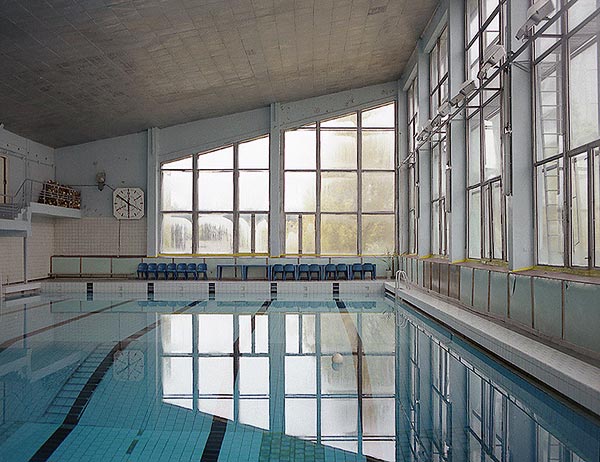
The Azure Swimming Pool (Ukrainian: Басейн Лазурний) was one of the indoor swimming pools in the abandoned city of Pripyat,[1][2] Ukraine, which was affected by the 1986 Chernobyl nuclear disaster.

History

[edit]

The complex was built in the 1970s and remained in use until 1998 (12 years after the Chernobyl nuclear disaster); during those 12 years the swimming pool was mainly used by Chernobyl liquidators.[3] The swimming pool was considered to be one of the cleanest places in Pripyat.[4] However, the swimming pool and the adjacent indoor basketball court have been abandoned and left to decay since its closure in 1998.

[edit]

The swimming pool appears in the following:

[edit]

See also

[edit]

References

[edit]
[edit]
Revisions and contributorsEdit on WikipediaRead on Wikipedia
from Grokipedia
The Azure Swimming Pool (Ukrainian: Басейн Лазурний), also known as Lazurny, is an abandoned indoor swimming facility located in the ghost city of , , within the . Constructed in the 1970s as part of the amenities for workers at the nearby , it featured a large glass frontage, diving boards, and supported a local swimming team before the 1986 disaster. Following the reactor explosion and subsequent evacuation of Pripyat's 50,000 residents, the pool uniquely remained operational, serving —cleanup personnel—until its closure in 1998, twelve years post-accident. This extended use stemmed from its status as one of the cleanest sites in the contaminated zone, with minimal radiation buildup due to regular maintenance and water flushing. Now derelict and overtaken by nature, the structure attracts urban explorers and tourists, symbolizing the abrupt halt of Soviet urban development amid nuclear catastrophe, and has been depicted in video games like S.T.A.L.K.E.R. as a haunting relic of the era.

Location and Physical Characteristics

Architectural Design and Facilities

The Azure Swimming Pool, or Lazurny, was constructed in the early 1970s as an indoor facility embodying Soviet utilitarian design principles, prioritizing functional efficiency and collective recreation for the residents of , a built to house workers. The core aquatic area featured a main pool with five dedicated swimming lanes, configured for and competitive use, complemented by two diving boards that necessitated variable depths to accommodate both shallow-water and deeper dives. A smaller auxiliary pool provided additional space for lessons or casual use. The structure included expansive glass frontages to maximize natural light, enhancing the indoor environment while aligning with modular Soviet construction techniques for sports venues. Auxiliary amenities integrated typical elements of Soviet sports complexes, such as locker rooms, showers, and a gymnasium equipped for physical training, alongside an adjacent multi-purpose sports hall with a to support broader athletic activities. These features enabled year-round operation, serving the recreational needs of Pripyat's approximately 50,000 inhabitants through structured programs like swimming teams.

Site Context in Pripyat

Pripyat was established on February 4, 1970, as a closed city—designated an "atomgrad"—specifically to house workers and their families employed at the nearby Chernobyl Nuclear Power Plant, with urban planning emphasizing self-sufficiency and amenities to support life in a remote industrial zone. The city's layout divided into distinct zones for residential, administrative, educational, and recreational functions, reflecting Soviet priorities for fostering physical and social well-being among nuclear personnel to sustain productivity in a high-stakes environment. The Azure Swimming Pool occupied a central position within Pripyat's recreational-sports on Sportivnaya Street, positioned adjacent to Number 3 and other athletic facilities, which facilitated easy access and integration into daily community activities. This placement aligned with the broader infrastructural strategy of clustering leisure venues near residential and educational hubs, promoting routine exercise as a counterbalance to the occupational hazards of nuclear work. Pre-1986 accessibility relied on Pripyat's internal public transport system, including buses and trams linking residential districts to recreational sites, while pool entry was subsidized—typically free for plant employees and families or available at minimal cost—to encourage widespread participation in health-promoting activities amid the isolated, industry-focused setting.

Historical Timeline

Construction and Pre-Operational Phase

The Azure Swimming Pool, known in Ukrainian as Bazén Lazurnyi, was constructed during the early development phase of , a planned Soviet city established in 1970 to support the workforce. Construction commenced in the early 1970s, aligning with the rapid urbanization of the area under centralized Soviet planning to provide recreational amenities for nuclear industry employees. The project formed part of a state-orchestrated buildup, with all funding derived from Union of Soviet Socialist Republics (USSR) government allocations directed toward "atomic cities" like , eschewing any private investment in favor of collective welfare facilities. Oversight for the build fell under Soviet state construction entities, adhering to Gosstroi protocols that standardized across the USSR to ensure scalability and resilience in utilitarian designs. The architecture prioritized functional longevity, incorporating a robust structure with a prominent facade for lighting, a main pool basin measuring approximately 50 meters with five lanes, two diving boards, and integrated gymnasium areas for multi-sport use. These elements reflected broader Soviet engineering emphases on mass accessibility and minimal ornamentation, avoiding Western-style luxuries to focus on communal health benefits for the working . Pre-operational preparations included installation of water filtration systems, heating infrastructure tied to the city's district energy network, and basic maintenance setups, all calibrated for year-round indoor operation in the region's harsh climate. By the mid-1970s, the facility was structurally complete and fitted for initial use, though exact commissioning dates vary in records between 1970 and the early 1970s, consistent with Pripyat's foundational timeline. No major delays or controversies were documented in the state-driven process, underscoring the USSR's efficiency in erecting support infrastructure for strategic nuclear sites.

Operational Use Before 1986

The Azure Swimming Pool (Ukrainian: Басейн Лазурний), situated on Sportivnaya Street in , operated as the city's primary indoor aquatic facility from its opening in the 1970s until April 1986. Designed with five lanes and diving boards, it supported recreational swimming, physical conditioning, and organized sports for Pripyat's approximately 49,000 residents, including nuclear plant workers and their families. Daily operations followed standard Soviet public facility patterns, with sessions allocated for general public use, school classes, and training for local swimming groups. The pool maintained an active competitive team, fostering youth athletic development in line with state priorities for mass and in industrial communities. Access was nominally free or subsidized, embodying egalitarian principles of the , though actual availability could be constrained by centralized resource allocation and maintenance scheduling. Routine maintenance, handled by local utilities under the city soviet, involved regular , filtration, and structural checks, with no documented major operational failures or safety incidents prior to the . This upkeep ensured consistent service as a community hub, contributing to worker morale and family recreation in the isolated atomic city environment.

Post-Chernobyl Continued Use

Following the Chernobyl nuclear disaster on April 26, 1986, the Azure Swimming Pool, known as Lazurny, was maintained in operation primarily for the benefit of liquidators—cleanup workers including and engineers tasked with efforts. These individuals accessed the facility for recreational swimming, which supported physical conditioning and psychological respite during extended shifts in the contaminated zone. The pool's indoor environment was regarded as among the least contaminated sites in , enabling its sustained functionality without major structural alterations beyond routine maintenance to support basic operations. Liquidators utilized it for informal gatherings and exercise, fostering camaraderie amid the isolation and hazards of work. Documented use persisted through the , with the facility remaining active until 1998, as corroborated by accounts from zone personnel and visual records from 1996 depicting operational conditions. This extension, spanning over a decade post-disaster, reflected pragmatic adaptations to sustain worker welfare while reactors continued partial operation nearby.

Final Closure and Abandonment

The Azure Swimming Pool, known as Lazurny in Ukrainian, ceased operations in 1998, approximately 12 years after the , as the demand from liquidators declined with the scaling back of decontamination efforts and following a health and safety inspection that deemed continued use untenable. This phased closure reflected broader administrative decisions to curtail non-essential activities within the , prioritizing radiation containment over recreational facilities originally maintained for worker welfare. Since 's in 1991, the —including and its infrastructure like the swimming pool—has been under the legal jurisdiction of the Ukrainian government, administered through entities such as the State Agency of Ukraine on Exclusion Zone Management. Post-closure, the site transitioned to full abandonment, with initial neglect evident in the cessation of maintenance, allowing environmental factors like unchecked moisture and debris accumulation to begin compromising the interior shortly after shutdown. Early reports noted sporadic unauthorized access contributing to minor structural disruptions, though systematic oversight remained minimal amid the zone's restricted access protocols.

Chernobyl Disaster Integration

Immediate Shutdown and Liquidator Role

The Chernobyl disaster commenced with the explosion at Unit 4 of the Chernobyl Nuclear Power Plant at 1:23 a.m. on April 26, 1986, releasing massive amounts of radioactive material into the atmosphere. Pripyat, the nearby city housing plant workers and their families, including the Azure Swimming Pool (known as Lazurny), faced immediate operational disruption as authorities prioritized containment and public safety. By midday on April 27, 1986, evacuation orders were issued for the city's approximately 49,000 residents, halting all civilian activities at the pool and rendering it temporarily inoperable for its intended recreational purpose. In the ensuing acute phase of the crisis, the Azure Swimming Pool was rapidly repurposed under Soviet military and oversight to support the influx of liquidators—roughly 600,000 personnel, including soldiers, engineers, and conscripted workers mobilized from across the USSR to perform cleanup tasks such as debris removal and . Rather than serving as a primary site, the facility functioned mainly as a controlled recreational outlet, allowing responders brief access for and to mitigate psychological strain amid grueling shifts in highly radioactive environments. This continued operation during clean-up efforts underscored logistical adaptations prioritizing workforce morale over full abandonment, with the pool maintained as one of Pripyat's relatively low-contamination zones. The repurposing excluded any public reopening, confining access strictly to authorized liquidator groups under centralized command structures that enforced radiation monitoring and restricted entry protocols. This extension of utility persisted through the initial months of the response, aligning with broader Soviet strategies to sustain operational tempo in the despite the inherent hazards of aerosolized fission products and surface contamination. No records indicate formal of the pool itself during this period; instead, its role emphasized pragmatic continuity for emergency personnel.

Radiation Exposure and Long-Term Effects

The Azure Swimming Pool, like other structures in , experienced contamination primarily from cesium-137 and isotopes deposited via the Chernobyl plume, with interior surfaces accumulating dust-borne radionuclides rather than direct heavy fallout seen outdoors. Gamma dose rates within Pripyat buildings, including recreational facilities, have been measured as generally lower than external areas due to structural shielding and limited deposition on horizontal surfaces, though localized hotspots from settled particles persist. Liquidators utilizing the pool for decontamination and recreation between 1986 and 1998 were exposed as part of the broader cohort receiving effective doses often exceeding 100 mSv, primarily from external gamma radiation and inhalation in the , correlating with elevated risks of (excluding chronic lymphoid leukemia) and observed in epidemiological studies up to 35 years post-accident. No fatalities or health outcomes have been documented as uniquely attributable to pool-specific exposure, with effects aligned to cumulative zone-wide doses rather than isolated facility use. Ongoing monitoring by the (IAEA) and Ukrainian authorities documents , particularly of cesium-137 ( 30.17 years), resulting in declining dose rates across the ; assessments confirm that short-term visits to interior sites like the pool incur negligible additional risk when adhering to exposure limits, with typical ambient levels in structures now comparable to or below 1 μSv/h in non-hotspot areas.

Present-Day Status

Physical Deterioration and Preservation Efforts

Since its closure in 1998, the Azure Swimming Pool has suffered extensive physical deterioration from prolonged exposure to weather and neglect. The building's large frames are entirely devoid of glass, permitting rainwater infiltration that has led to peeling and mold growth on interior surfaces. and have severely affected metal fixtures, such as railings and diving boards, accelerating degradation of these components. Tiled floors and walls exhibit cracking and peeling, with mosaic tiles along the pool edges showing fractures from settling and moisture expansion. Graffiti, applied by unauthorized visitors, covers portions of the interior walls, contributing to surface damage. The diving tower structure persists largely intact structurally, though its surfaces bear corrosion marks, while vegetation including moss penetrates cracks in the pool basin and surrounding concrete. Preservation interventions remain limited, as the Chernobyl Exclusion Zone's management policy emphasizes minimal human interference to allow natural processes, prioritizing radiological containment over structural restoration for sites like the pool. Ukrainian authorities enforce barriers and patrols to curb looting and vandalism, maintaining the facility's status as an unaltered historical relic without dedicated repair programs. Recent urban exploration documentation from the 2020s confirms ongoing decay without reversal efforts.

Tourism Accessibility and Safety Protocols

Access to the Azure Swimming Pool within requires participation in licensed guided tours into the , managed by Ukrainian authorities through mandatory checkpoints at the zone's perimeter, where passports are inspected and permits verified. Participants must be at least 18 years old, and tours depart from with advance booking essential due to daily quotas. Visits to the pool, integrated into broader itineraries, are time-limited to approximately 30-60 minutes to minimize exposure duration. Day-trip costs typically range from €100 to €150 per person, covering transport, entry fees, and guide services, with group rates lowering the per-person expense. Safety protocols emphasize radiation monitoring and behavioral restrictions enforced by certified guides. Each tour group is accompanied by personnel equipped with Geiger counters to measure real-time levels, ensuring paths avoid hotspots exceeding safe thresholds, such as those near discarded equipment or dust-prone areas. Visitors receive pre-entry briefings on no-touch rules for artifacts, mandatory closed-toe footwear and long clothing to prevent skin contact with particulates, and prohibitions on eating outdoors or disturbing surfaces that could aerosolize contaminants. Dosimeters may be issued to track individual exposure, with post-tour certificates confirming doses. Empirical data from monitored tours indicate average visitor radiation doses of 0.002 to 0.01 millisieverts (mSv) over a full day, equivalent to the cosmic from a one-hour or several days in a high-background city like —far below the 1 mSv annual natural average or occupational limits. This low exposure, verified through routine monitoring by tour operators and zone administrators, supports the safety of regulated access, with over 2 million visitors since 2011 reporting no acute health incidents attributable to tours. In contrast, illegal urban exploration (urbex) bypasses these controls, elevating risks of arrest by patrols, navigation into unmonitored hotspots, and inadvertent ingestion or inhalation of radionuclides without protective oversight. Such unauthorized entries, often at night to evade detection, lack dosimetric tracking and can result in fines up to €1000 or deportation, while empirical contrasts show official tours maintaining near-100% safe returns by adhering to mapped low-risk routes. These protocols refute hyperbolic "death zone" narratives by prioritizing verifiable dosimetry over anecdotal fears, confirming the site's manageability for short, supervised visits.

Cultural and Symbolic Role

The Azure Swimming Pool, known locally as Lazurny, has been referenced or recreated in various video games depicting the . In 4: Modern Warfare (released November 5, 2007), the game's "" mission is set in a fictionalized , drawing inspiration from real locations including the Lazurny Pool, which contributed to its recognition among gamers. The S.T.A.L.K.E.R. series, starting with Shadow of Chernobyl (released March 20, 2007), features recreations of Pripyat's abandoned structures, with fan discussions and developer notes linking the pool's design to in-game environments, though not always explicitly modeled. In television, the HBO miniseries Chernobyl (premiered May 6, 2019) includes scenes of a illustrating pre-disaster daily life in during its final episode, using a set in to evoke the Lazurny facility's role in community recreation, though not filmed on location. The pool also appears in (urbex) documentaries and videos, such as those capturing its deteriorated interior and archived pre-1986 footage of operational swims, highlighting its eerie post-abandonment state for audiences interested in Chernobyl tourism. Additionally, the facility is featured in the music video for Pink Floyd's "Marooned" from the 1994 album , incorporating footage of the pool's abandoned hall to symbolize desolation. These portrayals often emphasize the site's intact yet decaying architecture, contrasting its pre-disaster functionality with radiation-induced abandonment.

Interpretations in Historical Narratives

In historical narratives sympathetic to Soviet industrial achievements, the Azure Swimming Pool is portrayed as an exemplar of state investment in worker welfare to underpin the productivity of the nuclear sector. Constructed in the mid-1970s as part of Pripyat's infrastructure, the facility provided residents—primarily employees and their families—with access to organized recreation, including swimming and gymnastics, aimed at countering the psychological strains of in a remote location and fostering loyalty to the atomic energy program. Critical interpretations, prevalent in post-Soviet , frame the pool as emblematic of the regime's in pursuing rapid nuclear expansion without commensurate safeguards, where aesthetic and recreational amenities obscured systemic opacity and risk underestimation. The decision to sustain operations for liquidators until 1998, allowing cleanup personnel to use it for and stress relief amid ongoing , is cited as evidence of an ingrained prioritizing mission continuity over evacuations or exposure mitigation, exacerbating health burdens on responders. Empirical assessments avoid ascribing unique controversies to the pool, instead situating it within documented patterns of liquidator underreporting, including elevated doses from prolonged site activities; United Nations analyses project up to 4,000 excess cancer deaths among highly exposed cohorts such as cleanup workers over their lifetimes. This reflects broader causal factors like design flaws and operational lapses rather than isolated facility issues, underscoring the need for source scrutiny given initial Soviet minimization of long-term impacts.

References

Add your contribution
Related Hubs
User Avatar
No comments yet.