| Relative key | D-flat major |
|---|---|
| Parallel key | B-flat major |
| Dominant key | F minor |
| Subdominant key | E-flat minor |
| Enharmonic key | A-sharp minor |
| Component pitches | |
| B♭, C, D♭, E♭, F, G♭, A♭ | |
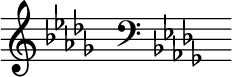
B-flat minor is a minor scale based on B♭, consisting of the pitches B♭, C, D♭, E♭, F, G♭, and A♭. Its key signature has five flats. Its relative major is D-flat major and its parallel major is B-flat major. Its enharmonic equivalent, A-sharp minor, which would contain seven sharps, is not normally used.
The B-flat natural minor scale is:

Changes needed for the melodic and harmonic versions of the scale are written in with accidentals as necessary. The B-flat harmonic minor and melodic minor scales are:


The scale degree chords of B-flat minor are:
B-flat minor is traditionally a 'dark' key.[1]
The old valveless horn was barely capable of playing in B-flat minor: the only example found in 18th-century music is a modulation that occurs in the first minuet of Franz Krommer's Concertino in D major, Op. 80.[2]