Hubbry Logo
SubdominantSubdominantMain
Open search
Subdominant
Community hub
Subdominant
logo
7 pages, 0 posts
0 subscribers
Be the first to start a discussion here.
Subdominant
Subdominant
from Wikipedia

{
\override Score.TimeSignature #'stencil = ##f
\relative c' {
  \clef treble
  \time 7/4 c4 d e \once \override NoteHead.color = #red f g \once \override NoteHead.color = #red a b \time 2/4 \once \override NoteHead.color = #red c2 \bar "||"
  \time 4/4 <f, a c>1 \bar "||"
} }

{
\override Score.TimeSignature #'stencil = ##f
\relative c' {
  \clef treble
  \time 7/4 c4 d es \once \override NoteHead.color = #red f g \once \override NoteHead.color = #red aes bes \time 2/4 \once \override NoteHead.color = #red c2 \bar "||"
  \time 4/4 <f, aes c>1 \bar "||"
} }
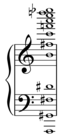
The scale and subdominant triad in C major (top) and C minor (bottom).

In music, the subdominant is the fourth tonal degree (scale degree 4) of the diatonic scale. It is so called because it is the same distance below the tonic as the dominant is above the tonic – in other words, the tonic is the dominant of the subdominant.[1][2][3] It also happens to be the note one step below the dominant.[4] In the movable do solfège system, the subdominant note is sung as fa.

The triad built on the subdominant note is called the subdominant chord. In Roman numeral analysis, the subdominant chord is typically symbolized by the Roman numeral "IV" in a major key, indicating that the chord is a major triad. In a minor key, it is symbolized by "iv", indicating that the chord is a minor triad.

In very much conventionally tonal music, harmonic analysis will reveal a broad prevalence of the primary (often triadic) harmonies: tonic, dominant, and subdominant (i.e., I and its chief auxiliaries a 5th removed), and especially the first two of these.

— Berry (1976)[5]

These chords may also appear as seventh chords: in major, as IVM7, or in minor as iv7 or sometimes IV7:[6]


{
\override Score.TimeSignature #'stencil = ##f
\relative c' {
   \clef treble
   \time 4/4
   \key c \major
   <f a c e>1_\markup { \concat { "IV" \raise #1 \small "M7" } } \bar "||"

   \clef treble
   \time 4/4
   \key c \minor
   <f aes c es>1_\markup { \concat { "iv" \raise #1 \small "7" } }
   <f a c es>^\markup { \tiny { "infrequent" } }_\markup { \concat { "IV" \raise #1 \small "7" } } \bar "||"
} }

A cadential subdominant chord followed by a tonic chord produces the so-called plagal cadence.

As with other chords which often precede the dominant, subdominant chords typically have predominant function. In Riemannian theory, it is considered to balance the dominant around the tonic (being as far below the tonic as the dominant is above).

The term subdominant may also refer to a relationship of musical keys. For example, relative to the key of C major, the key of F major is the subdominant. Music which modulates (changes key) often modulates to the subdominant when the leading tone is lowered by half step to the subtonic (B to B in the key of C). Modulation to the subdominant key often creates a sense of musical relaxation, as opposed to modulation to the dominant (fifth note of the scale), which increases tension.

References

[edit]
[edit]
Revisions and contributorsEdit on WikipediaRead on Wikipedia
from Grokipedia
In music theory, the subdominant refers to the fourth scale degree of a and the triad or constructed on that degree, denoted as IV in major keys and iv in minor keys. This chord is named for its position a below the tonic, mirroring the dominant's interval above it, and it serves as a key element in establishing harmonic progression. For example, in the key of , the subdominant degree is F, and the subdominant chord is (F-A-C). The subdominant functions primarily as a pre-dominant harmony, creating a sense of departure from the tonic while building moderate tension that typically progresses to the dominant () chord before resolving to the tonic (I), as seen in the common IV-V-I . This role contributes to the structural coherence of phrases in Western tonal music, appearing frequently in genres from classical to pop and , where it adds contrast and emotional variety—brighter and more open in major keys, more somber in minor. Unlike the highly unstable dominant, the subdominant exhibits a neutral or preparatory character, neither fully at rest like the tonic nor strongly pulling toward resolution. In broader harmonic contexts, the subdominant can be expanded or substituted with related chords, such as the ii chord ( minor), which shares similar pre-dominant qualities due to common tones and , enhancing development and modulation. Its placement between the tonic and dominant underscores the symmetrical organization of primary triads in tonal , a foundational concept in music education and composition.

Definition and Fundamentals

Scale Degree

In diatonic scales, the subdominant refers to the fourth scale degree, denoted as ^4. This note occupies a pivotal position within the scale structure, serving as the foundation for harmonic elements that contribute to tonal progression. For instance, in the (C-D-E-F-G-A-B), the subdominant is F, positioned as the fourth note in the ascending sequence. Similarly, in C minor (natural form: C-D-E♭-F-G-A♭-B♭), F remains the subdominant. The consistent placement of this degree underscores its role across tonalities. Intervallically, the subdominant forms a above the tonic, creating a stable yet preparatory interval that contrasts with the dominant's above the same reference point. The "subdominant" originates from its location a below the tonic, inverting the dominant's upward relationship and reflecting the Latin prefix "sub-" meaning "under." This symmetric intervallic design highlights the subdominant's relational balance within the scale. In , a for denoting harmony based on scale degrees, the triad constructed on the subdominant is labeled IV in major keys (indicating a major triad) and iv in minor keys (indicating a minor triad). Here, the subdominant note functions explicitly as the of this triad, anchoring its pitch content and determining its . Acoustically, the subdominant's role as the root emphasizes its foundational stability in chordal formations, where it generates that align with the scale's diatonic framework, supporting broader harmonic resolutions without introducing tension.

Triad and Chord

The subdominant triad is constructed by stacking thirds on the fourth scale degree of the , forming a three-note chord consisting of the , major or minor third, and . In keys, it is a major triad; for example, in C , the subdominant triad is F–A–C. In keys, it is a minor triad; for example, in C , the subdominant triad is F–A♭–C. The subdominant seventh chord extends the triad by adding a minor seventh interval above the root, creating a four-note chord that functions as a pre-dominant harmony. In major keys, this is denoted as IV⁷ and comprises a triad with an added ; for example, in C major, it is F–A–C–E♭. In minor keys, it is denoted as iv⁷ and uses a minor triad with a ; for example, in C minor, it is F–A♭–C–E♭. Inversions of the subdominant triad and rearrange the notes so that a pitch other than the is in the bass, altering the chord's voicing while preserving its intervallic structure. The first inversion of the subdominant triad places the third in the bass and is notated with a superscript 6 (IV⁶ in major keys or iv⁶ in minor keys). In minor keys, the first inversion of the triad (ii⁶, such as F–A♭–D in C minor) often serves in subdominant contexts due to its shared function. The second inversion places the fifth in the bass and is notated with ⁶₄ (IV⁶₄ or iv⁶₄). For the subdominant , first inversion is notated as ⁶₅, with the third in the bass. In and modern harmonic practice, subdominant chords frequently incorporate extensions and altered voicings to enhance color and texture. Common extensions include the added (add9), which appends the ninth scale degree to the triad without altering the seventh; for example, in C , F–A–C–G. Suspended fourth (sus4) voicings replace the third with the fourth scale degree, yielding an open sonority with subdominant qualities, such as F–B♭–C in C . These variations allow for flexible resolutions and richer improvisational opportunities.

Harmonic Function

Relation to Tonic and Dominant

In tonal , the subdominant functions as a pre-dominant chord, serving as an intermediary that builds tension between the stable tonic (I) and the tense dominant (V). This role contrasts the tonic's sense of resolution and repose with the dominant's drive toward closure, positioning the subdominant (typically IV) as a preparatory that anticipates the dominant's arrival. Unlike the tonic, which anchors the key, or the dominant, which creates instability through its leading tone, the subdominant introduces mild dissonance and forward momentum without the full urgency of the dominant. Within the circle of fifths, the subdominant occupies a pivotal position adjacent to the dominant, facilitating root motion by descending fifth (or ascending fourth) that underpins much of tonal progression. This relationship—IV progressing to V—forms the core of diatonic motion, where the subdominant's root leads smoothly to the dominant's, reinforcing the key's gravitational pull toward resolution. Voice leading principles further emphasize the subdominant's seamless connection to the dominant, prioritizing stepwise motion and retention of common tones where possible to ensure contrapuntal smoothness. For instance, in a IV (F-A-C) to V (G-B-D) progression, the bass ascends stepwise from F to G, while upper may move by step (e.g., A to B, C to D) to minimize leaps and maintain independence. In functional harmony theory, as developed by Hugo Riemann, the subdominant is designated as the "S" function, representing a parallel yet contrasting pole to the tonic (T) and dominant (D). Riemann's framework groups chords by their relational roles rather than strict scale degrees, with S embodying expansion and preparation that complements T's stability and D's contraction, thus structuring the underlying syntax of tonal music. This triadic functional model underscores the subdominant's essential place in balancing harmonic forces.

Role in Progressions and Cadences

The subdominant chord, denoted as IV in major keys or iv in minor, functions primarily as a pre-dominant harmony, bridging the tonic and to build tension toward resolution. This role positions it as a preparatory element that typically progresses to the dominant () chord, creating forward momentum in tonal . In plagal , the subdominant resolves directly to the tonic (IV–I or iv–i), providing a sense of gentle closure often associated with sacred , such as the "Amen" at endings. In authentic cadences, the subdominant precedes the dominant to form the extended progression IV–V–I (or iv–V–i), enhancing the phrase model's directed motion from stability (tonic) through preparation (subdominant) to tension (dominant) and back to resolution. This setup is integral to the I–IV–V–I cycle, a foundational progression in tonal harmony that underscores much of Western music, from classical to folk traditions. The supertonic chord (ii or ii°) often substitutes for IV due to their shared pitch content and pre-dominant function, as seen in the ii–V–I progression, which offers a smoother voice leading alternative while maintaining the preparatory role. Deceptive cadences may incorporate the subdominant indirectly, where after a V–vi motion, the music returns to IV or ii to lead into a subsequent authentic cadence, avoiding premature closure. The subdominant also facilitates modulation as a pivot chord, exploiting its diatonic presence in related keys—for instance, the IV chord in C major ( triad) functions as the tonic (I) in , enabling smooth shifts to the subdominant key. This pivot technique is particularly effective for pre-dominant chords, as their weaker tension allows seamless reinterpretation without abrupt disruption. In contemporary , the subdominant appears in the ubiquitous I–V–vi–IV loop, where it contributes emotional variety and cyclical drive, as evidenced in numerous chart-topping songs.

Contexts and Variations

In Major and Minor Keys

In major keys, the subdominant functions as the IV triad, a major chord constructed on the fourth scale degree, providing a bright and sound that contrasts with the tonic while preparing resolution to the dominant. For example, in , the IV chord is (F-A-C), emphasizing the subdominant tone (F) and contributing to a sense of stability and uplift within the diatonic framework. This major quality arises from the natural major scale's structure, where the fourth, fifth, and sixth degrees form a major triad, often used in plagal cadences for a gentle, conclusive effect. In minor keys, the subdominant typically appears as the iv triad, a minor chord on the fourth scale degree in natural minor, yielding a darker and more introspective tone, such as (F-A♭-C) in C minor. However, composers frequently raise the sixth scale degree via the or melodic minor to transform it into a major IV triad (F-A-C in C minor), introducing a brighter, more element borrowed from major for heightened expressivity. This minor iv quality, with its lowered third (A♭), inherently adds melancholy and tension, distinguishing it from the subdominant's role in major keys. Key-specific progressions highlight these differences: in major keys, the IV-I forms a full plagal cadence, offering peaceful resolution and uplift, as in the hymn-like conclusion of many pieces. In minor keys, the IV-i (or iv-i) progression can serve as a half-cadence variant, creating suspense or emotional depth by delaying full resolution, while the minor iv often evokes melancholy through its dissonant leanings toward the dominant. Overall, the subdominant in major keys promotes consonance and elevation, whereas in minor it amplifies pathos, shaping the affective contour of tonal music.

In Non-Diatonic and Modal Music

In modal music, the subdominant's role adapts to the degrees, shifting its harmonic quality and function from the diatonic major-key IV. In the , characterized by a flattened seventh scale degree, the subdominant chord remains a major IV, while the bVII chord often assumes a dominant-like role, creating a brighter, less resolved tension compared to Ionian . This alteration emphasizes modal color over strong cadential pull, as seen in voicings that incorporate tensions like the 9th or 13th for added expressiveness. In the , with its and , the subdominant manifests as a major IV chord—a departure from the iv of the —lending a brighter, more uplifting quality to the otherwise melancholic tonality. This major IV functions primarily as a subdominant, facilitating smooth transitions back to the tonic (i) and evoking a sense of hopeful departure. The flattened seventh further colors the progression, often leading to bVII substitutions that reinforce the subdominant area without resolving dominantly. Chromatic subdominants expand the diatonic palette through secondary and borrowed forms, introducing temporary tonal shifts. Secondary subdominants, such as IV/V (the subdominant of the dominant), tonicize the V chord by approaching it from a fourth above, creating chains like ii/V or IV/V that heighten tension before dominant resolution. Borrowed subdominants, like the flat subdominant (bIV) in major keys, draw from minor, adding a modal or bluesy inflection; for instance, in C major, Ab major serves as bIV, evoking emotional depth through its lowered . In jazz and blues, the subdominant IV chord anchors the 12-bar blues form, appearing in bars 5–6 and 9–10 to provide contrast and narrative progression. Typically voiced as a dominant seventh (IV7) for added dissonance, it often incorporates 9ths or 13ths in jazz variations, enhancing color and facilitating improvisational extensions, as in the quick-change to IV in bar 2. Substitutions like ii–V–I in bar 9 replace the plain IV, blending subdominant function with dominant motion for sophisticated harmonic flow. Non-Western traditions feature analogous functions to the subdominant, though without direct chordal equivalence due to their melodic emphasis. In Indian ragas, the fourth (madhyama, or Ma) often acts as a pivotal note, implying subdominant-like tension and departure, as in phrases that melodically suggest a IV chord before returning to the tonic . These elements prioritize modal ascent and emotional narrative over functional harmony.

Historical and Compositional Usage

Origins in Western Theory

During the medieval and periods, modal theory in further developed these ideas, identifying the note a fourth above the finalis as a key point of melodic repose and stability, acting as an early analogue to the subdominant by supporting the finalis without the tension of the dominant (typically a fifth above). In plagal modes, this fourth-degree note facilitated plagal cadences and reciting tones, bridging modal practices toward emerging tonal hierarchies. The subdominant received its formal theoretical recognition in the through Jean-Philippe Rameau's Traité de l'harmonie réduite à ses principes naturels (), where he conceptualized the triad built on the fourth scale degree as the natural counterpart to the dominant, forming with the tonic a complete system of fundamental harmonies derived from the fundamental bass. Rameau described this chord—often an added-sixth on the subdominant degree—as essential for defining the mode and enabling smooth progressions, contrasting the dominant's dissonant seventh with the subdominant's support. In the late , advanced this framework in his functional theory, designating the subdominant (S) as one of three primary functions alongside the tonic (T) and dominant (D), and codifying the characteristic cycle S-D-T as the normative progression underlying tonal music. grouped chords like IV, ii, and vi under the subdominant function, emphasizing its role in building tension toward the dominant while maintaining relational ties to the tonic through common tones.

Examples in Classical and Modern Works

In Johann Sebastian Bach's chorale from BWV 147, the subdominant chord (IV) plays a key role in forming plagal cadences that provide a gentle, resolving close, particularly in the harmonized melody's phrasing, emphasizing the text's devotional serenity. This usage exemplifies the subdominant's pre-dominant function in sacred , where IV often precedes the tonic to evoke a sense of peaceful affirmation. In Wolfgang Amadeus Mozart's Piano Sonata No. 14 in C minor, K. 457, the development section of the first movement employs subdominant pivots, such as modulations to the subdominant minor (), to expand thematic material and heighten dramatic tension within . These harmonic shifts illustrate the Classical era's strategic use of the subdominant to facilitate smooth key changes and prolong instability before returning to the tonic. Richard Wagner's opera features chromatic subdominants prominently in the prelude, where the iconic (F-B-D♯-G♯) functions as an altered subdominant in , enriched with appoggiaturas and half-diminished elements to create unresolved tension and yearning. This innovative treatment expands the subdominant's role beyond diatonic norms, incorporating to blur tonal boundaries and drive the Romantic leitmotif-driven narrative. In modern , The ' "Let It Be" (1970) highlights the subdominant through its recurring I-IV-I-V progression in C major, particularly in the chorus and solo, where the plagal IV-I motion evokes reassurance and draws on influences for emotional uplift. Similarly, in the "Autumn Leaves" (1945), the subdominant function appears via ii-IV substitutions, such as treating the ii7 (e.g., Am7♭5 in ) as a proxy for IV to add color and fluidity to the ii-V-I chains, enhancing improvisational flexibility.

References

Add your contribution
Related Hubs
User Avatar
No comments yet.