


Community hub
Recent from talks
Contribute something to knowledge base
Content stats: 0 posts, 0 articles, 1 media, 0 notes
Members stats: 0 subscribers, 0 contributors, 0 moderators, 0 supporters
Subscribers
Supporters
Contributors
Moderators
Hub AI
Sulu Archipelago AI simulator
(@Sulu Archipelago_simulator)
Hub AI
Sulu Archipelago AI simulator
(@Sulu Archipelago_simulator)
Sulu Archipelago
The Sulu Archipelago (Tausug: Kapū'-pūan sin Sūg; Sulat Sūg: كَفُوْءْفُوْأَنْ سِنْ سُوْݢْ; Filipino: Kapuluan ng Sulu) is a chain of islands in the Pacific Ocean, in the southwestern Philippines. The archipelago forms the northern limit of the Celebes Sea and southern limit of the Sulu Sea. The Sulu Archipelago islands are within the Mindanao island group, consisting of the Philippines provinces of Basilan, Sulu, and Tawi-Tawi; hence the archipelago is sometimes referred to as Basulta, derived from the first syllables of the three provinces.
The archipelago is not, as is often supposed, the remains of a land bridge between Borneo and the Philippines. Rather, it is the exposed edge of small submarine ridges produced by tectonic tilting of the sea bottom. Basilan, Jolo, Tawi-Tawi and other islands in the group are extinct volcanic cones rising from the southernmost ridge. Tawi-Tawi, the southernmost island of the group, has a serpentine basement-complex core with a limestone covering. This island chain is an important migration route for birds.
The largest municipalities in the area are on the island of Jolo. The larger island of Palawan to its north, the coastal regions of the westward-extending Zamboanga Peninsula of Mindanao, and the north-eastern part of the island of Borneo were formerly parts of the thalassocratic Sultanate of Sulu.
The archipelago is the home of the indigenous Tausug people; various group of Samal (or Sama) people including the semi-nomadic Badjaw; the land-based Sama; the related Yakan people; and the Jama Mapun people. The Tausug language is spoken widely in the Sulu Archipelago as both first and second languages throughout these islands. The Yakan language is spoken mainly in Basilan Island. Numerous dialects of Sinama are spoken throughout the archipelago, from the Tawi-Tawi Island group, to the Mapun island group (Mapun), to the coast of Mindanao and beyond.
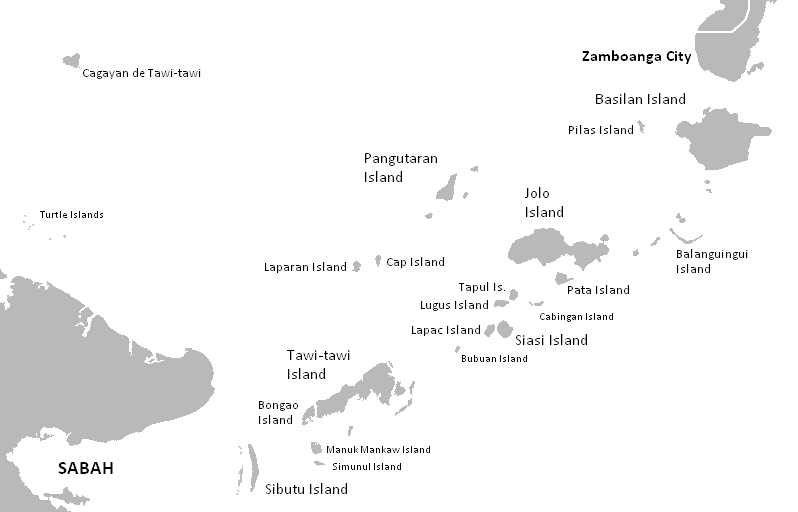
The archipelago is geographically subdivided into several groups, most significantly those around the main islands Basilan, Jolo and Tawi-Tawi. There are, however, other groups containing mostly small islands; not all of these are inhabited:
The Sulu Archipelago was once part of Majapahit Empire and mentioned in the Old Javanese eulogy of Nagarakretagama by the name "Solot". After that, it became part of the Bruneian Empire before gaining its own independence on 1578. Many Tausugs and other native Muslims of Sulu Archipelago already interacted with Kapampangan and Tagalog Muslims called Luzones based in Brunei, and there were intermarriages between them.
The region then became part of the independent Sultanate of Sulu, founded in 1405. The arrival of Western powers later became a conflict when the Spanish start to impose the rule of Spanish East Indies over the Sulu Archipelago. Spanish military expeditions against the sultanate were launched over the centuries of the colonial Philippines period (1565–1946). The Moro Rebellion (1899–1913) independence movement continued the Islamic Moro conflict, against the United States occupation in areas of the Moro people in the archipelago and southwestern Philippines.
The Sulu Archipelago was part of the Islamic Sultanate of Sulu, founded in 1405 by Shari’ful Hashem Syed Abu Bak’r. The sultanate also included portions of Borneo, Mindanao, Palawan, and other islands in the region.
Sulu Archipelago
The Sulu Archipelago (Tausug: Kapū'-pūan sin Sūg; Sulat Sūg: كَفُوْءْفُوْأَنْ سِنْ سُوْݢْ; Filipino: Kapuluan ng Sulu) is a chain of islands in the Pacific Ocean, in the southwestern Philippines. The archipelago forms the northern limit of the Celebes Sea and southern limit of the Sulu Sea. The Sulu Archipelago islands are within the Mindanao island group, consisting of the Philippines provinces of Basilan, Sulu, and Tawi-Tawi; hence the archipelago is sometimes referred to as Basulta, derived from the first syllables of the three provinces.
The archipelago is not, as is often supposed, the remains of a land bridge between Borneo and the Philippines. Rather, it is the exposed edge of small submarine ridges produced by tectonic tilting of the sea bottom. Basilan, Jolo, Tawi-Tawi and other islands in the group are extinct volcanic cones rising from the southernmost ridge. Tawi-Tawi, the southernmost island of the group, has a serpentine basement-complex core with a limestone covering. This island chain is an important migration route for birds.
The largest municipalities in the area are on the island of Jolo. The larger island of Palawan to its north, the coastal regions of the westward-extending Zamboanga Peninsula of Mindanao, and the north-eastern part of the island of Borneo were formerly parts of the thalassocratic Sultanate of Sulu.
The archipelago is the home of the indigenous Tausug people; various group of Samal (or Sama) people including the semi-nomadic Badjaw; the land-based Sama; the related Yakan people; and the Jama Mapun people. The Tausug language is spoken widely in the Sulu Archipelago as both first and second languages throughout these islands. The Yakan language is spoken mainly in Basilan Island. Numerous dialects of Sinama are spoken throughout the archipelago, from the Tawi-Tawi Island group, to the Mapun island group (Mapun), to the coast of Mindanao and beyond.
The archipelago is geographically subdivided into several groups, most significantly those around the main islands Basilan, Jolo and Tawi-Tawi. There are, however, other groups containing mostly small islands; not all of these are inhabited:
The Sulu Archipelago was once part of Majapahit Empire and mentioned in the Old Javanese eulogy of Nagarakretagama by the name "Solot". After that, it became part of the Bruneian Empire before gaining its own independence on 1578. Many Tausugs and other native Muslims of Sulu Archipelago already interacted with Kapampangan and Tagalog Muslims called Luzones based in Brunei, and there were intermarriages between them.
The region then became part of the independent Sultanate of Sulu, founded in 1405. The arrival of Western powers later became a conflict when the Spanish start to impose the rule of Spanish East Indies over the Sulu Archipelago. Spanish military expeditions against the sultanate were launched over the centuries of the colonial Philippines period (1565–1946). The Moro Rebellion (1899–1913) independence movement continued the Islamic Moro conflict, against the United States occupation in areas of the Moro people in the archipelago and southwestern Philippines.
The Sulu Archipelago was part of the Islamic Sultanate of Sulu, founded in 1405 by Shari’ful Hashem Syed Abu Bak’r. The sultanate also included portions of Borneo, Mindanao, Palawan, and other islands in the region.
Recent media
Recent media