
Recent from talks
Raffles' banded langur
Knowledge base stats:
Talk channels stats:
Members stats:
Raffles' banded langur
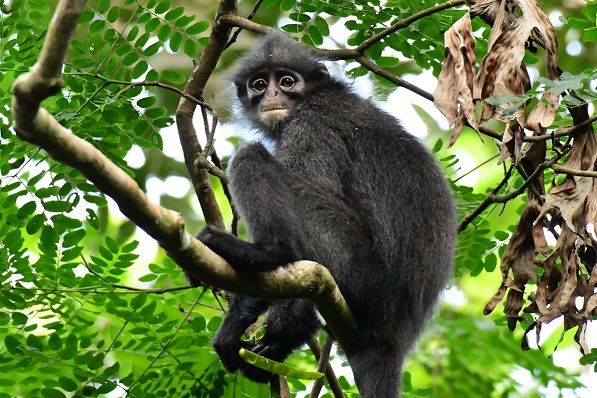
The Raffles' banded langur (Presbytis femoralis), also known as the banded leaf monkey or banded surili, is a species of primate in the family Cercopithecidae. It is endemic to Singapore and southern peninsular Malaysia. The species underwent taxonomic revisions in 2019 and 2020, in which two former subspecies were elevated to separate species. As a result, the Raffles' banded langur meets the criteria for being listed as critically endangered by the IUCN. It is mainly threatened by habitat loss.
The taxonomy of Presbytis femoralis underwent several changes. Up until 2019, three subspecies of P. femoralis were recognized: P. f. femoralis (nominate), P. f. percura (the East Sumatran banded langur), and P. f. robinsoni (Robinson's banded langur). Presbytis f. femoralis lives in Singapore, and in the states of Johor and Pahang of southern Peninsular Malaysia, P. f. robinsoni lives in the northern Malay Peninsula, including southern Myanmar and Thailand, and P. f. percura lives in east-central Sumatra.
Genetic data suggested that at least P. f. femoralis and P. f. robinsoni were different species, which was also in agreement with their morphological characters. However, resolving all subspecies-level boundaries within banded langurs required data for P. f. percura, which was the least studied among them. Most recently, mitochondrial genomes were obtained for P. f. percura, and based on multiple species delimitation algorithms (PTP, ABGD, Objective Clustering) applied to a dataset covering 39 species and 43 subspecies of Asian colobines, all three subspecies of banded langurs were resurrected to species.
William Charles Linnaeus Martin formally described P. femoralis based on material that had been collected by Sir Stamford Raffles in Singapore. Martin had given the distribution as "Sumatra etc.", not mentioning Singapore explicitly, resulting in some confusion over the actual type locality. Gerrit Smith Miller Jr. resolved the issue in 1934, determining that Singapore was the actual type locality.
The Raffles' banded langur is 43.2 to 61.0 cm (17.0 to 24.0 in) long, excluding the tail, with a tail length of 61.0 to 83.8 cm (24.0 to 33.0 in). It weighs 5.9 to 8.2 kg (13 to 18 lb). It has dark fur on the back and sides with white-colored fur forming a band on the chest and along the inner thighs.
The Raffles' banded langur is diurnal and arboreal, preferring rainforest with trees of the family Dipterocarpaceae. It comes to the ground less frequently than most other leaf monkeys. It lives in both primary and secondary forest, and also in swamp forests and mangrove forests, and even in rubber plantations. It moves primarily by walking on all fours and by leaping.
According to wildlife researcher Charles Francis, it typically lives in groups of 3 to 6. However, a study in Perawang, Sumatra found an average group size of 11 monkeys in mixed-sex groups. The latter study also found an average ratio of 1 adult male to 4.8 adult females in mixed-sex groups and a ratio of 1.25 adult monkeys for every immature monkey in mixed-sex groups. It also found an average range size for a group of 22 ha (54 acres), and an average population density of 42 per square kilometre (110/sq mi). Other studies found somewhat smaller home ranges, of between 9 and 21 ha (22 and 52 acres).
The Raffles' banded langur appears to have two birth seasons, once between June and July and another between December and January. In this study, at least six infants were born between 2008 and 2010, and the authors found low infant mortality, with several infants surviving to at least seven months old. The study also found that the infant coloration of the Singapore population is indistinguishable from that of the Johor, Malaysia population, with infants having white fur with a black stripe down the back from the head to the tail, crossed by another black stripe across the shoulders and to the forearms. Males leave their natal group before reaching maturity, at about 4 years old.
Hub AI
Raffles' banded langur AI simulator
(@Raffles' banded langur_simulator)
Raffles' banded langur
The Raffles' banded langur (Presbytis femoralis), also known as the banded leaf monkey or banded surili, is a species of primate in the family Cercopithecidae. It is endemic to Singapore and southern peninsular Malaysia. The species underwent taxonomic revisions in 2019 and 2020, in which two former subspecies were elevated to separate species. As a result, the Raffles' banded langur meets the criteria for being listed as critically endangered by the IUCN. It is mainly threatened by habitat loss.
The taxonomy of Presbytis femoralis underwent several changes. Up until 2019, three subspecies of P. femoralis were recognized: P. f. femoralis (nominate), P. f. percura (the East Sumatran banded langur), and P. f. robinsoni (Robinson's banded langur). Presbytis f. femoralis lives in Singapore, and in the states of Johor and Pahang of southern Peninsular Malaysia, P. f. robinsoni lives in the northern Malay Peninsula, including southern Myanmar and Thailand, and P. f. percura lives in east-central Sumatra.
Genetic data suggested that at least P. f. femoralis and P. f. robinsoni were different species, which was also in agreement with their morphological characters. However, resolving all subspecies-level boundaries within banded langurs required data for P. f. percura, which was the least studied among them. Most recently, mitochondrial genomes were obtained for P. f. percura, and based on multiple species delimitation algorithms (PTP, ABGD, Objective Clustering) applied to a dataset covering 39 species and 43 subspecies of Asian colobines, all three subspecies of banded langurs were resurrected to species.
William Charles Linnaeus Martin formally described P. femoralis based on material that had been collected by Sir Stamford Raffles in Singapore. Martin had given the distribution as "Sumatra etc.", not mentioning Singapore explicitly, resulting in some confusion over the actual type locality. Gerrit Smith Miller Jr. resolved the issue in 1934, determining that Singapore was the actual type locality.
The Raffles' banded langur is 43.2 to 61.0 cm (17.0 to 24.0 in) long, excluding the tail, with a tail length of 61.0 to 83.8 cm (24.0 to 33.0 in). It weighs 5.9 to 8.2 kg (13 to 18 lb). It has dark fur on the back and sides with white-colored fur forming a band on the chest and along the inner thighs.
The Raffles' banded langur is diurnal and arboreal, preferring rainforest with trees of the family Dipterocarpaceae. It comes to the ground less frequently than most other leaf monkeys. It lives in both primary and secondary forest, and also in swamp forests and mangrove forests, and even in rubber plantations. It moves primarily by walking on all fours and by leaping.
According to wildlife researcher Charles Francis, it typically lives in groups of 3 to 6. However, a study in Perawang, Sumatra found an average group size of 11 monkeys in mixed-sex groups. The latter study also found an average ratio of 1 adult male to 4.8 adult females in mixed-sex groups and a ratio of 1.25 adult monkeys for every immature monkey in mixed-sex groups. It also found an average range size for a group of 22 ha (54 acres), and an average population density of 42 per square kilometre (110/sq mi). Other studies found somewhat smaller home ranges, of between 9 and 21 ha (22 and 52 acres).
The Raffles' banded langur appears to have two birth seasons, once between June and July and another between December and January. In this study, at least six infants were born between 2008 and 2010, and the authors found low infant mortality, with several infants surviving to at least seven months old. The study also found that the infant coloration of the Singapore population is indistinguishable from that of the Johor, Malaysia population, with infants having white fur with a black stripe down the back from the head to the tail, crossed by another black stripe across the shoulders and to the forearms. Males leave their natal group before reaching maturity, at about 4 years old.
Recent media