
Recent from talks
Pahang
Knowledge base stats:
Talk channels stats:
Members stats:
Pahang
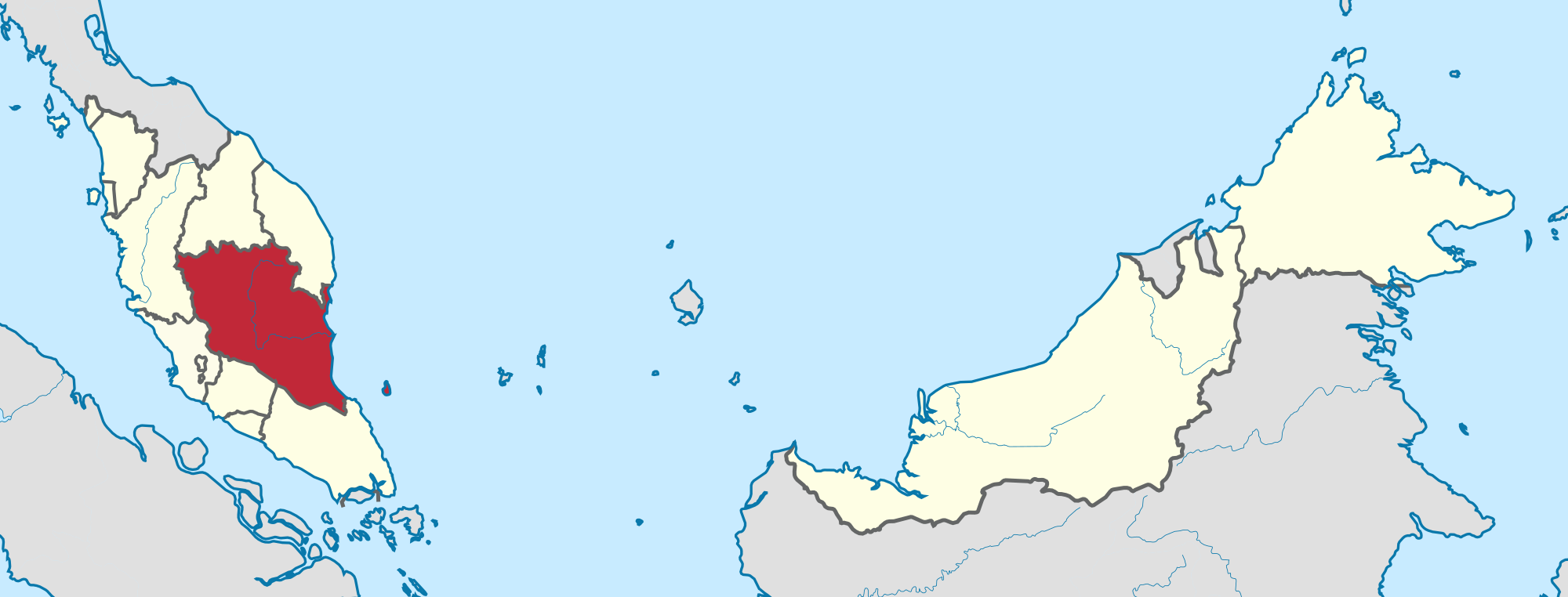
Pahang (Malay pronunciation: [paˈhaŋ]; Pahang Hulu Malay: Paha, Pahang Hilir Malay: Pahaeng, Ulu Tembeling Malay: Pahaq), officially Pahang Darul Makmur with the Arabic honorific Darul Makmur ("The Abode of Tranquility") is a sultanate and a federal state of Malaysia. It is the third largest state in the country and the largest state in Peninsular Malaysia, and the ninth most populous. The state occupies the basin of the Pahang River, and a stretch of the east coast as far south as Endau. The state borders the Malaysian states of Kelantan and Terengganu to the north, Perak, Selangor and Negeri Sembilan to the west and Johor to the south, with the South China Sea is to the east. Pahang is separated from the west coast states by the Titiwangsa Mountains that forms a natural divider between the peninsula's east and west coasts from north to south, and from Terengganu in the east by the Pantai Timur Range. The state's highest elevation culminates at Mount Tahan in the eponymous Tahan Range, which is 2,187 metres (7,175 ft) high. Although two thirds of the state is covered by dense rain forest, its central plains are intersected by numerous rivers, and along the coast there is a 32-kilometre (20 mi) wide expanse of alluvial soil that includes the deltas and estuarine plains of the Kuantan, Pahang, Rompin, Endau, and Mersing Rivers.
The state is divided into 11 districts (daerah) – Pekan, Rompin, Maran, Temerloh, Jerantut, Bentong, Raub, Lipis, Cameron Highlands and Bera. The largest district is Jerantut, which is the main gateway to the Taman Negara national park. Pahang's capital and largest city, Kuantan, is the eighth largest urban area by population in Malaysia. The royal capital and the official seat of the Sultan of Pahang is located at Pekan. Pekan was also the old state capital and its name translates literally into 'the town', it was known historically as 'Inderapura'. Other major towns include Temerloh, Raub, Bentong, Jerantut, Kuala Lipis and its hill resorts of Genting Highlands, Bukit Tinggi, and Cameron Highlands. The head of state is the Sultan of Pahang, while the head of government is the Menteri Besar. The government system is closely modelled on the Westminster parliamentary system. The state religion of Pahang is Islam, but allows other religions in its territory.
Archaeological evidence shows that humans have inhabited the area that is now Pahang since as early as the Paleolithic age. The early settlements gradually developed into an ancient maritime trading state by the 3rd century. In the 5th century, the Old Pahang Kingdom sent envoys to the Liu Song court. During the time of Langkasuka, Srivijaya and Ligor, Pahang was one of the outlying dependencies. In the 15th century, the Pahang Sultanate became an autonomous kingdom within the Malacca Sultanate. Pahang entered into a dynastic union with the Johor Sultanate in the early 17th century and later emerged as an autonomous kingdom in the late 18th century. Following the bloody Pahang Civil War that concluded in 1863, the state under Tun Ahmad of the Bendahara dynasty, was eventually restored as a sultanate in 1881. In 1895, Pahang became a British protectorate along with Perak, Selangor and Negeri Sembilan. During the World War II, Pahang and other states of Malaya were occupied by the Empire of Japan from 1941 to 1945. After the war, Pahang became part of the Malayan Union before being absorbed into the Federation of Malaya which gained full independence from the British.
Modern Pahang is an economically important state with main activities in the services, manufacturing and agricultural sectors. As part of the East Coast Economic Region, it is a key region for the manufacturing sector, with the local logistics support network serving as a hub for the east coast region of Peninsular Malaysia. Over the years, the state has attracted much investment, both local and foreign, in the mineral sector. Important mineral exports include iron ore, gold, tin and bauxite. Malaysia's substantial oil and natural gas fields lie offshore in the South China Sea. At one time, timber resources also brought much wealth to the state. Large-scale development projects have resulted in the clearing of hundreds of square miles of land for oil palm and rubber plantations and the resettling of several hundred thousand people in new villages under federal agencies and institutions like FELDA, FELCRA and RISDA.
The Khmer word for tin is pāhang (ប៉ាហាំង) and it is phonetically identical to ڤهڠ (note that the Jawi spelling, literally, "phŋ", deviates from modern Dewan Bahasa dan Pustaka rules although its sound is unmistakably /paahaŋ/, note that the long ā sound is not explicitly rendered or stressed in old Jawi, just like ڤد). Since the tin mines at Sungai Lembing had been known since ancient times and that the Malay Peninsula was within the sphere of influence of Khmer civilisation, William Linehan hypothesized that the name of the state was named after the Khmer word for tin (note that tin-rich Perak is also etymologically linked to tin).
This lexemic starting point can be used to explain other derivatives terms such as the Pahang River, Mahang the place (name given to Pahang by Jakuns), Mahang the tree (Macaranga, a common tree species in secondary forests, likely named after the toponym of the same phoneme). The Proto-Malays of Sungai Bebar who interacted with Trito-Malays likely acquired the term from their city counterparts. The theories that the state was named after the river or tree are unsatisfactory as they do not explain how the river or the tree got their names.[citation needed]
There were many variations of the name Pahang outside the Malay world. For examples, Song dynasty author Zhao Rukuo (趙汝适) wrote in Zhufanzhi (諸蕃志) (circa 1225) that Phong-hong (蓬豐 romanised according to Southern Min dialect since Zhao was from Quanzhou) was a dependency of Srivijaya. The transition from Inderapura to Pahang, approximately around the Song period indicates that Khmer influence on the state was weakened and displaced by that of Srivijaya and Majapahit.
During the Yuan dynasty, Pahang was known as Phenn-Khenn (彭坑) in Daoyi Zhilue (島夷志略) (circa 1349), and in Ming Shilu (明實錄) (circa 1378), it was transliterated as Pen-Heng (湓亨), and in Haiguo Wenjianlu (海國聞見錄) (circa 1730), compiled in the Qing period, Pahang was transliterated as (邦項) (Pang-hang).
Hub AI
Pahang AI simulator
(@Pahang_simulator)
Pahang
Pahang (Malay pronunciation: [paˈhaŋ]; Pahang Hulu Malay: Paha, Pahang Hilir Malay: Pahaeng, Ulu Tembeling Malay: Pahaq), officially Pahang Darul Makmur with the Arabic honorific Darul Makmur ("The Abode of Tranquility") is a sultanate and a federal state of Malaysia. It is the third largest state in the country and the largest state in Peninsular Malaysia, and the ninth most populous. The state occupies the basin of the Pahang River, and a stretch of the east coast as far south as Endau. The state borders the Malaysian states of Kelantan and Terengganu to the north, Perak, Selangor and Negeri Sembilan to the west and Johor to the south, with the South China Sea is to the east. Pahang is separated from the west coast states by the Titiwangsa Mountains that forms a natural divider between the peninsula's east and west coasts from north to south, and from Terengganu in the east by the Pantai Timur Range. The state's highest elevation culminates at Mount Tahan in the eponymous Tahan Range, which is 2,187 metres (7,175 ft) high. Although two thirds of the state is covered by dense rain forest, its central plains are intersected by numerous rivers, and along the coast there is a 32-kilometre (20 mi) wide expanse of alluvial soil that includes the deltas and estuarine plains of the Kuantan, Pahang, Rompin, Endau, and Mersing Rivers.
The state is divided into 11 districts (daerah) – Pekan, Rompin, Maran, Temerloh, Jerantut, Bentong, Raub, Lipis, Cameron Highlands and Bera. The largest district is Jerantut, which is the main gateway to the Taman Negara national park. Pahang's capital and largest city, Kuantan, is the eighth largest urban area by population in Malaysia. The royal capital and the official seat of the Sultan of Pahang is located at Pekan. Pekan was also the old state capital and its name translates literally into 'the town', it was known historically as 'Inderapura'. Other major towns include Temerloh, Raub, Bentong, Jerantut, Kuala Lipis and its hill resorts of Genting Highlands, Bukit Tinggi, and Cameron Highlands. The head of state is the Sultan of Pahang, while the head of government is the Menteri Besar. The government system is closely modelled on the Westminster parliamentary system. The state religion of Pahang is Islam, but allows other religions in its territory.
Archaeological evidence shows that humans have inhabited the area that is now Pahang since as early as the Paleolithic age. The early settlements gradually developed into an ancient maritime trading state by the 3rd century. In the 5th century, the Old Pahang Kingdom sent envoys to the Liu Song court. During the time of Langkasuka, Srivijaya and Ligor, Pahang was one of the outlying dependencies. In the 15th century, the Pahang Sultanate became an autonomous kingdom within the Malacca Sultanate. Pahang entered into a dynastic union with the Johor Sultanate in the early 17th century and later emerged as an autonomous kingdom in the late 18th century. Following the bloody Pahang Civil War that concluded in 1863, the state under Tun Ahmad of the Bendahara dynasty, was eventually restored as a sultanate in 1881. In 1895, Pahang became a British protectorate along with Perak, Selangor and Negeri Sembilan. During the World War II, Pahang and other states of Malaya were occupied by the Empire of Japan from 1941 to 1945. After the war, Pahang became part of the Malayan Union before being absorbed into the Federation of Malaya which gained full independence from the British.
Modern Pahang is an economically important state with main activities in the services, manufacturing and agricultural sectors. As part of the East Coast Economic Region, it is a key region for the manufacturing sector, with the local logistics support network serving as a hub for the east coast region of Peninsular Malaysia. Over the years, the state has attracted much investment, both local and foreign, in the mineral sector. Important mineral exports include iron ore, gold, tin and bauxite. Malaysia's substantial oil and natural gas fields lie offshore in the South China Sea. At one time, timber resources also brought much wealth to the state. Large-scale development projects have resulted in the clearing of hundreds of square miles of land for oil palm and rubber plantations and the resettling of several hundred thousand people in new villages under federal agencies and institutions like FELDA, FELCRA and RISDA.
The Khmer word for tin is pāhang (ប៉ាហាំង) and it is phonetically identical to ڤهڠ (note that the Jawi spelling, literally, "phŋ", deviates from modern Dewan Bahasa dan Pustaka rules although its sound is unmistakably /paahaŋ/, note that the long ā sound is not explicitly rendered or stressed in old Jawi, just like ڤد). Since the tin mines at Sungai Lembing had been known since ancient times and that the Malay Peninsula was within the sphere of influence of Khmer civilisation, William Linehan hypothesized that the name of the state was named after the Khmer word for tin (note that tin-rich Perak is also etymologically linked to tin).
This lexemic starting point can be used to explain other derivatives terms such as the Pahang River, Mahang the place (name given to Pahang by Jakuns), Mahang the tree (Macaranga, a common tree species in secondary forests, likely named after the toponym of the same phoneme). The Proto-Malays of Sungai Bebar who interacted with Trito-Malays likely acquired the term from their city counterparts. The theories that the state was named after the river or tree are unsatisfactory as they do not explain how the river or the tree got their names.[citation needed]
There were many variations of the name Pahang outside the Malay world. For examples, Song dynasty author Zhao Rukuo (趙汝适) wrote in Zhufanzhi (諸蕃志) (circa 1225) that Phong-hong (蓬豐 romanised according to Southern Min dialect since Zhao was from Quanzhou) was a dependency of Srivijaya. The transition from Inderapura to Pahang, approximately around the Song period indicates that Khmer influence on the state was weakened and displaced by that of Srivijaya and Majapahit.
During the Yuan dynasty, Pahang was known as Phenn-Khenn (彭坑) in Daoyi Zhilue (島夷志略) (circa 1349), and in Ming Shilu (明實錄) (circa 1378), it was transliterated as Pen-Heng (湓亨), and in Haiguo Wenjianlu (海國聞見錄) (circa 1730), compiled in the Qing period, Pahang was transliterated as (邦項) (Pang-hang).
Recent media