Hubbry Logo
Shell (theater)Shell (theater)Main
Open search
Shell (theater)
Community hub
Shell (theater)
logo
8 pages, 0 posts
0 subscribers
Be the first to start a discussion here.
Shell (theater)
Shell (theater)
from Wikipedia
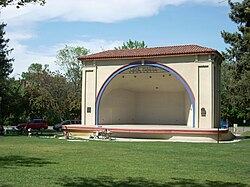
The Gene Harris bandshell at Julia Davis Park in Boise, Idaho, a municipal example.
An image of the Lake Braddock Symphony Orchestra performing at District IX Festival, on March 18, 2006, at Centreville High School. Behind the orchestra is a simple shell.
Acoustic shell of the former Avenida cinema in San Luis Potosí, Mexico. It is now located in the parking lot of a restaurant

In theatre, a shell (also known as an acoustical shell, choral shell or bandshell) is a curved, hard surface designed to reflect sound towards an audience.

Often shells are designed to be removable, either rolling away on wheels or lifting into a flyspace. Shells are most commonly used for orchestras, bands and choirs, although they can also be used in any application that requires passive sound amplification. Shells are generally made of hard materials, because they are designed to absorb as little sound as possible.

History

[edit]

Acoustical shells were developed to reflect sound outward, focused in one direction as opposed to the ″sound in the round″ diffused from all sides of the open gazebo bandstand. In the United States they were built in large city parks and amusement parks as bands increased in size.

Free−standing outdoor shells in a variety of styles were built starting in the 1890s. Professional architects were often employed to design them with varying degrees of acoustical success. The Hollywood Bowl shell, based on a 1928 prototype by Lloyd Wright, has been rebuilt several times with the present structure being the fifth on that site.

Rectangular pavilions with enclosed shell and stage, similar to one in Boise, Idaho (pictured), were being built after 1900. These proved very effective as outdoor performing venues, and many are still in use.

The Rotorua Soundshell was an outdoor shell theatre in the Rotorua CBD on the shore of Lake Rotorua, New Zealand. Built in 1947, it was the locale for the Rotorua Soundshell Talent Quest, won in 1956 by the original Howard Morrison Quartet, thereby launching the career of Sir Howard Morrison. The shell building was replaced in 1958 by a modern structure that thrived until its demolition in 2019, retaining its original name despite no longer being an acoustic shell.[1][2]

See also

[edit]

References

[edit]
Revisions and contributorsEdit on WikipediaRead on Wikipedia
from Grokipedia
In theater, a shell, also known as an acoustical shell, choral shell, or bandshell, is a curved, reflective structure typically constructed from wood or composite materials, positioned behind or enclosing performers on stage to direct and amplify toward the while improving overall acoustic clarity. These structures are essential for musical and choral s, as they minimize sound leakage to backstage areas, enhance reciprocal listening among performers, and create a unified acoustical space between the stage and . By reflecting and scattering sound waves, shells can increase perceived by over 3 decibels for the audience and more than 5 decibels onstage, effectively simulating the effect of doubling the ensemble size according to acoustical studies. Acoustical shells generally comprise modular components, including sound-reflective side and rear towers that surround the performers on the floor, along with a suspended canopy to enclose the from above. This design optimizes sound projection for orchestras, bands, and choirs by focusing acoustic energy outward, reducing echoes within the area, and blending instrumental tones more evenly. Modern shells are often relocatable and adjustable to accommodate varying configurations, such as transforming a theater into a hall setup. The concept of acoustic shells traces its roots to ancient open-air theaters, where natural hill contours and stone surfaces aided sound reflection for speech and , but formalized modern designs emerged in the late 19th and early 20th centuries to address the needs of larger orchestras and amplified music. A landmark example is the 's evolving band shells, beginning with a 1926 design by the Allied Architects Association, followed by Lloyd Wright's innovative 1927 pyramidal structure, and subsequent iterations up to the current shell with concentric circle design completed in 2004. The venue has hosted legendary performances for over a century. Today, acoustical shells remain a staple in professional venues worldwide, continually refined through advancements in materials and engineering to meet diverse performance demands.

Overview

Definition

A shell, also known as an acoustical shell, choral shell, or bandshell, is a curved, hard-surfaced structure designed to reflect and project sound from performers toward an audience. This architectural element functions as a sounding board, typically shaped like a concave or parabolic form to capture and redirect acoustic waves originating from the stage. Key characteristics of shells include their modular construction, which allows for assembly and disassembly as needed, and their removable nature, often facilitated by wheels for mobility or mechanisms to retract them into overhead flyspace in theaters. They are primarily employed in theaters, auditoriums, and outdoor venues to support performances by orchestras, choirs, bands, or theatrical ensembles, ensuring balanced sound distribution. Unlike flat proscenium arches, which serve as visual frames separating the stage from the audience, or simple stage backdrops focused on scenic enclosure, shells are specifically engineered for acoustic reflection to bridge the spatial divide and enhance audibility. These structures provide acoustic benefits by organizing sound waves to improve projection and clarity without altering the venue's primary sightlines.

Purpose and Acoustic Function

The primary purpose of a theater shell is to direct sound waves generated by performers outward toward the audience, thereby reducing diffusion and enhancing overall intelligibility for music, speech, and theatrical performances. This acoustic enhancement compensates for the absence of electronic amplification in natural settings, allowing unamplified ensembles to project clearly over larger distances without significant loss in quality. By reflecting sound in a controlled manner, the shell minimizes scattering that would otherwise occur in open or reverberant spaces, ensuring that the audience receives a coherent and balanced auditory experience. Key benefits include improved balance among performers, as the shell prevents sound from dissipating behind the stage and instead channels it forward, enabling musicians to hear one another more effectively for better intonation and synchronization. It creates a focused projection that amplifies the in expansive venues, simulating natural to enrich the acoustic environment without artificial aids. This results in a more immersive and harmonious output, particularly beneficial for acoustic performances where precise control is essential. Theater shells are essential for applications in symphonic, choral, and band performances, where performers are oriented to face the directly, contrasting with in-the-round configurations that lack such directional reinforcement. In these setups, the shell optimizes mutual audibility among members while delivering enhanced clarity to listeners, supporting high-fidelity unamplified events in both indoor and outdoor contexts.

History

Early Development

Theater shells, also known as bandshells, emerged in the late in the United States, particularly for outdoor performances in city parks and amusement venues, to improve sound projection amid the growing popularity of and bands. These structures evolved from earlier gazebo-style bandstands, which typically scattered sound omnidirectionally due to their open, circular designs, creating challenges for audiences in larger open-air settings. Key early innovations focused on incorporating curved reflectors, such as concave ceilings or rear walls, to direct toward the rather than dispersing it evenly. This shift began addressing acoustic limitations of traditional bandstands, with rectangular forms gaining traction for bands and orchestras. Around 1895, the involvement of professional architects in acoustical gained momentum, influenced by pioneering research at Harvard University's Fogg Art Museum, where Wallace Clement Sabine conducted foundational experiments on room and absorption, establishing scientific principles that informed venue designs. Initial challenges stemmed from limited available materials, resulting in rudimentary constructions primarily of or for outdoor rectangular pavilions. These early shells prioritized basic reflection over complex engineering, reflecting the nascent state of while serving community ensembles in public spaces.

Major Milestones and Evolutions

The marked a pivotal shift in shell design with the introduction of architect-driven , exemplified by Lloyd Wright's 1928 shell for the in . This structure, composed of nine wooden panels that could be assembled and disassembled in a day, represented an early modular design aimed at optimizing sound projection for outdoor performances. The shell has since undergone multiple rebuilds, evolving through four major iterations by 1929 and reaching its current fifth version in 2004, demonstrating ongoing adaptations to improve durability and acoustics. In the mid-20th century, post-World War II constructions highlighted the expansion of shell applications, including the in , initially built in 1947 as a permanent outdoor venue for music and community events. This structure was rebuilt in with a modern design incorporating enhanced materials for better weather resistance and sound reflection, serving until its in 2019 due to structural concerns. Concurrently, the integration of modular systems emerged in indoor theaters, featuring suspended or freestanding acoustic panels that allowed flexible reconfiguration to suit varying performance needs, such as orchestral or dramatic setups in multipurpose halls. From the late 20th to early , shell evolutions incorporated for lighter, more resilient structures, with mobile designs introduced in the , and advanced computer-aided acoustic modeling to simulate sound propagation and refine shapes. The rise of electronic amplification contributed to a decline in fixed outdoor shells, reducing the need for passive reflection in amplified events, though a resurgence occurred in acoustic purist venues prioritizing unamplified natural sound. Shell designs spread globally beyond the , influencing constructions in and with an emphasis on hybrid indoor-outdoor adaptability for diverse climates and uses. In , the example illustrated early international adoption, while in , innovative projects like Japan's Ark Nova inflatable shell in 2013 demonstrated portable, resilient forms for disaster-affected areas, blending mobility with acoustic enhancement.

Design and Construction

Acoustic Principles

Acoustic shells in theaters primarily operate through the principles of sound reflection and diffraction to enhance projection and clarity for performers and audiences. Sound waves generated by performers strike the hard, curved surfaces of the shell, which reflect them toward the seating area, mimicking the behavior of a mirror directing light rays. This reflection follows the law of reflection, where the angle of incidence equals the angle of reflection (θi=θr\theta_i = \theta_r), ensuring that sound is redirected efficiently without significant deviation in direction. The curved geometry of shells, often parabolic or ellipsoidal, focuses these reflected waves to create a concentrated sound beam, particularly effective for high-frequency components that might otherwise dissipate rapidly. In a parabolic design, sound originating from the focal point is collimated into a parallel wavefront, extending the effective projection distance beyond what free-field propagation alone would achieve, where intensity follows an inverse square law decay (I1/d2I \propto 1/d^2, with dd as distance). This focusing minimizes energy loss and directs sound to the audience, improving intelligibility over distances typical in theater settings. To maintain acoustic fidelity, shells minimize sound absorption by employing rigid, non-porous surfaces that reflect rather than dissipate energy, preserving the full spectrum of frequencies. This approach controls time (RT60), the duration for sound to decay by 60 dB, targeting values around 1.5 to 2.5 seconds in theater environments to balance speech clarity with musical warmth—shorter times enhance articulation for , while moderate durations support resonance. Careful design addresses phase interference, where overlapping reflected and direct waves could cause destructive cancellation; by aligning reflection paths, shells promote constructive interference, fostering cohesive sound from orchestral ensembles without comb-filtering effects. Theater-specific adaptations optimize these principles for varying audience configurations, such as adjusting curvature radius to match seating rake and size, thereby avoiding echoes from delayed reflections or acoustic shadows in raked seating areas.

Materials and Structural Features

Acoustic shells in theater settings are primarily constructed from hard, reflective materials to optimize projection by minimizing absorption and maximizing reflection of waves. Common materials include wood, , , , , and composite panels, which provide durable surfaces suitable for both indoor and outdoor applications. These materials exhibit high reflection coefficients, typically exceeding 0.9 for mid-frequencies (500–2000 Hz), ensuring efficient redirection of toward the while avoiding soft absorbers like fabric that would reduce acoustic clarity. Structural features of acoustic shells emphasize modularity and versatility to accommodate varying performance needs. Panels are often designed as interchangeable components, such as laminated sandwich or honeycomb-core composites framed in aluminum, allowing for quick assembly and disassembly to facilitate storage and reconfiguration. Support systems typically incorporate extruded aluminum trusses for rigidity and hydraulic rams or cranks for elevation and retraction of ceiling elements, enabling seamless integration with stage rigging and lighting infrastructure. Engineering considerations focus on , functionality, and adaptability across environments. For outdoor shells, weatherproofing involves UV-resistant and waterproof coatings on materials to withstand exposure, as seen in or portable designs rated for at least 2000 mm hydrostatic head. is incorporated through constrained layer treatments or structural reinforcements to mitigate from performance vibrations, preserving acoustic integrity. is achieved via modular towers and panels that adjust to ensemble sizes, with configurations ranging from compact setups for small groups (e.g., 12 ft wide by 16–30 ft high) to full-stage enclosures for orchestras up to 42 ft wide by 30 ft deep. Safety and maintenance protocols ensure long-term reliability and compliance with structural standards. Shells must meet load-bearing requirements, such as caster capacities of up to 2000 lb per unit and adherence to welding standards like AWS , to support overhead and personnel access. Maintenance includes regular inspections for material degradation, cleaning of reflective surfaces, and operational checks on hydraulic systems, with periodic acoustic testing using methods like room measurements to verify reflection performance over time.

Types and Applications

Indoor Shells

Indoor acoustic shells are modular structures designed specifically for enclosed theater and auditorium environments, featuring retractable or canopy-style elements that provide flexibility in multi-use venues. These shells typically consist of movable panels, towers, and ceiling canopies that can be deployed to form a reflective enclosure behind or above the performing area to accommodate stages. Integration with pits is common, achieved through compatible risers or lifts that elevate performers while directing sound away from the pit and toward the , minimizing energy loss. Such shells are primarily applied in symphonic halls, opera houses, and school auditoriums, where they support unamplified performances like choral groups and chamber ensembles by enhancing natural sound projection within controlled, reverberant spaces. In these settings, the shells create an enclosed acoustic environment on stage, reflecting sound to blend ensemble elements effectively without relying on electronic amplification. For instance, in multipurpose theaters, retractable designs allow quick reconfiguration for diverse events, from orchestral concerts to spoken-word productions. The primary advantages of indoor shells include focused, intimate sound distribution that improves performer support by approximately 5 dB onstage, fostering better ensemble cohesion in reverberant rooms. For audiences, they provide balanced acoustics with increased sound strength exceeding 3 dB in seating areas, enhancing clarity at mid- and high frequencies while contributing to an overall sense of auditory envelopment. However, challenges arise from the need for precise alignment of panels and towers to optimize reflection angles, as misalignment can exacerbate room modes—standing waves that distort low frequencies—and lead to uneven sound distribution depending on shell geometry and venue size. These issues require careful customization and testing to ensure compatibility with the enclosed space's inherent acoustics.

Outdoor Bandshells

Outdoor bandshells are typically larger structures designed as fixed or semi-permanent installations to accommodate open-air s. These shells feature elevated platforms to optimize performer positioning and visibility, often incorporating side reflectors or baffles that serve as screens to mitigate environmental interference. Their parabolic or concave shapes are engineered to focus waves, countering over distance and disruptions by directing reflections toward the audience. Commonly found in public parks, amphitheaters, and grounds, outdoor bandshells support performances by bands, orchestras, and events, enhancing natural acoustics through integration with surrounding landscapes such as hillsides that act as reflective surfaces. This setup allows for immersive experiences in expansive settings, where the shell amplifies unamplified effectively over large audience areas, providing clarity for larger crowds without electronic reinforcement. While offering advantages in scale and natural projection for public gatherings, outdoor bandshells face challenges from exposure to weather elements, necessitating robust foundations for stability and provisions for seasonal storage in semi-permanent models to prevent damage. In contrast to modular indoor shells, their fixed nature prioritizes enduring environmental adaptations over frequent reconfiguration.

Notable Examples

Iconic Venues

The in , USA, stands as one of the most enduring examples of an outdoor shell theater, originally designed by architect in 1928 as a series of concentric arches to enhance acoustic projection in the natural amphitheater setting. This innovative shell replaced an earlier 1927 pyramidal design by Wright and marked a significant step in the evolution toward parabolic forms that better reflect sound waves toward audiences, influencing subsequent amphitheater constructions worldwide. Over the decades, the venue underwent multiple rebuilds, including a 55-ton shell in 1929 that lasted over seven decades and a fifth iteration unveiled in 2004 featuring an acoustic canopy for improved clarity, transforming it into a 17,500-seat amphitheater that hosts major orchestral and pop performances annually. Its design legacy exemplifies the progression from rudimentary reflectors to sophisticated parabolic structures, setting a benchmark for large-scale outdoor venues. In , USA, the Bandshell exemplifies an early 20th-century rectangular design, constructed in 1928 within Julia Davis Park as a dedicated space for community concerts and events. Named in honor of pianist in 2001, the bandshell has retained its historical integrity through restorations, including a major refurbishment completed in 2021 following a 2018 fire that damaged its structure while preserving its original Spanish Mission-style features. This intact design continues to support ongoing use for live music, festivals like Treefort Music Fest, and public gatherings, demonstrating the longevity of simple shells in urban park settings. The in , , represents a key post-World War II development in outdoor acoustic venues outside the , initially constructed in 1947/48 on the shores of to host talent quests, concerts, and civic events. The original structure was demolished on 1958 amid celebrations, prompting a rebuild that reopened in the late with enhanced features for better sound reflection, which influenced similar post-war designs across by prioritizing community accessibility and natural integration. Although demolished in 2019 as part of lakefront redevelopment, its multi-purpose role in fostering local and its acoustic innovations left a lasting impact on regional outdoor theater practices.

Modern Implementations

In the , theater shells have increasingly incorporated hybrid digital-acoustic systems to enhance quality in diverse environments. These systems combine traditional acoustic reflection with electronic processing, such as embedded sensors and arrays of microphones and speakers that enable real-time adjustments to and sound distribution. For instance, Meyer Sound's Constellation system, which uses to simulate variable acoustics, has been adapted for outdoor use, allowing shells to mimic indoor concert hall conditions without permanent structural changes. This integration addresses limitations of purely acoustic designs in open-air settings, where wind and audience noise can degrade sound clarity. Sustainable materials have also become a key trend, driven by environmental concerns in construction and operation. Modern shells prioritize low-impact options like synthetic turf infilled with sand to minimize water usage and heat retention, alongside features such as reflective coatings and natural ventilation to reduce energy demands. While recycled composites are emerging in broader acoustic applications, theater shells often employ lightweight tensile fabrics and aluminum trusses for portability, which lower transportation emissions compared to traditional heavy builds. These choices aim for certifications like Silver, balancing durability with reduced ecological footprints. Notable recent examples illustrate these advancements. The Rady Shell at Jacobs Park in San Diego, opened in 2021 after delays from 2020, features a tensile membrane structure designed by Soundforms, covering 13,000 square feet and accommodating up to 10,000 attendees with terraced seating. Its acoustics rely on a pioneering outdoor deployment of the Meyer Sound Constellation system, enhancing natural projection for symphony and multimedia events. In the UK, Soundforms prototypes, developed since 2007, offer mobile shells for pop-up performances, using an inflatable skin over aluminum trusses and timber panels to replicate concert hall reverberation for ensembles like string quartets. Deployed at events like the 2012 London Olympics, these portable units assemble without cranes, supporting outdoor chamber music. Post-2010 renovations in European opera houses, such as the Teatro Alighieri in Ravenna, have integrated removable wooden acoustic panels to improve sound diffusion and reverberation by 15-20%, preserving historical integrity while adapting to contemporary needs. Innovations in computer modeling have enabled custom acoustic designs tailored to specific venues. Advanced simulations predict sound propagation and optimize shell geometries, allowing for precise and panel placement to focus reflections without physical prototypes. In the Rady Shell's case, such modeling informed wind-resistant features alongside acoustic tuning, ensuring consistent performance across genres. Adaptability for multimedia theater has grown, with shells now supporting projections on curved surfaces for immersive visuals; for example, tensile membranes in designs like the Rady Shell facilitate high-resolution mapping, blending audio with video for hybrid productions. Current challenges include balancing traditional acoustic purity with amplification technologies, as electronic enhancements can sometimes overpower natural reflections, requiring careful to maintain cohesion. Environmental in new builds poses additional hurdles, such as sourcing low-carbon materials amid constraints and mitigating emissions in coastal or urban sites prone to climate impacts like rising sea levels. These issues drive ongoing research into bio-based composites and modular systems to minimize waste.

References

Add your contribution
Related Hubs
User Avatar
No comments yet.