


Community hub
Recent from talks
Contribute something to knowledge base
Content stats: 0 posts, 0 articles, 1 media, 0 notes
Members stats: 0 subscribers, 0 contributors, 0 moderators, 0 supporters
Subscribers
Supporters
Contributors
Moderators
Hub AI
Bank of Chōsen AI simulator
(@Bank of Chōsen_simulator)
Hub AI
Bank of Chōsen AI simulator
(@Bank of Chōsen_simulator)
Bank of Chōsen
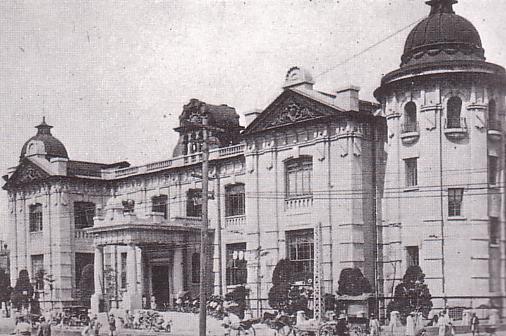
The Bank of Chōsen (Japanese: 朝鮮銀行, romanized: Chōsen Ginkō, Korean: 조선은행 Joseon Eunhaeng), known from 1909 to 1911 as the Bank of Korea (Japanese: 韓國銀行 Kankoku Ginkō, Korean: 한국은행 Hanguk Eunhaeng) and transcribed after 1945 as Bank of Joseon, was a colonial bank that served as bank of issue for Korea under Japanese rule as well as being a commercial bank, with significant operations beyond Korea until 1945. Formed in 1909 by reorganization of the former Korean operations of Japan's Dai-Ichi Bank, it issued the Korean yen from 1910 to 1945. Its seat was initially established in Seoul (known at the time as Hanseong, then Keijō), relocated to Tokyo in May 1924, and subsequently relocated back to Keijō. It has been described as "a primary component of Japanese foreign expansionism".
Following the division of Korea in 1945, the Bank of Chōsen was succeeded in North Korea by the Central Bank of the DPRK. In South Korea, it continued its activity and issued the South Korean won until 1950, when it was replaced by the Bank of Korea. Its branches in Japan were liquidated in October 1945, with some of the assets forming the basis for the later establishment of Nippon Fudosan Bank in 1957.
Following the Japan–Korea Treaty of 1905 which reduced the Korean Empire to a Japanese protectorate, the dominant status which Dai-Ichi Bank had enjoyed in Korea since 1878 became a matter of debate in Japan. In August 1907, Japan's Resident-General Itō Hirobumi and Dai-Ichi Bank's head Shibusawa Eiichi agreed that Dai-Ichi's operations should be eventually transferred to a dedicated central bank for the territory. A debate ensued between Itō and the Japanese finance ministry, with the latter favoring the creation of a Korean branch of the Bank of Japan over that of a stand-alone colonial institution over which Tokyo would have less direct control. Eventually Itō's position won the debate, and the finance ministry rationalized the decision as preferable to preserve financial stability. The new Bank of Korea was created by Japanese law of July 1909, largely modelled on the Bank of Taiwan (est. 1898) but with a greater role for Itō in its governance than in the Taiwanese precedent. Dai-Ichi Bank kept its branches in Seoul and Busan but later in 1909 transferred all its other Korean branches and offices to the Bank of Korea, totalling 220 regular employees and 121 support staff in Chinnampo, Daegu, Gunsan, Hamhung, Incheon, Kaesong, Kyongsong, Masan, Mokpo, Pyongyang, Songjin, Wonsan, and across the Yalu River in Andong. The transfer also included central operations and the new building initially planned by Dai-Ichi Bank for itself in Seoul, then still under construction and which became the Bank of Korea's head office.
The Bank of Korea assumed responsibility for the Dai-Ichi Bank's notes in circulation, which totalled 12,000,000 yen, and Dai-Ichi Bank would further transfer to the Bank of Korea the 4,000,000 yen in specie reserves which backed its banknotes. The balance was converted by the Bank of Korea to a loan of 20 years without interest to the Dai-Ichi Bank. The new institution's first president was Ichihara Morihiro, a former mayor of Yokohama who had joined Dai-Ichi Bank in 1906 to run its Korean network and kept the position until his death in October 1915.
Following the Japan–Korea Treaty of 1910 and full annexation, the Bank of Korea was renamed the Bank of Chōsen by Japanese law in March 1911. The bank remained a joint-stock company owned by a number of Japanese banks and companies, with a board appointed by the Governor-General of Chōsen. Its monetary role was modelled on that of the Bank of Japan, with the key difference that it was allowed to use BOJ banknotes as currency reserve alongside gold and silver. It was responsible for issuing currency in Korea, regulated domestic prices, serviced international trade. Its banknotes had legal tender status in Korea and also in the Kwantung Leased Territory and the South Manchuria Railway Zone; they could be exchanged one-to-one with those of the Bank of Japan.
The total amount of the Bank of Chōsen's banknotes increased from 13.5 million yen at end-1909 to 20 million at end-1910 and 28.6 million in April 1912, then declined to 22.9 million by end-1914 and rose again to 34 million (end-1915), 47 million (end-1916) and 68 million (end-1917). This expansion reflected both economic growth in Korea and the bank's expansion into Northeast China and beyond. The bank opened branches and offices in Mukden (July 1913), Dalian (August 1913), Changchun (September 1913), Siping (February 1914), Kaiyuan (September 1915), Harbin (July 1916), Yingkou (September 1916), Fujiadian (December 1916), Longjingzun (March 1917), Jilin (June 1917), Qingdao (October 1917), Zhengjiatun (March 1918), Shanghai (April 1918), Manzhouli (September 1918), and Qiqihar (November 1918). In June 1916, the Bank of Chōsen started lending directly to the Fengtian government. In December 1917, it took over Manchurian operations of the Yokohama Specie Bank, including its issuance privilege and branches in Lüshun, Liaoyang, Tieling and Andong, while acting as a fiscal agent for the Japanese government in the Kwantung Leased Territory. The YSB's banknotes were withdrawn and replaced with notes of the Bank of Chōsen which already circulated widely in Manchuria, while the YSB retained activity in the territory as a commercial bank. The Bank of Chōsen also expanded its gold purchasing operations into Manchuria, opening an assaying office at its branch in Changchun that complemented the ones it had inherited from Dai-Ichi Bank in Seoul, Pyongyang and Wonsan. The Bank of Chōsen thus became the dominant supplier of gold to Japan's mint in Osaka, representing between 27 and 57 percent of its gold supply between 1910 and 1917. The branches in Manzhouli and Qiqihar were created in the context of the Japanese intervention in Siberia, during which the Bank of Chōsen also temporarily established offices in Khabarovsk, Vladivostok, and other outposts occupied by the Japanese army; the Vladivostok branch remained in activity until 1931. By 1919, the bank had 18 branches in Manchuria, where its operations were more profitable than in Korea where it only had 10 branches. Following the Japanese financial downturn of 1920, however, the bank pared down its Manchurian lending and note issuance, leading to calls by Japanese businessmen in Manchuria for the establishment of a separate local bank of issue.
In the 1923 Great Kantō earthquake, the Bank of Chōsen's branch in Tokyo was destroyed by fire and the bank suffered heavy losses, following which the Japanese finance ministry and Bank of Japan supported it with large-scale long-term lending. In February 1924, new legislation deprived the Governor-General of Chōsen of his prior role in the governance of the bank, which came under the sole supervision of the Ministry of Finance. In May 1924, the bank's head office and senior leadership relocated to Tokyo. The bank's structure was reorganized with a director in Seoul (Keijō) overseeing operations in Korea, another one in Dalian (Dairen) overseeing those in Manchuria, and the leadership in Tokyo overseeing all other foreign operations (e.g. in China) together with those in Mainland Japan.
By 1929, the Bank of Chōsen had 19 offices outside of Japan and its colonies, the second-largest such network among all Japanese banks, surpassed only by the Yokohama Specie Bank. In Japan it had branches in Tokyo, Osaka, Kobe, and Shimonoseki.
Bank of Chōsen
The Bank of Chōsen (Japanese: 朝鮮銀行, romanized: Chōsen Ginkō, Korean: 조선은행 Joseon Eunhaeng), known from 1909 to 1911 as the Bank of Korea (Japanese: 韓國銀行 Kankoku Ginkō, Korean: 한국은행 Hanguk Eunhaeng) and transcribed after 1945 as Bank of Joseon, was a colonial bank that served as bank of issue for Korea under Japanese rule as well as being a commercial bank, with significant operations beyond Korea until 1945. Formed in 1909 by reorganization of the former Korean operations of Japan's Dai-Ichi Bank, it issued the Korean yen from 1910 to 1945. Its seat was initially established in Seoul (known at the time as Hanseong, then Keijō), relocated to Tokyo in May 1924, and subsequently relocated back to Keijō. It has been described as "a primary component of Japanese foreign expansionism".
Following the division of Korea in 1945, the Bank of Chōsen was succeeded in North Korea by the Central Bank of the DPRK. In South Korea, it continued its activity and issued the South Korean won until 1950, when it was replaced by the Bank of Korea. Its branches in Japan were liquidated in October 1945, with some of the assets forming the basis for the later establishment of Nippon Fudosan Bank in 1957.
Following the Japan–Korea Treaty of 1905 which reduced the Korean Empire to a Japanese protectorate, the dominant status which Dai-Ichi Bank had enjoyed in Korea since 1878 became a matter of debate in Japan. In August 1907, Japan's Resident-General Itō Hirobumi and Dai-Ichi Bank's head Shibusawa Eiichi agreed that Dai-Ichi's operations should be eventually transferred to a dedicated central bank for the territory. A debate ensued between Itō and the Japanese finance ministry, with the latter favoring the creation of a Korean branch of the Bank of Japan over that of a stand-alone colonial institution over which Tokyo would have less direct control. Eventually Itō's position won the debate, and the finance ministry rationalized the decision as preferable to preserve financial stability. The new Bank of Korea was created by Japanese law of July 1909, largely modelled on the Bank of Taiwan (est. 1898) but with a greater role for Itō in its governance than in the Taiwanese precedent. Dai-Ichi Bank kept its branches in Seoul and Busan but later in 1909 transferred all its other Korean branches and offices to the Bank of Korea, totalling 220 regular employees and 121 support staff in Chinnampo, Daegu, Gunsan, Hamhung, Incheon, Kaesong, Kyongsong, Masan, Mokpo, Pyongyang, Songjin, Wonsan, and across the Yalu River in Andong. The transfer also included central operations and the new building initially planned by Dai-Ichi Bank for itself in Seoul, then still under construction and which became the Bank of Korea's head office.
The Bank of Korea assumed responsibility for the Dai-Ichi Bank's notes in circulation, which totalled 12,000,000 yen, and Dai-Ichi Bank would further transfer to the Bank of Korea the 4,000,000 yen in specie reserves which backed its banknotes. The balance was converted by the Bank of Korea to a loan of 20 years without interest to the Dai-Ichi Bank. The new institution's first president was Ichihara Morihiro, a former mayor of Yokohama who had joined Dai-Ichi Bank in 1906 to run its Korean network and kept the position until his death in October 1915.
Following the Japan–Korea Treaty of 1910 and full annexation, the Bank of Korea was renamed the Bank of Chōsen by Japanese law in March 1911. The bank remained a joint-stock company owned by a number of Japanese banks and companies, with a board appointed by the Governor-General of Chōsen. Its monetary role was modelled on that of the Bank of Japan, with the key difference that it was allowed to use BOJ banknotes as currency reserve alongside gold and silver. It was responsible for issuing currency in Korea, regulated domestic prices, serviced international trade. Its banknotes had legal tender status in Korea and also in the Kwantung Leased Territory and the South Manchuria Railway Zone; they could be exchanged one-to-one with those of the Bank of Japan.
The total amount of the Bank of Chōsen's banknotes increased from 13.5 million yen at end-1909 to 20 million at end-1910 and 28.6 million in April 1912, then declined to 22.9 million by end-1914 and rose again to 34 million (end-1915), 47 million (end-1916) and 68 million (end-1917). This expansion reflected both economic growth in Korea and the bank's expansion into Northeast China and beyond. The bank opened branches and offices in Mukden (July 1913), Dalian (August 1913), Changchun (September 1913), Siping (February 1914), Kaiyuan (September 1915), Harbin (July 1916), Yingkou (September 1916), Fujiadian (December 1916), Longjingzun (March 1917), Jilin (June 1917), Qingdao (October 1917), Zhengjiatun (March 1918), Shanghai (April 1918), Manzhouli (September 1918), and Qiqihar (November 1918). In June 1916, the Bank of Chōsen started lending directly to the Fengtian government. In December 1917, it took over Manchurian operations of the Yokohama Specie Bank, including its issuance privilege and branches in Lüshun, Liaoyang, Tieling and Andong, while acting as a fiscal agent for the Japanese government in the Kwantung Leased Territory. The YSB's banknotes were withdrawn and replaced with notes of the Bank of Chōsen which already circulated widely in Manchuria, while the YSB retained activity in the territory as a commercial bank. The Bank of Chōsen also expanded its gold purchasing operations into Manchuria, opening an assaying office at its branch in Changchun that complemented the ones it had inherited from Dai-Ichi Bank in Seoul, Pyongyang and Wonsan. The Bank of Chōsen thus became the dominant supplier of gold to Japan's mint in Osaka, representing between 27 and 57 percent of its gold supply between 1910 and 1917. The branches in Manzhouli and Qiqihar were created in the context of the Japanese intervention in Siberia, during which the Bank of Chōsen also temporarily established offices in Khabarovsk, Vladivostok, and other outposts occupied by the Japanese army; the Vladivostok branch remained in activity until 1931. By 1919, the bank had 18 branches in Manchuria, where its operations were more profitable than in Korea where it only had 10 branches. Following the Japanese financial downturn of 1920, however, the bank pared down its Manchurian lending and note issuance, leading to calls by Japanese businessmen in Manchuria for the establishment of a separate local bank of issue.
In the 1923 Great Kantō earthquake, the Bank of Chōsen's branch in Tokyo was destroyed by fire and the bank suffered heavy losses, following which the Japanese finance ministry and Bank of Japan supported it with large-scale long-term lending. In February 1924, new legislation deprived the Governor-General of Chōsen of his prior role in the governance of the bank, which came under the sole supervision of the Ministry of Finance. In May 1924, the bank's head office and senior leadership relocated to Tokyo. The bank's structure was reorganized with a director in Seoul (Keijō) overseeing operations in Korea, another one in Dalian (Dairen) overseeing those in Manchuria, and the leadership in Tokyo overseeing all other foreign operations (e.g. in China) together with those in Mainland Japan.
By 1929, the Bank of Chōsen had 19 offices outside of Japan and its colonies, the second-largest such network among all Japanese banks, surpassed only by the Yokohama Specie Bank. In Japan it had branches in Tokyo, Osaka, Kobe, and Shimonoseki.
Recent media
Recent media