


Community hub
Recent from talks
Contribute something
Nothing was collected or created yet.
Incheon
View on Wikipedia | This article has multiple issues. Please help improve it or discuss these issues on the talk page. (Learn how and when to remove these messages)
|


Incheon[a] is a city located in northwestern South Korea, bordering Seoul and Gyeonggi Province to the east. Inhabited since the Neolithic, Incheon was home to just 4,700 people when it became an international port in 1883. As of February 2020, about 3 million people live in the city, making it South Korea's third-most-populous city after Seoul and Busan.[4]
Key Information


The city's growth has been assured in modern times with the development of its port due to its natural advantages as a coastal city and its proximity to the South Korean capital. It is part of the Seoul Metropolitan Area, along with Seoul itself and Gyeonggi Province, forming the world's fourth-largest metropolitan area by population.
Incheon has since led the economic development of South Korea by opening its port to the outside world, ushering in the modernization of South Korea as a center of industrialization. In 2003, the city was designated as South Korea's first free economic zone.[5][6] Since then, large local companies and global enterprises have increasingly invested in the Incheon Free Economic Zone, including Samsung which chose Songdo International City as its new investment destination for its bio industry.[citation needed]
As an international city, Incheon has held numerous large-scale international conferences, such as the Incheon Global Fair & Festival in 2009. The 17th Asian Games Incheon 2014 was also held in Incheon on 19 September 2014. Incheon is also a major transportation hub in northeast Asia, with Incheon International Airport and Incheon Port.[citation needed] The large volume of port traffic makes Incheon a Large-Port Metropolis using the Southampton System of Port-City classification.[7]
History
[edit]The first historical record of the Incheon area dates back to 475 AD, during the reign of King Jangsu of Goguryeo, by the name of Michuhol, which is supposed to be located on modern Munhak Hill (문학산). The area underwent several name changes with successive kingdoms and dynasties. In Goryeo era, Incheon was called Gyeongwon (경원) or Inju (인주). The current name was turned to Incheon in 1413.[citation needed] Later, Incheon County became Incheon Metropolitan Prefecture (dohobu, 도호부). Old Incheon consisted of modern southern Incheon (i.e. Jung-gu, Dong-gu, Nam-gu, Yeonsu District, and Namdong District) and the northern part of Siheung. The city center was Gwangyo-dong, where the prefecture office (도호부청사) and the local academy (hyanggyo, 향교) were located. The "original" two remaining buildings of the Incheon prefecture office are located in Munhak Elementary School, while the newly built (in 2001) prefecture office buildings are right across from Munhak Baseball Stadium.
Modern history
[edit],_1890.jpg)
Another historical name of the city, Jemulpo (alternatively Romanized as Chemulpo), was not widely used until the opening of the port in 1883. It was frequently used until the Japanese annexation.[8][9] After the opening of the Incheon port, the city center moved from Gwangyo to Jemulpo. Today, either Jemulpo or Gwangyo-dong is considered "Original Incheon" (원인천). It was internationally known as Jinsen during Japanese rule, based on the Japanese pronunciation of Incheon's Sino-Korean name.
In 1914, the Japanese colonial government merged outer parts of old Incheon (including the former center of Gwangyo) with Bupyeong County, forming Bucheon County.[10] Between 1936 and 1940, some part of Bucheon County was recombined into Incheon, by which some part of "old" Bupyeong was annexed into Incheon.
Incheon was originally part of Gyeonggi Province, but was granted Directly Governed (now Metropolitan) City status on 1 July 1981; the city officially separated from the province. In 1989, neighboring islands and Gyeyang township of Gimpo County[b] were ceded to Incheon and in 1995 Geomdan township of Gimpo County and two counties of Ganghwa and Onjin were annexed to Incheon.[citation needed]
Incheon was known as Inchon prior to South Korea's adoption of a new Romanization system in 2000.[11]

Major events
[edit]The city was the site of the Battle of Chemulpo Bay, where the first shots of the Russo-Japanese War were fired.
During the Korean War, Incheon was occupied by North Korean troops on 4 July 1950. Incheon was the site of the Battle of Inchon when the United States troops landed to relieve pressure on the Pusan Perimeter and to launch a United Nations offensive northward. The result was a decisive UN victory and it was recaptured on 19 September 1950.[12] USS Inchon was named after the tide-turning battle that ensued.
Prior to and during the June Democratic Movement in 1987, Incheon was the site of several pro-democracy protests.
Incheon has also hosted a series of major international events. The Global Fair & Festival 2009 Incheon was held in the Songdo District in August 2009. It was open from 7 August to 25 October for a period of 80 days. It was a comprehensive international event with global institutions and corporations as participants. Various musicians and artists performed during the event.

The city hosted a meeting of the G20 Finance Ministers in February 2010.[13] Incheon was the site of the third Global Model United Nations Conference, held from 10 to 14 August 2011.
It first hosted the Incheon Women Artists' Biennale in 2004 which expanded into welcoming international artists in its subsequent 2007, 2009[14] and 2011.
Incheon hosted the Asian Games in 2014.[15] It hosted the 6th OECD World Forum in 2018.[16]
Incheon was designated as the World Book Capital for the year 2015 by UNESCO.[17]
Education
[edit]On 27 February 2007, Incheon declared itself an "English City", and inaugurated the "Incheon Free English Zone" program. The goal of the program is to make the city as proficient in English as Singapore.[18] This is for the ultimate purpose of establishing Incheon as a commercial and business hub of northeast Asia (see Free Economic Zone below). The official slogan of the program is "Smile with English".[citation needed]
Higher education
[edit]Incheon is home to a number of colleges and universities:
- George Mason University Korea Campus
- Ghent University Global Campus
- Gyeongin National University of Education Incheon campus
- Inha University (formerly Inha Institute of Technology)
- Gachon University Medical·Ganghwa campus
- Gyeongin Women's College
- Inha Technical College
- Incheon Catholic University
- Incheon City College
- Incheon National University
- Jaineung College
- University of Utah Asia Campus
- SUNY South Korea
- Anyang University Ganghwa campus
- Yonsei University International campus
- Korea Polytechnics II
- Seongsan Hyo University
- Juan International University
Climate
[edit]Incheon has a humid subtropical climate (Köppen: Cwa) using the −3 °C (27 °F) isotherm,[19] and humid continental climate[20] (Köppen Dwa, respectively) using the 0 °C (32 °F) isotherm. Like other metropolitan cities, Incheon has a strong urban heat island effect.[21] Incheon's climate is about average compared to the rest of Korea, with 8 locations being cooler and 10 locations being warmer, and with 9 locations being wetter and 9 locations being drier.[22]
Incheon experiences each of its four seasons, distinctly feeling the rise and fall of temperature and humidity. The temperature however, never rises to an extreme, and the climate of the city is essentially mild. Incheon is swept by the seasonal winds as the northwesterly winds strike the city in the winter and the summer in Incheon is affected by gusts of the warm southwesterly winds.[23]
| Climate data for Incheon (1991–2020 normals, extremes 1904–present) | |||||||||||||
|---|---|---|---|---|---|---|---|---|---|---|---|---|---|
| Month | Jan | Feb | Mar | Apr | May | Jun | Jul | Aug | Sep | Oct | Nov | Dec | Year |
| Record high °C (°F) | 15.8 (60.4) |
18.2 (64.8) |
21.9 (71.4) |
32.7 (90.9) |
31.2 (88.2) |
33.8 (92.8) |
38.9 (102.0) |
38.9 (102.0) |
33.4 (92.1) |
28.6 (83.5) |
26.2 (79.2) |
17.5 (63.5) |
38.9 (102.0) |
| Mean daily maximum °C (°F) | 2.2 (36.0) |
4.8 (40.6) |
10.1 (50.2) |
16.2 (61.2) |
21.6 (70.9) |
25.6 (78.1) |
27.8 (82.0) |
29.2 (84.6) |
25.8 (78.4) |
19.9 (67.8) |
12.0 (53.6) |
4.5 (40.1) |
16.6 (61.9) |
| Daily mean °C (°F) | −1.5 (29.3) |
0.7 (33.3) |
5.6 (42.1) |
11.5 (52.7) |
16.8 (62.2) |
21.3 (70.3) |
24.4 (75.9) |
25.6 (78.1) |
21.5 (70.7) |
15.3 (59.5) |
7.9 (46.2) |
0.7 (33.3) |
12.5 (54.5) |
| Mean daily minimum °C (°F) | −4.8 (23.4) |
−2.8 (27.0) |
2.1 (35.8) |
7.9 (46.2) |
13.1 (55.6) |
18.0 (64.4) |
21.8 (71.2) |
22.9 (73.2) |
18.1 (64.6) |
11.4 (52.5) |
4.3 (39.7) |
−2.7 (27.1) |
9.1 (48.4) |
| Record low °C (°F) | −21.0 (−5.8) |
−18.4 (−1.1) |
−13.8 (7.2) |
−3.6 (25.5) |
3.4 (38.1) |
8.7 (47.7) |
12.8 (55.0) |
14.4 (57.9) |
5.3 (41.5) |
−3.2 (26.2) |
−12.0 (10.4) |
−18.6 (−1.5) |
−21.0 (−5.8) |
| Average precipitation mm (inches) | 15.9 (0.63) |
25.1 (0.99) |
33.8 (1.33) |
63.5 (2.50) |
96.3 (3.79) |
106.0 (4.17) |
337.7 (13.30) |
274.6 (10.81) |
130.3 (5.13) |
51.1 (2.01) |
50.8 (2.00) |
22.3 (0.88) |
1,207.4 (47.54) |
| Average precipitation days (≥ 0.1 mm) | 5.9 | 5.2 | 5.9 | 7.9 | 8.4 | 9.5 | 15.0 | 12.4 | 8.1 | 6.0 | 8.6 | 7.7 | 100.6 |
| Average snowy days | 7.1 | 4.4 | 2.0 | 0.2 | 0.0 | 0.0 | 0.0 | 0.0 | 0.0 | 0.0 | 1.8 | 6.6 | 22.1 |
| Average relative humidity (%) | 61.1 | 61.2 | 63.4 | 64.5 | 69.8 | 75.9 | 83.8 | 80.1 | 72.9 | 66.7 | 64.3 | 61.8 | 68.8 |
| Mean monthly sunshine hours | 186.6 | 188.5 | 215.3 | 220.0 | 239.5 | 212.5 | 159.7 | 189.8 | 200.4 | 219.1 | 170.2 | 176.7 | 2,378.3 |
| Percentage possible sunshine | 58.0 | 59.5 | 55.3 | 55.6 | 52.7 | 46.1 | 35.0 | 45.4 | 52.9 | 60.6 | 55.2 | 57.3 | 52.0 |
| Source: Korea Meteorological Administration (percent sunshine 1981–2010)[24][25][26] | |||||||||||||
| Climate data for Ganghwa County, Incheon (1991–2020 normals, extremes 1972–present) | |||||||||||||
|---|---|---|---|---|---|---|---|---|---|---|---|---|---|
| Month | Jan | Feb | Mar | Apr | May | Jun | Jul | Aug | Sep | Oct | Nov | Dec | Year |
| Record high °C (°F) | 12.6 (54.7) |
17.4 (63.3) |
22.3 (72.1) |
29.2 (84.6) |
31.0 (87.8) |
33.2 (91.8) |
35.5 (95.9) |
35.8 (96.4) |
31.7 (89.1) |
28.3 (82.9) |
23.8 (74.8) |
16.0 (60.8) |
35.8 (96.4) |
| Mean daily maximum °C (°F) | 1.7 (35.1) |
4.5 (40.1) |
9.8 (49.6) |
16.2 (61.2) |
21.4 (70.5) |
25.4 (77.7) |
27.6 (81.7) |
29.0 (84.2) |
25.5 (77.9) |
19.5 (67.1) |
11.5 (52.7) |
3.9 (39.0) |
16.3 (61.3) |
| Daily mean °C (°F) | −3.2 (26.2) |
−0.7 (30.7) |
4.6 (40.3) |
10.7 (51.3) |
16.0 (60.8) |
20.5 (68.9) |
23.7 (74.7) |
24.7 (76.5) |
20.2 (68.4) |
13.7 (56.7) |
6.3 (43.3) |
−0.9 (30.4) |
11.3 (52.3) |
| Mean daily minimum °C (°F) | −8.1 (17.4) |
−5.8 (21.6) |
−0.6 (30.9) |
5.3 (41.5) |
11.0 (51.8) |
16.3 (61.3) |
20.6 (69.1) |
21.2 (70.2) |
15.6 (60.1) |
8.1 (46.6) |
1.2 (34.2) |
−5.7 (21.7) |
6.6 (43.9) |
| Record low °C (°F) | −22.5 (−8.5) |
−19.4 (−2.9) |
−11.3 (11.7) |
−4.4 (24.1) |
1.6 (34.9) |
6.9 (44.4) |
12.7 (54.9) |
12.5 (54.5) |
3.0 (37.4) |
−4.2 (24.4) |
−12.0 (10.4) |
−19.8 (−3.6) |
−22.5 (−8.5) |
| Average precipitation mm (inches) | 15.6 (0.61) |
22.5 (0.89) |
31.4 (1.24) |
64.9 (2.56) |
110.9 (4.37) |
110.0 (4.33) |
355.6 (14.00) |
300.4 (11.83) |
131.5 (5.18) |
55.8 (2.20) |
46.3 (1.82) |
21.3 (0.84) |
1,266.2 (49.85) |
| Average precipitation days (≥ 0.1 mm) | 5.0 | 4.8 | 6.0 | 7.5 | 8.2 | 8.6 | 14.1 | 11.9 | 7.4 | 5.6 | 7.5 | 6.6 | 93.2 |
| Average snowy days | 7.3 | 4.3 | 2.4 | 0.2 | 0.0 | 0.0 | 0.0 | 0.0 | 0.0 | 0.1 | 1.5 | 5.1 | 20.6 |
| Average relative humidity (%) | 63.6 | 61.0 | 61.4 | 62.4 | 68.6 | 75.1 | 82.8 | 79.9 | 73.8 | 68.9 | 67.8 | 65.4 | 69.2 |
| Mean monthly sunshine hours | 186.2 | 186.5 | 217.0 | 221.7 | 235.3 | 208.5 | 153.0 | 184.9 | 203.8 | 214.3 | 166.0 | 171.8 | 2,349 |
| Percentage possible sunshine | 58.7 | 61.8 | 58.9 | 59.0 | 54.8 | 50.0 | 38.6 | 47.7 | 57.4 | 63.3 | 55.7 | 55.6 | 54.6 |
| Source: Korea Meteorological Administration (percent sunshine 1981–2010)[24][25][26] | |||||||||||||
| Climate data for Baengnyeongdo, Ongjin County, Incheon (2001–2020 normals, extremes 2000–present) | |||||||||||||
|---|---|---|---|---|---|---|---|---|---|---|---|---|---|
| Month | Jan | Feb | Mar | Apr | May | Jun | Jul | Aug | Sep | Oct | Nov | Dec | Year |
| Record high °C (°F) | 9.4 (48.9) |
15.5 (59.9) |
17.3 (63.1) |
23.7 (74.7) |
28.1 (82.6) |
30.0 (86.0) |
33.5 (92.3) |
33.2 (91.8) |
29.9 (85.8) |
25.6 (78.1) |
20.3 (68.5) |
13.8 (56.8) |
33.5 (92.3) |
| Mean daily maximum °C (°F) | 1.2 (34.2) |
2.8 (37.0) |
7.1 (44.8) |
13.0 (55.4) |
18.7 (65.7) |
22.9 (73.2) |
25.4 (77.7) |
26.9 (80.4) |
23.5 (74.3) |
17.7 (63.9) |
10.6 (51.1) |
3.8 (38.8) |
14.5 (58.1) |
| Daily mean °C (°F) | −1.3 (29.7) |
0.0 (32.0) |
3.8 (38.8) |
9.1 (48.4) |
14.5 (58.1) |
19.0 (66.2) |
22.3 (72.1) |
23.8 (74.8) |
20.1 (68.2) |
14.7 (58.5) |
7.9 (46.2) |
1.2 (34.2) |
11.3 (52.3) |
| Mean daily minimum °C (°F) | −3.4 (25.9) |
−2.2 (28.0) |
1.3 (34.3) |
6.0 (42.8) |
11.1 (52.0) |
16.1 (61.0) |
19.9 (67.8) |
21.5 (70.7) |
17.8 (64.0) |
12.3 (54.1) |
5.5 (41.9) |
−1.1 (30.0) |
8.7 (47.7) |
| Record low °C (°F) | −17.4 (0.7) |
−15.3 (4.5) |
−7.7 (18.1) |
0.5 (32.9) |
5.0 (41.0) |
7.3 (45.1) |
13.0 (55.4) |
14.1 (57.4) |
10.7 (51.3) |
2.1 (35.8) |
−3.9 (25.0) |
−11.3 (11.7) |
−17.4 (0.7) |
| Average precipitation mm (inches) | 13.3 (0.52) |
17.4 (0.69) |
18.2 (0.72) |
47.5 (1.87) |
74.3 (2.93) |
72.0 (2.83) |
201.0 (7.91) |
158.5 (6.24) |
90.6 (3.57) |
31.0 (1.22) |
41.9 (1.65) |
21.6 (0.85) |
787.3 (31.00) |
| Average precipitation days (≥ 0.1 mm) | 7.4 | 4.8 | 5.3 | 6.9 | 8.1 | 10.0 | 13.9 | 11.1 | 6.7 | 5.0 | 8.5 | 9.9 | 97.6 |
| Average snowy days | 11.0 | 6.2 | 2.3 | 0.1 | 0.0 | 0.0 | 0.0 | 0.0 | 0.0 | 0.2 | 3.0 | 12.7 | 35.5 |
| Average relative humidity (%) | 63.4 | 63.0 | 65.5 | 65.7 | 70.1 | 80.2 | 88.0 | 83.7 | 75.9 | 67.8 | 64.7 | 63.8 | 71.0 |
| Mean monthly sunshine hours | 139.9 | 166.6 | 216.9 | 219.3 | 239.6 | 191.0 | 136.7 | 189.6 | 212.4 | 217.6 | 146.7 | 117.3 | 2,193.6 |
| Percentage possible sunshine | 43.3 | 54.3 | 53.9 | 53.0 | 51.4 | 38.6 | 28.6 | 40.8 | 54.5 | 60.6 | 49.3 | 37.9 | 46.8 |
| Source: Korea Meteorological Administration (percent sunshine 1981–2010)[24][25][26] | |||||||||||||
Economy
[edit]Incheon forms the heart of Capital Industrial Region. During the industrialization of South Korea, several industrial complexes were built throughout the city, and as a result, the city was largely dependent on manufacturing industry. But with the designation of Incheon Free Economic Zone in 2003, the city is now making an effort to foster new growth industries. Major industrial parks include Bupyeong industrial complex, which hosts GM Incheon plant(formerly a GM Daewoo Incheon plant), Juan industrial complex, and Namdong Industrial complex.[citation needed]
In recent years, bio industry is emerging as a new growth industry of the city.[citation needed] Currently, with the total production capacity of 330kℓ per year, the city ranks 2nd in the world by production capacity along with San Francisco, United States.[citation needed] The capacity is under expansion, and after completion in 2018, the city will rank 1st with the production capacity of 510kℓ.[27] Also, logistics industry is also experiencing a rapid growth, thanks to Incheon Airport, which was ranked fourth in the world by cargo traffic, and the expansion of Incheon Port.
Transportation
[edit]Incheon is a major domestic and international transport hub for Korea.

Air
[edit]Incheon International Airport is South Korea's primary international airport and a regional air hub. In 2015, it was the world's 22nd busiest airport by passenger traffic, with 49,412,750 passengers.[28]
There were a total of 305,446 flights (300,634 international, 4,812 domestic) to and from Incheon International Airport in 2015, an average of 837 flights (824 international, 13 domestic) daily. Korea's two main carriers, Korean Air and Asiana Airlines, serviced 50.9% of flights, while low-cost and foreign carriers serviced the remaining 49.1% of flights.[29] The airport is experiencing a rapid increase in passengers, and the opening of Terminal 2 in December 2017 spurred additional traffic.
The airport was also featured in the Korean drama series, Air City.
Incheon International Airport ranked "5th in the world" among international airports in late 2018.[30][when?][needs update]
Sea
[edit]Incheon's sea port is the second largest port in Korea after Busan Port.
The International Passenger Terminal located at the port offers ferries to five cities in China: Dalian, Qingdao, Tianjin, Dandong, and Weihai. There are also ferries to Incheon's outlying islands as well as Baengnyeongdo inside of the Northern Limit Line.
Buses
[edit]Incheon Bus Terminal, located at its eponymous subway stop, offers express bus transportation to all parts of Korea. Many city bus lines offer transportation within city limits as well as to the neighboring cities of Bucheon, Gimpo, Seoul, and Siheung.
-
 Incheon Air Bus Terminal
 -
 Bus Terminal
 -
 Cheongna GRT
 -
 Incheon City Tour Bus
 -
 Incheon City Bus No 30


Trains
[edit]
Local service to Guro, Seoul, Cheongnyangni, Uijeongbu and Soyosan is offered by Seoul's subway Line 1. The line has 11 stations within Incheon and connects to the Incheon Subway at Bupyeong and Juan stations.
Rapid service on the same line to Yongsan station in Seoul depart from Dongincheon station and stops at major stations.
The Airport Express (AREX) line runs from Incheon International Airport to Seoul Station via Gimpo International Airport. The Incheon-Gimpo section was opened in March 2007 and was extended to Seoul station in December 2010. Passengers can choose a high-speed service stopping only at Incheon airport and Seoul, which takes 43 minutes but departs only every half-hour; or the all-station service which takes 53 minutes but leaves every six minutes.
KTX service was introduced on the AREX line on 30 June 2014, with stops at Incheon International Airport station and Geomam station. There are additional plans to use the newly built Suin Line to bring KTX service to Incheon station by 2021.[31]
Subway
[edit]
The Incheon Subway has two subway lines serving the city. The first line connects to the Seoul Metropolitan Subway system at Bupyeong station (Seoul Subway Line 1), and AREX line at Gyeyang station. It connects International Business District station in Songdo to Gyeyang station. The line has 28 stations on 29.4 kilometres (18.3 miles) of track. The line also has transfer stations with the Suin Line at Woninjae station, with the Incheon Subway Line 2 at Incheon City Hall station, and with Seoul Subway Line 7 at Bupyeong-gu Office station. Incheon Subway Line 2 opened in July 2016 and runs from Geomdan Oryu station to Unyeon station. The automated line is 29.2 kilometres (18.1 miles) long, and has 27 stations, including transfer stations at Geomam station with the AREX line, Juan station with Seoul Subway Line 1 and Incheon Subway Line 2 at Incheon City Hall station.
The Incheon subway is operated by the Incheon Rapid Transit Corporation (IRTC).
Korail has also constructed a new commuter rail line named Suin Line. The line opened in 2012 from Oido station in Siheung to Songdo station in Incheon. It was then extended in 2016, and now reaches Incheon station where passengers can transfer to Seoul Subway Line 1. In 2020, the line was extended from Oido station to Suwon Station.
SMRT (one of three operating companies of Seoul Metropolitan Subway) has extended Seoul Metropolitan Subway Line 7 to Bupyeong-gu office by 2011 and provided transfers to the Incheon Subway system. It has 3 stations within Incheon. By 2020, the line will further be extended westwards to Seoknam station where it will be possible to transfer to Incheon Subway Line 2.
Free Economic Zone
[edit]The Incheon Free Economic Zone (IFEZ) comprises the regions of Songdo, Cheongna, and Yeongjong Island, covering a total area of 51,739 acres (20,938 hectares). IFEZ was established to develop these areas into centres for logistics, international business, leisure, and tourism, aimed primarily at the Northeast Asian region. The designation of "Free Economic Zone" refers to efforts to enhance the business environment for foreign enterprises and improve living conditions for expatriates. It was the first zone of its kind in South Korea, formally designated in August 2003. The region includes infrastructure for air and sea transportation, logistics, international business, financial services, and residential facilities, alongside educational, medical, and leisure amenities.
New Songdo City
[edit]Development of Songdo International City began in 1994 on reclaimed land and has been intended as a centre for international business, trade, technology, and environmentally conscious urban living. Initially projected to be completed by 2020, some areas continue to be under development, with evolving projects and adjustments to the original master plan.[32] Songdo houses various multinational companies and hosts several international institutions, including the Green Climate Fund. The city is also recognised for its smart city technologies and eco-friendly design, featuring extensive green spaces, smart infrastructure, and advanced waste management systems.
- Development area: 13,162 acres (53.26 km2)
- Planned population: 252,000 persons[citation needed]
Yeongjong Island
[edit]As of 2012, Yeongjong International City, centred around Incheon International Airport, has been under development as an eco-friendly airport city. Originally scheduled for completion by 2020, certain projects are still ongoing as the area continues to evolve.[33] The development aims to combine logistical facilities with residential, business, and tourism sectors, leveraging its proximity to the airport.
- Development area: 34,183 acres (138.33 km2)[citation needed]
Cheongna
[edit]Cheongna, located on the mainland near Yeongjong Island, is designed to focus on entertainment and leisure. It includes residential zones, sports facilities, and a business district catering to international finance. Although initially slated for completion by 2008, development timelines have since been extended, with some projects, such as the theme park, still in the planning or early construction stages.
- Development Size: 4,394 acres (17.78 km2)
- Planned population: 90,000 persons[citation needed]


Administrative divisions
[edit]
Incheon is divided into 8 districts (gu) and 2 counties (gun).
- Bupyeong District (Korean: 부평구; Hanja: 富平區)
- Dong District (동구; 東區)
- Gyeyang District (계양구; 桂陽區)
- Jung District (중구; 中區)
- Michuhol District (미추홀구; 彌鄒忽區)
- Namdong District (남동구; 南洞區)
- Seo District (서구; 西區)
- Yeonsu District (연수구; 延壽區)
- Ganghwa County (강화군; 江華郡)
- Ongjin County (옹진군; 甕津郡)
Demographics
[edit]- Not religious (52.0%)
- Protestantism (22.0%)
- Catholicism (12.0%)
- Buddhism (12.0%)
- Others (2.00%)
| Year | Pop. | ±% |
|---|---|---|
| 1970 | 634,046 | — |
| 1980 | 1,083,906 | +71.0% |
| 1990 | 1,817,919 | +67.7% |
| 2000 | 2,475,139 | +36.2% |
| 2010 | 2,662,509 | +7.6% |
| 2020 | 2,945,454 | +10.6% |
| Source: [35][36] | ||
According to the 2015 census, 32.6% of the population follow Christianity (23.1% Protestantism and 9.5% Catholicism) and 8.7% follow Buddhism. 57.9% of the population is irreligious. 0.8% of the population follow other religions including Islam, Muism, and Confucianism.[37]
Sports
[edit]
Incheon is home to the following professional and semi-professional sports teams:
- Association football
The K League 1 team Incheon United FC was founded in 2003. The club was known to have a rivalry against former Bucheon SK (now Jeju SK FC) due to the teams' close geographical relationship. The K4 League team FC Namdong is based in the Namdong District of Incheon.
The WK League women's team is called the Hyundai Steel Red Angels.
- Baseball
The KBO League team SSG Landers. The first Incheon-based professional baseball team were Sammi Superstars.
- Basketball
The WKBL team Incheon Shinhan Bank S-Birds is based in Incheon. Between 1997 and 2021, Incheon hosted the KBL team Incheon Electroland Elephants.
- Volleyball
The V-League teams are Incheon Korean Air Jumbos (men's) and Incheon Heungkuk Life Pink Spiders (women's).
- Munhak Sports Complex
The Munhak Sports Complex houses both a football stadium and a baseball stadium. The football stadium was Incheon's venue for the 2002 Football World Cup, and is also the home venue for Incheon United. The baseball stadium is the home venue for the SSG Landers.
In April 2007, Incheon was selected as the host city for the 2014 Asian Games, beating out New Delhi.[38]
- Yeonhui Cricket Ground
Yeonhui Cricket Ground is a purpose-built cricket stadium in Incheon built for cricket events at the 2014 Asian Games. The 2014 Asian Games featured cricket for both the men's and the women's event and this ground was used for the scheduled cricket matches played at the games. It is the first cricket stadium in South Korea.[39][40]
- Incheon Football Stadium (Sungui Arena)
Incheon Football Stadium is the first football-only stadium in Incheon. It was built in 2012 with a capacity for 20,891 spectators.
Points of interest
[edit]Incheon administers several of Korea's western islands, including Ganghwa Island, Yeongjong Island, and Baengnyeongdo, with Baengnyeongdo being South Korea's westernmost point.
Key points of interest in Incheon include:
- Bupyeong Station: A major transport hub where Seoul Subway Line 1 and Incheon Subway Line intersect. Bupyeong is known for its vast underground shopping centre, featuring 1,408 stores over 31,692 square metres (as recorded by the National Archives of Korea). This centre was recognised by the American World Record Academy in 2014 for having the largest number of stores in the world. Above ground, Bupyeong offers a lively mix of restaurants, shops, and a Lotte Mart.
- Jayu (Freedom) Park: Located near Incheon's port, this park is home to a statue of General Douglas MacArthur and a memorial marking the centennial of U.S.-Korea relations.
- Chinatown: Korea's only official Chinatown, situated across from Incheon Station, close to Jayu Park, offering a taste of Chinese culture and cuisine.
- Incheon Bus Terminal Area: Centred around the city's bus terminal, this area also features a subway station and a performance venue. The bustling Rodeo Street in Guwol-dong is lined with restaurants, department stores, and shops.
- Wolmido: A former military site at Green Beach, used during the Incheon Landing. It is now a popular tourist destination with a boardwalk, amusement park, and seafood restaurants. Ferries to Yeongjongdo and Jakyakdo depart from here.
- Jakyakdo Island: A small island located between Wolmido and Yeongjongdo. Visitors can enjoy scenic walks, picnic spots, a restaurant, and seasonal accommodation.
- Incheon Landing Operation Memorial Hall: This site commemorates the Incheon Landing with a plaza and museum displaying weapons and artefacts from the operation and the Korean War.
- Incheon Dohobu Cheongsa: The former government complex of Incheon, dating back to at least the reign of King Sejong in the 15th century. It is located near Munhak Stadium.
- Ara Canal: A waterway linking the Han River to the Yellow Sea. The canal is bordered by parks and a popular bike path.
- Korean-Chinese Cultural Centre: Built by the Jung-gu District, this centre promotes cultural exchange and understanding between Korea and China.
- Songwol-dong Fairy Tale Village: Created as part of a renovation project, this vibrant village is now a popular attraction for children and young visitors.
- Baedari Secondhand Bookstore Alley: Historical space in Dongu-gu housing multiple bookstores.
-
 Monument to 100 years of friendship between Korea and the US in Jayu Park
 -
 A walkway in Jayu Park
 -
 The only official Chinatown in South Korea
 -
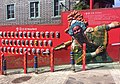 Peking Opera wall Chinatown, Incheon, South Korea
 -
 Korean-Chinese cultural center Chinatown in South Korea
 -
 Songwol-dong Fairy Tale Village in Incheon in South Korea
 -
 Port of Incheon
 -

-
 The tiny island of Jakyakdo
 -
 Wolmido promenade
 -
 Incheon International Airport
 -
 Incheon Munhak Stadium
 -
 Lotte Department & Incheon Bus Terminal
 -
 Park Taehwan Swimming Stadium
 -
 Incheon Munhak Stadium (SSG Landers Baseball Team Home)
 -
 Guwol Rodeo Street
 -
 Guwol Asiad Park at Night (2014 Asian Game Park)
 -
 Incheon Grand Park
 -
 Sorae Bridge
 -
 Sorae Art Center & Halls


.jpg)


_2024.jpg)


Notable people
[edit]- Lee Je-no, member of NCT and its subunit NCT Dream
- Miyeon, singer
- Hapkido Grand Master Han Bong-soo
- Hangzoo, Rhythm Power
- Han Ji-sung, Stray Kids
- Kim Ryeo-wook, Super Junior
- Kim Hyo-yeon, Girls' Generation
- Choi Min-ho, Shinee
- Kang Ki-young, actor
- Michaela Dietz, voice actress
- Kim Gu-ra, comedian and host
- Kim Nam-il, footballer
- Cho Yong-hyung, footballer
- Shin Ji, Koyote
- Yoon Chae-kyung, April
- Kang Hye-jung, actress
- Kwon Nara, actress
- Go Kyung-pyo, actor
- Lee Sung-hyun, kickboxer
- Choi Ji-man, baseball player (New York Yankees, Milwaukee Brewers, Tampa Bay Rays)
- Ku Hye-sun, actress
- Hyolyn, Sistar
- Roh Ji-hoon, singer
- Ryu Hyun-jin, baseball player (Hanwha Eagles, Los Angeles Dodgers, Toronto Blue Jays)
- Park Cho-a, soloist and former member of AOA
- Bang Min-ah, Girl's Day
- Nam Ji-hyun, actress
- Kyung Soo-jin, actress
- Kim Young-kwang
- JinJoo Lee, DNCE
- Ong Seong-wu, former member of Wanna One, actor and soloist
- Yoo Seung-ho, actor
- Lee Kang-in, footballer
- Kim Sung-joo, singer, actor, UNIQ
- Sung Dong-il, actor
- Sohee, singer and member of Alice
- Park Nam-choon, member of the National Assembly and mayor of Incheon
- Doyeon, singer, actress and member of Weki Meki and WJMK
- Young Kim, U.S. representative for California[41]
- Hong Soo-hyun, actress
- Peggy Gou, DJ
- Kim Won-pil, singer-songwriter, keyboardist and member of Day6
- Do Han-se, rapper and member of Victon
International relations
[edit]
 Alexandria, Egypt (2000)
 Anchorage, United States (1986)
 Banten, Indonesia (2009)
- Burbank, United States (1961)
 Chongqing, China (2007)
 Haiphong, Vietnam (1997)
- Honolulu, United States (2003)
 Kitakyushu, Japan (1988)
- Kobe, Japan (2010)
 Kolkata, India (2007)
 Manila, Philippines (2008)
 Mérida, Mexico (2007)
 Panama City, Panama (2000)
- Philadelphia, United States (1983)
 Phnom Penh, Cambodia (2009)
- Seattle, United States
- Shenyang, China (2014)
 Taoyuan, Taiwan (2009)
 Tel Aviv, Israel (2000)
- Tianjin, China (1993)
 Ulaanbaatar, Mongolia (2017)
 Veneto, Italy (2010)
 Vladivostok, Russia (2012)
- Yekaterinburg, Russia (2009)
 Gödöllő, Hungary (2023)


See also
[edit]
.svg)

Notes
[edit]- ^ Korean: 인천; Korean pronunciation: [intɕʰʌ̹n]; or Inch'ŏn; literally "kind river"), formerly Jemulpo or Chemulp'o (Korean: 제물포) until the period after 1910, officially the Incheon Metropolitan City (인천광역시)
- ^ Prior to 1973, the township belonged to Bucheon or old Bupyeong.
References
[edit]- ^ 연령별 인구현황 [Population by Age]. Ministry of the Interior and Safety. Archived from the original on 20 April 2018. Retrieved 20 October 2018.
- ^ "2023년 지역소득(잠정)". www.kostat.go.kr.
- ^ "Regional GDP, Gross regional income and Individual income". nosis.kr.
- ^ "Population, Households and Housing Units". Statistics Korea. 28 July 2022. Archived from the original on 25 January 2023. Retrieved 25 January 2023.
- ^ Bost, F. "World Free Zones Organization; Index cards by country; SOUTH KOREA" (PDF). World Free Zones Organization. Archived (PDF) from the original on 5 July 2024. Retrieved 15 April 2024.
- ^ Lee, Changwon (1 December 2005). "Development of Free Economic Zones and Labor Standards: A Case Study of Free Economic Zones in Korea". DigitalCollections@ILR. hdl:1813/89761.
- ^ Roberts, Toby; Williams, Ian; Preston, John (2021). "The Southampton system: A new universal standard approach for port-city classification". Maritime Policy & Management. 48 (4): 530–542. doi:10.1080/03088839.2020.1802785. S2CID 225502755.
- ^ Incheon Metropolitan City Archived 7 January 2006 at the Wayback Machine
- ^ Ewing, Stefan (25 January 2006). "By Train from Seoul to Incheon – and Jemulpo, too". Korea Web. Archived from the original on 28 September 2007.
- ^ "GAMEON'ASIA 2015, March 25–27, 2015, Ghent University, Incheon, South-Korea, Conference Venue | EUROSIS". www.eurosis.org. Archived from the original on 24 March 2022. Retrieved 8 July 2021.
- ^ Herald, Korea (2 March 2022). "[Lee Kyong-hee] Romanization of Korean – alphabet buffet". The Korea Herald. Archived from the original on 18 March 2024. Retrieved 18 March 2024.
- ^ Bill Sloan, The Darkest Summer: Pusan and Inchon 1950: The Battles That Saved South Korea—and the Marines—From Extinction(2009)
- ^ "G20 Information Centre". utoronto.ca. Archived from the original on 16 February 2013. Retrieved 19 January 2010.
- ^ Garcia, Cathy Rose A. (30 July 2009). "Spotlight on Women Artists at Incheon Biennale". The Korea Times. Archived from the original on 11 August 2011.
- ^ "- Olympic Council of Asia". www.ocasia.org. Archived from the original on 11 September 2018. Retrieved 18 February 2019.
- ^ "The 6th OECD World Forum: the Future of Well-being, 27–29 November 2018, Incheon, Korea". OECD. Archived from the original on 3 November 2021. Retrieved 3 November 2021.
- ^ "Incheon (Republic of Korea) named World Book Capital 2015". UNESCO. 23 July 2013. Archived from the original on 9 June 2021. Retrieved 19 April 2022.
- ^ "Arirang News". Arirang.co.kr. 20 March 2007. Archived from the original on 7 October 2013. Retrieved 13 May 2013.
- ^ Kottek, M.; J. Grieser; C. Beck; B. Rudolf; F. Rubel (2006). "World Map of the Köppen-Geiger climate classification updated" (PDF). Meteorol. Z. 15 (3): 259–263. Bibcode:2006MetZe..15..259K. doi:10.1127/0941-2948/2006/0130. Archived (PDF) from the original on 12 April 2019. Retrieved 8 December 2012.
- ^ Peel, M. C.; Finlayson B. L. & McMahon, T. A. (2007). "Updated world map of the Köppen–Geiger climate classification" (PDF). Hydrol. Earth Syst. Sci. 11 (5): 1633–1644. Bibcode:2007HESS...11.1633P. doi:10.5194/hess-11-1633-2007. ISSN 1027-5606. Archived (PDF) from the original on 2 December 2019. Retrieved 25 March 2022.
- ^ Yeon-Hee Kim; Jong-Jin Baik; Byoung-Cheol Choi. "MAXIMUM URBAN HEAT ISLAND INTENSITY IN LARGE CITIES OF KOREA" (PDF). University of Łódź. Archived (PDF) from the original on 23 January 2018. Retrieved 23 January 2018.
- ^ "Inchon, Korea: Climate, Global Warming, and Daylight Charts and Data". climate-charts.com. Archived from the original on 14 January 2009. Retrieved 31 July 2008.
- ^ "AsiaRooms – LateRooms – Last Minute Hotel Deals & Cheap Hotels". asiarooms.com. Archived from the original on 13 May 2008.
- ^ a b c "Climatological Normals of Korea (1991 ~ 2020)" (PDF) (in Korean). Korea Meteorological Administration. pp. II-29, II-30, II-468. Archived from the original (PDF) on 29 January 2022. Retrieved 4 April 2022.
- ^ a b c 순위값 – 구역별조회 (in Korean). Korea Meteorological Administration. Archived from the original on 7 October 2021. Retrieved 16 October 2021.
- ^ a b c "Climatological Normals of Korea" (PDF). Korea Meteorological Administration. 2011. p. 499 and 649. Archived from the original (PDF) on 7 December 2016. Retrieved 8 December 2016.
- ^ 송도국제도시 세계 최대 바이오의약품 생산기지로 뜬다 [Songdo International City becomes the world's largest biopharmaceutical production base] (in Korean). 12 October 2015. Archived from the original on 14 October 2015.
- ^ "Year to date Passenger Traffic: December 2015". Airports Council International (ACI). Archived from the original on 29 January 2017.
- ^ "Incheon Airport" Airport Statistics: 인천공항 [Airport Statistics: Incheon International Airport] (in Korean). Archived from the original on 22 June 2016. Retrieved 15 June 2016.
- ^ 인천공항 국제여객 순위 '세계 5위' 기염. Kiho Ilbo (in Korean). 9 January 2019. Archived from the original on 17 April 2021. Retrieved 17 April 2021.
- ^ Bae, Joon-yong (19 April 2016). 인천역에 KTX 들어오나? [Will KTX come to Incheon station?]. Incheon Daily News (in Korean). Archived from the original on 8 August 2016.
- ^ 송도 들어서는 롯데몰 건축허가 변경 승인됐다 (A change in the building permit for Lotte Mall in Songdo was approved.). OBS Gyeongin TV. 14 December 2023. Retrieved 30 September 2024.
- ^ 서, 미숙 (23 March 2020). 우미·제일·서한건설, 세종·인천에 공공지원 민간임대 건설 - (Umi, Cheil, Seohan Construction, construction of public support private lease in Sejong and Incheon). Yonhap News Agency (delivered by Naver). Retrieved 30 September 2024.
- ^ "2024 종교인식조사 종교인구 현황과 종교 활동" [Status of religious population and religious activities in South Korea (2024)] (in Korean). 11 December 2024.
- ^ "World Urbanization Prospects". Archived from the original on 19 January 2020. Retrieved 20 February 2020.
- ^ "Population Census". Statistics Korea.
- ^ "2015 Census – Religion Results" (in Korean). KOSIS KOrean Statistical Information Service. Archived from the original on 26 February 2021. Retrieved 10 March 2021.
- ^ Yoo, Soh-jung (6 July 2010). "2014 Asian Games to promote regional harmony". The Korea Herald. Archived from the original on 19 April 2014.
- ^ "INCHEON PUTTING IN THE HARD YARDS". Asian Cricket Council. 4 December 2013. Archived from the original on 13 July 2019. Retrieved 13 July 2019.
- ^ "Yeonhui Cricket Ground (Incheon Asian Games 2014)". modernseoul.org. 4 December 2013. Archived from the original on 13 July 2019. Retrieved 13 July 2019.
- ^ "KIM, Young". Biographical Directory of the United States Congress. Retrieved 12 July 2025.
- ^ "Sister Cities & Affiliated Cities". incheon.go.kr. Incheon Metropolitan Government. Archived from the original on 9 August 2020. Retrieved 13 April 2020.
External links
[edit] Definitions from Wiktionary
 Media from Commons
 News from Wikinews
 Quotations from Wikiquote
 Texts from Wikisource
 Textbooks from Wikibooks
 Resources from Wikiversity
 Travel information from Wikivoyage


Articles Related to Incheon | |||||||||||||||||||||||||||
|---|---|---|---|---|---|---|---|---|---|---|---|---|---|---|---|---|---|---|---|---|---|---|---|---|---|---|---|
| |||||||||||||||||||||||||||


| International | |
|---|---|
| National | |
| Geographic | |
| Other | |

Incheon
View on GrokipediaIncheon Metropolitan City is a special self-governing metropolitan city located in northwestern South Korea, adjacent to Seoul, with a resident population of 3,039,450 as of June 2025.[1] It serves as the principal international gateway to the country, hosting Incheon International Airport, which handles the majority of South Korea's international air traffic and has been recognized as the world's top airport for service quality for 12 consecutive years while ranking seventh globally in international passenger volume.[2] The Port of Incheon complements this role as a major maritime hub, achieving a record container throughput of 3.56 million TEUs in 2024, underscoring its critical position in national logistics and trade.[3] With an economy valued at over 100 trillion South Korean won, Incheon ranks as the nation's second-largest economic center after Seoul, driven by sectors including advanced manufacturing, logistics, biotechnology, and services within its expansive Free Economic Zone—the largest in South Korea.[4][5] The city's strategic development includes modern districts like Songdo International City, which features innovative urban planning with central parks and high-rise towers, fostering international business and research collaborations.[6] Incheon's integration into the greater Capital Region enhances its role in regional economic dynamism, though it faces challenges such as low birth rates, with fertility dropping to 0.75 children per woman by recent measures.[7] Historically, as the former treaty port of Chemulpo opened to foreign trade in the late 19th century, Incheon has evolved from a coastal outpost into a pivotal node for global connectivity and industrial growth.[8]
Geography
Location and physical features
Incheon is positioned in northwestern South Korea, approximately 28 kilometers west of Seoul at the downstream end of the Han River, with its western expanse directly bordering the Yellow Sea.[9] This coastal orientation, combined with coordinates around 37°28′N latitude and 126°37′E longitude, places it at a latitude similar to cities like San Francisco and Madrid, facilitating its function as a maritime entry point.[9] The municipality covers a land area of 1,063 square kilometers, including mainland territory and over 160 islands, of which about 66% is insular.[10] Its terrain features predominantly flat coastal plains along the Yellow Sea shoreline, augmented by extensive land reclamation projects that have expanded usable area from tidal flats and shallow bays. Inland areas transition to low hills, with overall elevations remaining below 300 meters above sea level and lacking major originating rivers, relying instead on smaller streams prone to tidal influence.[11] The shallow Yellow Sea adjacent to Incheon exhibits one of the world's highest tidal ranges, up to 9 meters, which shapes local hydrology through significant inundation and siltation patterns, complicating natural harbor formation and heightening vulnerability to storm surges and flooding in low-lying zones.[12] These physical attributes—proximate urban adjacency, expansive low-elevation plains suitable for large-scale infrastructure, and dynamic coastal dynamics—underpin Incheon's geospatial suitability as a gateway interfacing continental interiors with oceanic routes.[12]Climate and environmental conditions
Incheon features a humid subtropical climate under the Köppen classification Cwa, marked by distinct seasonal variations driven by the East Asian monsoon, with cold, relatively dry winters and hot, humid summers. Average high temperatures reach 29°C in July and August, while January lows average -3°C, reflecting continental influences tempered by coastal proximity. Annual precipitation averages approximately 1,150 mm, with over 60% concentrated in the summer monsoon period from June to September, often resulting in heavy rainfall events that contribute to localized flooding risks in urban areas.[13][14]| Month | Max Temp (°C) | Mean Temp (°C) | Min Temp (°C) | Precipitation (mm) | Sunshine Hours |
|---|---|---|---|---|---|
| January | 2.2 | -1.1 | -5.0 | 15.2 | 185 |
| February | 5.0 | 1.1 | -2.8 | 25.4 | 190 |
| March | 10.0 | 6.1 | 2.2 | 35.6 | 215 |
| April | 16.1 | 12.2 | 7.8 | 66.0 | 220 |
| May | 21.7 | 17.2 | 13.3 | 93.9 | 240 |
| June | 25.6 | 21.7 | 17.8 | 104.1 | 210 |
| July | 27.8 | 25.0 | 21.7 | 340.4 | 160 |
| August | 29.4 | 26.1 | 22.8 | 274.3 | 190 |
| September | 25.6 | 22.2 | 18.3 | 129.5 | 200 |
| October | 20.0 | 15.6 | 11.7 | 50.8 | 220 |
| November | 12.2 | 8.3 | 4.4 | 50.8 | 170 |
| December | 4.4 | 1.1 | -2.8 | 20.3 | 175 |
History
Pre-20th century developments
Archaeological evidence indicates human settlement in the Incheon region dating back to the Neolithic period, with findings of rice phytoliths and waterlogged husks from the Lower Han River valley suggesting early agricultural activity around 3500–2000 BCE.[21] During the Three Kingdoms period (57 BCE–668 CE), the area was contested among Baekje, Goguryeo, and Silla, serving as a strategic point along the Han River for territorial control and maritime access.[22] Artifacts such as pottery from this era have been recovered, underscoring continuous habitation and cultural development.[23] Following Baekje's fall in 660 CE, Incheon functioned as a maritime channel for exchanges with China, facilitating trade in goods like cereals and positioning it as a key node in regional sea routes during the Unified Silla and Goryeo periods.[22] By the Joseon Dynasty (1392–1897), it had evolved into a modest port primarily handling grain exports to China, though limited by Korea's isolationist policies.[24] The locale remained a small fishing village with rudimentary infrastructure, comprising around two dozen huts as late as 1882.[25] In 1883, under the Treaty of Chemulpo with Japan, the port—known then as Jemulpo or Chemulpo—opened to foreign trade, marking Korea's initial step toward internationalization and attracting merchants from China and elsewhere.[22] This development spurred early commercial growth, with Chinese traders from Shandong Province establishing settlements in 1884 to deal in sundries, salt, cereals, and gold, laying precursors to industrialization through expanded port facilities.[24] Pre-1900 population records reflect a modest base under 5,000 residents, providing empirical context for subsequent expansion.[26]Japanese colonial era and liberation
During Japanese rule from 1910 to 1945, Incheon, known as Jinsen, served as a primary conduit for resource extraction from the Korean Peninsula, with investments focused on enhancing port facilities and rail connections to facilitate exports of agricultural goods like rice to Japan. The Gyeongin Railway, linking Incheon to Seoul and operational since 1899, was integrated into the colonial transport network under Japanese administration, enabling efficient movement of raw materials and military logistics while spurring urban expansion through associated industrial activities such as shipping and warehousing.[27] These developments, driven by imperial economic priorities rather than local welfare, nonetheless established durable infrastructure that later supported post-colonial recovery by providing pre-existing capacity for trade and transport. Urbanization accelerated in Incheon amid these changes, as Japanese firms established banks, hotels, and trading posts in the port district, drawing Korean laborers and contributing to population growth through migration for employment in colonial enterprises. Local resistance to rule manifested notably in the 1919 March 1st Independence Movement, where approximately 150 Incheon residents participated in demonstrations, raising the Korean flag and demanding sovereignty in response to the broader nationwide uprising against annexation.[28] Such events highlighted underlying tensions but were suppressed without altering the extractive orientation of colonial policy. Japan's surrender on August 15, 1945, marked Incheon's liberation from 35 years of colonial governance, with the port's strategic value prompting a swift U.S. military landing on September 8, 1945, by elements of the XXIV Corps to secure the area and initiate occupation.[29] The ensuing United States Army Military Government in Korea administered the southern zone, including Incheon, leveraging the inherited port and rail assets—originally built for exploitation—to stabilize logistics and enable an economic rebound unhindered by the need for foundational builds from scratch. This causal continuity from colonial-era investments underscores how infrastructure designed for imperial gain provided practical continuity for post-liberation functionality, despite the regime's coercive origins.[30]Korean War: Operation Chromite and immediate aftermath
Operation Chromite commenced on September 15, 1950, when United Nations Command (UNC) forces, primarily from X Corps under General Douglas MacArthur's overall direction, executed an amphibious landing at Incheon to sever North Korean People's Army (NKPA) supply lines and halt their southward advance toward the Pusan Perimeter.[31][32] The assault exploited Incheon's extreme tidal range of approximately 30 feet, enabling landing craft to scale seawalls during high tide for surprise against lightly defended positions, as NKPA forces had concentrated on the Pusan front.[33] Initial phases secured Wolmido Island and key port facilities with minimal resistance, involving U.S. Marine and Army units alongside Republic of Korea (ROK) forces.[34] The operation rapidly expanded to about 70,000-75,000 UNC troops, including the 1st Marine Division, 7th Infantry Division, and ROK 1st Marine Regiment, which advanced inland to link with Eighth Army forces breaking out from Pusan.[35] By September 28, UNC elements recaptured Seoul after intense urban fighting, encircling and destroying much of the NKPA's committed strength.[32] Total UNC casualties for the Incheon-Seoul campaign through late September numbered around 3,500 killed, wounded, or missing, contrasted with approximately 14,000 NKPA losses, demonstrating the maneuver's effectiveness in exploiting amphibious mobility to unhinge enemy logistics and force a strategic retreat northward.[32] This reversal compelled the NKPA to abandon its offensive, relieving pressure on southern UNC positions and restoring South Korean territorial integrity south of the 38th parallel.[36] In the immediate aftermath, Incheon's port infrastructure and adjacent urban areas suffered extensive damage from pre-landing naval and air bombardments, as well as ground combat, disrupting local commerce and displacing residents amid the NKPA's withdrawal.[33] UNC military engineering units initiated rapid clearance of debris and restoration of basic port functionality to support ongoing logistics, while early humanitarian aid from U.S. and ROK sources provided food and medical relief to civilians affected by the fighting.[37] The success underscored the coordinated efficacy of Western-allied naval, air, and ground forces in countering communist-initiated aggression, shifting momentum decisively before Chinese intervention later in 1950.[38]Post-war economic transformation
Following the armistice of July 27, 1953, Incheon faced extensive destruction from the Korean War, with its port facilities and urban infrastructure reduced to rubble, mirroring South Korea's overall economic desolation where GDP per capita stood at approximately $67.[39] Reconstruction relied heavily on U.S. aid, totaling over $3 billion in grants and loans through 1960, which funded port repairs and initial industrial revival, enabling Incheon to resume as a vital trade gateway despite persistent shortages and inflation.[40] This external support, combined with domestic stabilization under the Rhee administration, laid the groundwork for transitioning from subsistence agriculture and light manufacturing to export-oriented recovery, though early growth remained modest amid political instability.[41] The 1960s marked acceleration via Park Chung-hee's five-year plans from 1962, directing resources toward heavy industries in Incheon, including steel, chemicals, and machinery, bolstered by chaebol conglomerates like Hyundai and Samsung through protected domestic markets and subsidized credit.[42] Shipbuilding emerged as a pillar, with Incheon's coastal advantages attracting yards that contributed to national output, rising from negligible post-war levels to global competitiveness by leveraging cheap labor and technology transfers.[43] Oil refining and petrochemical complexes also took root, supported by the 1973 Heavy and Chemical Industry Drive, though this state favoritism fostered cronyism, inflating debt among select firms and distorting resource allocation away from comparative advantages.[42] Empirical gains were evident in South Korea's GDP per capita surging to $1,707 by 1980, with Incheon's industrial zones outpacing rural areas due to port synergies, yet efficiency critiques highlight overinvestment in capital-intensive sectors amid global oil shocks.[44] Incheon's port throughput exemplified this export-led boom, expanding facilities in the 1970s to handle growing volumes from minimal post-war figures to millions of tons annually by the late 1980s, underpinning national trade as manufacturing exports climbed from 3% of GDP in 1960 to over 30% by 1980.[45] Designation as a directly governed city in 1981 granted administrative autonomy equivalent to a province, facilitating localized incentives for investment without full central oversight, though this intertwined with broader policy flaws like suppressed wages and environmental neglect in heavy sectors.[46] By the 1990s, prior to the Asian financial crisis, Incheon's transformation reflected causal drivers of disciplined export competition and human capital mobilization over pure protectionism, yielding sustained per capita income multiples despite interventionist distortions.[40]Contemporary urban expansion and events
Since the early 2000s, Incheon's urban landscape has expanded significantly through the Incheon Free Economic Zone (IFEZ), established in 2003 to encompass districts like Songdo International Business District, Cheongna International City, and Yeongjong Island. Songdo, built on approximately 600 hectares of reclaimed land southwest of central Incheon, emerged as a planned smart city focused on international business, research, and education, with developments including high-rise towers and eco-oriented infrastructure driven by private investments from global firms.[47][48] Cheongna and Yeongjong complemented this by integrating residential, commercial, and logistics zones, with total IFEZ investments exceeding 2 trillion KRW in key smart city components by 2024.[49] These projects contributed to sustained population growth, rising from about 2.5 million in 2000 to 2.975 million by 2022, reflecting annual increases of around 0.5% in recent years amid migration to new districts.[50][51] Incheon hosted the 17th Asian Games from September 19 to October 4, 2014, featuring 439 events across 36 sports and drawing participants from across Asia, which spurred infrastructure upgrades and temporary economic boosts in venues like the Incheon Asiad Main Stadium.[52] The event's legacy included enhanced sports facilities, though long-term utilization has varied, with some public spaces in new districts facing underuse despite initial planning for vibrancy.[53] Recent initiatives highlight diversification beyond core urban builds. In 2024, Incheon Metropolitan City signed a memorandum of understanding with Ørsted to advance offshore wind development, culminating in September 2025 partnerships with POSCO and Korea Electric Power Corporation for a 1.4 GW project approximately 70 km offshore, comprising two farms of 800 MW and 600 MW capacities aimed at powering around one million households annually.[54] Separately, in September 2025, the Therme Group agreed with IFEZ authorities to develop Therme Korea-Incheon, a 99,041 square meter wellness resort featuring spa, water park, and relaxation facilities on commercial land parcels, with site surveys and plans targeted for completion by late 2024 to enable lease finalization. These efforts underscore reliance on private-sector collaboration for sustainability claims, as public-led expansions have occasionally amplified inequalities in access to new amenities.[55]Government and administration
Administrative structure and divisions
Incheon is classified as a metropolitan city (gwangyeoksi) under South Korea's local government system, granting it provincial-level administrative autonomy independent of Gyeonggi Province.[56] This designation took effect on January 1, 1995, transitioning the city from direct central government control—established in 1981—to full metropolitan status, which includes authority over fiscal policy, urban planning, and local ordinances.[57][56] On March 1 of the same year, Ganghwa-gun and Ongjin-gun were incorporated from Gyeonggi Province, expanding the city's jurisdiction to include offshore islands and rural areas.[56] Administratively, Incheon comprises eight districts (gu)—Bupyeong-gu, Dong-gu, Gyeyang-gu, Jung-gu, Michuhol-gu, Namdong-gu, Seo-gu, and Yeonsu-gu—and two counties (gun): Ganghwa-gun and Ongjin-gun.[58] These primary divisions are subdivided into smaller units, including 68 dong (urban neighborhoods), 5 eup (towns), and 9 myeon (rural townships), facilitating granular management of services such as zoning and public utilities.[59] District offices handle urban affairs like housing and commerce, while county offices oversee agricultural and insular governance, with each gu and gun led by an elected head under the mayor's oversight.[60] Population distribution underscores the urban-rural divide, with the eight districts accounting for over 90% of Incheon's approximately 3 million residents as of 2023.[61] Seo-gu, encompassing parts of the Incheon Free Economic Zone and proximity to Incheon International Airport, holds the highest population at around 430,000, driven by residential and industrial density exceeding 5,000 persons per square kilometer.[58] Namdong-gu follows with dense concentrations in manufacturing zones and housing estates, supporting over 300,000 inhabitants in a compact area.[58] In contrast, the counties exhibit lower densities—Ganghwa-gun at about 70,000 and Ongjin-gun under 10,000—due to their rural, agricultural, and island-based economies.[58] This structure enables targeted resource allocation, with urban districts receiving higher infrastructure investments to manage congestion and expansion.[62]Local governance and political dynamics
The mayor of Incheon, serving as the head of the metropolitan city's executive branch, is elected by direct popular vote for a four-year term, with elections held nationwide every four years in June.[63] The current mayor, Yoo Jeong-bok of the conservative People Power Party (PPP), assumed office on June 1, 2022, following a by-election triggered by the death of the previous incumbent.[64] [65] The Incheon Metropolitan Council, comprising 40 members elected via a mix of constituency and proportional representation, provides legislative oversight, with the PPP holding a working majority as of the 2022 elections (approximately 26 seats to the Democratic Party of Korea's 14).[64] Political dynamics in Incheon reflect national partisan divides but with local emphases on urban development and economic zoning. The 2022 local elections saw the PPP's Yoo secure victory with strong turnout in industrial and port-adjacent districts, capturing about 50% of the vote amid a broader conservative wave following the presidential contest, indicating empirical support for deregulation-oriented policies aimed at bolstering the Incheon Free Economic Zone.[65] In contrast, the opposition Democratic Party maintains influence through council seats and advocacy for equity-focused initiatives, such as expanded welfare and housing affordability measures. Recent partisan clashes intensified in October 2025, when Democratic Party lawmakers pushed for probes into alleged election law violations by Mayor Yoo's administration, including claims of improper office closures during voting periods; PPP members countered that such scrutiny risked politicizing routine operations and overreaching into local autonomy.[64] [66] Local policy-making balances initiatives like infrastructure projects and disaster management against national directives, with the city's 2025 budget totaling 14.94 trillion KRW (approximately 10.4 billion USD), funded partly through central transfers that constrain full fiscal independence.[67] While South Korea's Local Autonomy Act grants metropolitan cities like Incheon authority over ordinances and budgets, critics in the city council highlight persistent central concentration of finances and regulatory power, limiting local flexibility—evident in Incheon's October 2025 council resolution decrying 30 years of incomplete decentralization.[68] PPP-led governance prioritizes business deregulation to attract investment, whereas Democratic voices emphasize redistributive equity, though empirical outcomes hinge on council negotiations and national alignment.[69]Economy
Major industries and economic indicators
Incheon's economy centers on manufacturing, which accounts for a substantial portion of its output through heavy industries including steel production, petrochemicals, chemicals, and metal fabrication in complexes like Namdong National Industrial Complex.[70] These sectors leverage the city's industrial infrastructure, with over 17 complexes hosting thousands of enterprises focused on materials, equipment, and processing.[71] Petrochemical operations, particularly in areas like Yeongheung, support downstream industries such as plastics and fertilizers, contributing to export-oriented production amid South Korea's global supply chain integration.[72] While this reliance on international trade enhances efficiency and competitiveness via specialization, it exposes the local economy to disruptions from geopolitical tensions or commodity price volatility, as evidenced by resilience in 2024 manufacturing surveys despite global slowdowns.[73] The city's gross regional domestic product (GRDP) totaled 116.863 trillion South Korean won (approximately US$80.81 billion) in 2023, marking a position as South Korea's second-largest local economy after Seoul.[73] Per capita GRDP stood at around 38.84 million won (roughly US$28,000) in recent years, reflecting industrial productivity tempered by a workforce of over 100,000 in key complexes.[74] Unemployment remains low, aligning with national figures at approximately 2.5-3% in 2024, supported by steady demand in manufacturing despite broader economic headwinds.[75]| Economic Indicator | Value (2023/2024) | Source |
|---|---|---|
| GRDP | 116.863 trillion KRW (~US$80.81B) | Statistics Korea via Korea JoongAng Daily[73] |
| Key Sectors Contribution | Manufacturing: steel, petrochemicals, chemicals | Invest Korea[70] |
| Unemployment Rate | ~2.5-3% | Trading Economics (national alignment)[75] |
Incheon Free Economic Zone: Establishment and achievements
The Incheon Free Economic Zone (IFEZ) was designated on August 11, 2003, as South Korea's first free economic zone, spanning 122.43 square kilometers across the Songdo, Yeongjong, and Cheongna districts.[77][72] This establishment marked a deliberate policy shift toward market-oriented reforms, offering deregulation in economic activities alongside targeted incentives to attract foreign direct investment (FDI) and multinational firms.[78] Key incentives include 100% exemptions for five years on national taxes such as corporate income tax, individual income tax, and tariffs for imported capital goods, followed by reductions; local taxes like acquisition and property taxes receive up to 100% exemptions for 15 years in certain cases.[79][80] These measures, combined with streamlined administrative support and enhanced living conditions for expatriates, positioned IFEZ as a testing ground for reduced regulatory barriers to stimulate business entry and operations.[72] Empirical outcomes demonstrate the effectiveness of IFEZ's deregulatory framework in driving economic gains. Firms located within Korean free economic zones, including IFEZ, have recorded statistically significant enhancements in sales, labor productivity, and export volumes compared to non-zone counterparts, attributable to the incentives and relaxed regulations that lower operational costs and facilitate market access.[81] Cumulative FDI inflows reached approximately $15.9 billion by the end of 2024, with annual declarations consistently meeting or exceeding targets—such as $655 million in the prior year and $553.5 million through the third quarter of 2025, representing 92.3% of the $600 million goal.[82][83] This influx has concentrated in high-value sectors like biotechnology, semiconductors, and renewable energy, underscoring the zone's role in magnetizing capital and talent through competitive advantages over more regulated domestic areas.[84] Songdo International City, a core IFEZ component, has emerged as an innovation hub, hosting facilities like the Cytiva Korea Innovation Hub and fostering collaborations in smart city technologies and advanced manufacturing.[85] The zone's performance earned top ratings in national evaluations, reflecting sustained productivity lifts and export growth tied to its policy environment.[86] These achievements highlight how targeted deregulation causally contributes to superior firm outcomes by enabling efficient resource allocation and global integration, countering broader narratives of regulatory stasis in Korean economic policy.[81]Economic challenges and policy critiques
Despite the incentives offered through the Incheon Free Economic Zone, regulatory hurdles remain a significant barrier to attracting investment and achieving development objectives. Businesses operating in South Korea frequently cite stringent and sector-specific regulations as the foremost obstacle, complicating compliance and increasing operational costs for foreign entities.[87] Structural impediments, such as regulatory misalignment across borders, continue to restrict trade connectivity and economic integration efforts in the region.[88] In Songdo's smart city framework, top-down urban planning has drawn criticism for fostering enclave-style development that privileges corporate and elite interests while marginalizing broader community needs.[89] This approach, characterized by centralized imposition of advanced technological systems, has amplified socioeconomic disparities, particularly for non-Korean residents including those from Uzbekistan, Kazakhstan, and Vietnam, who face unequal access to services designed primarily for high-income users.[55][90] Experts have further faulted such state-led models for inadequate community engagement, resulting in underutilized infrastructure and failure to adapt to organic market demands.[91] Foreign direct investment performance underscores these policy limitations, with Incheon's declared FDI reaching $553.5 million by the third quarter of 2025—92.3% of the annual $600 million target—amid a national 18% decline in FDI over the same period.[84][92] Analyses of the Free Economic Zone's framework highlight how overreliance on government-orchestrated incentives and planning can perpetuate dependency on state support rather than cultivating self-sustaining market dynamics, with calls for targeted deregulation to mitigate cronyistic tendencies and enhance competitiveness.[93][94] While tax and procedural relaxations have yielded partial gains, empirical shortfalls in meeting FDI benchmarks in prior years and persistent inequality metrics suggest that evidence-driven reforms prioritizing private initiative over bureaucratic oversight would better address causal bottlenecks in growth.[95]Transportation
Incheon International Airport operations
Incheon International Airport, operational since its opening on March 20, 2001, serves as South Korea's primary international gateway and one of Asia's leading aviation hubs.[96] It handled a peak of approximately 71 million passengers annually prior to the COVID-19 pandemic, with 2024 figures reaching 70.67 million international passengers, securing it the third-highest global ranking for international traffic—its best performance since inception.[97] The airport's dual-terminal setup, expanded through phases including the 2024 completion of its fourth expansion, now supports up to 106 million passengers yearly, emphasizing efficient handling of high-volume traffic via advanced infrastructure like automated baggage systems and expansive cargo facilities processing millions of tons annually.[98] Operational efficiency is evidenced by consistent top rankings from Airports Council International (ACI), including 12 consecutive years as the world's best airport and pioneering Level 5 accreditation in customer experience, reflecting low dwell times, high on-time performance, and seamless transit processing for over 40% of passengers.[99] Metrics such as a 97.1% recovery in transit passengers by mid-2024 underscore resilient operations, bolstered by real-time analytics for flight scheduling and resource allocation.[100] Technological integrations, including the Smart Pass system launched in 2023 and fully expanded in September 2025, enable facial recognition for immigration, boarding, and baggage drop after passport-linked pre-registration, reducing processing times while relying on biometric data storage that raises factual considerations of privacy versus expediency in high-security environments.[101][102] To enhance business travel efficiency, dedicated priority immigration lanes for foreign business visitors commenced operation on August 31, 2025, as a pilot through December, targeting reduced wait times from an average of 35 minutes via separate counters and streamlined verification.[103] These measures, alongside biometric advancements, position the airport as a connectivity enabler, supporting multimodal integrations like coordinated air-to-cruise transfers that leverage its proximity to Incheon Port for seamless fly-cruise itineraries, thereby amplifying regional economic links through optimized passenger flows.[104]Maritime port and logistics
Incheon Port serves as a critical maritime gateway for the Seoul-Incheon metropolitan region, handling containerized cargo primarily destined for domestic consumption and regional distribution rather than large-scale transshipment. In 2024, the port achieved a record throughput of 3.56 million twenty-foot equivalent units (TEUs), marking a 2.7% increase from the prior year and surpassing its annual target of 3.5 million TEUs by late December.[3] This volume positions Incheon as South Korea's second-largest container port after Busan, supporting logistics for industries in the adjacent Incheon Free Economic Zone through efficient handling of imports like electronics components and exports such as automobiles and petrochemicals.[105] The port's logistics infrastructure emphasizes automated terminals and integrated supply chains, with monthly container volumes averaging around 300,000 TEUs in peak periods. Transshipment activity remains limited, accounting for a small fraction of total throughput—for instance, April 2024 saw 6,306 TEUs in transshipped containers—reflecting its role as a feeder port rather than a global hub.[106] Strategic expansions, including berth deepenings and crane installations completed in recent years, have bolstered capacity to meet rising e-commerce and manufacturing demands, with the Incheon Port Authority projecting 3.6 million TEUs for 2025.[107] Geopolitical tensions in the Yellow Sea introduce empirical risks to port operations, as North Korean naval incursions and patrol vessel activities near maritime boundaries have escalated, potentially disrupting shipping lanes and requiring heightened South Korean naval escorts.[108] Such provocations, including sporadic artillery fire across disputed sea borders, have historically delayed vessel traffic and elevated insurance premiums for cargoes transiting the region, underscoring vulnerabilities in Incheon's proximity to the Korean Demilitarized Zone's maritime extensions.[109]Ground transportation networks
The Airport Railroad Express (AREX) provides a direct express rail link from Incheon International Airport to Seoul Station, with a travel time of approximately 43 minutes for the nonstop service departing every 40 minutes.[110] All-stop trains on the same line operate more frequently, every 5 to 10 minutes, but extend the journey to 59 to 66 minutes depending on the terminal and connections.[111] Incheon Subway Line 1 integrates with Seoul's metropolitan rail network, offering extensions that connect areas like Gyeyang to central Seoul; a recent Geomdan Extension, operational as of mid-2025, reduces travel time from Geomdan New Town to Seoul Station to 38 minutes.[112] Line 2 serves intra-city routes across 27 stations, focusing on districts like Seo-gu and Incheon Grand Park without direct Seoul extensions.[113] Bus services include an extensive city bus network operated by Incheon Transit Corporation, with routes like No. 30 providing local connectivity, and Bus Rapid Transit (BRT) lines such as the Cheongna corridor offering dedicated lanes for higher speeds between districts like Cheongna International City and Gangseo.[114] BRT fares stand at 2,600 KRW for adults on key routes, with integration via the T-money card system for seamless transfers to rail.[114] Ground Rapid Transit (GRT) in Cheongna employs bi-modal vehicles combining bus and light rail features for efficient urban movement. Daily public bus operations have seen ridership gains, with peak-hour intervals shortened by up to 8 minutes through optimizations, contributing to overall system usage increases of around 10,000 passengers per day in targeted areas.[115] Road networks feature key arteries like the Incheon Bridge and Seoul-Incheon Expressway, facilitating vehicular access to Seoul amid the metropolitan area's density. Congestion persists on these routes, though AI-optimized traffic signals implemented citywide have boosted average travel speeds by 4.4% and cut delays by 8.0% as of early 2025.[116] KTX high-speed rail integration occurs indirectly through airport limousine buses (e.g., No. 6770) linking Incheon terminals to Gwangmyeong KTX Station, enabling transfers for southward routes to cities like Busan without entering central Seoul.[117] This multimodal approach supports broader connectivity, though rail services like AREX demonstrate higher efficiency than roads, where empirical velocity data indicate spreading congestion patterns during peaks.[118]Education
Higher education landscape
Incheon serves as a hub for higher education in South Korea, with key institutions including the private Inha University, established in 1954 as an engineering-focused institute by Korean expatriates in the United States, and the public Incheon National University, which enrolls approximately 14,000 students across its campuses.[119][120] Other notable entities include Gyeongin National University of Education for teacher training and the Incheon Global Campus (IGC), hosting international branch campuses such as George Mason University Korea and SUNY Korea, which together enrolled about 4,225 students as of 2024.[121][122] These institutions emphasize STEM disciplines, with Inha University ranking 14th nationally in South Korea for overall academic performance and demonstrating strong research output through numerous patents in areas like materials science and vehicle engineering.[121][123] Research productivity is a hallmark, particularly in engineering and technology, supporting Incheon's Free Economic Zone (FEZ) ambitions in logistics, biotechnology, and international business. Incheon National University achieved a 9th global ranking in the 2025 World University Rankings for Innovation (WURI), reflecting its emphasis on startups and practical applications, while ranking competitively in engineering (801-1000 globally per Times Higher Education) and materials science.[124][125][126] Inha University's patent portfolio, including advancements in 3D manual conversion and silicon carbide production, underscores industry-relevant innovation, with citations from patent analyses highlighting its forward citation impact.[127][128] The IGC's programs in economics, global affairs, and applied sciences further align with FEZ goals, though critiques note occasional mismatches between academic offerings and targeted industries like high-tech manufacturing.[129][130] Funding dynamics reveal a mix of public and private models, with public institutions like Incheon National University benefiting from government support that keeps tuition lower—averaging around 4.3 million KRW annually nationwide for public universities—while private ones like Inha rely more on tuition and endowments, facing higher operational costs but fostering closer industry partnerships due to historical ties.[131] South Korea's higher education sector overall depends heavily on private funding (37.2% nationally), enabling flexibility in Incheon's private universities to prioritize STEM patents and FEZ collaborations over broad public mandates.[132][133] This structure has driven empirical outcomes, such as Inha's low 7% acceptance rate signaling selectivity in technical fields, aiding regional economic integration without over-reliance on state subsidies.[121]Primary and secondary schooling
Primary and secondary education in Incheon follows South Korea's national compulsory system, spanning six years of elementary school (ages 6-12) and three years of middle school (ages 12-15), with high school (ages 15-18) being non-compulsory but attended by over 95% of eligible students nationwide. Enrollment in primary schools reaches 99.03% of eligible children as of 2022, reflecting near-universal participation driven by legal mandates and cultural emphasis on education.[134] Public institutions dominate, operating approximately 173 elementary schools and 125 high schools as of recent records up to 2017, supplemented by middle schools integrated into the local network.[135] [136] Adult literacy in South Korea, including Incheon, stands at 98.80% as of 2018, supported by rigorous curricula emphasizing core subjects like mathematics, Korean language, and sciences. Student performance aligns with national benchmarks, as evidenced by South Korea's 2022 PISA scores of 527 in mathematics, 515 in reading, and 528 in science—well above OECD averages of 472, 476, and 485, respectively—indicating strong foundational skills among Incheon's youth.[137] [138] However, emerging pressures include sharply declining elementary enrollments due to South Korea's low birth rates, with new first-grade classes hitting historic lows in 2025, straining smaller schools in less urban districts.[139] International schools cater to expatriate and multicultural families, with institutions like Chadwick International in Songdo offering IB curricula from kindergarten through high school, and Cheongna Dalton School providing college-preparatory programs in English.[140] [141] These private options, numbering a handful amid public dominance, address demand from Incheon's global hubs like the Free Economic Zone but enroll a small fraction of students overall. Local challenges include potential disparities between densely urban areas like Yeonsu-gu and more rural outskirts such as Ganghwa-gun, where resource access may lag despite national equity efforts. Infrastructure investments mitigate capacity issues, including space restructuring and expansions at schools like Bupyeong-dong Elementary in 2025 to accommodate after-school programs and modern facilities. Planned openings, such as Wycombe Abbey's co-educational campus by 2028, signal ongoing adaptation to international needs, though public sector priorities focus on maintaining high standards amid demographic shifts.[142] [143]Demographics
Population growth and trends
Incheon's population expanded significantly from 1.8 million residents in 1990 to approximately 2.85 million by 2023, reflecting sustained internal migration from rural areas and other urban centers amid broader South Korean urbanization.[144][50] This growth averaged around 1-2% annually in the intervening decades, as documented in national census records, with net positive migration offsetting limited natural population increase.[145] By early 2024, the population had surpassed 3 million, marking a milestone driven by continued inflows tied to infrastructural developments, though annual growth rates have moderated to under 0.5% in recent years.[146] Projections based on current demographic parameters, including Statistics Korea's modeling of migration and vital statistics, anticipate a peak of 3.126 million in 2037 followed by a gradual decline to 3.111 million by 2042, as low birth rates increasingly dominate.[146] The city's total fertility rate stood at 0.75 children per woman in recent years, far below the 2.1 replacement threshold, contributing to a negative natural increase that relies on migration for net growth.[7] Median age has risen to 41.5 years, signaling accelerated aging trends consistent with national patterns of extended life expectancy and deferred childbearing, which empirical data from regional surveys link to urbanization-induced lifestyle shifts.[147] These dynamics underscore a transition from rapid expansion to stabilization, with future trajectories hinging on sustained in-migration amid contracting cohorts.[148]Socioeconomic and ethnic profiles
Incheon's population is predominantly ethnic Korean, accounting for over 95% of residents, reflecting South Korea's overall high degree of ethnic homogeneity. Foreign nationals represent a minority, estimated at around 5% citywide as of 2023, with concentrations higher in areas like the Incheon Free Economic Zone (FEZ) due to labor demands in manufacturing, logistics, and construction.[149] Prominent foreign worker nationalities include Vietnamese, who lead inflows for non-professional roles, alongside Central Asians such as Uzbeks and ethnic Koreans from China, often employed in export-oriented industries within the FEZ's Songdo, Yeongjong, and Cheongna districts.[150][151] Average annual household income in Incheon approximates 50 million KRW (roughly $37,000 USD at 2023 exchange rates), comparable to national figures and supported by the city's industrial and logistics sectors. The relative poverty rate hovers around 10%, below the national average of 14.9% for 2023, attributable to employment opportunities tied to port and airport operations, though elderly poverty remains elevated consistent with broader South Korean trends exceeding 39%.[152][153][154] Income inequality in Incheon mirrors South Korea's national Gini coefficient of approximately 0.33 as of recent measurements, indicating moderate disparity driven by contrasts between high-wage zones like affluent Songdo International Business District and lower-income traditional industrial or port-adjacent neighborhoods. Foreign labor inflows address chronic shortages in low-skill sectors, enabling FEZ growth and GDP contributions—Incheon's 2023 GRDP reached 117 trillion KRW—but empirical analyses suggest localized wage pressures on native workers in comparable roles, as migrant employment expands the labor supply without proportionally raising skill thresholds.[155][156][157]Culture and society
Sports and athletic achievements
Incheon hosted the 2014 Asian Games from September 19 to October 4, featuring 439 events across 36 sports at venues including the Incheon Asiad Main Stadium and Munhak Stadium complex.[158] The host nation, South Korea, secured 79 gold medals, placing second overall behind China with 151 golds, alongside 76 silvers and 63 bronzes for a total of 218 medals.[159] This event underscored Incheon's capacity for large-scale international competitions, utilizing facilities like the Namdong Asiad Rugby Field and various gymnasia.[160] Professional sports teams based in Incheon have achieved notable domestic successes, often backed by private corporate sponsorships. Incheon United FC, founded in 2004 and competing in the K League 2 as of 2025 after relegation from K League 1 in 2023-24, reached the Korean FA Cup finals in 2005 and 2015, and qualified for the AFC Champions League playoffs in 2023 by defeating Vietnam's Haiphong FC 3-1.[161] [162] In volleyball, the Korean Air Jumbos (men's team, sponsored by Korean Air since 1969) won four consecutive V-League championships through 2024, including a 3-0 series sweep over OK Financial Group in the 2023-24 final.[163] The Heungkuk Life Pink Spiders (women's team) claimed the 2024-25 V-League title with a 3-2 victory over Jung Kwan Jang Red Sparks in Game 5, marking their fifth championship.[164] In basketball, the Shinhan Bank S-Birds (women's team, sponsored by Shinhan Financial Group since acquiring the franchise in 2004) have won the WKBL regular season and championship a combined six times by 2012, establishing a record for dominance in women's professional basketball.[165] Baseball's SSG Landers play at Incheon SSG Landers Field within the Munhak Stadium complex, contributing to the city's multi-sport infrastructure that supports both elite competition and community athletics.[166] These achievements highlight Incheon's role in fostering high-level athletic performance through dedicated venues and sustained private investment.Key landmarks and cultural sites
Incheon's key landmarks encompass a mix of historical sites from the late 19th century port opening and modern developments, alongside ancient cultural relics preserved amid urban expansion. The Open Port Area, established following the 1883 port inauguration, features colonial-era architecture reflecting early foreign influence, including customs buildings and warehouses now repurposed for cultural exhibits.[167] Adjacent Jayu Park, Korea's first Western-style park laid out in 1888 by Russian engineer Samatin, offers landscaped grounds with statues commemorating independence movements, overlooking the harbor.[168] Incheon Chinatown, formed in 1884 after the port's designation as Qing China territory, stands as South Korea's oldest and sole official Chinatown, with structures like the Paeru gate and Melon House exemplifying preserved Sino-Korean heritage.[169] This enclave, initially a hub for Chinese laborers and traders, originated the dish jjajangmyeon in the early 20th century through local adaptations of Chinese cuisine.[170] Wolmi Island, connected by causeway, hosts war memorials from the 1950 Incheon Landing Operation, where U.S. Marines captured the island on September 15 as a prelude to recapturing Seoul, with sites including the Incheon Landing Memorial Hall displaying artifacts and amphibious vehicles.[171] On Ganghwa Island, Jeondeungsa Temple, founded in 381 CE by monk Ado-hwasang, represents the peninsula's oldest extant Buddhist temple, featuring halls and pagodas rebuilt after historical destructions during invasions. Modern attractions include Songdo Central Park, a 101-acre seawater-fed green space completed in 2012 within the Songdo International Business District, offering canal walks, water taxis, and integrated high-rises that highlight engineered urban ecology.[172] These sites illustrate Incheon's evolution from treaty port to global hub, with preservation efforts countering rapid development pressures, though specific annual visitor figures for individual landmarks remain inconsistently reported across official tallies.[173]
Notable individuals
Park Sung-hyun, born on January 1, 1983, in Incheon, is a retired archer who won the gold medal in the women's individual recurve event at the 2004 Athens Olympics and contributed to the team gold at the 2008 Beijing Olympics, establishing herself as one of South Korea's premier archers with multiple World Archery Championships titles.[174]Ryu Hyun-jin, born February 25, 1987, in Incheon, is a professional baseball pitcher who debuted in the KBO League with the Hanwha Eagles before signing with Major League Baseball's Los Angeles Dodgers in 2013, where he achieved a no-hitter in 2021 with the Toronto Blue Jays and earned an All-Star selection in 2020.[175]
Lee Chun-soo, born July 9, 1981, in Incheon, is a former footballer who captained South Korea's U-23 national team at the 2004 Olympics and played professionally in the J1 League with clubs like Suwon Samsung Bluewings and FC Tokyo, amassing over 50 caps for the senior national team.[175]
Yoo Jeong-bok, born June 17, 1957, and long associated with Incheon through his political career, has served as the city's mayor since July 2022, focusing on urban development and economic initiatives following his tenure as a National Assembly member.
International relations
Diplomatic ties and sister cities
Incheon has established formal sister city relationships with 22 cities in 15 countries to advance mutual interests in economic development, cultural exchange, and educational programs.[176] These partnerships, initiated as early as 1961, emphasize cooperation in trade, tourism, and youth exchanges, with agreements often renewed through bilateral ceremonies and memoranda of understanding (MOUs). For instance, the relationship with Tianjin, China, dating to December 7, 1993, has supported ongoing trade dialogues and joint events marking anniversaries, contributing to logistics and economic ties in the region.[177] Similarly, the longstanding tie with Anchorage, Alaska, United States, established on October 7, 1986, has endured for nearly four decades, fostering people-to-people connections amid shared Pacific Rim interests.[178] While proponents highlight empirical benefits such as student exchange programs and increased bilateral tourism—evident in partnerships like those with Honolulu (since October 15, 2003) that align with Incheon's aviation hub status—critics argue that administrative costs and symbolic gestures often outweigh measurable economic returns, with limited data on direct trade uplifts from most ties.[176] Incheon's city government also pursues broader international agreements, including an MOU with Frankfurt, Germany, for strategic industry collaboration, and pilot zone linkages with Weihai, China, under the Korea-China Free Trade Agreement to enhance port logistics and cross-border commerce.[179][180] These extend beyond sister cities to friendly city designations with 17 additional entities, though specific outcomes remain qualitatively assessed rather than rigorously quantified in public reports. The following table enumerates Incheon's sister cities:| Country | City | Establishment Date |
|---|---|---|
| United States | Burbank | 1961.12.18 |
| United States | Philadelphia | 1983.08.15 |
| United States | Anchorage | 1986.10.07 |
| United States | Honolulu | 2003.10.15 |
| Japan | Kitakyushu | 1988.12.20 |
| Japan | Kobe | 2010.04.06 |
| China | Tianjin | 1993.12.07 |
| China | Chongqing | 2007.06.01 |
| China | Shenyang | 2014.06.12 |
| Vietnam | Haiphong | 1997.07.25 |
| Panama | Panama | 2000.03.16 |
| Israel | Tel Aviv | 2000.05.14 |
| Egypt | Alexandria | 2000.05.17 |
| India | Kolkata | 2007.10.15 |
| Mexico | Merida | 2007.10.15 |
| Philippines | Manila | 2008.10.07 |
| Cambodia | Phnom Penh | 2009.03.27 |
| Indonesia | Banten | 2009.09.14 |
| Russia | Yekaterinburg | 2009.09.14 |
| Russia | Vladivostok | 2012.06.30 |
| Italy | Veneto | 2010.09.06 |
| Mongolia | Ulaanbaatar | 2017.05.24 |