
Recent from talks
Bantu expansion
Knowledge base stats:
Talk channels stats:
Members stats:
Bantu expansion
The Bantu expansion was a major series of migrations of the original Proto-Bantu-speaking group, which spread from an original nucleus around West-Central Africa across Central Africa, Eastern Africa, and Southern Africa. In the process, the Proto-Bantu-speaking settlers absorbed, displaced, and possibly in some cases replaced pre-existing hunter-gatherer and pastoralist groups that they encountered.
There is linguistic evidence for this expansion – a great many of the languages which are spoken across sub-Equatorial Africa are remarkably similar to each other, suggesting a recent common cultural origin of their original speakers. The linguistic core of the Bantu languages, which constitute a branch of the Atlantic-Congo language family, was located in the southern regions of Cameroon. Genetic evidence also indicates that there was a large human migration from central Africa, with varying levels of admixture with local population.
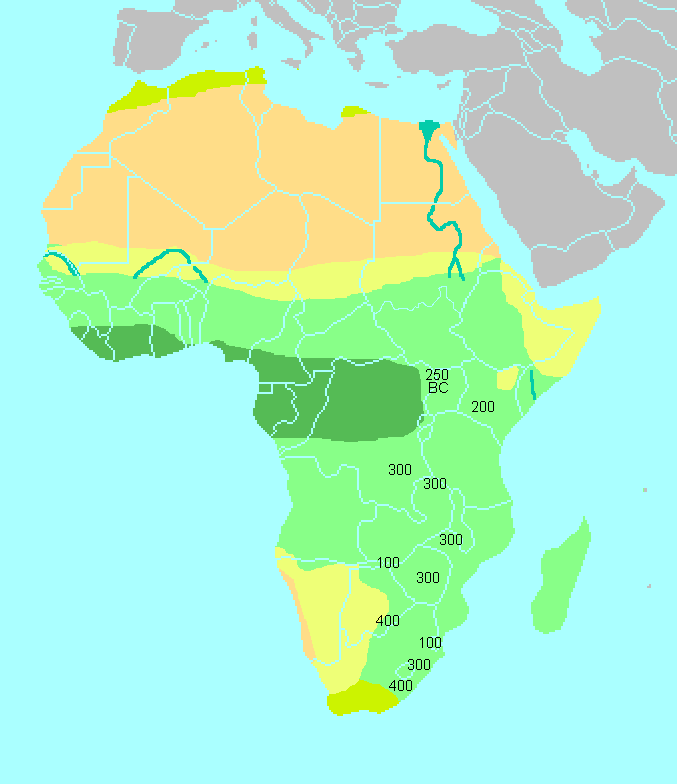
The expansion is believed to have taken place between about 6,000 and 1,500 years ago (approximately 4,000 BCE to 500 CE). Linguistic analysis suggests that the expansion proceeded in two directions: the first (termed the "Western Stream") proceeded south either along the Atlantic coast or following rivers through the Congo rainforest, reaching central Angola around 500 BCE. The second (termed the "Eastern Stream") proceeded east either along the northern fringe of the forest or along the Ubangi River, and reached west of Lake Victoria around 500 BCE. From there, they split into two groups, with one heading west to regroup with the Western Stream, and the other dispersing over Eastern and Southern Africa. The expansion reached South Africa, probably as early as 300 CE.
Bantuists believe that the Bantu expansion most likely began on the highlands between Cameroon and Nigeria. The 60,000-km2 Mambilla region straddling the borderlands here has been identified as containing remnants of "the Bantu who stayed home" as the bulk of Bantu-speakers moved away from the region. Archaeological evidence from the separate works of Jean Hurault (1979, 1986 and 1988) and Rigobert Tueché (2000) in the region indicates cultural continuity from 3000 BCE until today. The majority of the groups of the Bamenda highlands (occupied for 2000 years until today), somewhat south and contiguous with the Mambilla region, have an ancient history of descent from the north in the direction of the Mambilla region.
Initially, archaeologists believed that they could find archaeological similarities in the region's ancient cultures that the Bantu-speakers were held to have traversed. Linguists, classifying the languages and creating a genealogical table of relationships, believed they could reconstruct material culture elements. They believed that the expansion was caused by the development of agriculture, the making of ceramics, and the use of iron, which permitted new ecological zones to be exploited. In 1966, Roland Oliver published an article presenting these correlations as a reasonable hypothesis. The hypothesized Bantu expansion pushed out or assimilated the hunter-forager proto-Khoisan, who had formerly inhabited Southern Africa. In Eastern and Southern Africa, Bantu speakers may have adopted livestock husbandry from other unrelated Cushitic-and Nilotic-speaking peoples they encountered. Herding practices reached the far south several centuries before Bantu-speaking migrants did. Archaeological, linguistic, genetic, and environmental evidence all support the conclusion that the Bantu expansion was a significant human migration. Generally, the movements of Bantu language-speaking peoples from the Cameroon/Nigeria border region throughout much of sub-Saharan Africa radically reshaped the genetic structure of the continent and led to extensive admixture between migrants and local populations. A 2023 genetic study of 1,487 Bantu speakers sampled from 143 populations across 14 African countries revealed that the expansion occurred ~4,000 years ago in Western Africa. The results showed that Bantu speakers received significant gene-flow from local groups in regions they expanded into.
Based on dental evidence, Irish (2016) concluded that the common ancestors of West African and Proto-Bantu peoples may have originated in the western region of the Sahara, amid the Kiffian period at Gobero, and may have migrated southward, from the Sahara into various parts of West Africa (e.g., Benin, Cameroon, Ghana, Nigeria, Togo), as a result of desertification of the Green Sahara in 7000 BCE. From Nigeria and Cameroon, agricultural Proto-Bantu peoples began to migrate, and amid migration, diverged into East Bantu peoples (e.g., Democratic Republic of Congo) and West Bantu peoples (e.g., Congo, Gabon) between 2500 BCE and 1200 BCE. He suggests that Igbo people and Yoruba people may have admixture from back-migrated Bantu peoples.
Before the expansion of Bantu-speaking farmers, Central, Southern, and Southeast Africa were likely populated by Pygmy foragers, Khoisan-speaking hunter-gatherers, Nilo-Saharan-speaking herders, and Cushitic-speaking pastoralists.
It is thought that Central African Pygmies and Bantu speakers branched out from a common ancestral population c. 70,000 years ago. Many Batwa groups speak Bantu languages; however, a considerable portion of their vocabulary is not Bantu in origin. Much of this vocabulary is botanical, deals with honey collecting, or is otherwise specialised for the forest and is shared between western Batwa groups. It has been proposed that this is the remnant of an independent western Batwa (Mbenga or "Baaka") language.
Hub AI
Bantu expansion AI simulator
(@Bantu expansion_simulator)
Bantu expansion
The Bantu expansion was a major series of migrations of the original Proto-Bantu-speaking group, which spread from an original nucleus around West-Central Africa across Central Africa, Eastern Africa, and Southern Africa. In the process, the Proto-Bantu-speaking settlers absorbed, displaced, and possibly in some cases replaced pre-existing hunter-gatherer and pastoralist groups that they encountered.
There is linguistic evidence for this expansion – a great many of the languages which are spoken across sub-Equatorial Africa are remarkably similar to each other, suggesting a recent common cultural origin of their original speakers. The linguistic core of the Bantu languages, which constitute a branch of the Atlantic-Congo language family, was located in the southern regions of Cameroon. Genetic evidence also indicates that there was a large human migration from central Africa, with varying levels of admixture with local population.
The expansion is believed to have taken place between about 6,000 and 1,500 years ago (approximately 4,000 BCE to 500 CE). Linguistic analysis suggests that the expansion proceeded in two directions: the first (termed the "Western Stream") proceeded south either along the Atlantic coast or following rivers through the Congo rainforest, reaching central Angola around 500 BCE. The second (termed the "Eastern Stream") proceeded east either along the northern fringe of the forest or along the Ubangi River, and reached west of Lake Victoria around 500 BCE. From there, they split into two groups, with one heading west to regroup with the Western Stream, and the other dispersing over Eastern and Southern Africa. The expansion reached South Africa, probably as early as 300 CE.
Bantuists believe that the Bantu expansion most likely began on the highlands between Cameroon and Nigeria. The 60,000-km2 Mambilla region straddling the borderlands here has been identified as containing remnants of "the Bantu who stayed home" as the bulk of Bantu-speakers moved away from the region. Archaeological evidence from the separate works of Jean Hurault (1979, 1986 and 1988) and Rigobert Tueché (2000) in the region indicates cultural continuity from 3000 BCE until today. The majority of the groups of the Bamenda highlands (occupied for 2000 years until today), somewhat south and contiguous with the Mambilla region, have an ancient history of descent from the north in the direction of the Mambilla region.
Initially, archaeologists believed that they could find archaeological similarities in the region's ancient cultures that the Bantu-speakers were held to have traversed. Linguists, classifying the languages and creating a genealogical table of relationships, believed they could reconstruct material culture elements. They believed that the expansion was caused by the development of agriculture, the making of ceramics, and the use of iron, which permitted new ecological zones to be exploited. In 1966, Roland Oliver published an article presenting these correlations as a reasonable hypothesis. The hypothesized Bantu expansion pushed out or assimilated the hunter-forager proto-Khoisan, who had formerly inhabited Southern Africa. In Eastern and Southern Africa, Bantu speakers may have adopted livestock husbandry from other unrelated Cushitic-and Nilotic-speaking peoples they encountered. Herding practices reached the far south several centuries before Bantu-speaking migrants did. Archaeological, linguistic, genetic, and environmental evidence all support the conclusion that the Bantu expansion was a significant human migration. Generally, the movements of Bantu language-speaking peoples from the Cameroon/Nigeria border region throughout much of sub-Saharan Africa radically reshaped the genetic structure of the continent and led to extensive admixture between migrants and local populations. A 2023 genetic study of 1,487 Bantu speakers sampled from 143 populations across 14 African countries revealed that the expansion occurred ~4,000 years ago in Western Africa. The results showed that Bantu speakers received significant gene-flow from local groups in regions they expanded into.
Based on dental evidence, Irish (2016) concluded that the common ancestors of West African and Proto-Bantu peoples may have originated in the western region of the Sahara, amid the Kiffian period at Gobero, and may have migrated southward, from the Sahara into various parts of West Africa (e.g., Benin, Cameroon, Ghana, Nigeria, Togo), as a result of desertification of the Green Sahara in 7000 BCE. From Nigeria and Cameroon, agricultural Proto-Bantu peoples began to migrate, and amid migration, diverged into East Bantu peoples (e.g., Democratic Republic of Congo) and West Bantu peoples (e.g., Congo, Gabon) between 2500 BCE and 1200 BCE. He suggests that Igbo people and Yoruba people may have admixture from back-migrated Bantu peoples.
Before the expansion of Bantu-speaking farmers, Central, Southern, and Southeast Africa were likely populated by Pygmy foragers, Khoisan-speaking hunter-gatherers, Nilo-Saharan-speaking herders, and Cushitic-speaking pastoralists.
It is thought that Central African Pygmies and Bantu speakers branched out from a common ancestral population c. 70,000 years ago. Many Batwa groups speak Bantu languages; however, a considerable portion of their vocabulary is not Bantu in origin. Much of this vocabulary is botanical, deals with honey collecting, or is otherwise specialised for the forest and is shared between western Batwa groups. It has been proposed that this is the remnant of an independent western Batwa (Mbenga or "Baaka") language.
Recent media