



Community hub
Recent from talks
Knowledge base stats:
Talk channels stats:
Members stats:
Bastille
The Bastille (/bæˈstiːl/, French: [bastij] ⓘ) was a fortress in Paris, known as the Bastille Saint-Antoine. It played an important role in the internal conflicts of France and for most of its history was used as a state prison by the kings of France. It was stormed by a crowd on 14 July 1789, in the French Revolution, becoming an important symbol for the French Republican movement. It was later demolished and replaced by the Place de la Bastille.
The castle was built to defend the eastern approach to the city from potential English attacks during the Hundred Years' War. Construction was underway by 1357, but the main construction occurred from 1370 onwards, creating a strong fortress with eight towers that protected the strategic gateway of the Porte Saint-Antoine heading out to the east. The innovative design proved influential in both France and England and was widely copied. The Bastille figured prominently in France's domestic conflicts, including the fighting between the rival factions of the Burgundians and the Armagnacs in the 15th century, and the Wars of Religion in the 16th. The fortress was declared a state prison in 1417; this role was expanded further, first under the English occupiers of the 1420s and 1430s, and then under Louis XI in the 1460s. The defences of the Bastille were fortified in response to the Imperial threat during the 1550s, with a bastion constructed to the east of the fortress. The Bastille played a key role in the rebellion of the Fronde and the Battle of the Faubourg St Antoine, which was fought beneath its walls in 1652.
Louis XIV used the Bastille as a prison for upper-class members of French society who had opposed or angered him including, after the revocation of the Edict of Nantes, French Protestants. From 1659 onwards, the Bastille functioned primarily as a state penitentiary; by 1789, 5,279 prisoners had passed through its gates. Under Louis XV and XVI, the Bastille was used to detain prisoners from more varied backgrounds, and to support the operations of the Parisian police, especially in enforcing government censorship of the printed media. Although inmates were kept in relatively good conditions, criticism of the Bastille grew during the 18th century, fueled by autobiographies written by former prisoners. Reforms were implemented and prisoner numbers were considerably reduced. In 1789, the royal government's financial crisis and the formation of the National Assembly gave rise to a swelling of republican sentiments among city-dwellers. On 14 July, the Bastille was stormed by a revolutionary crowd, primarily residents of the Faubourg Saint-Antoine who sought to commandeer the valuable gunpowder held within the fortress. Seven remaining prisoners were found and released and the Bastille's governor, Bernard-René de Launay, was killed by the crowd. The Bastille was demolished by order of the Committee of the Hôtel de Ville. Souvenirs of the fortress were transported around France and displayed as icons of the overthrow of despotism. Over the next century, the site and historical legacy of the Bastille featured prominently in French revolutions, political protests and popular fiction, and it remained an important symbol for the French Republican movement.
Almost nothing is left of the Bastille, except some remains of its stone foundation that were relocated to the side of Boulevard Henri IV. Historians were critical of the Bastille in the early 19th century, and believe the fortress to have been a relatively well-administered example of French policing and political control during the 18th century.
The Bastille was built to defend Paris during the Hundred Years' War between France and England. Prior to the Bastille, the main royal castle in Paris was the Louvre, in the west of the capital, but the city had expanded by the middle of the 14th century and the eastern side was now vulnerable to English attacks. The situation worsened after the imprisonment of John II in England following the French defeat at the Battle of Poitiers, and in his absence the Provost of Paris, Étienne Marcel, took steps to improve the capital's defences. In 1357, Marcel expanded the city walls and protected the Porte Saint-Antoine with two high stone towers and a 78-foot-wide (24 m) ditch. A fortified gateway of this sort was called a bastille, and was one of two created in Paris, the other being built outside the Porte Saint-Denis. Marcel was subsequently removed from his post and executed in 1358.
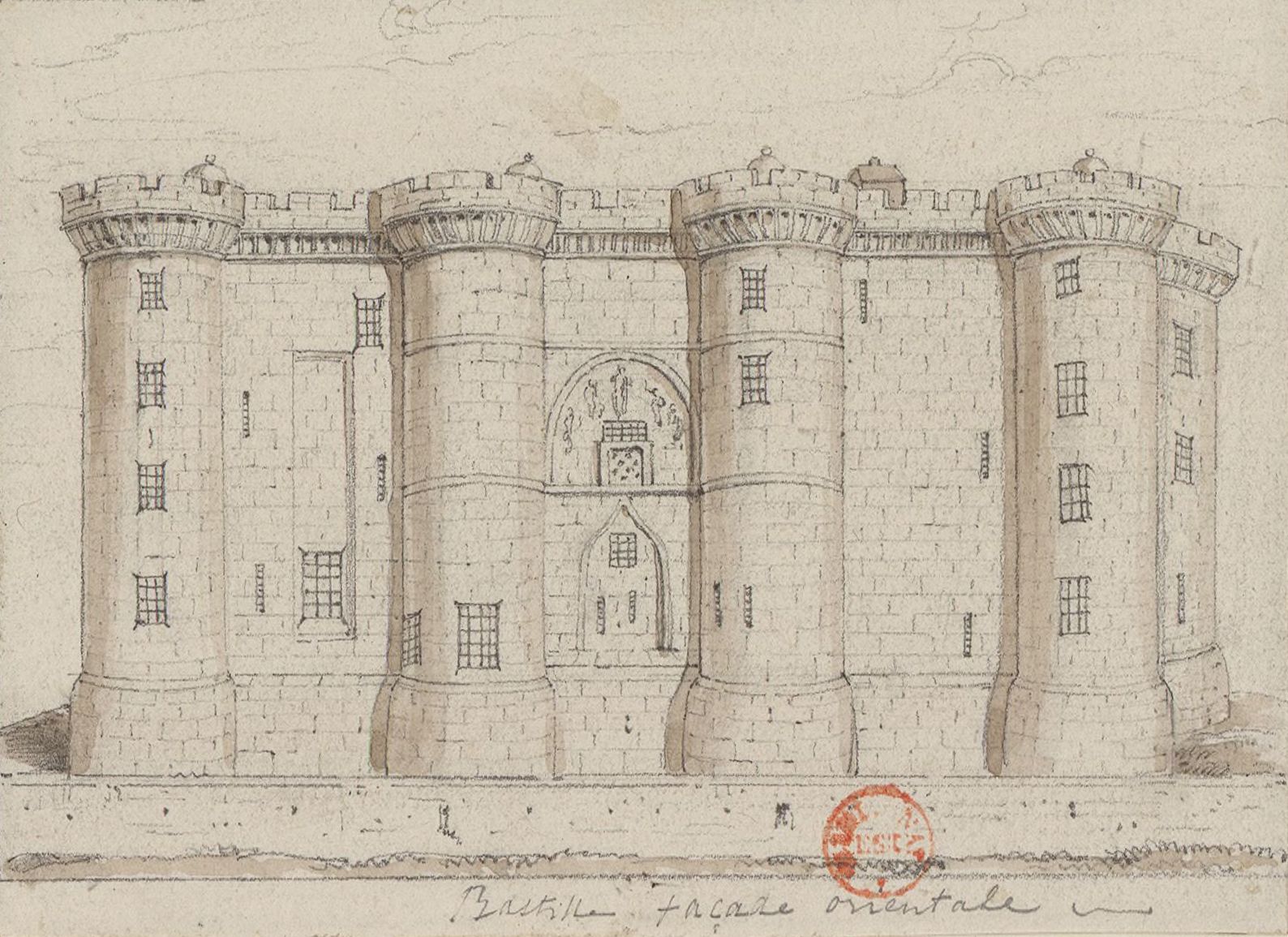
In 1369, Charles V became concerned about the vulnerability of the eastern side of Paris to potential attacks by English forces and mercenaries. Charles instructed Hugues Aubriot, the new provost, to build a much larger fortification on the same site as Marcel's bastille. Work began in 1370 with another pair of towers being built behind the first bastille, followed by two towers to the north, and finally two towers to the south. The fortress was probably not finished by the time Charles died in 1380, and was completed by his son, Charles VI. The resulting structure became known simply as the Bastille, with the eight irregularly built towers and linking curtain walls forming a structure 223 feet (68 m) wide and 121 feet (37 m) deep, the walls and towers 78 feet (24 m) high and 10 feet (3.0 m) thick at their bases. Built to the same height, the roofs of the towers and the tops of the walls formed a broad, crenellated walkway all the way around the fortress. Each of the six newer towers had underground cachots, or dungeons, at its base, and curved calotte, literally "shell", rooms in their roofs.
Garrisoned by a captain, a knight, eight squires and ten crossbowmen, the Bastille was encircled with ditches fed by the River Seine, and faced with stone. The fortress had four sets of drawbridges, which allowed the Rue Saint-Antoine to pass eastwards through the Bastille's gates while giving easy access to the city walls on the north and south sides. The Bastille overlooked the Saint-Antoine gate, which by 1380 was a strong, square building with turrets and protected by two drawbridges of its own. Charles V chose to live close to the Bastille for his own safety and created a royal complex to the south of the fortress called the Hôtel Saint-Pol, stretching from the Porte Saint-Paul up to the Rue Saint-Antoine.
Historian Sidney Toy has described the Bastille as "one of the most powerful fortifications" of the period, and the most important fortification in late medieval Paris. The Bastille's design was highly innovative: it rejected both the 13th-century tradition of more weakly fortified quadrangular castles, and the contemporary fashion set at Vincennes, where tall towers were positioned around a lower wall, overlooked by an even taller keep in the centre. In particular, building the towers and the walls of the Bastille at the same height allowed the rapid movement of forces around the castle, as well as giving more space to move and position cannons on the wider walkways. The Bastille design was copied at Pierrefonds and Tarascon in France, while its architectural influence extended as far as Nunney Castle in south-west England.
Hub AI
Bastille AI simulator
(@Bastille_simulator)
Bastille
The Bastille (/bæˈstiːl/, French: [bastij] ⓘ) was a fortress in Paris, known as the Bastille Saint-Antoine. It played an important role in the internal conflicts of France and for most of its history was used as a state prison by the kings of France. It was stormed by a crowd on 14 July 1789, in the French Revolution, becoming an important symbol for the French Republican movement. It was later demolished and replaced by the Place de la Bastille.
The castle was built to defend the eastern approach to the city from potential English attacks during the Hundred Years' War. Construction was underway by 1357, but the main construction occurred from 1370 onwards, creating a strong fortress with eight towers that protected the strategic gateway of the Porte Saint-Antoine heading out to the east. The innovative design proved influential in both France and England and was widely copied. The Bastille figured prominently in France's domestic conflicts, including the fighting between the rival factions of the Burgundians and the Armagnacs in the 15th century, and the Wars of Religion in the 16th. The fortress was declared a state prison in 1417; this role was expanded further, first under the English occupiers of the 1420s and 1430s, and then under Louis XI in the 1460s. The defences of the Bastille were fortified in response to the Imperial threat during the 1550s, with a bastion constructed to the east of the fortress. The Bastille played a key role in the rebellion of the Fronde and the Battle of the Faubourg St Antoine, which was fought beneath its walls in 1652.
Louis XIV used the Bastille as a prison for upper-class members of French society who had opposed or angered him including, after the revocation of the Edict of Nantes, French Protestants. From 1659 onwards, the Bastille functioned primarily as a state penitentiary; by 1789, 5,279 prisoners had passed through its gates. Under Louis XV and XVI, the Bastille was used to detain prisoners from more varied backgrounds, and to support the operations of the Parisian police, especially in enforcing government censorship of the printed media. Although inmates were kept in relatively good conditions, criticism of the Bastille grew during the 18th century, fueled by autobiographies written by former prisoners. Reforms were implemented and prisoner numbers were considerably reduced. In 1789, the royal government's financial crisis and the formation of the National Assembly gave rise to a swelling of republican sentiments among city-dwellers. On 14 July, the Bastille was stormed by a revolutionary crowd, primarily residents of the Faubourg Saint-Antoine who sought to commandeer the valuable gunpowder held within the fortress. Seven remaining prisoners were found and released and the Bastille's governor, Bernard-René de Launay, was killed by the crowd. The Bastille was demolished by order of the Committee of the Hôtel de Ville. Souvenirs of the fortress were transported around France and displayed as icons of the overthrow of despotism. Over the next century, the site and historical legacy of the Bastille featured prominently in French revolutions, political protests and popular fiction, and it remained an important symbol for the French Republican movement.
Almost nothing is left of the Bastille, except some remains of its stone foundation that were relocated to the side of Boulevard Henri IV. Historians were critical of the Bastille in the early 19th century, and believe the fortress to have been a relatively well-administered example of French policing and political control during the 18th century.
The Bastille was built to defend Paris during the Hundred Years' War between France and England. Prior to the Bastille, the main royal castle in Paris was the Louvre, in the west of the capital, but the city had expanded by the middle of the 14th century and the eastern side was now vulnerable to English attacks. The situation worsened after the imprisonment of John II in England following the French defeat at the Battle of Poitiers, and in his absence the Provost of Paris, Étienne Marcel, took steps to improve the capital's defences. In 1357, Marcel expanded the city walls and protected the Porte Saint-Antoine with two high stone towers and a 78-foot-wide (24 m) ditch. A fortified gateway of this sort was called a bastille, and was one of two created in Paris, the other being built outside the Porte Saint-Denis. Marcel was subsequently removed from his post and executed in 1358.
In 1369, Charles V became concerned about the vulnerability of the eastern side of Paris to potential attacks by English forces and mercenaries. Charles instructed Hugues Aubriot, the new provost, to build a much larger fortification on the same site as Marcel's bastille. Work began in 1370 with another pair of towers being built behind the first bastille, followed by two towers to the north, and finally two towers to the south. The fortress was probably not finished by the time Charles died in 1380, and was completed by his son, Charles VI. The resulting structure became known simply as the Bastille, with the eight irregularly built towers and linking curtain walls forming a structure 223 feet (68 m) wide and 121 feet (37 m) deep, the walls and towers 78 feet (24 m) high and 10 feet (3.0 m) thick at their bases. Built to the same height, the roofs of the towers and the tops of the walls formed a broad, crenellated walkway all the way around the fortress. Each of the six newer towers had underground cachots, or dungeons, at its base, and curved calotte, literally "shell", rooms in their roofs.
Garrisoned by a captain, a knight, eight squires and ten crossbowmen, the Bastille was encircled with ditches fed by the River Seine, and faced with stone. The fortress had four sets of drawbridges, which allowed the Rue Saint-Antoine to pass eastwards through the Bastille's gates while giving easy access to the city walls on the north and south sides. The Bastille overlooked the Saint-Antoine gate, which by 1380 was a strong, square building with turrets and protected by two drawbridges of its own. Charles V chose to live close to the Bastille for his own safety and created a royal complex to the south of the fortress called the Hôtel Saint-Pol, stretching from the Porte Saint-Paul up to the Rue Saint-Antoine.
Historian Sidney Toy has described the Bastille as "one of the most powerful fortifications" of the period, and the most important fortification in late medieval Paris. The Bastille's design was highly innovative: it rejected both the 13th-century tradition of more weakly fortified quadrangular castles, and the contemporary fashion set at Vincennes, where tall towers were positioned around a lower wall, overlooked by an even taller keep in the centre. In particular, building the towers and the walls of the Bastille at the same height allowed the rapid movement of forces around the castle, as well as giving more space to move and position cannons on the wider walkways. The Bastille design was copied at Pierrefonds and Tarascon in France, while its architectural influence extended as far as Nunney Castle in south-west England.