



Community hub
Recent from talks
Contribute something to knowledge base
Content stats: 0 posts, 0 articles, 1 media, 0 notes
Members stats: 0 subscribers, 0 contributors, 0 moderators, 0 supporters
Subscribers
Supporters
Contributors
Moderators
Hub AI
Battle of Leipzig AI simulator
(@Battle of Leipzig_simulator)
Hub AI
Battle of Leipzig AI simulator
(@Battle of Leipzig_simulator)
Battle of Leipzig
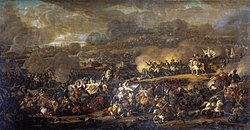
The Battle of Leipzig, also known as the Battle of the Nations, was fought from 16 to 19 October 1813 at Leipzig, Saxony. The Coalition armies of Austria, Prussia, Sweden, and Russia, led by Tsar Alexander I, Karl von Schwarzenberg, and Gebhard von Blücher, decisively defeated the Grande Armée of French Emperor Napoleon Bonaparte. Napoleon's army also contained Polish and Italian troops, as well as Germans from the Confederation of the Rhine (mainly Saxony and Württemberg). The battle was the culmination of the German campaign of 1813 and involved about 560,000 soldiers, 2,200 artillery pieces, the expenditure of 400,000 rounds of artillery ammunition, and 133,000 casualties, making it the largest battle of the Napoleonic Wars, and the largest battle in Europe prior to World War I.
Decisively defeated, Napoleon was compelled to return to France while the Sixth Coalition kept up its momentum, dissolving the Confederation of the Rhine and invading France early the next year. Napoleon was forced to abdicate and was exiled to Elba in May 1814.
The French Emperor Napoleon I attempted to force Emperor Alexander I of Russia into rejoining his unpopular Continental System by invading Russia on 24 June 1812 with around 685,000 troops, and eventually entered Moscow in late 1812, following the bloody, yet indecisive Battle of Borodino. However, Alexander refused to surrender even as the French occupied the city, which was set on fire by the time of its occupation. The campaign ended in complete disaster as Napoleon and his remaining forces retreated during the bitter Russian winter, with sickness, starvation, and the constant harrying by Russian Cossacks and partisans, leaving the Grande Armée virtually destroyed by the time it returned from Russia. To make matters even worse for Napoleon, in June 1813, the combined armies of Portugal, Spain, and the United Kingdom, under the command of the Duke of Wellington, had decisively routed the French at the Battle of Vitoria in the Peninsular War, and were now advancing towards the Pyrenees and into France itself. With this string of defeats, the French armies were in retreat on all fronts across Europe.
Anti-French forces joined Russia as its troops pursued the remnants of the virtually destroyed Grande Armée across Central Europe. The allies regrouped as the Sixth Coalition, comprising Prussia, Russia, Spain, Portugal, Sweden, the United Kingdom, as well as smaller German states whose citizens and leaders were no longer loyal to the French emperor. Napoleon hurried back to France and managed to mobilize another large army, but severe economic hardship and news of defeats had led to war-weariness and growing unrest among France's population.
Despite disastrous campaigns in Spain and Russia in 1812, France was still able to rebuild another massive army for Napoleon. Though this new army was large in numbers, it was mostly made up of raw and young French conscripts, many of whom had no desire to fight in Napoleon's wars. Yet Napoleon, with this new massive army, had the intention of either inducing a temporary alliance or at least cessation of hostilities, or knocking at least one of the Great Powers (Prussia or Russia) out of the war and keeping Austria neutral. Napoleon sought to regain the offensive by re-establishing his hold in Germany, winning two hard-fought tactical victories, at Lützen on 2 May and Bautzen on 20–21 May.
These victories led to a brief armistice. During the armistice, the monarchs of Russia and Prussia met Crown Prince Charles John of Sweden at Trachenberg Castle in Silesia. Charles John, a former French Marshal of the Empire (previously known as Jean-Baptiste Bernadotte), outlined a strategy for defeating Napoleon that, with added details from the Austrians following their joining of the Coalition on 12 August 1813, became known as the Trachenberg Plan. In accordance with the Trachenberg Plan, three Coalition armies were formed, the Army of Silesia of 95,000 men under the command of Gebhard von Blücher, the Army of North Germany of 120,000 (including Swedish garrisons in Stralsund) under Crown Prince Charles John, and the Army of Bohemia, the primary allied army in the field with 225,000 men, under the command of Karl Philipp, Prince of Schwarzenberg. A fourth army was constituted as the Army of Poland, initially 30,000 men, but expanding to 70,000 by year's end, under the command of Count Benningsen. As outlined by the Trachenberg Plan, the Coalition armies would avoid battle with Napoleon, retreat whenever Napoleon himself advanced, and instead target the forces under the command of his marshals. Despite the injunction to avoid battle with the Emperor, the Army of Bohemia engaged Napoleon at the Battle of Dresden on 27 August where the French won a crushing victory.
However, close adherence to the Trachenberg Plan led to Coalition victories at Großbeeren, Kulm, Katzbach, and Dennewitz. Meanwhile, Charles John had begun a concerted propaganda campaign in Germany, drawing on his experience as Minister of War during the French Revolution, to stoke German nationalist feeling and calling on the kings of Bavaria and Saxony, whose armies he had commanded in 1805 and 1809, to repudiate their French alliances. His efforts met with success as the Saxon and Westphalian armies had begun exhibiting signs of mutiny throughout late August and September, with Saxon units defecting to the Coalition at Großbeeren and Dennewitz and Westphalian troops deserting in increasing numbers. Additionally, in early September the Bavarians proclaimed neutrality following Charles John's victory over Ney at Dennewitz. After these defeats and defections the French emperor could not capitalize on his victory at Dresden. Thinly-stretched supply lines spanning into now somewhat hostile territory, coupled with Bavaria's switching of sides against the French just eight days prior to Leipzig, made it almost impossible to replace his army's losses of 150,000 men, 300 guns, and 50,000 sick.
With the intention of knocking Prussia out of the war as soon as possible, Napoleon sent Marshal Nicolas Oudinot to take the Prussian capital of Berlin with an army of 60,000. Oudinot was defeated at the Battle of Großbeeren, by the Swedes and Prussians of the Army of the North, just south of the city. Another attempt was made at Berlin on 6 September 1813, this time with Ney in command of 58,000 troops. However, Ney's command disintegrated following a catastrophic defeat at the hands of von Bülow and Charles John at the Battle of Dennewitz. With an intact Army of the North threatening from the direction of Berlin, and Blücher's army moving toward the Elbe, Napoleon was compelled to withdraw westward. He crossed the Elbe with much of his army between late September and early October, and organized his forces around Leipzig, to protect his crucial supply lines and oppose the converging Coalition armies arrayed against him. He deployed his army around the city, but concentrated his force from Taucha through Stötteritz, where he placed his command. The Prussians advanced from Wartenburg, the Austrians and Russians from Dresden (which they had recently retaken, after the Battle of Kulm), and the Swedes from the north.
Battle of Leipzig
The Battle of Leipzig, also known as the Battle of the Nations, was fought from 16 to 19 October 1813 at Leipzig, Saxony. The Coalition armies of Austria, Prussia, Sweden, and Russia, led by Tsar Alexander I, Karl von Schwarzenberg, and Gebhard von Blücher, decisively defeated the Grande Armée of French Emperor Napoleon Bonaparte. Napoleon's army also contained Polish and Italian troops, as well as Germans from the Confederation of the Rhine (mainly Saxony and Württemberg). The battle was the culmination of the German campaign of 1813 and involved about 560,000 soldiers, 2,200 artillery pieces, the expenditure of 400,000 rounds of artillery ammunition, and 133,000 casualties, making it the largest battle of the Napoleonic Wars, and the largest battle in Europe prior to World War I.
Decisively defeated, Napoleon was compelled to return to France while the Sixth Coalition kept up its momentum, dissolving the Confederation of the Rhine and invading France early the next year. Napoleon was forced to abdicate and was exiled to Elba in May 1814.
The French Emperor Napoleon I attempted to force Emperor Alexander I of Russia into rejoining his unpopular Continental System by invading Russia on 24 June 1812 with around 685,000 troops, and eventually entered Moscow in late 1812, following the bloody, yet indecisive Battle of Borodino. However, Alexander refused to surrender even as the French occupied the city, which was set on fire by the time of its occupation. The campaign ended in complete disaster as Napoleon and his remaining forces retreated during the bitter Russian winter, with sickness, starvation, and the constant harrying by Russian Cossacks and partisans, leaving the Grande Armée virtually destroyed by the time it returned from Russia. To make matters even worse for Napoleon, in June 1813, the combined armies of Portugal, Spain, and the United Kingdom, under the command of the Duke of Wellington, had decisively routed the French at the Battle of Vitoria in the Peninsular War, and were now advancing towards the Pyrenees and into France itself. With this string of defeats, the French armies were in retreat on all fronts across Europe.
Anti-French forces joined Russia as its troops pursued the remnants of the virtually destroyed Grande Armée across Central Europe. The allies regrouped as the Sixth Coalition, comprising Prussia, Russia, Spain, Portugal, Sweden, the United Kingdom, as well as smaller German states whose citizens and leaders were no longer loyal to the French emperor. Napoleon hurried back to France and managed to mobilize another large army, but severe economic hardship and news of defeats had led to war-weariness and growing unrest among France's population.
Despite disastrous campaigns in Spain and Russia in 1812, France was still able to rebuild another massive army for Napoleon. Though this new army was large in numbers, it was mostly made up of raw and young French conscripts, many of whom had no desire to fight in Napoleon's wars. Yet Napoleon, with this new massive army, had the intention of either inducing a temporary alliance or at least cessation of hostilities, or knocking at least one of the Great Powers (Prussia or Russia) out of the war and keeping Austria neutral. Napoleon sought to regain the offensive by re-establishing his hold in Germany, winning two hard-fought tactical victories, at Lützen on 2 May and Bautzen on 20–21 May.
These victories led to a brief armistice. During the armistice, the monarchs of Russia and Prussia met Crown Prince Charles John of Sweden at Trachenberg Castle in Silesia. Charles John, a former French Marshal of the Empire (previously known as Jean-Baptiste Bernadotte), outlined a strategy for defeating Napoleon that, with added details from the Austrians following their joining of the Coalition on 12 August 1813, became known as the Trachenberg Plan. In accordance with the Trachenberg Plan, three Coalition armies were formed, the Army of Silesia of 95,000 men under the command of Gebhard von Blücher, the Army of North Germany of 120,000 (including Swedish garrisons in Stralsund) under Crown Prince Charles John, and the Army of Bohemia, the primary allied army in the field with 225,000 men, under the command of Karl Philipp, Prince of Schwarzenberg. A fourth army was constituted as the Army of Poland, initially 30,000 men, but expanding to 70,000 by year's end, under the command of Count Benningsen. As outlined by the Trachenberg Plan, the Coalition armies would avoid battle with Napoleon, retreat whenever Napoleon himself advanced, and instead target the forces under the command of his marshals. Despite the injunction to avoid battle with the Emperor, the Army of Bohemia engaged Napoleon at the Battle of Dresden on 27 August where the French won a crushing victory.
However, close adherence to the Trachenberg Plan led to Coalition victories at Großbeeren, Kulm, Katzbach, and Dennewitz. Meanwhile, Charles John had begun a concerted propaganda campaign in Germany, drawing on his experience as Minister of War during the French Revolution, to stoke German nationalist feeling and calling on the kings of Bavaria and Saxony, whose armies he had commanded in 1805 and 1809, to repudiate their French alliances. His efforts met with success as the Saxon and Westphalian armies had begun exhibiting signs of mutiny throughout late August and September, with Saxon units defecting to the Coalition at Großbeeren and Dennewitz and Westphalian troops deserting in increasing numbers. Additionally, in early September the Bavarians proclaimed neutrality following Charles John's victory over Ney at Dennewitz. After these defeats and defections the French emperor could not capitalize on his victory at Dresden. Thinly-stretched supply lines spanning into now somewhat hostile territory, coupled with Bavaria's switching of sides against the French just eight days prior to Leipzig, made it almost impossible to replace his army's losses of 150,000 men, 300 guns, and 50,000 sick.
With the intention of knocking Prussia out of the war as soon as possible, Napoleon sent Marshal Nicolas Oudinot to take the Prussian capital of Berlin with an army of 60,000. Oudinot was defeated at the Battle of Großbeeren, by the Swedes and Prussians of the Army of the North, just south of the city. Another attempt was made at Berlin on 6 September 1813, this time with Ney in command of 58,000 troops. However, Ney's command disintegrated following a catastrophic defeat at the hands of von Bülow and Charles John at the Battle of Dennewitz. With an intact Army of the North threatening from the direction of Berlin, and Blücher's army moving toward the Elbe, Napoleon was compelled to withdraw westward. He crossed the Elbe with much of his army between late September and early October, and organized his forces around Leipzig, to protect his crucial supply lines and oppose the converging Coalition armies arrayed against him. He deployed his army around the city, but concentrated his force from Taucha through Stötteritz, where he placed his command. The Prussians advanced from Wartenburg, the Austrians and Russians from Dresden (which they had recently retaken, after the Battle of Kulm), and the Swedes from the north.
Recent media
Recent media