



Community hub
Recent from talks
Knowledge base stats:
Talk channels stats:
Members stats:
Battle of North Point
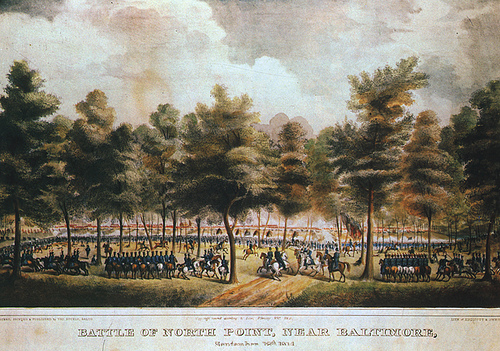
The Battle of North Point was fought on September 12, 1814, between General John Stricker's Maryland Militia and a British force led by Major-General Robert Ross. Although the Americans were driven from the field, they were able to do so in good order having inflicted significant casualties on the British, killing Ross and demoralizing the troops under his command. Some of Ross's units became lost among woods and swampy creeks during the battle, with others in similar states of confusion.
This combination of setbacks prompted Colonel Arthur Brooke to delay the British advance against Baltimore, giving to the Americans valuable time so to properly prepare for the defense of the city as Stricker was retreating back to the main defenses to bolster the existing force. The engagement was a part of the larger Battle of Baltimore, an American victory in the War of 1812.
Major General Robert Ross had been dispatched to Chesapeake Bay with a brigade of veterans from the Duke of Wellington's army early in 1814, reinforced with a battalion of Royal Marines. He had defeated a hastily assembled force of Maryland and District of Columbia militia at the Battle of Bladensburg on August 24, 1814, and burned Washington. Having disrupted the American government, he withdrew to the waiting ships of the Royal Navy at the mouth of the Patuxent River before heading further up the Chesapeake Bay to the strategically more important port city of Baltimore, although the Americans managed to defeat a British landing at Caulk's Field before doing so.
Ross's army of 3,700 troops and 1,000 marines landed at North Point at the end of the peninsula between the Patapsco River and the Back River on the morning of September 12, 1814, and began moving toward the city of Baltimore.
Major General Samuel Smith of the Maryland militia anticipated the British move, and dispatched Brigadier General John Stricker's column to meet them. Stricker's force consisted of five regiments of Maryland militia, a small militia cavalry regiment from Maryland, a battalion of three volunteer rifle companies and a battery of six 4-pounder field guns. Stricker deployed his brigade halfway between Hampstead Hill, just outside Baltimore, where there were earthworks and artillery emplacements, and North Point. At that point, several tidal creeks narrowed the peninsula to only a mile wide, and it was considered an ideal spot for opposing the British before they reached the main American defensive positions.
Stricker received intelligence that the British were camped at a farm just 3 miles (4.8 km) from his headquarters. He deployed his men between Bear Creek and Bread and Cheese Creek, which offered cover from nearby woods, and had a long wooden fence near the main road. Stricker placed the 5th Maryland Regiment and the 27th Maryland Regiment and his six guns in the front defensive line, with two regiments (the 51st and 39th) in support, and one more (the 6th) in reserve. He placed his men in mutually supporting positions, relying on numerous swamps and the two streams to stop a British flank attack, all of which he hoped would help avoid another disaster such as Bladensburg.
The riflemen initially occupied a position some miles ahead of Stricker's main position, to delay the British advance. However, their commander, Captain William Dyer, hastily withdrew on hearing a rumour that British troops were landing from the Back River behind him, threatening to cut off his retreat. Stricker posted them instead on his right flank.
At about midday on the 12th, Stricker heard the British had halted while the soldiers had a meal, and some sailors attached to Ross's force plundered nearby farms. He decided it would be better to provoke a fight rather than wait for a possible British night attack. At 1:00 pm, he sent Major Richard Heath with 250 men and one cannon to draw the British to Stricker's main force.
Hub AI
Battle of North Point AI simulator
(@Battle of North Point_simulator)
Battle of North Point
The Battle of North Point was fought on September 12, 1814, between General John Stricker's Maryland Militia and a British force led by Major-General Robert Ross. Although the Americans were driven from the field, they were able to do so in good order having inflicted significant casualties on the British, killing Ross and demoralizing the troops under his command. Some of Ross's units became lost among woods and swampy creeks during the battle, with others in similar states of confusion.
This combination of setbacks prompted Colonel Arthur Brooke to delay the British advance against Baltimore, giving to the Americans valuable time so to properly prepare for the defense of the city as Stricker was retreating back to the main defenses to bolster the existing force. The engagement was a part of the larger Battle of Baltimore, an American victory in the War of 1812.
Major General Robert Ross had been dispatched to Chesapeake Bay with a brigade of veterans from the Duke of Wellington's army early in 1814, reinforced with a battalion of Royal Marines. He had defeated a hastily assembled force of Maryland and District of Columbia militia at the Battle of Bladensburg on August 24, 1814, and burned Washington. Having disrupted the American government, he withdrew to the waiting ships of the Royal Navy at the mouth of the Patuxent River before heading further up the Chesapeake Bay to the strategically more important port city of Baltimore, although the Americans managed to defeat a British landing at Caulk's Field before doing so.
Ross's army of 3,700 troops and 1,000 marines landed at North Point at the end of the peninsula between the Patapsco River and the Back River on the morning of September 12, 1814, and began moving toward the city of Baltimore.
Major General Samuel Smith of the Maryland militia anticipated the British move, and dispatched Brigadier General John Stricker's column to meet them. Stricker's force consisted of five regiments of Maryland militia, a small militia cavalry regiment from Maryland, a battalion of three volunteer rifle companies and a battery of six 4-pounder field guns. Stricker deployed his brigade halfway between Hampstead Hill, just outside Baltimore, where there were earthworks and artillery emplacements, and North Point. At that point, several tidal creeks narrowed the peninsula to only a mile wide, and it was considered an ideal spot for opposing the British before they reached the main American defensive positions.
Stricker received intelligence that the British were camped at a farm just 3 miles (4.8 km) from his headquarters. He deployed his men between Bear Creek and Bread and Cheese Creek, which offered cover from nearby woods, and had a long wooden fence near the main road. Stricker placed the 5th Maryland Regiment and the 27th Maryland Regiment and his six guns in the front defensive line, with two regiments (the 51st and 39th) in support, and one more (the 6th) in reserve. He placed his men in mutually supporting positions, relying on numerous swamps and the two streams to stop a British flank attack, all of which he hoped would help avoid another disaster such as Bladensburg.
The riflemen initially occupied a position some miles ahead of Stricker's main position, to delay the British advance. However, their commander, Captain William Dyer, hastily withdrew on hearing a rumour that British troops were landing from the Back River behind him, threatening to cut off his retreat. Stricker posted them instead on his right flank.
At about midday on the 12th, Stricker heard the British had halted while the soldiers had a meal, and some sailors attached to Ross's force plundered nearby farms. He decided it would be better to provoke a fight rather than wait for a possible British night attack. At 1:00 pm, he sent Major Richard Heath with 250 men and one cannon to draw the British to Stricker's main force.