
.jpg/250px-Beech_Bonanza_Takeoff_(5517383917).jpg)


.jpg)
Community hub
Recent from talks
Contribute something
Nothing was collected or created yet.
Beechcraft Bonanza
View on Wikipedia
 | This article needs additional citations for verification. (January 2010) |
The Beechcraft Bonanza is an American general aviation aircraft introduced in 1947 by Beech Aircraft Corporation of Wichita, Kansas. The six-seater, single-engined aircraft is still produced by Beechcraft and has been in continuous production longer than any other aircraft in history.[5][6] More than 17,000 Bonanzas of all variants have been built,[7][8] produced in both distinctive V-tail and conventional tail configurations; early conventional-tail versions were marketed as the Debonair.[8][9]
Key Information

.jpg)
Design and development
[edit]
At the end of World War II, two all-metal light aircraft emerged, the Model 35 Bonanza and the Cessna 195, that represented very different approaches to the premium end of the postwar civil-aviation market.[citation needed] With its high-wing, seven-cylinder radial engine, fixed tailwheel undercarriage, and roll-down side windows, the Cessna 195 was a continuation of prewar technology. The Bonanza, however, featured an easier-to-manage, horizontally opposed, six-cylinder engine, retractable tricycle undercarriage (although the nosewheel initially was not steerable, but castering)[10][verification needed] and low-wing configuration.
Designed by a team led by Ralph Harmon,[3] the model 35 Bonanza was a relatively fast, low-wing, all-aluminum design, at a time when most light aircraft were still made of wood and fabric.[citation needed] The Model 35 featured retractable landing gear, and its signature V-tail (equipped with combination elevator-rudders called "ruddervators").[11] The prototype 35 Bonanza made its first flight on December 22, 1945, with the type receiving an airworthiness certificate on March 25, 1947.[3] Production began that year.[3] The first 30–40 Bonanzas produced had fabric-covered flaps and ailerons, after which those surfaces were covered with magnesium alloy sheet.[12]
The Bonanza family eventually comprised three major variants:
- Model 35 Bonanza (1947–1982; V-tail)[13]
- Model 33 Debonair or Bonanza (1960–1995; conventional tail)[14]
- Model 36 Bonanza (1968–present; a stretched Model 33)[14]
The Model 33 Debonair was introduced in 1960 as a lower-priced model with more austere standard instrumentation, exterior equipment, paint schemes, and interior fabrics and trim than the more prestigious V-tail Bonanza.[9][15] However, most Bonanza features were available as factory options on the Debonair, and by the mid 1960s, most Debonair buyers were ordering most or all of these options. Realizing this, Beechcraft dropped the Debonair name and most of the basic and seldom-ordered standard features with the introduction of the E33 in 1968.[15]
Despite its name, the Twin Bonanza is a substantially wider and heavier aircraft that is mostly dissimilar to the single-engined Bonanza; the only major shared parts are the front fuselage sides, windows, and main cabin door.[16] However, the Twin Bonanza had trouble competing with the similarly capable but substantially lighter Cessna 310 and Piper PA-23, so Beechcraft used the basic Bonanza fuselage and many other Bonanza parts to create the twin-engined Travel Air, which was later developed into the Baron.[17]
Operational history
[edit]The V-tail design gained a reputation as the "forked-tail doctor killer",[18] due to crashes by overconfident wealthy amateur pilots,[19] fatal accidents, and in-flight breakups.[20] "Doctor killer" has sometimes been used to describe the conventional-tailed version, as well.[21][22] However, a detailed analysis by the Aircraft Owners and Pilots Association of accident records for common single-engine retractable-gear airplanes in the United States between 1982 and 1989 found that the Bonanza had a slightly lower accident rate than other types in the study. Pilot error was cited in 73% of V-tail crashes and 83% of conventional-tail crashes, with aircraft-related causes accounting for 15% and 11% of crashes respectively.[23] However, the study noted that the aircraft had an unusually high incidence of gear-up landings and inadvertent landing gear retractions on the ground, which were attributed to a non-standard gear-retraction switch on early models that is easily confused with the switch that operates the flaps. Models starting in 1984 use a more distinctive relocated landing-gear switch, augmented by "squat switches" in the landing gear that prevent its operation while compressed by the aircraft's weight, and a throttle position switch that prevents gear retraction at low engine power settings.[23]
In 1982, the production of the V-tail Model 35 ended.[24] In the late 1980s, repeated V-tail structural failures prompted the United States Department of Transportation and Federal Aviation Administration (FAA) to conduct extensive wind tunnel and flight tests, which proved that the V-tail did not meet type certification standards under certain conditions; the effort culminated with the issuance of an airworthiness directive to strengthen the tail, which significantly reduced the incidence of in-flight breakups. Despite this, Beech has long contended that most V-tail failures involve operations well beyond the aircraft's intended flight envelope.[23][14] Subsequent analysis of National Transportation Safety Board (NTSB) accident records between 1962 and 2007 revealed an average of three V-tail structural failures per year, while the conventional-tailed Bonanza 33 and 36 suffered only eleven such failures in total during the same 45 years. Most V-tail failures involved flight under visual flight rules into instrument meteorological conditions, flight into thunderstorms, or airframe icing.[25]
In addition to the structural issues, the Bonanza 35 has a relatively narrow center of gravity envelope, and the tail design is intolerant of imbalances caused by damage, improper maintenance, or repainting. Such imbalances may induce dangerous aeroelastic flutter.[23] Due to the anodic properties of the magnesium used for the V-tail ruddervator skins, they tend to corrode, often resulting in permanent grounding of affected aircraft because the problem can only be fixed by complete replacement of the skins or the entire empennage, and the required parts are no longer available.[26] The American Bonanza Society has issued a reward of $500,000 to encourage the development of aftermarket replacement skins under a supplemental type certificate.[26] Despite these issues, many Bonanza 35 owners insist that the aircraft is reasonably safe, and its reputation has resulted in reduced purchase costs for budget-conscious buyers.[25]
The conventional-tail Model 33 continued in production until 1995.[8][27] Still built today is the Model 36 Bonanza, a longer-bodied, straight-tail variant of the original design,[28] introduced in 1968.[8][29] No Bonanzas were delivered in 2021, but on April 10, 2022, it was announced that production of the Bonanza G36 had restarted.[30]
In January 2012, the Australian Civil Aviation Safety Authority issued an airworthiness directive grounding all Bonanzas, Twin Bonanzas, and Debonairs equipped with a single pole-style yoke and that have forwarded elevator control cables that are more than 15 years old until they could be inspected. The AD was issued based on two aircraft found to have frayed cables, one of which suffered a cable failure just prior to takeoff, and resulting concerns about the age of the cables in fleet aircraft of this age. At the time of the grounding, some Bonanzas had reached 64 years in service. Aircraft with frayed cables were grounded until the cables were replaced, and those that passed inspection were required to have their cables replaced within 60 days regardless. The AD affected only Australian aircraft and was not adopted by the airworthiness authority responsible for the type certificate, the US Federal Aviation Administration. The FAA instead opted to issue a Special Airworthiness Information Bulletin requesting that the elevator control cables be inspected during the annual inspection.[31][32][33]
QU-22 Pave Eagle
[edit]The QU-22 was a Beech 36/A36 Bonanza modified during the Vietnam War to be an electronic monitoring signal relay aircraft, developed under the project name "Pave Eagle" for the United States Air Force. An AiResearch turbocharged, reduction-geared Continental GTSIO-520-G engine was used to reduce its noise signature, much like the later Army-Lockheed YO-3A.[citation needed] These aircraft were intended to be used as unmanned drones to monitor seismic and acoustic sensors dropped along the Ho Chi Minh Trail in Laos and report troop and supply movements. When the project was put into operation in 1968, however, the aircraft were all flown by pilots of the 554th Reconnaissance Squadron Detachment 1, call sign "Vampire". A separate operation "Compass Flag" monitored the General Directorate of Rear Services along the Ho Chi Minh Trail, linking to the 6908th security squadron.[34]
Six YQU-22A prototypes (Model 1074,[35] modifications of the Beech 33 Debonair) were combat-tested in 1968, and two were lost during operations, with a civilian test pilot killed. Twenty-seven QU-22Bs (Model 1079)[35]were modified, 13 in 1969 and 14 in 1970, with six lost in combat. Two Air Force pilots were killed in action. All the losses were due to engine failures or effects of turbulence.[36] A large cowl bump above the spinner was faired-in for an AC current generator, and a higher weight set of Baron wings and spars were used to handle the 236-US-gallon (890 L) fuel load.[34]
-
 1965 S35 V-tailed Bonanza
 -
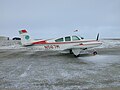
-
 A 1950 B35 operated by the National Test Pilot School at the Mojave Airport
 -
 A brand-new 2011 Bonanza G36 at the Beechcraft display; EAA AirVenture 2011
 -
 2013 Bonanza G36 at AirVenture 2013

.JPG)


Variants
[edit]Model 35 Bonanza
[edit]- 35
- (1947–1948), initial production version with 165 hp (123 kW) Continental E-185 or E-185-1 engine, five prototypes and 1,500 production aircraft built.[37]
- A35
- (1949) Model 35 with higher takeoff weight, tubular wing spars and nosewheel steering, 701 built.[13]
- B35
- (1950) A35 with a Continental E-185-8 engine, 480 built.[13]
- C35
- (1950-1952) B35 with a 185hp Continental E-185-11 engine, metal propeller, larger tail surfaces, and higher takeoff weight, approved for the Lycoming GO-435-D1 engine,[38] 719 built.[13]
- 35R
- (1951) Remanufactured Model 35 with many of the improvements introduced on the B35 and C35, meant as an alternative to new C35 production as the latter suffered from delays due to the Korean War. 14 Model 35s were modified to this standard, with each having the suffix "R1" through "R14" appended to their original serial numbers.[8][39]
- D35
- (1953) C35 with increased takeoff weight and minor changes, approved for the Lycoming GO-435-D1 engine.[38] 298 built.[13]
- E35
- (1954) Powered by E-185-11 or 225 hp (168 kW) Continental E-225-8 engine, 301 built.[40]
- F35
- (1955) Powered by E-185-11 or E-225-8 engine. Extra rear window each side, strengthened wing leading edges and tail spar caps. 392 built.[40]
- G35
- (1956) Powered by Continental E-225-8 engine, thicker windshield. 476 built.[40]
- H35

- (1957) Powered by a 240 hp (180 kW) Continental O-470-G engine, and with modified structure. 464 built.[40]
- J35
- (1958) Powered by a 250 hp (190 kW) fuel injected Continental IO-470-C engine. 396 built.[40]
- K35
- (1959) Increased fuel load, optional fifth seat and increased takeoff weight, 436 built.[40]
- M35
- (1960) Similar to K35, 400 built.[40]


- N35
- (1961) Powered by a 260 hp (190 kW) Continental IO-470-N engine, increased fuel capacity, increased takeoff weight, and larger rear side windows,[41] 280 built.[40]
- O35
- (1961) Experimental version fitted with laminar flow airfoil. Only one built.[40]
- P35
- (1962–1963) New instrument panel. 467 built.[40]
- S35
- (1964–1966) Powered by Continental IO-520-B engine, higher takeoff weight, longer cabin interior, optional fifth and sixth seat and new rear window,[42] 667 built.[40]
- V35
- (1966–1967) Fitted with single-piece windshield, powered by IO-520-B or optional 285 hp (213 kW) turbocharged TSIO-520-D engine (as V35-TC). 873 built, including 79 V35-TCs.[43]
- V35A
- (1968–1969) Fitted with revised windshield, powered by IO-520-B or by optional turbocharged TSIO-520-D engine (as V35A-TC), 470 built, including 46 V35A-TCs.[44]
- V35B
- (1970–1982) Initially with minor improvements over V35A, but had major internal redesign in 1972, and 24-volt electrical system in 1978. Normally powered by IO-520B, but available with optional TSIO-520-D (as V35TC) until 1971. 1335 built, including 7 V35TCs.[45][46]
- UC-35
- Brazilian Air Force designation of the A35 Bonanza.[47]
- B.S.5
- (Thai: บ.ส.๕) Royal Thai Armed Forces designation for the M35 Bonanza.[48]
Model 33 Debonair/Bonanza
[edit]

- 35-33 Debonair
- (1959) Based on Bonanza with conventional fin and tailplane, and basic trim and interior, powered by one 225 hp (168 kW) Continental IO-470-J, 233 built. First flown on 14 September 1959.[49][50]
- 35-A33 Debonair
- (1961) Fitted with improved interior trim, and powered by IO-470J or IO-470K. 154 built.[50]
- B33 Debonair
- (1961-1965) Further refined version, with new instrument panel, contoured fin leading edge and fuel tank modifications (as per N35 Bonanza). IO-470K engine. 426 built.[50]
- C33 Debonair
- (1965-1967) Higher gross weight and provision for enlarged rear windows. 304 built.[51]
- C33A Debonair
- (1966-1967) Powered by 285 hp (213 kW) Continental IO-520-B engine. 179 built.[52]
- D33
- One S35 modified as a military close-support prototype, with conventional tail assembly and six underwing hardpoints.[52]
- E33 Bonanza
- (1968-1969) Powered by 225 hp (168 kW) IO-470K. 116 built.[52]
- E33A Bonanza
- (1968-1969) E33 with a 285 hp Continental IO-520-B engine, 85 built.[52]
- E33B Bonanza
- E33 with strengthened airframe and certified for aerobatics. Unbuilt.[52]
- E33C Bonanza
- (1968-1969) E33B with a 285 hp Continental IO-520-B engine, 25 built.[53]
- F33 Bonanza
- (1970) E33 with modified rear side windows and minor improvements, 20 built[54]
- F33A Bonanza
- (1970-1994) F33 with a 285 hp Continental IO-520-B engine, later aircraft have a longer S35/V35 cabin and extra seats, 1502 built.[27][54][8]

- F33C Bonanza
- (1970 onwards) F33A certified for aerobatics, 154 built on special order up to 1987[54][8]
- G33 Bonanza
- (1972-1973) F33 with a 260 hp (190 kW) Continental IO-470-N engine and V35B trim, 50 built.[54]
Model 36 Bonanza
[edit]

- 36
- (1968–1969) Revised utility aircraft with similar tail to Model 33 with a 10 in (25 cm) fuselage stretch, four cabin windows each side, starboard rear double doors and seats for six, one 285 hp Continental IO-520-B engine, 184 built.[55][56]
- A36
- (1970–2005) Model 36 with improved deluxe interior, a new fuel system, higher takeoff weight, until 1984 IO-520-BA or IO-520-BB with 285 BHP, from 1984 fitted with a Continental IO-550-BB 300 BHP engine and redesigned instrument panel and controls, 2128 built[29][57]
- A36AT
- Model A36 "Airline Trainer" with reduced-diameter propeller, exhaust baffles, and reduced RPM to reduce noise for flight schools.[58]
- A36TC
- (1979–1981) Model 36 with a three-bladed propeller and a 300 hp turbocharged Continental TSIO-520-UB engine, 280 built
- T36TC
- (1979) A36 fitted with T-tail and a 325 hp Continental TSIO-520 engine, one built
- B36TC
- (1982–2002) A36TC with longer span wing, increased range, redesigned instrument panel and controls, higher takeoff weight, 116 built[59]
- G36
- (2006–present) – glass cockpit update of the A36 with the Garmin G1000 system[7][60]
QU-22
[edit]
- YQU-22A (Model 1074)
- USAF military designation for a prototype intelligence-gathering drone version of the Bonanza 36, six built
- YAU-22A (Model PD.249)
- Prototype low-cost close-support version using Bonanza A36 fuselage and Baron B55 wings, one built
- QU-22B (Model 1079)
- Production drone model for the USAF operation Pave Eagle, 27 built, modified with turbocharging, three-bladed propeller, and tip-tanks[61]
Model 40
[edit]- Model 40
- The Beechcraft Model 40 was an experimental twin-engined aircraft based on the Bonanza. Only one prototype was built in 1948. It featured a unique over/under arrangement of two 180-hp Franklin engines mounted with one on top of the other and driving a single propeller. The plane had a different engine cowl from a standard Bonanza, and the nose gear could not fully retract, but otherwise it greatly resembled the production Bonanzas of the time. Certification rules demanded a firewall be fitted between the two engines, however, thus stopping development.[62][63] The FAA registration of the Model 40 was canceled on January 26, 1951.[64]
Modifications
[edit]
- Allison Turbine Bonanza
- Allison, in conjunction with Soloy Aviation Solutions, certified a conversion of Beech A36 Bonanza aircraft to be powered by an Allison 250-B17C turboprop engine.[65]
- Continental Voyager Bonanza (A36)
- Standard aircraft with a liquid-cooled Continental Motors TSIOL-550-B engine.[66][67]
- Propjet Bonanza (A36)
- Standard aircraft modified by Tradewind Turbines with an Allison 250-B17F/2 turboprop engine (Original STC # 3523NM by Soloy).[68]
- TurbineAir Bonanza (B36TC)
- Modification by Rocket Engineering subsidiary West Pacific Air, LLC with a 500 hp Pratt & Whitney PT6A-21 turboprop engine and 124 U.S. gallons (470 L; 103 imp gal) fuel capacity.[69][70][71][72]
- Whirlwind System II Turbonormalized Bonanza (36, A36, G36)
- Standard aircraft modified by Tornado Alley Turbo with a Tornado Alley Turbonormalizing (keeps power up to 20,000ft)[73] system and approved for a 4000 lb MTOW
- Whirlwind TCP Bonanza (A36TC or B36TC)
- Standard aircraft modified by Tornado Alley Turbo with a TCM IO-550B engine and Tornado Alley Turbonormalizing system, this airframe is approved for a 4042 lb MTOW.
- Bay Super V
- A multi-engine conversion of the C35 Bonanza.
- Parastu 14
- Reverse engineered derivative of F33A by Defense Industries Organization of Iran, fitted with winglets. First flown April 5, 1988. Approximately 14 in service by 2001.[74][75][failed verification]
Operators
[edit]Civil
[edit]-9_-_BEECHCRAFT_BONANZA_-_FL_(s63-03989).jpg)
The Bonanza is popular with air charter companies, and is operated by private individuals and companies.
In 1949, Turner Airlines (later renamed Lake Central Airlines) commenced operations using three V-tail Bonanzas.[76] That same year, Central Airlines began operations using eight Bonanzas,[77] later adding three more to the fleet before starting to phase them out in 1950 in favor of the Douglas DC-3.[78]
Military
[edit] Haiti
Haiti- Haitian Air Corps – 1 x Bonanza F33[79]
 Indonesia
- Indonesian Naval Aviation – 4 x Bonanza G36.[80] Formerly operated Bonanza F33A[81]
 Iran
Iran- Imperial Iranian Air Force – 10 x Bonanza F33A and 39 x Bonanza F33C[82]
 Israel
- Israeli Air Force - Bonanza A36[83] called Hofit.[84]
 Ivory Coast
- Ivory Coast Air Force – 1 x Bonanza F33C[85]
 Mexico
- Mexican Air Force – 10 x Bonanza F33C[86]
 Netherlands
- Netherlands Government Flying School – 16 x Bonanza F33C[87]
 Nicaragua
- National Guard – 1 x Bonanaza A35[88]
 Portugal
- Portuguese Air Force – 1 × Bonanza A35 operated 1949–55.[89]
 Spain
Spain- Spanish Air Force – 29 x Bonanza F33C and 25 x Bonanza F33A[90]
 Thailand
- Royal Thai Navy – 3 x Beech 35 Bonanza[91]
 United States
- United States Air Force - QU-22Bs.[92]


Notable flights
[edit]- In January 1949, the fourth Bonanza to come off the production line was piloted by Captain William Odom from Honolulu, Hawaii, to the continental United States (2,900 statute miles), the first light airplane to do so.[93] The airplane was called Waikiki Beech, and its 40-gallon (150 L) fuel capacity was increased (using fuselage and wing tanks) to 268 gallons (1010 L), which gave a still-air range of nearly 5,000 statute miles.
- In March 1949, Captain Odom piloted Waikiki Beech a distance of 5,273 miles (8,486 km) from Honolulu to Teterboro, New Jersey, setting a nonstop record. The flight time was 36:01 hours, at an average speed of 146.3 miles per hour (235.4 km/h), consuming 272.25 US gallons (1,030.6 L; 226.70 imp gal) of fuel. After that flight, the airplane was donated to the Smithsonian Institution's National Air Museum, as the National Air and Space Museum was then called.[94][95]
- On October 7, 1951, an American congressman from Illinois, Peter F. Mack, Jr., began an around-the-world trip in Waikiki Beech, on loan from the museum and reconditioned at the Beech factory, and renamed Friendship Flame. He spent 15 weeks traveling through 30 countries (223 hours flight time). The plane was again refurbished in 1975 and returned to the National Air and Space Museum. It is still on display there, with both names painted on its sides.[96]
- On May 31, 2014, 19-year-old MIT student Matt Guthmiller from Aberdeen, South Dakota, departed Gillespie Field in El Cajon, California, in a 1981 A36 Bonanza on a 44-day-12-hour solo circumnavigation, making him the Guinness World Record holder as the youngest person to fly solo around the world when he landed back in El Cajon on July 14, 2014, at 19 years, 7 months, and 15 days of age. During 170 hours of flight time, he made 23 stops in 15 countries on five continents, and covered about 30,500 miles (49,100 km), while raising awareness for computer science education and supporting Code.org.[97]
Accidents and incidents
[edit]- On October 28, 1947, Oregon Governor Earl Snell, Oregon Secretary of State Robert S. Farrell Jr., and State Senate President Marshall E. Cornett were killed along with pilot Cliff Hogue when their Bonanza 35 crashed in stormy weather southwest of Dog Lake in Lake County, Oregon.[98]
- On January 26, 1952, Zubeida Begum and Hanwant Singh, Maharaja of Jodhpur, died when their Beechcraft Bonanza crashed in Godwar (Rajasthan), India. Hanwant Singh was overworked while campaigning for elections and is reported to have been sleeping only four hours a night. The wreckage from this crash was discovered in storage in the cellar of the Central Jail in Jodhpur in 2011.[99]
- On July 31, 1955, the rising Hollywood star Robert Francis died with two others when the Bonanza he was piloting crashed immediately after take-off from Burbank Airport.[100]
- On February 3, 1959, rock and roll stars Buddy Holly, Ritchie Valens, and The Big Bopper, as well as pilot Roger Peterson, died when their Beechcraft Bonanza 35, registration N3794N, crashed shortly after takeoff at night in poor weather.[101] The accident in northern Iowa later became known as "The Day the Music Died", after Don McLean referred to it by that name in his song "American Pie".
- On July 31, 1964, country music star Jim Reeves and his pianist Dean Manuel died when the Beechcraft Debonair N8972M Reeves was piloting crashed in the Brentwood area of Nashville during a violent thunderstorm.[102]
- On February 14, 1975, Congressman Jerry Pettis was killed when the Beechcraft Model V35B Bonanza he was piloting crashed near Cherry Valley, California, after he encountered adverse weather conditions. The Jerry Pettis Memorial Veterans Administration Hospital in Loma Linda, California, is named in his honor.[103]
- On February 7, 1981, Apple Computer cofounder Steve Wozniak crashed his Beechcraft Bonanza while taking off from Santa Cruz Sky Park. The NTSB investigation revealed Wozniak did not have a "high performance" endorsement (meaning he was not legally qualified to operate the airplane) and had a "lack of familiarity with the aircraft." The cause of the crash was determined to be a premature liftoff, followed by a stall and "mush" into a 12-foot embankment.[104] Wozniak later made a full recovery, albeit with a case of temporary anterograde amnesia.
- On March 19, 1982, Ozzy Osbourne's guitarist Randy Rhoads was killed when the wing of the Bonanza F35 in which he was riding hit the band's tour bus then crashed into a tree and a nearby residence. Both of the other people on the aircraft, pilot Andrew Aycock and Osbourne's makeup artist Rachel Youngblood, also died in the crash. The NTSB cited the causes of the crash as poor judgement, buzzing, and misjudged clearance, as well as indicating that the use of the aircraft was not authorized by the aircraft's owner.[105]
- On January 14, 1996, Armenian-Turkish musician Onno Tunç died when a private Bonanza crashed in bad weather on a mountain at Tazdağ near Selimiye village of Armutlu, Yalova on his journey from Bursa to Istanbul.[106]
- On March 13, 2006, game show host Peter Tomarken crashed his Bonanza A36 into Santa Monica Bay while climbing from Santa Monica Airport in California. He was en route to San Diego to pick up a cancer patient who needed transportation to UCLA Medical Center for treatment. Tomarken and his wife were killed in the crash.[107]
- On July 23, 2014, Haris Suleman, a Pakistani-American pilot attempting to fly around the world in 30 days to promote education, crashed his Beechcraft Bonanza in the Pacific Ocean, killing him and leaving his father Babar Suleman, also on board, missing.[108]
Specifications (2011 model G36)
[edit]

Data from Hawker Beechcraft[109][110]
General characteristics
- Crew: one
- Capacity: five passengers
- Length: 27 ft 6 in (8.38 m)
- Wingspan: 33 ft 6 in (10.21 m)
- Height: 8 ft 7 in (2.62 m)
- Wing area: 181 sq ft (16.8 m2)
- Aspect ratio: 6.2
- Airfoil: Root:NACA 23016.5. Tip:23012
- Empty weight: 2,517 lb (1,142 kg)
- Gross weight: 3,650 lb (1,656 kg)
- Powerplant: 1 × Continental IO-550-B , 300 hp (220 kW)
- Propellers: three-bladed Hartzell Propeller, 6 ft 8 in (2.03 m) diameter
Performance
- Cruise speed: 176 kn (203 mph, 326 km/h)
- Range: 716 nmi (824 mi, 1,326 km) with full passenger load
- Ferry range: 930 nmi (1,070 mi, 1,720 km)
- Service ceiling: 18,500 ft (5,600 m)
- Rate of climb: 1,230 ft/min (6.2 m/s)
- Wing loading: 20.16 lb/sq ft (98.4 kg/m2)
Avionics
See also
[edit]
Related development
Aircraft of comparable role, configuration, and era
- Bellanca Viking
- Cessna 210
- Mooney M20
- Parastu 14
- Piper PA-24 Comanche
- Piper PA-32R 301T Saratoga II TC
Related lists
References
[edit]- Notes
- ^ "Beechcraft and Hawker Serialization List: 1945 thru 2024" (PDF). Textron Aviation. 2025.
- ^ Simpson, R.W. (1995). Airlife's General Aviation: A guide to Postwar General Aviation Manufacturers and their aircraft (2nd ed.). Airlife Publishing. pp. 75–77. ISBN 1-85310-577-5.
- ^ a b c d Pelletier 1995, p. 89.
- ^ Potts, Mike (July 2007). "Beech Bonanza: Celebrating 60 years of continuous production, and still going strong" (PDF). www.AvBuyer.com. World Aircraft Sales Magazine. p. 109. Archived from the original (PDF) on March 25, 2009.
- ^ Anders Clark (June 25, 2015). "The Beechcraft A36 Bonanza". Disciples of Flight. Retrieved August 12, 2015.
- ^ Scott Perdue (May 1, 2007). "The Bonanza Hits 60 Strong and Fast!". PlaneAndPilotMag.com. Archived from the original on September 24, 2015. Retrieved August 12, 2015.
- ^ a b "Beechcraft Bonanza G36. Product Analysis" (PDF). Wichita, Kansas: Hawker Beechcraft Corporation. pp. 3–4. Archived from the original (PDF) on March 25, 2009. Retrieved December 8, 2008.
- ^ a b c d e f g "Beechcraft Serialization List, 1945 thru 2014" (PDF). beechcraft.com. Beechcraft. August 26, 2014. Archived from the original (PDF) on October 16, 2014. Retrieved October 16, 2014.
- ^ a b Jacobshagen, Norman (June 1960). "Check Pilot Report: Beech Debonair". Flying. Vol. 66, no. 6. New York: Ziff-Davis. pp. 38–39, 89–91. Retrieved October 16, 2014.
- ^ Flying magazine, ibid.
- ^ "The Bonanza". Flying. Vol. 39, no. 3. New York: Ziff-Davis. September 1946. p. 31. Retrieved October 16, 2014.
- ^ McClellen, J. Mac (August 2007). "60 Years of Continuous Bonanza Production". Flying. Vol. 134, no. 8. pp. 62–63. Retrieved July 27, 2021.
- ^ a b c d e Pelletier 1995, p. 90.
- ^ a b c "Beechcraft Bonanza". www.aopa.org. Aircraft Owners and Pilots Association. October 9, 2009. Retrieved July 29, 2020.
- ^ a b "Bonanza F33A - Ticket to Adventure". www.aopa.org. Aircraft Owners and Pilots Association. February 5, 1998. Retrieved July 29, 2019.
- ^ Bedell, Peter A. (September 5, 1999). "Beech Twin Bonanza: A Legend Roars On". www.aopa.org. Aircraft Owners and Pilots Association. Retrieved February 26, 2021.
- ^ Bedell, Peter A. (October 5, 2002). "Beech Travel Air: Baron Lite". www.aopa.org. Aircraft Owners and Pilots Association. Retrieved February 26, 2021.
- ^ Emily Johns (March 29, 2009). "Congressman gets bird's-eye view of flood". Star Tribune (Minneapolis-St.Paul). Archived from the original on April 3, 2009.
- ^ Alicia Caldwell (September 13, 1988). "Pilot in crash had only student license". Tampa Bay Times.
- ^ Bill Miller (September 21, 2008). "Snapshot: Bad day for the Flying Dutchman". Mail Tribune.
- ^ Hawes C. Spencer (June 22, 2006). "NEWS- Qroe quandary: Cause of crash shrouded in fog". The Hook.
- ^ Lisa Greene (July 20, 2003). "Doctors find solace in high places". St. Petersburg Times.
- ^ a b c d Landsberg, Bruce (February 5, 1994). "Bonanza Safety Review". www.aopa.org. Aircraft Owners and Pilots Association. Retrieved March 26, 2019.
- ^ McClellan, J. Mac (April 2002). "V-Tail Bonanza to a Baron 58". Flying. New York: Ziff-Davis. Retrieved October 16, 2014.
- ^ a b Twombly, Ian J. (January 1, 2018). "Budget Buy: Beechcraft Bonanza 35". www.aopa.org. Aircraft Owners and Pilots Association. Retrieved March 26, 2019.
- ^ a b "Bonanza Society boosts ruddervator replacement design prize". www.aopa.org. October 20, 2021. Retrieved June 22, 2023.
- ^ a b Bradley, Patrick (October 1984). "Bargain Bonanza: Beech F33A". Flying. New York: Ziff-Davis. Retrieved October 16, 2014.
- ^ Brechner, Berl (August 1984). "Airplane Evolution: Beech Bonanzas". Flying. New York: Ziff-Davis. Retrieved October 16, 2014.
- ^ a b Moll, Nigel (May 1984). "Pilot Report: Bonanza A36". Flying. New York: Ziff-Davis. Retrieved October 16, 2014.
- ^ Simpson, Rod (Summer 2022). "General Aviation News". Air-Britain Aviation World. pp. 124–125. ISSN 1742-996X.
- ^ Niles, Russ (January 15, 2012). "Australia Grounds Older Bonanzas". AVweb. Retrieved January 16, 2012.
- ^ AAP (January 16, 2012). "CASA issues directive on light planes". Herald Sun. Retrieved January 16, 2012.
- ^ Niles, Russ (January 24, 2012). "No FAA Bonanza Cable AD". AVweb. Retrieved January 26, 2012.
- ^ a b Mike Collins (September 2014). "The Bonanza Goes to War Meet the QU-22B and the men that flew her". AOPA Pilot.
- ^ a b "Bygone Beechcrafts – Part Two". King Air. Retrieved November 21, 2023.
- ^ "USAF Qu-22 Pave Eagle". Retrieved September 29, 2014.
- ^ Pelletier 1995, p. 89–90.
- ^ a b Federal Aviation Administration (March 26, 2007). "Aircraft Specification A-777" (PDF). Archived from the original (PDF) on April 24, 2009. Retrieved March 6, 2012.
- ^ Ball 1971, p. 188–189
- ^ a b c d e f g h i j k Pelletier 1995, p. 91.
- ^ Jacobshagen, Norman (January 1961). "Check Pilot Report: Bonanza N35". Flying. Vol. 68, no. 1. New York: Ziff-Davis. pp. 40–41, 102. Retrieved October 16, 2014.
- ^ Schlaeger, Gerald J. (May 1964). "Pilot Report: Sweet Sixteen Plus 2". Flying. New York: Ziff-Davis. pp. 40–41, 97–99. Retrieved October 16, 2014.
- ^ Pelletier 1995, pp. 91–92
- ^ Pelletier 1995, p 92
- ^ Pelletier 1995, pp. 92–93
- ^ Taylor 1971, p. 228.
- ^ "Brazilian Military Aircraft Designations". designation-systems.net. Retrieved March 17, 2025.
- ^ "Thai Military Aircraft Designations". designation-systems.net. Retrieved March 20, 2025.
- ^ "Aircraft Specification 3A15, Revision 95" (PDF). FAA. April 12, 2013. Archived from the original (PDF) on December 28, 2016. Retrieved January 3, 2014.
- ^ a b c Pelletier 1995, p. 121
- ^ Pelletier 1995, pp. 121–122
- ^ a b c d e Pelletier 1995, p. 122
- ^ Pelletier 1995, pp. 122–122
- ^ a b c d Pelletier 1995, p. 123
- ^ Pelletier 1995, p. 147
- ^ Taylor 1969, p. 250
- ^ McClellan, J. Mac (September 1989). "Simply Irresistible: The Bonanza A36". Flying. New York: Ziff-Davis. Retrieved October 16, 2014.
- ^ "The Quieter Bonanza". www.aopa.org. May 9, 1992. Retrieved November 7, 2023.
- ^ George, Fred (June 1992). "Coast-to-Coast Speed Record in a B36TC Bonanza". Flying. New York: Ziff-Davis. Retrieved October 16, 2014.
- ^ McClellan, J. Mac (March 2006). "Beech First with Complete G1000 System". Flying. New York: Ziff-Davis. Retrieved October 16, 2014.
- ^ Air Progress: 75. December 1971.
{{cite journal}}: Missing or empty|title=(help) - ^ Colby, Douglas. "The Ultimate V-Tail". Plane & Pilot Magazine. Werner Publishing Corporation. Retrieved July 21, 2009.
- ^ Ball 1971, p. 186
- ^ "N-Number Inquiry Results: N3749N". Federal Aviation Administration.
- ^ Taylor 1988, pp. 324–325
- ^ McClellan, J. Mac. (May 1989). "Now, Voyager". Flying. Vol. 116, no. 5. New York: Ziff-Davis. pp. 34–35. Retrieved October 16, 2014.
- ^ "Supplemental Type Certificate Number SA3151SO" (PDF). faa.gov. Federal Aviation Administration. July 16, 2007. Archived from the original (PDF) on December 28, 2016. Retrieved October 16, 2014.
- ^ "Tradewind Turbines". Retrieved September 29, 2014.
- ^ Pete Bedell (December 2013). "Performance Bonanza". AOPA Pilot: T=13.
- ^ "TurbineAir". Retrieved October 16, 2014.
- ^ "Supplemental Type Certificate Number SA01156SE" (PDF). faa.gov. Federal Aviation Administration. July 16, 2007. Archived from the original (PDF) on December 28, 2016. Retrieved October 16, 2014.
- ^ Pete Bidell (January 2015). "Turbine Bonanza Conversions". AOPA Pilot: T-2.
- ^ "Speed: Buying 180 Knots for $180,000"
- ^ Jackson 2005, p. 298
- ^ "Payvand – Iranian Air Force Highly Equipped". Archived from the original on April 4, 2022. Retrieved September 29, 2014.
- ^ Our History - Lake Central Airlines, US Airways website, retrieved January 14, 2014
- ^ "Central Airlines Buys 8 Planes for Feeder Service in 3 States". The Dallas Morning News. Dallas, Texas. Associated Press. August 11, 1949. Retrieved November 5, 2019.
- ^ "Central Airlines to Start DC-3 Service over Routes". The Dallas Morning News. Dallas, Texas. September 7, 1950. Retrieved November 5, 2019.
Until other DC-3's are added to the present three, Central will continue using its Bonanzas—of which there are eleven—on the Fort Worth–Texarkana and Fort Worth–Wichita routes.
- ^ Andrade 1982, p. 97.
- ^ "Empat Pesawat Latih Baru Puspenerbal Diserahterimakan Hari Ini". Surya. Surabaya.tribunnews.com. December 30, 2013. Retrieved June 28, 2015.
- ^ Willis, David, ed. (1999). Aerospace Encyclopedia of World Air Forces. London, UK: Aerospace Publishing Ltd. p. 293. ISBN 1-86184-045-4.
- ^ Andrade 1982, p. 107.
- ^ "IAF gets first female squadron leader". The Jerusalem Post | JPost.com.
- ^ "Closing of Sde Dov AFB Ceremonial flypast". Flickr. July 1, 2019.
- ^ Andrade 1982, p. 126.
- ^ Andrade 1982, p. 156.
- ^ Andrade 1982, p. 164.
- ^ Andrade 1982, p. 166.
- ^ Nicolli Air Enthusiast May–June 1998, p. 38.
- ^ Andrade 1982, p. 203.
- ^ World Air Forces – Historical Listings Thailand (THL), archived from the original on January 25, 2012, retrieved August 30, 2012
- ^ Taylor 1971, p. 230.
- ^ Air & Space Vol. 22, No. 3, August 2007, "A Bonanza Anniversary", p. 14
- ^ Air & Space, V 22, N 3, p. 14
- ^ Ball 1971, p. 208
- ^ Air & Space, V 22, N 3, p. 15
- ^ "MIT student finishes record flight around the world". BostonGlobe.com. Retrieved September 29, 2014.
- ^ "Governor, Top Aids Lost in Crash: ...Wreckage Found with 'No Sign of Life' (Earl Snell)". Statesman Journal. October 30, 1947. p. 1 – via newspapers.com.
- ^ Parihar, Rohit (July 2, 2011). "Jodhpur's Maharaja and his wife's aircraft wreckage discovered inside jail". India Today.
- ^ Spokesman Review (via Google), "Cause of Plane Crash Sought" dated August 2, 1955, retrieved on June 6, 2015.
- ^ "Aircraft Accident Report – File No. 2-0001" (PDF). Civil Aeronautics Board, Page 3, "The Aircraft" section. September 15, 1959. Archived from the original (PDF) on March 18, 2009. Retrieved September 6, 2011.
- ^ "N8972M". National Transportation Safety Board. Retrieved August 8, 2019.
- ^ "Famous people who died in aviation accidents". planecrashinfo.com. Retrieved October 1, 2016.
- ^ "NTSB Accident Summary LAX81FA044". ntsb.gov. National Transportation Safety Board. February 7, 1981. Archived from the original on October 19, 2012. Retrieved October 15, 2014.
- ^ "NTSB preliminary report". Archived from the original on October 16, 2012.
- ^ "Onno Tunç Kimdir? Biyografsii". www.biyografisi.org. October 29, 2021.
- ^ "NTSB preliminary report". Archived from the original on December 30, 2013.
- ^ "Teen Pilot and Dad Killed in Fatal Flight 'Inspire' Donors to Give $3.1M". NBC News. December 2, 2014.
- ^ Hawker Beechcraft G36 Specifications Archived 2011-07-02 at the Wayback Machine
- ^ Hawker Beechcraft G36 Performance Archived 2011-06-28 at the Wayback Machine
- Bibliography
- Andrade, John (1982). Militair 1982. London: Aviation Press Limited. ISBN 0-907898-01-7.
- Ball, Larry A. (1971). Those Incomparable Bonanzas. Wichita, Kansas: McCormick-Armstrong. ISBN 9780964151413.
- Ball, Larry A. (1990). They Called Me Mr. Bonanza. Wichita, Kansas: McCormick-Armstrong. ISBN 978-0911978056.
- "Beechcraft Serialization List, 1945 thru 2014" (PDF). beechcraft.com. Beechcraft. August 26, 2014. Archived from the original (PDF) on October 16, 2014. Retrieved December 30, 2016.
- Jackson, Paul, ed. (2005). Jane's All the World's Aircraft 2005–2006. Coulsdon, UK: Jane's Information Group. ISBN 0-7106-2684-3.
- Niccoli, Riccardo (May–June 1998). "Portuguese Numerology: Serial systems used by the Aeronautica Militar and the Força Aerea Portuguesa". Air Enthusiast. No. 75. pp. 33–45. ISSN 0143-5450.
- Pelletier, A. J. (1995). Beech Aircraft and their Predecessors. Annapolis, Maryland, USA: Naval Institute Press. ISBN 1-55750-062-2.
- Taylor, John W. R., ed. (1969). Jane's All the World's Aircraft 1969–70. London: Sampson Low Marston & Co., Ltd. ISBN 0-354-000-519.
- Taylor, John W. R., ed. (1971). Jane's All the World's Aircraft 1971–72. London: Sampson Low Marston & Co., Ltd. ISBN 0-354-00094-2.
- Taylor, John W. R., ed. (1988). Jane's All the World's Aircraft 1988–89. London: Jane's Information Group. ISBN 0-7106-0867-5.
External links
[edit]
- Official website
- The history of the development of the Bonanza
- History of the V-tail safety issue Archived March 3, 2014, at the Wayback Machine
- AVweb review of the Beechcraft 36 Bonanza Archived October 17, 2015, at the Wayback Machine
| International | |
|---|---|
| National | |

Beechcraft Bonanza
View on GrokipediaDevelopment and Design
Origins and Initial Development
Following World War II, Beech Aircraft Corporation, founded by Walter Beech in 1932, shifted focus from military production—where it had manufactured over 7,000 combat aircraft—to developing high-performance civilian airplanes for the burgeoning general aviation market. Walter Beech envisioned a sophisticated, executive-level aircraft that would offer superior speed, comfort, and efficiency, capitalizing on wartime advancements to meet postwar demand for personal and business transportation.[7][8] The initial design goals for the Model 35 Bonanza centered on a single-engine, four-to-five-seat configuration with retractable tricycle landing gear, all-metal construction, and a low-wing layout, explicitly aimed at outperforming contemporaries like the Cessna 195, which relied on prewar radial-engine technology. Engineers incorporated wartime-derived innovations, such as a laminar flow wing section inspired by high-speed fighter aircraft, to enhance aerodynamic efficiency. The prototype, powered initially by a 125-horsepower Lycoming O-290-A four-cylinder engine for testing, underwent parallel development with alternative powerplants and wing planforms to optimize performance.[9][10][11] Key milestones included the first flight of the third prototype (NX80150) on December 22, 1945, piloted by test pilot Vern L. Carstens from Wichita, Kansas. Production models adopted a 165-horsepower Continental E-165 flat-six engine, selected for its reliability and power output after extensive evaluation. The distinctive V-tail design, featuring two ruddervators instead of separate horizontal and vertical stabilizers, was chosen to reduce weight, parts count, and drag—resulting in a cleaner aerodynamic profile with less trim drag—while maintaining control authority equivalent to a conventional tail. Early production faced challenges, including a 1946 prototype accident that prompted over 1,500 hours of additional flight testing before U.S. Civil Aeronautics Authority certification in March 1947.[10][12][13][8] The Bonanza entered production in 1947 at a base price of approximately $7,975, with more than 1,400 advance orders reflecting strong initial market enthusiasm. By the end of 1947, around 1,000 units had been delivered, and through 1948, the Model 35 series reached 1,500 aircraft produced. Sales continued robustly into 1949 and 1950, with the A35 variant adding 273 more units in 1949 alone, establishing the Bonanza as a benchmark for light aircraft performance and solidifying Beech's postwar reputation.[8][14][1]Key Design Features and Innovations
The Beechcraft Bonanza's distinctive V-tail configuration, known as the ruddervator system, integrates elevator and rudder functions into two angled surfaces that replace the conventional tail assembly. This design employs a mechanical mixer linked to the pilot's controls via cables and pushrods, deflecting the ruddervators differentially for yaw (opposite directions) and symmetrically for pitch (same direction). The system offers aerodynamic advantages, including reduced drag through minimized wetted surface area compared to traditional cruciform tails, contributing to the aircraft's high cruise efficiency, and enhanced longitudinal stability by positioning the surfaces farther aft. Early production models faced stability concerns, particularly pitch and yaw oscillations leading to flutter risks, which were mitigated through airworthiness directives mandating structural reinforcements and the addition of anti-servo tabs on the ruddervators; these tabs deflect in the same direction as the surface to increase control forces, improving stability and preventing overcontrol while maintaining responsive handling.[15] The Bonanza's wing design emphasizes high-speed performance with a moderate aspect ratio of 6.2, utilizing NACA 23000-series airfoils—specifically NACA 23016.5 at the root tapering to NACA 23012 at the tip—for efficient lift generation and low drag characteristics. This configuration, with a wing area of approximately 181 square feet, supports a wing loading that enables initial cruise speeds up to 175 mph at optimal altitudes, balancing speed with forgiving stall behavior through built-in washout (4 degrees incidence at root, 1 degree at tip). The all-metal stressed-skin fuselage construction, featuring flush-riveted aluminum panels and a semi-monocoque structure with a sled-like keel, provides durability and crash resistance while enclosing a spacious four-place cabin with upright seating, generous legroom, and a large baggage compartment accessible via a dedicated door (up to 120 pounds capacity in later early models). Control systems include electrically actuated retractable tricycle landing gear, streamlining the undercarriage for reduced drag during flight. Powerplant integration in the initial production models centered on the Continental E-165 engine, rated at 165 horsepower, mounted in a fireproofed cowling with cowl flaps for cooling management and paired with options like the Sensenich wooden propeller for smooth operation and good takeoff performance. The fuel system comprises dual wing tanks totaling 80 gallons usable capacity in upgraded early configurations, with electric pumps, selectors, and anti-siphon valves ensuring reliable delivery and extended range. A key innovation is the "Bonanza Boom" landing gear, featuring extended main gear struts that raise the fuselage for superior propeller ground clearance (up to 8 inches static) without compromising center of gravity; this, combined with careful weight distribution—emphasizing forward loading to maintain a narrow CG envelope—enhances overall handling stability and reduces the risk of tail strikes during takeoff and landing.[15][16]Variants and Models
Model 35 Bonanza Series
The Beechcraft Model 35 Bonanza was introduced in 1947 as a revolutionary single-engine general aviation aircraft, featuring an all-metal semi-monocoque fuselage, retractable tricycle landing gear, and the distinctive V-tail configuration for reduced drag and enhanced aerodynamics.[17] Initial production models, designated simply as the Model 35, were powered by a Continental E-165 engine of 165 horsepower, later upgraded mid-production to the E-185 variant delivering 185 horsepower, enabling a cruise speed of approximately 160 miles per hour.[18] Certification was granted by the Civil Aeronautics Administration on March 25, 1947, with the first deliveries occurring that year, marking the start of a production run that emphasized luxury, performance, and versatility for private and business pilots.[19] Over its 35-year production span from 1947 to 1982, the Model 35 series evolved through numerous sub-variants, with more than 10,402 units built, making it one of the most prolific light aircraft designs.[14] Key early models included the A35 (1949, 701 built, E-185 engine), B35 (1950, 480 built, E-185), C35 (1951-1952, 719 built, E-185), and subsequent iterations like the D35 through G35 (1953-1956, progressively adding structural reinforcements and improved propellers while retaining the V-tail).[14] By the late 1950s, the H35 (1957, 464 built) with a 240 hp Continental O-470-G engine and the J35 (1958, 396 built) with a 250 hp fuel-injected Continental IO-470-C engine, followed by the K35 (1959, 436 built).[20] The series transitioned to fuel-injected IO-470 engines in the M35 (1960, 400 built, 260 horsepower), enhancing reliability and performance, with further refinements in the N35 (1961, 280 built) and P35 (1962-1963, 467 built) including updated avionics such as improved navigation radios and optional autopilot systems.[14] Interiors saw upgrades like more comfortable seating, better soundproofing, and enhanced instrumentation panels across these models.[17] Engine power continued to increase in the 1960s with the introduction of the Continental IO-520 in the V35 (1966-1967, 622 built, 285 horsepower), which boosted cruise speeds to over 200 miles per hour and extended range capabilities.[14] Subsequent variants, including the S35 (1964-1965, 667 built, IO-470), V35A (1968-1969, 470 built, IO-520), and the final V35B (1970-1982, 1,334 built, IO-520 or optional IO-550), incorporated aerodynamic refinements such as long-chord stabilators, one-piece windshields, and trapezoidal rear windows for better visibility.[14] Gross weight rose from 2,540 pounds in early models to 3,400 pounds by the V35B, allowing for greater payload while maintaining the V-tail design throughout the series.[20] In 1959, amid concerns over V-tail handling characteristics like pitch-yaw coupling during stalls, Beechcraft introduced a straight-tail alternative in the related Debonair line, but the Model 35 persisted with its signature V-tail configuration.[19] To suit civilian market demands for longer missions, optional equipment included in-wing auxiliary fuel tanks adding 20 gallons (expandable to 40 gallons via tip tanks in later models), oxygen systems for high-altitude operations, and deicing provisions for all-weather flying.[21] These adaptations, combined with progressive speed gains—from 160 miles per hour in the initial Model 35 to more than 200 miles per hour in the V35B—positioned the aircraft as a premium choice for cross-country travel. Production of the Model 35 ceased in 1982 with the V35B, as Beechcraft shifted focus to conventional-tail designs amid ongoing debates over the V-tail's stall behavior, which contributed to its notorious legacy as the "V-tail Doctor Killer" due to a higher incidence of stall-spin accidents in early models.[22] Despite this, the series remains celebrated for its enduring performance and aesthetic appeal among aviation enthusiasts.[23]Model 33 Debonair and Bonanza
The Beechcraft Model 33 Debonair was introduced in 1960 as a more affordable variant of the Bonanza lineup, featuring a conventional tail design to mitigate criticisms and safety concerns surrounding the V-tail configuration of the earlier Model 35 series, which had experienced in-flight structural failures. The initial model was equipped with a 225 horsepower Continental IO-470 engine and emphasized cost-effective construction with simpler instrumentation and finishes compared to its predecessor. Its first flight occurred on September 14, 1959, with production commencing shortly thereafter.[24][25][19] In 1965, the C33 Debonair (also designated 35-C33) was introduced, retaining the 225 hp Continental IO-470J engine but incorporating a higher gross weight of 3,050 lbs, provision for a large third window (enlarged rear windows), individual adjustable rear seats, an optional fifth seat, and an enlarged storage shelf. Production ran from 1965 to 1967, with approximately 305 units built.[26][27] In 1966, the lineup saw an engine upgrade to the 285 horsepower Continental IO-520 in the C33A variant, enhancing performance while maintaining the focus on accessibility. By 1968, Beechcraft rebranded the series as the Bonanza, dropping the Debonair name to align it more closely with the prestigious family, resulting in sub-models like the E33 (produced 1968–1969) and F33 (1970). These later iterations incorporated aerodynamic refinements such as a swept tail and improved visibility through a standard third cabin window and a speed-sweep windscreen without a center post. An optional turbocharger, as in the limited-production F33C with the TSIO-520 engine, was available for better high-altitude performance. Overall, approximately 3,100 Model 33 aircraft were built through 1995, prioritizing economy, straightforward handling, and reliability over the sportier traits of the V-tail models.[28][19][29][30][25] The Model 33's interior offered four standard seats with an optional fifth for occasional use, providing a spacious cabin with large windows for enhanced visibility and easier baggage access via a wide entry door. Standard equipment included instrument flight rules (IFR) avionics packages, making it suitable for all-weather operations. Marketed as the "poor man's Bonanza," it appealed to flight training schools and personal owners seeking a capable retractable-gear aircraft at a lower entry price, with sales reaching their peak during the 1970s amid growing demand for versatile general aviation planes. Compared briefly to the V-tail Model 35, the conventional tail contributed to its reputation for more predictable handling, broadening its appeal for everyday use.[25][28][30][31]Model 36 Bonanza
The Beechcraft Model 36 Bonanza debuted in 1968 as a stretched variant of the Bonanza lineup, featuring a fuselage extended by 10 inches ahead of the wing to accommodate greater passenger and cargo capacity while retaining the conventional tail design as standard. Powered by a 285 horsepower Continental IO-520-B engine, it addressed demand for a more versatile aircraft suitable for family travel and utility missions, with four side windows per cabin side and a large two-piece utility door on the right aft fuselage for easier loading. This configuration marked a shift toward enhanced practicality without compromising the Bonanza's renowned handling characteristics.[32][33][34] The series evolved through designations from A36 to the current G36 model as of 2025, with significant upgrades including the introduction of the Garmin G1000 glass cockpit avionics suite in the 2005 G36 for improved situational awareness and automation. Later iterations incorporated a 300 horsepower Continental IO-550-B engine starting in 1984, boosting performance and enabling a gross weight increase to 3,850 pounds via supplemental type certificates and cooling modifications. Designed for six occupants in a spacious cabin, the Model 36 offers standard seating for up to six with options for club-style executive interiors or reconfigurable layouts for cargo, and fuel capacity expandable to 120 gallons with long-range tanks for extended operations.[35][36][2][33] Over 4,000 units of the Model 36 series have been produced since its inception, with manufacturing continuing under Textron Aviation; recent models incorporate standard LED exterior lighting for enhanced visibility and improved corrosion protection treatments to extend airframe longevity in diverse environments. Compared to the more compact Model 33, the Model 36 trades slightly lower cruise speeds—typically around 176 knots—for superior range up to 920 nautical miles and greater payload flexibility, making it ideal for longer missions with full loads.[14][37][38][2][39]Military and Modified Variants
The Beechcraft T-34 Mentor is a military trainer aircraft derived from the Model 35 Bonanza, featuring a conventional tail design adapted for primary flight training by the United States Navy and Air Force starting in the early 1950s.[40] Introduced to replace older trainers like the T-6 Texan, the T-34 incorporated strengthened airframes, military avionics, and armament provisions in some variants, with over 2,000 units produced for various operators worldwide.[41] Its single-engine configuration and low-wing layout retained the Bonanza's handling characteristics while emphasizing durability for rigorous training missions.[42] Another significant military adaptation is the QU-22 Pave Eagle, a modified version of the Model 36/A36 Bonanza developed in the late 1960s for electronic warfare and signals intelligence during the Vietnam War.[43] The QU-22B variant, produced in limited numbers (approximately 27 aircraft), featured extended fuel tanks, reinforced wings from the Beechcraft Baron, and specialized antennas for relaying sensor data from ground-based acoustic and seismic detectors along the Ho Chi Minh Trail under the Igloo White program.[44] Operated primarily by the U.S. Air Force's 556th Reconnaissance Squadron, it could function as either a manned or unmanned drone, providing real-time intelligence to guide airstrikes until the program's end in the mid-1970s.[45] Aftermarket modifications have extended the Bonanza's utility across civilian and specialized roles, with many approved via Federal Aviation Administration (FAA) Supplemental Type Certificates (STCs). Short takeoff and landing (STOL) kits, such as the Robertson system, enhance low-speed performance by modifying wing leading edges, flaps, and ailerons to reduce stall speeds and improve climb rates, enabling operations from unprepared strips.[15] Tip tanks, offered by manufacturers like D'Shannon Aviation and Osborne (now under GAMI), add 40 gallons of auxiliary fuel capacity to extend range by up to 400 nautical miles while increasing gross weight limits in some configurations, though they require careful center-of-gravity management.[46][47] Turbine engine conversions represent a high-performance upgrade, replacing the standard piston engine with a Pratt & Whitney Canada PT6A turboprop, such as the 500-shaft-horsepower PT6A-21 in Rocket Engineering's TurbineAir program.[48] These conversions, STC-approved since the 1990s, boost cruise speeds to over 240 knots and service ceilings above 25,000 feet, appealing to owners seeking enhanced climb and hot/high performance, though they increase operating costs significantly.[49] In response to structural concerns identified in the 1980s, FAA Airworthiness Directives (ADs) mandated reinforcements to the V-tail on early Bonanza models (C35 through V35B), including spar inspections and doubler installations to prevent in-flight failures linked to high-speed flutter and fatigue.[15] These ADs, issued starting in 1984, required compliance by 1987 and have substantially reduced breakup incidents, with ongoing inspections ensuring long-term airworthiness.[50] All such modifications, including STOL kits, tip tanks, and turbine swaps, must hold valid FAA STCs to maintain certification, with examples like GAMI's gross weight increase STC allowing up to 3,800 pounds on IO-550-equipped models.[51] As of 2025, Stralis Aircraft in Australia is advancing a hydrogen-electric retrofit for the A36 Bonanza, integrating a 240-kilowatt electric motor powered by hydrogen fuel cells stored in wingtip tanks to achieve zero-emission flight.[52] In August 2025, Stralis partnered with Advent Technologies for advanced fuel cell integration. Ground tests were completed in late 2024, and a US launch customer was secured in July 2025. The project, targeting certification and first flights in late 2025, aims to demonstrate sustainable propulsion with comparable range to the original piston version, supported by partnerships for U.S. operations.[53][54][55] This initiative builds on FAA STC pathways for experimental retrofits, emphasizing reduced emissions and noise for regional missions.[56]Operational History
Civilian Applications
The Beechcraft Bonanza has been a staple in general aviation since its introduction, primarily serving as a personal transport aircraft for cross-country travel due to its combination of speed, range, and comfort in a four- to six-seat configuration.[57] Owners frequently use it for business trips and recreational flying, appreciating its retractable gear and all-metal construction that enable efficient operations over distances up to 750 nautical miles.[2] Its popularity among pilots stems from the aircraft's responsive handling and luxurious cabin, making it a preferred choice for weekend getaways and family outings in the post-World War II era of expanding private aviation.[58] Additionally, the Bonanza supports flight training through specialized programs offered by organizations like the American Bonanza Society and FlightSafety International, which emphasize transition training for its unique V-tail or conventional tail designs.[59][60] The aircraft's role in civilian applications evolved significantly after World War II, capitalizing on the boom in personal aircraft ownership as surplus pilots sought reliable singles for leisure and professional use.[61] In air racing, modified Bonanzas have competed in events like the National Championship Air Races since the 1950s, showcasing their speed and agility in pylon and demonstration classes, with aerobatic variants such as the F33C participating since the 1970s.[62] For aerial photography and surveying, the Bonanza's stability and endurance have made it suitable for missions, including those conducted by operators like Adastra Aerial Surveys in Australia, where it equipped with cameras for mapping and reconnaissance tasks.[63][64] These adaptations highlight its versatility beyond basic transport, contributing to its longevity as one of the longest-produced general aviation aircraft.[65] Economic considerations play a key role in the Bonanza's civilian appeal, with variable operating costs estimated at $150 to $200 per hour in 2025, driven primarily by fuel consumption of 15 to 16 gallons per hour at cruise speeds exceeding 170 knots.[66][67] Insurance premiums pose challenges, particularly for early V-tail models, which carry a historical reputation for structural issues leading to higher rates—often 2 to 3 times those of comparable singles like the Cessna 182—due to past in-flight breakups and the need for specialized coverage.[68][20] Resale values remain strong, with new G36 models priced above $900,000 and well-maintained used examples fetching $300,000 to $600,000, reflecting sustained demand in the pre-owned market.[66][69] Globally, the Bonanza enjoys widespread adoption for cross-country flights, with strong presence in the United States as the primary market, followed by Europe and Australia, where its reliability supports regional travel and specialized operations.[70] In Australia, it has been adapted for innovative projects like hydrogen-electric conversions, underscoring ongoing civilian interest.[71] Over 18,000 units have been produced since 1947, with thousands remaining active worldwide in 2025, bolstered by robust parts availability and owner communities.[65] In modern civilian trends, Bonanzas are increasingly equipped with glass cockpits like the Garmin G1000 NXi for enhanced situational awareness, facilitating instrument flight rules (IFR) operations and reducing pilot workload during en route navigation.[2] Compliance with Automatic Dependent Surveillance-Broadcast (ADS-B) requirements has become standard, with transponders like the GTX-345 integrated into both new and retrofitted panels to meet airspace mandates and improve traffic avoidance.[72] These upgrades, often costing $50,000 to $120,000 for older models, align the aircraft with contemporary safety standards while preserving its appeal for instrument-rated pilots in busy airspace.[73][74]Military and Special Missions
The Beechcraft Bonanza derivatives played significant roles in military training, particularly through the T-34C Turbo Mentor, a turboprop-powered variant developed for the U.S. Navy. Introduced in 1975 with its first flight on September 21, 1973, the T-34C featured a Pratt & Whitney Canada PT6A-25 engine and served as the primary flight trainer for Navy and Marine Corps pilots, providing proficiency training and support services.[75] The U.S. Navy procured 353 T-34C aircraft between 1977 and 1990, emphasizing its reliability in tandem-cockpit configuration for basic aerobatics and instrument training.[75] This variant's Bonanza-derived airframe offered stable handling characteristics suited to novice pilots, contributing to its adoption by other operators including the U.S. Army (six units) and NASA (two units).[75] In reconnaissance and electronic warfare, the Bonanza's Model 36 airframe was adapted as the QU-22A/B Pave Eagle for Vietnam War operations from 1967 to 1972. Under the Pave Eagle II program, 27 QU-22B aircraft were modified to relay signals from acoustic and seismic sensors along the Ho Chi Minh Trail as part of the Igloo White system, orbiting at low altitudes to collect battlefield intelligence for Task Force Alpha at Nakhon Phanom Royal Thai Air Force Base.[43] Operated by the 553rd Reconnaissance Wing, these missions focused on monitoring enemy troop and supply movements, though equipment reliability issues required all flights to include a pilot despite the unmanned design intent.[43] The program suffered a high loss rate, with several aircraft downed by ground fire or other causes, leading to its cancellation in 1972 after just a few years of service.[43] The QU-22 also represented early drone conversion efforts for the Bonanza, with prototypes like the YQU-22A designed as low-cost unmanned platforms for close air support and sensor relay, though operational use remained manned.[43] In Israel, Bonanza Model 35 aircraft were among the Israeli Air Force's initial fleet in 1948, modified with machine guns for interdiction missions during the War of Independence and later employed in liaison and border patrol roles through the 1950s and 1960s.[76] More recently, the A36 variant, designated "Hofit," has supported light cargo and training missions for No. 135 Squadron.[77] By the post-Cold War era, Bonanza derivatives saw limited military application, primarily in specialized training before widespread retirement. The T-34C was phased out by the U.S. Navy in 2012-2013, replaced by the T-6B Texan II for advanced primary training, though some airframes persisted in export or reserve roles into the 2020s.[75]Operators
Civil Operators
The Beechcraft Bonanza is operated by a diverse array of civilian entities worldwide, including flight schools, corporate fleets, charter services, and private owners, with its versatility supporting training, executive transport, and specialized missions. In the United States, major flight schools such as Leading Edge Aviation utilize Bonanzas in their training fleets for advanced single-engine instruction, leveraging the aircraft's performance for instrument and multi-engine transition programs.[78] Corporate users, including Textron Aviation itself, employ the Bonanza G36 for executive transportation, valuing its spacious cabin and efficiency for short-haul business trips that bypass congested roadways.[79] Air charter operators like Linear Air offer Bonanza services for on-demand private flights, providing quick access to remote airstrips with a capacity for up to six passengers.[80] Internationally, Bonanzas see extensive use in rugged environments and commercial operations. In Canada, bush operators adapt modified Bonanzas for backcountry flights, equipping them with oversized tires and high-lift devices to navigate unprepared strips in remote northern territories for cargo and passenger transport.[81] European air taxi firms in the United Kingdom and Germany incorporate Bonanzas into fleets for regional charters and sightseeing, with owners benefiting from communities like the European Bonanza Society.[82] In Australia, single-engine Bonanza models continue in niche geophysical survey roles due to their endurance and payload capacity.[83] The American Bonanza Society (ABS), a key organization for civilian owners, provides comprehensive maintenance support through its Beechcraft Maintenance Evaluation program, training academies, and technical resources, helping sustain the active fleet, with over 12,000 Bonanza-series aircraft registered in the U.S. civil registry as of December 2024.[14] Ownership demographics skew heavily toward private individuals, with over two-thirds comprising personal owners, many in the 50-70 age range and 93% actively piloting; recent trends show buyers favoring the modern G36 model for its updated avionics and Garmin integration, though new orders have been paused by the manufacturer as of late 2025.[84][85] These operations are facilitated by FAA type certification, which ensures compliance for U.S. civil use, and EASA approval under Type Certificate A.279, enabling seamless global deployment across certified regions.[86]Military Operators
The Beechcraft T-34 Mentor, a military variant derived from the Bonanza, has been a primary trainer for the United States Navy and Marine Corps since the 1950s, with the T-34C Turbo Mentor model continuing to support pilot training programs as of 2025.[87] These aircraft are primarily operated by Training Air Wing Four (TAW-4) at Naval Air Station Corpus Christi, Texas, where they provide initial flight screening and basic aerobatic instruction for naval aviators.[88] The United States Army previously utilized QU-22 variants, modified Bonanzas designated as Pave Eagle for electronic intelligence relay missions during the Vietnam War era, though these units were retired decades ago.[89] Internationally, the Israeli Air Force operated over 20 Bonanza A36 variants, known locally as Hofit, for visual reconnaissance and patrol duties from the 1970s until their retirement in the 1990s.[90] The Turkish Air Force has employed T-34A Mentors, many license-built in Canada, as trainers since the late 1950s, with examples still documented in service into the 2020s.[91] In Spain, the Air Force acquired 25 T-34s in 1958 for basic pilot training at the General Air Academy, operating them until 1988 when they were replaced by the Enaer T-35 Pillán.[92] The Philippine Air Force used T-34 Mentors for training in the 1960s, though current operations focus on more modern platforms.[93] Japan's Fuji Heavy Industries produced 173 T-34 variants under license starting in the 1950s, including the T-3 primary trainer and subsequent developments like the turboprop-powered T-5 for the Japan Maritime Self-Defense Force, which entered service in 1988 and remains active.[94] Initial U.S. military procurement began in the early 1950s, with the Air Force ordering T-34As in 1953 and the Navy acquiring T-34Bs in 1954, totaling over 2,300 units built globally for 23 nations.[95] As of 2025, approximately 100 military T-34 and Bonanza-derived aircraft remain in service worldwide, predominantly as trainers with ongoing upgrades for avionics and engines to extend their operational life.[94]Notable Events
Record Flights and Achievements
The Beechcraft Bonanza achieved early prominence in aviation records through the efforts of pilot William P. Odom, who flew a modified Model 35 in 1949 to set multiple Fédération Aéronautique Internationale (FAI) benchmarks. On March 7–8, 1949, Odom completed a nonstop flight from Honolulu, Hawaii, to Teterboro, New Jersey, covering 4,957 miles in 36 hours and 1 minute, establishing an FAI Class C-1d world record for distance in a straight line for piston-engine aircraft under 3,858 pounds. These feats, conducted in the aircraft nicknamed the "Waikiki Beech," demonstrated the Bonanza's reliability and efficiency for long-range operations, with the plane now preserved at the Smithsonian National Air and Space Museum.[96] In 1951, a stock Model 35 Bonanza named "Friendship Flame" undertook a pioneering circumnavigation, visiting 30 countries over 15 weeks and covering more than 25,000 miles to promote international goodwill, highlighting the aircraft's suitability for global travel. More recently, in 2016, pilot Adrian Eichhorn completed a solo around-the-world flight in a 1962 P35 Bonanza, traversing five continents and over 23,000 miles in 106 flight hours, including challenging segments across the Atlantic and Pacific, underscoring the model's enduring capability for endurance missions. The Bonanza has also excelled in aerobatic competitions sanctioned by the International Aerobatic Club (IAC), particularly the clipped-wing F33C variant certified for unlimited aerobatics. Pilots like Jim Peitz have performed in IAC events and airshows, leveraging the aircraft's responsive handling for sequences including loops, rolls, and spins, with ongoing participation in U.S. National Aerobatic Championships demonstrating its role in grassroots and competitive aerobatics. Through the American Bonanza Society's Beechcraft Pilot Proficiency Program (BPPP), established in 1983, G36 owners regularly earn FAA WINGS credits for recurrent training focused on cross-country navigation and safety, contributing to high proficiency standards among operators. The Bonanza's cultural significance as a post-World War II icon of personal aviation progress is evident in its appearances in films such as It's a Mad, Mad, Mad, Mad World (1963), where it featured in key chase sequences, symbolizing the era's optimism in accessible, high-performance flight.Accidents and Incidents
The V-tail variants of the Beechcraft Bonanza have been associated with significant safety concerns related to the ruddervators, the combined rudder-elevator control surfaces made of magnesium, which are prone to corrosion. This corrosion can lead to imbalance, flutter, and in-flight structural failure of the tail assembly. The FAA's 1986 Task Force Report on V-tail Bonanza in-flight breakups, initiated at the request of the American Bonanza Society, documented over 200 fatal accidents involving structural failures from the aircraft's introduction through 1984, many linked to ruddervator issues and exacerbated by high-speed operations.[97] In response, the FAA issued multiple airworthiness directives in the 1980s, including AD 85-26-02 requiring inspections of the horizontal stabilizer rear spar for cracks and corrosion, and subsequent directives like AD 97-06-11 mandating checks on ruddervator control rods for corrosion damage to prevent tail separation. The Bonanza's overall fatal accident rate has historically exceeded the general aviation average, attributed to its high performance, rapid acceleration, and susceptibility to stall-spin scenarios during maneuvering or improper speed management. Analysis by the AOPA Air Safety Institute indicates a fatal accident rate of approximately 1.81 per 100,000 flight hours for the Bonanza 36 model, compared to an industry average of about 1.0 per 100,000 hours for similar retractable-gear singles, with pilot-related factors like loss of control in 73% of V-tail crashes.[50] These tendencies stem from the aircraft's benign stall characteristics at low speeds but aggressive spin entry when stalled with power, often in visual flight rules conditions.[50] Notable incidents highlight these risks, including the February 3, 1959, crash of a Model 35 Bonanza near Mason City, Iowa, which killed musician Buddy Holly, Ritchie Valens, and The Big Bopper due to pilot spatial disorientation in instrument meteorological conditions, as determined by the Civil Aeronautics Board investigation.[98] Another early tragedy was the October 28, 1947, crash of a Bonanza in rural Oregon, killing Oregon Governor Earl Snell, Secretary of State Robert S. Farrell Jr., and Senate President Marshall N. Cornett amid stormy weather and possible structural stress, marking one of the type's first high-profile losses. Mid-air collisions have also occurred, such as the August 15, 2012, fatal crash near Albany, New York, where a Bonanza A36TC stalled and collided with terrain after engine problems. Safety improvements since the 2000s have addressed these vulnerabilities through aftermarket modifications and ongoing regulatory oversight. Vortex generator kits, such as those approved by the FAA for Bonanza models via STC SA02294CH, reduce stall speeds by 5-7 knots and improve lateral control during engine-out or low-speed maneuvers, mitigating spin tendencies.[99] For aging V-tail airframes, the FAA continues to monitor fleet-wide issues, with a 2025 breakthrough by SRS Aviation providing FAA-approved replacement skins for corroded magnesium ruddervators, resolving a long-standing parts shortage that grounded many aircraft.[100] These enhancements, combined with updated pilot operating handbooks emphasizing stall avoidance, have contributed to a decline in fatal accident rates. The Bonanza's accident history has profoundly influenced general aviation safety training protocols, particularly the emphasis on spin awareness and recovery for high-performance singles. Incidents involving inadvertent spins prompted the FAA and organizations like AOPA to advocate for advanced upset prevention and recovery training (UPRT) in curricula, including rudder coordination and power-off stall practice, as outlined in the aircraft's POH to counteract the type's flat-spin risks. This legacy has led to broader adoption of spin-resistant design criteria in modern GA aircraft and mandatory proficiency checks for transition pilots.[101]Specifications
General Characteristics (G36 Model)
The Beechcraft Bonanza G36 is a single-engine, low-wing general aviation aircraft designed for six occupants, featuring a conventional all-metal semi-monocoque structure that emphasizes durability and ease of maintenance.[37] Its airframe utilizes aluminum alloy construction throughout, with a retractable tricycle landing gear system that enhances ground handling and propeller clearance.[37] The aircraft holds FAA certification under 14 CFR Part 23 for normal and utility categories, enabling operations under both visual flight rules (VFR) and instrument flight rules (IFR) conditions.[37] Key dimensional specifications include a wingspan of 33 feet 6 inches (10.21 m), an overall length of 27 feet 6 inches (8.38 m), a height of 8 feet 7 inches (2.62 m), and a wing area of 181 square feet (16.81 m²), providing a balance of lift efficiency and hangar compatibility.[37] These proportions contribute to the G36's aerodynamic profile, derived from the original Model 36 Bonanza design. Weight parameters are structured around a maximum takeoff weight of 3,805 pounds (1,726 kg), a standard empty weight of approximately 2,605 pounds (1,182 kg), and a useful load of 1,200 pounds (544 kg), allowing flexibility for payload and fuel distribution.[37][2]| Category | Specification |
|---|---|
| Dimensions | Wingspan: 33 ft 6 in (10.21 m) Length: 27 ft 6 in (8.38 m) Height: 8 ft 7 in (2.62 m) Wing Area: 181 ft² (16.81 m²) |
| Weights | Empty Weight: 2,605 lb (1,182 kg) Max Takeoff Weight: 3,805 lb (1,726 kg) Useful Load: 1,200 lb (544 kg) |
Performance Data (G36 Model)
The Beechcraft Bonanza G36 is equipped with a Continental IO-550-B six-cylinder, fuel-injected engine rated at 300 horsepower at 2,700 RPM, featuring direct-drive configuration and paired with a Hartzell three-blade, constant-speed metal propeller.[2][37] Key flight speeds for the G36 include a maximum cruise speed of 176 knots true airspeed (TAS) at 75% power and 6,000 feet altitude under standard conditions, a stall speed of 61 knots indicated airspeed (IAS) in landing configuration, and a never-exceed speed of 205 knots IAS.[37][103][2] The aircraft achieves a maximum range of 920 nautical miles at 75% power with a 45-minute reserve, corresponding to an endurance of approximately 5.5 hours including reserves, based on 74 gallons of usable fuel capacity.[2][37] The initial rate of climb is 1,230 feet per minute at sea level.[104] Operational limits encompass a service ceiling of 18,500 feet at lighter weights, reducing to 17,500 feet at maximum gross weight, and a takeoff distance of 1,913 feet over a 50-foot obstacle under standard sea-level conditions at 3,650 pounds.[37] Fuel consumption averages 15 gallons per hour during high-speed cruise at 8,000 feet and 20 degrees rich of peak exhaust gas temperature (EGT), with lean-of-peak operations enabling efficiency gains of 2-3 gallons per hour while preserving most cruise performance.[103][105]| Parameter | Value (Standard Conditions) | Notes/Source |
|---|---|---|
| Maximum Cruise Speed | 176 ktas | At 75% power, 6,000 ft[37] |
| Stall Speed (Landing Config) | 61 kias | Vso[103] |
| Never-Exceed Speed | 205 kias | Vne[2] |
| Maximum Range | 920 nm | With 45-min reserve[2] |
| Endurance | 5.5 hours | Including reserves, 74 gal usable[37] |
| Initial Climb Rate | 1,230 fpm | Sea level[104] |
| Service Ceiling | 18,500 ft | At 3,605 lb[37] |
| Takeoff Distance (over 50 ft) | 1,913 ft | Sea level, 3,650 lb[37] |
| Fuel Consumption (Cruise) | 15 gph | High-speed, 8,000 ft[103] |